2007 CHEVROLET MALIBU lock
[x] Cancel search: lockPage 287 of 510
Your Driving, the Road, and Your Vehicle.... 288
Defensive Driving...................................... 288
Drunken Driving........................................ 289
Control of a Vehicle.................................. 292
Braking...................................................... 292
Anti-Lock Brake System (ABS).................. 293
Braking in Emergencies............................. 295
Traction Control System (TCS).................. 295
Enhanced Traction System (ETS).............. 297
Steering.................................................... 299
Off-Road Recovery.................................... 302
Passing..................................................... 302
Loss of Control.......................................... 304
Competitive Driving................................... 305
Driving at Night......................................... 306
Driving in Rain and on Wet Roads............ 307City Driving............................................... 311
Freeway Driving........................................ 312
Before Leaving on a Long Trip.................. 313
Highway Hypnosis..................................... 314
Hill and Mountain Roads........................... 315
Winter Driving........................................... 317
If Your Vehicle is Stuck in Sand,
Mud, Ice, or Snow................................. 322
Rocking Your Vehicle to Get It Out........... 323
Loading Your Vehicle................................ 324
Towing........................................................ 330
Towing Your Vehicle................................. 330
Recreational Vehicle Towing...................... 330
Towing a Trailer........................................ 333
Section 4 Driving Your Vehicle
287
Page 293 of 510
If your vehicle’s engine ever stops while you are
driving, brake normally but do not pump the
brakes. If you do, the pedal may get harder to
push down. If the engine stops, you will still have
some power brake assist. But you will use it
when you brake. Once the power assist is used
up, it may take longer to stop and the brake pedal
will be harder to push.
Adding non-GM accessories can affect your
vehicle’s performance. SeeAccessories and
Modications on page 344.
Anti-Lock Brake System (ABS)
Your vehicle might have the Anti-Lock Brake
System (ABS), an advanced electronic braking
system that will help prevent a braking skid.
If your vehicle has
ABS, this warning
light on the instrument
panel will come on
briey when you start
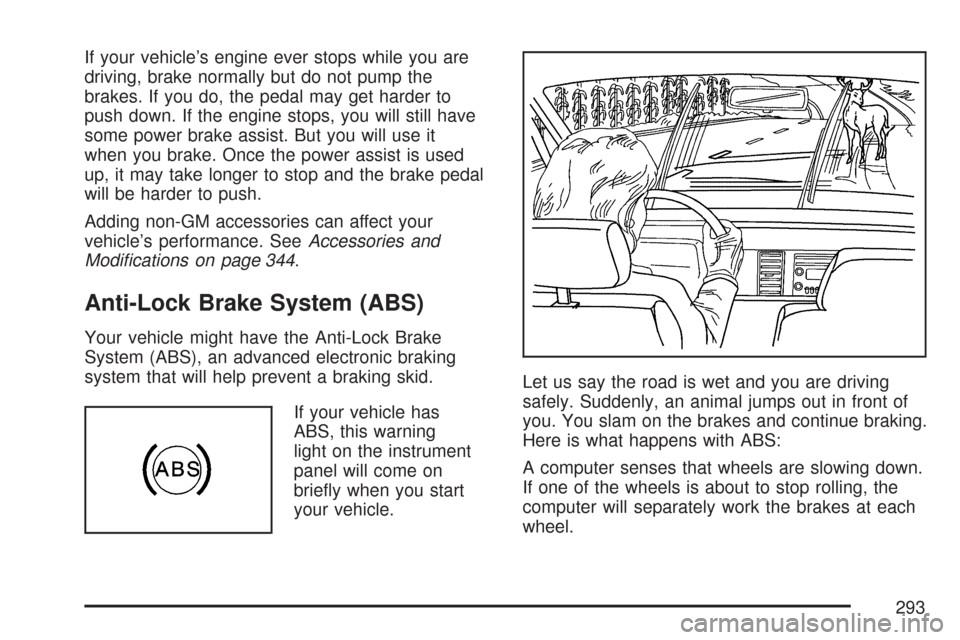
your vehicle.Let us say the road is wet and you are driving
safely. Suddenly, an animal jumps out in front of
you. You slam on the brakes and continue braking.
Here is what happens with ABS:
A computer senses that wheels are slowing down.
If one of the wheels is about to stop rolling, the
computer will separately work the brakes at each
wheel.
293
Page 294 of 510
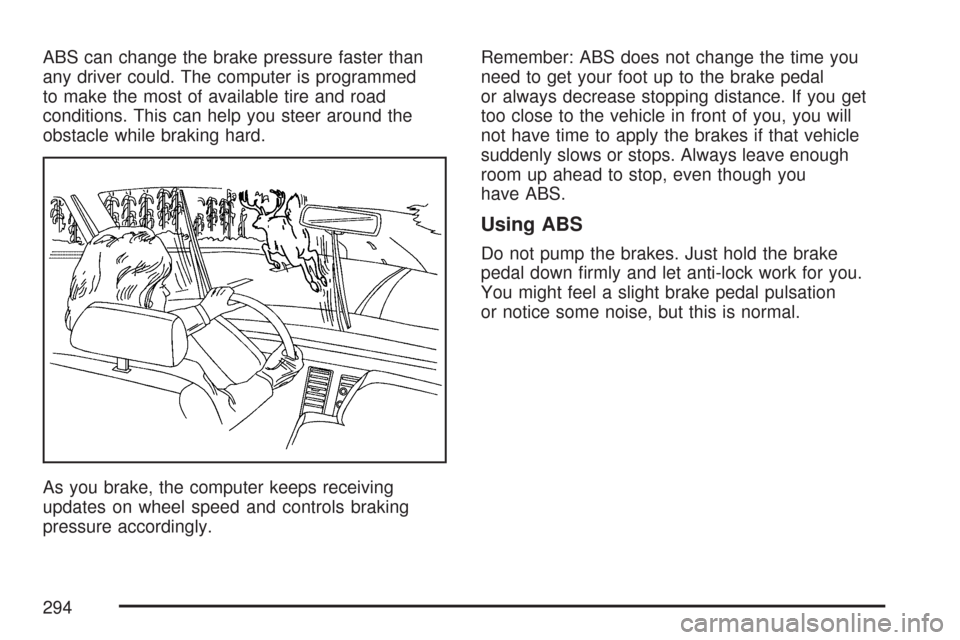
ABS can change the brake pressure faster than
any driver could. The computer is programmed
to make the most of available tire and road
conditions. This can help you steer around the
obstacle while braking hard.
As you brake, the computer keeps receiving
updates on wheel speed and controls braking
pressure accordingly.Remember: ABS does not change the time you
need to get your foot up to the brake pedal
or always decrease stopping distance. If you get
too close to the vehicle in front of you, you will
not have time to apply the brakes if that vehicle
suddenly slows or stops. Always leave enough
room up ahead to stop, even though you
have ABS.
Using ABS
Do not pump the brakes. Just hold the brake
pedal down rmly and let anti-lock work for you.
You might feel a slight brake pedal pulsation
or notice some noise, but this is normal.
294
Page 295 of 510
Braking in Emergencies
At some time, nearly every driver gets into a
situation that requires hard braking.
If you have ABS, you can steer and brake at the
same time. However, if you do not have ABS,
your rst reaction — to hit the brake pedal
hard and hold it down — might be the wrong thing
to do. Your wheels can stop rolling. Once they
do, the vehicle cannot respond to your steering.
Momentum will carry it in whatever direction it
was headed when the wheels stopped rolling.
That could be off the road, into the very thing you
were trying to avoid, or into traffic.
If you do not have ABS, use a “squeeze” braking
technique. This will give you maximum braking
while maintaining steering control. You can do
this by pushing on the brake pedal with steadily
increasing pressure.In an emergency, you will probably want to
squeeze the brakes hard without locking the
wheels. If you hear or feel the wheels sliding,
ease off the brake pedal. This will help you
retain steering control. If you do have ABS, it is
different. SeeAnti-Lock Brake System (ABS)
on page 293.
In many emergencies, steering can help you
more than even the very best braking.
Traction Control System (TCS)
Your vehicle may have a Traction Control System
(TCS) that limits wheel spin. This is especially
useful in slippery road conditions. The system
operates only if it senses that one or both of
the front wheels are spinning or beginning to
lose traction. When this happens, the system
reduces engine power and may also upshift
the transmission to limit wheel spin. Also, the
traction control system activates the appropriate
corner brakes to gain even quicker control to
limit wheel spin.
295
Page 300 of 510
The traction you can get in a curve depends on
the condition of the tires and the road surface,
the angle at which the curve is banked, and your
speed. While you are in a curve, speed is the
one factor you can control.
Suppose you are steering through a sharp curve.
Then you suddenly apply the brakes. Both
control systems — steering and braking — have
to do their work where the tires meet the road.
Unless you have four-wheel anti-lock brakes,
adding the hard braking can demand too much
of those places. You can lose control.
The same thing can happen if you are steering
through a sharp curve and you suddenly
accelerate. Those two control systems — steering
and acceleration — can overwhelm those places
where the tires meet the road and make you lose
control. SeeTraction Control System (TCS) on
page 295orEnhanced Traction System (ETS)
on page 297.What should you do if this ever happens? Ease
up on the brake or accelerator pedal, steer the
vehicle the way you want it to go, and slow down.
Speed limit signs near curves warn that you should
adjust your speed. Of course, the posted speeds
are based on good weather and road conditions.
Under less favorable conditions you will want
to go slower.
If you need to reduce your speed as you approach
a curve, do it before you enter the curve, while
the front wheels are straight ahead.
Try to adjust your speed so you can “drive”
through the curve. Maintain a reasonable, steady
speed. Wait to accelerate until you are out of
the curve, and then accelerate gently into
the straightaway.
Adding non-dealer/non-retailer accessories can
affect your vehicle’s performance. SeeAccessories
and Modications on page 344.
300
Page 301 of 510
Steering in Emergencies
There are times when steering can be more
effective than braking. For example, you come
over a hill and nd a truck stopped in your lane,
or a car suddenly pulls out from nowhere, or
a child darts out from between parked cars
and stops right in front of you. You can avoid
these problems by braking — if you can stop in
time. But sometimes you cannot; there is not room.
That is the time for evasive action — steering
around the problem.
Your vehicle can perform very well in emergencies
like these. First apply the brakes — but, unless
you have anti-lock brakes, not enough to lock the
wheels. SeeBraking on page 292. It is better
to remove as much speed as you can from
a possible collision. Then steer around the
problem, to the left or right depending on the
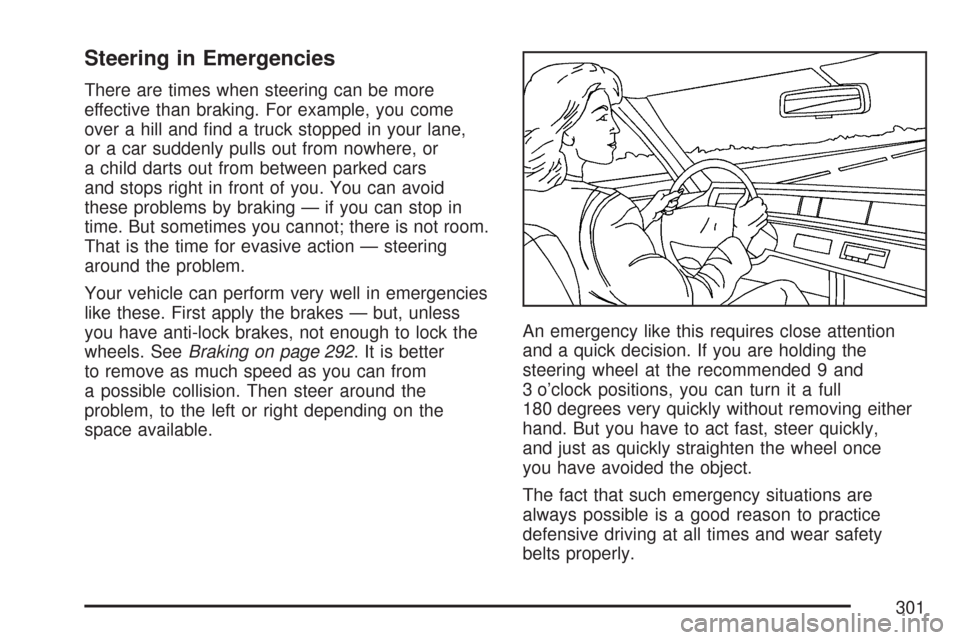
space available.An emergency like this requires close attention
and a quick decision. If you are holding the
steering wheel at the recommended 9 and
3 o’clock positions, you can turn it a full
180 degrees very quickly without removing either
hand. But you have to act fast, steer quickly,
and just as quickly straighten the wheel once
you have avoided the object.
The fact that such emergency situations are
always possible is a good reason to practice
defensive driving at all times and wear safety
belts properly.
301
Page 305 of 510
A cornering skid and an acceleration skid are best
handled by easing your foot off the accelerator
pedal.
If your vehicle starts to slide, ease your foot off
the accelerator pedal and quickly steer the way
you want the vehicle to go. If you start steering
quickly enough, your vehicle may straighten out.
Always be ready for a second skid if it occurs.
Of course, traction is reduced when water, snow,
ice, gravel, or other material is on the road.
For safety, you will want to slow down and adjust
your driving to these conditions. It is important
to slow down on slippery surfaces because
stopping distance will be longer and vehicle
control more limited.
While driving on a surface with reduced traction,
try your best to avoid sudden steering, acceleration,
or braking, including reducing vehicle speed by
shifting to a lower gear. Any sudden changes could
cause the tires to slide. You may not realize the
surface is slippery until your vehicle is skidding.
Learn to recognize warning clues — such as
enough water, ice, or packed snow on the road to
make a mirrored surface — and slow down when
you have any doubt.If you have the Anti-Lock Brake System (ABS),
remember: It helps avoid only the braking skid.
If you do not have ABS, then in a braking
skid, where the wheels are no longer rolling,
release enough pressure on the brakes to get
the wheels rolling again. This restores steering
control. Push the brake pedal down steadily
when you have to stop suddenly. As long as the
wheels are rolling, you will have steering control.
Competitive Driving
See your warranty book before using your vehicle
for competitive driving. After reviewing your
warranty book, please see the GM Performance
Parts website or catalog for parts and equipment
required for competitive driving.
Notice:If you use your vehicle for competitive
driving, the engine may use more oil than it
would with normal use. Low oil levels can
damage the engine. Be sure to check the oil
level often during competitive driving and
keep the level at or near the upper mark that
shows the proper operating range on the
engine oil dipstick. For information on how
to add oil, seeEngine Oil on page 359.
305
Page 319 of 510
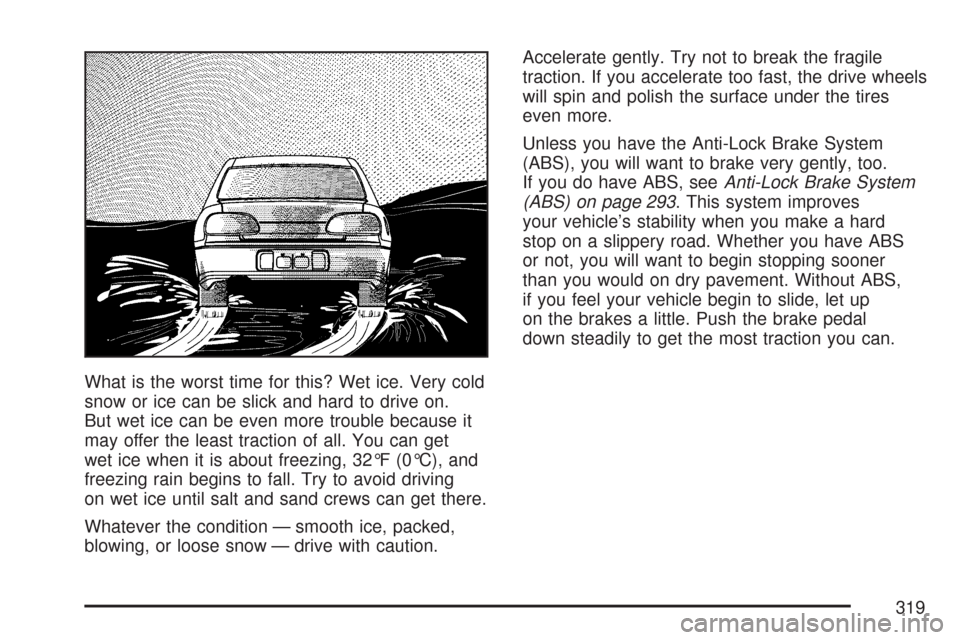
What is the worst time for this? Wet ice. Very cold
snow or ice can be slick and hard to drive on.
But wet ice can be even more trouble because it
may offer the least traction of all. You can get
wet ice when it is about freezing, 32°F (0°C), and
freezing rain begins to fall. Try to avoid driving
on wet ice until salt and sand crews can get there.
Whatever the condition — smooth ice, packed,
blowing, or loose snow — drive with caution.Accelerate gently. Try not to break the fragile
traction. If you accelerate too fast, the drive wheels
will spin and polish the surface under the tires
even more.
Unless you have the Anti-Lock Brake System
(ABS), you will want to brake very gently, too.
If you do have ABS, seeAnti-Lock Brake System
(ABS) on page 293. This system improves
your vehicle’s stability when you make a hard
stop on a slippery road. Whether you have ABS
or not, you will want to begin stopping sooner
than you would on dry pavement. Without ABS,
if you feel your vehicle begin to slide, let up
on the brakes a little. Push the brake pedal
down steadily to get the most traction you can.
319