Page 321 of 510
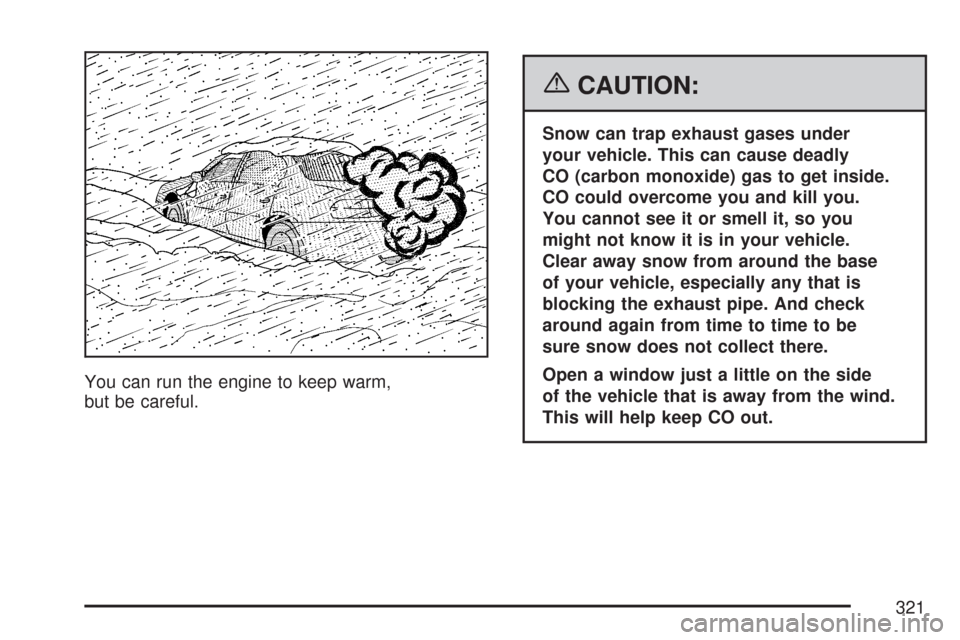
You can run the engine to keep warm,
but be careful.
{CAUTION:
Snow can trap exhaust gases under
your vehicle. This can cause deadly
CO (carbon monoxide) gas to get inside.
CO could overcome you and kill you.
You cannot see it or smell it, so you
might not know it is in your vehicle.
Clear away snow from around the base
of your vehicle, especially any that is
blocking the exhaust pipe. And check
around again from time to time to be
sure snow does not collect there.
Open a window just a little on the side
of the vehicle that is away from the wind.
This will help keep CO out.
321
Page 324 of 510
Loading Your Vehicle
It is very important to know how much weight your
vehicle can carry. This weight is called the vehicle
capacity weight and includes the weight of all
occupants, cargo and all nonfactory-installed
options. Two labels on your vehicle show how much
weight it may properly carry, the Tire and Loading
Information label and the Certication label.
{CAUTION:
Do not load your vehicle any heavier than
the Gross Vehicle Weight Rating (GVWR),
or either the maximum front or rear Gross
Axle Weight Rating (GAWR). If you do,
parts on your vehicle can break, and it
can change the way your vehicle handles.
These could cause you to lose control
and crash. Also, overloading can shorten
the life of your vehicle.
Tire and Loading Information Label
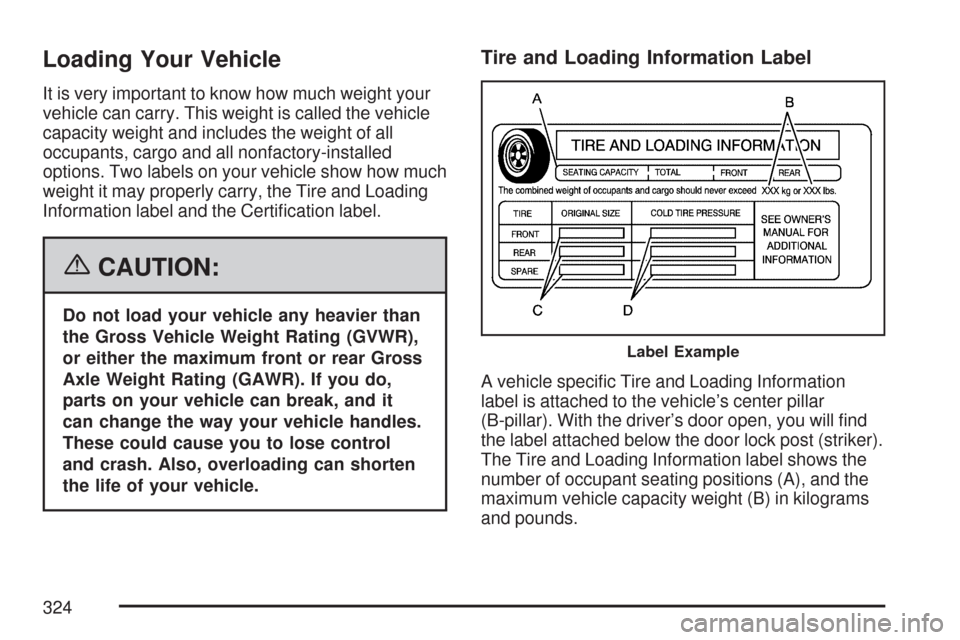
A vehicle specic Tire and Loading Information
label is attached to the vehicle’s center pillar
(B-pillar). With the driver’s door open, you will nd
the label attached below the door lock post (striker).
The Tire and Loading Information label shows the
number of occupant seating positions (A), and the
maximum vehicle capacity weight (B) in kilograms
and pounds.
Label Example
324
Page 331 of 510
Dinghy Towing
The Malibu Sedan SS and Maxx SS cannot be
dinghy towed.
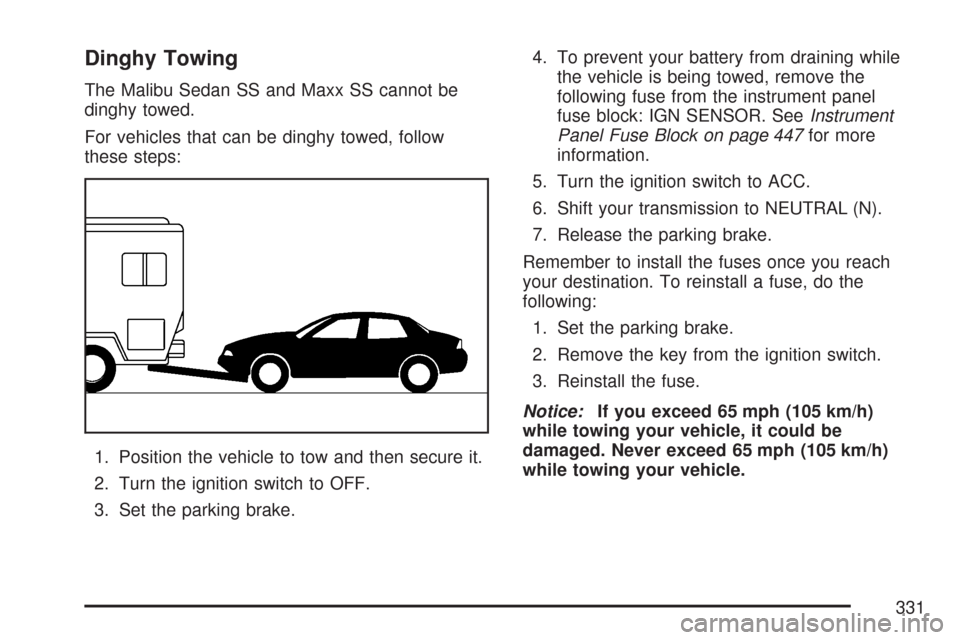
For vehicles that can be dinghy towed, follow
these steps:
1. Position the vehicle to tow and then secure it.
2. Turn the ignition switch to OFF.
3. Set the parking brake.4. To prevent your battery from draining while
the vehicle is being towed, remove the
following fuse from the instrument panel
fuse block: IGN SENSOR. SeeInstrument
Panel Fuse Block on page 447for more
information.
5. Turn the ignition switch to ACC.
6. Shift your transmission to NEUTRAL (N).
7. Release the parking brake.
Remember to install the fuses once you reach
your destination. To reinstall a fuse, do the
following:
1. Set the parking brake.
2. Remove the key from the ignition switch.
3. Reinstall the fuse.
Notice:If you exceed 65 mph (105 km/h)
while towing your vehicle, it could be
damaged. Never exceed 65 mph (105 km/h)
while towing your vehicle.
331
Page 336 of 510
Hitches
It’s important to have the correct hitch equipment.
Crosswinds, large trucks going by and rough
roads are a few reasons why you’ll need the
right hitch. Here are some rules to follow:
The rear bumper on your vehicle is not
intended for hitches. Do not attach rental
hitches or other bumper-type hitches to it.
Use only a frame-mounted hitch that does
not attach to the bumper.
Will you have to make any holes in the body
of your vehicle when you install a trailer
hitch? If you do, then be sure to seal the
holes later when you remove the hitch.
If you don’t seal them, deadly carbon
monoxide (CO) from your exhaust can get
into your vehicle. SeeEngine Exhaust
on page 136. Dirt and water can, too.
Safety Chains
You should always attach chains between
your vehicle and your trailer. Cross the safety
chains under the tongue of the trailer so that
the tongue will not drop to the road if it becomes
separated from the hitch. Instructions about
safety chains may be provided by the hitch
manufacturer or by the trailer manufacturer.
Follow the manufacturer’s recommendation for
attaching safety chains and do not attach them
to the bumper. Always leave just enough slack
so you can turn with your rig. And, never
allow safety chains to drag on the ground.
Trailer Brakes
Does your trailer have its own brakes?
Be sure to read and follow the instructions for
the trailer brakes so you’ll be able to install, adjust
and maintain them properly. And because you
may have anti-lock brakes, do not try to tap into
your vehicle’s hydraulic brake system. If you
do, both systems won’t work well, or at all.
336
Page 343 of 510
Vehicle Identication.................................. 444
Vehicle Identication Number (VIN)........... 444
Service Parts Identication Label............... 444
Electrical System........................................ 445
Add-On Electrical Equipment..................... 445
Headlamp Wiring....................................... 445
Windshield Wiper Fuses............................ 445Power Windows and Other Power
Options.................................................. 446
Fuses........................................................ 446
Instrument Panel Fuse Block..................... 447
Engine Compartment Fuse Block............... 449
Rear Compartment Fuse Block.................. 451
Capacities and Specications.................... 454
Section 5 Service and Appearance Care
343
Page 344 of 510
Service
Your dealer knows your vehicle best and wants
you to be happy with it. We hope you will go
to your dealer for all your service needs. You will
get genuine GM parts and GM-trained and
supported service people.
We hope you will want to keep your GM vehicle
all GM. Genuine GM parts have one of these
marks:
Accessories and Modications
When you add non-GM accessories to your vehicle
they can affect your vehicle’s performance and
safety, including such things as, airbags, braking,
stability, ride and handling, emissions systems,
aerodynamics, durability, and electronic systems
like anti-lock brakes, traction control and stability
control. Some of these accessories may even
cause malfunction or damage not covered by
warranty.
GM Accessories are designed to complement and
function with other systems on your vehicle.
Your GM dealer/retailer can accessorize your
vehicle using genuine GM Accessories. When you
go to your GM dealer/retailer and ask for GM
Accessories, you will know that GM-trained and
supported service technicians will perform the work
using genuine GM Accessories.
344
Page 349 of 510
Filling the Tank
{CAUTION:
Fuel vapor burns violently and a fuel re
can cause bad injuries. To help avoid
injuries to you and others, read and follow
all the instructions on the pump island.
Turn off your engine when you are
refueling. Do not smoke if you are near
fuel or refueling your vehicle. Do not use
cellular phones. Keep sparks, ames, and
smoking materials away from fuel. Do not
leave the fuel pump unattended when
refueling your vehicle. This is against the
law in some places. Do not re-enter the
vehicle while pumping fuel. Keep children
away from the fuel pump; never let
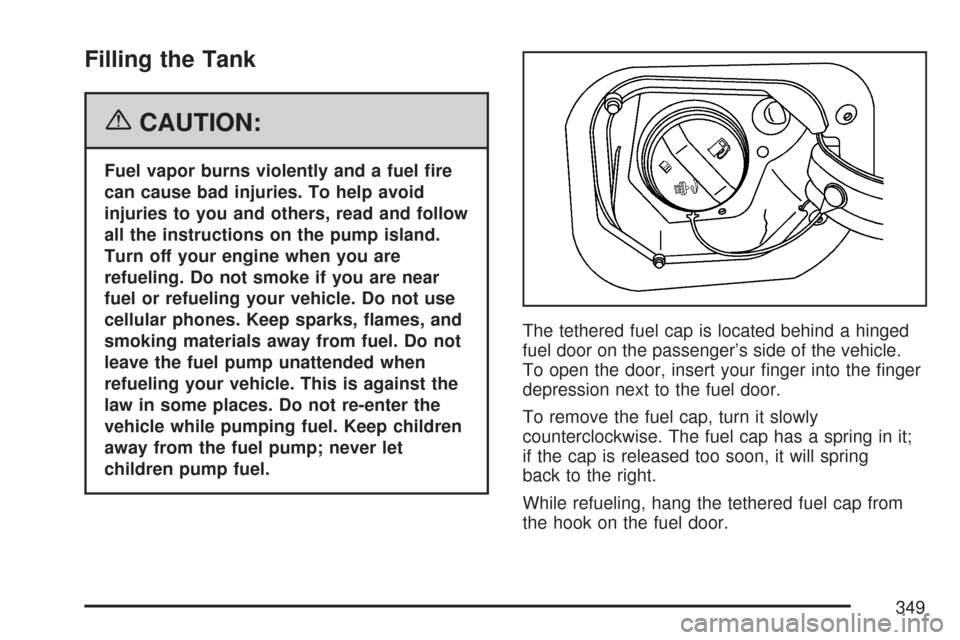
children pump fuel.The tethered fuel cap is located behind a hinged
fuel door on the passenger’s side of the vehicle.
To open the door, insert your nger into the nger
depression next to the fuel door.
To remove the fuel cap, turn it slowly
counterclockwise. The fuel cap has a spring in it;
if the cap is released too soon, it will spring
back to the right.
While refueling, hang the tethered fuel cap from
the hook on the fuel door.
349
Page 350 of 510
{CAUTION:
Fuel can spray out on you if you open the
fuel cap too quickly. If you spill fuel and
then something ignites it, you could be
badly burned. This spray can happen if
your tank is nearly full, and is more likely
in hot weather. Open the fuel cap slowly
and wait for any hiss noise to stop. Then
unscrew the cap all the way.
Be careful not to spill fuel. Do not top off or overll
the tank and wait a few seconds after you have
nished pumping before removing the nozzle.
Clean fuel from painted surfaces as soon as
possible. SeeWashing Your Vehicle on page 439.
When replacing the fuel cap, turn it clockwise until
it clicks. Make sure the cap is fully installed.
The diagnostic system can determine if the fuel
cap has been left off or improperly installed.
This would allow fuel to evaporate into the
atmosphere. SeeMalfunction Indicator Lamp
on page 212.The CHECK GAS CAP message will be displayed
on the Driver Information Center (DIC) if the
fuel cap is not properly installed. SeeDIC
Warnings and Messages on page 222for more
information.
{CAUTION:
If a re starts while you are refueling, do
not remove the nozzle. Shut off the ow of
fuel by shutting off the pump or by
notifying the station attendant. Leave the
area immediately.
Notice:If you need a new fuel cap, be sure to
get the right type. Your dealer/retailer can
get one for you. If you get the wrong type, it
may not t properly. This may cause your
malfunction indicator lamp to light and may
damage your fuel tank and emissions system.
SeeMalfunction Indicator Lamp on page 212.
350