Page 355 of 510
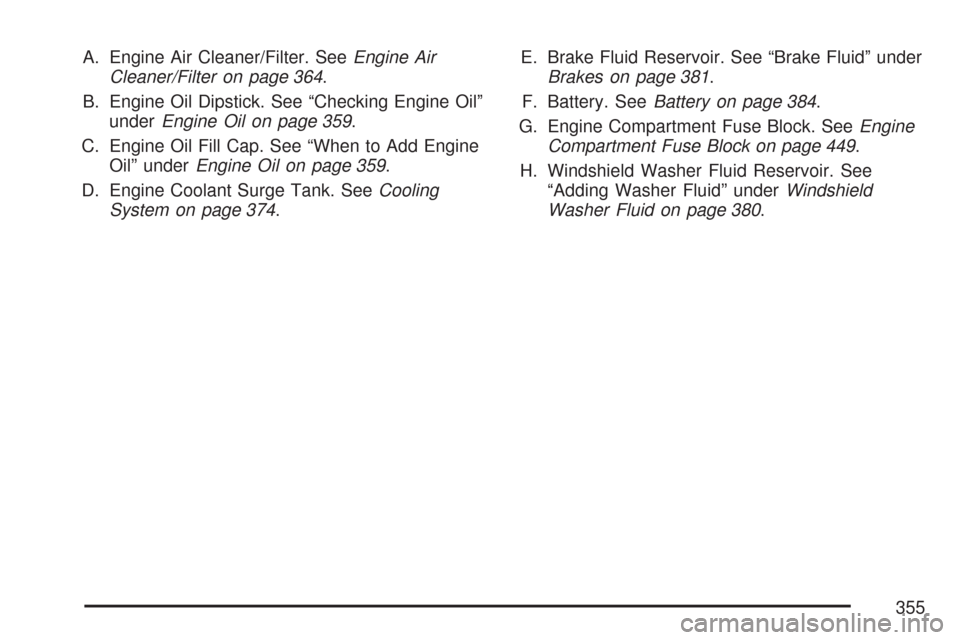
A. Engine Air Cleaner/Filter. SeeEngine Air
Cleaner/Filter on page 364.
B. Engine Oil Dipstick. See “Checking Engine Oil”
underEngine Oil on page 359.
C. Engine Oil Fill Cap. See “When to Add Engine
Oil” underEngine Oil on page 359.
D. Engine Coolant Surge Tank. SeeCooling
System on page 374.E. Brake Fluid Reservoir. See “Brake Fluid” under
Brakes on page 381.
F. Battery. SeeBattery on page 384.
G. Engine Compartment Fuse Block. SeeEngine
Compartment Fuse Block on page 449.
H. Windshield Washer Fluid Reservoir. See
“Adding Washer Fluid” underWindshield
Washer Fluid on page 380.
355
Page 357 of 510
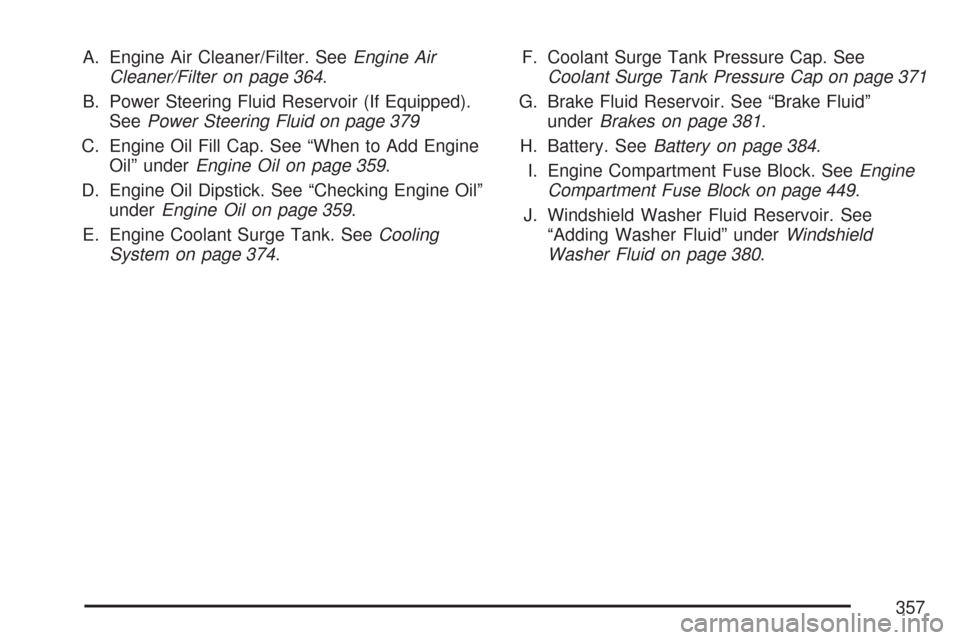
A. Engine Air Cleaner/Filter. SeeEngine Air
Cleaner/Filter on page 364.
B. Power Steering Fluid Reservoir (If Equipped).
SeePower Steering Fluid on page 379
C. Engine Oil Fill Cap. See “When to Add Engine
Oil” underEngine Oil on page 359.
D. Engine Oil Dipstick. See “Checking Engine Oil”
underEngine Oil on page 359.
E. Engine Coolant Surge Tank. SeeCooling
System on page 374.F. Coolant Surge Tank Pressure Cap. See
Coolant Surge Tank Pressure Cap on page 371
G. Brake Fluid Reservoir. See “Brake Fluid”
underBrakes on page 381.
H. Battery. SeeBattery on page 384.
I. Engine Compartment Fuse Block. SeeEngine
Compartment Fuse Block on page 449.
J. Windshield Washer Fluid Reservoir. See
“Adding Washer Fluid” underWindshield
Washer Fluid on page 380.
357
Page 359 of 510
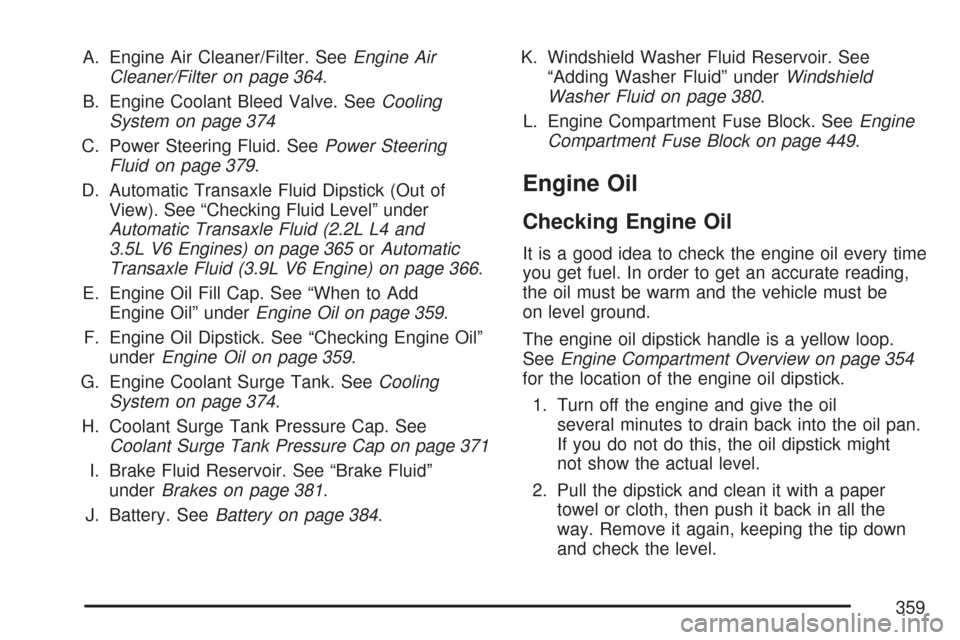
A. Engine Air Cleaner/Filter. SeeEngine Air
Cleaner/Filter on page 364.
B. Engine Coolant Bleed Valve. SeeCooling
System on page 374
C. Power Steering Fluid. SeePower Steering
Fluid on page 379.
D. Automatic Transaxle Fluid Dipstick (Out of
View). See “Checking Fluid Level” under
Automatic Transaxle Fluid (2.2L L4 and
3.5L V6 Engines) on page 365orAutomatic
Transaxle Fluid (3.9L V6 Engine) on page 366.
E. Engine Oil Fill Cap. See “When to Add
Engine Oil” underEngine Oil on page 359.
F. Engine Oil Dipstick. See “Checking Engine Oil”
underEngine Oil on page 359.
G. Engine Coolant Surge Tank. SeeCooling
System on page 374.
H. Coolant Surge Tank Pressure Cap. See
Coolant Surge Tank Pressure Cap on page 371
I. Brake Fluid Reservoir. See “Brake Fluid”
underBrakes on page 381.
J. Battery. SeeBattery on page 384.K. Windshield Washer Fluid Reservoir. See
“Adding Washer Fluid” underWindshield
Washer Fluid on page 380.
L. Engine Compartment Fuse Block. SeeEngine
Compartment Fuse Block on page 449.
Engine Oil
Checking Engine Oil
It is a good idea to check the engine oil every time
you get fuel. In order to get an accurate reading,
the oil must be warm and the vehicle must be
on level ground.
The engine oil dipstick handle is a yellow loop.
SeeEngine Compartment Overview on page 354
for the location of the engine oil dipstick.
1. Turn off the engine and give the oil
several minutes to drain back into the oil pan.
If you do not do this, the oil dipstick might
not show the actual level.
2. Pull the dipstick and clean it with a paper
towel or cloth, then push it back in all the
way. Remove it again, keeping the tip down
and check the level.
359
Page 377 of 510
{CAUTION:
Adding only plain water to your cooling
system can be dangerous. Plain water, or
some other liquid such as alcohol, can
boil before the proper coolant mixture will.
Your vehicle’s coolant warning system is
set for the proper coolant mixture. With
plain water or the wrong mixture, your
engine could get too hot but you would
not get the overheat warning. Your engine
could catch re and you or others could
be burned. Use a 50/50 mixture of clean,
drinkable water and DEX-COOL
®coolant.
Notice:In cold weather, water can freeze and
crack the engine, radiator, heater core and
other parts. Use the recommended coolant and
the proper coolant mixture.
{CAUTION:
You can be burned if you spill coolant on
hot engine parts. Coolant contains
ethylene glycol and it will burn if the
engine parts are hot enough. Do not spill
coolant on a hot engine.
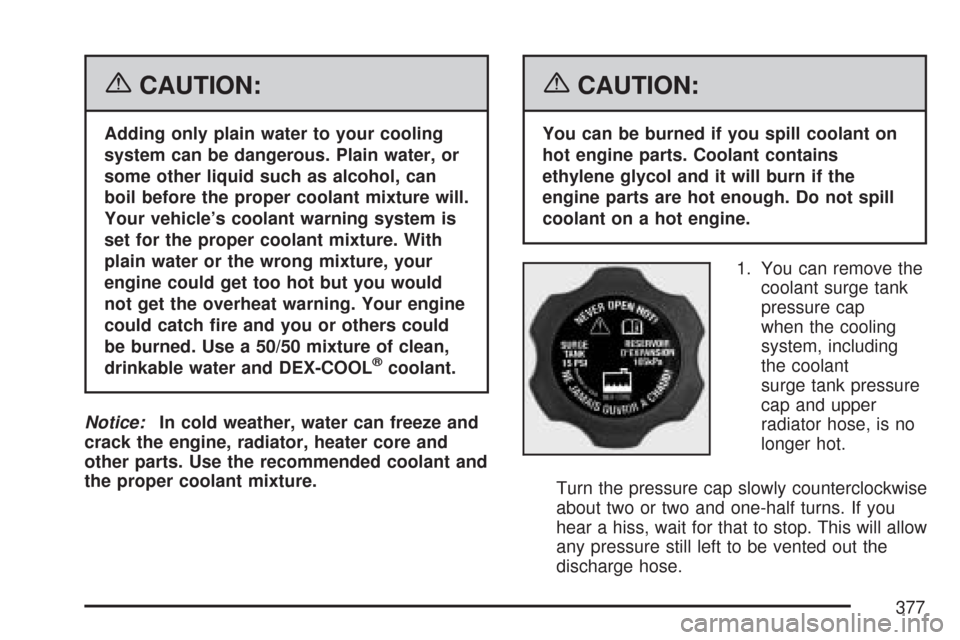
1. You can remove the
coolant surge tank
pressure cap
when the cooling
system, including
the coolant
surge tank pressure
cap and upper
radiator hose, is no
longer hot.
Turn the pressure cap slowly counterclockwise
about two or two and one-half turns. If you
hear a hiss, wait for that to stop. This will allow
any pressure still left to be vented out the
discharge hose.
377
Page 391 of 510
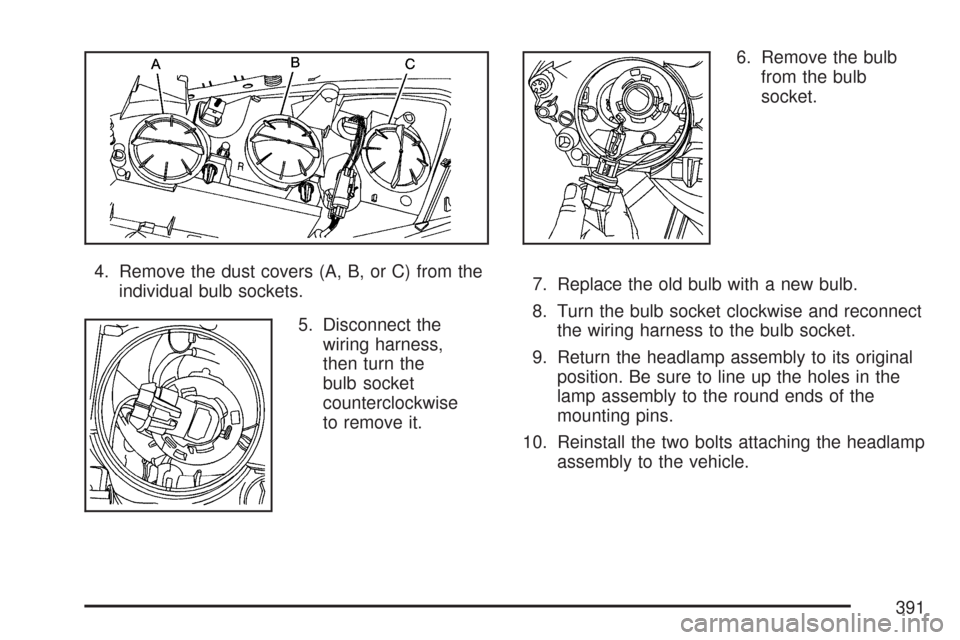
4. Remove the dust covers (A, B, or C) from the
individual bulb sockets.
5. Disconnect the
wiring harness,
then turn the
bulb socket
counterclockwise
to remove it.6. Remove the bulb
from the bulb
socket.
7. Replace the old bulb with a new bulb.
8. Turn the bulb socket clockwise and reconnect
the wiring harness to the bulb socket.
9. Return the headlamp assembly to its original
position. Be sure to line up the holes in the
lamp assembly to the round ends of the
mounting pins.
10. Reinstall the two bolts attaching the headlamp
assembly to the vehicle.
391
Page 392 of 510
Taillamps, Turn Signal, Stoplamps
and Back-up Lamps
To replace one of these bulbs, do the following:
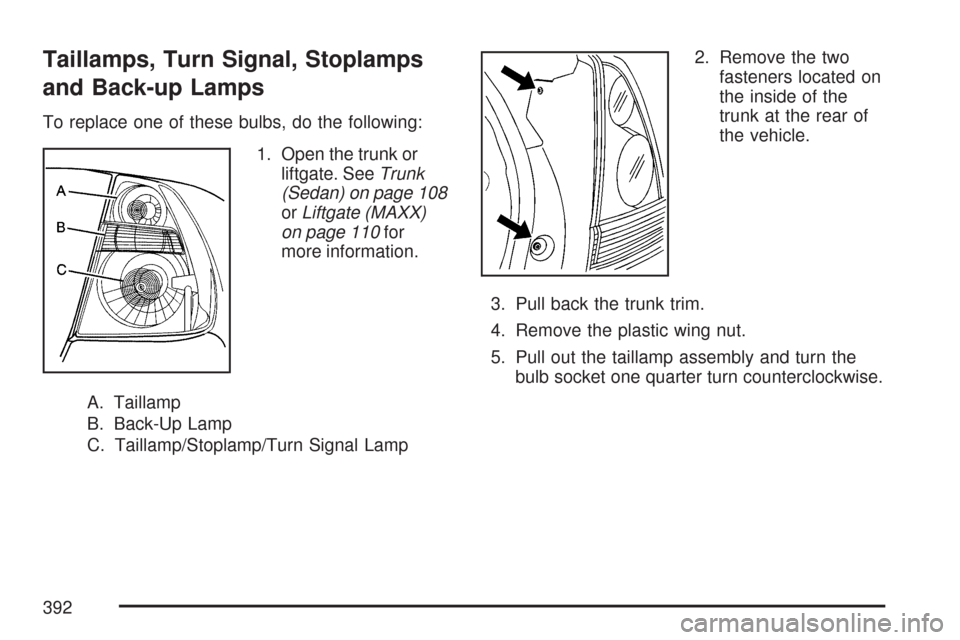
1. Open the trunk or
liftgate. SeeTrunk
(Sedan) on page 108
orLiftgate (MAXX)
on page 110for
more information.
A. Taillamp
B. Back-Up Lamp
C. Taillamp/Stoplamp/Turn Signal Lamp2. Remove the two
fasteners located on
the inside of the
trunk at the rear of
the vehicle.
3. Pull back the trunk trim.
4. Remove the plastic wing nut.
5. Pull out the taillamp assembly and turn the
bulb socket one quarter turn counterclockwise.
392
Page 393 of 510
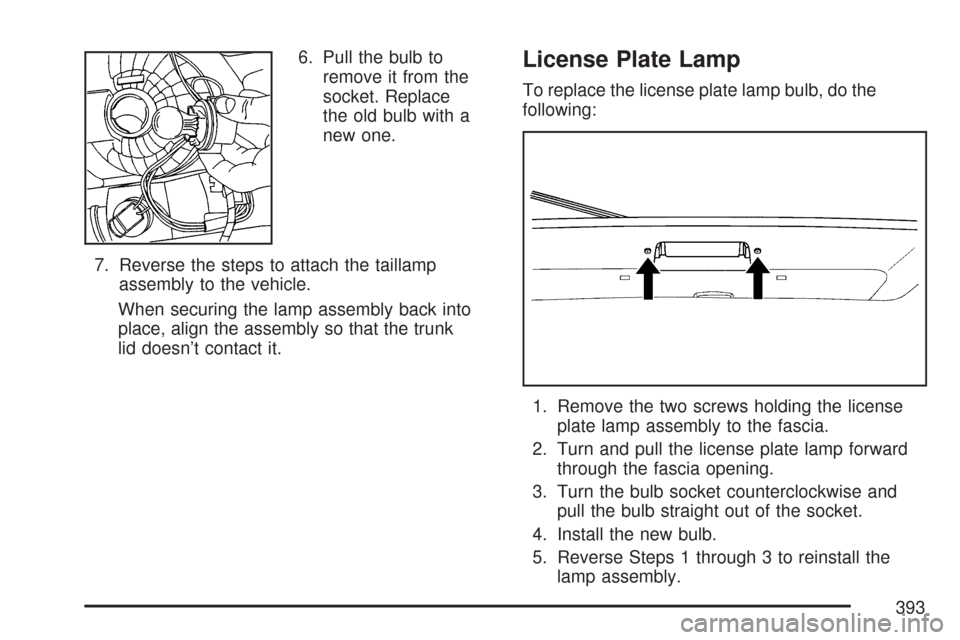
6. Pull the bulb to
remove it from the
socket. Replace
the old bulb with a
new one.
7. Reverse the steps to attach the taillamp
assembly to the vehicle.
When securing the lamp assembly back into
place, align the assembly so that the trunk
lid doesn’t contact it.License Plate Lamp
To replace the license plate lamp bulb, do the
following:
1. Remove the two screws holding the license
plate lamp assembly to the fascia.
2. Turn and pull the license plate lamp forward
through the fascia opening.
3. Turn the bulb socket counterclockwise and
pull the bulb straight out of the socket.
4. Install the new bulb.
5. Reverse Steps 1 through 3 to reinstall the
lamp assembly.
393
Page 412 of 510
Different Size Tires and Wheels
If you add wheels or tires that are a different size
than your original equipment wheels and tires,
this may affect the way your vehicle performs,
including its braking, ride and handling
characteristics, stability, and resistance to rollover.
Additionally, if your vehicle has electronic
systems such as, anti-lock brakes, traction control,
and electronic stability control, the performance
of these systems can be affected.
{CAUTION:
If you add different sized wheels, your
vehicle may not provide an acceptable
level of performance and safety if tires not
recommended for those wheels are
selected. You may increase the chance
that you will crash and suffer serious
injury. Only use GM specic wheel and
tire systems developed for your vehicle,
and have them properly installed by a GM
certied technician.SeeBuying New Tires on page 410and
Accessories and Modications on page 344for
additional information.
Uniform Tire Quality Grading
Quality grades can be found where applicable on
the tire sidewall between tread shoulder and
maximum section width. For example:
Treadwear 200 Traction AA Temperature A
The following information relates to the system
developed by the United States National Highway
Traffic Safety Administration (NHTSA), which
grades tires by treadwear, traction, and
temperature performance. This applies only to
vehicles sold in the United States. The grades are
molded on the sidewalls of most passenger car
tires. The Uniform Tire Quality Grading (UTQG)
system does not apply to deep tread, winter-type
snow tires, space-saver, or temporary use
spare tires, tires with nominal rim diameters of
10 to 12 inches (25 to 30 cm), or to some
limited-production tires.
412