2006 SUZUKI SX4 PPL
[x] Cancel search: PPLPage 981 of 1556

Downloaded from www.Manualslib.com manuals search engine Air Conditioning System: Automatic Type 7B-41
On-Board Diagnostic System DescriptionS6RW0D7221004
NOTE
The diagnostic information as diagnostic
trouble code (DTC) can be known by using
SUZUKI scan tool. For further details, refer to
“DTC Check”.
HVAC control module detects malfunctions, which may
occur in the following area.
• Inside air temperature sensor
• Evaporator temperature sensor
• Sunload sensor
• Temperature control actuator
• Air flow control actuator
• Temperature selector of HVAC control module
• Air flow selector of HVAC control module
• Blower speed selector of HVAC control module
• Back-up power supply circuit of HAVC control module
• Serial communication line between BCM and HVAC
control module• Received data from BCM as follows
– Outside air temperature sensor signal
– ECT sensor signal
– A/C refrigerant pressure sensor signal
– VSS signal
– Engine type signal
– Combination meter spec signal
– CAN communication circuit failure signal
When HVAC control module detects malfunction, the “A/
C” indicator light (1) flashes to warn and the diagnostic
trouble code (DTC) is stored in the memory of the
module. When diagnosing trouble, the DTC can be
checked according to “DTC Check”.
Schematic and Routing Diagram
A/C System Air Flow DiagramS6RW0D7222001
Refer to “A/C System Air Flow Diagram”.
1
I5RW0A722002-01
Page 986 of 1556

Downloaded from www.Manualslib.com manuals search engine 7B-46 Air Conditioning System: Automatic Type
Description for Each Step
Step 1. Customer complaint analysis
Talk to customer, and then record details of the problem.
Customer questionnaire (Example)
NOTE
The form is a standard sample. It should be modified according to conditions characteristic of each
market.
Step 2. Visual inspection
As a preliminary step, be sure to perform visual check of
the items that support proper function of the air
conditioning system referring to “Visual Inspection”.
Step 3. DTC check
Check DTC referring to “DTC Check”.
Step 4. DTC troubleshooting
Based on the DTC, perform an applicable DTC
diagnostic flow and locate the cause of the trouble,
namely in a sensor, wire harness, connector, actuator,
HVAC control module or other part and repair faulty
parts.
Step 5. A/C system performance inspection
Inspect A/C system suspected to be a possible cause
referring to “A/C System Performance Inspection”.Step 6. A/C system symptom diagnosis
Check any part or system suspected to be a possible
cause referring to “A/C System Symptom Diagnosis”.
Step 7. Check for intermittent problem
Check any part where an intermittent trouble is easy to
occur (e.g., wire harness, connector, etc.), referring to
“Intermittent and Poor Connection Inspection in Section
00” and related circuit of trouble cord recorded.
Step 8. Final confirmation test
Confirm if the problem symptom is troubleshoot and the
A/C system is free from any abnormal conditions. If there
existed DTC, clear the DTC. Then, check if the DTC is
still detected and if there is any other DTC.
I4RH01722014-01
Page 993 of 1556

Downloaded from www.Manualslib.com manuals search engine Air Conditioning System: Automatic Type 7B-53
) B1521Blower Speed
Selector
Malfunction16 1Signal voltage of blower speed selector in HVAC
control module is higher than specification.Flashed
16 2Signal voltage of blower speed selector in HVAC
control module is lower than specification.Flashed
) B1522Air Flow Selector
Malfunction17 1Signal voltage of airflow selector in HVAC control
module is higher than specification.Flashed
17 2Signal voltage of airflow selector in HVAC control
module is lower than specification.Flashed
) B1541Back-up Power
Supply Circuit
Malfunction14 1• Back-up power supply voltage of HVAC control
module is higher than or lower than
specification.
• When connect battery with vehicle and then,
turn ignition switch to ON position for first time.—
) B1546A/C Refrigerant
Pressure
Malfunction13 5• Signal voltage of outside air temperature sensor
is more than specified value. However, A/C
refrigerant pressure is less than specified value.
• Insufficient refrigerant in A/C system.—
) B1551Serial
Communication
Circuit
Malfunction91Circuit voltage of serial communication circuit is
higher than specification.Flashed
92Circuit voltage of serial communication circuit is
lower than specification.Flashed
) B1552HVAC Control
Module Check
Sum Error94HVAC control module received unspecified data
from BCM more than 8 times.Flashed
) B1553CAN
Communication
Circuit
Malfunction10 4HVAC control module received signal indicating
reception error from ECM.Flashed
) B1557VSS Signal
Failure11 4HVAC control module receives invalid data of VSS
signal from BCM.—
) B1561ECT signal
Failure54HVAC control module receives invalid data of ECT
signal from BCM.Flashed
) B1562Outside
Temperature
Sensor Signal
Failure14HVAC control module receives invalid data of
outside air temperature sensor signal from BCM.Flashed
) B1563A/C Refrigerant
Pressure Sensor
Signal Failure13 4HVAC control module receives invalid data of A/C
refrigerant pressure sensor signal from BCM.—
) B1570Engine Type
Signal Failure20 4HVAC control module receives invalid data of
engine type signal from BCM.—
) B1571Combination
Meter Spec
Signal Failure21 4HVAC control module receives invalid data of
combination meter spec signal from BCM.—
NO CODE Normal See NOTE below — —DTC No.
(displayed
on SUZUKI
scan tool)Detection itemDTC (indicated on
HVAC control
module)
Condition when trouble detected (DTC is
determined when following condition detected)“A/C”
indicator
light Indicated
by “REC”
indicator
lightIndicated
by “FRE”
indicator
light
Page 1001 of 1556
Downloaded from www.Manualslib.com manuals search engine Air Conditioning System: Automatic Type 7B-61
DTC Troubleshooting
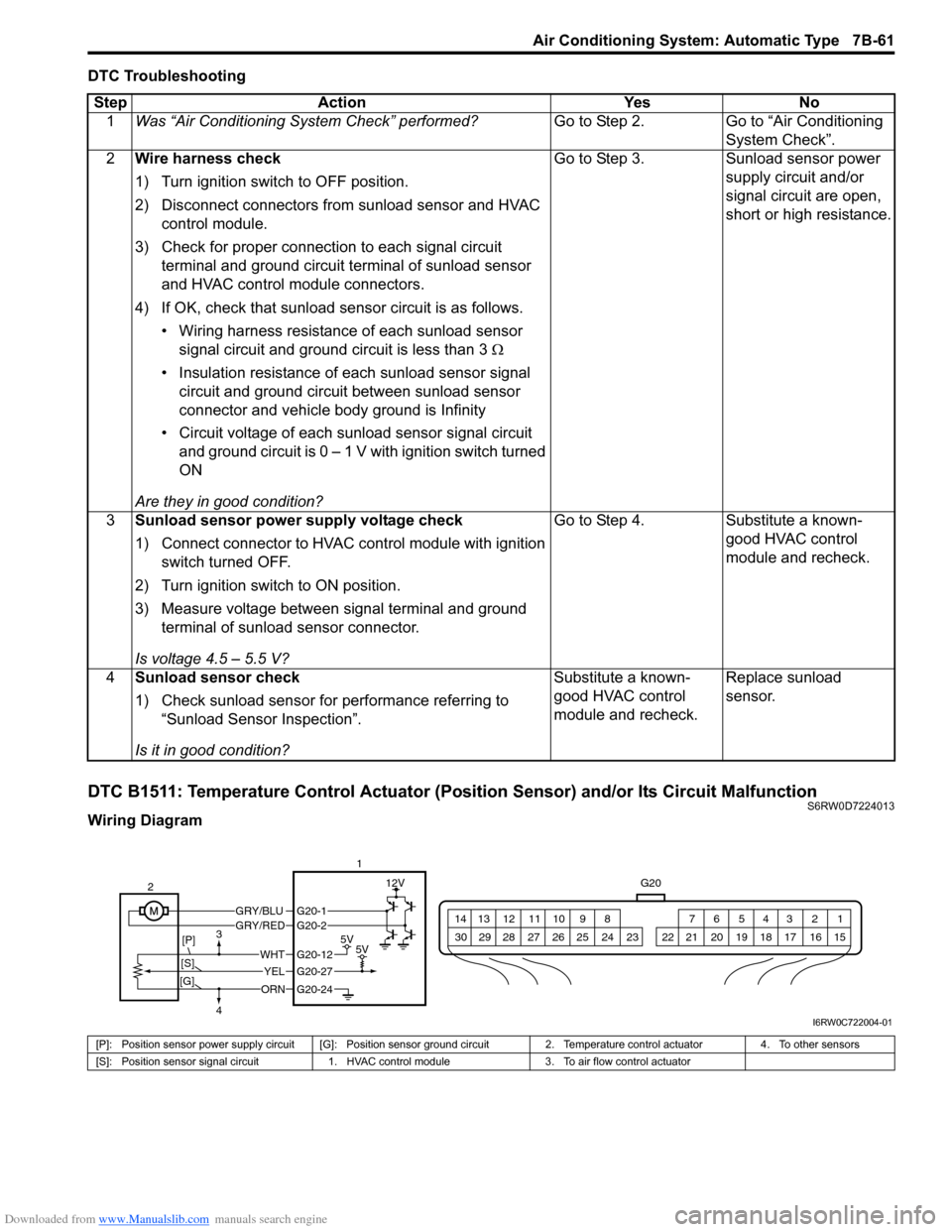
DTC B1511: Temperature Control Actuator (Position Sensor) and/or Its Circuit MalfunctionS6RW0D7224013
Wiring DiagramStep Action Yes No
1Was “Air Conditioning System Check” performed?Go to Step 2. Go to “Air Conditioning
System Check”.
2Wire harness check
1) Turn ignition switch to OFF position.
2) Disconnect connectors from sunload sensor and HVAC
control module.
3) Check for proper connection to each signal circuit
terminal and ground circuit terminal of sunload sensor
and HVAC control module connectors.
4) If OK, check that sunload sensor circuit is as follows.
• Wiring harness resistance of each sunload sensor
signal circuit and ground circuit is less than 3 Ω
• Insulation resistance of each sunload sensor signal
circuit and ground circuit between sunload sensor
connector and vehicle body ground is Infinity
• Circuit voltage of each sunload sensor signal circuit
and ground circuit is 0 – 1 V with ignition switch turned
ON
Are they in good condition?Go to Step 3. Sunload sensor power
supply circuit and/or
signal circuit are open,
short or high resistance.
3Sunload sensor power supply voltage check
1) Connect connector to HVAC control module with ignition
switch turned OFF.
2) Turn ignition switch to ON position.
3) Measure voltage between signal terminal and ground
terminal of sunload sensor connector.
Is voltage 4.5 – 5.5 V?Go to Step 4. Substitute a known-
good HVAC control
module and recheck.
4Sunload sensor check
1) Check sunload sensor for performance referring to
“Sunload Sensor Inspection”.
Is it in good condition?Substitute a known-
good HVAC control
module and recheck.Replace sunload
sensor.
G20
1 2 3 4 5 6 7 8 9 10 11 12 13 14
15 16 17 18 19 20 21 24 23 22 25 26 27 28 29 30
GRY/BLUGRY/RED
5V5V
12V
ORN
WHT
YEL
G20-12
G20-27
G20-24
G20-1G20-2
2
[P]
[S]3
4
[G]
1
I6RW0C722004-01
[P]: Position sensor power supply circuit [G]: Position sensor ground circuit 2. Temperature control actuator 4. To other sensors
[S]: Position sensor signal circuit 1. HVAC control module 3. To air flow control actuator
Page 1002 of 1556
Downloaded from www.Manualslib.com manuals search engine 7B-62 Air Conditioning System: Automatic Type
DTC Detecting Condition and Trouble Area
DTC Troubleshooting
NOTE
• When DTC B1502, B1503, B1504 and B1512 are indicated together, it is possible that sensor ground
circuit is open.
• When DTC B1512 is indicated together, it is possible that position sensor power supply circuit is
open.
DTC Detecting Condition Trouble Area
Temperature control actuator position sensor signal voltage is higher than or
lower than specified value for specified time continuously.• Temperature control actuator circuit
• Temperature control actuator
• HVAC control module
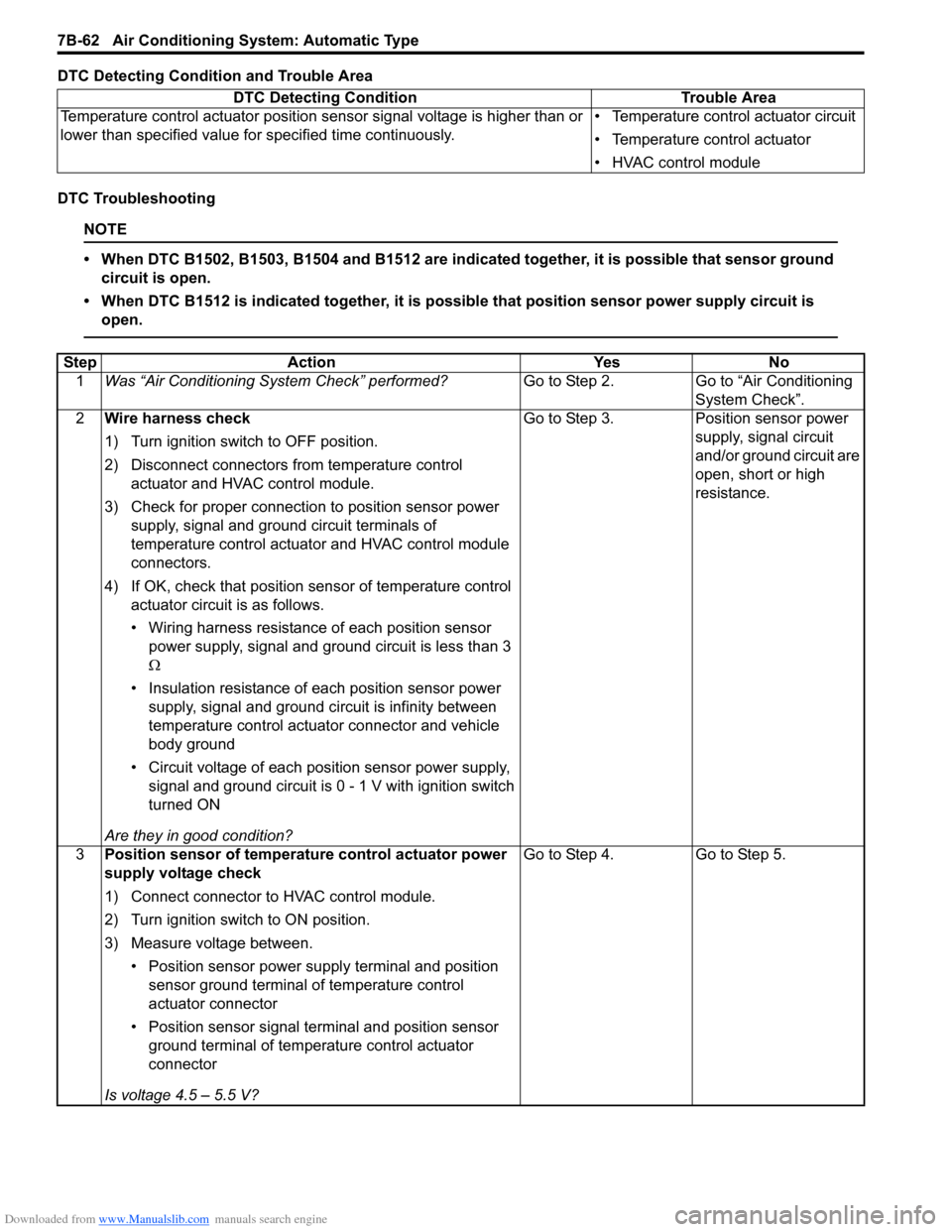
Step Action Yes No
1Was “Air Conditioning System Check” performed?Go to Step 2. Go to “Air Conditioning
System Check”.
2Wire harness check
1) Turn ignition switch to OFF position.
2) Disconnect connectors from temperature control
actuator and HVAC control module.
3) Check for proper connection to position sensor power
supply, signal and ground circuit terminals of
temperature control actuator and HVAC control module
connectors.
4) If OK, check that position sensor of temperature control
actuator circuit is as follows.
• Wiring harness resistance of each position sensor
power supply, signal and ground circuit is less than 3
Ω
• Insulation resistance of each position sensor power
supply, signal and ground circuit is infinity between
temperature control actuator connector and vehicle
body ground
• Circuit voltage of each position sensor power supply,
signal and ground circuit is 0 - 1 V with ignition switch
turned ON
Are they in good condition?Go to Step 3. Position sensor power
supply, signal circuit
and/or ground circuit are
open, short or high
resistance.
3Position sensor of temperature control actuator power
supply voltage check
1) Connect connector to HVAC control module.
2) Turn ignition switch to ON position.
3) Measure voltage between.
• Position sensor power supply terminal and position
sensor ground terminal of temperature control
actuator connector
• Position sensor signal terminal and position sensor
ground terminal of temperature control actuator
connector
Is voltage 4.5 – 5.5 V?Go to Step 4. Go to Step 5.
Page 1003 of 1556
Downloaded from www.Manualslib.com manuals search engine Air Conditioning System: Automatic Type 7B-63
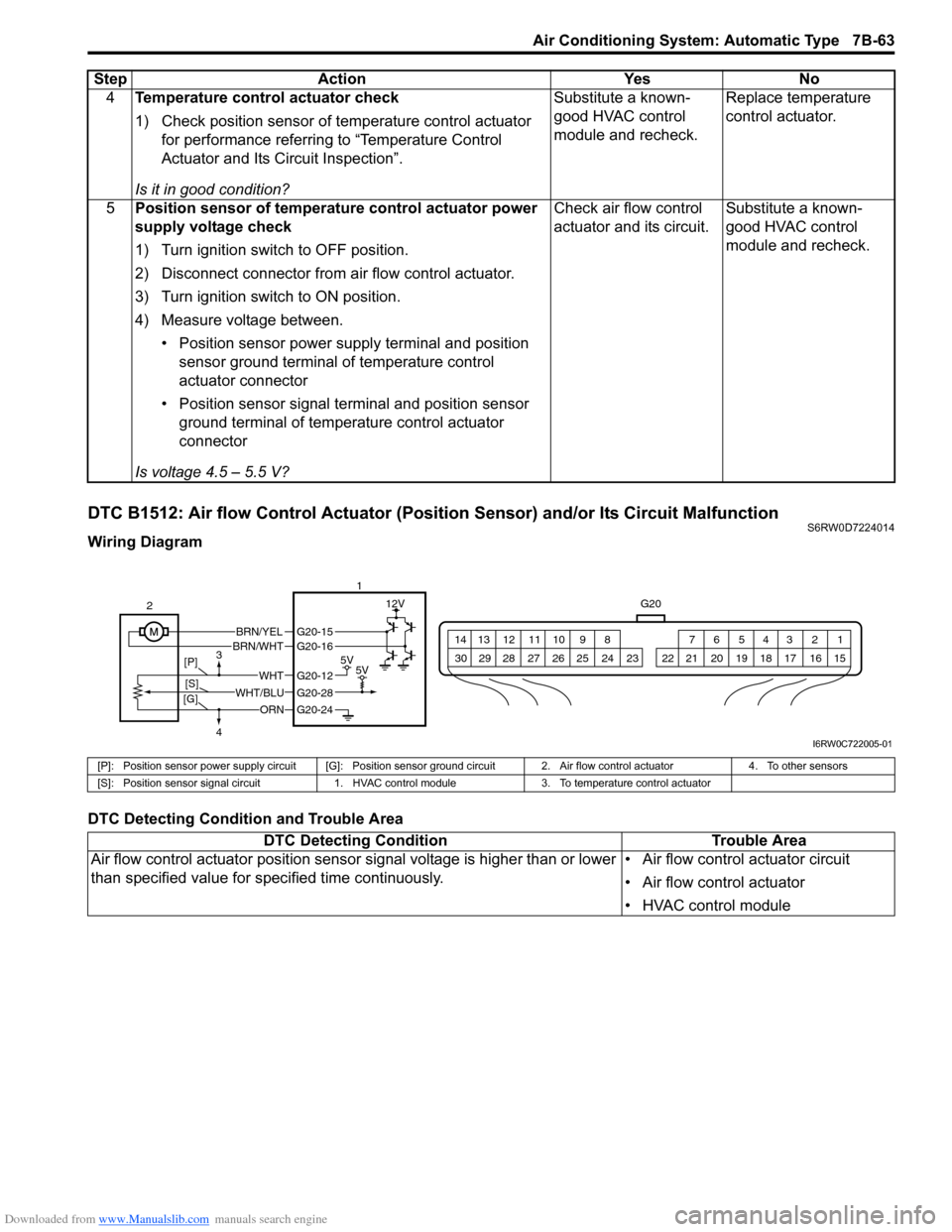
DTC B1512: Air flow Control Actuator (Position Sensor) and/or Its Circuit MalfunctionS6RW0D7224014
Wiring Diagram
DTC Detecting Condition and Trouble Area4Temperature control actuator check
1) Check position sensor of temperature control actuator
for performance referring to “Temperature Control
Actuator and Its Circuit Inspection”.
Is it in good condition?Substitute a known-
good HVAC control
module and recheck.Replace temperature
control actuator.
5Position sensor of temperature control actuator power
supply voltage check
1) Turn ignition switch to OFF position.
2) Disconnect connector from air flow control actuator.
3) Turn ignition switch to ON position.
4) Measure voltage between.
• Position sensor power supply terminal and position
sensor ground terminal of temperature control
actuator connector
• Position sensor signal terminal and position sensor
ground terminal of temperature control actuator
connector
Is voltage 4.5 – 5.5 V?Check air flow control
actuator and its circuit.Substitute a known-
good HVAC control
module and recheck. Step Action Yes No
G20
1 2 3 4 5 6 7 8 9 10 11 12 13 14
15 16 17 18 19 20 21 24 23 22 25 26 27 28 29 30
BRN/YELBRN/WHT
5V5V
12V
ORN
WHTG20-12
G20-28
G20-24
G20-15G20-16
WHT/BLU 2
3
4
[P]
[G][S]1
I6RW0C722005-01
[P]: Position sensor power supply circuit [G]: Position sensor ground circuit 2. Air flow control actuator 4. To other sensors
[S]: Position sensor signal circuit 1. HVAC control module 3. To temperature control actuator
DTC Detecting Condition Trouble Area
Air flow control actuator position sensor signal voltage is higher than or lower
than specified value for specified time continuously.• Air flow control actuator circuit
• Air flow control actuator
• HVAC control module
Page 1004 of 1556

Downloaded from www.Manualslib.com manuals search engine 7B-64 Air Conditioning System: Automatic Type
DTC Troubleshooting
NOTE
• When DTC B1502, B1503, B1504 and B1511 are indicated together, it is possible that sensor ground
circuit is open.
• When DTC B1511 is indicated together, it is possible that position sensor power supply circuit is
open.
Step Action Yes No
1Was “Air Conditioning System Check” performed?Go to Step 2. Go to “Air Conditioning
System Check”.
2Wire harness check
1) Turn ignition switch to OFF position.
2) Disconnect connectors from air flow control actuator and
HVAC control module.
3) Check for proper connection to position sensor power
supply, signal and ground circuit terminals of air flow
control actuator and HVAC control module connectors.
4) If OK, check that position sensor of air flow control
actuator circuit is as follows.
• Wiring harness resistance of each position sensor
power supply, signal and ground circuit is less than 3
Ω
• Insulation resistance of each position sensor power
supply, signal and ground circuit is infinity between air
flow control actuator connector and vehicle body
ground
• Circuit voltage of each position sensor power supply,
signal and ground circuit is 0 - 1 V with ignition switch
turned ON
Are they in good condition?Go to Step 3. Position sensor power
supply, signal circuit
and/or ground circuit are
open, short or high
resistance.
3Position sensor of air flow control actuator power
supply voltage check
1) Connect connector to HVAC control module with ignition
switch turned OFF.
2) Turn ignition switch to ON position.
3) Measure voltage between.
• Position sensor power supply terminal and position
sensor ground terminal of air flow control actuator
connector
• Position sensor signal terminal and position sensor
ground terminal of air flow control actuator connector
Is voltage 4.5 – 5.5 V?Go to Step 4. Go to Step 5.
4Air flow control actuator check
1) Check position sensor of air flow control actuator for
performance referring to “Air Flow Control Actuator and
Its Circuit Inspection”.
Is it in good condition?Substitute a known-
good HVAC control
module and recheck.Replace air flow control
actuator.
Page 1005 of 1556
Downloaded from www.Manualslib.com manuals search engine Air Conditioning System: Automatic Type 7B-65
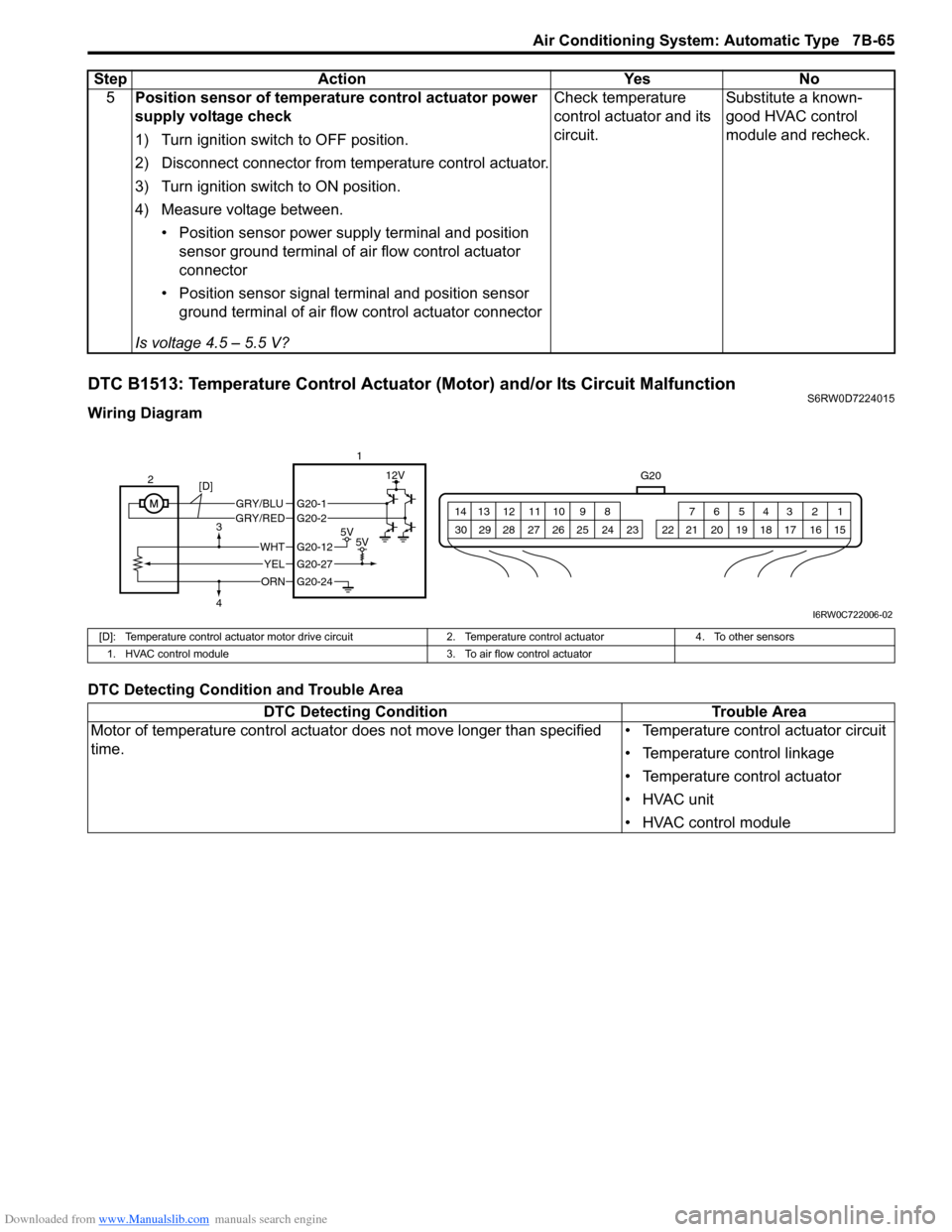
DTC B1513: Temperature Control Actuator (Motor) and/or Its Circuit MalfunctionS6RW0D7224015
Wiring Diagram
DTC Detecting Condition and Trouble Area5Position sensor of temperature control actuator power
supply voltage check
1) Turn ignition switch to OFF position.
2) Disconnect connector from temperature control actuator.
3) Turn ignition switch to ON position.
4) Measure voltage between.
• Position sensor power supply terminal and position
sensor ground terminal of air flow control actuator
connector
• Position sensor signal terminal and position sensor
ground terminal of air flow control actuator connector
Is voltage 4.5 – 5.5 V?Check temperature
control actuator and its
circuit.Substitute a known-
good HVAC control
module and recheck. Step Action Yes No
G20
1 2 3 4 5 6 7 8 9 10 11 12 13 14
15 16 17 18 19 20 21 24 23 22 25 26 27 28 29 30
GRY/BLUGRY/RED
5V5V
12V
ORN
WHT
YEL
G20-12
G20-27
G20-24
G20-1G20-2
2
[D]
3
41
I6RW0C722006-02
[D]: Temperature control actuator motor drive circuit 2. Temperature control actuator 4. To other sensors
1. HVAC control module 3. To air flow control actuator
DTC Detecting Condition Trouble Area
Motor of temperature control actuator does not move longer than specified
time.• Temperature control actuator circuit
• Temperature control linkage
• Temperature control actuator
• HVAC unit
• HVAC control module