2006 SUZUKI SX4 PPL
[x] Cancel search: PPLPage 914 of 1556

Downloaded from www.Manualslib.com manuals search engine 6C-34 Power Assisted Steering System:
Steering Wheel Play CheckS6RW0D6304021
• Check steering wheel for looseness or rattle by
moving it in its shaft direction and lateral direction.
If found defective, repair or replace.
• Check steering wheel for play, holding vehicle in
straight forward condition on the ground with engine
stopped.
If steering wheel play is not within specification,
inspect as follows and replace if found defective.
– Tie-rod end ball stud for wear (Ball stud should
move when more than 0.2 N⋅m (2 kg-cm, 0.44 lb-ft)
torque is applied.)
– Lower ball joint for wear
– Steering shaft joint for wear
– Steering pinion or rack gear for wear or breakage
– Each part for looseness
Steering wheel play
“a”
: 0 – 30 mm (0 – 1.18 in.)
Steering Force CheckS6RW0D6304022
1) Place vehicle on level road and set steering wheel at
straight-ahead position.
2) Check if tire inflation pressure is as specified
referring to the tire placard.
3) Remove driver air bag (inflator) module referring to
“Driver Air Bag (Inflator) Module Removal and
Installation in Section 8B”.
4) Start engine.
5) With engine idling, measure steering force by turning
torque wrench.
Steering force
: Less than 6.4 N⋅m (0.64 kgf-m, 4.6 lb-ft)
6) Install driver air bag (inflator) module referring to
“Driver Air Bag (Inflator) Module Removal and
Installation in Section 8B”.
I3RM0A630021-01
I3RM0A630022-01
Page 915 of 1556

Downloaded from www.Manualslib.com manuals search engine Power Assisted Steering System: 6C-35
Repair Instructions
Steering Gear Case Assembly ComponentsS6RW0D6306001
NOTE
The figure shows left-hand steering vehicle. For right-hand steering vehicle the figure is symmetrical.
8
6
5
9
13
18
17
3
12
7(b)
(b)
(a)
(c)2
1
(e)
(d)
3
(a)
25
6
8
7
9
(b)
(b)
1621
1920
15
1207F
14
4
4
10
11
12(c)
12
(c)
10
11
I6RW0C630010-01
1. Steering gear case 11. Clip 21. O-ring
2. Tie-rod lock washer 12. Steering gear case mounting bolt
: Refer to “Steering Gear Case Assembly Removal and
Installation”. : 75 N⋅m (7.5 kgf-m, 54.5 lb-ft)
3. Tie-rod 13. Steering gear case grommet : 45 N⋅m (4.5 kgf-m, 32.5 lb-ft)
4. Wire 14. Member bracket : 70 N⋅m (7.0 kgf-m, 51.0 lb-ft)
5. Boot 15. Steering rack plunger : Refer to “Steering Rack Plunger Removal and
Installation”.
6. Rack boot clip 16. Steering rack plunger spring : 60 N⋅m (6.0 kgf-m, 43.5 lb-ft)
7. Tie-rod end lock nut 17. Steering rack damper screw
: Apply sealant 99000-31250 to all around thread part of rack
damper screw.: Do not reuse.
8. Tie-rod end 18. Steering rack damper lock nut
9. Tie-rod end nut 19. Washer
10. Boot 20. Spring washer
: Make sure of the direction of installation referring to “Steering
Rack Plunger Removal and Installation”.
Page 919 of 1556

Downloaded from www.Manualslib.com manuals search engine Power Assisted Steering System: 6C-39
7) Unbend bent part of tie-rod lock washer (1).
8) Remove tie-rod (3) from rack (2).
Installation
1) Install tie-rod (1) and new tie-rod lock washer (3) to
rack (2).
2) Hold rack with soft jawed vise and tighten tie-rod to
specified torque.
Tightening torque
Tie-rod (a): 75 N·m (7.5 kgf-m, 54.5 lb-ft)
3) Bend lock washer at 2 places (1) as shown in figure.
4) Apply grease “A” to boot inside as shown in figure.
Position boot properly in grooves of gear case (or
rack side mount) and tie-rod.
After this, check to ensure that boot is free from twist
and dent.
“A”: Grease 99000–25050 (SUZUKI Super
Grease E) 5) Clamp boot with clip and wire. Wire should be new
and should go around the boot twice.
Pull its both ends together by screwdriver or such
and make sure that the wire won’t be crossed. Then
twist the ends 4 – 5 times, the twisted ends should
be bent in the circumferential direction.
NOTE
After clamping, make sure that the boot
installation part is fixed.
If the boot turns easily by hand, tighten with
higher torque to fix it firmly.
6) Install tie-rod end lock nut and tie-rod end to tie-rod.
Position lock nut to marking (1) made in removal.
NOTE
When tie-rod was replaced, measure length
“a” on removed tie-rod and use it on new
replacement tie-rod so as to position lock nut
properly.
7) Install member bracket (1), and then install earth
cable (2) as shown in figure.
Angle “a”
: Within 20°
Tightening torque
Earth cable bolt (a): 4.0 N·m (0.4 kgf-m, 2.8 lb-ft)
3
2
1I5RW0A630021-01
31, (a)
2
I6RW0B630019-01
I4RS0A630035-01
“A”
I7RW01632010-01
IYSQ01630035-01
I3RM0A630052-01
“a”
1
(a)
2
I6RW0C630011-01
Page 920 of 1556

Downloaded from www.Manualslib.com manuals search engine 6C-40 Power Assisted Steering System:
Steering Rack Plunger Removal and InstallationS6RW0D6306009
Removal
1) Loosen lock nut (1) with holding damper screw (2).
2) Remove lock nut (1), rack damper screw (2), rack
plunger spring (3), washer (5), spring washers (6),
O-ring (7) and rack plunger (4).
Installation
1) Install plunger (1), new O-ring (6), washer (4), spring
washers (5) and spring (2) as shown.
NOTE
Do not wipe off grease previously applied to
new plunger.
2) Apply sealant to rack damper screw (3) and tighten
them as follows.
a) Tighten damper screw to 25 N⋅m (2.5 kgf-m, 18.0
lb-ft).
b) Loosen damper screw until 180°.
c) Retighten damper screw to 3.9 N⋅m (0.39 kgf-m,
3.0 lb-ft).
d) After tightening rack damper screw to specified
torque, turn it back by 10° or less.
“A”: Water tight sealant 99000–31250
(SUZUKI Bond No.1207F)
Tightening torque
Rack damper screw (a): Tighten 25 N⋅m (2.5
kgf-m, 18.0 lb-ft) and loosen 180° and then
tighten 3.9 N⋅m (0.39 kgf-m, 3.0 lb-ft) and turn
it back by 10° or less by the specified
procedure.3) Pinion rotation torque should be checked with rack
position centered.
Also, check if rack as a whole moves smoothly.
Special tool
(A): 09944–18220
Tightening torque
Rotation torque of pinion (a): 2.2 N·m (0.22 kgf-
m, 1.5 lb-ft)
4) After adjustment, tighten lock nut to specified torque
with holding damper screw at the position.
Tightening torque
Steering rack damper lock nut: 60 N·m (6.0 kgf-
m, 43.5 lb-ft)Steering Rack Plunger InspectionS6RW0D6306010
NOTE
Do not wipe off grease applied to rack
plunger which is removed.
• Inspect rack plunger (1) for wear or damage.
• Inspect rack plunger spring (2) for deterioration.
If any abnormality is found, replace.
I5RW0A630024-02
I5RW0A630025-03
I3RM0A630055-02
I5RW0A630026-02
Page 926 of 1556

Downloaded from www.Manualslib.com manuals search engine 7-ii Table of Contents
Compressor Drive Belt Removal and
Installation ....................................................... 7B-31
Compressor Assembly Removal and
Installation ....................................................... 7B-31
Compressor Assembly Components................. 7B-32
Magnet Clutch Inspection.................................. 7B-32
Magnet Clutch Removal and Installation........... 7B-33
Thermal Switch Inspection ................................ 7B-35
Thermal Switch Removal and Installation ......... 7B-35
Relief Valve Inspection...................................... 7B-36
Relief valve Removal and Installation ............... 7B-36
Specifications .....................................................7B-37
Tightening Torque Specifications ...................... 7B-37
Special Tools and Equipment ...........................7B-37
Recommended Service Material ....................... 7B-37
Special Tool ...................................................... 7B-37
Automatic Type .....................................................7B-38
Precautions.........................................................7B-38
A/C System Caution .......................................... 7B-38
Precautions in Diagnosing Trouble ................... 7B-38
Precautions on Servicing A/C System .............. 7B-38
General Description ...........................................7B-39
Auto A/C System Description ............................ 7B-39
HVAC Control Description................................. 7B-40
Sub-Cool A/C System Description .................... 7B-40
On-Board Diagnostic System Description ......... 7B-41
Schematic and Routing Diagram ......................7B-41
A/C System Air Flow Diagram........................... 7B-41
A/C System Wiring Diagram ............................. 7B-42
Component Location .........................................7B-43
A/C System Major Components Location ......... 7B-43
Electronic Control System Components
Location .......................................................... 7B-44
Diagnostic Information and Procedures ..........7B-45
Air Conditioning System Check......................... 7B-45
A/C System Symptom Diagnosis ...................... 7B-47
Abnormal Noise Symptom Diagnosis of A/C
System ............................................................ 7B-49
DTC Check........................................................ 7B-49
DTC Clearance ................................................. 7B-51
DTC Table ......................................................... 7B-52
Fail-Safe Table .................................................. 7B-54
Scan Tool Data ................................................. 7B-55
Visual Inspection ............................................... 7B-57
DTC B1502: Inside Air Temperature Sensor
Circuit Malfunction .......................................... 7B-57
DTC B1503: Evaporator Temperature Sensor
Circuit Malfunction .......................................... 7B-59
DTC B1504: Sunload Sensor Circuit
Malfunction ...................................................... 7B-60
DTC B1511: Temperature Control Actuator
(Position Sensor) and/or Its Circuit
Malfunction ...................................................... 7B-61
DTC B1512: Air flow Control Actuator
(Position Sensor) and/or Its Circuit
Malfunction ...................................................... 7B-63
DTC B1513: Temperature Control Actuator
(Motor) and/or Its Circuit Malfunction .............. 7B-65DTC B1514: Air Flow Control Actuator (Motor)
and/or Its Circuit Malfunction........................... 7B-67
DTC B1520 / B1521 / B1522: Temperature /
Blower Speed / Air Flow Selector
Malfunction ...................................................... 7B-68
DTC B1541: Back-Up Power Supply Circuit
Malfunction ...................................................... 7B-69
DTC B1546: A/C Refrigerant Pressure
Malfunction ...................................................... 7B-70
DTC B1551: Serial Communication Circuit
Malfunction ...................................................... 7B-70
DTC B1552: HVAC Control Module Check
Sum Error ........................................................ 7B-72
DTC B1553: CAN Communication Circuit
Malfunction ...................................................... 7B-72
DTC B1557: VSS Signal Failure ....................... 7B-73
DTC B1561: ECT Signal Failure ....................... 7B-73
DTC B1562: Outside Air Temperature Signal
Failure ............................................................. 7B-74
DTC B1563: A/C Refrigerant Pressure Signal
Failure ............................................................. 7B-74
DTC B1570: Engine Type Signal Failure .......... 7B-75
DTC B1571: Combination Meter Spec Signal
Failure ............................................................. 7B-75
Inspection of HVAC Control Module and Its
Circuit .............................................................. 7B-76
A/C System Inspection at ECM ......................... 7B-79
Repair Instructions ............................................7B-79
Operation Procedure for Refrigerant Charge .... 7B-79
HVAC Unit Components ................................... 7B-80
HVAC Unit Removal and Installation ................ 7B-81
Temperature Control Actuator Removal and
Installation ....................................................... 7B-81
Temperature Control Actuator and Its Circuit
Inspection ........................................................ 7B-81
Air Flow Control Actuator Removal and
Installation ....................................................... 7B-83
Air Flow Control Actuator and Its Circuit
Inspection ........................................................ 7B-83
Air Intake Actuator Removal and Installation .... 7B-84
Air Intake Actuator Inspection ........................... 7B-84
Actuator Linkage Inspection.............................. 7B-84
Blower Motor Controller Removal and
Installation ....................................................... 7B-84
Blower Motor Controller Inspection ................... 7B-85
HVAC Control Module Removal and
Installation ....................................................... 7B-85
Sunload Sensor Removal and Installation ........ 7B-85
Sunload Sensor Inspection ............................... 7B-86
Outside Air Temperature Sensor Removal
and Installation ................................................ 7B-86
Outside Air Temperature Sensor Inspection ..... 7B-86
Inside Air Temperature Sensor Removal and
Installation ....................................................... 7B-86
Inside Air Temperature Sensor Inspection ........ 7B-86
Condenser Cooling Fan Relay Inspection......... 7B-87
Condenser Cooling Fan Removal and
Installation ....................................................... 7B-87
Condenser Cooling Fan Inspection ................... 7B-87
Condenser Assembly On-Vehicle Inspection .... 7B-87
Page 941 of 1556

Downloaded from www.Manualslib.com manuals search engine Air Conditioning System: Manual Type 7B-1
HVAC
Air Conditioning System
Manual Type
Precautions
A/C System CautionS6RW0D7210001
CAUTION!
The A/C system of this vehicle uses HFC-134a (R-134a) refrigerant, specified compressor oil and
specified parts.
Do not use CFC-12 (R-12) refrigerant, R-12 exclusive use compressor oil and R-12 exclusive parts in
this A/C system, do not attempt to use R-12 servicing equipment. Otherwise, use of it will result in
leakage of refrigerant, damage or other faulty condition of A/C system and damage or other faulty
condition of servicing equipment.
When replenishing or changing refrigerant and compressor oil and when replacing parts, make sure
that the material or the part to be used is appropriate to the A/C installed in the vehicle being serviced.
Use of incorrect one will result in leakage of refrigerant, damage in parts or other faulty condition.
Precautions on Servicing A/C SystemS6RW0D7210002
WARNING!
Should refrigerant HFC-134a (R-134a) is exposed to your eye(s), consult a doctor immediately.
• Do not reuse your hand to rub affected eye(s). Instead, use fresh cold water to splash it over
affected area to thus gradually raise its temperature above the freezing point.
• Obtain proper treatment as soon as possible from a doctor or eye specialist. Should liquid
refrigerant HFC-134a (R-134a) is exposed to your skin, such affected part should be treated in the
same manner as when skin is frostbitten or frozen.
Handling Refrigerant HFC-134a (R-134a)
• Always wear goggles to protect your eyes.
• Avoid direct contact to liquid refrigerant.
• Do not heat refrigerant container higher than 40 °C (104 °F).
• Do not discharge refrigerant into atmosphere.
• Do not expose bright metals to liquid refrigerant. Refrigerant combined with moisture is corrosive and tarnishes
surfaces of bright metals including chrome.
• Never use heat for bending pipes. When bending a pipe, try to make its bending angle as smooth as possible.
• Keep internal parts of air conditioning free from moisture and dirt. When disconnecting any line from system, install
a blind plug or cap to the fitting immediately.
• When handling recovery and recycling equipment, be sure to follow the instruction manual for the equipment.
• Check local governmental regulations regarding working with refrigerator systems and its tooling.
• When connecting hoses and pipes, apply a few drops of compressor oil (refrigerant oil) to O-ring.
• Replace O-ring with new one once hoses, pipes and parts disconnected.
• When tightening or loosening a fitting, use two wrenches, one for turning and the other for support.
• Route drain hose so that drained water does not make any contact to vehicle components.
• If pipes or hoses are replaced, replenish specified amount of compressor oil to compressor suction side referring to
“Replenishing Compressor Oil” in “Operation Procedure for Refrigerant Charge”.
Page 946 of 1556

Downloaded from www.Manualslib.com manuals search engine 7B-6 Air Conditioning System: Manual Type
Component Location
A/C System Major Components LocationS6RW0D7213001
7
8
2435
69
9
(a)
(a)
(a)
(b)
(b)
(c)
1
I7RW01721004-03
1. HVAC unit 6. Discharge hose : 25 N⋅m (2.5 kgf-m, 18.0 lb-ft)
2. Compressor 7. Suction hose : 3.5 N⋅m (0.35 kgf-m, 2.51 lb-ft)
3. Condenser assembly 8. Liquid pipe : Apply compressor oil to O-ring.
4. Condenser cooling fan 9. Expansion valve
5. Receiver/dryer : 11 N⋅m (1.1 kgf-m, 8.0 lb-ft)
Page 958 of 1556
Downloaded from www.Manualslib.com manuals search engine 7B-18 Air Conditioning System: Manual Type
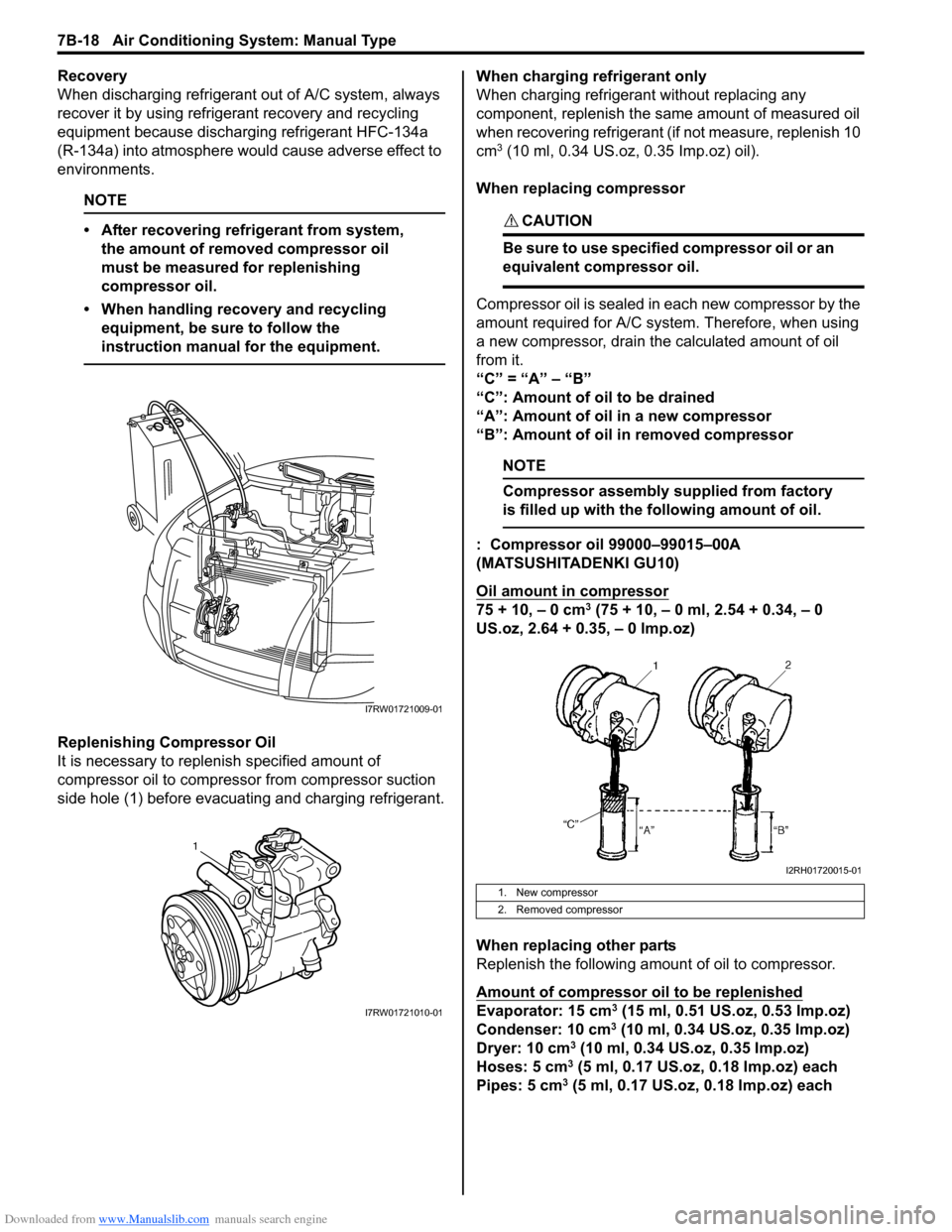
Recovery
When discharging refrigerant out of A/C system, always
recover it by using refrigerant recovery and recycling
equipment because discharging refrigerant HFC-134a
(R-134a) into atmosphere would cause adverse effect to
environments.
NOTE
• After recovering refrigerant from system,
the amount of removed compressor oil
must be measured for replenishing
compressor oil.
• When handling recovery and recycling
equipment, be sure to follow the
instruction manual for the equipment.
Replenishing Compressor Oil
It is necessary to replenish specified amount of
compressor oil to compressor from compressor suction
side hole (1) before evacuating and charging refrigerant.When charging refrigerant only
When charging refrigerant without replacing any
component, replenish the same amount of measured oil
when recovering refrigerant (if not measure, replenish 10
cm
3 (10 ml, 0.34 US.oz, 0.35 Imp.oz) oil).
When replacing compressor
CAUTION!
Be sure to use specified compressor oil or an
equivalent compressor oil.
Compressor oil is sealed in each new compressor by the
amount required for A/C system. Therefore, when using
a new compressor, drain the calculated amount of oil
from it.
“C” = “A” – “B”
“C”: Amount of oil to be drained
“A”: Amount of oil in a new compressor
“B”: Amount of oil in removed compressor
NOTE
Compressor assembly supplied from factory
is filled up with the following amount of oil.
: Compressor oil 99000–99015–00A
(MATSUSHITADENKI GU10)
Oil amount in compressor
75 + 10, – 0 cm3 (75 + 10, – 0 ml, 2.54 + 0.34, – 0
US.oz, 2.64 + 0.35, – 0 lmp.oz)
When replacing other parts
Replenish the following amount of oil to compressor.
Amount of compressor oil to be replenished
Evaporator: 15 cm3 (15 ml, 0.51 US.oz, 0.53 Imp.oz)
Condenser: 10 cm3 (10 ml, 0.34 US.oz, 0.35 Imp.oz)
Dryer: 10 cm3 (10 ml, 0.34 US.oz, 0.35 Imp.oz)
Hoses: 5 cm3 (5 ml, 0.17 US.oz, 0.18 Imp.oz) each
Pipes: 5 cm3 (5 ml, 0.17 US.oz, 0.18 Imp.oz) each
I7RW01721009-01
1
I7RW01721010-01
1. New compressor
2. Removed compressor
I2RH01720015-01