2006 SUZUKI SX4 PPL
[x] Cancel search: PPLPage 25 of 1556

Downloaded from www.Manualslib.com manuals search engine General Information: 0A-2
S:
SAE: Society of Automotive Engineers
SDM: Sensing and Diagnostic Module (Air Bag
Controller, Air bag Control Module)
SDT: Smart Diagnostic Tester
SFI: Sequential Multiport Fuel Injection
SOHC: Single Over Head Camshaft
T:
TBI: Throttle Body Fuel Injection (Single-Point Fuel
Injection, SPI)
TCC: Torque Converter Clutch
TCM: Transmission Control Module (A/T Controller, A/T
Control Module)
TDC: Top Dead Center
TP Sensor: Throttle Position SensorTVV: Thermal Vacuum Valve (Thermal Vacuum
Switching Valve, TVSV, Bimetal Vacuum Switching
Valve, BVSV)
TWC: Three Way Catalytic Converter (Three Way
Catalyst)
2WD: 2 Wheel Drive
U:
USB: Universal Serial Bus
V:
VIN: Vehicle Identification Number
VSS: Vehicle Speed Sensor
VVT: Variable Valve Timing (Camshaft Position Control)
W:
WU-OC: Warm Up Oxidation Catalytic Converter
WU-TWC: Warm Up Three Way Catalytic Converter
SymbolsS6RW0D0101002
Wire Color SymbolsS6RW0D0101003
Symbol Definition Symbol Definition
Tightening torque Apply SUZUKI BOND NO. 1216B
99000-31230
Apply oil (engine, transmission, transfer,
differential)Apply SILICONE SEALANT
99000-31120
Apply fluid (brake, power steering or
automatic transmission fluid)Apply SEALING COMPOUND 366E
99000-31090
Apply SUZUKI SUPER GREASE A
99000-25011
Apply SUZUKI SUPER GREASE C
99000-25030Apply THREAD LOCK 1322
99000-32110
Apply SUZUKI SUPER GREASE E
99000-25050Apply THREAD LOCK 1333B
99000-32020
Apply SUZUKI SUPER GREASE H
99000-25120Apply THREAD LOCK 1342
99000-32050
Apply SUZUKI SUPER GREASE I
99000-25210
Apply SUZUKI BOND NO. 1215
99000-31110Do not reuse
Apply SUZUKI BOND NO. 1207F
99000-31250Note on reassembly
Apply SUZUKI BOND NO. 1217G
99000-31260
Symbol Wire Color Symbol Wire Color
B BLK Black O, Or ORN Orange
Bl BLU Blue R RED Red
Br BRN Brown W WHT White
G GRN Green Y YEL Yellow
Gr GRY Gray P PNK Pink
Lbl LT BLU Light blue V PPL Violet
Lg LT GRN Light green
Page 27 of 1556

Downloaded from www.Manualslib.com manuals search engine General Information: 0A-4
Standard Tightening Torque
Each fastener should be tightened to the torque specified in each section. If no description or specification is provided,
refer to the following tightening torque chart for the applicable torque for each fastener. When a fastener of greater
strength than the original one is used, however, use the torque specified for the original fastener.
NOTE
• For the flanged bolt, flanged nut and self-lock nut of 4T and 7T strength, add 10% to the tightening
torque given in the following chart.
• The following chart is applicable only where the fastened parts are made of steel light alloy.
Tightening torque chart
*:Self-lock nutStrength UnitThread diameter (Nominal diameter) (mm)
4 5 6 8 10 12 14 16 18
A equivalent of 4T strength fastener N⋅m 1.5 3.0 5.5 13 29 45 65 105 160
kgf-m 0.15 0.30 0.55 1.3 2.9 4.5 6.5 10.5 16
lb-ft 1.0 2.5 4.0 9.5 21.0 32.5 47.0 76.0 116.0
A equivalent of 6.8 strength fastener
without flangeN⋅m 2.4 4.7 8.4 20 42 80 125 193 280
kgf-m 0.24 0.47 0.84 2.0 4.2 8.0 12.5 19.3 28
lb-ft 2.0 3.5 6.0 14.5 30.5 58.0 90.5 139.5 202.5
A equivalent of 6.8 strength fastener
with flange
*: Self-lock nut (6 strength)N⋅m 2.4 4.9 8.8 21 44 84 133 203 298
kgf-m 0.24 0.49 0.88 2.1 4.4 8.4 13.3 20.3 29.8
lb-ft 2.0 3.5 6.5 15.5 32.0 61.0 96.5 147.0 215.5
A equivalent of 7T strength fastener N⋅m 2.3 4.5 10 23 50 85 135 210 240
kgf-m 0.23 0.45 1.0 2.3 5.0 8.5 13.5 21 24
lb-ft 2.0 3.5 7.5 17.0 36.5 61.5 98.0 152.0 174.0
A equivalent of 8.8 strength bolt (8
strength nut) without flangeN⋅m 3.1 6.3 11 27 56 105 168 258 373
kgf-m 0.31 0.63 1.1 2.7 5.6 10.5 16.8 25.8 37.3
lb-ft 2.5 4.5 8.0 19.5 40.5 76.0 121.5 187.0 270.0
A equivalent of 8.8 strength bolt (8
strength nut) with flangeN⋅m 3.2 6.5 12 29 59 113 175 270 395
kgf-m 0.32 0.65 1.2 2.9 5.9 11.3 17.5 27 39.5
lb-ft 2.5 5.0 9.0 21.0 43.0 82.0 126.5 195.5 286.0
I2RH01010012-01
I2RH01010013-01
I2RH01010014-01
I2RH01010015-01
I2RH01010016-01
I2RH01010017-01
Page 28 of 1556

Downloaded from www.Manualslib.com manuals search engine 0A-5 General Information:
Vehicle Lifting PointsS6RW0D0101005
WARNING!
• Before applying hoist to underbody, always take vehicle balance throughout service into
consideration. Vehicle balance on hoist may change depending on what part to be removed.
• Before lifting up the vehicle, check to be sure that end of hoist arm is not in contact with brake pipe,
fuel pipe, bracket or any other part.
• When using frame contact hoist, apply hoist as shown (right and left at the same position). Lift up
the vehicle till 4 tires are a little off the ground and make sure that the vehicle will not fall off by
trying to move vehicle body in both ways. Work can be started only after this confirmation.
• Make absolutely sure to lock hoist after vehicle is hoisted up.
When Using Frame Contact Hoist
When Using Floor Jack
WARNING!
If the vehicle to be jacked up only at the front
or rear end, be sure to block the wheels on
ground in order to ensure safety.
After the vehicle is jacked up, be sure to
support it on stands. It is extremely
dangerous to do any work on the vehicle
raised on jack alone.
CAUTION!
Never apply jack against rear suspension
parts (i.e., torsion beam, etc.) or vehicle floor,
or it may get deformed.
1
:2
:3
4
c
5
I5RW0A010001-02
1. Vehicle front3. Floor jack position 5. Cap
2. Support position for frame contact hoist and safety stand 4. Body mounting stay
Page 33 of 1556

Downloaded from www.Manualslib.com manuals search engine Maintenance and Lubrication: 0B-2
NOTE
• “R”: Replace or change
• “I”: Inspect and correct, replace or lubricate if necessary
• For spark plugs, replace every 50,000 km if the local law requires.
• Nickel spark plug: BKR6E-11 (NGK) or K20PR-U11 (DENSO)
• Iridium spark plug: IFR6J11 (NGK)
• Periodic replacement of fuel filter is not necessary if it is not instructed in “Periodic Maintenance
Schedule” section of the Owner’s manual. The scheduled maintenance varies depending on the
vehicle specification.
Maintenance Recommended under Severe Driving ConditionsS6RW0D0205002
If the vehicle is usually used under the conditions corresponding to any severe condition code given below, IT IS
RECOMMENDED that applicable maintenance operation be performed at the particular interval as shown in the
following table.
Severe condition code:
A: Repeated short trips
B: Driving on rough and/or muddy roads
C: Driving on dusty roads
D: Driving in extremely cold weather and/or salted roads
E: Repeated short trips in extremely cold weather
F: Leaded fuel use
G: – – – – –
H: Towing a trailer (if admitted)Automatic transaxle fluidFluid level (I: ))—I—I—I
Fluid change (R: ))Replace every 165,000 km (99,000
miles)
Fluid hose (i: ))———I——
Transfer oil (4WD) (leakage, level) (I: )) I—I—I—
Rear differential oil (4WD) (leakage, level) (I: )) (R: ) 1st 15,000 km only) R or I — I — I —
All latches, hinges and locks (I: ))—I—I—I
HVAC air filter (if equipped) (I: )) (R: ))—IR—IR
Severe
condition codeMaintenanceMaintenance
operationMaintenance interval
– B C D – – – – Accessory drive belt) IEvery 15,000 km
(9,000 miles) or 12 months
) REvery 45,000 km
(27,000 miles) or 36 months
A – C D E F – H Engine oil and oil filter) REvery 7,500 km
(4,500 miles) or 6 months
– – C – – – – – Air cleaner filter *1) IEvery 2,500 km
(1,500 miles)
) REvery 30,000 km
(18,000 miles) or 24 months
A B C – E F – H Spark plugsNickel plug
) REvery 10,000 km (6,000 miles) or 8
months
Iridium plug
(Highly recommended)Every 30,000 km (18,000 miles) or
24 months
– B C D – – – H Wheel bearings) IEvery 15,000 km
(9,000 miles) or 12 months
– B – D E – – HDrive shaft boots / Propeller shaft
(4WD)) / ) IEvery 15,000 km
(9,000 miles) or 12 months IntervalKm (x 1,000) 15 30 45 60 75 90
Miles (x 1,000) 9 18 27 36 45 54
Months 12 24 36 48 60 72
Page 42 of 1556

Downloaded from www.Manualslib.com manuals search engine 0B-11 Maintenance and Lubrication:
HVAC Air Filter (If Equipped) InspectionS6RW0D0206034
Check HVAC air filter for dirt and dust referring to “HVAC
Air Filter Inspection (If Equipped) in Section 7A”. If air
filter is dirty, clean or replace air filter with new one.
HVAC Air Filter (If Equipped) ReplacementS6RW0D0206035
Replace HVAC air filter with new one referring to “HVAC
Air Filter Removal and Installation (If Equipped) in
Section 7A”.
Final Inspection for Maintenance ServiceS6RW0D0206036
WARNING!
When carrying out road tests, select a safe
place where no man or no running vehicle is
seen so as to prevent any accident.
Seats
Check that seat slides smoothly and locks securely at
any position. Also check that reclining mechanism of
front seat back allows it to be locked at any angle.
Seat Belt
Inspect belt system including webbing, buckles, latch
plates, retractors and anchors for damage or wear.
Check that seat belt is securely locked. If “REPLACE
BELT” label on seat belt is visible, replace belt.
Battery Electrolyte Level Check
Check that the electrolyte level of all battery cells is
between the upper and lower level lines on the case. If
battery is equipped with built-in indicator, check battery
condition by the indicator.
Accelerator Pedal Operation
Check that pedal operates smoothly without getting
caught or interfered by any other part.
Engine Start
Check engine start for readiness.
WARNING!
Before performing the following check, be
sure to have enough room around the
vehicle. Then, firmly apply both the parking
brake and the regular brakes. Do not use the
accelerator pedal. If the engine starts, be
ready to turn off the ignition promptly. Take
these precautions because the vehicle could
move without warning and possibly cause
personal injury or property damage.
On automatic transaxle vehicles, try to start the engine in
each select lever position. The starting motor should
crank only in “P” (Park) or “N” (Neutral).
On manual transaxle vehicles, place the shift lever in
“Neutral,” depress clutch pedal fully and try to start.
Exhaust System Check
Check for leakage, cracks or loose supports.
Clutch (for Manual Transaxle)
Check for the following.
• Clutch is completely released when depressing clutch
pedal,
• No slipping clutch occurs when releasing pedal and
accelerating.
• Clutch itself is free from any abnormal condition.
Gearshift or Select Lever
Check gear shift or select lever for smooth shifting to all
positions and for good performance of transaxle in any
position.
With automatic transaxle equipped vehicle, also check
that shift indicator indicates properly according to which
position select lever is shifted to.
With automatic transaxle equipped vehicle, make sure
that vehicle is at complete stop when shifting select lever
to “P” range position and release all brakes.
Brake
Foot brake
Check the following:
• that brake pedal has proper travel,
• that brake works properly,
• that it is free from noise,
• that vehicle does not pull to one side when brake is
applied.
• and that brake do not drag.
Parking brake
Check that lever has proper travel.
WARNING!
With vehicle parked on a fairly steep slope,
make sure nothing is in the way downhill to
avoid any personal injury or property
damage. Be prepared to apply regular brake
quickly even if vehicle should start to move.
Check to ensure that parking brake is fully effective
when the vehicle is stopped on the safe slope and brake
lever is pulled all the way.
Page 46 of 1556

Downloaded from www.Manualslib.com manuals search engine 1-ii Table of Contents
DTC P0123: Throttle Position Sensor (Main)
Circuit High ..................................................... 1A-89
DTC P0131 / P0132: O2 Sensor (HO2S)
Circuit Low Voltage / High Voltage (Sensor-
1) ..................................................................... 1A-92
DTC P0133: O2 Sensor (HO2S) Circuit Slow
Response (Sensor-1) ...................................... 1A-95
DTC P0134: O2 Sensor (HO2S) Circuit No
Activity Detected (Sensor-1) ........................... 1A-96
DTC P0137 / P0138: O2 Sensor (HO2S)
Circuit Low Voltage / High Voltage (Sensor-
2) ..................................................................... 1A-98
DTC P0140: O2 Sensor (HO2S) Circuit No
Activity Detected (Sensor-2) ......................... 1A-101
DTC P0171 / P0172: Fuel System Too Lean /
Rich ............................................................... 1A-103
DTC P0222: Throttle Position Sensor (Sub)
Circuit Low .................................................... 1A-105
DTC P0223: Throttle Position Sensor (Sub)
Circuit High ................................................... 1A-107
DTC P0300 / P0301 / P0302 / P0303 / P0304:
Random Misfire Detected / Cylinder 1 /
Cylinder 2 / Cylinder 3 / Cylinder 4 Misfire
Detected ........................................................ 1A-110
DTC P0327 / P0328: Knock Sensor Circuit
Low / High ..................................................... 1A-112
DTC P0335: Crankshaft Position (CKP)
Sensor Circuit ............................................... 1A-114
DTC P0340: Camshaft Position (CMP)
Sensor Circuit ............................................... 1A-116
DTC P0401 / P0402: Exhaust Gas
Recirculation Flow Insufficient Detected /
Excessive Detected ...................................... 1A-119
DTC P0403: Exhaust Gas Recirculation
Control Circuit ............................................... 1A-122
DTC P0420: Catalyst System Efficiency
below Threshold ............................................ 1A-124
DTC P0443: Evaporative Emission System
Purge Control Valve Circuit........................... 1A-126
DTC P0462 / P0463: Fuel Level Sensor
Circuit Low / High .......................................... 1A-128
DTC P0480: Fan 1 (Radiator Cooling Fan)
Control Circuit ............................................... 1A-129
DTC P0481: Cooling Fan 2 (A/C Condenser
Fan) Control Circuit ....................................... 1A-131
DTC P0500: Vehicle Speed Sensor (VSS)
Malfunction .................................................... 1A-134
DTC P0532: A/C Refrigerant Pressure
Sensor Circuit Low ........................................ 1A-136
DTC P0533: A/C Refrigerant Pressure
Sensor Circuit High ....................................... 1A-138
DTC P0601 / P0602 / P0607: Internal Control
Module Memory Check Sum Error / Control
Module Programming Error / Control Module
Performance ................................................. 1A-139
DTC P0616: Starter Relay Circuit Low............ 1A-140
DTC P0617: Starter Relay Circuit High ........... 1A-141
DTC P1510: ECM Back-Up Power Supply
Malfunction .................................................... 1A-143DTC P2101: Throttle Actuator Control Motor
Circuit Range / Performance ......................... 1A-144
DTC P2102: Throttle Actuator Control Motor
Circuit Low .................................................... 1A-146
DTC P2103: Throttle Actuator Control Motor
Circuit High.................................................... 1A-147
DTC P2111: Throttle Actuator Control System
- Stuck Open ................................................. 1A-148
DTC P2119: Throttle Actuator Control Throttle
Body Range / Performance ........................... 1A-149
DTC P2122: Pedal Position Sensor (Main)
Circuit Low Input ........................................... 1A-151
DTC P2123: Pedal Position Sensor (Main)
Circuit High Input........................................... 1A-153
DTC P2127: Pedal Position Sensor (Sub)
Circuit Low Input ........................................... 1A-155
DTC P2128: Pedal Position Sensor (Sub)
Circuit High Input........................................... 1A-158
DTC P2135: Throttle Position Sensor (Main /
Sub) Voltage Correlation ............................... 1A-160
DTC P2138: Pedal Position Sensor (Main /
Sub) Voltage Correlation ............................... 1A-163
DTC P2227 / P2228 / P2229: Barometric
Pressure Circuit Malfunction ......................... 1A-165
DTC U0073: Control Module Communication
Bus Off .......................................................... 1A-166
DTC U0101: Lost Communication with TCM .. 1A-166
DTC U0121: Lost Communication with ABS
Control Module .............................................. 1A-166
DTC U0140: Lost Communication with Body
Control Module .............................................. 1A-166
Troubleshooting for CAN-DTC ........................ 1A-167
Inspection of ECM and Its Circuits .................. 1A-172
ECM Power and Ground Circuit Check........... 1A-193
Fuel Injector Circuit Check .............................. 1A-196
Fuel Pump and Its Circuit Check..................... 1A-198
Fuel Pressure Check....................................... 1A-201
A/C Condenser Cooling Fan Control System
Inspection ...................................................... 1A-202
A/C System Circuits Check ............................. 1A-205
Electric Load Signal Circuit Check .................. 1A-209
Radiator Cooling Fan Control System Check . 1A-211
Repair Instructions ..........................................1A-212
Idle Speed and IAC Throttle Valve Opening
Inspection ...................................................... 1A-212
Special Tools and Equipment .........................1A-213
Special Tool .................................................... 1A-213
Aux. Emission Control Devices ............. 1B-1
Diagnostic Information and Procedures ............1B-1
EGR System Inspection (If Equipped) ................ 1B-1
Repair Instructions ..............................................1B-1
EVAP Canister Purge Inspection ........................ 1B-1
EVAP Canister Purge Valve and Its Circuit
Inspection .......................................................... 1B-1
Vacuum Passage Inspection............................... 1B-2
Vacuum Hose Inspection .................................... 1B-3
EVAP Canister Purge Valve Inspection .............. 1B-3
EVAP Canister Inspection ................................... 1B-4
Page 55 of 1556

Downloaded from www.Manualslib.com manuals search engine Engine General Information and Diagnosis: 1A-5
General Description
Statement on Cleanliness and CareS6RW0D1101001
An automobile engine is a combination of many
machined, honed, polished and lapped surfaces with
tolerances that are measured in the thousands of an
millimeter (ten thousands of an inch).
Accordingly, when any internal engine parts are
serviced, care and cleanliness are important.
It should be understood that proper cleaning and
protection of machined surfaces and friction areas is part
of the repair procedure. This is considered standard
shop practice even if not specifically stated.
• A liberal coating of engine oil should be applied to
friction areas during assembly to protect and lubricate
the surfaces on initial operation.
• Whenever valve train components, pistons, piston
rings, connecting rods, rod bearings, and crankshaft
journal bearings are removed for service, they should
be retained in order.
At the time of installation, they should be installed in
the same locations and with the same mating
surfaces as when removed.
• Battery cables should be disconnected before any
major work is performed on the engine.
Failure to disconnect cables may result in damage to
wire harness or other electrical parts.
• The four cylinders of the engine are identified by
numbers; No.1 (1), No.2 (2), No.3 (3) and No.4 (4)
counted from crankshaft pulley side to flywheel side.
Engine Diagnosis General DescriptionS6RW0D1101002
NOTE
There are two types of OBD system
depending on the vehicle specification.
For identification, refer to “Precaution on On-
Board Diagnostic (OBD) System”.
This vehicle is equipped with an engine and emission
control system which are under control of ECM.
The engine and emission control system in this vehicle
are controlled by ECM. ECM has an On-Board
Diagnostic system which detects a malfunction in this
system and abnormality of those parts that influence the
engine exhaust emission. When diagnosing engine
troubles, be sure to have full understanding of the outline
of “On-Board Diagnostic System Description” and each
item in “Precautions in Diagnosing Trouble” and execute
diagnosis according to “Engine and Emission Control
System Check”.
There is a close relationship between the engine
mechanical, engine cooling system, ignition system,
exhaust system, etc. and the engine and emission
control system in their structure and operation. In case of
an engine trouble, even when the malfunction indicator
lamp (MIL) doesn’t turn ON, it should be diagnosed
according to “Engine and Emission Control System
Check”.
On-Board Diagnostic System DescriptionS6RW0D1101003
NOTE
There are two types of OBD system
depending on the vehicle specification.
For identification, refer to “Precaution on On-
Board Diagnostic (OBD) System”.
Euro OBD model
ECM in this vehicle has the following functions.
• When the ignition switch is turned ON with the engine
at a stop, malfunction indicator lamp (MIL) (1) turns
ON to check the circuit of the malfunction indicator
lamp (1).
• When ECM detects a malfunction which gives an
adverse effect to vehicle emission while the engine is
running, it makes the malfunction indicator lamp (1) in
the meter cluster of the instrument panel turn ON or
flash (flashing only when detecting a misfire which
can cause damage to the catalyst) and stores the
malfunction area in its memory.
(If it detects that continuously 3 driving cycles are
normal after detecting a malfunction, however, it
makes MIL (1) turn OFF although DTC stored in its
memory will remain.)
1
234
I3RM0A110001-01
Page 57 of 1556
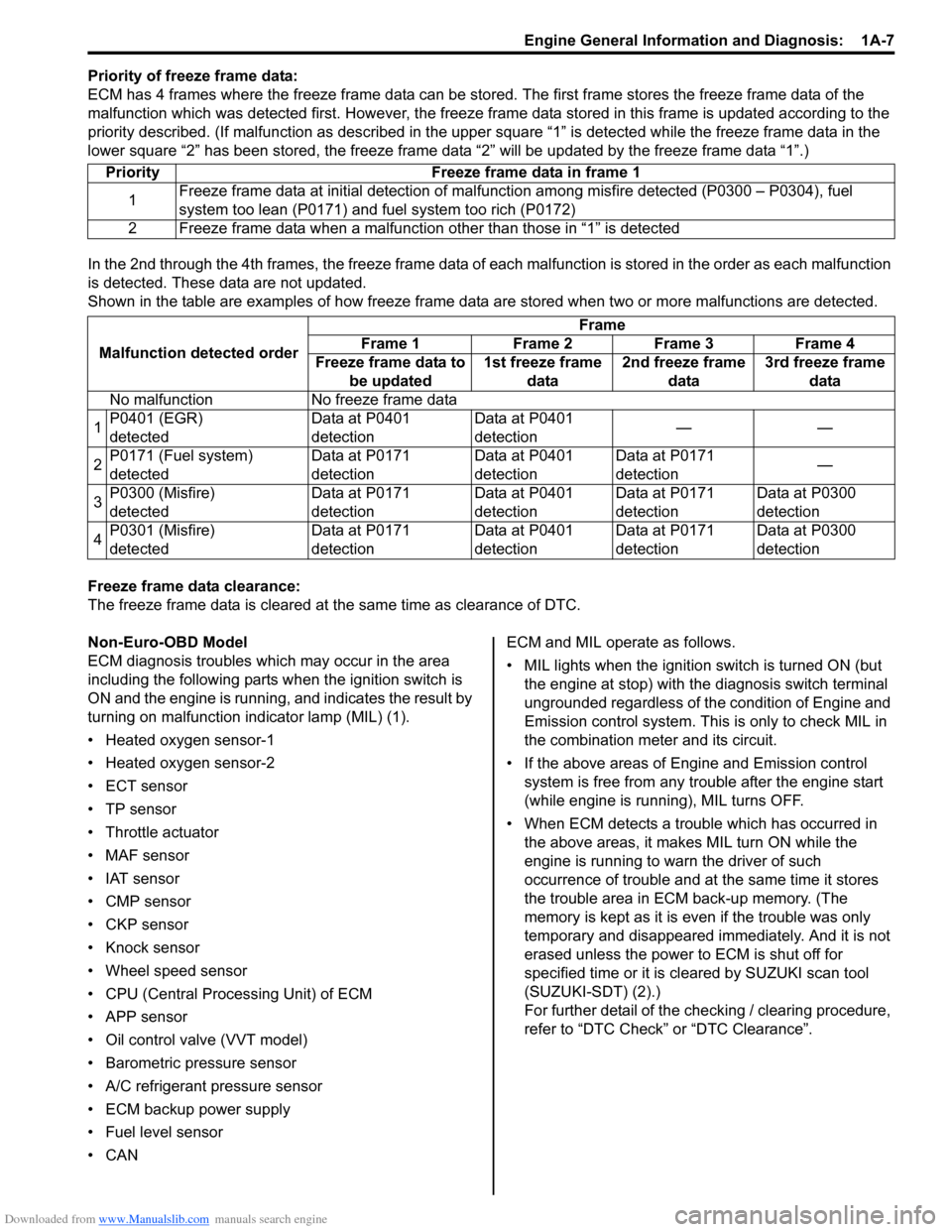
Downloaded from www.Manualslib.com manuals search engine Engine General Information and Diagnosis: 1A-7
Priority of freeze frame data:
ECM has 4 frames where the freeze frame data can be stored. The first frame stores the freeze frame data of the
malfunction which was detected first. However, the freeze frame data stored in this frame is updated according to the
priority described. (If malfunction as described in the upper square “1” is detected while the freeze frame data in the
lower square “2” has been stored, the freeze frame data “2” will be updated by the freeze frame data “1”.)
In the 2nd through the 4th frames, the freeze frame data of each malfunction is stored in the order as each malfunction
is detected. These data are not updated.
Shown in the table are examples of how freeze frame data are stored when two or more malfunctions are detected.
Freeze frame data clearance:
The freeze frame data is cleared at the same time as clearance of DTC.
Non-Euro-OBD Model
ECM diagnosis troubles which may occur in the area
including the following parts when the ignition switch is
ON and the engine is running, and indicates the result by
turning on malfunction indicator lamp (MIL) (1).
• Heated oxygen sensor-1
• Heated oxygen sensor-2
• ECT sensor
•TP sensor
• Throttle actuator
• MAF sensor
• IAT sensor
• CMP sensor
• CKP sensor
• Knock sensor
• Wheel speed sensor
• CPU (Central Processing Unit) of ECM
• APP sensor
• Oil control valve (VVT model)
• Barometric pressure sensor
• A/C refrigerant pressure sensor
• ECM backup power supply
• Fuel level sensor
•CANECM and MIL operate as follows.
• MIL lights when the ignition switch is turned ON (but
the engine at stop) with the diagnosis switch terminal
ungrounded regardless of the condition of Engine and
Emission control system. This is only to check MIL in
the combination meter and its circuit.
• If the above areas of Engine and Emission control
system is free from any trouble after the engine start
(while engine is running), MIL turns OFF.
• When ECM detects a trouble which has occurred in
the above areas, it makes MIL turn ON while the
engine is running to warn the driver of such
occurrence of trouble and at the same time it stores
the trouble area in ECM back-up memory. (The
memory is kept as it is even if the trouble was only
temporary and disappeared immediately. And it is not
erased unless the power to ECM is shut off for
specified time or it is cleared by SUZUKI scan tool
(SUZUKI-SDT) (2).)
For further detail of the checking / clearing procedure,
refer to “DTC Check” or “DTC Clearance”. Priority Freeze frame data in frame 1
1Freeze frame data at initial detection of malfunction among misfire detected (P0300 – P0304), fuel
system too lean (P0171) and fuel system too rich (P0172)
2 Freeze frame data when a malfunction other than those in “1” is detected
Malfunction detected orderFrame
Frame 1 Frame 2 Frame 3 Frame 4
Freeze frame data to
be updated1st freeze frame
data2nd freeze frame
data3rd freeze frame
data
No malfunction No freeze frame data
1P0401 (EGR)
detectedData at P0401
detectionData at P0401
detection——
2P0171 (Fuel system)
detectedData at P0171
detectionData at P0401
detectionData at P0171
detection—
3P0300 (Misfire)
detectedData at P0171
detectionData at P0401
detectionData at P0171
detectionData at P0300
detection
4P0301 (Misfire)
detectedData at P0171
detectionData at P0401
detectionData at P0171
detectionData at P0300
detection