2006 SUZUKI SX4 PPL
[x] Cancel search: PPLPage 151 of 1556

Downloaded from www.Manualslib.com manuals search engine Engine General Information and Diagnosis: 1A-101
DTC P0140: O2 Sensor (HO2S) Circuit No Activity Detected (Sensor-2)S6RW0D1104035
Wiring Diagram
Refer to “DTC P0137 / P0138: O2 Sensor (HO2S) Circuit Low Voltage / High Voltage (Sensor-2)”.
DTC Detecting Condition and Trouble Area
DTC Confirmation Procedure
WARNING!
• When performing a road test, select a place where there is no traffic or possibility of a traffic
accident and be very careful during testing to avoid occurrence of an accident.
• Road test should be carried out by 2 persons, a driver and a tester, on a level road.
1) With ignition switch turned OFF, connect scan tool.
2) Turn ON ignition switch and clear DTC using scan tool.
3) Start engine and warm up to normal operating temperature.
4) Increase vehicle speed to 60 – 80 km/h (37 – 50 mile/h) at 5th gear or D range.
5) Release accelerator pedal and with engine brake applied, keep vehicle coasting (with fuel cut for 4 sec. or more),
then stop vehicle and run engine at idle speed for 60 sec. or more.
6) Check DTC and pending DTC.
DTC Troubleshooting
NOTE
Before this troubleshooting is performed, read the precautions for DTC troubleshooting referring to
“Precautions for DTC Troubleshooting”.
DTC detecting condition Trouble area
HO2S-2 voltage is higher than specified value after warming up engine
(circuit open).
(2 driving cycle detection logic)•HO2S-2
• HO2S-2 circuit
•ECM
• Exhaust gas leakage
• Air intake system
Step Action Yes No
1Was “Engine and Emission Control System Check”
performed?Go to Step 2. Go to “Engine and
Emission Control
System Check”.
2HO2S-2 ground check
1) Disconnect connector from HO2S-2 with ignition switch
turned OFF.
2) Check for proper connection to HO2S-2 connector at
“RED/BLU”, “BRN”, “ORN” and “BLK/WHT” wire
terminals.
3) If connections are OK, measure resistance between
“ORN” wire terminal of HO2S-2 connector and engine
ground.
Is resistance less than 5
Ω?Go to Step 3. “ORN” wire is open or
high resistance circuit.
Poor “C01-57” terminal
connection. Faulty ECM
ground.
If they are OK,
substitute a known-
good ECM and recheck.
Page 154 of 1556

Downloaded from www.Manualslib.com manuals search engine 1A-104 Engine General Information and Diagnosis:
DTC Troubleshooting
NOTE
Before this troubleshooting is performed, read the precautions for DTC troubleshooting referring to
“Precautions for DTC Troubleshooting”.
Step Action Yes No
1Was “Engine and Emission Control System Check”
performed?Go to Step 2. Go to “Engine and
Emission Control
System Check”.
2Is there DTC(s) other than fuel system (DTC P0171 /
P0172)?Go to applicable DTC
diag. flow.Go to Step 3.
3Intake system and exhaust system for leakage check
Are intake system and exhaust system in good condition?Go to Step 4. Repair or replace
defective part.
4Fuel pressure check
1) Check fuel pressure referring to “Fuel Pressure Check”.
Is check result satisfactory?Go to Step 5. Repair or replace
defective part.
5Fuel injectors and its circuit check
1) Check fuel injectors referring to “Fuel Injector Inspection
in Section 1G”.
Is check result satisfactory?Go to Step 6. Faulty injector(s) or its
circuit.
6Visual inspection
1) Check MAF sensor and air intake system.
• Objects which block measuring duct and resistor of
MAF sensor.
• Other air flow which does not pass MAF sensor.
Are they in good condition?Go to Step 7. Repair or replace
defective part.
7MAF sensor for performance check
1) With ignition switch turned OFF, install scan tool.
2) Start engine and warm up to normal operating
temperature.
3) Check MAF value using scan tool (Refer to “Scan Tool
Data” for normal value.).
Is each value within specified range?Go to Step 8. Go to “DTC P0101:
Mass Air Flow Circuit
Range / Performance”.
8ECT sensor for performance check
1) Check ECT sensor referring to Step 3 and 4 of “DTC
P0118: Engine Coolant Temperature Circuit High”.
Is check result satisfactory?Go to Step 9. Faulty ECT sensor or its
circuit.
9HO2S-1 for performance check
1) Check HO2S-1 referring to Step 3 of “DTC P0131 /
P0132: O2 Sensor (HO2S) Circuit Low Voltage / High
Voltage (Sensor-1)”.
Is check result satisfactory?Substitute a known-
good ECM and recheck.Faulty HO2S-1 or its
circuit.
Page 161 of 1556

Downloaded from www.Manualslib.com manuals search engine Engine General Information and Diagnosis: 1A-111
DTC Troubleshooting
NOTE
If the vehicle runs under fuel deficient condition (such as a condition in which the fuel pump is unable
to draw fuel properly), DTC of misfire may possibly be detected due to fuel pressure drop even though
there is no abnormal condition existing in the Engine and Emission System.
Therefore, if the DTC still cannot be detected with “Trouble Symptom Confirmation” executed in
accordance with “Engine and Emission Control System Check” the possible cause may be due to a
running condition under insufficient fuel supply at the time of detecting DTC of misfire.
Step Action Yes No
1Was “Engine and Emission Control System Check”
performed?Go to Step 2. Go to “Engine and
Emission Control
System Check”.
2Does fuel level meter indicate “E” level (empty)?Add fuel and recheck. Go to Step 3.
3Fuel quality check
1) Check that there is fuel of good quality in the fuel tank.
Is it OK?Go to Step 4. Clean in fuel system
circuit and change fuel.
4Ignition system check
1) Check spark plug and ignition spark of cylinder where
misfire occurs, referring to “Spark Plug Inspection in
Section 1H” and “Ignition Spark Test in Section 1H”.
Are they in good condition?Go to Step 5. Faulty ignition coil, wire
harness, spark plug or
other system parts.
5Fuel injector circuit check
1) Using sound scope, check each injector operating sound
at engine cranking or idling.
Do all injectors make operating sound?Go to Step 6. Check coupler
connection and wire
harness of injector not
making operating sound
and injector itself. If OK,
substitute a known-
good ECM and recheck.
6Fuel pressure check
1) Check fuel pressure referring to “Fuel Pressure Check”.
Is check result satisfactory?Go to Step 7. Repair or replace fuel
system.
7Fuel injector check
1) Check fuel injector(s) referring to “Fuel Injector
Inspection in Section 1G”.
Is check result satisfactory?Go to Step 8. Replace defective
injector.
8Ignition timing check
1) Check ignition timing referring to “Ignition Timing
Inspection in Section 1H”.
Is check result satisfactory?Go to Step 9. Check related sensors.
9EGR system check
1) Check EGR system referring to “EGR System Inspection
(If Equipped) in Section 1B”.
Is check result satisfactory?Go to Step 10. Repair or replace EGR
system.
10Exhaust system check
1) Check exhaust system for exhaust gas clogged.
Is it OK?Go to Step 11. Repair clogged of
exhaust system.
Page 165 of 1556

Downloaded from www.Manualslib.com manuals search engine Engine General Information and Diagnosis: 1A-115
DTC Confirmation Procedure
1) With ignition switch turned OFF, connect scan tool.
2) Turn ON ignition switch and clear DTC using scan tool.
3) Crank engine for 3 – 5 sec.
4) Check DTC and pending DTC.
DTC Troubleshooting
NOTE
Before this troubleshooting is performed, read the precautions for DTC troubleshooting referring to
“Precautions for DTC Troubleshooting”.
Step Action Yes No
1Was “Engine and Emission Control System Check”
performed?Go to Step 2. Go to “Engine and
Emission Control
System Check”.
2CKP sensor and connector for proper installation check
Is CKP sensor installed properly and connector connected
securely?Go to Step 3. Correct.
3Wire harness and connection check
1) Disconnect connector from CKP sensor with ignition
switch turned OFF.
2) Check for proper connection to CKP sensor at “BLK/
RED”, “PNK” and “BLK/ORN” wire terminals.
3) If OK, turn ON ignition switch and check voltage at “BLK/
RED”, “PNK” and “BLK/ORN” wire terminals of
disconnected CKP sensor connector.
CKP sensor voltage
Terminal “B+”: 10 – 14 V
Terminal “Vout”: 4 – 5 V
Terminal “GND”: 0 V
Is check result satisfactory?Go to Step 7. Go to Step 4.
4Was terminal “Vout” voltage in Step 3 within specification?Go to Step 5. “PNK” wire is open or
shorted to ground /
power supply circuit.
If wire and connection
are OK, substitute a
known-good ECM and
recheck.
I2RH0B110048-01
Page 168 of 1556

Downloaded from www.Manualslib.com manuals search engine 1A-118 Engine General Information and Diagnosis:
3Wire harness and connection check
1) Disconnect connector from CMP sensor.
2) Check for proper connection to CMP sensor at “BLK/
RED”, “RED/YEL” and “BLK/ORN” wire terminals.
3) If OK, turn ON ignition switch and check voltage at “BLK/
RED”, “RED/YEL” and “BLK/ORN” wire terminals of
disconnected CMP sensor connector.
CMP sensor voltage
Terminal “B+”: 10 – 14 V
Terminal “Vout”: 4 – 5 V
Terminal “GND”: 0 V
For engine without VVT system
For engine with VVT system
Is check result satisfactory?Go to Step 7. Go to Step 4.
4Was terminal “Vout” voltage in Step 3 within specification?Go to Step 5. “RED/YEL” wire is open
or shorted to ground /
power supply circuit.
If wire and connection
are OK, substitute a
known-good ECM and
recheck.
5Ground circuit check
1) Turn ignition switch to OFF position.
2) Measure resistance between “BLK/ORN” wire terminal
of CMP sensor connector and engine ground.
Is measured resistance value less than 3
Ω?Go to Step 6. “BLK/ORN” wire is open
or high resistance
circuit.
6Was terminal “B+” voltage in Step 3 within specification?Go to Step 7. “BLK/RED” wire is open
circuit. If wire and
connection are OK,
substitute a known-
good ECM and recheck. Step Action Yes No
I4RS0B110031-01
I4RS0B110094-01
Page 170 of 1556

Downloaded from www.Manualslib.com manuals search engine 1A-120 Engine General Information and Diagnosis:
DTC Detecting Condition and Trouble Area
DTC Confirmation Procedure
WARNING!
• When performing a road test, select a place where there is no traffic or possibility of a traffic
accident and be very careful during testing to avoid occurrence of an accident.
• Road test should be carried out by 2 persons, a driver and a tester, on a level road.
NOTE
Check to make sure that following conditions are satisfied when using this “DTC confirmation
procedure”.
• Intake air temperature at engine start: –10 °C (14 °F) to 80 °C (176 °F)
• Intake air temperature: –10 °C (14 °F) to 70 °C (158 °F)
• Engine coolant temperature: 70 °C (158 °F) or more
• Altitude (barometric pressure): 2500 m, 8200 ft or less (560 mmHg, 74.4 kPa or more)
1) With ignition switch turned OFF, connect scan tool.
2) Turn ON ignition switch and clear DTC using scan tool.
3) Start engine and warm up to normal operating temperature.
4) Run engine at idle for 10 min.
5) Drive vehicle and increase engine speed 3000 rpm in 3rd gear or “3” range.
6) Release accelerator pedal and with engine brake applied, keep vehicle coasting for 5 sec. or more. (Keep fuel cut
condition for 5 sec. or more) If fuel cut condition is not kept for 5 sec. or more, coast down a slope in engine speed
1000 – 3000 rpm for 5 sec. or more.
7) Stop vehicle and run engine at idle.
8) For european market model, check whether EGR system readiness/monitoring test has completed or not by using
scan tool.
If evaporative system readiness/monitoring test has not completed, check vehicle conditions (environmental) and
repeat Steps 3) through 7).
9) Check DTC and pending DTC.DTC detecting condition Trouble area
DTC P0401:
Difference in intake manifold absolute pressure between opened EGR valve and closed
EGR valve is smaller than specified value.
(2 driving cycle detection logic, monitoring once / 1 driving)
DTC P0402:
Difference in intake manifold absolute pressure between opened EGR valve and closed
EGR valve is larger than specified value.
(2 driving cycle detection logic, monitoring once / 1 driving)• EGR valve
• EGR passage
• MAP sensor
•ECM
Page 173 of 1556
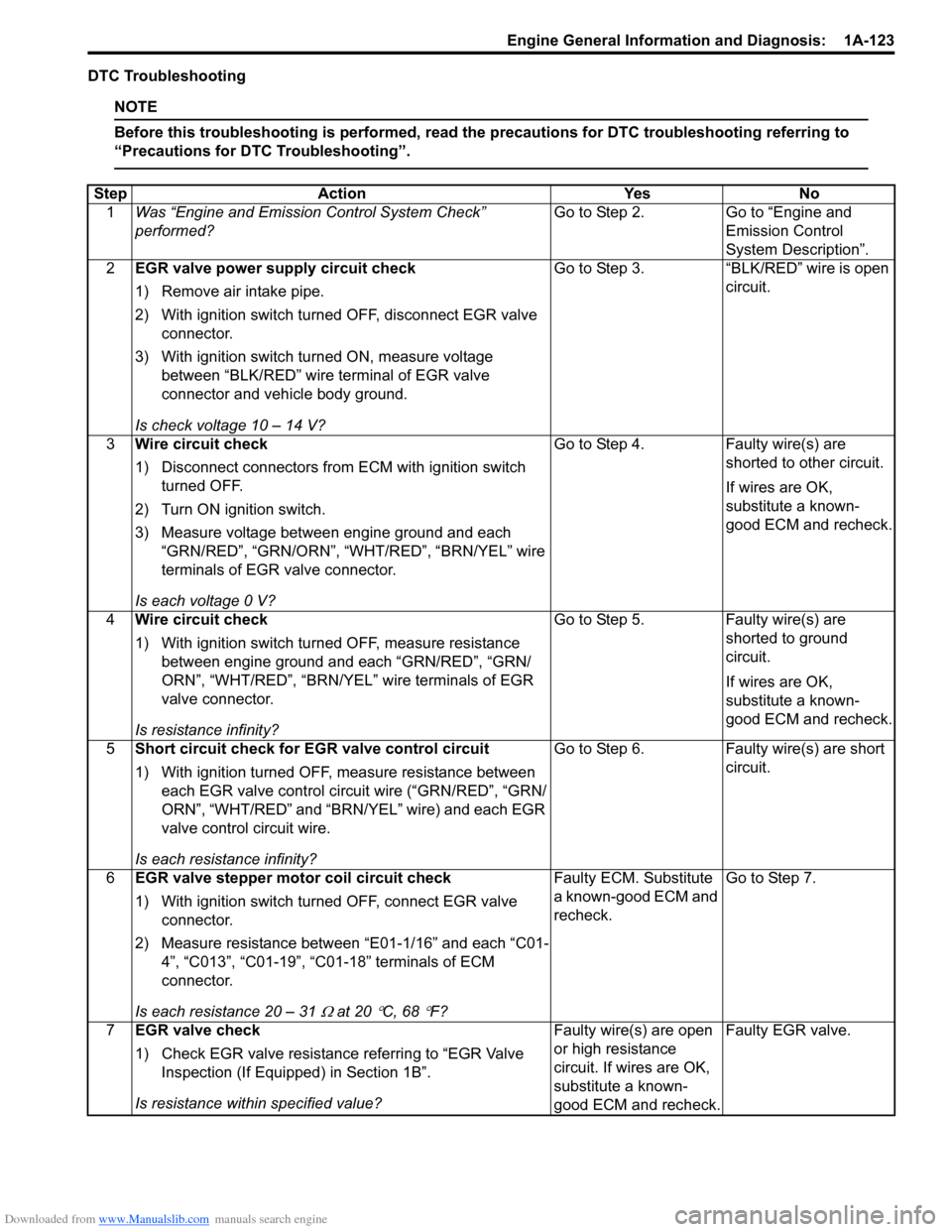
Downloaded from www.Manualslib.com manuals search engine Engine General Information and Diagnosis: 1A-123
DTC Troubleshooting
NOTE
Before this troubleshooting is performed, read the precautions for DTC troubleshooting referring to
“Precautions for DTC Troubleshooting”.
Step Action Yes No
1Was “Engine and Emission Control System Check”
performed?Go to Step 2. Go to “Engine and
Emission Control
System Description”.
2EGR valve power supply circuit check
1) Remove air intake pipe.
2) With ignition switch turned OFF, disconnect EGR valve
connector.
3) With ignition switch turned ON, measure voltage
between “BLK/RED” wire terminal of EGR valve
connector and vehicle body ground.
Is check voltage 10 – 14 V?Go to Step 3. “BLK/RED” wire is open
circuit.
3Wire circuit check
1) Disconnect connectors from ECM with ignition switch
turned OFF.
2) Turn ON ignition switch.
3) Measure voltage between engine ground and each
“GRN/RED”, “GRN/ORN”, “WHT/RED”, “BRN/YEL” wire
terminals of EGR valve connector.
Is each voltage 0 V?Go to Step 4. Faulty wire(s) are
shorted to other circuit.
If wires are OK,
substitute a known-
good ECM and recheck.
4Wire circuit check
1) With ignition switch turned OFF, measure resistance
between engine ground and each “GRN/RED”, “GRN/
ORN”, “WHT/RED”, “BRN/YEL” wire terminals of EGR
valve connector.
Is resistance infinity?Go to Step 5. Faulty wire(s) are
shorted to ground
circuit.
If wires are OK,
substitute a known-
good ECM and recheck.
5Short circuit check for EGR valve control circuit
1) With ignition turned OFF, measure resistance between
each EGR valve control circuit wire (“GRN/RED”, “GRN/
ORN”, “WHT/RED” and “BRN/YEL” wire) and each EGR
valve control circuit wire.
Is each resistance infinity?Go to Step 6. Faulty wire(s) are short
circuit.
6EGR valve stepper motor coil circuit check
1) With ignition switch turned OFF, connect EGR valve
connector.
2) Measure resistance between “E01-1/16” and each “C01-
4”, “C013”, “C01-19”, “C01-18” terminals of ECM
connector.
Is each resistance 20 – 31
Ω at 20 °C, 68 °F?Faulty ECM. Substitute
a known-good ECM and
recheck.Go to Step 7.
7EGR valve check
1) Check EGR valve resistance referring to “EGR Valve
Inspection (If Equipped) in Section 1B”.
Is resistance within specified value?Faulty wire(s) are open
or high resistance
circuit. If wires are OK,
substitute a known-
good ECM and recheck.Faulty EGR valve.
Page 177 of 1556

Downloaded from www.Manualslib.com manuals search engine Engine General Information and Diagnosis: 1A-127
DTC Troubleshooting
WARNING!
In order to reduce risk of fire and personal injury, this work must be performed in a well ventilated area
and away from any open flames such as gas water heater.
NOTE
Before this troubleshooting is performed, read the precautions for DTC troubleshooting referring to
“Precautions for DTC Troubleshooting”.
Step Action Yes No
1Was “Engine and Emission Control System Check”
performed?Go to Step 2. Go to “Engine and
Emission Control
System Check”.
2EVAP canister purge power supply circuit check
1) Turn OFF ignition switch and disconnect connector from
EVAP canister purge valve.
2) Measure voltage between engine ground and “BLK/
RED” wire terminal of EVAP canister purge valve
connector with ignition switch turned ON.
Is it voltage 10 – 14 V?Go to Step 3. “BLK/RED” wire is open
circuit.
3Wire circuit check
1) Disconnect connectors from ECM with ignition switch
turned OFF.
2) Measure resistance between “C01-29” terminal of ECM
connector and vehicle body ground.
Is resistance infinity?Go to Step 4. “BLU/BLK” wire is
shorted to ground
circuit.
4Wire circuit check
1) Measure voltage between “C01-29” terminal of ECM
connector and vehicle body ground with ignition switch
turned ON.
Is voltage 0 V?Go to Step 5. “BLU/BLK” wire is
shorted to other circuit.
5Wire circuit check
1) Connect connector to purge control valve with ignition
switch turned OFF.
2) Turn ON ignition switch and measure voltage between
“C01-29” terminal of ECM connector and vehicle body
ground.
Is it voltage 10 – 14 V?Go to Step 6. “BLU/BLK” wire is open
circuit.
6EVAP canister purge control valve check
1) Check EVAP canister purge control valve referring to
“EVAP Canister Purge Valve Inspection in Section 1B”.
Is it in good condition?Go to Step 7. Faulty EVAP canister
purge control valve.
7EVAP canister purge control circuit check
1) With ignition switch turn OFF, measure resistance
between “E01-1/16” terminal and “C01-29” terminal of
ECM connector.
Is resistance below 34
Ω at 20 °C, 68 °F?Faulty ECM. Substitute
a known-good ECM and
recheck.“BLK/RED” and/or
“BLU/BLK” wire are high
resistance circuit.