2006 MERCEDES-BENZ SPRINTER instrument panel
[x] Cancel search: instrument panelPage 979 of 2305

BULB SPECIFICATIONS
LAMP BULB
Cargo/Dome Lamp K - 12V 18W
Dome/Reading Lamp K - 12V 10W
Dome Lamp w/Intrusion
SensorK - 12V 6W
Entry/Exit Lamp W5W - 12V 5W
ASH RECEIVER / CIGAR
LIGHTER LAMP UNIT
REMOVAL
An ash receiver/cigar lighter lamp unit is optional
equipment on this model (Fig. 1). The bulb and bulb
holder are secured by an integral mount to the out-
side of the cigar lighter halo ring, and serves to illu-
minate both the translucent halo ring and the ash
receiver. A small lens that is snap-fit into the inboard
side of the ash receiver bin allows light from the
lamp on the halo ring to also illuminate the ash
receiver. The ash receiver/cigar lighter lamp is ser-
viced only as a unit with the ash receiver housing
and cigar lighter receptacle. If the lamp is faulty or
damaged, the entire ash receiver housing and cigar
lighter receptacle unit must be replaced. (Refer to 23
- BODY/INSTRUMENT PANEL/ASH RECEIVER -
REMOVAL).
INSTALLATION
An ash receiver/cigar lighter lamp unit is optional
equipment on this model (Fig. 1). The bulb and bulb
holder are secured by an integral mount to the out-side of the cigar lighter halo ring, and serves to illu-
minate both the translucent halo ring and the ash
receiver. A small lens that is snap-fit into the inboard
side of the ash receiver bin allows light from the
lamp on the halo ring to also illuminate the ash
receiver. The ash receiver/cigar lighter lamp is ser-
viced only as a unit with the ash receiver housing
and cigar lighter receptacle. If the lamp is faulty or
damaged, the entire ash receiver housing and cigar
lighter receptacle unit must be replaced. (Refer to 23
- BODY/INSTRUMENT PANEL/ASH RECEIVER -
INSTALLATION).
CARGO / DOME LAMP BULB
REMOVAL
(1) Disconnect and isolate the battery negative
cable.
(2) Remove the cargo/dome lamp unit from its
mounting location, but do not disconnect the vehicle
wire harness from the lamp connector receptacle.
(Refer to 8 - ELECTRICAL/LAMPS/LIGHTING -
INTERIOR/CARGO/DOME LAMP UNIT -
REMOVAL).
(3) Grasp the lamp housing in one hand and care-
fully pull the bulb out of the bulb holder with the
other hand (Fig. 2).
INSTALLATION
(1) Grasp the cargo/dome lamp housing in one
hand and carefully insert the bulb into the bulb
holder with the other hand (Fig. 2).
(2) Reinstall the cargo/dome lamp unit into its
mounting location. (Refer to 8 - ELECTRICAL/
LAMPS/LIGHTING - INTERIOR/CARGO/DOME
LAMP UNIT - INSTALLATION).
(3) Reconnect the battery negative cable.
Fig. 1 Ash Receiver/Cigar Lighter Lamp Unit
1 - CIGAR LIGHTER
2 - HALO RING
3 - LENS
4 - LAMP UNIT (BIN REMOVED)
5 - ASH RECEIVER BIN
6 - ASH RECEIVER
Fig. 2 Cargo/Dome Lamp Bulb Remove/Install
1 - LAMP HOUSING
2 - BULB
3 - CONNECTOR RECEPTACLE
8L - 30 LAMPS/LIGHTING - INTERIORVA
Page 980 of 2305
CARGO / DOME LAMP UNIT
REMOVAL
(1) Disconnect and isolate the battery negative
cable.
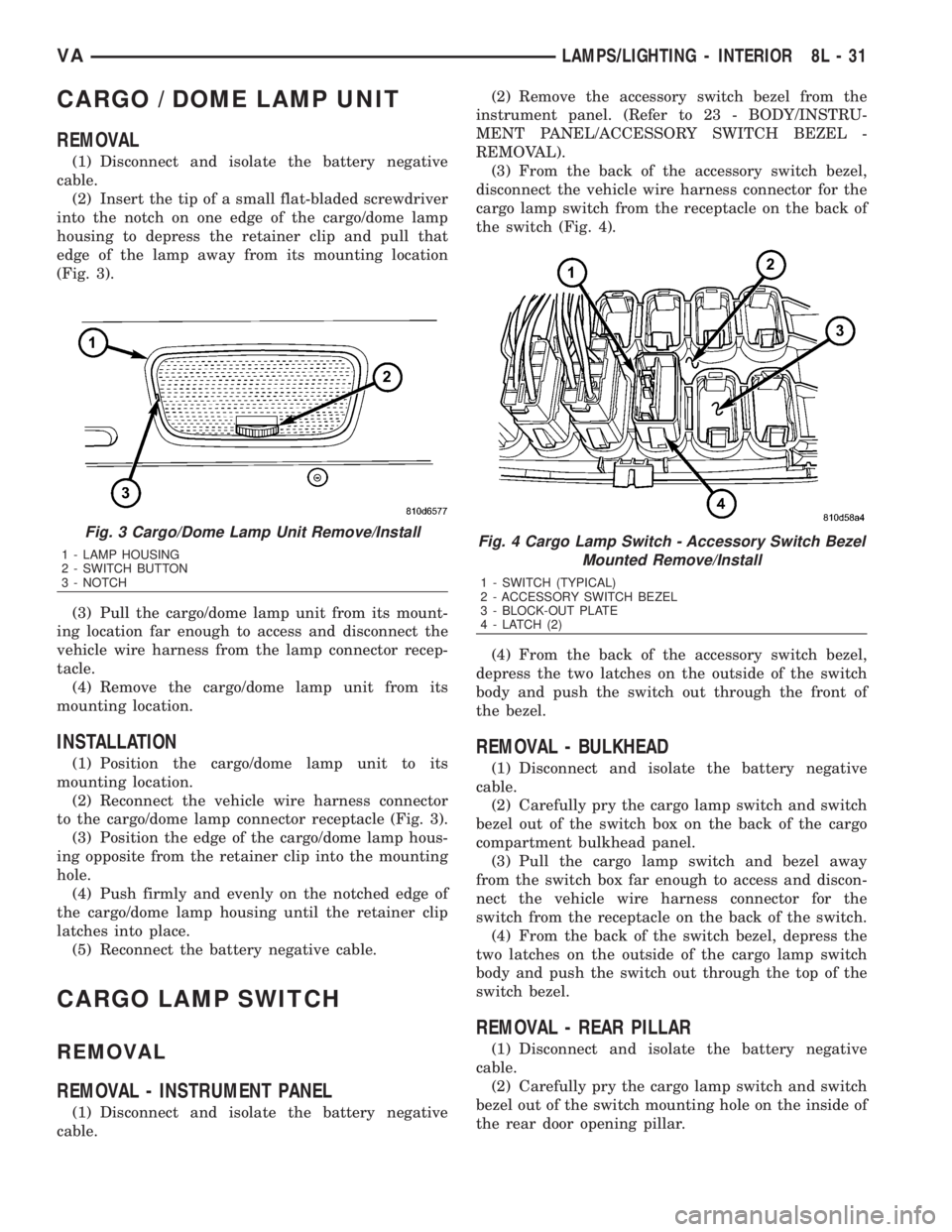
(2) Insert the tip of a small flat-bladed screwdriver
into the notch on one edge of the cargo/dome lamp
housing to depress the retainer clip and pull that
edge of the lamp away from its mounting location
(Fig. 3).
(3) Pull the cargo/dome lamp unit from its mount-
ing location far enough to access and disconnect the
vehicle wire harness from the lamp connector recep-
tacle.
(4) Remove the cargo/dome lamp unit from its
mounting location.
INSTALLATION
(1) Position the cargo/dome lamp unit to its
mounting location.
(2) Reconnect the vehicle wire harness connector
to the cargo/dome lamp connector receptacle (Fig. 3).
(3) Position the edge of the cargo/dome lamp hous-
ing opposite from the retainer clip into the mounting
hole.
(4) Push firmly and evenly on the notched edge of
the cargo/dome lamp housing until the retainer clip
latches into place.
(5) Reconnect the battery negative cable.
CARGO LAMP SWITCH
REMOVAL
REMOVAL - INSTRUMENT PANEL
(1) Disconnect and isolate the battery negative
cable.(2) Remove the accessory switch bezel from the
instrument panel. (Refer to 23 - BODY/INSTRU-
MENT PANEL/ACCESSORY SWITCH BEZEL -
REMOVAL).
(3) From the back of the accessory switch bezel,
disconnect the vehicle wire harness connector for the
cargo lamp switch from the receptacle on the back of
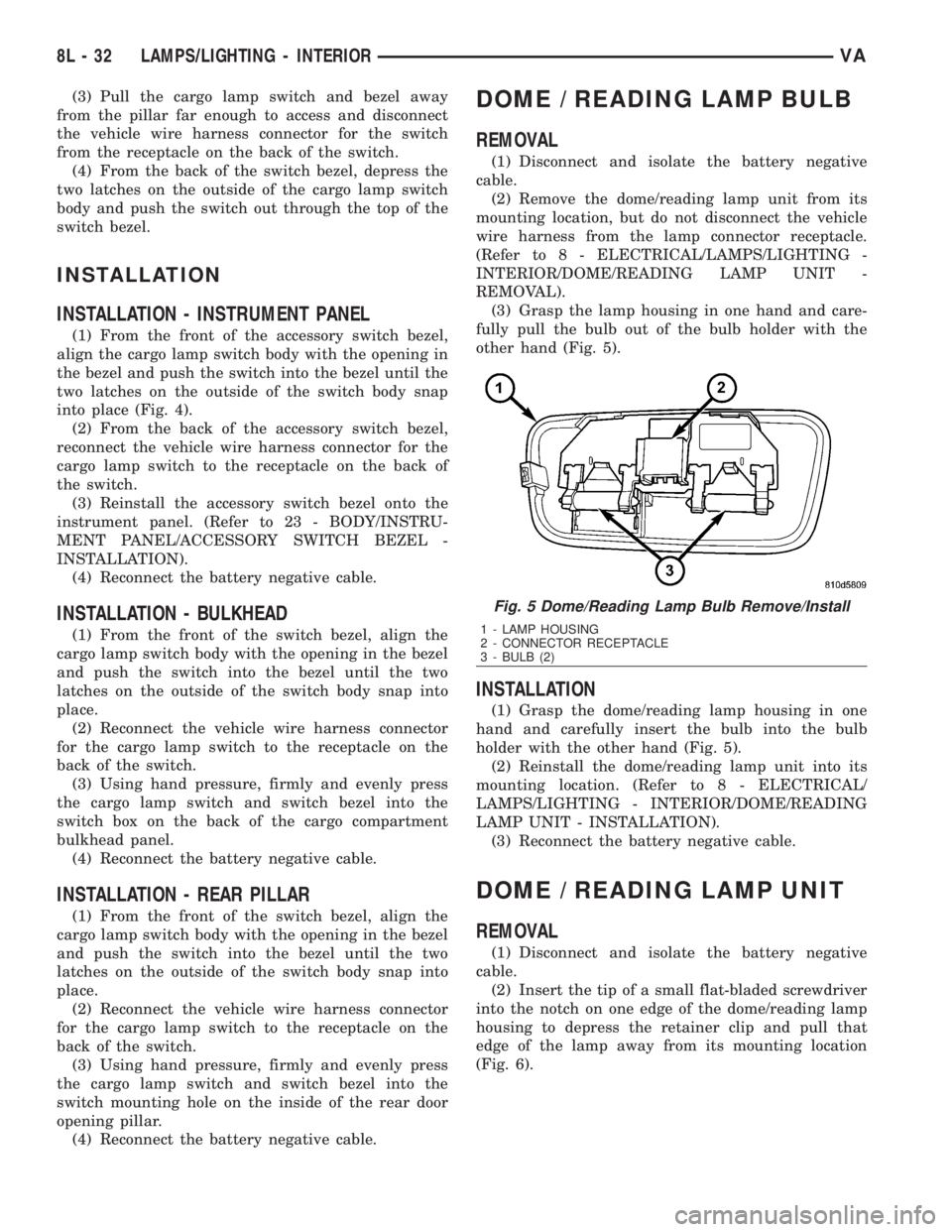
the switch (Fig. 4).
(4) From the back of the accessory switch bezel,
depress the two latches on the outside of the switch
body and push the switch out through the front of
the bezel.
REMOVAL - BULKHEAD
(1) Disconnect and isolate the battery negative
cable.
(2) Carefully pry the cargo lamp switch and switch
bezel out of the switch box on the back of the cargo
compartment bulkhead panel.
(3) Pull the cargo lamp switch and bezel away
from the switch box far enough to access and discon-
nect the vehicle wire harness connector for the
switch from the receptacle on the back of the switch.
(4) From the back of the switch bezel, depress the
two latches on the outside of the cargo lamp switch
body and push the switch out through the top of the
switch bezel.
REMOVAL - REAR PILLAR
(1) Disconnect and isolate the battery negative
cable.
(2) Carefully pry the cargo lamp switch and switch
bezel out of the switch mounting hole on the inside of
the rear door opening pillar.
Fig. 3 Cargo/Dome Lamp Unit Remove/Install
1 - LAMP HOUSING
2 - SWITCH BUTTON
3 - NOTCHFig. 4 Cargo Lamp Switch - Accessory Switch Bezel
Mounted Remove/Install
1 - SWITCH (TYPICAL)
2 - ACCESSORY SWITCH BEZEL
3 - BLOCK-OUT PLATE
4 - LATCH (2)
VALAMPS/LIGHTING - INTERIOR 8L - 31
Page 981 of 2305
(3) Pull the cargo lamp switch and bezel away
from the pillar far enough to access and disconnect
the vehicle wire harness connector for the switch
from the receptacle on the back of the switch.
(4) From the back of the switch bezel, depress the
two latches on the outside of the cargo lamp switch
body and push the switch out through the top of the
switch bezel.
INSTALLATION
INSTALLATION - INSTRUMENT PANEL
(1) From the front of the accessory switch bezel,
align the cargo lamp switch body with the opening in
the bezel and push the switch into the bezel until the
two latches on the outside of the switch body snap
into place (Fig. 4).
(2) From the back of the accessory switch bezel,
reconnect the vehicle wire harness connector for the
cargo lamp switch to the receptacle on the back of
the switch.
(3) Reinstall the accessory switch bezel onto the
instrument panel. (Refer to 23 - BODY/INSTRU-
MENT PANEL/ACCESSORY SWITCH BEZEL -
INSTALLATION).
(4) Reconnect the battery negative cable.
INSTALLATION - BULKHEAD
(1) From the front of the switch bezel, align the
cargo lamp switch body with the opening in the bezel
and push the switch into the bezel until the two
latches on the outside of the switch body snap into
place.
(2) Reconnect the vehicle wire harness connector
for the cargo lamp switch to the receptacle on the
back of the switch.
(3) Using hand pressure, firmly and evenly press
the cargo lamp switch and switch bezel into the
switch box on the back of the cargo compartment
bulkhead panel.
(4) Reconnect the battery negative cable.
INSTALLATION - REAR PILLAR
(1) From the front of the switch bezel, align the
cargo lamp switch body with the opening in the bezel
and push the switch into the bezel until the two
latches on the outside of the switch body snap into
place.
(2) Reconnect the vehicle wire harness connector
for the cargo lamp switch to the receptacle on the
back of the switch.
(3) Using hand pressure, firmly and evenly press
the cargo lamp switch and switch bezel into the
switch mounting hole on the inside of the rear door
opening pillar.
(4) Reconnect the battery negative cable.
DOME / READING LAMP BULB
REMOVAL
(1) Disconnect and isolate the battery negative
cable.
(2) Remove the dome/reading lamp unit from its
mounting location, but do not disconnect the vehicle
wire harness from the lamp connector receptacle.
(Refer to 8 - ELECTRICAL/LAMPS/LIGHTING -
INTERIOR/DOME/READING LAMP UNIT -
REMOVAL).
(3) Grasp the lamp housing in one hand and care-
fully pull the bulb out of the bulb holder with the
other hand (Fig. 5).
INSTALLATION
(1) Grasp the dome/reading lamp housing in one
hand and carefully insert the bulb into the bulb
holder with the other hand (Fig. 5).
(2) Reinstall the dome/reading lamp unit into its
mounting location. (Refer to 8 - ELECTRICAL/
LAMPS/LIGHTING - INTERIOR/DOME/READING
LAMP UNIT - INSTALLATION).
(3) Reconnect the battery negative cable.
DOME / READING LAMP UNIT
REMOVAL
(1) Disconnect and isolate the battery negative
cable.
(2) Insert the tip of a small flat-bladed screwdriver
into the notch on one edge of the dome/reading lamp
housing to depress the retainer clip and pull that
edge of the lamp away from its mounting location
(Fig. 6).
Fig. 5 Dome/Reading Lamp Bulb Remove/Install
1 - LAMP HOUSING
2 - CONNECTOR RECEPTACLE
3 - BULB (2)
8L - 32 LAMPS/LIGHTING - INTERIORVA
Page 984 of 2305
(4) Remove the bulb from the bulb holder.
INSTALLATION
(1) Insert the bulb into the entry/exit lamp bulb
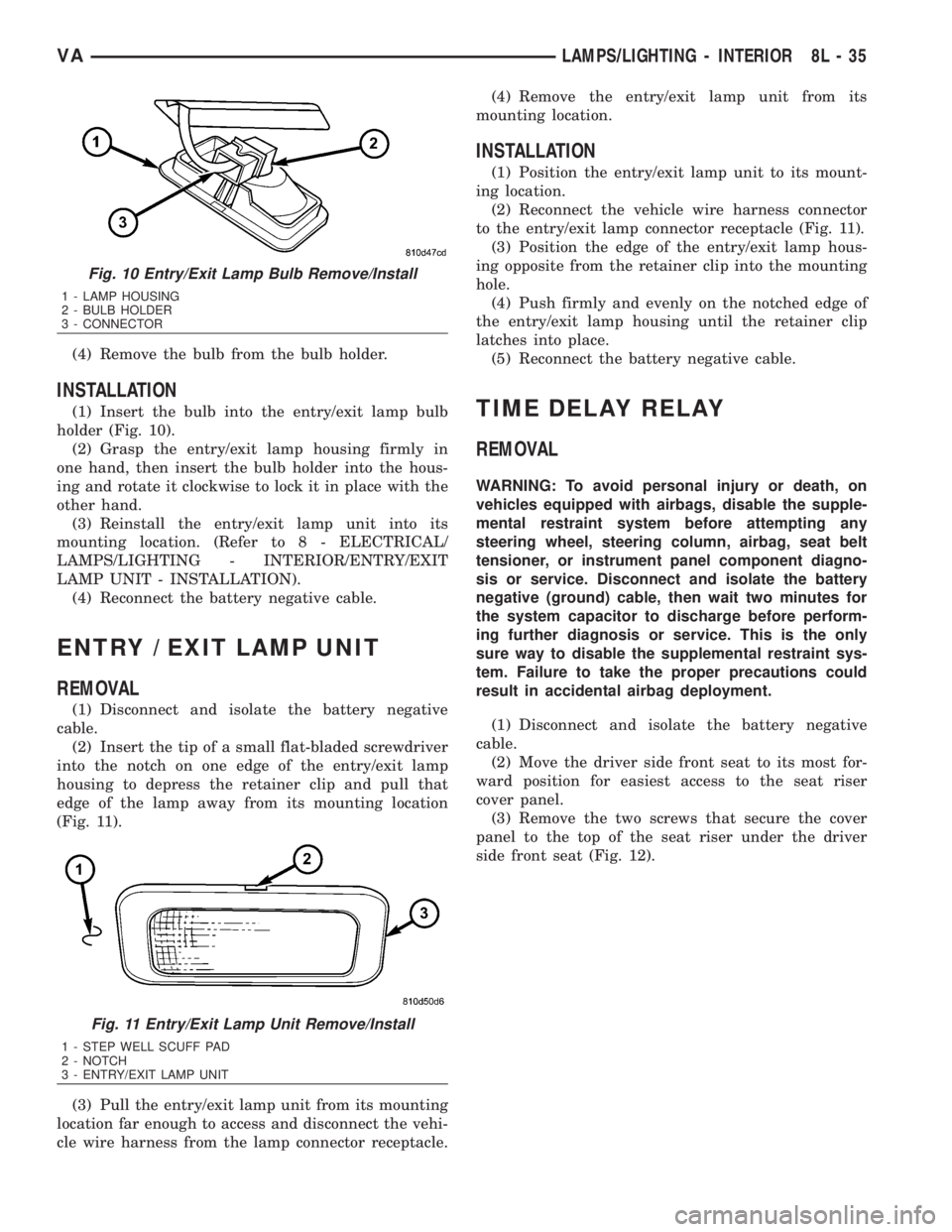
holder (Fig. 10).
(2) Grasp the entry/exit lamp housing firmly in
one hand, then insert the bulb holder into the hous-
ing and rotate it clockwise to lock it in place with the
other hand.
(3) Reinstall the entry/exit lamp unit into its
mounting location. (Refer to 8 - ELECTRICAL/
LAMPS/LIGHTING - INTERIOR/ENTRY/EXIT
LAMP UNIT - INSTALLATION).
(4) Reconnect the battery negative cable.
ENTRY / EXIT LAMP UNIT
REMOVAL
(1) Disconnect and isolate the battery negative
cable.
(2) Insert the tip of a small flat-bladed screwdriver
into the notch on one edge of the entry/exit lamp
housing to depress the retainer clip and pull that
edge of the lamp away from its mounting location
(Fig. 11).
(3) Pull the entry/exit lamp unit from its mounting
location far enough to access and disconnect the vehi-
cle wire harness from the lamp connector receptacle.(4) Remove the entry/exit lamp unit from its
mounting location.
INSTALLATION
(1) Position the entry/exit lamp unit to its mount-
ing location.
(2) Reconnect the vehicle wire harness connector
to the entry/exit lamp connector receptacle (Fig. 11).
(3) Position the edge of the entry/exit lamp hous-
ing opposite from the retainer clip into the mounting
hole.
(4) Push firmly and evenly on the notched edge of
the entry/exit lamp housing until the retainer clip
latches into place.
(5) Reconnect the battery negative cable.
TIME DELAY RELAY
REMOVAL
WARNING: To avoid personal injury or death, on
vehicles equipped with airbags, disable the supple-
mental restraint system before attempting any
steering wheel, steering column, airbag, seat belt
tensioner, or instrument panel component diagno-
sis or service. Disconnect and isolate the battery
negative (ground) cable, then wait two minutes for
the system capacitor to discharge before perform-
ing further diagnosis or service. This is the only
sure way to disable the supplemental restraint sys-
tem. Failure to take the proper precautions could
result in accidental airbag deployment.
(1) Disconnect and isolate the battery negative
cable.
(2) Move the driver side front seat to its most for-
ward position for easiest access to the seat riser
cover panel.
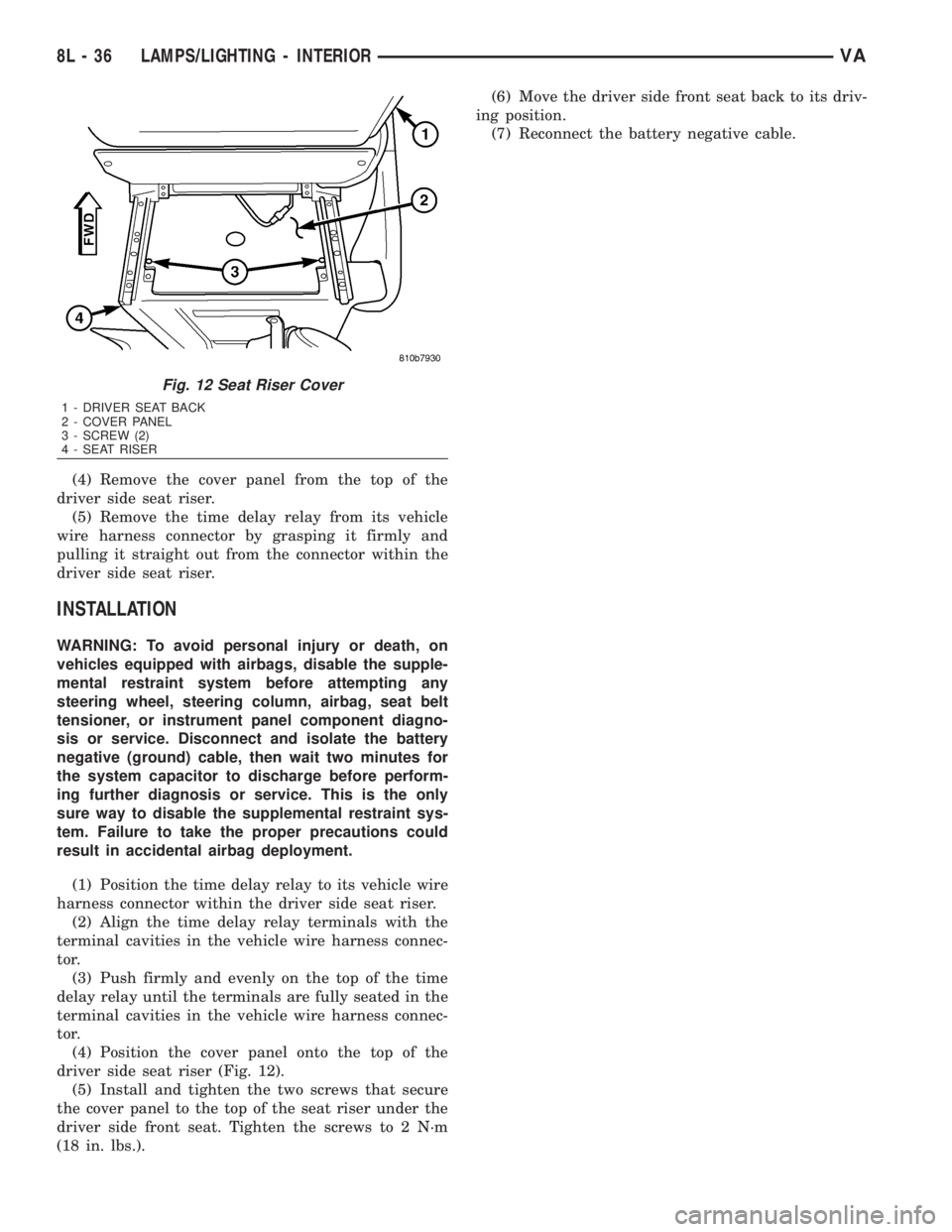
(3) Remove the two screws that secure the cover
panel to the top of the seat riser under the driver
side front seat (Fig. 12).
Fig. 10 Entry/Exit Lamp Bulb Remove/Install
1 - LAMP HOUSING
2 - BULB HOLDER
3 - CONNECTOR
Fig. 11 Entry/Exit Lamp Unit Remove/Install
1 - STEP WELL SCUFF PAD
2 - NOTCH
3 - ENTRY/EXIT LAMP UNIT
VALAMPS/LIGHTING - INTERIOR 8L - 35
Page 985 of 2305
(4) Remove the cover panel from the top of the
driver side seat riser.
(5) Remove the time delay relay from its vehicle
wire harness connector by grasping it firmly and
pulling it straight out from the connector within the
driver side seat riser.
INSTALLATION
WARNING: To avoid personal injury or death, on
vehicles equipped with airbags, disable the supple-
mental restraint system before attempting any
steering wheel, steering column, airbag, seat belt
tensioner, or instrument panel component diagno-
sis or service. Disconnect and isolate the battery
negative (ground) cable, then wait two minutes for
the system capacitor to discharge before perform-
ing further diagnosis or service. This is the only
sure way to disable the supplemental restraint sys-
tem. Failure to take the proper precautions could
result in accidental airbag deployment.
(1) Position the time delay relay to its vehicle wire
harness connector within the driver side seat riser.
(2) Align the time delay relay terminals with the
terminal cavities in the vehicle wire harness connec-
tor.
(3) Push firmly and evenly on the top of the time
delay relay until the terminals are fully seated in the
terminal cavities in the vehicle wire harness connec-
tor.
(4) Position the cover panel onto the top of the
driver side seat riser (Fig. 12).
(5) Install and tighten the two screws that secure
the cover panel to the top of the seat riser under the
driver side front seat. Tighten the screws to 2 N´m
(18 in. lbs.).(6) Move the driver side front seat back to its driv-
ing position.
(7) Reconnect the battery negative cable.
Fig. 12 Seat Riser Cover
1 - DRIVER SEAT BACK
2 - COVER PANEL
3 - SCREW (2)
4 - SEAT RISER
8L - 36 LAMPS/LIGHTING - INTERIORVA
Page 987 of 2305
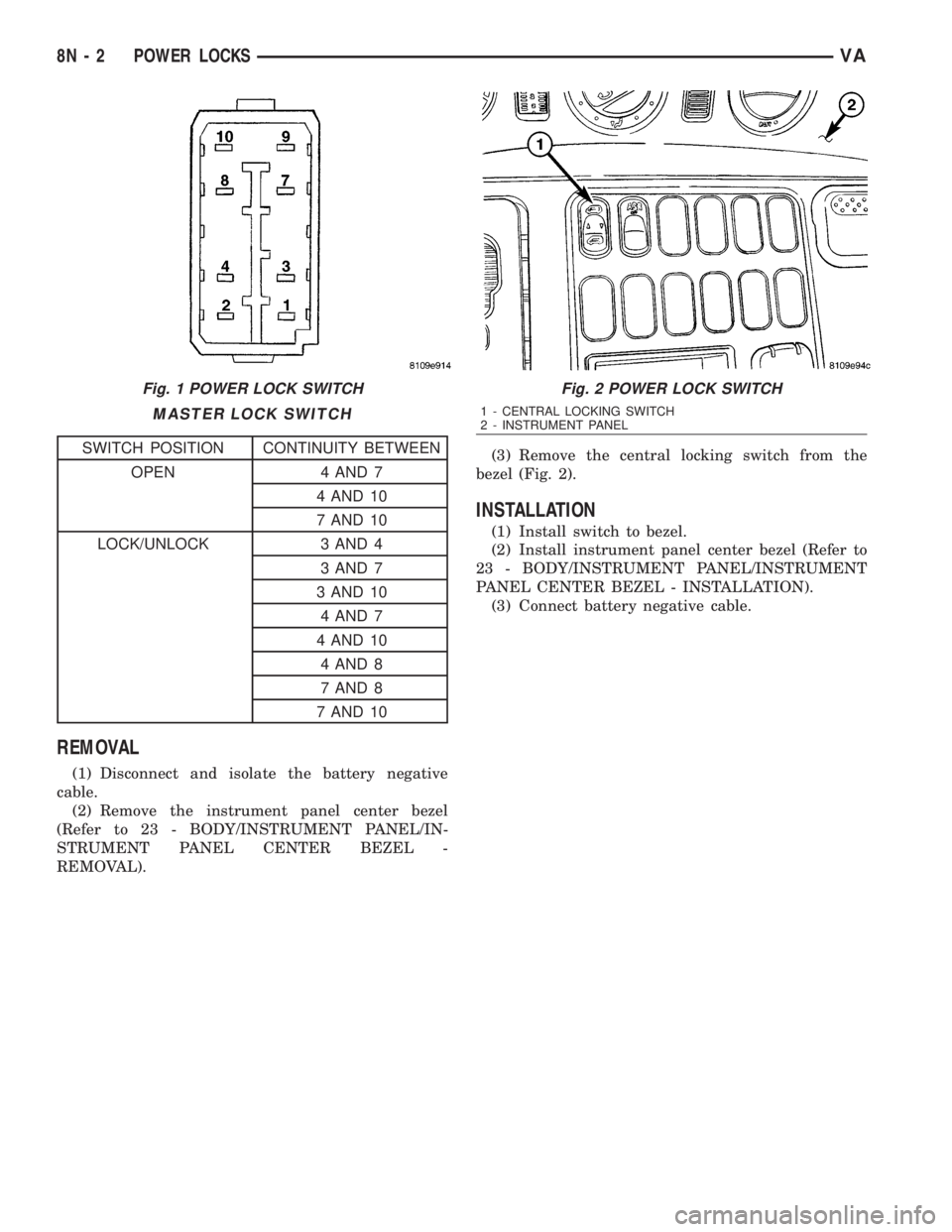
MASTER LOCK SWITCH
SWITCH POSITION CONTINUITY BETWEEN
OPEN 4 AND 7
4 AND 10
7 AND 10
LOCK/UNLOCK 3 AND 4
3 AND 7
3 AND 10
4 AND 7
4 AND 10
4 AND 8
7 AND 8
7 AND 10
REMOVAL
(1) Disconnect and isolate the battery negative
cable.
(2) Remove the instrument panel center bezel
(Refer to 23 - BODY/INSTRUMENT PANEL/IN-
STRUMENT PANEL CENTER BEZEL -
REMOVAL).(3) Remove the central locking switch from the
bezel (Fig. 2).
INSTALLATION
(1) Install switch to bezel.
(2) Install instrument panel center bezel (Refer to
23 - BODY/INSTRUMENT PANEL/INSTRUMENT
PANEL CENTER BEZEL - INSTALLATION).
(3) Connect battery negative cable.
Fig. 1 POWER LOCK SWITCHFig. 2 POWER LOCK SWITCH
1 - CENTRAL LOCKING SWITCH
2 - INSTRUMENT PANEL
8N - 2 POWER LOCKSVA
Page 994 of 2305

travelling end-release seat belt buckles secured to
the inboard seat track. The driver side front seat belt
buckle of all models includes an integral seat belt
switch that detects whether its seat belt has been
fastened.
²Rear Seat Belts- All rear seating positions are
equipped with three-point seat belt systems. Each
rear seating position belt employs an integral seat
cushion frame mounted inertia latch-type retractor, a
fixed position upper seat back frame mounted turn-
ing loop, and a fixed lower seat belt anchor secured
to the seat cushion frame. All rear seat belts have
fixed end-release seat belt buckles that are also
secured to the seat cushion frame.
PASSIVE RESTRAINTS
A Next Generation driver airbag is standard facto-
ry-installed safety equipment on this model, while a
passenger side front airbag and side curtain airbags
are optional. This airbag system is a passive, inflat-
able, Supplemental Restraint System (SRS) and vehi-
cles with this equipment can be readily identified by
the ªSRS - AIRBAGº logo molded into the driver air-
bag trim cover in the center of the steering wheel
and, if the vehicle is so equipped, also into the pas-
senger airbag door on the instrument panel above
the glove box (Fig. 2). Vehicles with the airbag sys-
tem can also be identified by the airbag indicator,
which will illuminate in the instrument cluster for
about six seconds as a bulb test each time the igni-
tion switch is turned to the On position. A pyrotech-
nic-type seat belt tensioner is integral to the front
seat belt retractor mounted on the lower B-pillar on
the driver side, and to the passenger side retractor of
vehicles equipped with the optional passenger side
airbag.
The supplemental restraint system includes the
following major components, which are described in
further detail elsewhere in this service information:²Airbag Control Module- The Airbag Control
Module (ACM) is located on a mount on the floor
panel within the driver side seat riser, beneath the
driver seat in the passenger compartment.
²Airbag (SRS) Indicator- The airbag indicator
is integral to the ElectroMechanical Instrument Clus-
ter (EMIC), which is located on the instrument panel
in front of the driver.
²Clockspring- The clockspring is located near
the top of the steering column, directly beneath the
steering wheel.
²Driver Airbag- The driver airbag is located in
the center of the steering wheel, beneath the driver
airbag trim cover.
²Driver Knee Blocker- The structure of the
lower instrument panel serves as a knee blocker for
the driver.
²Passenger Airbag- The optional passenger air-
bag is located within the instrument panel, behind
the passenger airbag door on the instrument panel
above the glove box on the passenger side of the vehi-
cle.
²Passenger Knee Blocker- The structure of
the glove box door and the lower instrument panel
serve as a knee blocker for the front seat passenger.
²Seat Belt Tensioner- A seat belt tensioner is
integral to the driver side front seat belt retractor
unit, and to the passenger side front seat belt retrac-
tor unit on vehicles equipped with an optional pas-
senger airbag.
²Side Curtain Airbags- Optional side curtain
airbags are available for this model when it is also
equipped with dual front airbags. In vehicles
equipped with this option, a side curtain airbag is
located on the inside of the roof side rail within a
garnish molding that extends from the A-pillar to the
B-pillar above each front door opening within the
passenger compartment of the vehicle.
²Side Impact Sensor- Two side impact sensors
are used on vehicles equipped with the optional side
curtain airbags, one on each side of the vehicle. One
sensor is located near the front of each front door
step well, concealed behind the step well trim.
The ACM contains a central processing unit and
programming that allows it to communicate on a
serial data bus diagnostic circuit connected to the
16-way Data Link Connector (DLC) located below the
left end of the instrument panel. This method of com-
munication is used for initialization of the ACM and
for diagnosis of the SRS circuits and components
using a diagnostic scan tool.
Hard wired circuitry connects the supplemental
restraint system components to each other through
the electrical system of the vehicle. These hard wired
circuits are integral to several wire harnesses, which
are routed throughout the vehicle and retained by
many different methods. These circuits may be con-
nected to each other, to the vehicle electrical system,
Fig. 2 SRS Logo
VARESTRAINTS 8O - 3
Page 995 of 2305

and to the supplemental restraint system compo-
nents through the use of a combination of soldered
splices, splice block connectors, and many different
types of wire harness terminal connectors and insu-
lators. Refer to the appropriate wiring information.
The wiring information includes wiring diagrams,
proper wire and connector repair procedures, further
details on wire harness routing and retention, as well
as pin-out and location views for the various wire
harness connectors, splices and grounds.
OPERATION
ACTIVE RESTRAINTS
The primary passenger restraints in this or any
other vehicle are the standard equipment factory-in-
stalled seat belts. Seat belts are referred to as an
active restraint because the vehicle occupants are
required to physically fasten and properly adjust
these restraints in order to benefit from them. See
the owner's manual in the vehicle glove box for more
information on the features, use and operation of all
of the factory-installed active restraints.
PASSIVE RESTRAINTS
The passive restraints are referred to as a supple-
mental restraint system because they were designed
and are intended to enhance the protection for the
occupants of the vehicleonlywhen used in conjunc-
tion with the seat belts. They are referred to as pas-
sive restraints because the vehicle occupants are not
required to do anything to make them operate; how-
ever, the vehicle occupants must be wearing their
seat belts in order to obtain the maximum safety
benefit from the factory-installed supplemental
restraint system.
The supplemental restraint system electrical cir-
cuits are continuously monitored and controlled by a
microprocessor and software contained within the
Airbag Control Module (ACM). An airbag indicator in
the ElectroMechanical Instrument Cluster (EMIC)
illuminates for about four seconds as a bulb test each
time the ignition switch is turned to the On or Start
positions. Following the bulb test, the airbag indica-
tor is turned on or off by the ACM to indicate the
status of the supplemental restraint system. If the
airbag indicator comes on either solid or flashing at
any time other than during the bulb test, it indicates
that there is a problem in the supplemental restraint
system electrical circuits. Such a problem may cause
airbags not to deploy when required, or to deploy
when not required.
Deployment of the supplemental restraints
depends upon the angle and severity of an impact.
Deployment is not based upon vehicle speed; rather,
deployment is based upon the rate of deceleration as
measured by the forces of gravity (G force) upon the
impact sensor(s). When an impact is severe enough,the microprocessor in the ACM signals the inflator of
the appropriate airbag units to deploy their airbag
cushions. The front seat belt tensioners are provided
with a deployment signal by the ACM in conjunction
with the driver and passenger airbags.
During a frontal vehicle impact, the knee blockers
work in concert with properly fastened and adjusted
seat belts to restrain both the driver and the front
seat passenger in the proper position for an airbag
deployment. The knee blockers also absorb and dis-
tribute the crash energy from the driver and the
front seat passenger to the structure of the instru-
ment panel. The seat belt tensioners remove the
slack from the front seat belts to provide further
assurance that the driver and front seat passenger
are properly positioned and restrained for an airbag
deployment.
Typically, the vehicle occupants recall more about
the events preceding and following a collision than
they do of an airbag deployment itself. This is
because the airbag deployment and deflation occur so
rapidly. In a typical 48 kilometer-per-hour (30 mile-
per-hour) barrier impact, from the moment of impact
until the airbags are fully inflated takes only a few
milliseconds. Within one to two seconds from the
moment of impact, the airbags are almost entirely
deflated. The times cited for these events are approx-
imations, which apply only to a barrier impact at the
given speed. Actual times will vary somewhat,
depending upon the vehicle speed, impact angle,
severity of the impact, and the type of collision.
When the ACM monitors a problem in any of the
airbag system circuits or components, including the
seat belt tensioners, it stores a fault code or Diagnos-
tic Trouble Code (DTC) in its memory circuit and
sends a hard wired output to the EMIC to turn on
the airbag indicator. If the EMIC detects a problem
in the airbag indicator or airbag indicator circuit, the
cluster will flash the seatbelt indicator on and off.
Proper testing of the supplemental restraint system
components as well as the retrieval or erasure of a
DTC from the ACM requires the use of a diagnostic
scan tool. Refer to the appropriate diagnostic infor-
mation.
See the owner's manual in the vehicle glove box for
more information on the features, use and operation
of all of the factory-installed passive restraints.
8O - 4 RESTRAINTSVA