2006 MERCEDES-BENZ SPRINTER fuel filter
[x] Cancel search: fuel filterPage 1684 of 2305
(7) Connect a scan tool, select from Main Menu,
System Select, Engine, System Tests, Fuel Quantity
Test, Engine Cranking Test and follow the screen.
(8) After ten seconds, a maximum of 2.5 ml
(between2&3graduation lines) may be reached in
the inner vials. If the level has exceeded the 2.5 ml,
replace that affected cylinder's injector, clear the
memory using the scan tool, empty the test vials, and
retest.
RUNNING TEST
NOTE: If an injector is found to be out of specifica-
tion, repeat this test procedure after the injector
replacement. Hydraulic flow will take the path of
least resistance and multiple failures may be identi-
fied. Engine temperature must be above 80É C
(176ÉF) to perform the running test.
Perform this test with the engine at operating tem-
perature. This test will assist in determining a defec-
tive or internally leaking injector(s) is present by
measuring the amount of fuel return.
(1) Turn the ignition off.
(2) Remove the engine cover (Refer to 9 - ENGINE
- REMOVAL).
(3) Disconnect the fuel return hoses at the top of
the injectors.
(4) Pinch off the fuel return line at the banjo bolt
fitting of the fuel rail.
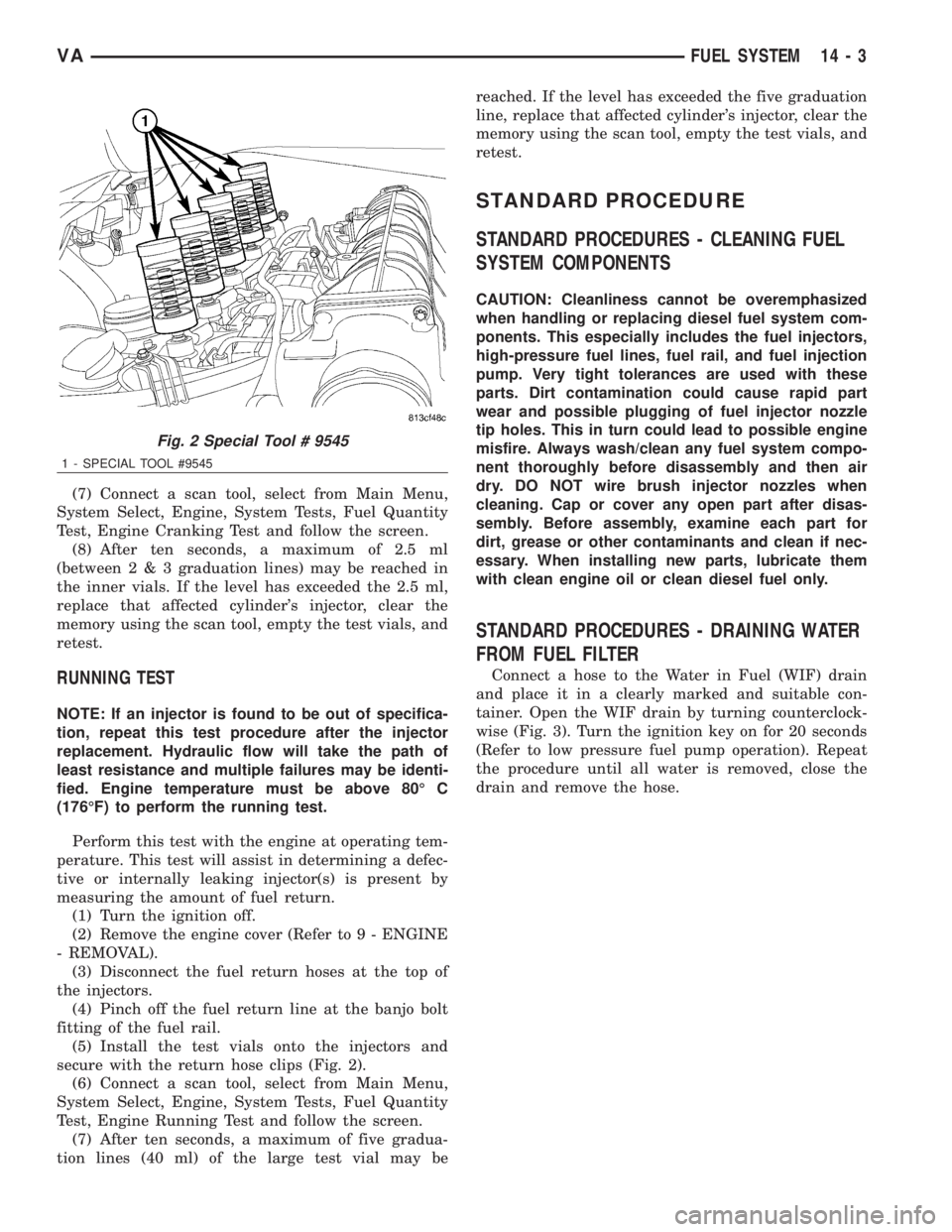
(5) Install the test vials onto the injectors and
secure with the return hose clips (Fig. 2).
(6) Connect a scan tool, select from Main Menu,
System Select, Engine, System Tests, Fuel Quantity
Test, Engine Running Test and follow the screen.
(7) After ten seconds, a maximum of five gradua-
tion lines (40 ml) of the large test vial may bereached. If the level has exceeded the five graduation
line, replace that affected cylinder's injector, clear the
memory using the scan tool, empty the test vials, and
retest.
STANDARD PROCEDURE
STANDARD PROCEDURES - CLEANING FUEL
SYSTEM COMPONENTS
CAUTION: Cleanliness cannot be overemphasized
when handling or replacing diesel fuel system com-
ponents. This especially includes the fuel injectors,
high-pressure fuel lines, fuel rail, and fuel injection
pump. Very tight tolerances are used with these
parts. Dirt contamination could cause rapid part
wear and possible plugging of fuel injector nozzle
tip holes. This in turn could lead to possible engine
misfire. Always wash/clean any fuel system compo-
nent thoroughly before disassembly and then air
dry. DO NOT wire brush injector nozzles when
cleaning. Cap or cover any open part after disas-
sembly. Before assembly, examine each part for
dirt, grease or other contaminants and clean if nec-
essary. When installing new parts, lubricate them
with clean engine oil or clean diesel fuel only.
STANDARD PROCEDURES - DRAINING WATER
FROM FUEL FILTER
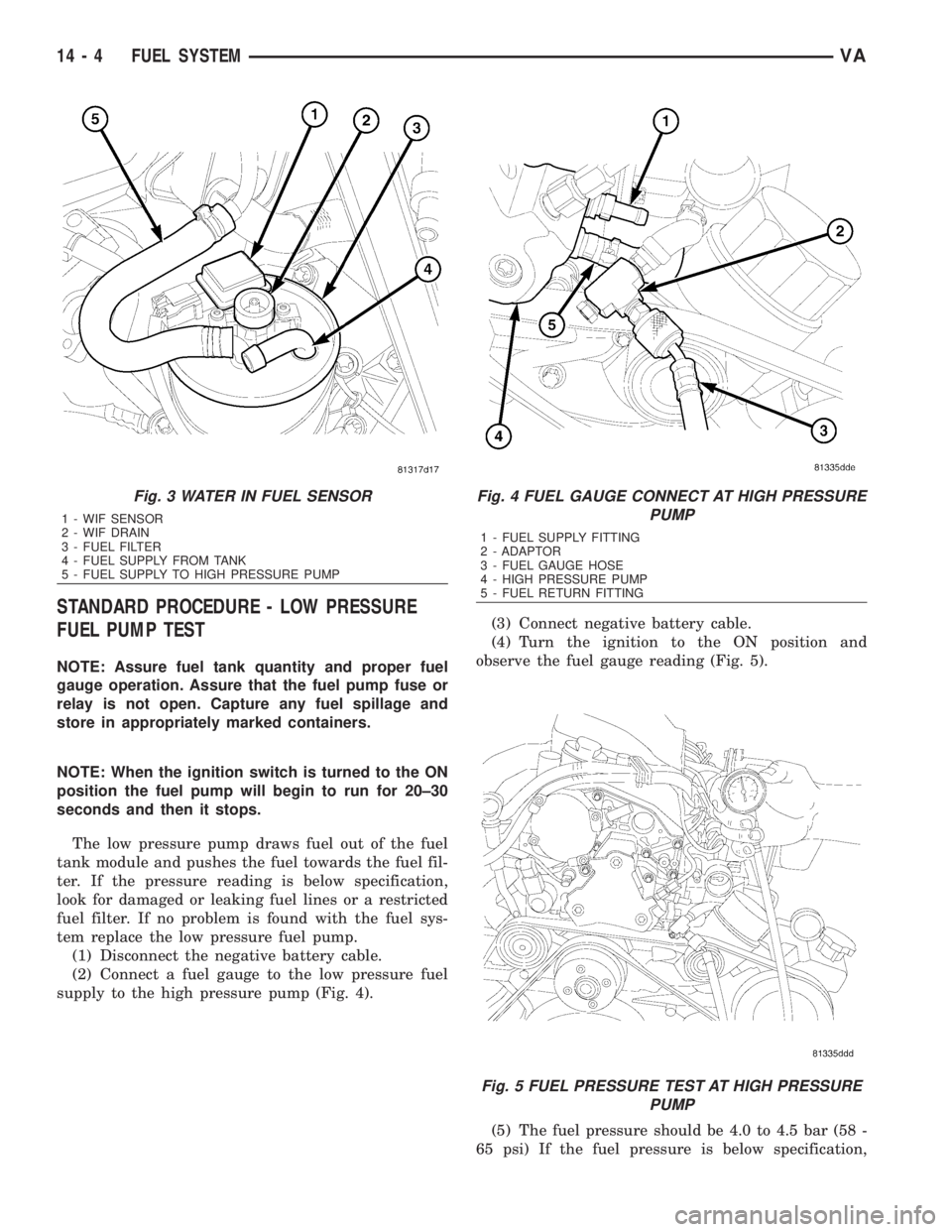
Connect a hose to the Water in Fuel (WIF) drain
and place it in a clearly marked and suitable con-
tainer. Open the WIF drain by turning counterclock-
wise (Fig. 3). Turn the ignition key on for 20 seconds
(Refer to low pressure fuel pump operation). Repeat
the procedure until all water is removed, close the
drain and remove the hose.
Fig. 2 Special Tool # 9545
1 - SPECIAL TOOL #9545
VAFUEL SYSTEM 14 - 3
Page 1685 of 2305
STANDARD PROCEDURE - LOW PRESSURE
FUEL PUMP TEST
NOTE: Assure fuel tank quantity and proper fuel
gauge operation. Assure that the fuel pump fuse or
relay is not open. Capture any fuel spillage and
store in appropriately marked containers.
NOTE: When the ignition switch is turned to the ON
position the fuel pump will begin to run for 20±30
seconds and then it stops.
The low pressure pump draws fuel out of the fuel
tank module and pushes the fuel towards the fuel fil-
ter. If the pressure reading is below specification,
look for damaged or leaking fuel lines or a restricted
fuel filter. If no problem is found with the fuel sys-
tem replace the low pressure fuel pump.
(1) Disconnect the negative battery cable.
(2) Connect a fuel gauge to the low pressure fuel
supply to the high pressure pump (Fig. 4).(3) Connect negative battery cable.
(4) Turn the ignition to the ON position and
observe the fuel gauge reading (Fig. 5).
(5) The fuel pressure should be 4.0 to 4.5 bar (58 -
65 psi) If the fuel pressure is below specification,
Fig. 3 WATER IN FUEL SENSOR
1 - WIF SENSOR
2 - WIF DRAIN
3 - FUEL FILTER
4 - FUEL SUPPLY FROM TANK
5 - FUEL SUPPLY TO HIGH PRESSURE PUMP
Fig. 4 FUEL GAUGE CONNECT AT HIGH PRESSURE
PUMP
1 - FUEL SUPPLY FITTING
2 - ADAPTOR
3 - FUEL GAUGE HOSE
4 - HIGH PRESSURE PUMP
5 - FUEL RETURN FITTING
Fig. 5 FUEL PRESSURE TEST AT HIGH PRESSURE
PUMP
14 - 4 FUEL SYSTEMVA
Page 1686 of 2305
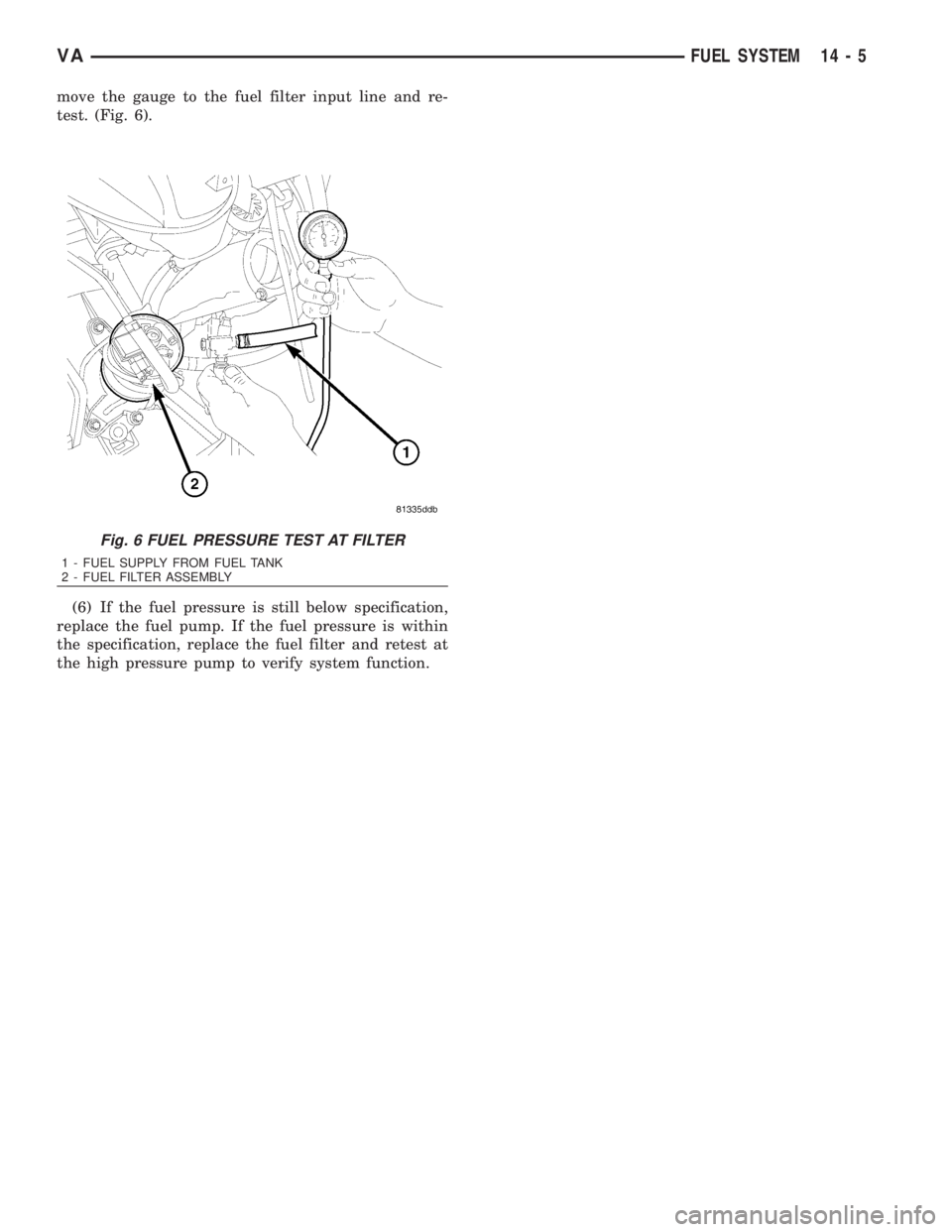
move the gauge to the fuel filter input line and re-
test. (Fig. 6).
(6) If the fuel pressure is still below specification,
replace the fuel pump. If the fuel pressure is within
the specification, replace the fuel filter and retest at
the high pressure pump to verify system function.
Fig. 6 FUEL PRESSURE TEST AT FILTER
1 - FUEL SUPPLY FROM FUEL TANK
2 - FUEL FILTER ASSEMBLY
VAFUEL SYSTEM 14 - 5
Page 1687 of 2305
FUEL DELIVERY
TABLE OF CONTENTS
page page
FUEL DELIVERY
DESCRIPTION..........................6
OPERATION............................7
STANDARD PROCEDURE
STANDARD PROCEDURE - DRAINING
FUEL TANK - DIESEL...................8
FUEL CONTAMINATION.................8
SPECIFICATIONS
TORQUE.............................9
SPECIAL TOOLS
FUEL SYSTEM........................9
FUEL DRAIN TUBES
DIAGNOSIS AND TESTING - FUEL SUPPLY
RESTRICTIONS.......................10
FUEL FILTER
DESCRIPTION.........................10
REMOVAL.............................10
INSTALLATION.........................11
FUEL LINES
REMOVAL - HIGH PRESSURE LINES........11
INSTALLATION - HIGH PRESSURE LINES....12
FUEL RAIL PRESSURE SENSOR
DESCRIPTION.........................12
OPERATION...........................12
REMOVAL.............................12
INSTALLATION.........................13
FUEL PUMP
DESCRIPTION
DESCRIPTION - HIGH PRESSURE PUMP . . . 13
DESCRIPTION - LOW PRESSURE PUMP . . . 13OPERATION
OPERATION.........................13
OPERATION - LOW PRESSURE PUMP.....16
REMOVAL - HIGH PRESSURE PUMP........17
INSTALLATION - HIGH PRESSURE PUMP....17
FUEL PUMP MODULE
DESCRIPTION.........................18
REMOVAL.............................18
INSTALLATION.........................20
FUEL QUANTITY CONTROL VALVE
DESCRIPTION.........................21
OPERATION...........................21
REMOVAL.............................21
INSTALLATION.........................21
FUEL RAIL
DESCRIPTION.........................22
OPERATION...........................22
REMOVAL.............................22
INSTALLATION.........................22
FUEL TANK
DESCRIPTION.........................23
REMOVAL.............................25
INSTALLATION.........................26
FUEL LEVEL SENDING UNIT / SENSOR
DESCRIPTION.........................28
REMOVAL.............................29
INSTALLATION.........................29
WATER IN FUEL SENSOR
DESCRIPTION.........................30
OPERATION...........................30
FUEL DELIVERY
DESCRIPTION
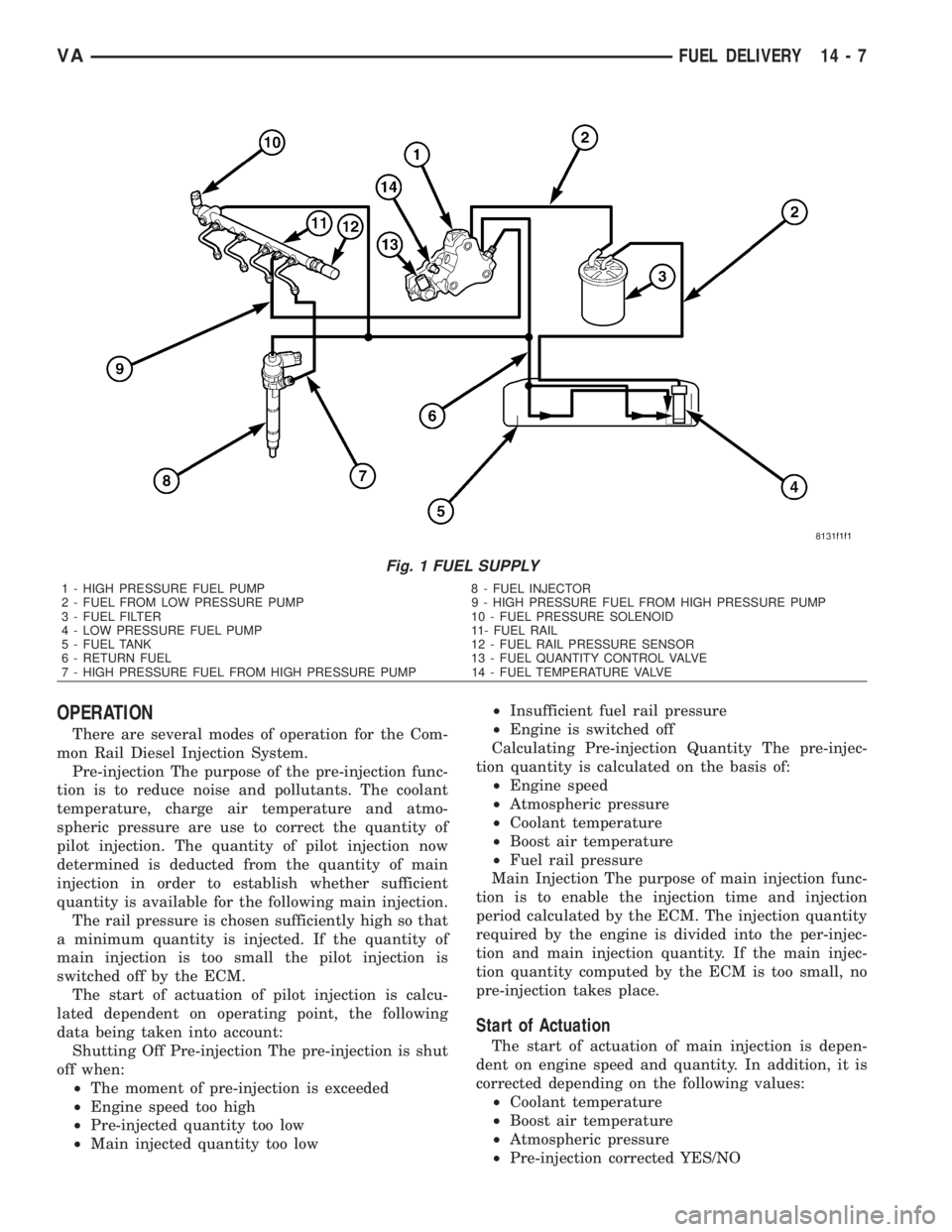
Fuel is collected in the fuel tank. The fuel is drawn
in by the fuel pump module in the tank and distrib-
uted to the fuel filter and onto the high pressure fuel
pump. From there the fuel is distributed onto the
fuel rail and then to the various injectors. Any fuel
not needed flows back to the fuel tank through the
cooler lines and mixes with the cool fuel in the fuel
pump module bowl to be used again (Fig. 1).
14 - 6 FUEL DELIVERYVA
Page 1688 of 2305
OPERATION
There are several modes of operation for the Com-
mon Rail Diesel Injection System.
Pre-injection The purpose of the pre-injection func-
tion is to reduce noise and pollutants. The coolant
temperature, charge air temperature and atmo-
spheric pressure are use to correct the quantity of
pilot injection. The quantity of pilot injection now
determined is deducted from the quantity of main
injection in order to establish whether sufficient
quantity is available for the following main injection.
The rail pressure is chosen sufficiently high so that
a minimum quantity is injected. If the quantity of
main injection is too small the pilot injection is
switched off by the ECM.
The start of actuation of pilot injection is calcu-
lated dependent on operating point, the following
data being taken into account:
Shutting Off Pre-injection The pre-injection is shut
off when:
²The moment of pre-injection is exceeded
²Engine speed too high
²Pre-injected quantity too low
²Main injected quantity too low²Insufficient fuel rail pressure
²Engine is switched off
Calculating Pre-injection Quantity The pre-injec-
tion quantity is calculated on the basis of:
²Engine speed
²Atmospheric pressure
²Coolant temperature
²Boost air temperature
²Fuel rail pressure
Main Injection The purpose of main injection func-
tion is to enable the injection time and injection
period calculated by the ECM. The injection quantity
required by the engine is divided into the per-injec-
tion and main injection quantity. If the main injec-
tion quantity computed by the ECM is too small, no
pre-injection takes place.
Start of Actuation
The start of actuation of main injection is depen-
dent on engine speed and quantity. In addition, it is
corrected depending on the following values:
²Coolant temperature
²Boost air temperature
²Atmospheric pressure
²Pre-injection corrected YES/NO
Fig. 1 FUEL SUPPLY
1 - HIGH PRESSURE FUEL PUMP 8 - FUEL INJECTOR
2 - FUEL FROM LOW PRESSURE PUMP 9 - HIGH PRESSURE FUEL FROM HIGH PRESSURE PUMP
3 - FUEL FILTER 10 - FUEL PRESSURE SOLENOID
4 - LOW PRESSURE FUEL PUMP 11- FUEL RAIL
5 - FUEL TANK 12 - FUEL RAIL PRESSURE SENSOR
6 - RETURN FUEL 13 - FUEL QUANTITY CONTROL VALVE
7 - HIGH PRESSURE FUEL FROM HIGH PRESSURE PUMP 14 - FUEL TEMPERATURE VALVE
VAFUEL DELIVERY 14 - 7
Page 1690 of 2305
(4) Fill fuel tank with fresh diesel fuel.
(5) Drain and remove the fuel filter. (Refer to 14 -
FUEL SYSTEM/FUEL DELIVERY/FUEL FILTER /
WATER SEPARATOR - REMOVAL)
(6) Install a new fuel filter. (Refer to 14 - FUEL
SYSTEM/FUEL DELIVERY/FUEL FILTER / WATER
SEPARATOR - INSTALLATION)
(7) Check the engine control module for any diag-
nostic trouble codes (DTCs). Record and clear any
DTCs that are present.
(8) Start and run the engine. Run the engine for
up to 15 minutes to allow time for any DTCs to reset
and shut off the engine.
(9) Check the engine control module for any diag-
nostic trouble codes (DTCs). Record any DTCs that
are present. Refer to the appropriate engine electrical
diagnostics to diagnose any DTCs that were set.
CAUTION: With the high pressure fuel system in
this vehicle, any residual contaminated fuel will be
removed very quickly. Shut off the engine immedi-
ately if signs of engine damage are noted.The engine should then be evaluated to determine
if the contaminated fuel has caused any damage to
the fuel system and/or engine. Indicators that the
fuel system has been damaged include the following:
²Unstable fuel rail pressure. This can manifest
itself as instability of idle speeds, excessive under-
shoot/overshoot at engine start-up, or excessive
undershoot/overshoot when the engine operating con-
ditions change. A typical engine response to a large
rail pressure undershoot would be a decrease in
engine speed or engine stall.
²Excessive noise from the engine. This could indi-
cate poor rail pressure control or the inability of the
injection system to inject the proper amount of fuel.
²Excessive smoke (black or white). This could
indicate the inability of the fuel system to inject the
proper amount of fuel.
NOTE: If any of these conditions are exhibited after
cleaning the fuel system, proceed to the appropri-
ate engine electrical diagnostic information. Repair
the fuel system and/or engine as necessary.
SPECIFICATIONS
TORQUE
DESCRIPTION N´m Ft. Lbs. In. Lbs.
FUEL TANK MOUNTING NUTS 15 - 17 11 - 13 -
FUEL TANK MODULE LOCKRING (LOCK-
NUT)60 44 -
PRESSURE CONTROL VALVE NUT TO
FUEL RAIL (2 STAGES)60, loosen 90É, re-
tighten to 8044, loosen 90É, re-
tighten to 59-
SPECIAL TOOLS
FUEL SYSTEM
SPECIAL TOOL CROSS REFERENCE CHART
MB
TOOL #MILLER
TOOL #DESCRIPTION
N/A 5069-2 FUEL GAUGE
N/A 6856 SPANNER WRENCH
N/A 9068 FUEL GAUGE ADAPTER
N/A 9285 FUEL LINE WRENCH
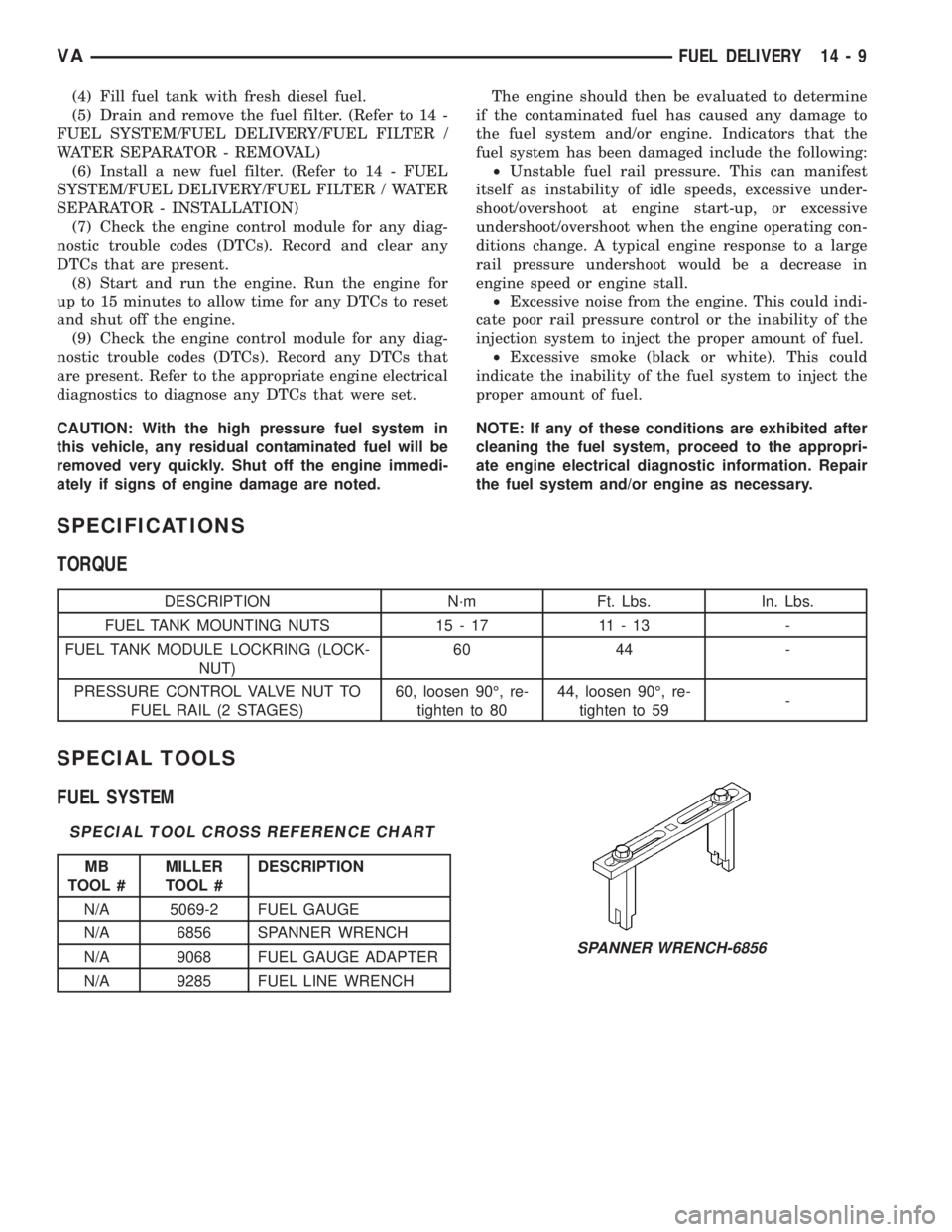
SPANNER WRENCH-6856
VAFUEL DELIVERY 14 - 9
Page 1691 of 2305
FUEL DRAIN TUBES
DIAGNOSIS AND TESTING - FUEL SUPPLY
RESTRICTIONS
LOW - PRESSURE LINES
Fuel supply line restrictions can cause starting
problems and prevent engine from accelerating. The
starting problems include; low power and/or white
fog like exhaust.
Test all fuel supply lines for restrictions or block-
age. Flush or replace as necessary.
HIGH - PRESSURE LINES
CAUTION: High pressure lines cannot contact each
other or other components. Do not attempt to weld
high-pressure fuel lines or to repair lines that are
damaged. High pressure lines must be replaced at
each disassembly. Use only recommended lines
when replacement of high-pressure fuel line is nec-
essary.
Restricted (kinked or bent) high-pressure lines can
cause starting problems, poor engine performance,engine mis-fire and white smoke from exhaust (Refer
to 14 - FUEL SYSTEM - WARNING).
FUEL FILTER
DESCRIPTION
The fuel filter was designed for improved high alti-
tude operation and for better re-start after the fuel
tank has been completely emptied. The water drain
plug and water in fuel (WIF) sensor are located on
the top of the filter. Water is drained by using the in-
tank electric fuel pump to generate flow (attach a
hose to the drain plug). The filter has a pressure dif-
ferential of 200±300 mbar (2.9 psi.) when new. When
dirty, the pressure differential rises to 800 mbar (11.6
psi.) (Fig. 2).
REMOVAL
WARNING: NO SPARKS, OPEN FLAMES OR SMOK-
ING. RISK OF POISONING FROM INHALING AND
SWALLOWING FUEL. RISK OF INJURY TO EYES
AND SKIN FROM CONTACT WITH FUEL. POUR
FUELS ONLY INTO SUITABLE AND APPROPRI-
ATELY MARKED CONTAINERS. WEAR PROTECTIVE
CLOTHING.
CAUTION: DO NOT bend, twist or cut the fuel hose
clamps. The fuel hose clamps through out the fuel
system are reusable when using special tool #9539.
Orginal clamps must be used when servicing the
fuel system.
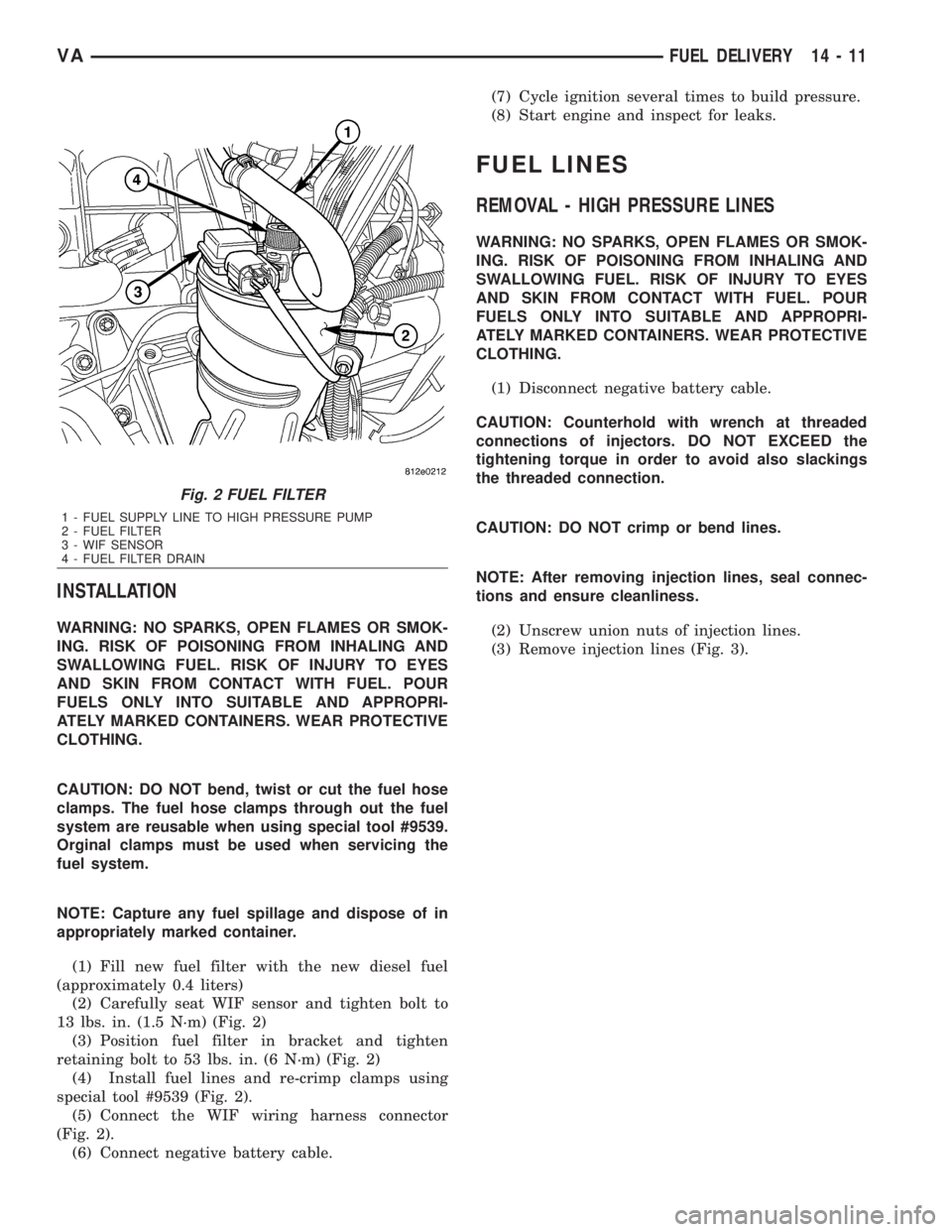
(1) Disconnect negative battery cable.
(2) Disconnect the water in fuel (WIF) sensor har-
ness connector (Fig. 2).
(3) Release the fuel inlet and outlet hose clamps
using special tool #9539 at the fuel filter (Fig. 2).
(4) Remove fuel filter retaining bracket bolt and
remove fuel filter (Fig. 2).
(5) Separate the WIF sensor from the fuel filter
(Fig. 2)
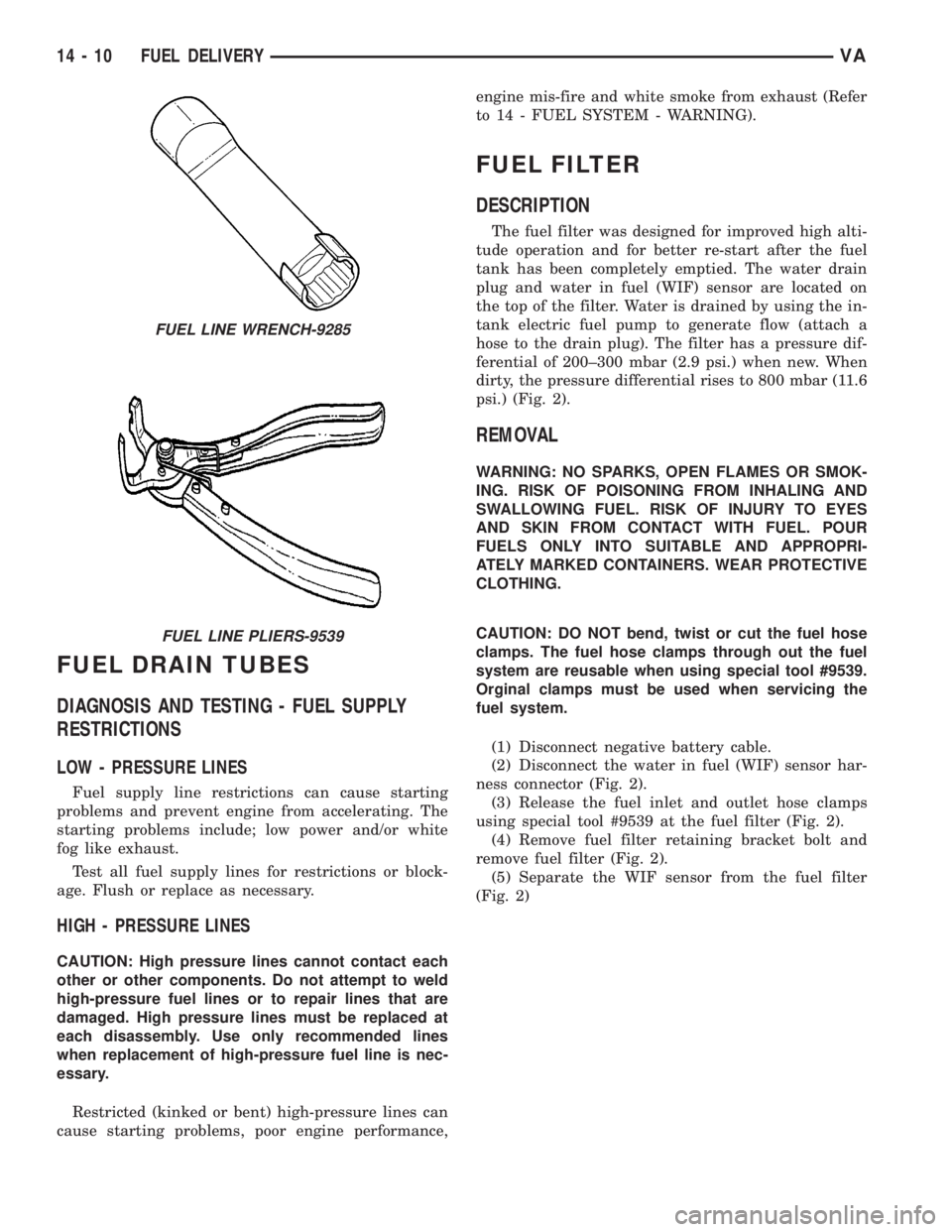
FUEL LINE WRENCH-9285
FUEL LINE PLIERS-9539
14 - 10 FUEL DELIVERYVA
Page 1692 of 2305
INSTALLATION
WARNING: NO SPARKS, OPEN FLAMES OR SMOK-
ING. RISK OF POISONING FROM INHALING AND
SWALLOWING FUEL. RISK OF INJURY TO EYES
AND SKIN FROM CONTACT WITH FUEL. POUR
FUELS ONLY INTO SUITABLE AND APPROPRI-
ATELY MARKED CONTAINERS. WEAR PROTECTIVE
CLOTHING.
CAUTION: DO NOT bend, twist or cut the fuel hose
clamps. The fuel hose clamps through out the fuel
system are reusable when using special tool #9539.
Orginal clamps must be used when servicing the
fuel system.
NOTE: Capture any fuel spillage and dispose of in
appropriately marked container.
(1) Fill new fuel filter with the new diesel fuel
(approximately 0.4 liters)
(2) Carefully seat WIF sensor and tighten bolt to
13 lbs. in. (1.5 N´m) (Fig. 2)
(3) Position fuel filter in bracket and tighten
retaining bolt to 53 lbs. in. (6 N´m) (Fig. 2)
(4) Install fuel lines and re-crimp clamps using
special tool #9539 (Fig. 2).
(5) Connect the WIF wiring harness connector
(Fig. 2).
(6) Connect negative battery cable.(7) Cycle ignition several times to build pressure.
(8) Start engine and inspect for leaks.
FUEL LINES
REMOVAL - HIGH PRESSURE LINES
WARNING: NO SPARKS, OPEN FLAMES OR SMOK-
ING. RISK OF POISONING FROM INHALING AND
SWALLOWING FUEL. RISK OF INJURY TO EYES
AND SKIN FROM CONTACT WITH FUEL. POUR
FUELS ONLY INTO SUITABLE AND APPROPRI-
ATELY MARKED CONTAINERS. WEAR PROTECTIVE
CLOTHING.
(1) Disconnect negative battery cable.
CAUTION: Counterhold with wrench at threaded
connections of injectors. DO NOT EXCEED the
tightening torque in order to avoid also slackings
the threaded connection.
CAUTION: DO NOT crimp or bend lines.
NOTE: After removing injection lines, seal connec-
tions and ensure cleanliness.
(2) Unscrew union nuts of injection lines.
(3) Remove injection lines (Fig. 3).
Fig. 2 FUEL FILTER
1 - FUEL SUPPLY LINE TO HIGH PRESSURE PUMP
2 - FUEL FILTER
3 - WIF SENSOR
4 - FUEL FILTER DRAIN
VAFUEL DELIVERY 14 - 11