2006 MERCEDES-BENZ SPRINTER ECU
[x] Cancel search: ECUPage 17 of 2305

loads are connected to cables and mounted in a
storage case. The cables can be directly connected to
some airbag system connectors. Jumpers are used
to convert the load tool cable connectors to the other
airbag system connectors. The adapters are con-
nected to the module harness connector to open
shorting clips and protect the connector terminal
during testing. When using the load tool follow all of
the safety procedures in the service information for
disconnecting airbag system components. Inspect
the wiring, connector and terminals for damage or
misalignment. Substitute the airbag load tool in
place of a Driver or Passenger Airbag, seat belt
tensioner, clockspring (use a jumper if needed).
Then follow all of the safety procedures in the
service information for connecting airbag system
components. Read the module active DTCs. If the
module reports NO ACTIVE DTCs the defective
components has been removed from the system and
should be replaced. If the DTC is still active, con-
tinue this process until all components in the circuit
have been tested. Then disconnect the module con-
nector and connect the matching adapter to the
module connector. With all airbags disconnected
and the adapter installed the squib wiring can be
tested for open and shorted conditions.
3.1.6 DIAGNOSTIC TROUBLE CODES
Airbag diagnostic trouble codes consist of active
and stored codes. If more than one code exists,
diagnostic priority should be given to the active
codes. Each diagnostic trouble code is diagnosed by
following a specific testing procedure. The diagnos-
tic test procedures contain step-by-step instructions
for determining the cause of the trouble codes. It is
not necessary to perform all of the tests in this book
to diagnose an individual code. Always begin by
reading the diagnostic trouble codes with the
DRBIIIt. This will direct you to the specific test(s)
that must be performed. In certain test procedures
within this manual, diagnostic trouble codes are
used as a diagnostic tool.
3.1.6.1 ACTIVE CODES
If the lamp remains on, there could be an active
DTC in the system. The code becomes active as soon
as the malfunction is detected or key-on, whichever
occurs first. An active trouble code indicates an
on-going malfunction. This means that the defect is
currently there every time the airbag control mod-
ule checks that circuit or component. Some DTCs,
Internal Module and squib DTCs, will keep the
indicator illuminated even if they are no longer
active. If the lamp is on and no active codes are
present, cycling the ignition switch off and then on
will refresh the lamp state. It is impossible to erase
an active code.
3.1.6.2 STORED CODES
Airbag codes are automatically stored in the
ACM's memory as soon as the malfunction is de-
tected. A stored code indicates there was an active
code present at some time. Stored diagnostic trou-
ble code will remain stored until erased by the DRB.
If a malfunction is not active while performing a
diagnostic test procedure, the active code diagnostic
test will not locate the source of the problem. In this
case, the stored code can indicate an area to inspect.
Maintain a safe distance from all airbags while
performing the following inspection. If no obvious
problems are found, erase stored codes, and with
the ignition on wiggle the wire harness and connec-
tors, rotate the steering wheel from stop to stop.
Recheck for codes periodically as you work through
the system. This procedure may uncover a malfunc-
tion that is difficult to locate.
3.2 COMMUNICATION
3.2.1 COMMUNICATION K-LINES
The K-Lines are a group of circuits that connect
each control module to the Data Link Connector
(DLC). Each control module is connected to the DLC
with a single K-Line. The DRBIIItuses the K-Line
to communicate with each control module. With the
use of the K-Lines the DRBIIItis able to read each
control modules DTCs, sensor displays, I/Os etc. If
DRBIIItcommunications with a particular control
module is lost, one of the possible causes could be a
fault in the module's K-Line.
NOTE: It is important to note the DRBIIIT
uses the K-Lines for diagnostic and
monitoring functions and is no way
connected to the CAN data bus network.
The following modules that use the K-line on this
vehicle are:
²Airbag Control Module (ACM)
²Automatic Temperature Control (ATC)
²Cabin Heater Module (CHM)
²Central Timer Module (CTM)
²Controller Antilock Brake (CAB)
²Engine Control Module (ECM)
²Heater Booster Module (HBM)
²Instrument Cluster (IC)
²Shifter Assembly (SA)
²Security System Module (SSM)
²Sentry Key Remote Entry Module (SKREEM)
²Transmission Control Module (TCM)
4
GENERAL INFORMATION
Page 23 of 2305

the A-pillar. The SKREEM receives radio messages
from the RKE transmitter (fob) and sends com-
mands via the RKE Interface circuit to the CTM. If
the vehicle is equipped with VTSS, the Security
System Module will be connected in series between
the SKREEM and the CTM.
Confirmation of the RKE Lock/Unlock state is
accomplished via the turn signals. When the vehicle
is locked via RKE the turn signals will flash three
times. When it is unlocked via RKE, the turn
signals will flash one time. If the vehicle has been
unlocked via RKE and no door is opened within 40
seconds, the entire vehicle will be locked again
automatically.
If a transmitter (fob) is operated more than 255
times in succession beyond the range of the receiver
(SKREEM), the RKE portion of the key will become
inoperative. In order to put it back in synchroniza-
tion it will be necessary to have ALL the other
transmitters that are used with this vehicle avail-
able and follow the following procedure:
1. Cycle the ignition on and off 2 times within 6
seconds (leave in off position).
2. Press the lock or unlock button of the disabled
transmitter within 3 seconds of turning the
ignition off.
3. Press any button (lock or unlock) 3 more times
within 6 seconds.
4. Wait 10 seconds.
5. Press any button of ALL other transmitters
belonging to this vehicle at least once within
the next 20 seconds.
For problems related to the Immobilizer function
of the SKREEM, see Service Information.
3.5.3 AUTO DOOR LOCKS
Whenever the engine is started, the CTM receives
a message to lock all doors except the drivers door.
This is accomplished through the D+ Relay. The D+
Relay is controlled by the Instrument Cluster which
receives a command from the ECM that the engine
is running. This relay supplies power to the CTM
(for auto locking), the daytime running lamps and
the rear window defogger.
3.5.4 ACCIDENT RESPONSE
The CTM is hardwired to the Airbag Control
Module through the Enhanced Accident Report
Driver circuit. Anytime the vehicle airbags are
deployed, the CTM will unlock all doors and a
9Crash9DTC will be stored in memory. The door
locks will be inoperative until that code is cleared. If
the vehicle is severly jarred, but not enough to
deploy the airbags, it is possible that the DTC could
be set and therefore the door locks would be inop-
erable. Whenever the door locks are not opera-tional, use the DRBIII and check DTC's . If the code
9ACM has unlocked the doors9appears, use the
DRBIII and erase it.
3.6 VEHICLE THEFT SECURITY SYSTEM
(VTSS)
The Security System Module (SSM) is located
under the driver's seat. The SSM communicates
with the DRBIII over the K-line. If equipped the
Vehicle Theft Security System will monitor the
following:
²door jamb switches
²hood ajar switch
²ignition switch
²interior of the vehicle for movement
²longitudinal and transverse movement of the
vehicle
²rear defogger grids for glass breakage
²trailer connector
To arm the system the hood and all of the doors
must be closed when the vehicle is locked with the
RKE transmitter or with the use of the key in the
driver door. If the key is used, it must be held in the
lock position for 2 seconds. When the system is first
activated, the hazard lamps will flash 3 times. Also
with the system armed, the Towing/Intrusion Sen-
sor On/Off Switch indicator will flash to indicate an
armed system. To disarm the system use the RKE
or the driver door lock cylinder. Unlocking and
opening one of the other doors with the system
armed will trip the vehicle theft security system.
Interior monitoring is done by the use of an
Intrusion Sensor located in the front headliner and
with one or two sensors in the ceiling of the cargo
area depending on how the vehicle is equipped.
Monitoring of the interior of the vehicle will begin
after the system has been armed for 30 seconds. The
on/off switch located on the instrument panel can be
used to turn off this feature with the ignition switch
in either the Locked/Off or ACC position. The vehi-
cle tow-monitoring feature can also be switched off
using this switch. Re-locking the vehicle a second
time will reactivate these features.
If a trailer is connected to the vehicle when the
system is armed, the SSM will sense a resistance
change on the turn signal circuits if the trailer
harness becomes disconnected and will trip the
alarm.
Tripping the vehicle theft security system will
cause the hazard lamps to flash and the siren to
sound at 30-second intervals. The siren is equipped
with it's own self-contained battery. In the event the
vehicle's battery power is disconnected the siren
will continue to sound on it's own.
10
GENERAL INFORMATION
Page 26 of 2305

WARNING:REASSEMBLE ALL COMPONENTS
BEFORE ROAD TESTING A VEHICLE. DO NOT
TRY TO READ THE DRBIIITSCREEN OR
OTHER TEST EQUIPMENT DURING A TEST
DRIVE. DO NOT HANG THE DRBIIITOR OTHER
TEST EQUIPMENT FROM THE REARVIEW
MIRROR DURING A TEST DRIVE. HAVE AN
ASSISTANT AVAILABLE TO OPERATE THE
DRBIIITOR OTHER TEST EQUIPMENT.
FAILURE TO FOLLOW THESE INSTRUCTIONS
CAN RESULT IN PERSONAL INJURY OR
DEATH.
5.0 REQUIRED TOOLS AND
EQUIPMENT
DRBIIIt(diagnostic read-out box)
Jumper wires
Ohmmeter
Voltmeter
Test Light
8310 Airbag System Load Tool
8443 SRS Airbag System Load Tool
9001 R F Detector
6.0 GLOSSARY OF TERMS
ABSantilock brake system
ACMairbag control module
ACTactuator
AECMairbag electronic control module
(ACM)
ASDMairbag system diagnostic module
(ACM)
AT Cautomatic temperature control
CABcontroller antilock bake
CANcontroller area network
CHMcabin heater module
CPAconnector positive assurance
CTMcentral timer module
DABdriver airbag
DCHAdiesel cabin heater assist (cabin
heater)
DLCdata link connector
DTCdiagnostic trouble code
DRdriver
EBLelectric back lite (rear window de
fogger)
ECMengine control module
GCCGulf Coast Countries
HBMheater booster module
HVACheater ventilation, air conditioning
ICinstrument cluster
MICmechanical instrument cluster
RSMRain Sensor Module
SAshifter assembly
SKREEMsentry key remote entry module
SSMsecurity system module
TCMtransmission control module
13
GENERAL INFORMATION
Page 121 of 2305
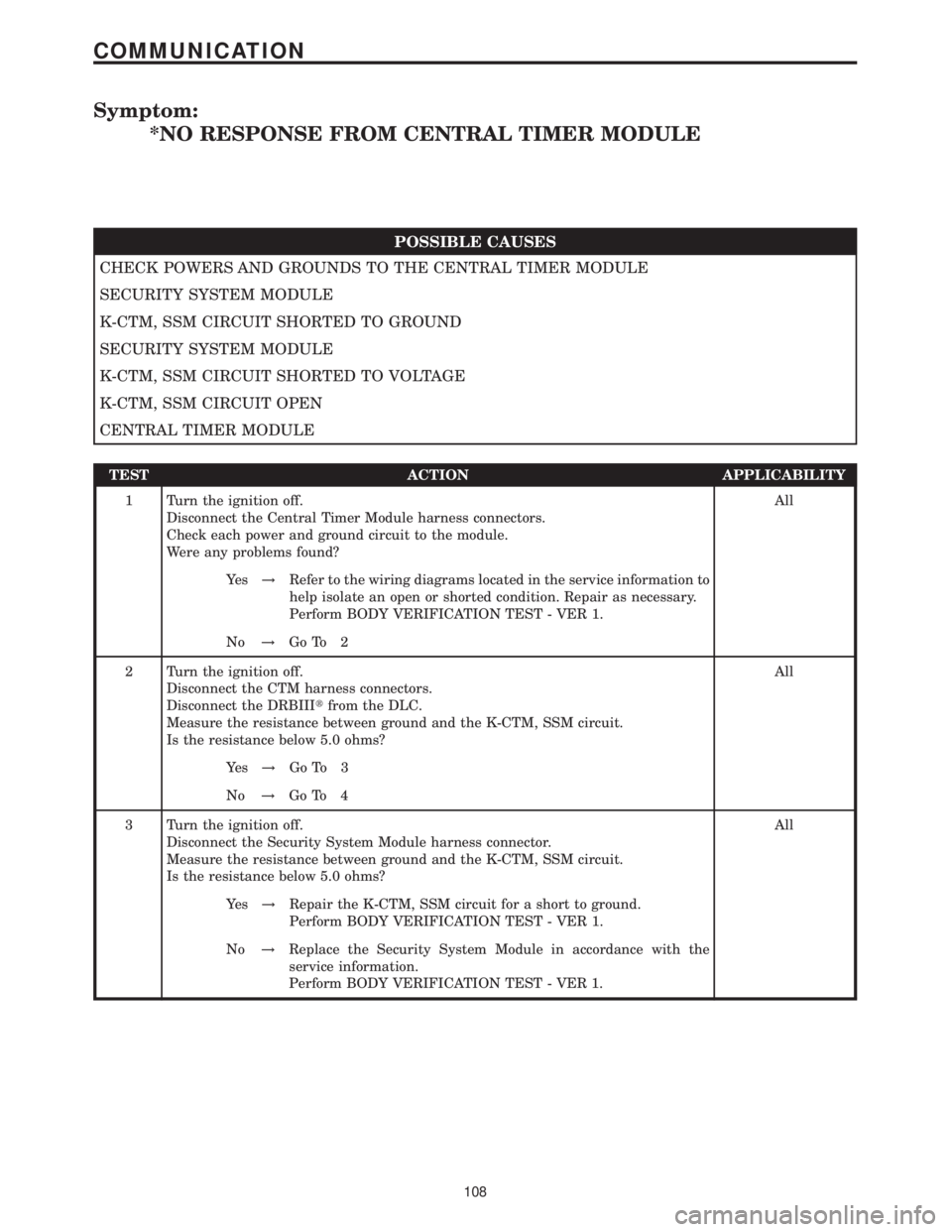
Symptom:
*NO RESPONSE FROM CENTRAL TIMER MODULE
POSSIBLE CAUSES
CHECK POWERS AND GROUNDS TO THE CENTRAL TIMER MODULE
SECURITY SYSTEM MODULE
K-CTM, SSM CIRCUIT SHORTED TO GROUND
SECURITY SYSTEM MODULE
K-CTM, SSM CIRCUIT SHORTED TO VOLTAGE
K-CTM, SSM CIRCUIT OPEN
CENTRAL TIMER MODULE
TEST ACTION APPLICABILITY
1 Turn the ignition off.
Disconnect the Central Timer Module harness connectors.
Check each power and ground circuit to the module.
Were any problems found?All
Ye s!Refer to the wiring diagrams located in the service information to
help isolate an open or shorted condition. Repair as necessary.
Perform BODY VERIFICATION TEST - VER 1.
No!Go To 2
2 Turn the ignition off.
Disconnect the CTM harness connectors.
Disconnect the DRBIIItfrom the DLC.
Measure the resistance between ground and the K-CTM, SSM circuit.
Is the resistance below 5.0 ohms?All
Ye s!Go To 3
No!Go To 4
3 Turn the ignition off.
Disconnect the Security System Module harness connector.
Measure the resistance between ground and the K-CTM, SSM circuit.
Is the resistance below 5.0 ohms?All
Ye s!Repair the K-CTM, SSM circuit for a short to ground.
Perform BODY VERIFICATION TEST - VER 1.
No!Replace the Security System Module in accordance with the
service information.
Perform BODY VERIFICATION TEST - VER 1.
108
COMMUNICATION
Page 122 of 2305
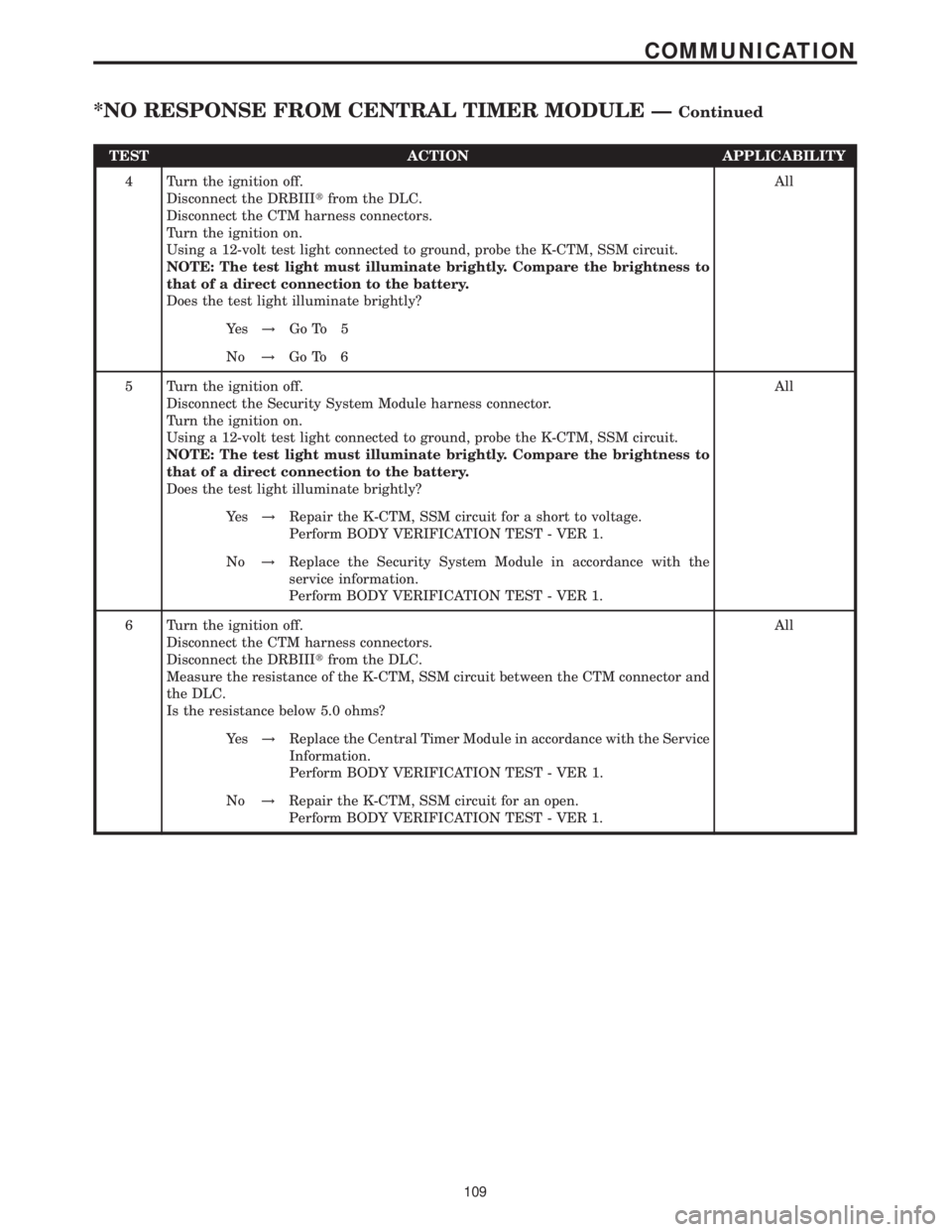
TEST ACTION APPLICABILITY
4 Turn the ignition off.
Disconnect the DRBIIItfrom the DLC.
Disconnect the CTM harness connectors.
Turn the ignition on.
Using a 12-volt test light connected to ground, probe the K-CTM, SSM circuit.
NOTE: The test light must illuminate brightly. Compare the brightness to
that of a direct connection to the battery.
Does the test light illuminate brightly?All
Ye s!Go To 5
No!Go To 6
5 Turn the ignition off.
Disconnect the Security System Module harness connector.
Turn the ignition on.
Using a 12-volt test light connected to ground, probe the K-CTM, SSM circuit.
NOTE: The test light must illuminate brightly. Compare the brightness to
that of a direct connection to the battery.
Does the test light illuminate brightly?All
Ye s!Repair the K-CTM, SSM circuit for a short to voltage.
Perform BODY VERIFICATION TEST - VER 1.
No!Replace the Security System Module in accordance with the
service information.
Perform BODY VERIFICATION TEST - VER 1.
6 Turn the ignition off.
Disconnect the CTM harness connectors.
Disconnect the DRBIIItfrom the DLC.
Measure the resistance of the K-CTM, SSM circuit between the CTM connector and
the DLC.
Is the resistance below 5.0 ohms?All
Ye s!Replace the Central Timer Module in accordance with the Service
Information.
Perform BODY VERIFICATION TEST - VER 1.
No!Repair the K-CTM, SSM circuit for an open.
Perform BODY VERIFICATION TEST - VER 1.
109
COMMUNICATION
*NO RESPONSE FROM CENTRAL TIMER MODULE ÐContinued
Page 133 of 2305
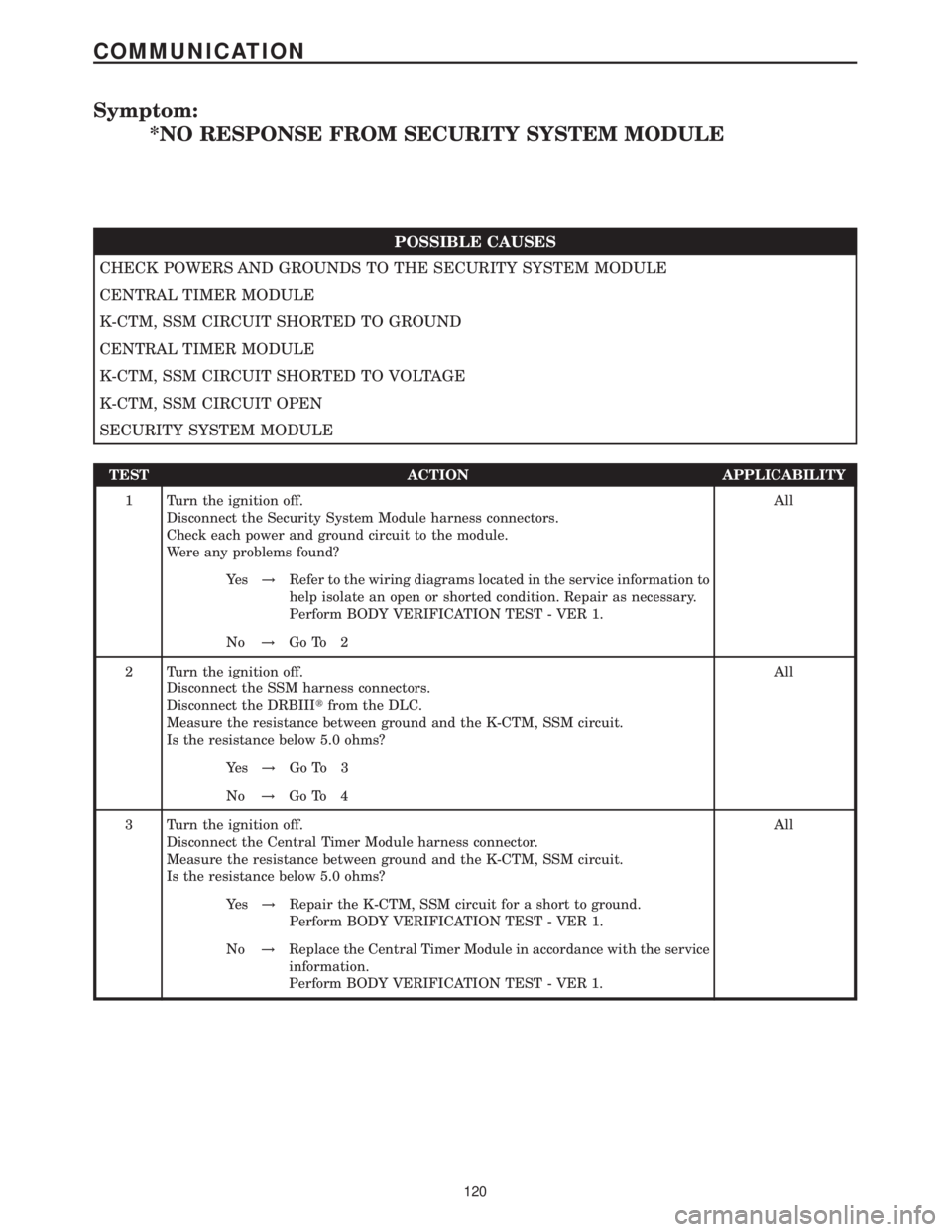
Symptom:
*NO RESPONSE FROM SECURITY SYSTEM MODULE
POSSIBLE CAUSES
CHECK POWERS AND GROUNDS TO THE SECURITY SYSTEM MODULE
CENTRAL TIMER MODULE
K-CTM, SSM CIRCUIT SHORTED TO GROUND
CENTRAL TIMER MODULE
K-CTM, SSM CIRCUIT SHORTED TO VOLTAGE
K-CTM, SSM CIRCUIT OPEN
SECURITY SYSTEM MODULE
TEST ACTION APPLICABILITY
1 Turn the ignition off.
Disconnect the Security System Module harness connectors.
Check each power and ground circuit to the module.
Were any problems found?All
Ye s!Refer to the wiring diagrams located in the service information to
help isolate an open or shorted condition. Repair as necessary.
Perform BODY VERIFICATION TEST - VER 1.
No!Go To 2
2 Turn the ignition off.
Disconnect the SSM harness connectors.
Disconnect the DRBIIItfrom the DLC.
Measure the resistance between ground and the K-CTM, SSM circuit.
Is the resistance below 5.0 ohms?All
Ye s!Go To 3
No!Go To 4
3 Turn the ignition off.
Disconnect the Central Timer Module harness connector.
Measure the resistance between ground and the K-CTM, SSM circuit.
Is the resistance below 5.0 ohms?All
Ye s!Repair the K-CTM, SSM circuit for a short to ground.
Perform BODY VERIFICATION TEST - VER 1.
No!Replace the Central Timer Module in accordance with the service
information.
Perform BODY VERIFICATION TEST - VER 1.
120
COMMUNICATION
Page 134 of 2305
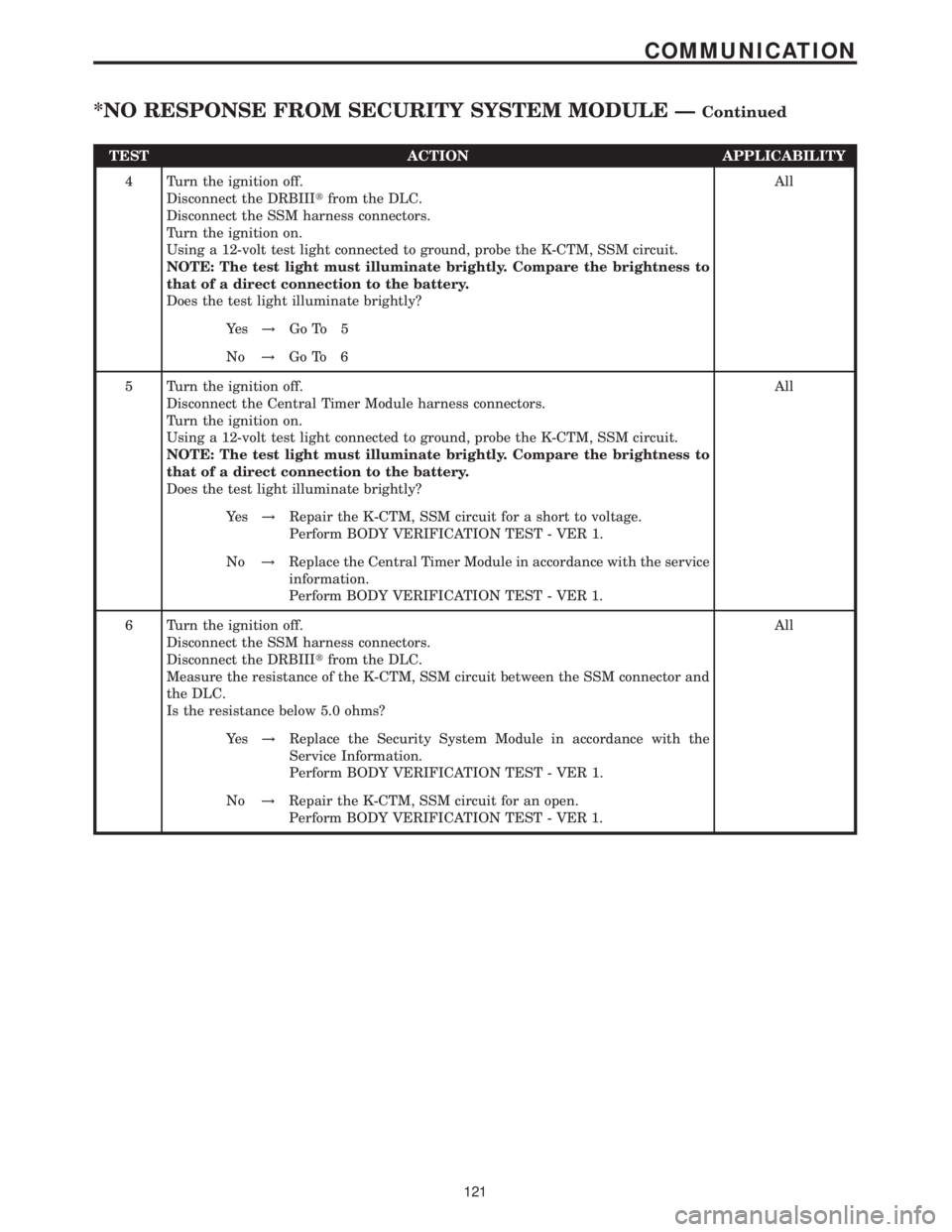
TEST ACTION APPLICABILITY
4 Turn the ignition off.
Disconnect the DRBIIItfrom the DLC.
Disconnect the SSM harness connectors.
Turn the ignition on.
Using a 12-volt test light connected to ground, probe the K-CTM, SSM circuit.
NOTE: The test light must illuminate brightly. Compare the brightness to
that of a direct connection to the battery.
Does the test light illuminate brightly?All
Ye s!Go To 5
No!Go To 6
5 Turn the ignition off.
Disconnect the Central Timer Module harness connectors.
Turn the ignition on.
Using a 12-volt test light connected to ground, probe the K-CTM, SSM circuit.
NOTE: The test light must illuminate brightly. Compare the brightness to
that of a direct connection to the battery.
Does the test light illuminate brightly?All
Ye s!Repair the K-CTM, SSM circuit for a short to voltage.
Perform BODY VERIFICATION TEST - VER 1.
No!Replace the Central Timer Module in accordance with the service
information.
Perform BODY VERIFICATION TEST - VER 1.
6 Turn the ignition off.
Disconnect the SSM harness connectors.
Disconnect the DRBIIItfrom the DLC.
Measure the resistance of the K-CTM, SSM circuit between the SSM connector and
the DLC.
Is the resistance below 5.0 ohms?All
Ye s!Replace the Security System Module in accordance with the
Service Information.
Perform BODY VERIFICATION TEST - VER 1.
No!Repair the K-CTM, SSM circuit for an open.
Perform BODY VERIFICATION TEST - VER 1.
121
COMMUNICATION
*NO RESPONSE FROM SECURITY SYSTEM MODULE ÐContinued
Page 225 of 2305
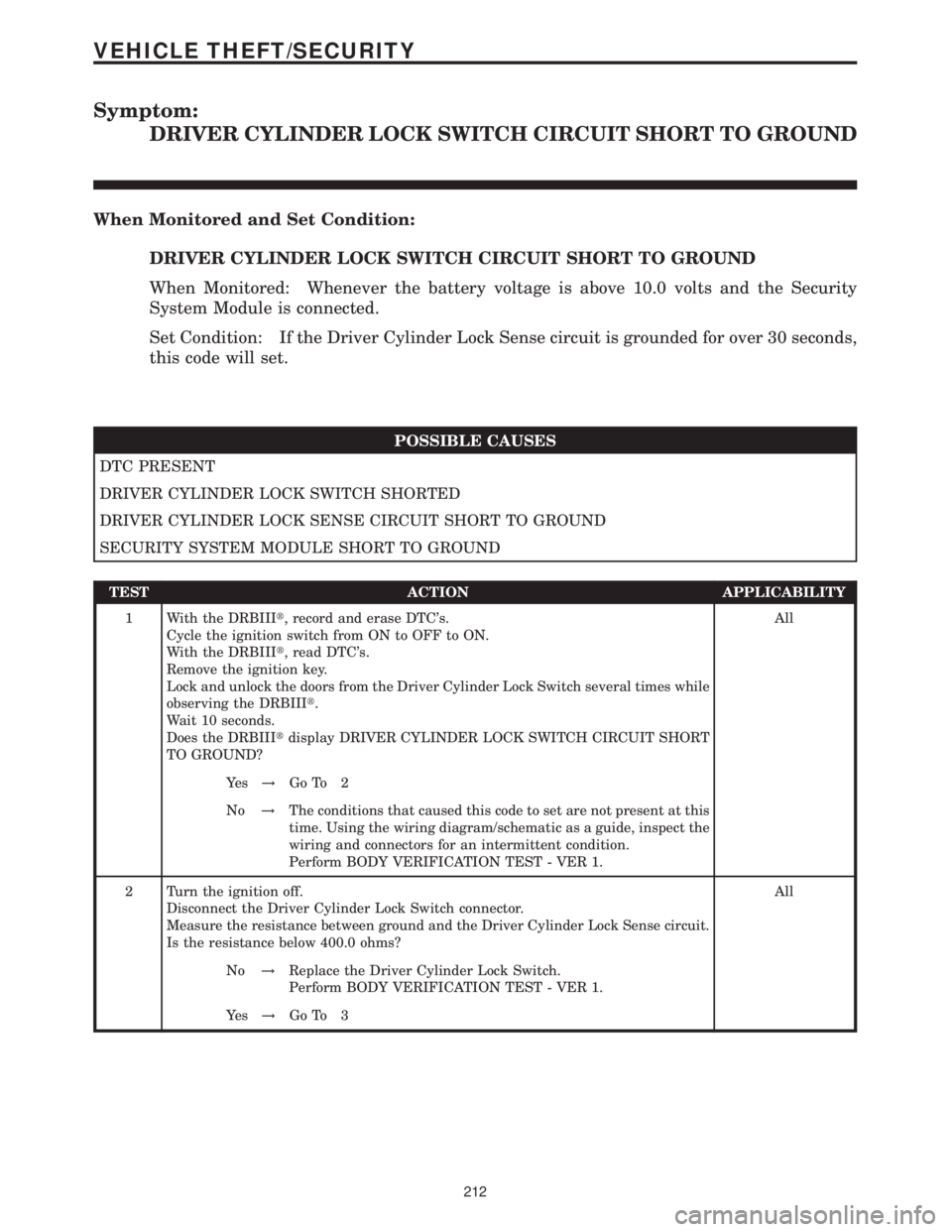
Symptom:
DRIVER CYLINDER LOCK SWITCH CIRCUIT SHORT TO GROUND
When Monitored and Set Condition:
DRIVER CYLINDER LOCK SWITCH CIRCUIT SHORT TO GROUND
When Monitored: Whenever the battery voltage is above 10.0 volts and the Security
System Module is connected.
Set Condition: If the Driver Cylinder Lock Sense circuit is grounded for over 30 seconds,
this code will set.
POSSIBLE CAUSES
DTC PRESENT
DRIVER CYLINDER LOCK SWITCH SHORTED
DRIVER CYLINDER LOCK SENSE CIRCUIT SHORT TO GROUND
SECURITY SYSTEM MODULE SHORT TO GROUND
TEST ACTION APPLICABILITY
1 With the DRBIIIt, record and erase DTC's.
Cycle the ignition switch from ON to OFF to ON.
With the DRBIIIt, read DTC's.
Remove the ignition key.
Lock and unlock the doors from the Driver Cylinder Lock Switch several times while
observing the DRBIIIt.
Wait 10 seconds.
Does the DRBIIItdisplay DRIVER CYLINDER LOCK SWITCH CIRCUIT SHORT
TO GROUND?All
Ye s!Go To 2
No!The conditions that caused this code to set are not present at this
time. Using the wiring diagram/schematic as a guide, inspect the
wiring and connectors for an intermittent condition.
Perform BODY VERIFICATION TEST - VER 1.
2 Turn the ignition off.
Disconnect the Driver Cylinder Lock Switch connector.
Measure the resistance between ground and the Driver Cylinder Lock Sense circuit.
Is the resistance below 400.0 ohms?All
No!Replace the Driver Cylinder Lock Switch.
Perform BODY VERIFICATION TEST - VER 1.
Ye s!Go To 3
212
VEHICLE THEFT/SECURITY