2006 MERCEDES-BENZ SPRINTER heating
[x] Cancel search: heatingPage 2071 of 2305
or diode is connected in parallel with the relay coil,
and helps to dissipate voltage spikes and electromag-
netic interference that can be generated as the elec-
tromagnetic field of the relay coil collapses.
The rear blower motor relay terminals are con-
nected to the vehicle electrical system through recep-
tacles in the relay block located in the rear A/C
evaporator housing.
The rear blower motor relays cannot be repaired
and, if faulty or damaged, they must be replaced.
Refer to the appropriate wiring information for diag-
nosis and testing of the ISO-standard relay and for
complete HVAC wiring diagrams.
REMOVAL
(1) Disconnect and isolate the negative battery
cable.
(2) Remove the air filter from the rear A/C evapo-
rator housing (Refer to 24 - HEATING & AIR CON-
DITIONING/DISTRIBUTION - REAR/AIR FILTER -
REMOVAL).
(3) Reach up into the rear A/C evaporator housing
and remove the rear blower motor relays as neces-
sary from the relay block (Fig. 12).
24 - 34 CONTROLS - REARVA
Page 2074 of 2305
INSTALLATION
(1) Install the rear A/C blower motor switch into
the accessory switch panel. Make sure the retaining
tabs are fully engaged.
(2) Connect the wire harness connector to the rear
A/C blower motor switch.
(3) Install the accessory switch panel (Refer to 23 -
BODY/INSTRUMENT PANEL/ACCESSORY
SWITCH BEZEL - INSTALLATION).
(4) Reconnect the negative battery cable.
EVAPORATOR TEMPERATURE
SENSOR
DESCRIPTION
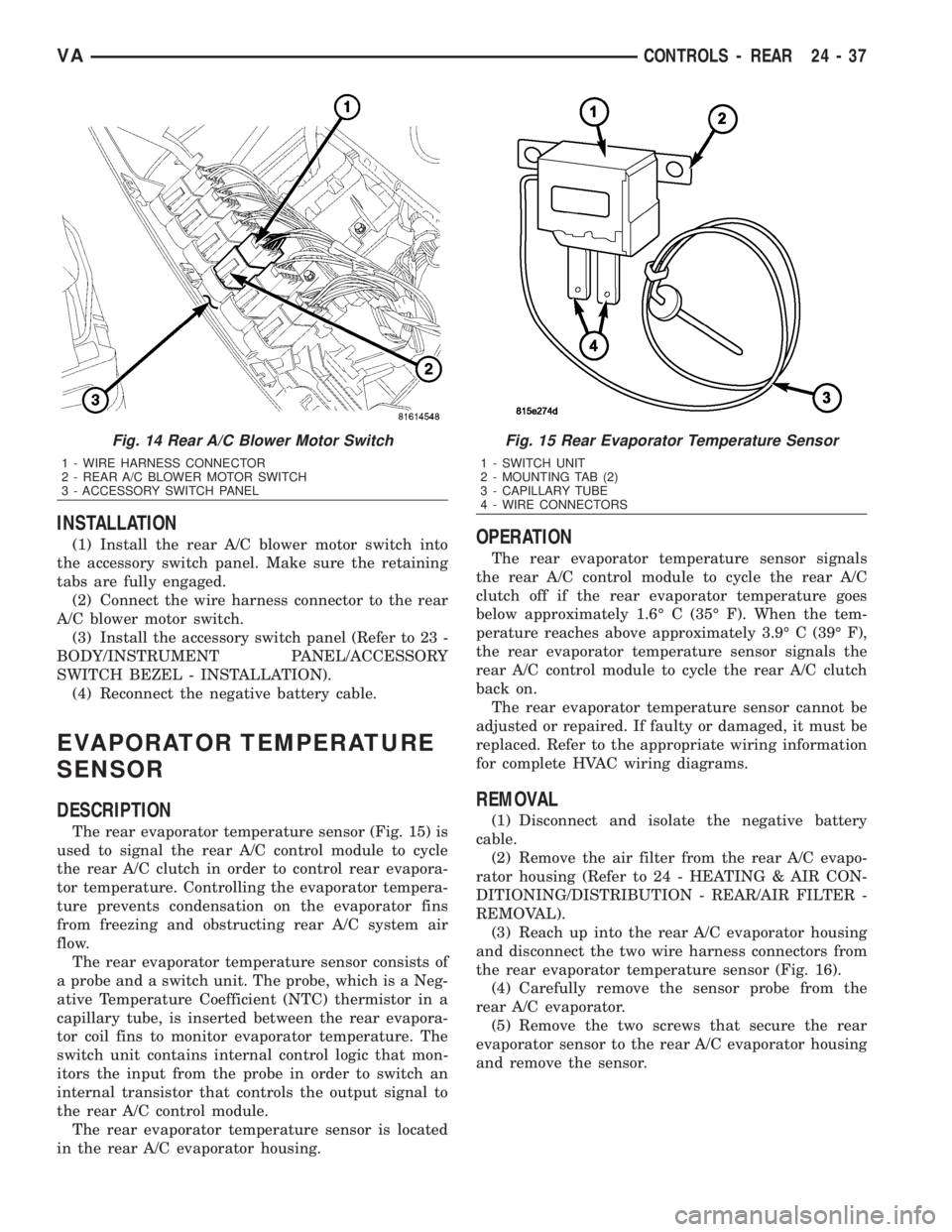
The rear evaporator temperature sensor (Fig. 15) is
used to signal the rear A/C control module to cycle
the rear A/C clutch in order to control rear evapora-
tor temperature. Controlling the evaporator tempera-
ture prevents condensation on the evaporator fins
from freezing and obstructing rear A/C system air
flow.
The rear evaporator temperature sensor consists of
a probe and a switch unit. The probe, which is a Neg-
ative Temperature Coefficient (NTC) thermistor in a
capillary tube, is inserted between the rear evapora-
tor coil fins to monitor evaporator temperature. The
switch unit contains internal control logic that mon-
itors the input from the probe in order to switch an
internal transistor that controls the output signal to
the rear A/C control module.
The rear evaporator temperature sensor is located
in the rear A/C evaporator housing.
OPERATION
The rear evaporator temperature sensor signals
the rear A/C control module to cycle the rear A/C
clutch off if the rear evaporator temperature goes
below approximately 1.6É C (35É F). When the tem-
perature reaches above approximately 3.9É C (39É F),
the rear evaporator temperature sensor signals the
rear A/C control module to cycle the rear A/C clutch
back on.
The rear evaporator temperature sensor cannot be
adjusted or repaired. If faulty or damaged, it must be
replaced. Refer to the appropriate wiring information
for complete HVAC wiring diagrams.
REMOVAL
(1) Disconnect and isolate the negative battery
cable.
(2) Remove the air filter from the rear A/C evapo-
rator housing (Refer to 24 - HEATING & AIR CON-
DITIONING/DISTRIBUTION - REAR/AIR FILTER -
REMOVAL).
(3) Reach up into the rear A/C evaporator housing
and disconnect the two wire harness connectors from
the rear evaporator temperature sensor (Fig. 16).
(4) Carefully remove the sensor probe from the
rear A/C evaporator.
(5) Remove the two screws that secure the rear
evaporator sensor to the rear A/C evaporator housing
and remove the sensor.
Fig. 14 Rear A/C Blower Motor Switch
1 - WIRE HARNESS CONNECTOR
2 - REAR A/C BLOWER MOTOR SWITCH
3 - ACCESSORY SWITCH PANEL
Fig. 15 Rear Evaporator Temperature Sensor
1 - SWITCH UNIT
2 - MOUNTING TAB (2)
3 - CAPILLARY TUBE
4 - WIRE CONNECTORS
VACONTROLS - REAR 24 - 37
Page 2077 of 2305
INSTALLATION
(1) Install the rear A/C temperature control into
the accessory switch panel. Make sure the retaining
tabs are fully engaged.
(2) Connect the wire harness connector to the rear
A/C temperature control.
(3) Install the accessory switch panel (Refer to 23 -
BODY/INSTRUMENT PANEL/ACCESSORY
SWITCH BEZEL - INSTALLATION).
(4) Reconnect the negative battery cable.
TEMPERATURE SENSOR
DESCRIPTION
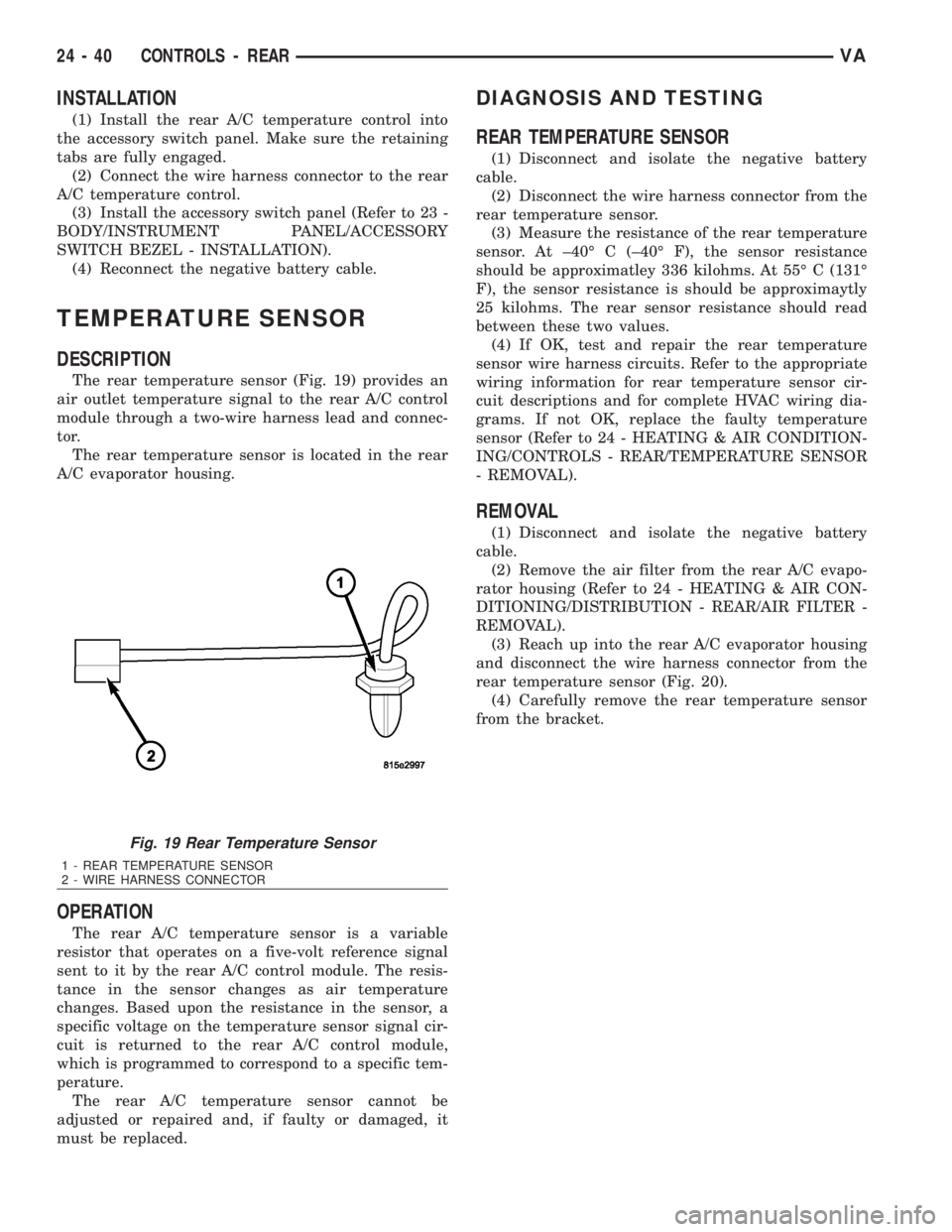
The rear temperature sensor (Fig. 19) provides an
air outlet temperature signal to the rear A/C control
module through a two-wire harness lead and connec-
tor.
The rear temperature sensor is located in the rear
A/C evaporator housing.
OPERATION
The rear A/C temperature sensor is a variable
resistor that operates on a five-volt reference signal
sent to it by the rear A/C control module. The resis-
tance in the sensor changes as air temperature
changes. Based upon the resistance in the sensor, a
specific voltage on the temperature sensor signal cir-
cuit is returned to the rear A/C control module,
which is programmed to correspond to a specific tem-
perature.
The rear A/C temperature sensor cannot be
adjusted or repaired and, if faulty or damaged, it
must be replaced.
DIAGNOSIS AND TESTING
REAR TEMPERATURE SENSOR
(1) Disconnect and isolate the negative battery
cable.
(2) Disconnect the wire harness connector from the
rear temperature sensor.
(3) Measure the resistance of the rear temperature
sensor. At ±40É C (±40É F), the sensor resistance
should be approximatley 336 kilohms. At 55É C (131É
F), the sensor resistance is should be approximaytly
25 kilohms. The rear sensor resistance should read
between these two values.
(4) If OK, test and repair the rear temperature
sensor wire harness circuits. Refer to the appropriate
wiring information for rear temperature sensor cir-
cuit descriptions and for complete HVAC wiring dia-
grams. If not OK, replace the faulty temperature
sensor (Refer to 24 - HEATING & AIR CONDITION-
ING/CONTROLS - REAR/TEMPERATURE SENSOR
- REMOVAL).
REMOVAL
(1) Disconnect and isolate the negative battery
cable.
(2) Remove the air filter from the rear A/C evapo-
rator housing (Refer to 24 - HEATING & AIR CON-
DITIONING/DISTRIBUTION - REAR/AIR FILTER -
REMOVAL).
(3) Reach up into the rear A/C evaporator housing
and disconnect the wire harness connector from the
rear temperature sensor (Fig. 20).
(4) Carefully remove the rear temperature sensor
from the bracket.
Fig. 19 Rear Temperature Sensor
1 - REAR TEMPERATURE SENSOR
2 - WIRE HARNESS CONNECTOR
24 - 40 CONTROLS - REARVA
Page 2079 of 2305
the rear A/C control module circuits and radio recep-
tion quality. The suppression filters for the rear
blower motors consist of capacitors and inductance
coils.
The rear blower motor suppression filters cannot
be repaired and, if faulty or damaged, they must be
replaced. Refer to the appropriate wiring information
for complete HVAC wiring diagrams.
REMOVAL
(1) Disconnect and isolate the negative battery
cable.
(2) Remove the cover from the rear A/C evaporator
housing (Refer to 24 - HEATING & AIR CONDI-
TIONING/DISTRIBUTION - REAR/A/C EVAPORA-
TOR COVER-REAR - REMOVAL).
(3) Disconnect the two wire harness connectors
from the rear blower motor suppression filter being
serviced (Fig. 22).
(4) Remove the screw that secures the each rear
blower motor suppression filter to the rear A/C evap-
orator housing and remove the suppression filters as
required.
24 - 42 CONTROLS - REARVA
Page 2080 of 2305
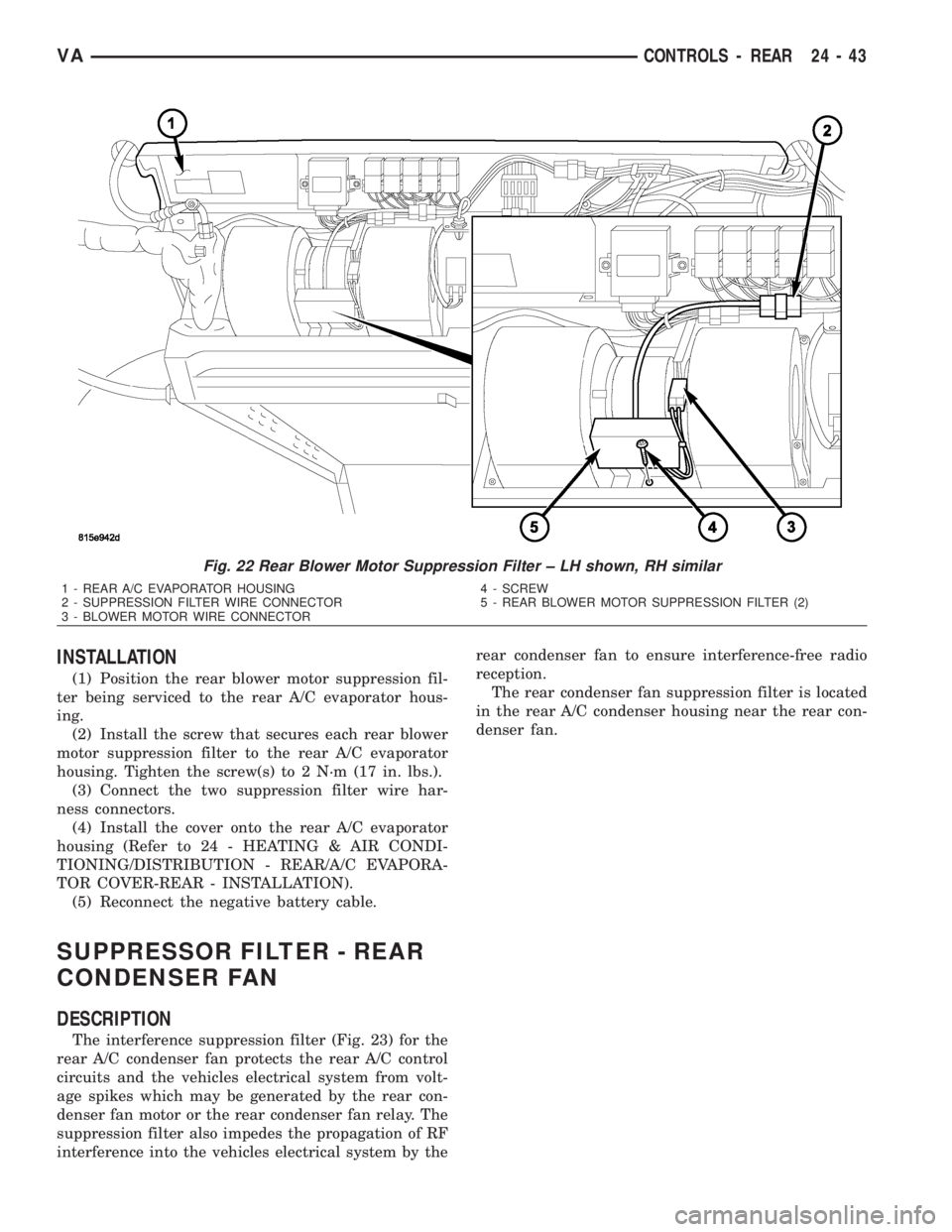
INSTALLATION
(1) Position the rear blower motor suppression fil-
ter being serviced to the rear A/C evaporator hous-
ing.
(2) Install the screw that secures each rear blower
motor suppression filter to the rear A/C evaporator
housing. Tighten the screw(s) to 2 N´m (17 in. lbs.).
(3) Connect the two suppression filter wire har-
ness connectors.
(4) Install the cover onto the rear A/C evaporator
housing (Refer to 24 - HEATING & AIR CONDI-
TIONING/DISTRIBUTION - REAR/A/C EVAPORA-
TOR COVER-REAR - INSTALLATION).
(5) Reconnect the negative battery cable.
SUPPRESSOR FILTER - REAR
CONDENSER FAN
DESCRIPTION
The interference suppression filter (Fig. 23) for the
rear A/C condenser fan protects the rear A/C control
circuits and the vehicles electrical system from volt-
age spikes which may be generated by the rear con-
denser fan motor or the rear condenser fan relay. The
suppression filter also impedes the propagation of RF
interference into the vehicles electrical system by therear condenser fan to ensure interference-free radio
reception.
The rear condenser fan suppression filter is located
in the rear A/C condenser housing near the rear con-
denser fan.
Fig. 22 Rear Blower Motor Suppression Filter ± LH shown, RH similar
1 - REAR A/C EVAPORATOR HOUSING
2 - SUPPRESSION FILTER WIRE CONNECTOR
3 - BLOWER MOTOR WIRE CONNECTOR4 - SCREW
5 - REAR BLOWER MOTOR SUPPRESSION FILTER (2)
VACONTROLS - REAR 24 - 43
Page 2081 of 2305
OPERATION
The rear condenser fan suppression filter provides
protection against transient interference signals or
similar interference to the electronic rear condenser
fan circuits which can effect the performance of the
rear A/C control module circuits and radio reception
quality. The suppression filter for the rear condenser
fan consist of capacitors and inductance coils.
The rear condenser fan suppression filter cannot be
repaired and, if faulty or damaged, it must be
replaced. Refer to the appropriate wiring information
for complete HVAC wiring diagrams.
REMOVAL
(1) Disconnect and isolate the negative battery
cable.
(2) Remove the cover from the rear A/C condenser
housing (Refer to 24 - HEATING & AIR CONDI-
TIONING/DISTRIBUTION - REAR/A/C CON-
DENSER COVER-REAR - REMOVAL).
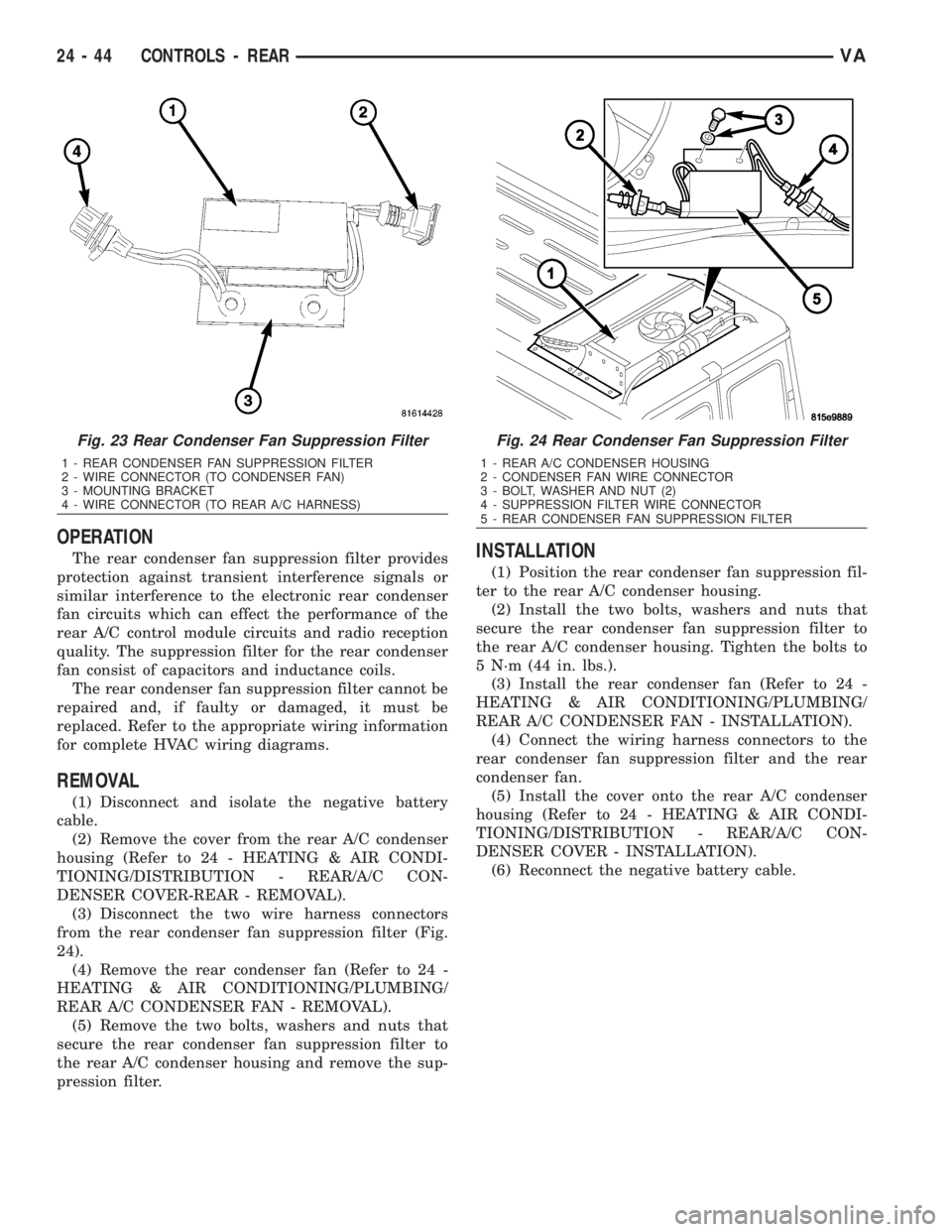
(3) Disconnect the two wire harness connectors
from the rear condenser fan suppression filter (Fig.
24).
(4) Remove the rear condenser fan (Refer to 24 -
HEATING & AIR CONDITIONING/PLUMBING/
REAR A/C CONDENSER FAN - REMOVAL).
(5) Remove the two bolts, washers and nuts that
secure the rear condenser fan suppression filter to
the rear A/C condenser housing and remove the sup-
pression filter.
INSTALLATION
(1) Position the rear condenser fan suppression fil-
ter to the rear A/C condenser housing.
(2) Install the two bolts, washers and nuts that
secure the rear condenser fan suppression filter to
the rear A/C condenser housing. Tighten the bolts to
5 N´m (44 in. lbs.).
(3) Install the rear condenser fan (Refer to 24 -
HEATING & AIR CONDITIONING/PLUMBING/
REAR A/C CONDENSER FAN - INSTALLATION).
(4) Connect the wiring harness connectors to the
rear condenser fan suppression filter and the rear
condenser fan.
(5) Install the cover onto the rear A/C condenser
housing (Refer to 24 - HEATING & AIR CONDI-
TIONING/DISTRIBUTION - REAR/A/C CON-
DENSER COVER - INSTALLATION).
(6) Reconnect the negative battery cable.
Fig. 23 Rear Condenser Fan Suppression Filter
1 - REAR CONDENSER FAN SUPPRESSION FILTER
2 - WIRE CONNECTOR (TO CONDENSER FAN)
3 - MOUNTING BRACKET
4 - WIRE CONNECTOR (TO REAR A/C HARNESS)
Fig. 24 Rear Condenser Fan Suppression Filter
1 - REAR A/C CONDENSER HOUSING
2 - CONDENSER FAN WIRE CONNECTOR
3 - BOLT, WASHER AND NUT (2)
4 - SUPPRESSION FILTER WIRE CONNECTOR
5 - REAR CONDENSER FAN SUPPRESSION FILTER
24 - 44 CONTROLS - REARVA
Page 2084 of 2305
BLOWER MOTOR
REMOVAL
(1) Disconnect and isolate the negative battery
cable.
(2) Remove the engine air cleaner housing cover
(Refer to 9 - ENGINE/AIR INTAKE SYSTEM/AIR
CLEANER ELEMENT - REMOVAL).
(3) Position the ventilation housing insulation
blanket out of the way of the blower motor assembly.
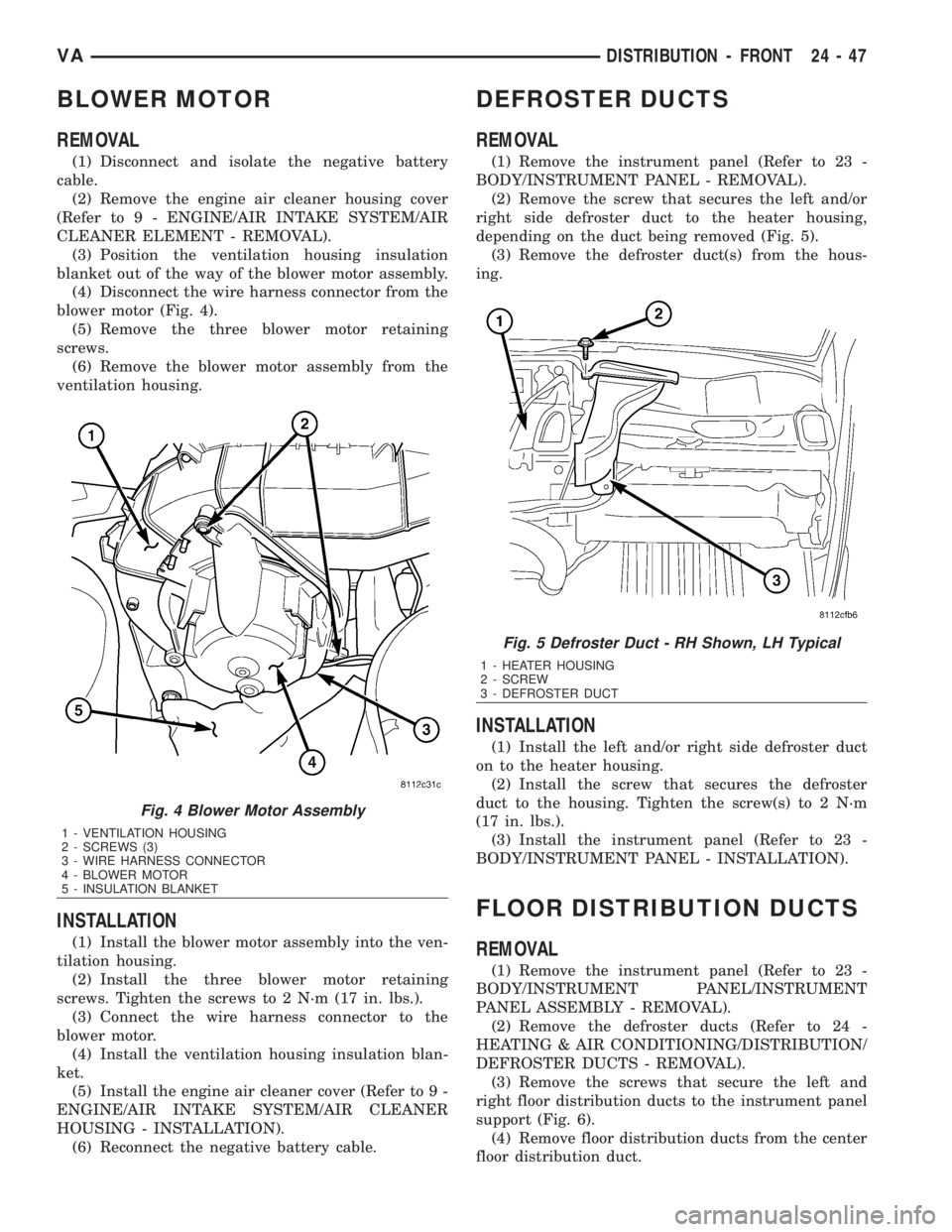
(4) Disconnect the wire harness connector from the
blower motor (Fig. 4).
(5) Remove the three blower motor retaining
screws.
(6) Remove the blower motor assembly from the
ventilation housing.
INSTALLATION
(1) Install the blower motor assembly into the ven-
tilation housing.
(2) Install the three blower motor retaining
screws. Tighten the screws to 2 N´m (17 in. lbs.).
(3) Connect the wire harness connector to the
blower motor.
(4) Install the ventilation housing insulation blan-
ket.
(5) Install the engine air cleaner cover (Refer to 9 -
ENGINE/AIR INTAKE SYSTEM/AIR CLEANER
HOUSING - INSTALLATION).
(6) Reconnect the negative battery cable.
DEFROSTER DUCTS
REMOVAL
(1) Remove the instrument panel (Refer to 23 -
BODY/INSTRUMENT PANEL - REMOVAL).
(2) Remove the screw that secures the left and/or
right side defroster duct to the heater housing,
depending on the duct being removed (Fig. 5).
(3) Remove the defroster duct(s) from the hous-
ing.
INSTALLATION
(1) Install the left and/or right side defroster duct
on to the heater housing.
(2) Install the screw that secures the defroster
duct to the housing. Tighten the screw(s) to 2 N´m
(17 in. lbs.).
(3) Install the instrument panel (Refer to 23 -
BODY/INSTRUMENT PANEL - INSTALLATION).
FLOOR DISTRIBUTION DUCTS
REMOVAL
(1) Remove the instrument panel (Refer to 23 -
BODY/INSTRUMENT PANEL/INSTRUMENT
PANEL ASSEMBLY - REMOVAL).
(2) Remove the defroster ducts (Refer to 24 -
HEATING & AIR CONDITIONING/DISTRIBUTION/
DEFROSTER DUCTS - REMOVAL).
(3) Remove the screws that secure the left and
right floor distribution ducts to the instrument panel
support (Fig. 6).
(4) Remove floor distribution ducts from the center
floor distribution duct.
Fig. 4 Blower Motor Assembly
1 - VENTILATION HOUSING
2 - SCREWS (3)
3 - WIRE HARNESS CONNECTOR
4 - BLOWER MOTOR
5 - INSULATION BLANKET
Fig. 5 Defroster Duct - RH Shown, LH Typical
1 - HEATER HOUSING
2 - SCREW
3 - DEFROSTER DUCT
VADISTRIBUTION - FRONT 24 - 47
Page 2085 of 2305
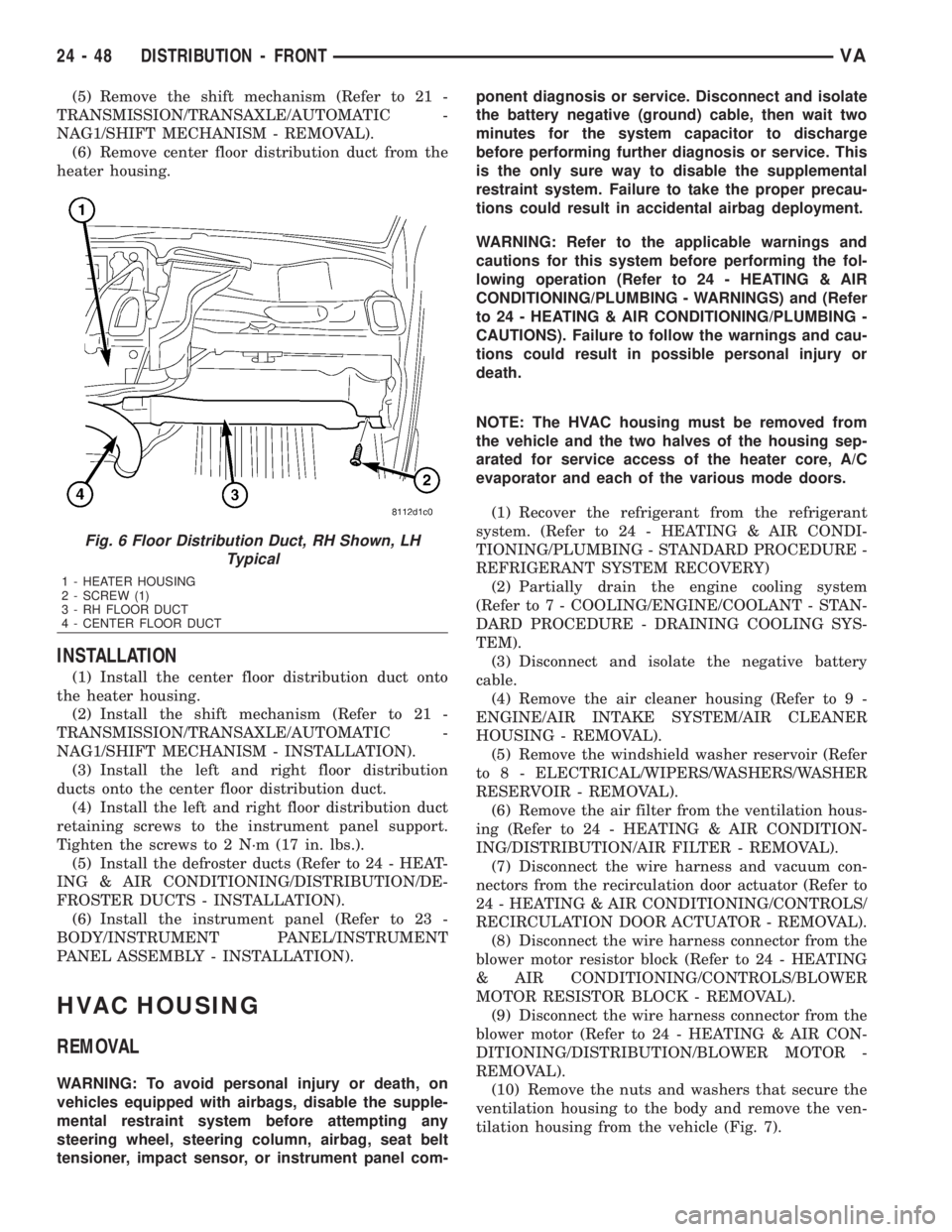
(5) Remove the shift mechanism (Refer to 21 -
TRANSMISSION/TRANSAXLE/AUTOMATIC -
NAG1/SHIFT MECHANISM - REMOVAL).
(6) Remove center floor distribution duct from the
heater housing.
INSTALLATION
(1) Install the center floor distribution duct onto
the heater housing.
(2) Install the shift mechanism (Refer to 21 -
TRANSMISSION/TRANSAXLE/AUTOMATIC -
NAG1/SHIFT MECHANISM - INSTALLATION).
(3) Install the left and right floor distribution
ducts onto the center floor distribution duct.
(4) Install the left and right floor distribution duct
retaining screws to the instrument panel support.
Tighten the screws to 2 N´m (17 in. lbs.).
(5) Install the defroster ducts (Refer to 24 - HEAT-
ING & AIR CONDITIONING/DISTRIBUTION/DE-
FROSTER DUCTS - INSTALLATION).
(6) Install the instrument panel (Refer to 23 -
BODY/INSTRUMENT PANEL/INSTRUMENT
PANEL ASSEMBLY - INSTALLATION).
HVAC HOUSING
REMOVAL
WARNING: To avoid personal injury or death, on
vehicles equipped with airbags, disable the supple-
mental restraint system before attempting any
steering wheel, steering column, airbag, seat belt
tensioner, impact sensor, or instrument panel com-ponent diagnosis or service. Disconnect and isolate
the battery negative (ground) cable, then wait two
minutes for the system capacitor to discharge
before performing further diagnosis or service. This
is the only sure way to disable the supplemental
restraint system. Failure to take the proper precau-
tions could result in accidental airbag deployment.
WARNING: Refer to the applicable warnings and
cautions for this system before performing the fol-
lowing operation (Refer to 24 - HEATING & AIR
CONDITIONING/PLUMBING - WARNINGS) and (Refer
to 24 - HEATING & AIR CONDITIONING/PLUMBING -
CAUTIONS). Failure to follow the warnings and cau-
tions could result in possible personal injury or
death.
NOTE: The HVAC housing must be removed from
the vehicle and the two halves of the housing sep-
arated for service access of the heater core, A/C
evaporator and each of the various mode doors.
(1) Recover the refrigerant from the refrigerant
system. (Refer to 24 - HEATING & AIR CONDI-
TIONING/PLUMBING - STANDARD PROCEDURE -
REFRIGERANT SYSTEM RECOVERY)
(2) Partially drain the engine cooling system
(Refer to 7 - COOLING/ENGINE/COOLANT - STAN-
DARD PROCEDURE - DRAINING COOLING SYS-
TEM).
(3) Disconnect and isolate the negative battery
cable.
(4) Remove the air cleaner housing (Refer to 9 -
ENGINE/AIR INTAKE SYSTEM/AIR CLEANER
HOUSING - REMOVAL).
(5) Remove the windshield washer reservoir (Refer
to 8 - ELECTRICAL/WIPERS/WASHERS/WASHER
RESERVOIR - REMOVAL).
(6) Remove the air filter from the ventilation hous-
ing (Refer to 24 - HEATING & AIR CONDITION-
ING/DISTRIBUTION/AIR FILTER - REMOVAL).
(7) Disconnect the wire harness and vacuum con-
nectors from the recirculation door actuator (Refer to
24 - HEATING & AIR CONDITIONING/CONTROLS/
RECIRCULATION DOOR ACTUATOR - REMOVAL).
(8) Disconnect the wire harness connector from the
blower motor resistor block (Refer to 24 - HEATING
& AIR CONDITIONING/CONTROLS/BLOWER
MOTOR RESISTOR BLOCK - REMOVAL).
(9) Disconnect the wire harness connector from the
blower motor (Refer to 24 - HEATING & AIR CON-
DITIONING/DISTRIBUTION/BLOWER MOTOR -
REMOVAL).
(10) Remove the nuts and washers that secure the
ventilation housing to the body and remove the ven-
tilation housing from the vehicle (Fig. 7).
Fig. 6 Floor Distribution Duct, RH Shown, LH
Typical
1 - HEATER HOUSING
2 - SCREW (1)
3 - RH FLOOR DUCT
4 - CENTER FLOOR DUCT
24 - 48 DISTRIBUTION - FRONTVA