2006 MERCEDES-BENZ SPRINTER heating
[x] Cancel search: heatingPage 1614 of 2305
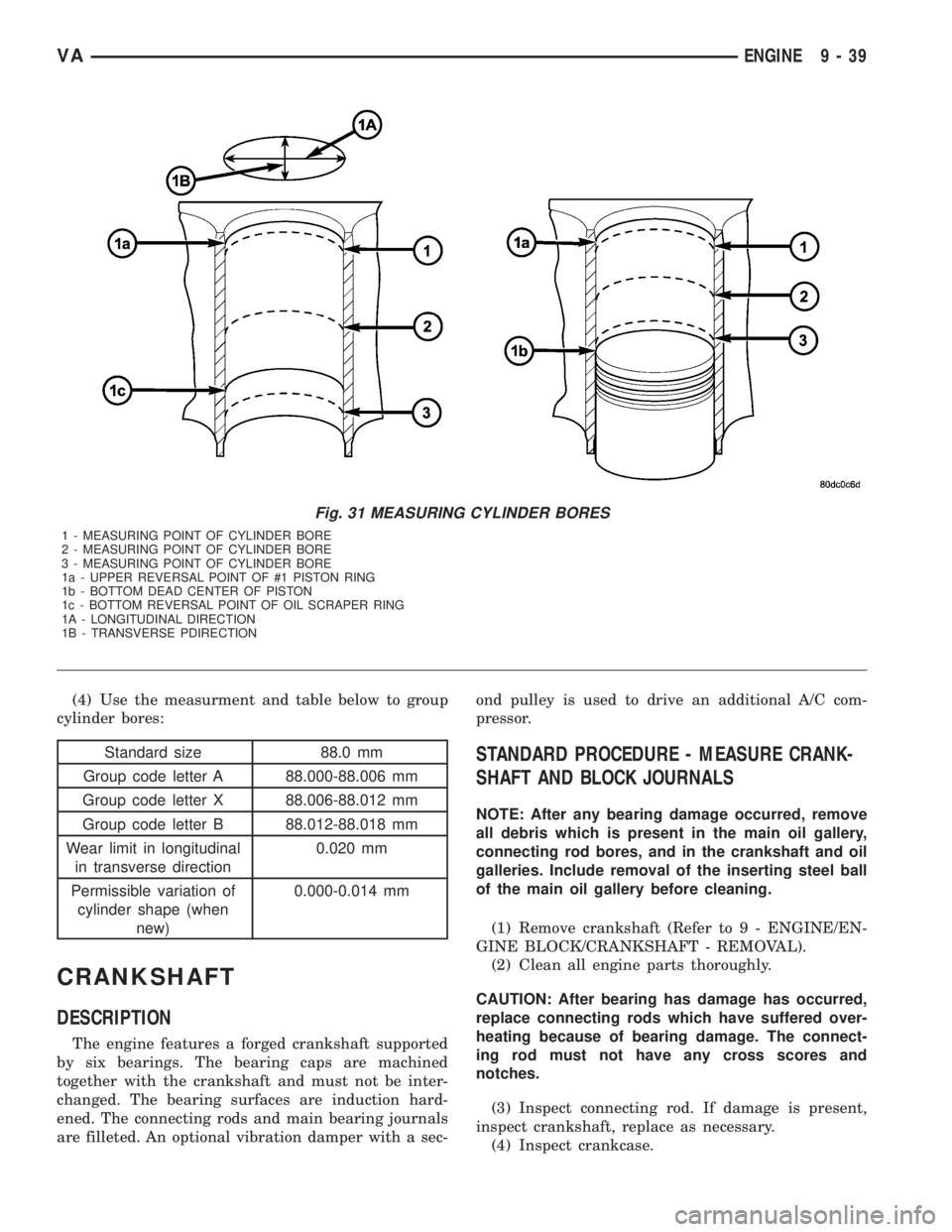
(4) Use the measurment and table below to group
cylinder bores:
Standard size 88.0 mm
Group code letter A 88.000-88.006 mm
Group code letter X 88.006-88.012 mm
Group code letter B 88.012-88.018 mm
Wear limit in longitudinal
in transverse direction0.020 mm
Permissible variation of
cylinder shape (when
new)0.000-0.014 mm
CRANKSHAFT
DESCRIPTION
The engine features a forged crankshaft supported
by six bearings. The bearing caps are machined
together with the crankshaft and must not be inter-
changed. The bearing surfaces are induction hard-
ened. The connecting rods and main bearing journals
are filleted. An optional vibration damper with a sec-ond pulley is used to drive an additional A/C com-
pressor.
STANDARD PROCEDURE - MEASURE CRANK-
SHAFT AND BLOCK JOURNALS
NOTE: After any bearing damage occurred, remove
all debris which is present in the main oil gallery,
connecting rod bores, and in the crankshaft and oil
galleries. Include removal of the inserting steel ball
of the main oil gallery before cleaning.
(1) Remove crankshaft (Refer to 9 - ENGINE/EN-
GINE BLOCK/CRANKSHAFT - REMOVAL).
(2) Clean all engine parts thoroughly.
CAUTION: After bearing has damage has occurred,
replace connecting rods which have suffered over-
heating because of bearing damage. The connect-
ing rod must not have any cross scores and
notches.
(3) Inspect connecting rod. If damage is present,
inspect crankshaft, replace as necessary.
(4) Inspect crankcase.
Fig. 31 MEASURING CYLINDER BORES
1 - MEASURING POINT OF CYLINDER BORE
2 - MEASURING POINT OF CYLINDER BORE
3 - MEASURING POINT OF CYLINDER BORE
1a - UPPER REVERSAL POINT OF #1 PISTON RING
1b - BOTTOM DEAD CENTER OF PISTON
1c - BOTTOM REVERSAL POINT OF OIL SCRAPER RING
1A - LONGITUDINAL DIRECTION
1B - TRANSVERSE PDIRECTION
VAENGINE 9 - 39
Page 1689 of 2305
Switching Off Main Injection
Main injection is switched off when:
²Engine speed is too high >4700 - 4800 rpm
²Main injection quantity too low
²Low fuel pressure in fuel rail
²Engine off
²External quantity control
²Deceleration mode
Calculating Main Injection
The quantity of main injection is calculated by:
²Engine speed
²Atmospheric pressure
²Coolant temperature
²Boost air temperature
²Fuel rail pressure
²Boost pressure
Period of Actuation
For calculating the period of actuation of the main
injection it is necessary to know whether a pre-injec-
tion has occurred or not.
The coolant temperature, charge air temperature
and the atmospheric pressure are used for correcting
the main injection quantity. If main injection quan-
tity is less than a minimum quantity which is depen-
dent on fuel rail pressure, no preinjection takes
place. In this case, only main injection is performed.
If the quantity is then still below the minimum
quantity, neither main injection or pre-injection takes
place (deceleration mode).
Deceleration Mode
The purpose of the deceleration mode is to inter-
rupt the operation of the injectors. The ECM deter-
mines the accelerator pedal position from a supplied
signal and it determines the engine speed by the
crank sensor. In the overrun and with the engine
speed above 1600, with the accelerator pedal no
pressed, the injectors are no longer actuated and the
fuel rail pressure is lowered by the pressure regula-
tor valve.
Full Load Injected Quantity
The purpose of the full load injected quantity is to
minimize the formation of smoke. The ECM limits
the fuel rail pressure when the engine is operating at
full load by way of the quantity control valve, and
quantity of fuel injected by the injectors. this mini-
mizes the formation of smoke when accelerating and
driving at constant speeds. If a fault occurs at the
boost pressure control, full load injected quantity is
reduced.
Limiting Maximum Engine Speed
The ECM determines the engine speed based on
the signal supplied by the crankshaft sensor and lim-its this by interrupting the operation of the fuel
injectors.
Fuel Quantity Control
The fuel quantity is controlled separately for each
cylinder by the ECM inline with the firing order.The
ECM detects the operating state which exists at the
engine by means of the sensors. In order adapt the
quantity injected, either the fuel rail pressure can be
adjusted by the fuel solenoid and quantity control
valve or the actuation time of the solenoid valves in
the injectors
Boiling Protection
In order to protect against thermal overload and
along with criteria programmed in the ECM, the
injection quantity is reduced as a function of the cool-
ant temperature and vehicle speed. If the coolant
temperature sensor fails the oil temperature signal
from the oil sensor is used as a suitable value.
Fuel Tank Protection
The fuel rail pressure is lowered in order to protect
the fuel tank from overheating. The fuel temperature
sensor measures the temperature of the fuel being
supplied from the tank, in the high pressure flange.
If the fuel is too warm the fuel rail pressure is fur-
ther reduced by the quantity control valve.
STANDARD PROCEDURE
STANDARD PROCEDURE - DRAINING FUEL
TANK - DIESEL
(1) Position a drain hose into the fuel fill opening.
(2) Drain fuel tank using an approved diesel fuel
draining station.
FUEL CONTAMINATION
If a diesel engine's fuel supply has been contami-
nated with gasoline, the following procedure must be
followed:
(1) Remove all fuel from the fuel tank. (Refer to 14
- FUEL SYSTEM/FUEL DELIVERY - STANDARD
PROCEDURE-DRAINING FUEL TANK) Use an
appropriate fuel container. Dispose of the contami-
nated fuel using the proper procedures.
CAUTION: Dispose of petroleum based products in
a manner consistent with all applicable Local, State,
Federal, and Provincial regulations.
(2) Remove and clean fuel tank. (Refer to 14 -
FUEL SYSTEM/FUEL DELIVERY/FUEL TANK -
REMOVAL)
(3) Install the fuel tank. (Refer to 14 - FUEL SYS-
TEM/FUEL DELIVERY/FUEL TANK - INSTALLA-
TION)
14 - 8 FUEL DELIVERYVA
Page 1704 of 2305
(5) Tighten fuel rail bolts to 14 N´m (124 in. lbs.)
(Fig. 19)
CAUTION: When tightening fuel injection line union
nuts, counter hold with a wrench at the thread con-
nection. ON NO ACCOUNT exceed the tightening
torque at any time.
(6) Tighten the pressure line to the fuel rail to 20
N´m (177 in. lbs.).
(7) Tighten the high pressure fuel lines at the fuel
rail to 22 N´m (195 in. lbs.).
(8) Reconnect engine harness electrical connectors.
(9) Connect the intake manifold air inlet duct.
(10) Connect negative battery cable.
CAUTION: Care must be taken when installing the
engine cover. Assure the proper routing of the fuel
injector return fuel hose to the banjo bolt fitting in
the left rear corner of the cover. Failure to do so
may pinch or damage the hose causing fuel leakage
or a driveability concern.
WARNING: USE EXTREME CAUTION WHEN THE
ENGINE IS OPERATING. DO NOT STAND IN A
DIRECT LINE WITH FAN. DO NOT PUT YOUR
HANDS NEAR PULLEYS, BELTS OR FAN. DO NOT
WEAR LOOSE CLOTHING.
(11) Start engine, run for a few minutes, turn the
engine off and inspect for leaks (Refer to 14 - FUEL
SYSTEM - WARNING).
FUEL TANK
DESCRIPTION
The plastic fuel tank (Fig. 20) is mounted to the
frame rails under the left/center side of the vehicle.
The fuel tank contains a serviceable fuel pump mod-
ule with an electric fuel pump, and a fuel level send-
ing unit. The tank is also equipped with 2 fuel lines:
a fuel supply line to the fuel pump, and a separate
fuel return line.
Fuel Temperature Control:A section of the fuel
return line is coiled at the rear section of the tank
(Fig. 21). This coiled section is used to help drop the
temperature of fuel returning to the tank. A thermo-
stat (preheating valve) (3) (Fig. 21) is used to keep
fuel temperature below 167 degrees F. If fuel temper-
ature is above 167 degrees F, fuel passes first
through the coiled cooler lines, and then into the fuel
tank. If fuel temperature is below 150 degrees F, fuel
bypasses the coiled cooler lines, and is returned
directly into the fuel tank.
An electric fuel pump (more commonly referred to
in diesel applications as a fuel transfer pump or fuel
lift pump) is attached to the fuel pump module. Thismodule (Fig. 22) is located in the fuel tank. Refer to
Fuel Pump Module for additional information.
VAFUEL DELIVERY 14 - 23
Page 1705 of 2305
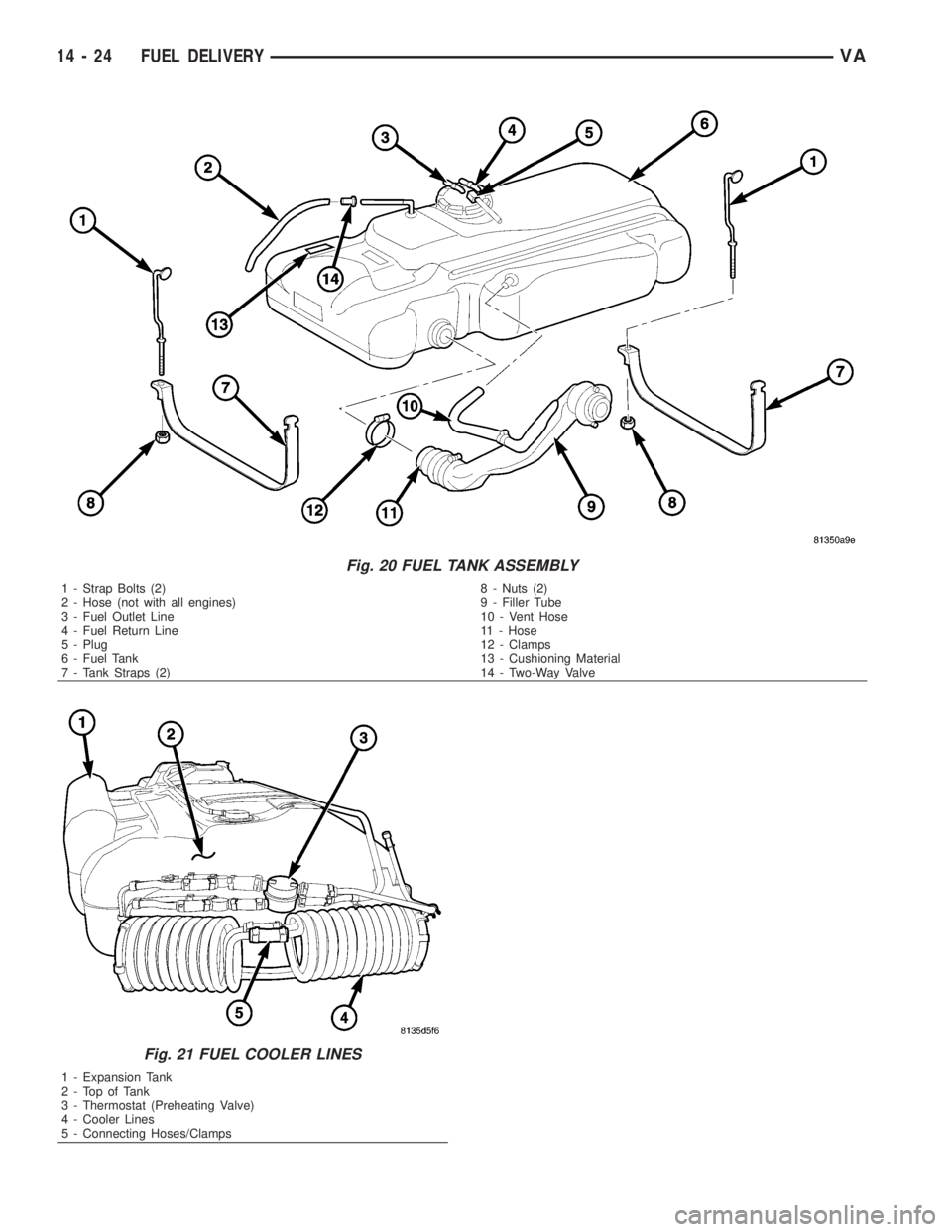
Fig. 20 FUEL TANK ASSEMBLY
1 - Strap Bolts (2)
2 - Hose (not with all engines)
3 - Fuel Outlet Line
4 - Fuel Return Line
5 - Plug
6 - Fuel Tank
7 - Tank Straps (2)8 - Nuts (2)
9 - Filler Tube
10 - Vent Hose
11 - Hose
12 - Clamps
13 - Cushioning Material
14 - Two-Way Valve
Fig. 21 FUEL COOLER LINES
1 - Expansion Tank
2-TopofTank
3 - Thermostat (Preheating Valve)
4 - Cooler Lines
5 - Connecting Hoses/Clamps
14 - 24 FUEL DELIVERYVA
Page 1707 of 2305
INSTALLATION
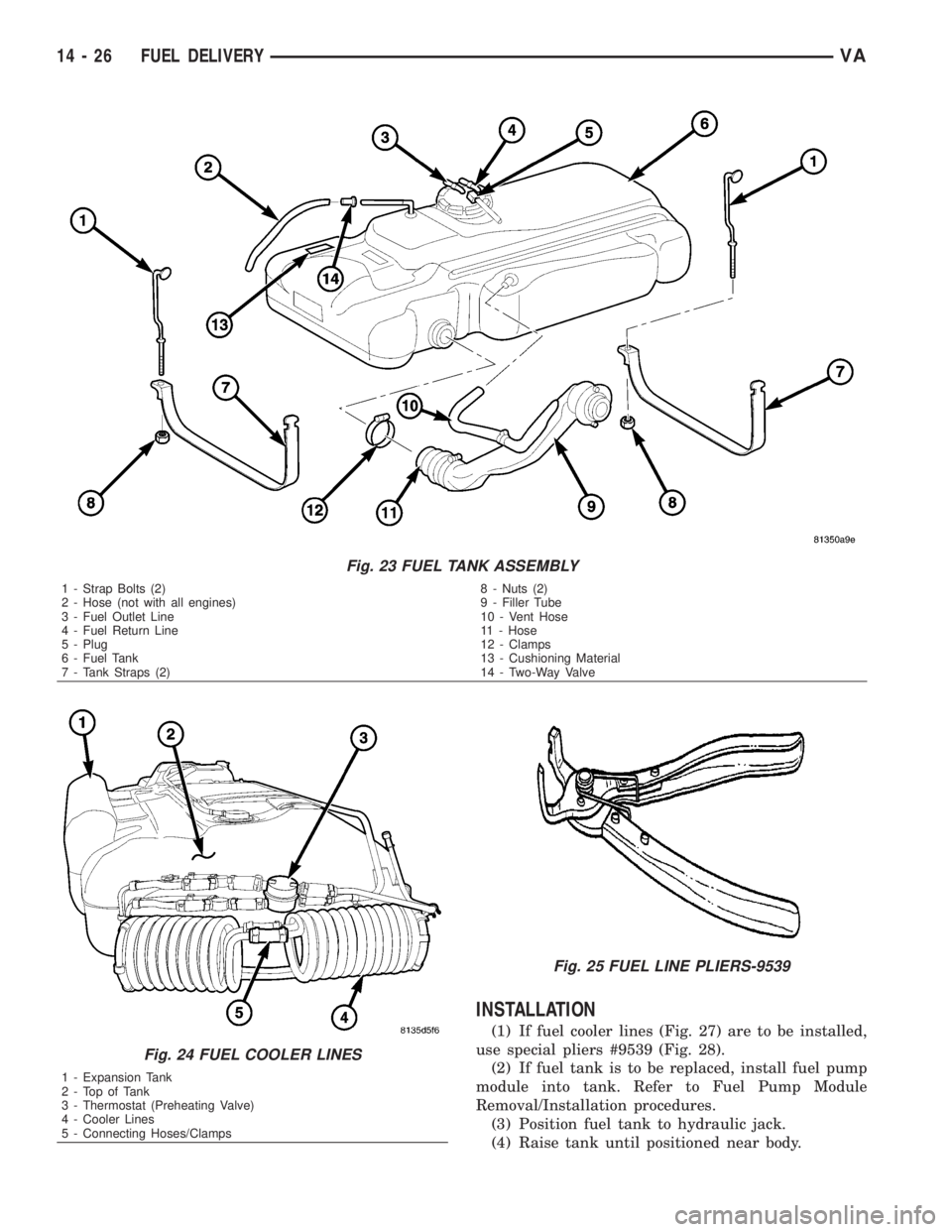
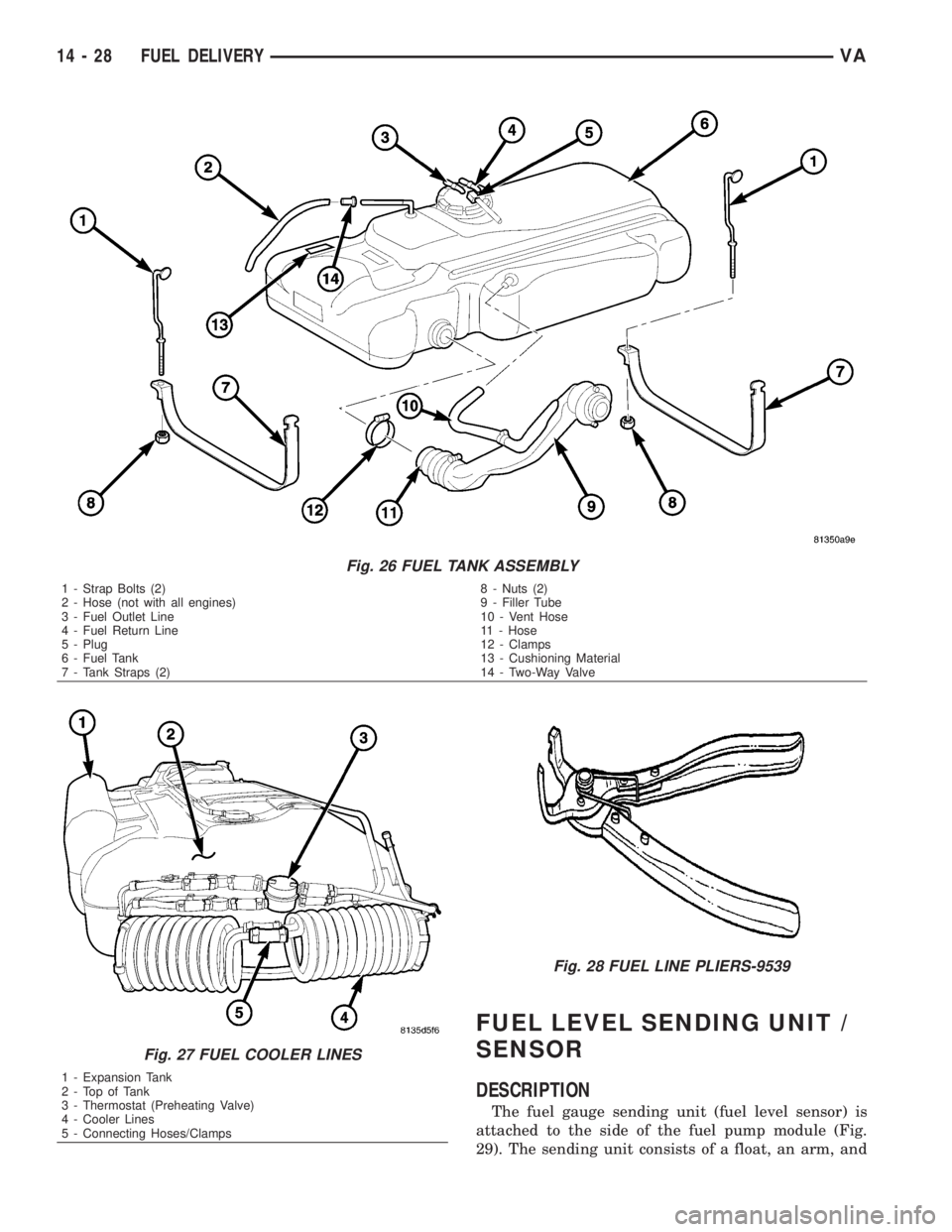
(1) If fuel cooler lines (Fig. 27) are to be installed,
use special pliers #9539 (Fig. 28).
(2) If fuel tank is to be replaced, install fuel pump
module into tank. Refer to Fuel Pump Module
Removal/Installation procedures.
(3) Position fuel tank to hydraulic jack.
(4) Raise tank until positioned near body.
Fig. 23 FUEL TANK ASSEMBLY
1 - Strap Bolts (2)
2 - Hose (not with all engines)
3 - Fuel Outlet Line
4 - Fuel Return Line
5 - Plug
6 - Fuel Tank
7 - Tank Straps (2)8 - Nuts (2)
9 - Filler Tube
10 - Vent Hose
11 - Hose
12 - Clamps
13 - Cushioning Material
14 - Two-Way Valve
Fig. 24 FUEL COOLER LINES
1 - Expansion Tank
2-TopofTank
3 - Thermostat (Preheating Valve)
4 - Cooler Lines
5 - Connecting Hoses/Clamps
Fig. 25 FUEL LINE PLIERS-9539
14 - 26 FUEL DELIVERYVA
Page 1709 of 2305
FUEL LEVEL SENDING UNIT /
SENSOR
DESCRIPTION
The fuel gauge sending unit (fuel level sensor) is
attached to the side of the fuel pump module (Fig.
29). The sending unit consists of a float, an arm, and
Fig. 26 FUEL TANK ASSEMBLY
1 - Strap Bolts (2)
2 - Hose (not with all engines)
3 - Fuel Outlet Line
4 - Fuel Return Line
5 - Plug
6 - Fuel Tank
7 - Tank Straps (2)8 - Nuts (2)
9 - Filler Tube
10 - Vent Hose
11 - Hose
12 - Clamps
13 - Cushioning Material
14 - Two-Way Valve
Fig. 27 FUEL COOLER LINES
1 - Expansion Tank
2-TopofTank
3 - Thermostat (Preheating Valve)
4 - Cooler Lines
5 - Connecting Hoses/Clamps
Fig. 28 FUEL LINE PLIERS-9539
14 - 28 FUEL DELIVERYVA
Page 1725 of 2305
INSTALLATION
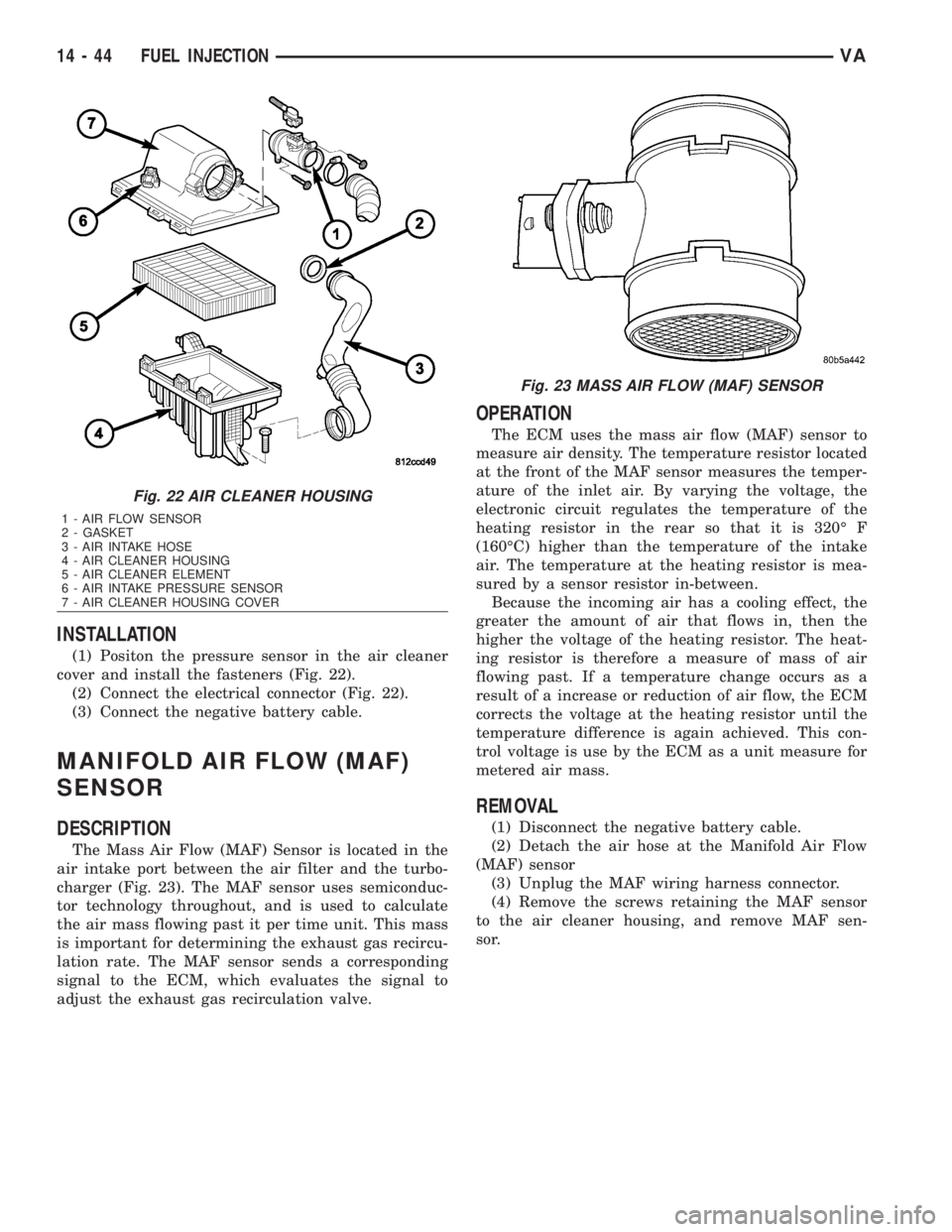
(1) Positon the pressure sensor in the air cleaner
cover and install the fasteners (Fig. 22).
(2) Connect the electrical connector (Fig. 22).
(3) Connect the negative battery cable.
MANIFOLD AIR FLOW (MAF)
SENSOR
DESCRIPTION
The Mass Air Flow (MAF) Sensor is located in the
air intake port between the air filter and the turbo-
charger (Fig. 23). The MAF sensor uses semiconduc-
tor technology throughout, and is used to calculate
the air mass flowing past it per time unit. This mass
is important for determining the exhaust gas recircu-
lation rate. The MAF sensor sends a corresponding
signal to the ECM, which evaluates the signal to
adjust the exhaust gas recirculation valve.
OPERATION
The ECM uses the mass air flow (MAF) sensor to
measure air density. The temperature resistor located
at the front of the MAF sensor measures the temper-
ature of the inlet air. By varying the voltage, the
electronic circuit regulates the temperature of the
heating resistor in the rear so that it is 320É F
(160ÉC) higher than the temperature of the intake
air. The temperature at the heating resistor is mea-
sured by a sensor resistor in-between.
Because the incoming air has a cooling effect, the
greater the amount of air that flows in, then the
higher the voltage of the heating resistor. The heat-
ing resistor is therefore a measure of mass of air
flowing past. If a temperature change occurs as a
result of a increase or reduction of air flow, the ECM
corrects the voltage at the heating resistor until the
temperature difference is again achieved. This con-
trol voltage is use by the ECM as a unit measure for
metered air mass.
REMOVAL
(1) Disconnect the negative battery cable.
(2) Detach the air hose at the Manifold Air Flow
(MAF) sensor
(3) Unplug the MAF wiring harness connector.
(4) Remove the screws retaining the MAF sensor
to the air cleaner housing, and remove MAF sen-
sor.
Fig. 22 AIR CLEANER HOUSING
1 - AIR FLOW SENSOR
2 - GASKET
3 - AIR INTAKE HOSE
4 - AIR CLEANER HOUSING
5 - AIR CLEANER ELEMENT
6 - AIR INTAKE PRESSURE SENSOR
7 - AIR CLEANER HOUSING COVER
Fig. 23 MASS AIR FLOW (MAF) SENSOR
14 - 44 FUEL INJECTIONVA
Page 1874 of 2305
FLUID AND FILTER
DESCRIPTION
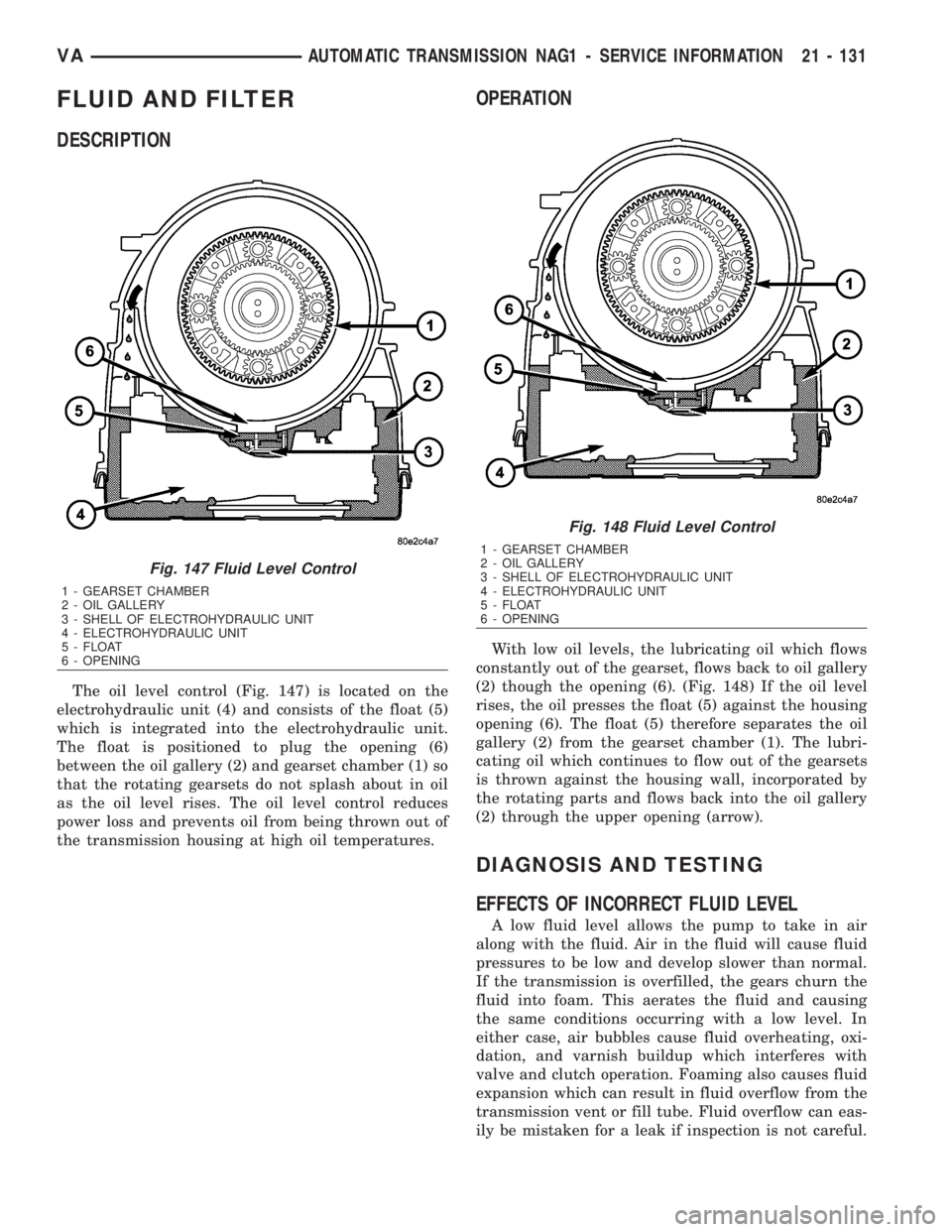
The oil level control (Fig. 147) is located on the
electrohydraulic unit (4) and consists of the float (5)
which is integrated into the electrohydraulic unit.
The float is positioned to plug the opening (6)
between the oil gallery (2) and gearset chamber (1) so
that the rotating gearsets do not splash about in oil
as the oil level rises. The oil level control reduces
power loss and prevents oil from being thrown out of
the transmission housing at high oil temperatures.
OPERATION
With low oil levels, the lubricating oil which flows
constantly out of the gearset, flows back to oil gallery
(2) though the opening (6). (Fig. 148) If the oil level
rises, the oil presses the float (5) against the housing
opening (6). The float (5) therefore separates the oil
gallery (2) from the gearset chamber (1). The lubri-
cating oil which continues to flow out of the gearsets
is thrown against the housing wall, incorporated by
the rotating parts and flows back into the oil gallery
(2) through the upper opening (arrow).
DIAGNOSIS AND TESTING
EFFECTS OF INCORRECT FLUID LEVEL
A low fluid level allows the pump to take in air
along with the fluid. Air in the fluid will cause fluid
pressures to be low and develop slower than normal.
If the transmission is overfilled, the gears churn the
fluid into foam. This aerates the fluid and causing
the same conditions occurring with a low level. In
either case, air bubbles cause fluid overheating, oxi-
dation, and varnish buildup which interferes with
valve and clutch operation. Foaming also causes fluid
expansion which can result in fluid overflow from the
transmission vent or fill tube. Fluid overflow can eas-
ily be mistaken for a leak if inspection is not careful.
Fig. 147 Fluid Level Control
1 - GEARSET CHAMBER
2 - OIL GALLERY
3 - SHELL OF ELECTROHYDRAULIC UNIT
4 - ELECTROHYDRAULIC UNIT
5 - FLOAT
6 - OPENING
Fig. 148 Fluid Level Control
1 - GEARSET CHAMBER
2 - OIL GALLERY
3 - SHELL OF ELECTROHYDRAULIC UNIT
4 - ELECTROHYDRAULIC UNIT
5 - FLOAT
6 - OPENING
VAAUTOMATIC TRANSMISSION NAG1 - SERVICE INFORMATION 21 - 131