Page 302 of 354
713
Maintenance
1
2
3
4
5
6
7
8
9
ENGINE OIL AND OIL FILTER
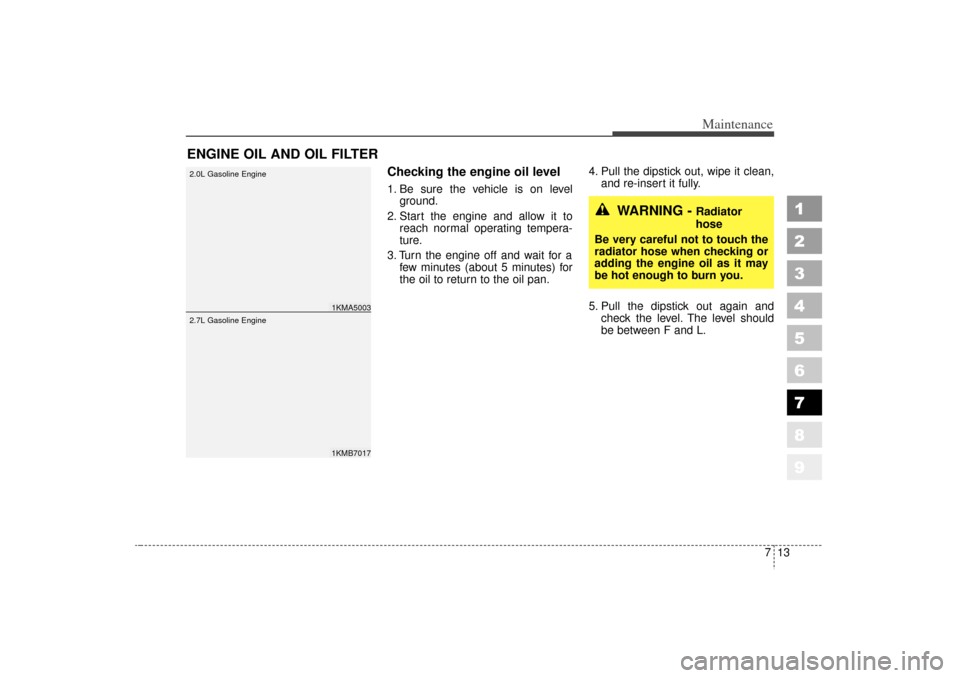
Checking the engine oil level 1. Be sure the vehicle is on levelground.
2. Start the engine and allow it to reach normal operating tempera-
ture.
3. Turn the engine off and wait for a few minutes (about 5 minutes) for
the oil to return to the oil pan. 4. Pull the dipstick out, wipe it clean,
and re-insert it fully.
5. Pull the dipstick out again and check the level. The level should
be between F and L.
1KMB70171KMA5003
2.0L Gasoline Engine2.7L Gasoline Engine
WARNING -
Radiator
hose
Be very careful not to touch the
radiator hose when checking or
adding the engine oil as it may
be hot enough to burn you.
KM CAN (ENG) 7.qxd 7/29/05 9:41 AM Page 13
Page 304 of 354
715
Maintenance
1
2
3
4
5
6
7
8
9
ENGINE COOLING SYSTEMThe high-pressure cooling system
has a reservoir filled with year-round
antifreeze coolant. The reservoir is
filled at the factory.
Check the antifreeze protection and
coolant level at least once a year, at
the beginning of the winter season,
and before traveling to a colder cli-
mate.
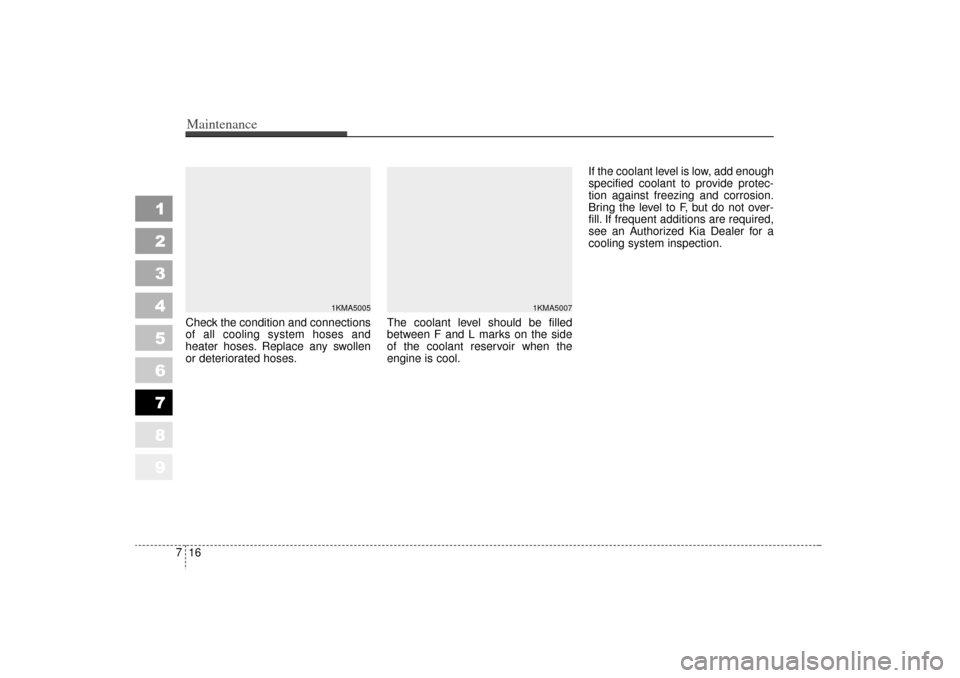
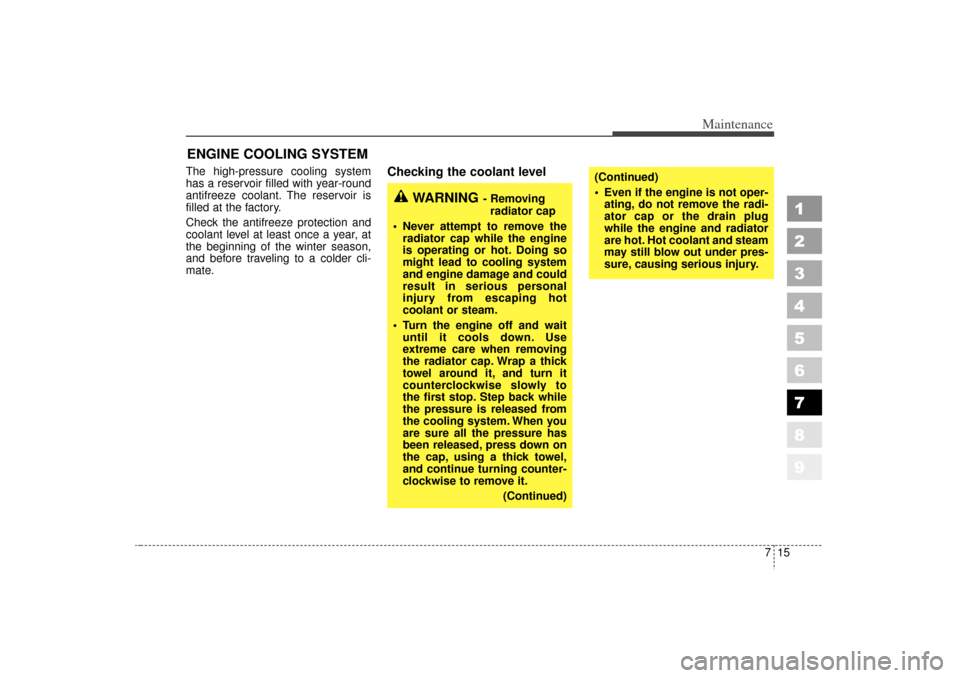
Checking the coolant level
WARNING
- Removingradiator cap
Never attempt to remove the radiator cap while the engine
is operating or hot. Doing so
might lead to cooling system
and engine damage and could
result in serious personal
injury from escaping hot
coolant or steam.
Turn the engine off and wait until it cools down. Use
extreme care when removing
the radiator cap. Wrap a thick
towel around it, and turn it
counterclockwise slowly to
the first stop. Step back while
the pressure is released from
the cooling system. When you
are sure all the pressure has
been released, press down on
the cap, using a thick towel,
and continue turning counter-
clockwise to remove it.
(Continued)
(Continued)
Even if the engine is not oper-ating, do not remove the radi-
ator cap or the drain plug
while the engine and radiator
are hot. Hot coolant and steam
may still blow out under pres-
sure, causing serious injury.
KM CAN (ENG) 7.qxd 7/29/05 9:41 AM Page 15
Page 305 of 354
Maintenance16
7
1
2
3
4
5
6
7
8
9
Check the condition and connections
of all cooling system hoses and
heater hoses. Replace any swollen
or deteriorated hoses. The coolant level should be filled
between F and L marks on the side
of the coolant reservoir when the
engine is cool.If the coolant level is low, add enough
specified coolant to provide protec-
tion against freezing and corrosion.
Bring the level to F, but do not over-
fill. If frequent additions are required,
see an Authorized Kia Dealer for a
cooling system inspection.
1KMA5005
1KMA5007
KM CAN (ENG) 7.qxd 7/29/05 9:41 AM Page 16
Page 308 of 354
719
Maintenance
1
2
3
4
5
6
7
8
9
✽ ✽NOTICEDo not allow brake/clutch fluid to
contact the vehicle's body paint, as
paint damage will result.
Brake/clutch fluid, which has been
exposed to open air for an extended
time should never be used as its
quality cannot be guaranteed. It
should be thrown out. Don't put in
the wrong kind of fluid. A few drops
of mineral-based oil, such as engine
oil, in your brake clutch system can
damage brake clutch system parts.
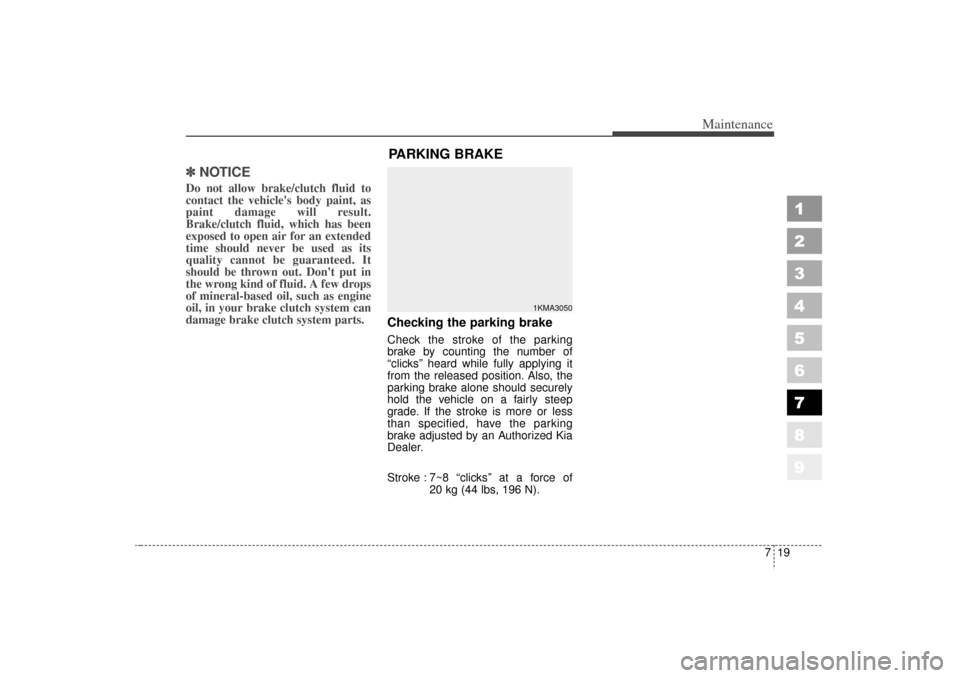
Checking the parking brake Check the stroke of the parking
brake by counting the number of
“clicks’’ heard while fully applying it
from the released position. Also, the
parking brake alone should securely
hold the vehicle on a fairly steep
grade. If the stroke is more or less
than specified, have the parking
brake adjusted by an Authorized Kia
Dealer.
Stroke : 7~8 “clicks’’ at a force of
20 kg (44 lbs, 196 N).
1KMA3050
PARKING BRAKE
KM CAN (ENG) 7.qxd 7/29/05 9:41 AM Page 19
Page 309 of 354
Maintenance20
7
1
2
3
4
5
6
7
8
9
DRIVE BELTS
Checking the compressor
drive beltHave the drive belts checked in
accordance with the maintenance
schedule.
2LDA7002/1KMA7025
➀
P/S pump pulley
➁ Water pump pulley ➂
A/C compressor pulley
➃ Generator pulley \b
Crankshaft pulley
2.0L Gasoline Engine
2.7L Gasoline Engine
➀➀
➃ ➃
➁
\b \b
➂
➂
Drive belts should be checked periodically for proper tension and adjusted
(2.0L only) if necessary. At the same time, belts should be examined for
cracks, wear, fraying or other evidence of deterioration and replaced if nec-
essary.
Belt routing should also be checked to be sure there is no interference
between the belts and other parts of the engine. After a belt is replaced, the
new belt should be adjusted again after two or three weeks to eliminate slack
resulting from initial stretching after use.
KM CAN (ENG) 7.qxd 7/29/05 9:41 AM Page 20
Page 310 of 354
721
Maintenance
1
2
3
4
5
6
7
8
9
POWER STEERING Checking the power steering
fluid level With the vehicle on level ground,
check the fluid level in the power
steering reservoir periodically. The
fluid should be between MAX and
MIN marks on the side of the reser-
voir at the normal temperature.
Before adding power steering fluid,
thoroughly clean the area around the
reservoir cap to prevent power steer-
ing fluid contamination.
If the level is low, add fluid to the
MAX level.In the event the power steering sys-
tem requires frequent addition of
fluid, the vehicle should be inspected
by an Authorized Kia Dealer.
✽ ✽
NOTICE• To avoid damage to the power
steering pump, do not operate the
vehicle for prolonged periods with
a low power steering fluid level.
Never start the engine when the reservoir tank is empty.
When adding fluid, be careful that dirt does not get into the tank.
Too little fluid can make the steer- ing wheel heavier or strange noise
can be generated.
The use of the non-specified fluid could reduce the effectiveness of
the power steering wheel and
cause damage to it.Use only the specified power steer-
ing fluid. (Refer to "Recommended
Lubricants" later in this section.)
Power steering hoseCheck the connections for oil leaks,
severe damage and the twists in the
power steering hose before driving.
1KMN5018
KM CAN (ENG) 7.qxd 7/29/05 9:41 AM Page 21
Page 312 of 354
723
Maintenance
1
2
3
4
5
6
7
8
9
AUTOMATIC TRANSAXLE (IF EQUIPPED)Checking the automatic
transaxle fluid level The automatic transaxle fluid level
should be checked regularly.
The volume of the transaxle fluid
changes with temperature. Although
it is best to check the level after hav-
ing driven the vehicle for at least 30
minutes, the level can be checked
after warming the fluid using the fol-
lowing procedure.1. Park the vehicle on level ground
and firmly apply the parking brake.
2. Allow the engine to idle for about 2 minutes.
3. Depress the brake pedal and move the shift lever slowly through
all ranges then set it in P (Park).
4. With the engine still idling, pull out the dipstick, wipe it clean and rein-
sert it fully.
5. Pull out the dipstick again and check the fluid level.
✽ ✽NOTICE Low fluid level causes transaxle
slippage. Overfilling can cause
foaming, loss of fluid and
transaxle malfunction.
The use of a non-specified fluid could result in transaxle malfunc-
tion and failure.
1KMN5051
WARNING -
Transaxle
fluid
The transaxle fluid level should
be checked when the engine is
at normal operating tempera-
ture. This means that the
engine, radiator, radiator hose
and exhaust system etc., are
very hot. Exercise great care not
to burn yourself during this pro-
cedure.
WARNING
- Parking brake
To avoid sudden movement of
the vehicle, apply parking brake
and depress the brake pedal
before moving the shift lever.
KM CAN (ENG) 7.qxd 7/29/05 9:41 AM Page 23
Page 315 of 354
Maintenance26
7
1
2
3
4
5
6
7
8
9
LUBRICANTS AND FLUIDS Checking the washer fluid
level The reservoir is translucent so that
you can check the level with a quick
visual inspection.
Check the fluid level in the washer
fluid reservoir and add fluid if neces-
sary. Plain water may be used if
washer fluid is not available.
However, use washer solvent with
antifreeze characteristics in cold cli-
mates to prevent freezing.
Body lubrication All moving points of the body, such
as door hinges, hood hinges, and
locks, should be lubricated each time
the engine oil is changed. Use a non-
freezing lubricant on locks during
cold weather.
Make sure the engine hood second-
ary latch keeps the hood from open-
ing when the primary latch is
released.
1KMA5021
WARNING -
Coolant
Do not use radiator coolant or antifreeze in the washer fluid
reservoir.
Radiator coolant can severely obscure visibility when
sprayed on the windshield
and may cause loss of vehicle
control or damage to paint
and body trim.
Windshield Washer fluid agents contain some amounts
of alcohol and can be flamma-
ble under certain circum-
stances. Do not allow sparks
or flame to contact the washer
fluid or the washer fluid reser-
voir. Damage to the vehicle or
it's occupants could occur.
Windshield washer fluid is poisonous to humans and ani-
mals. Do not drink and avoid
contacting windshield washer
fluid. Serious injury or death
could occur.
KM CAN (ENG) 7.qxd 7/29/05 9:41 AM Page 26