Page 316 of 354
727
Maintenance
1
2
3
4
5
6
7
8
9
AIR CLEANER Element replacement Have the air cleaner element
checked and replaced in accordance
with the maintenance schedule.
✽ ✽NOTICEDo not drive with the air cleaner
removed; this will result in excessive
engine wear.
1KMN5010
CAUTION
- Engine
Driving without an air cleaner
encourages backfiring, which
could cause a fire in the engine
compartment.
KM CAN (ENG) 7.qxd 7/29/05 9:41 AM Page 27
Page 322 of 354
733
Maintenance
1
2
3
4
5
6
7
8
9
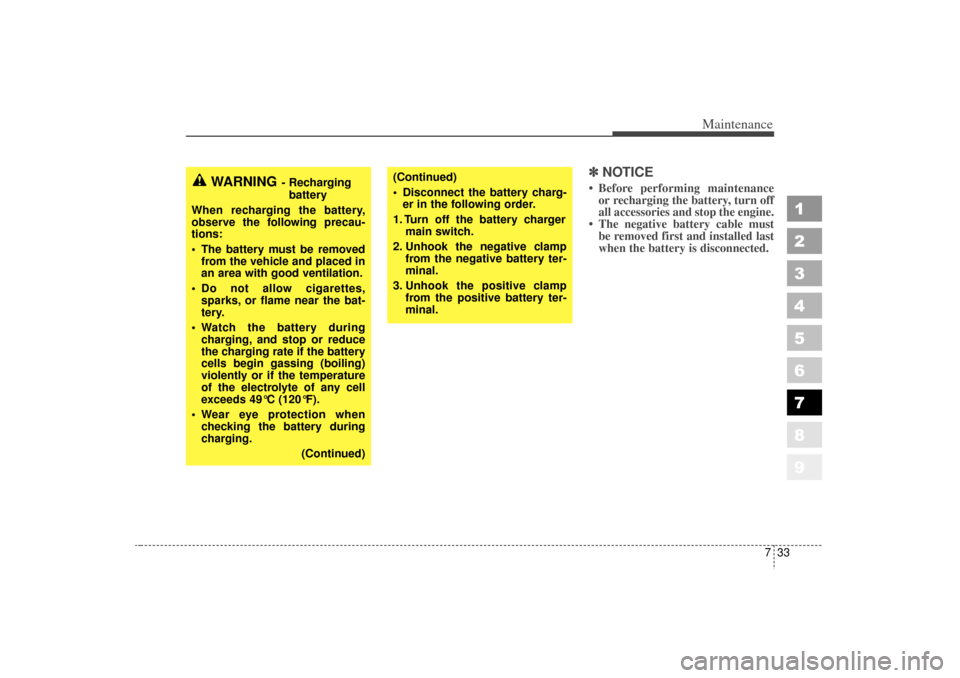
✽ ✽NOTICE Before performing maintenance
or recharging the battery, turn off
all accessories and stop the engine.
The negative battery cable must be removed first and installed last
when the battery is disconnected.
WARNING
- Recharging
battery
When recharging the battery,
observe the following precau-
tions:
The battery must be removed from the vehicle and placed in
an area with good ventilation.
Do not allow cigarettes, sparks, or flame near the bat-
tery.
Watch the battery during charging, and stop or reduce
the charging rate if the battery
cells begin gassing (boiling)
violently or if the temperature
of the electrolyte of any cell
exceeds 49°C (120°F).
Wear eye protection when checking the battery during
charging.
(Continued)
(Continued)
Disconnect the battery charg-er in the following order.
1. Turn off the battery charger main switch.
2. Unhook the negative clamp from the negative battery ter-
minal.
3. Unhook the positive clamp from the positive battery ter-
minal.
KM CAN (ENG) 7.qxd 7/29/05 9:41 AM Page 33
Page 339 of 354
Maintenance50
7
1
2
3
4
5
6
7
8
9
Recommended SAE viscosity
number ✽ ✽
NOTICEAlways be sure to clean the area
around any filler plug, drain plug,
or dipstick before checking or
draining any lubricant. This is espe-
cially important in dusty or sandy
areas and when the vehicle is used
on unpaved roads. Cleaning the plug
and dipstick areas will prevent dirt
and grit from entering the engine
and other mechanisms that could be
damaged.
Engine oil viscosity (thickness) has
an effect on fuel economy and cold
weather operating (starting and oil
flow). Lower viscosity engine oils can
provide better fuel economy and cold
weather performance, however,
higher viscosity engine oils are
required for satisfactory lubrication in
hot weather. Using oils of any viscos-
ity other than those recommended
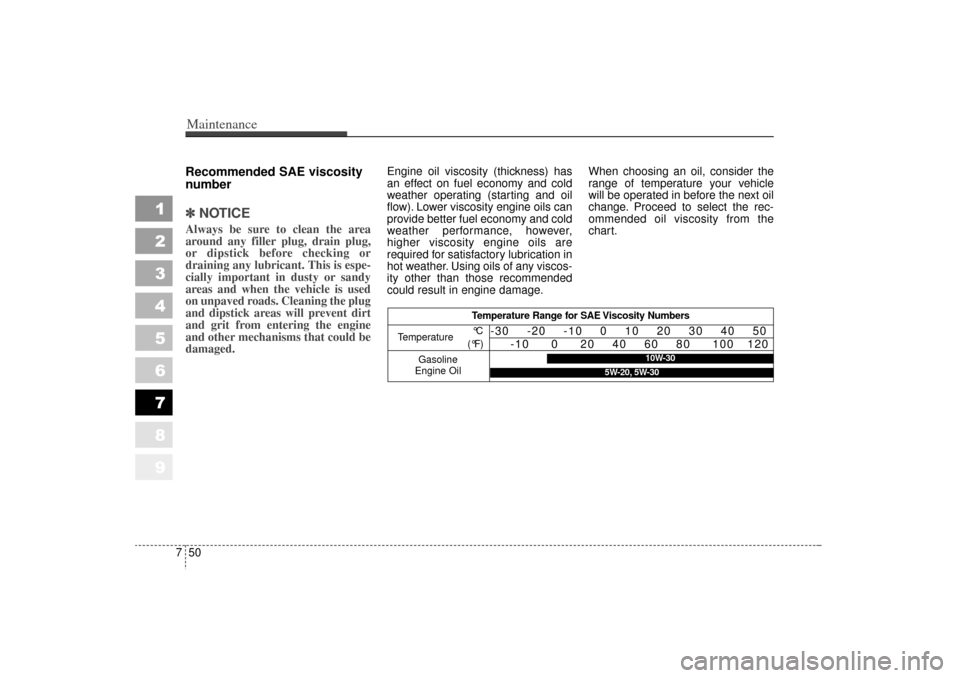
could result in engine damage. When choosing an oil, consider the
range of temperature your vehicle
will be operated in before the next oil
change. Proceed to select the rec-
ommended oil viscosity from the
chart.
Temperature Range for SAE Viscosity Numbers
Temperature
Gasoline
Engine Oil °C
(°F)
-30 -20 -10 0 10 20 30 40 50 -10 0 20 40 60 80 100 120
10W-30
5W-20, 5W-30
KM CAN (ENG) 7.qxd 7/29/05 9:41 AM Page 50
