2006 KIA Sportage check engine
[x] Cancel search: check enginePage 170 of 354
Driving your vehicle50
4
1
2
3
4
5
6
7
8
9
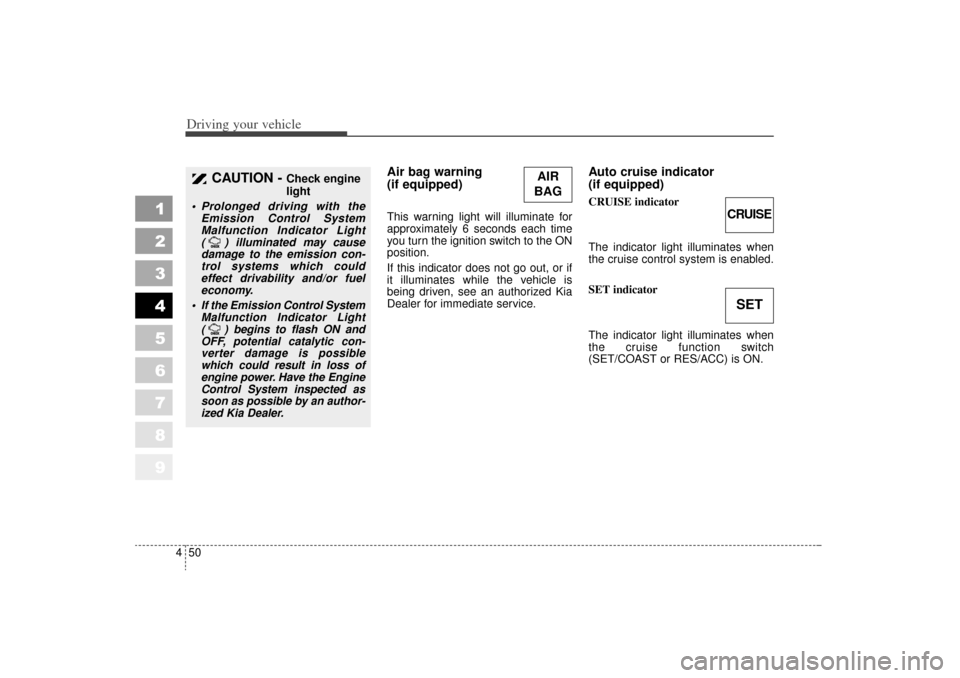
Air bag warning
(if equipped) This warning light will illuminate for
approximately 6 seconds each time
you turn the ignition switch to the ON
position.
If this indicator does not go out, or if
it illuminates while the vehicle is
being driven, see an authorized Kia
Dealer for immediate service.
Auto cruise indicator
(if equipped)CRUISE indicator
The indicator light illuminates when
the cruise control system is enabled.
SET indicator
The indicator light illuminates when
the cruise function switch
(SET/COAST or RES/ACC) is ON.
CAUTION -
Check engine
light
Prolonged driving with the Emission Control System
Malfunction Indicator Light
( ) illuminated may cause
damage to the emission con-
trol systems which could
effect drivability and/or fuel
economy.
If the
Emission
Control System
Malfunction Indicator Light
( ) begins to flash ON and
OFF, potential catalytic con-
verter damage is possible
which could result in loss of
engine power. Have the Engine
Control System inspected as
soon as possible by an author-
ized Kia Dealer.
AIR
BAG
CRUISESET
KM CAN (ENG) 4 new.qxd 7/29/05 9:35 AM Page 50
Page 183 of 354
463
Driving your vehicle
1
2
3
4
5
6
7
8
9
If the washer does not work, check
the washer fluid level. If the fluid level
is not sufficient, you will need to add
appropriate non-abrasive windshield
washer fluid to the washer reservoir.
The reservoir filler neck is located in
the front of the engine compartment
on the passenger side.✽ ✽NOTICETo prevent possible damage to the
washer pump, do not operate the
washer when the fluid reservoir is
empty.
Rear window wiper and wash-
er switch (if equipped)The rear window wiper and washer
switch is located at the end of the
wiper and washer switch lever. Turn
the switch to desired position to
operate the rear wiper and washer.
If the rear hatch window is open
( ), the rear wiper will not oper-
ate. Check the rear hatch window
warning light in the instrument clus-
ter, and make sure the rear hatch
window is closed completely. - Spraying washer fluid and wip-
ing
OFF - Wiper is not in operation
INT - Intermittent wiper operation
ON - Normal wiper opertion - Spraying washer fluid and wip-ing
1KMA2120
WARNING
- Windshield
washer
Do not use the washer in freez-
ing temperatures without first
warming the windshield with the
defrosters; the washer solution
could freeze on contact with the
windshield and obscure your
vision.
KM CAN (ENG) 4 new.qxd 7/29/05 9:35 AM Page 63
Page 215 of 354
53
Driving tips
EMISSION CONTROL SYSTEMThe emission control system of your
vehicle is covered by a written limited
warranty. Please see the warranty
information contained in the
Warranty & Consumer Information
Manual in your vehicle.Vehicle modifications This vehicle should not be modified.
Modification of your Kia could affect
its performance, safety or durability
and may even violate governmental
safety and emissions regulations.
In addition, damage or performance
problems resulting from any modifi-
cation may not be covered under
warranty.
Engine exhaust gas precau-
tions (carbon monoxide) Carbon monoxide can be presentwith other exhaust fumes.
Therefore, if you smell exhaust
fumes of any kind inside your vehi-
cle, have it inspected and repaired
immediately. If you ever suspect
exhaust fumes are coming into
your vehicle, drive it only with all
the windows fully open. Have your
vehicle checked and repaired
immediately. Do not operate the engine in con-
fined or closed areas (such as
garages) any more than what is
necessary to move the vehicle in or
out of the area.
When the vehicle is stopped in an open area for more than a short
time with the engine running,
adjust the ventilation system (as
needed) to draw outside air into the
vehicle.
Never sit in a parked or stopped vehicle for any extended time with
the engine running.
When the engine stalls or fails to start, excessive attempts to re-
start the engine may cause dam-
age to the emission control sys-
tem.
1
2
3
4
5
6
7
8
9
WARNING -
Exhaust
Engine exhaust gases contain
carbon monoxide (CO). Though
colorless and odorless, it is
dangerous and could be lethal if
inhaled. Follow the instructions
following to avoid CO poison-
ing.
KM CAN (ENG) 5 new.qxd 7/29/05 9:38 AM Page 3
Page 217 of 354
55
Driving tips
BEFORE DRIVING Before entering vehicle: Be sure that all windows, outsidemirror(s), and outside lights are
clean.
Check the condition of the tires.
Check under the vehicle for any sign of leaks.
Be sure there are no obstacles behind you if you intend to back up.Necessary inspections Fluid levels, such as engine oil,
engine coolant, brake fluid, and
washer fluid should be checked on a
regular basis, with the exact interval
depending on the fluid. Further
details are provided in Section 7,
Maintenance.
Before starting Close and lock all doors.
Position the seat so that all con-trols are easily reached.
Adjust the inside and outside rearview mirrors.
Be sure that all lights work.
Check all gauges.
Check the operation of warning lights when the ignition switch is
turned to the ON position.
Release the parking brake and make sure the brake warning light
goes out.
For safe operation, be sure you are
familiar with your vehicle and its
equipment.
1
2
3
4
5
6
7
8
9
WARNING
- Driving under
the influence of alcohol or
drugs
Drinking and driving is danger-
ous. Drunk driving is the num-
ber one contributor to the high-
way death toll each year. Even a
small amount of alcohol will
affect your reflexes, perceptions
and judgement. Driving while
under the influence of drugs is
as dangerous or more danger-
ous than driving drunk.
You are much more likely to
have a serious accident if you
drink or take drugs and drive.
If you are drinking or taking
drugs, don’t drive. Do not ride
with a driver who has been
drinking or taking drugs.
Choose a designated driver or
call a cab.
KM CAN (ENG) 5 new.qxd 7/29/05 9:38 AM Page 5
Page 222 of 354
Driving tips10
5
1
2
3
4
5
6
7
8
9
Driving in the rain Rain and wet roads can make driving
dangerous, especially if you’re not
prepared for the slick pavement.
Here are a few things to consider
when driving in the rain:
A heavy rainfall will make it harder
to see and will increase the dis-
tance needed to stop your vehicle,
so slow down.
Keep your windshield wiping equipment in good shape. Replace
your windshield wiper blades when
they show signs of streaking or
missing areas on the windshield. If your tires are not in good condi-
tion, making a quick stop on wet
pavement can cause a skid and
possibly lead to an accident. Be
sure your tires are in good shape.
Turn on your headlights to make it easier for others to see you.
Driving too fast through large pud- dles can affect your brakes. If you
must go through puddles, try to
drive through them slowly.
If you believe you may have gotten your brakes wet, apply them lightly
while driving until normal braking
operation returns.
Winter driving We recommend that you carryemergency equipment, including
tire chains, a window scraper,
windshield de-icer, a bag of sand
or salt, flares, a small shovel and
jumper cables.
Make sure you have sufficient eth- ylene-glycol coolant in the radiator.
Check the battery condition and cables. Cold temperatures reduce
the capacity of any battery, so it
must be in excellent condition to
provide enough winter starting
power.
Make sure the engine oil viscosity is suitable for cold weather.
Check the ignition system for loose connections and damage.
KM CAN (ENG) 5 new.qxd 7/29/05 9:38 AM Page 10
Page 223 of 354
511
Driving tips
1
2
3
4
5
6
7
8
9
Use antifreeze-formulated wind-shield washer fluid. (Do not use
engine coolant antifreeze.)
Do not use the parking brake if it might freeze. When parking, shift
to 1 (First) or R (Reverse) with a
manual transaxle or P (Park) with
an automatic transaxle and block
the rear wheels. Snow tires
If you mount snow tires on your Kia,
make sure they are radial tires of the
same size and load range as the
original tires. Mount snow tires on all
four wheels to balance your vehicle’s
handling in all weather conditions.
Keep in mind that the traction provid-
ed by snow tires on dry roads may
not be as high as your vehicle's orig-
inal equipment tires. You should drive
cautiously even when the roads are
clear. Check with the tire dealer for
maximum speed recommendations.
Do not install studded tires without
first checking local, state and munic-
ipal regulations for possible restric-
tions against their use.
WARNING
- Snow tire
size
Snow tires should be equivalent
in size and type to the vehicle's
standard tires. Otherwise, the
safety and handling of your
vehicle may be adversely affect-
ed.
KM CAN (ENG) 5 new.qxd 7/29/05 9:38 AM Page 11
Page 226 of 354
Driving tips14
5
1
2
3
4
5
6
7
8
9
USING FOUR-WHEEL DRIVEDriving on snow- or Ice-cov-
ered roads (“4WD LOCK” for
full-time 4WD operation) Use snow tires or tire chains. See
“Tires” and “Tire Chains” in this
section for more information.
Keep an adequate distance between yourself and other vehi-
cles.
Avoid sudden braking, acceleration or steering. These actions can
cause your vehicle to lose traction.
Driving in sand or mud (“4WD
LOCK” for full-time 4WD opera-
tion) Avoid sudden braking, accelerationor steering. These actions can
cause your vehicle to get stuck in
the sand or mud.
Drive at low speeds whenever pos- sible.
Use tire chains on all four wheels when driving in mud, if necessary.
In some unavoidable circum-
stances, install them on only the
front wheels, not the rear wheels.
You may need to get out of your vehicle at times to check road con-
ditions.
If you get stuck in the sand or mud, try placing stones, wood or other
similar materials under the tires to
get traction, or move forward and
backward repeatedly to get
unstuck.
✽ ✽
NOTICEProlonged rocking may cause engine
damage, overheating, transaxle dif-
ferential or transfer case damage or
failure and tire damage.
WARNING
- Traction
Make sure that no one stands in
front of or behind the tires when
materials are placed under the
tires to get more traction. The
tires may cause loose materials
to fly out from under the vehicle,
potentially causing serious bod-
ily injury or death.
KM CAN (ENG) 5 new.qxd 7/29/05 9:38 AM Page 14
Page 228 of 354
Driving tips16
5
1
2
3
4
5
6
7
8
9
Off-road driving with your
four-wheel drive vehicleOff-road driving can be great fun. But
it has definite hazards. The greatest
of these is the terrain itself.
“Off-roading” means you’ve left the
paved road system behind. Traffic
lanes are not marked. Curves are not
banked.
There are no carefully engineered
road signs to warn you of dangerous
conditions or to advise you of a safe
speed. You have to assess the envi-
ronment yourself. Surfaces can be
slippery, rough, uphill or downhill.
Off-road driving involves learning
new skills. That’s why it’s important
that you read and understand this
section. You’ll find useful driving
information and suggestions. These
will help make your off-road driving
safer and more enjoyable. Before you go off-roading
There are some things to do before
you leave the paved roads. Be sure
to have all necessary maintenance
and service work done beforehand.
Be sure to read all the information
about your four-wheel drive vehicle
in this manual. Is there enough fuel?
Is the spare tire fully inflated? Are the
fluid levels at the proper levels? What
are the local laws that apply to off-
roading where you’ll be driving? If
you don’t know, you should check
with law enforcement people in the
area. Will you be on someone’s pri-
vate land? If so, be sure to get the
necessary permission.
Loading your vehicle for off-road
driving
There are some important items to
remember about how to properly
load your vehicle.
The heaviest things should be in
the cargo area and forward of your
rear axle. Place heavier items as
far forward as you can.
Be sure the load is properly secured, so driving over off-road
terrain doesn’t shift your load or
throw items toward the driver or
passengers.
KM CAN (ENG) 5 new.qxd 7/29/05 9:38 AM Page 16