2006 KIA Sportage ECU
[x] Cancel search: ECUPage 25 of 354
Knowing your vehicle68
3
1
2
3
4
5
6
7
8
9
If the curtain airbag deploys, it
remains inflated for approximately
3 seconds. The curtain airbag
deployment occurs only on the
side of the vehicle affected by the
impact.
The side airbags (side and curtain airbags) are not designed to
deploy during collisions from the
front or rear of the vehicle or in
most rollover situations.
The curtain airbags are designed to deploy only during certain side-
impact collisions, depending on the
crash severity, angle, speed and
impact. The curtain airbags are not
designed to deploy in all side
impact situations.
WARNING
In order for side airbags (sideand curtain airbags) to pro-
vide their best protection,
occupants should sit in an
upright position with the seat
belts properly fastened.
Children must be seated in the proper child restraint system.
Make sure to secure the child
restraint system in a locked
position.
(Continued)
(Continued)
Advise occupants not to leantheir heads or bodies onto
doors, and not to place
objects between the doors
and them since this may
defeat operation of the side
airbags.
Never try to open or repair any components of the side cur-
tain airbag system. This
should only be done by an
authorized Kia dealer.
Failure to follow the above men-
tioned instructions can result in
injury or death to the vehicle
occupants in an accident.
KM CAN (ENG) 3 (55~)new.qxd 7/29/05 9:37 AM Page 68
Page 31 of 354
Knowing your vehicle74
3
1
2
3
4
5
6
7
8
9
How does the airbag system
operate Airbags only operate when the
ignition switch is turned to the ON
or START positions.
Airbags inflate instantly in the event of serious frontal or side col-
lision in order to help protect the
occupants from physical injury.
The airbag Electronic Control Unit
(ECU) is a small computer which
calculates the immediate impact
information and sends out a
deployment signal based on the
ECU's calculation of the likely
severity of the developing collision.
There is no single vehicle speed at which the airbags will inflate. Airbag deployment depends on a
number of factors including vehicle
speed, angles of impact and the
density and stiffness of the vehi-
cles or objects which your vehicle
hits in the collision. However, fac-
tors are not limited to those men-
tioned above.
The front airbags will completely inflate and deflate in an instant.
It is impossible for you to see the
airbags inflate during an accident.
It is much more likely that you will
simply see the deflated airbags
hanging out of their storage com-
partments after the collision. In order to help provide protection
in a severe collision, the airbags
must inflate rapidly. The speed of
airbag inflation has been deter-
mined by the Canadian Motor
Vehicle Safety Standard (CMVSS)
to reduce the likelihood of serious
or life-threatening injuries and is
thus a mandatory part of the airbag
design.
However, airbag inflation can also
cause injuries which normally can
include facial abrasions, bruises
and broken bones, and sometimes
more serious injuries because that
inflation speed also causes the
airbags to expand with a great deal
force.
There are even circumstances under which contact with the
steering wheel airbag can cause
fatal injuries, especially if the
occupant is positioned exces-
sively close to the steering
wheel.
KM CAN (ENG) 3 (55~)new.qxd 7/29/05 9:37 AM Page 74
Page 33 of 354
Knowing your vehicle76
3
1
2
3
4
5
6
7
8
9
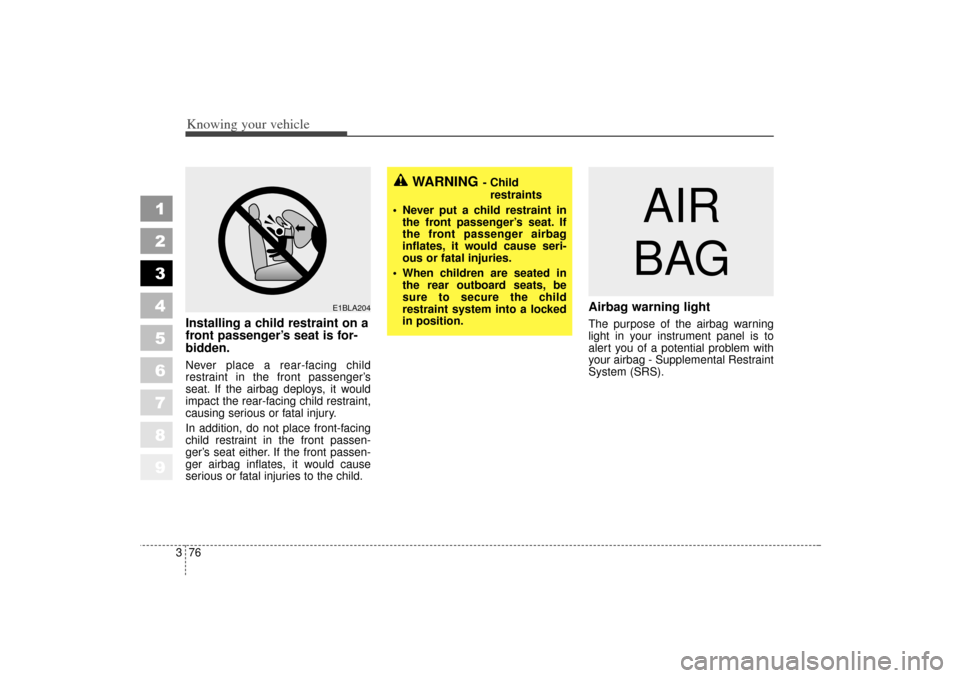
Installing a child restraint on a
front passenger’s seat is for-
bidden.Never place a rear-facing child
restraint in the front passenger’s
seat. If the airbag deploys, it would
impact the rear-facing child restraint,
causing serious or fatal injury.
In addition, do not place front-facing
child restraint in the front passen-
ger’s seat either. If the front passen-
ger airbag inflates, it would cause
serious or fatal injuries to the child.
Airbag warning lightThe purpose of the airbag warning
light in your instrument panel is to
alert you of a potential problem with
your airbag - Supplemental Restraint
System (SRS).
WARNING
- Child
restraints
Never put a child restraint in the front passenger’s seat. If
the front passenger airbag
inflates, it would cause seri-
ous or fatal injuries.
When children are seated in the rear outboard seats, be
sure to secure the child
restraint system into a locked
in position.
AIR
BAG
E1BLA204
KM CAN (ENG) 3 (55~)new.qxd 7/29/05 9:37 AM Page 76
Page 38 of 354
381
1
2
3
4
5
6
7
8
9
Knowing your vehicle
Closing the hood1. Before closing the hood, check thefollowing:
All filler caps in engine compart- ment must be correctly installed.
Gloves, rags or any other com- bustible material must be
removed from the engine com-
partment.
2. Secure the support rod in its clip.
3. Lower the hood to about 30 cm (12 inches) height and then let it
drop to properly lock in place.
Make sure the hood is properly
locked before driving.
CAUTION -
Hood
Before closing the hood, make sure that all engine parts and
tools have been removed from
the engine area and that no
one’s hands are near the hood
opening.
Do not leave gloves, rags or any other combustible materi-
al in the engine compartment.
Doing so may cause a heat-
induced fire.
KM CAN (ENG) 3 (55~)new.qxd 7/29/05 9:37 AM Page 81
Page 39 of 354
Knowing your vehicle82
3
1
2
3
4
5
6
7
8
9
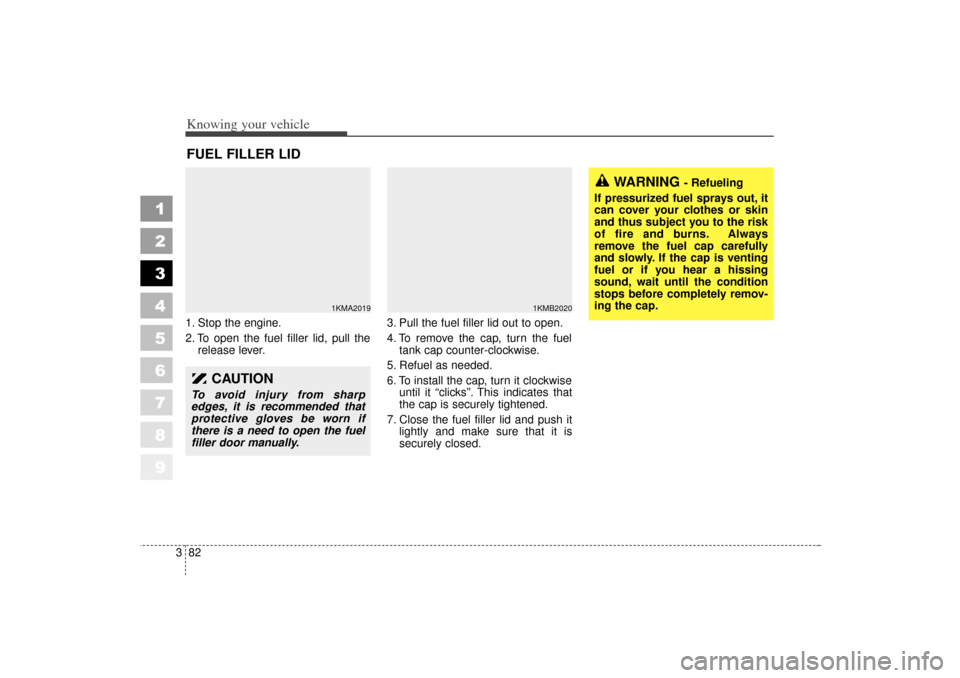
1. Stop the engine.
2. To open the fuel filler lid, pull the
release lever. 3. Pull the fuel filler lid out to open.
4. To remove the cap, turn the fuel
tank cap counter-clockwise.
5. Refuel as needed.
6. To install the cap, turn it clockwise until it “clicks”. This indicates that
the cap is securely tightened.
7. Close the fuel filler lid and push it lightly and make sure that it is
securely closed.FUEL FILLER LID
1KMA2019
1KMB2020
WARNING
- Refueling
If pressurized fuel sprays out, it
can cover your clothes or skin
and thus subject you to the risk
of fire and burns. Always
remove the fuel cap carefully
and slowly. If the cap is venting
fuel or if you hear a hissing
sound, wait until the condition
stops before completely remov-
ing the cap.
CAUTION
To avoid injury from sharp
edges, it is recommended that
protective gloves be worn if
there is a need to open the fuel
filler door manually.
KM CAN (ENG) 3 (55~)new.qxd 7/29/05 9:37 AM Page 82
Page 40 of 354
383
1
2
3
4
5
6
7
8
9
Knowing your vehicle
WARNING -
Refueling
dangers
Automotive fuels are flammable
materials. When refueling,
please note the following guide-
lines carefully. Failure to follow
these guidelines may result in
severe personal injury, severe
burns or death by fire or explo-
sion.
Before refueling note the loca- tion of the Emergency
Gasoline Shut-Off, if available,
at the gas station facility.
Before touching the fuel noz- zle, you should eliminate
potentially dangerous static
electricity discharge by touch-
ing another metal part of the
vehicle, a safe distance away
from the fuel filler neck, noz-
zle, or other gas source.
(Continued)
(Continued)
Do not get back into a vehicleonce you have begun refuel-
ing since you can generate
static electricity by touching,
rubbing or sliding against any
item or fabric (polyester, satin,
nylon, etc.) capable of produc-
ing static electricity. Static
electricity discharge can
ignite fuel vapors resulting in
rapid burning. If you must re-
enter the vehicle, you should
once again eliminate poten-
tially dangerous static elec-
tricity discharge by touching a
metal part of the vehicle, away
from the fuel filler neck, nozzle
or other gasoline source.
When using a portable fuel container be sure to place the
container on the ground prior
to refueling. Static electricity
discharge from the container
can ignite fuel vapors causing
a fire. Once refueling has
begun, contact with the vehi-
cle should be maintained until
the filling is complete.
(Continued)
(Continued)
Use only portable plastic fuel
containers designed to carry
and store gasoline.
Do not use cellular phones while refueling. Electric cur-
rent and/or electronic interfer-
ence from cellular phones can
potentially ignite fuel vapors
causing a fire.
When refueling, always shut the engine off. Sparks pro-
duced by electrical compo-
nents related to the engine
can ignite fuel vapors causing
a fire. Once refueling is com-
plete, check to make sure the
filler cap and filler door are
securely closed, before start-
ing the engine.
(Continued)
KM CAN (ENG) 3 (55~)new.qxd 7/29/05 9:37 AM Page 83
Page 41 of 354
Knowing your vehicle84
3
1
2
3
4
5
6
7
8
9
✽ ✽
NOTICE Make sure to refuel with unleaded
fuel only.
Check to make sure the fuel filler cap is securely closed after refuel-
ing. A loose fuel filler cap may
cause the "Check Engine"
(Malfunction Indicator) light in
the instrument panel to illuminate
unnecessarily.
If the fuel filler cap requires replacement, use only a genuine
Kia cap or the equivalent specified
for your vehicle. An incorrect fuel
filler cap can result in a serious
malfunction of the fuel system or
emission control system.
Do not spill fuel on the exterior surfaces of the vehicle. Any type of
fuel spilled on painted surfaces
may damage the paint.
(Continued)
DO NOT use matches or a
lighter and DO NOT SMOKE or
leave a lit cigarette in your
vehicle while at a gas station
especially during refueling.
Automotive fuel is highly flam-
mable and can, when ignited,
result in fire.
If a fire breaks out during refu- eling, leave the vicinity of the
vehicle, and immediately con-
tact the manager of the gas
station and then contact the
local fire department or 911.
KM CAN (ENG) 3 (55~)new.qxd 7/29/05 9:37 AM Page 84
Page 48 of 354

391
1
2
3
4
5
6
7
8
9
Knowing your vehicle
✽ ✽NOTICE To avoid possible theft, do not
leave valuables in the storage com-
partment.
Always keep the storage compart- ment covers closed while driving.
Do not attempt to place so many
items in the storage compartment
that the storage compartment
cover can not close securely.
STORAGE COMPARTMENT
WARNING -
Flammable
materials
Do not store cigarette lighters,
propane cylinders, or other
flammable/explosive materials
in the vehicle. These items may
catch fire and/or explode if the
vehicle is exposed to hot tem-
peratures for extended periods.
These compartments can be used to store small items required by the
driver or passengers.
1KMB2167
KM CAN (ENG) 3 (55~)new.qxd 7/29/05 9:37 AM Page 91