Page 94 of 354
Knowing your vehicle28
3
1
2
3
4
5
6
7
8
9
To unfold the rear seat;
1. Pull the lock release lever located
on the top of the seatback.
2. Lift and push the seatback back- ward firmly until it clicks into place.
Make sure the seatback is locked
in place.
3. Return the rear safety belt to the proper position.
WARNING
- Cargo
Cargo should always be
secured to prevent it from being
thrown about the vehicle in a
collision and causing injury to
the vehicle occupants. Special
care should be taken of objects
placed in the rear seats, since
those may hit the front seat
occupants in a frontal collision.
CAUTION -
Cargo loading
Make sure the engine is off, the
transaxle is in P and the parking
brake is applied whenever load-
ing or unloading cargo. Failure
to take these steps may allow
the vehicle to move if shift lever
is inadvertently moved to anoth-
er position.
CAUTION -
Rear floor
Do not remove the floor carpet
in your vehicle. Emission con-
trol system components in the
area of the rear seats cause
high exhaust temperatures
under the floor.
KM CAN (ENG) 3 (~54)new.qxd 7/29/05 9:33 AM Page 28
Page 100 of 354
Knowing your vehicle34
3
1
2
3
4
5
6
7
8
9
The rear safety belts use a special
auto-lock feature designed to allow a
child restraint to be used in these
positions without an added locking
clip. They normally lock only under
extreme or emergency conditions
(emergency lock mode). However
they can be adjusted so that they
remain fixed and locked when a child
restraint system is placed in these
positions. (Use this auto-lock mode
only to secure a child restraint, never
for passengers restrained by the
safety belts.) Page 3-48 gives
instructions on placing the safety belt
in the auto lock mode.
The drivers safety belt can only oper-
ate in the emergency lock mode. Safety belts provide the best restraint
when:
The seatback is upright.
The occupant is sitting upright (not
slouched).
The lap belt is snug across the hips.
The shoulder belt is snug across the chest.
The knees are straight forward.
To help you remember to fasten your
safety belt, a warning light will blink.
See “Safety belt warning light and
chime” on page 3-36.
WARNING
- After a colli- sion
Lap/shoulder belt assemblies may be stretched or damaged
when subjected to the stress
and forces of a collision.
The entire restraint system should be inspected following
any collision. All belts, retrac-
tors, anchors and hardware
damaged by a collision should
be replaced before the vehicle
is operated again.
WARNING -
Cargo area
Passengers should never be
allowed to ride in the cargo area
of a vehicle. No safety belts are
provided for the cargo area.
Persons riding in the vehicle
without a fastened safety belt
are much more likely to suffer
serious bodily injury or death
during an accident.
KM CAN (ENG) 3 (~54)new.qxd 7/29/05 9:33 AM Page 34
Page 105 of 354
339
Knowing your vehicle
1
2
3
4
5
6
7
8
9
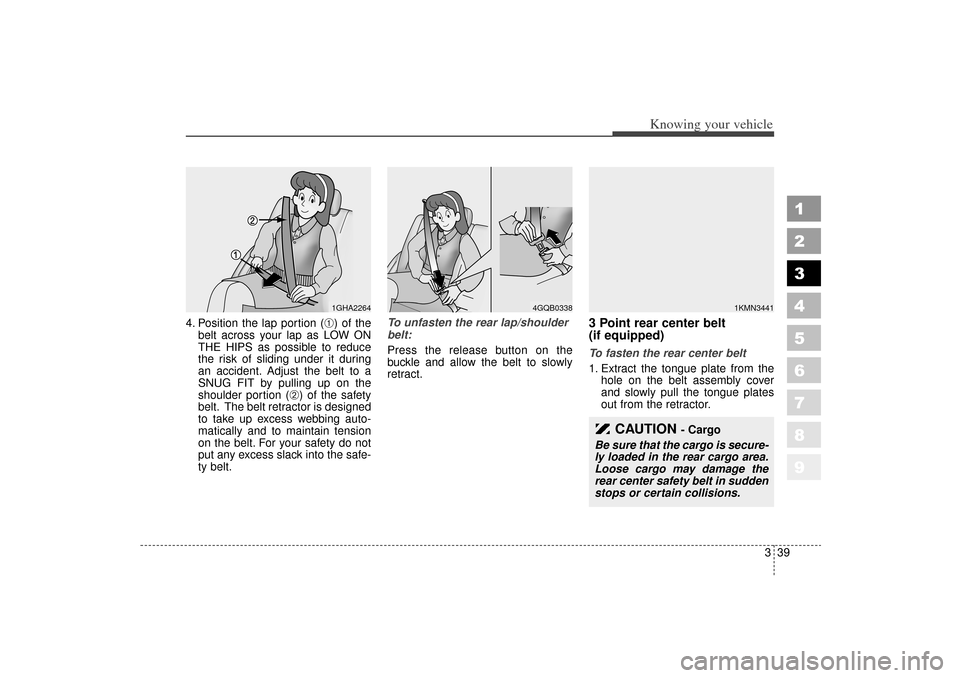
4. Position the lap portion (
➀) of the
belt across your lap as LOW ON
THE HIPS as possible to reduce
the risk of sliding under it during
an accident. Adjust the belt to a
SNUG FIT by pulling up on the
shoulder portion (
➁) of the safety
belt. The belt retractor is designed
to take up excess webbing auto-
matically and to maintain tension
on the belt. For your safety do not
put any excess slack into the safe-
ty belt. To unfasten the rear lap/shoulder
belt:
Press the release button on the
buckle and allow the belt to slowly
retract.
3 Point rear center belt
(if equipped) To fasten the rear center belt
1. Extract the tongue plate from the
hole on the belt assembly cover
and slowly pull the tongue plates
out from the retractor.
1GHA2264
4GQB0338
1KMN3441
CAUTION
- Cargo
Be sure that the cargo is secure-
ly loaded in the rear cargo area.
Loose cargo may damage the
rear center safety belt in sudden
stops or certain collisions.
KM CAN (ENG) 3 (~54)new.qxd 7/29/05 9:33 AM Page 39
Page 111 of 354
345
Knowing your vehicle
1
2
3
4
5
6
7
8
9
Child restraint system For small children and babies, the
use of a child seat or infant seat is
strongly recommended and is
required by law in almost all states.
This child seat or infant seat should
be of appropriate size for the child
and should be installed in accor-
dance with the manufacturer's
instructions.
Children riding in the car should sit
on the rear seat and must always be
properly restrained to minimize the
risk of injury in an accident, sudden
stop or sudden maneuver. According
to accident statistics, children are
safer when properly restrained in the
rear seats than in the front seat.Children could be injured or killed in
a crash if their restraints are not
properly secured. For small children
and babies, a child seat or infant seat
must be used. Before buying a par-
ticular child restraint system, make
sure it fits your car and seat belts,
and fits your child. Follow all the
instructions provided by the child
seat manufacturer when installing
the child restraint system.
WARNING
- Shoulder
belts on small children
Never allow a shoulder belt to be in contact with a child’s
neck or face while the vehicle
is in motion.
If safety belts are not properly worn and adjusted, there is a
risk of death or serious injury
to such a child.
KM CAN (ENG) 3 (~54)new.qxd 7/29/05 9:33 AM Page 45
Page 113 of 354
347
Knowing your vehicle
1
2
3
4
5
6
7
8
9
Installing a child restraint system
For safety reasons, we recommend
that the child restraint system be
used in the rear seats.
Never place a rear-facing child
restraint in the front passenger
seat, because of the danger that
an inflating passenger side air bag
could impact the rear-facing child
restraint and kill the child.
Since all passenger safety belts
move freely under normal conditions
and only lock under extreme or
emergency conditions (emergency
lock mode), you must manually
change these safety belts to the auto
lock mode to secure a child restraint.
(Continued)
Never allow a child to stand upor kneel while the vehicle is
moving.
Never use an infant carrier or child seat that "hooks" over a
seatback. It will not provide
adequate protection in an
accident.
Never allow a child to be held while they are in a moving
vehicle, as this could result in
serious injury to the child in
the event of an accident or a
sudden stop. Holding a child
in a moving vehicle does not
provide the child with any pro-
tection during an accident,
even if the person holding the
child is wearing a seat belt.
WARNING
- Child seat
installation
Before installing the child restraint system, read the
instructions supplied by the
child restraint system manu-
facturer.
If the safety belt does not operate as described in this
section, have the system
checked immediately by your
authorized Kia dealer.
Failure to observe this manu- al's instructions regarding
child restraint system and the
instructions provided with the
child restraint system could
increase the chance and/or
severity of injury in an acci-
dent.
KM CAN (ENG) 3 (~54)new.qxd 7/29/05 9:33 AM Page 47
Page 114 of 354
Knowing your vehicle48
3
1
2
3
4
5
6
7
8
9
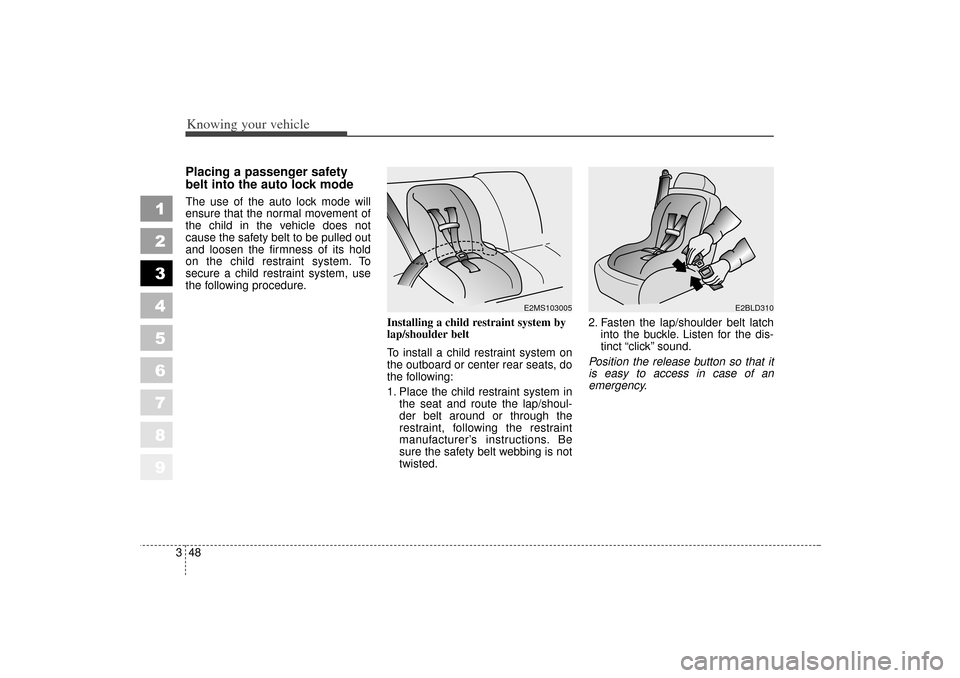
Placing a passenger safety
belt into the auto lock modeThe use of the auto lock mode will
ensure that the normal movement of
the child in the vehicle does not
cause the safety belt to be pulled out
and loosen the firmness of its hold
on the child restraint system. To
secure a child restraint system, use
the following procedure.
Installing a child restraint system by
lap/shoulder belt
To install a child restraint system on
the outboard or center rear seats, do
the following:
1. Place the child restraint system inthe seat and route the lap/shoul-
der belt around or through the
restraint, following the restraint
manufacturer’s instructions. Be
sure the safety belt webbing is not
twisted. 2. Fasten the lap/shoulder belt latch
into the buckle. Listen for the dis-
tinct “click” sound.
Position the release button so that it
is easy to access in case of an
emergency.
E2MS103005
E2BLD310
KM CAN (ENG) 3 (~54)new.qxd 7/29/05 9:33 AM Page 48
Page 116 of 354
Knowing your vehicle50
3
1
2
3
4
5
6
7
8
9
7. Double check that the retractor is
in the “Auto Lock” mode by
attempting to pull more of the safe-
ty belt out of the retractor. If you
cannot, the retractor is in the “Auto
Lock” mode.
To remove the child restraint, press
the release button on the buckle and
then pull the lap/shoulder belt out of
the restraint and allow the safety belt
to retract fully.
When the safety belt is allowed to
retract to its fully stowed position,
the retractor will automatically
switch from the “Auto Lock” mode
to the emergency lock mode for
normal adult usage.Securing a child restraint seat
with “Tether Anchor” system
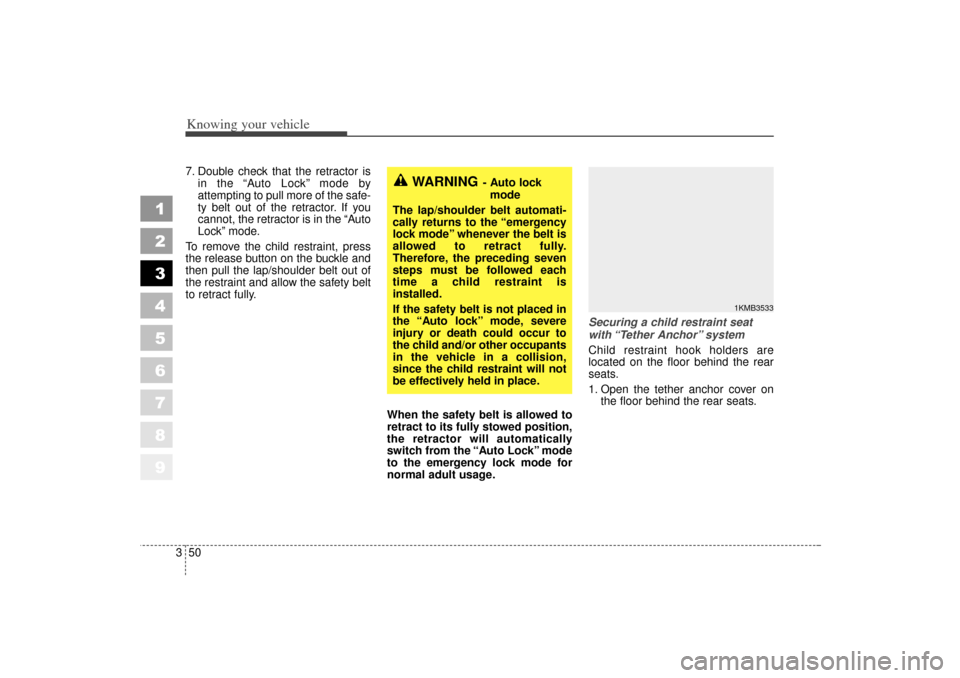
Child restraint hook holders are
located on the floor behind the rear
seats.
1. Open the tether anchor cover on
the floor behind the rear seats.
WARNING
- Auto lock
mode
The lap/shoulder belt automati-
cally returns to the “emergency
lock mode” whenever the belt is
allowed to retract fully.
Therefore, the preceding seven
steps must be followed each
time a child restraint is
installed.
If the safety belt is not placed in
the “Auto lock” mode, severe
injury or death could occur to
the child and/or other occupants
in the vehicle in a collision,
since the child restraint will not
be effectively held in place.
1KMB3533
KM CAN (ENG) 3 (~54)new.qxd 7/29/05 9:33 AM Page 50
Page 117 of 354
351
Knowing your vehicle
1
2
3
4
5
6
7
8
9
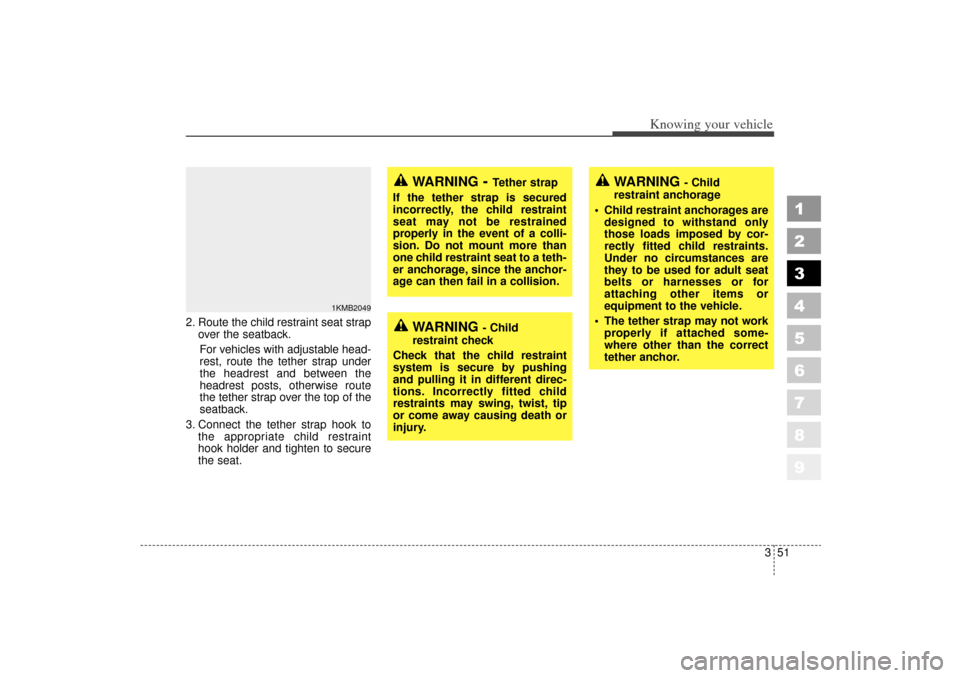
2. Route the child restraint seat strapover the seatback.
For vehicles with adjustable head-
rest, route the tether strap under
the headrest and between the
headrest posts, otherwise route
the tether strap over the top of the
seatback.
3. Connect the tether strap hook to the appropriate child restraint
hook holder and tighten to secure
the seat.
1KMB2049
WARNING
- Tether strap
If the tether strap is secured
incorrectly, the child restraint
seat may not be restrained
properly in the event of a colli-
sion. Do not mount more than
one child restraint seat to a teth-
er anchorage, since the anchor-
age can then fail in a collision.
WARNING
- Child
restraint check
Check that the child restraint
system is secure by pushing
and pulling it in different direc-
tions. Incorrectly fitted child
restraints may swing, twist, tip
or come away causing death or
injury.
WARNING
- Child
restraint anchorage
Child restraint anchorages are designed to withstand only
those loads imposed by cor-
rectly fitted child restraints.
Under no circumstances are
they to be used for adult seat
belts or harnesses or for
attaching other items or
equipment to the vehicle.
The tether strap may not work properly if attached some-
where other than the correct
tether anchor.
KM CAN (ENG) 3 (~54)new.qxd 7/29/05 9:33 AM Page 51