Page 1990 of 5267
a. The connecting rod split/face mustface toward the same side as the piston notch feature on the skirt. The
split face will face toward the exhaust side of the engine if properly installed.
11. Install the rod cap and bolts to the connecting rod. Tighten the connecting rod bolts evenly in 3 steps.
Tighten the bolts to 30 Nꞏm (22 ft. lbs.) torque.
Tighten the bolts to 60 Nꞏm (44 ft. lbs.) torque.
Rotate 60° clockwise.
12. The crankshaft must rotate freely. Check for freedom of rotation as thecaps are installed. If the crankshaft does
not rotate freely, check the installation of the rod bearing and the bearingsize.
13. Measure the side clearance between the connecting rod and the crankshaft. DO NOT measure the clearance
between the cap and crankshaft.
14. Install J-jet piston cooling nozzles.
15. Install block stiffener. Torque to 43 Nꞏm (32 ft. lbs.).
16. Install the suction tube and oil pan (Refer to 9 - ENGINE/LUBRICATION/OIL PAN - INSTALLATION).
17. Install the cylinder head onto the engine (Refer to 9 - ENGINE/CYLINDERHEAD - INSTALLATION).
18. Install a new filter and fill the crankcase with new engine oil.Prefill the filter with clean oil.
19. Connect the battery negative cables and start engine.
Page 2007 of 5267
SWITCH - OIL PRESSURE
REMOVAL
1. Disconnect the battery negative cables.
2. Disconnect the oil pressure switch connector.
3. Usingasuitablesocket,removetheoil pressure switch from the block (counter-clockwise).
INSTALLATION
1. If the switch is not being replaced, replace and lubricate the o-ring.
2. Install the oil pressure switch and tighten to 18 Nꞏm (159 in. lbs.) torque.
3. Connect oil pressure switch connector.
4. Connect the battery negative cables.
5. Start engine and check for oil leaks at the switch.
Page 2015 of 5267
VALVE TIMING
STANDARD PROCEDURE - TIMING VERIFICATION
1. Remove the cylinder head cover (Refer to 9 - ENGINE/CYLINDER HEAD/CYLINDER HEAD COVER(S) -
REMOVAL).
2. Remove fuel injector from cylindernumber 1 (Refer to 14 - FUEL SYSTEM/FUEL INJECTION/FUEL INJECTOR
- REMOVAL).
3. Using Special Tool 7471B rotate the engine until the TDC mark on the damper is at 12 o’clock.
4. Using a 8 in.x 1/4 in. dowel rod inserted into cylinder number 1, rock the crankshaft back and forth to verify
piston number 1 is at TDC.
5. With cylinder number still at TDC, inspect the keyway on the crankshaft gear for proper alignment (12 o’clock
position).
6. If the keyway is not at 12 o’clock position replace the crankshaft gear assembly.
7. If the keyway is at 12 o’clock position, remove front gear cover and verify timing mark alignment between the
camshaft gear and crankshaft gear, if not aligned inspect keyway on camshaft gear.
8. Inspect keyway on camshaft gear for proper alignment with the key in the camshaft, if alignment is off replace
the camshaft/gear assembly.
9. If timing marks alignment is off and no damage is found at either the crankshaft or camshaft gear keyways,
realign timing marks as necessary.
Page 2085 of 5267
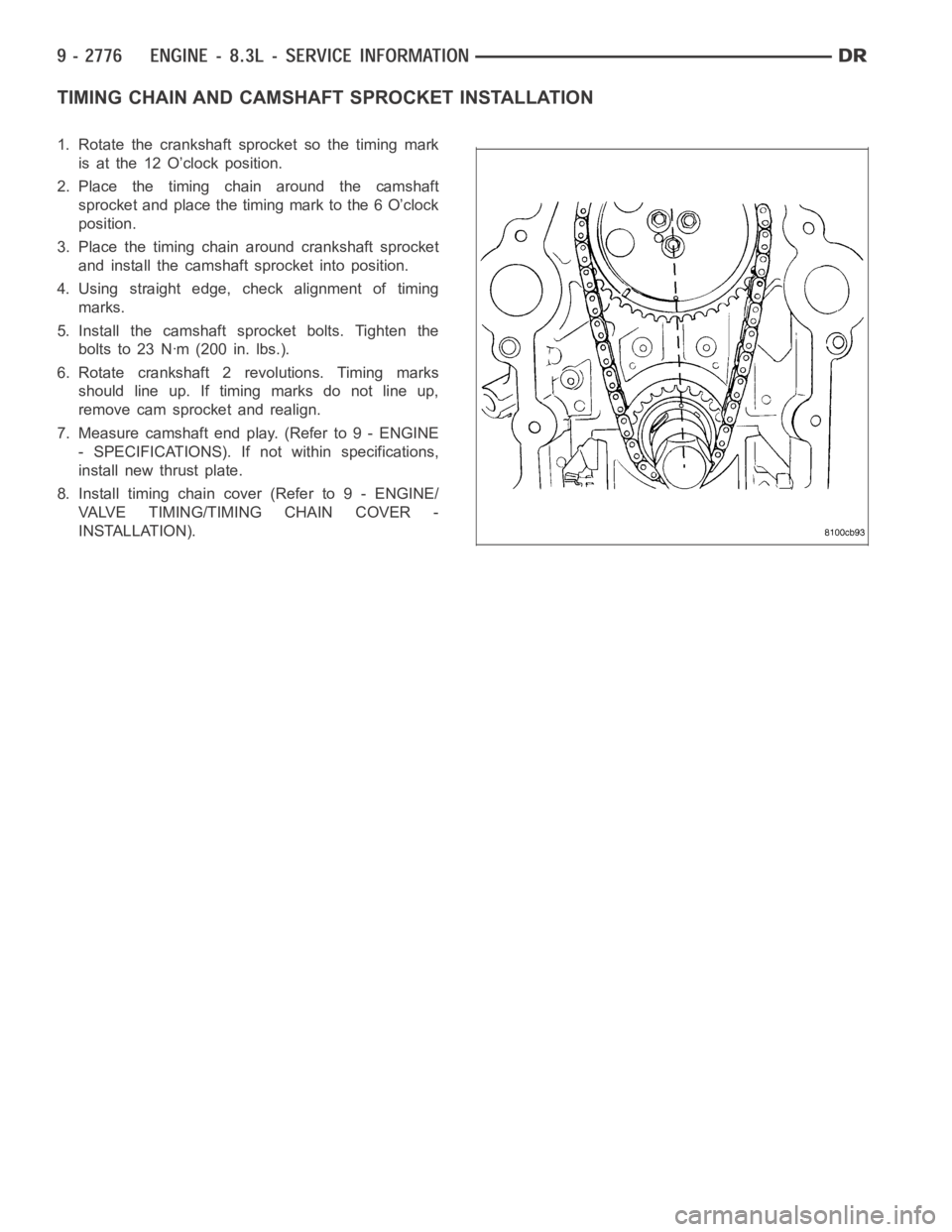
TIMING CHAIN ANDCAMSHAFT SPROCKET INSTALLATION
1. Rotate the crankshaft sprocket so the timing mark
is at the 12 O’clock position.
2. Place the timing chain around the camshaft
sprocket and place the timing mark to the 6 O’clock
position.
3. Place the timing chain around crankshaft sprocket
and install the camshaft sprocket into position.
4. Using straight edge, check alignment of timing
marks.
5. Install the camshaft sprocket bolts. Tighten the
bolts to 23 Nꞏm (200 in. lbs.).
6. Rotate crankshaft 2 revolutions. Timing marks
should line up. If timing marks do not line up,
remove cam sprocket and realign.
7. Measure camshaft end play. (Refer to 9 - ENGINE
- SPECIFICATIONS). If not within specifications,
install new thrust plate.
8. Install timing chain cover (Refer to 9 - ENGINE/
VALVE TIMING/TIMING CHAIN COVER -
INSTALLATION).
Page 2257 of 5267
MODULE - FUEL PUMP
DESCRIPTION
The fuel pump module assembly is located on the top of the fuel tank. The complete assembly contains the fol-
lowing components:
A combination fuel filter/fuel pressure regulator
A separate fuel pick-up, or inlet filter
An electric fuel pump
Alockringtoretainpumpmoduletotank
A soft gasket between tank flange and module
A fuel gauge sending unit (fuel level sensor)
Fuel line connection
The fuel gauge sending unit may be serviced separately. If the electrical fuel pump, primary inlet filter, fuel filter or
fuel pressure regulator require service, the fuel pump module must be replaced.
OPERATION
Refer to Fuel Pump, Inlet Filter, Fuel Filter / Fuel Pressure Regulator andFuel Gauge Sending Unit.
REMOVAL
WARNING: The fuel system may be under a constant pressure (even with the engine off). Before servicing
the fuel pump module, the fuel system pressure must be released.
1. Drain and remove fuel tank. Refer to Fuel Tank
Removal/Installation.
2. Note rotational position of module before attempt-
ing removal. An indexing arrow is located on top of
module for this purpose.
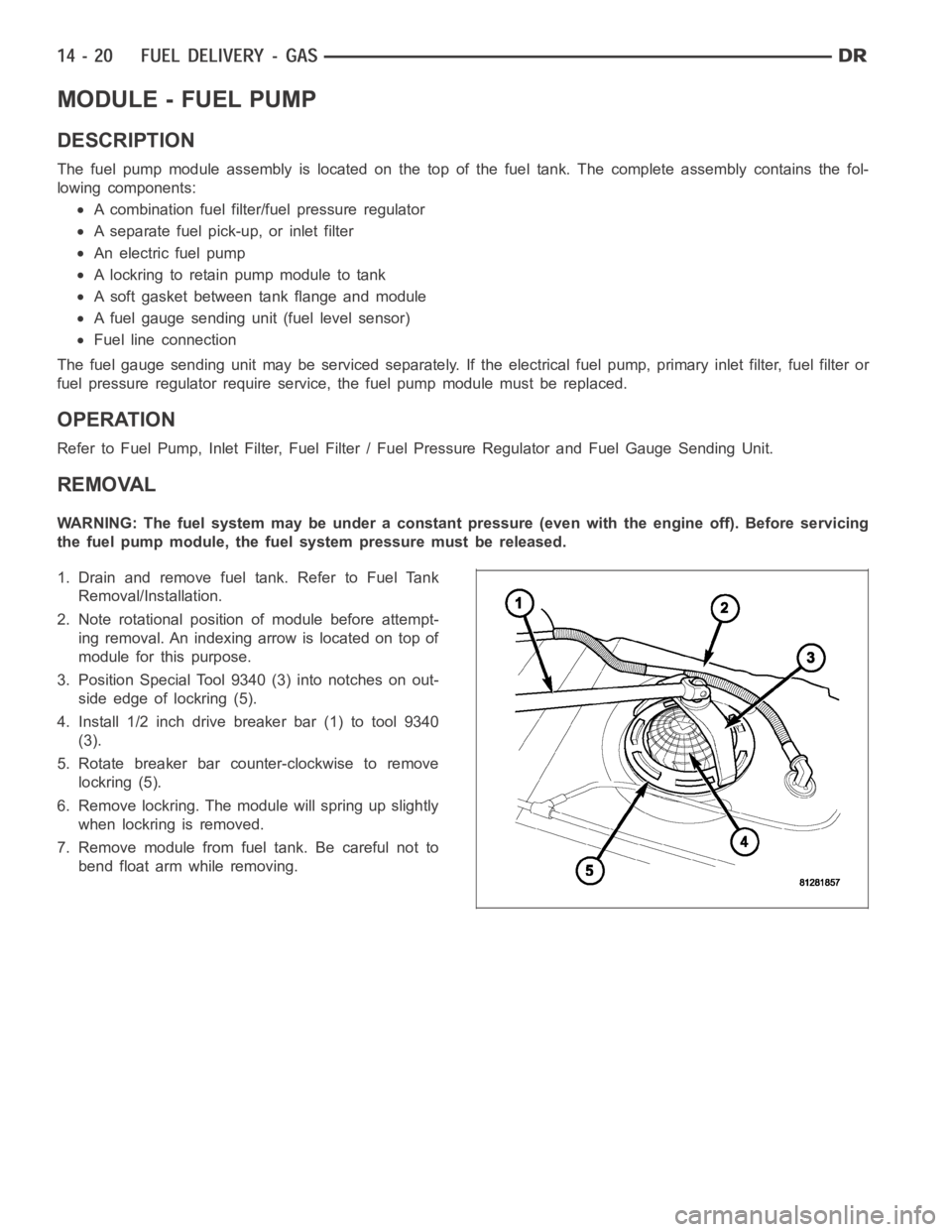
3. Position Special Tool 9340 (3) into notches on out-
side edge of lockring (5).
4. Install 1/2 inch drive breaker bar (1) to tool 9340
(3).
5. Rotate breaker bar counter-clockwise to remove
lockring (5).
6. Remove lockring. The module will spring up slightly
when lockring is removed.
7. Remove module from fuel tank. Be careful not to
bend float arm while removing.
Page 2258 of 5267
INSTALLATION
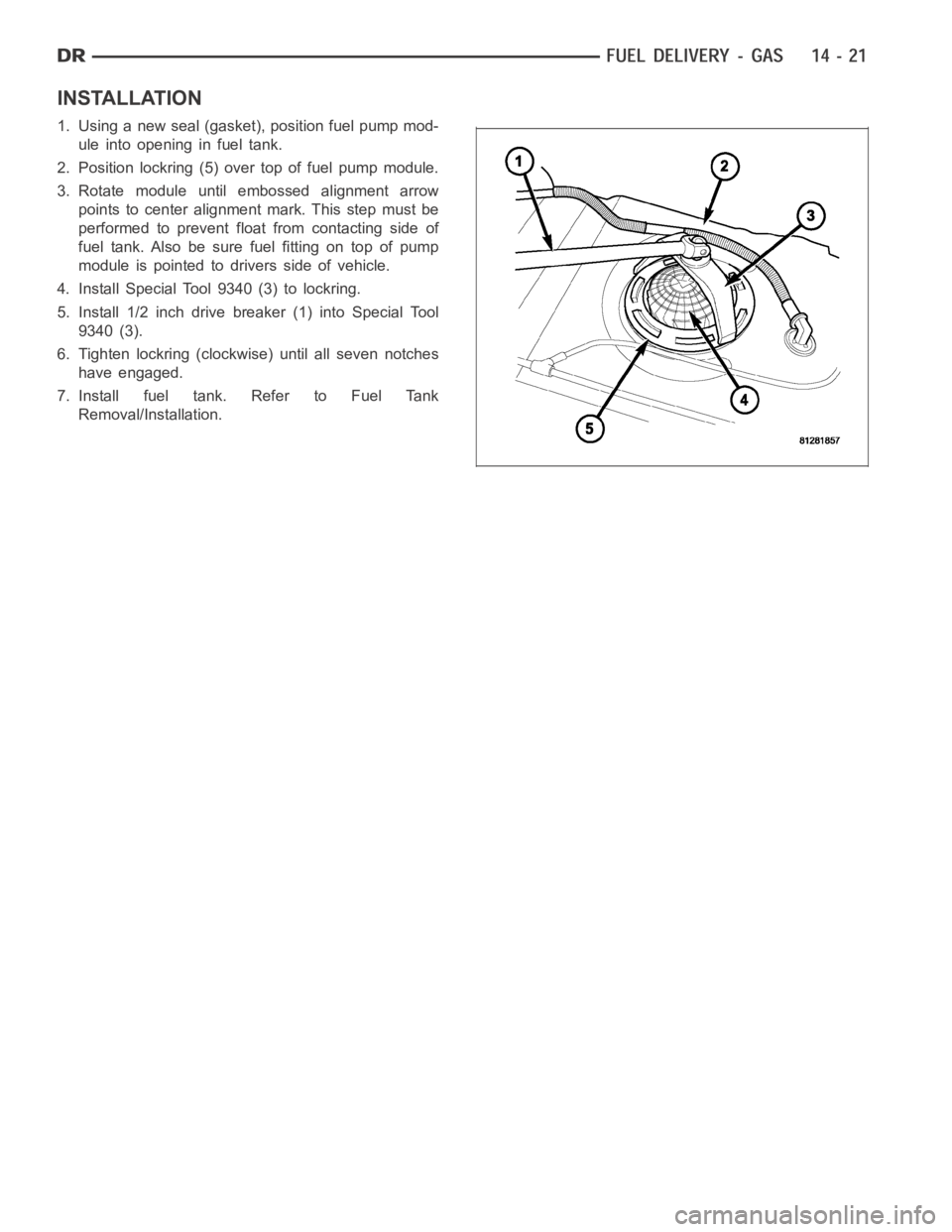
1. Using a new seal (gasket), position fuel pump mod-
uleintoopeninginfueltank.
2. Position lockring (5) over top of fuel pump module.
3. Rotate module until embossed alignment arrow
points to center alignment mark. This step must be
performed to prevent float from contacting side of
fuel tank. Also be sure fuel fitting on top of pump
module is pointed to drivers side of vehicle.
4. Install Special Tool 9340 (3) to lockring.
5. Install 1/2 inch drive breaker (1) into Special Tool
9340 (3).
6. Tighten lockring (clockwise) until all seven notches
have engaged.
7. Install fuel tank. Refer to Fuel Tank
Removal/Installation.
Page 2308 of 5267
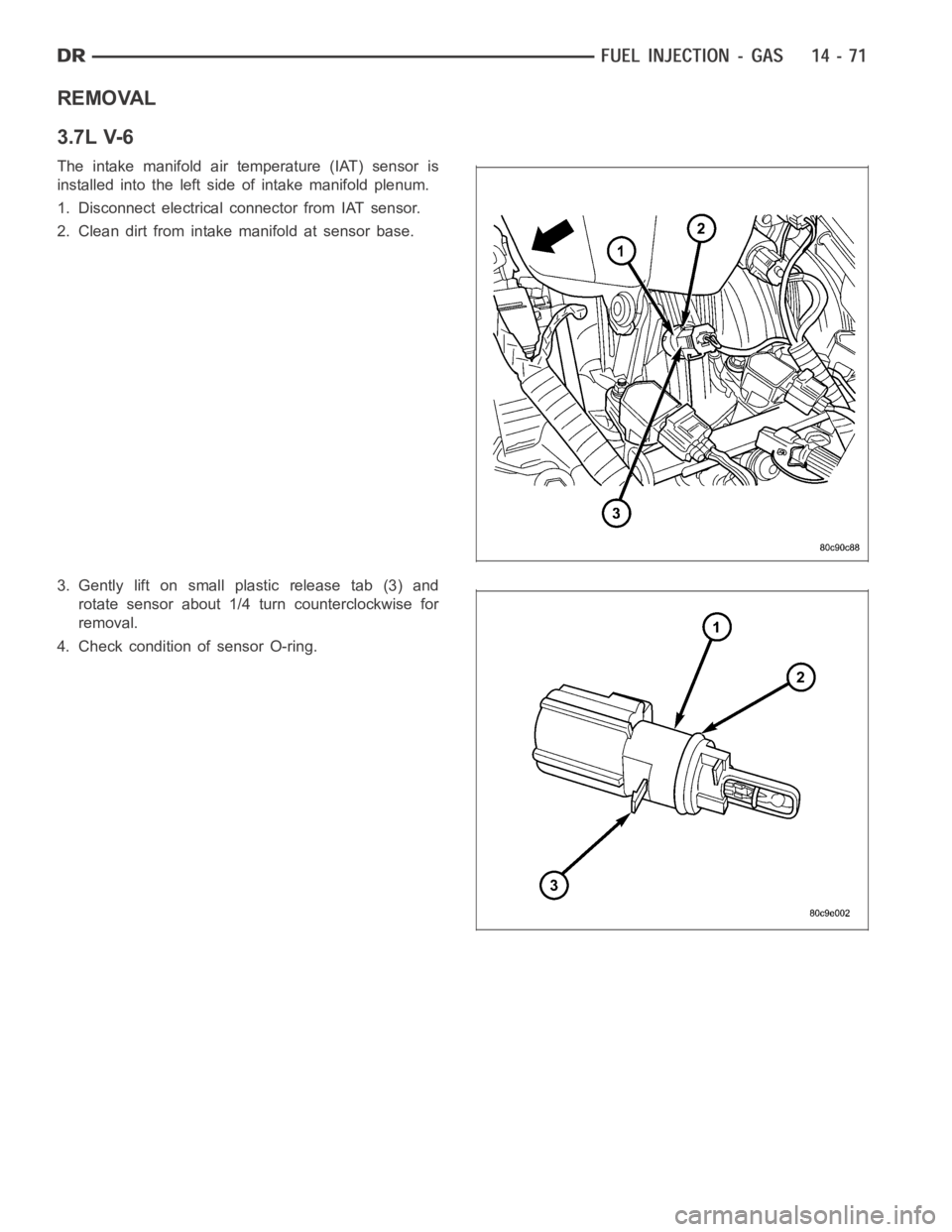
REMOVAL
3.7L V-6
The intake manifold air temperature (IAT) sensor is
installed into the left side of intake manifold plenum.
1. Disconnect electrical connector from IAT sensor.
2. Clean dirt from intake manifold at sensor base.
3. Gently lift on small plastic release tab (3) and
rotate sensor about 1/4 turn counterclockwise for
removal.
4. Check condition of sensor O-ring.
Page 2309 of 5267
4.7L V-8
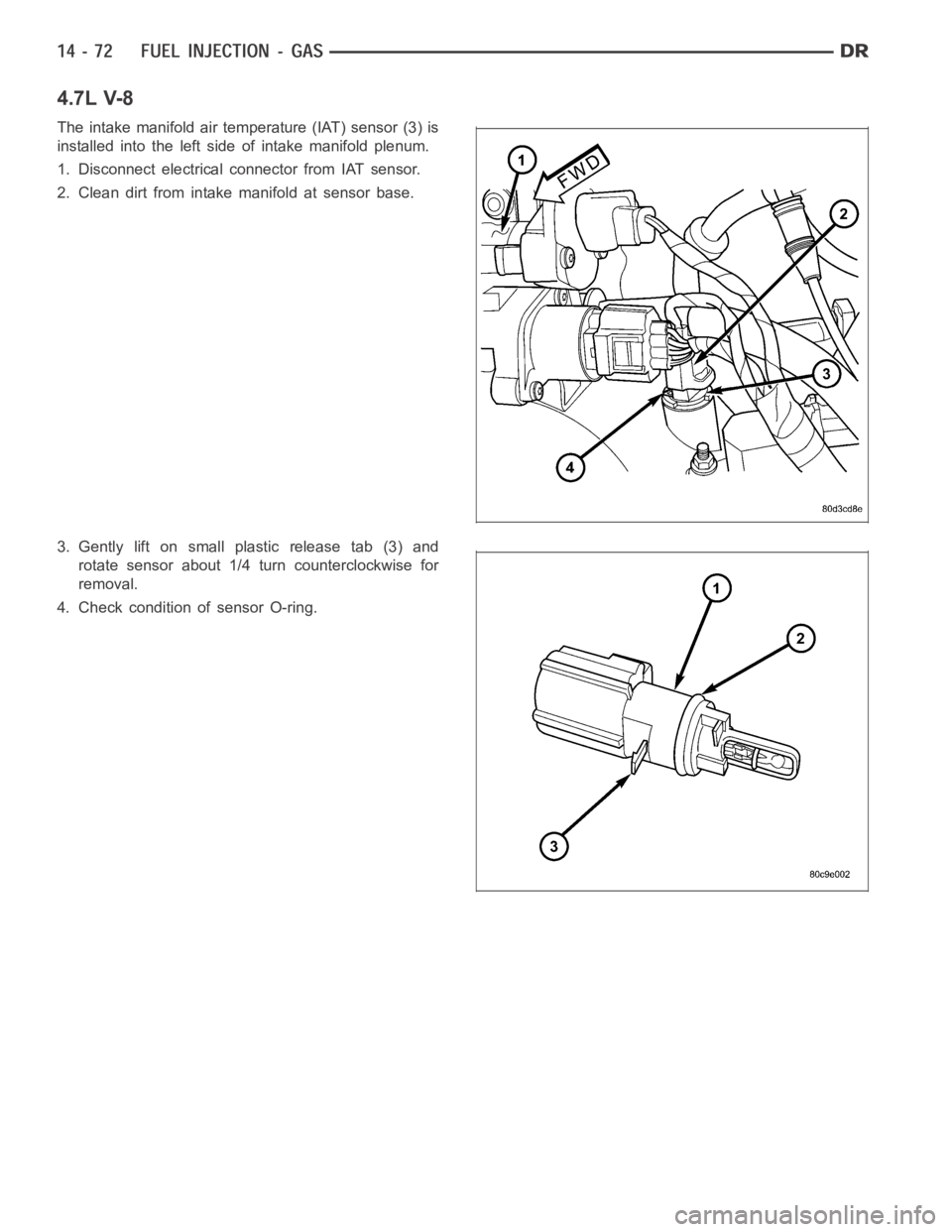
The intake manifold air temperature (IAT) sensor (3) is
installed into the left side of intake manifold plenum.
1. Disconnect electrical connector from IAT sensor.
2. Clean dirt from intake manifold at sensor base.
3. Gently lift on small plastic release tab (3) and
rotate sensor about 1/4 turn counterclockwise for
removal.
4. Check condition of sensor O-ring.