2006 DODGE RAM SRT-10 reset
[x] Cancel search: resetPage 4082 of 5267
7.FRONT AXLE DISCONNECT (FAD) MODULE
Using the wiring diagram/schematic as a guide, inspect all wiring and connectors that pertain to this circuit.
Were any problems found?
Ye s>>
Repair as necessary.
Perform the TRANSFER CASE VERIFICATION TEST-VER 1. (Refer to 21 - TRANSMISSION/TRANS-
AXLE/TRANSFER CASE - STANDARD PROCEDURE)
No>>
Replace the Front Axle Disconnect (FAD) Module in accordance with the Service Information.
Perform the TRANSFER CASE VERIFICATION TEST-VER 1. (Refer to 21 - TRANSMISSION/TRANS-
AXLE/TRANSFER CASE - STANDARD PROCEDURE)
8.TOTALLY INTEGRATED POWER MODULE (TIPM)
Using the wiring diagram/schematic as a guide, inspect all wiring and connectors that pertain to this circuit.
Were any problems found?
Ye s>>
Repair as necessary.
Perform the TRANSFER CASE VERIFICATION TEST-VER 1. (Refer to 21 - TRANSMISSION/TRANS-
AXLE/TRANSFER CASE - STANDARD PROCEDURE)
No>>
Replace the Totally Integrated Power Module (TIPM) in accordance with theService Information.
Perform the TRANSFER CASE VERIFICATION TEST-VER 1. (Refer to 21 - TRANSMISSION/TRANS-
AXLE/TRANSFER CASE - STANDARD PROCEDURE)
9.INTERMITTENT WIRING AND CONNECTORS
The conditions necessary to set this DTC are not present at this time.
Using the schematics as a guide, inspect the wiring and connectors specifictothiscircuit.
Wiggle test the wiring harness and connectors while checking for shorted and open circuits.
Using the scan tool, monitor the data related to this circuit while performing the wiggle test. Look for the data to
change or for the DTC to reset.
Were there any problems found?
Ye s>>
Repair as necessary.
Perform the TRANSFER CASE VERIFICATION TEST-VER 1. (Refer to 21 - TRANSMISSION/TRANS-
AXLE/TRANSFER CASE - STANDARD PROCEDURE)
No>>
Te s t C o m p l e t e .
STANDARD PROCEDURE
Page 4687 of 5267
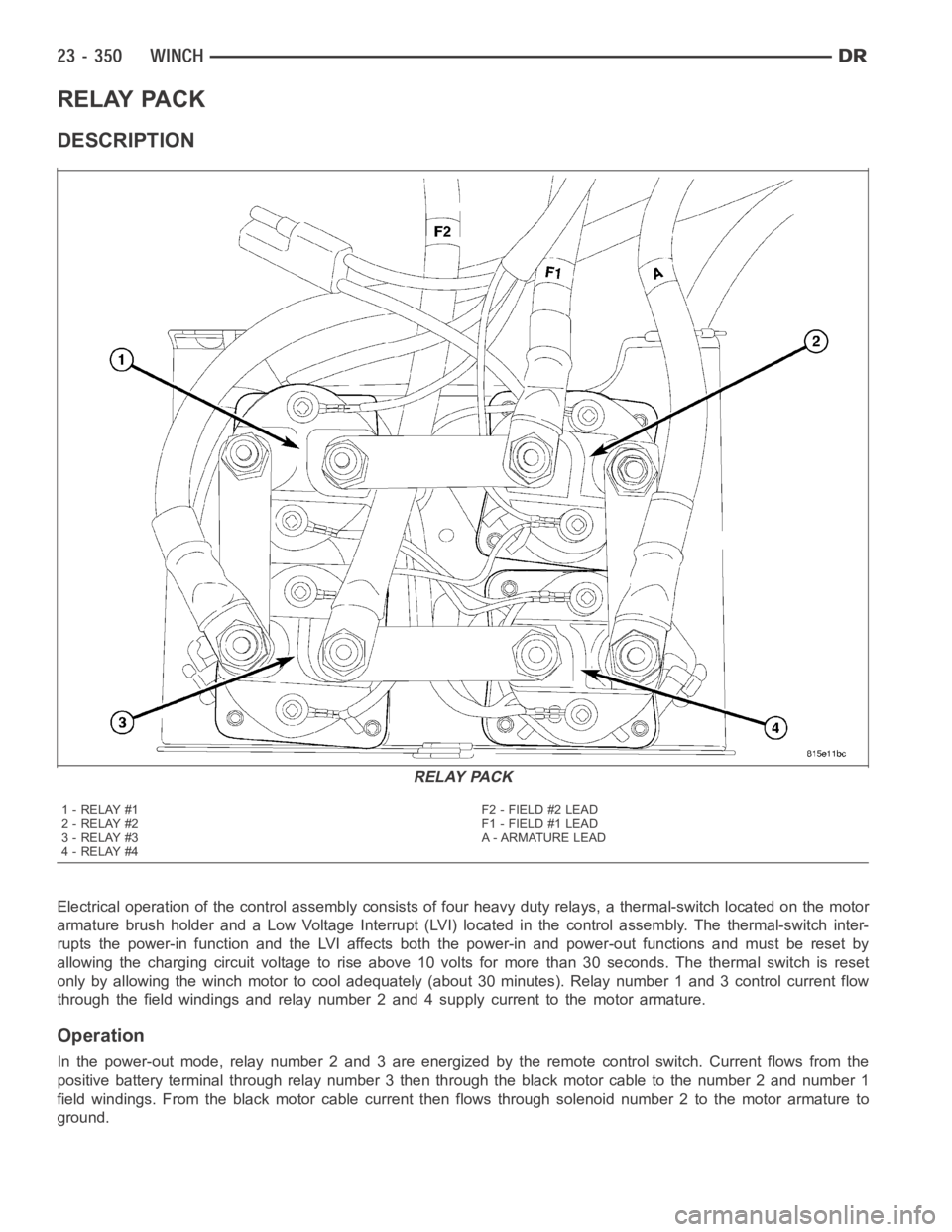
RELAY PACK
DESCRIPTION
Electrical operation of the control assembly consists of four heavy duty relays, a thermal-switch located on the motor
armature brush holder and a Low Voltage Interrupt (LVI) located in the control assembly. The thermal-switch inter-
rupts the power-in function and the LVI affects both the power-in and power-out functions and must be reset by
allowing the charging circuit voltage to rise above 10 volts for more than 30 seconds. The thermal switch is reset
only by allowing the winch motor to cool adequately (about 30 minutes). Relay number 1 and 3 control current flow
through the field windings and relay number 2 and 4 supply current to the motor armature.
Operation
In the power-out mode, relay number 2 and 3 are energized by the remote control switch. Current flows from the
positive battery terminal through relay number 3 then through the black motor cable to the number 2 and number 1
field windings. From the black motor cable current then flows through solenoid number 2 to the motor armature to
ground.
RELAY PACK
1-RELAY#1
2-RELAY#2
3-RELAY#3
4-RELAY#4F2 - FIELD #2 LEAD
F1 - FIELD #1 LEAD
A - ARMATURE LEAD
Page 4876 of 5267
When Monitored:
With the ignition on. Battery voltage greater than 10.4 volts.
Set Condition:
If the Totally Integrated Power Module (TIPM) detects a shorted low condition in the (C123) Condenser Fan
Control circuit.
Possible Causes
(C123) CONDENSER FAN CONTROL OUTPUT CIRCUIT SHORTED TO GROUND
CONDENSER FAN MOTOR
TIPM
Diagnostic Test
1.VERIFY DTC IS ACTIVE
Turn the ignition on.
With the scan tool, erase TIPM DTCs.
Turn the ignition off, wait 10 seconds, and turn the ignition on.
With the scan tool, actuate the Condenser Fan.
With the scan tool, read TIPM DTCs.
Does this DTC reset?
Ye s>>
With the scan tool, de-actuate the Condenser Fan. Then, Go To 2
No>>
With the scan tool, de-actuate the Condenser Fan. Then, check for an intermittent condition by inspect-
ing the related wiring harness for chafed, pierced, pinched, and partially broken wires. Also, inspect the
related connectors for broken, bent, corroded, and contaminated terminals.
Perform BODY VERIFICATION TEST – VER 1. (Refer to 8 - ELECTRICAL/ELECTRONIC CONTROL
MODULES - STANDARD PROCEDURE).
2.CHECK (C123) CONDENSER FAN CONTROL OUTPUT CIRCUIT FOR A SHORT TO GROUND
Turn the ignition off.
Disconnect the TIPM C8 harness connector.
Disconnect the Condenser Fan Motor harness connector.
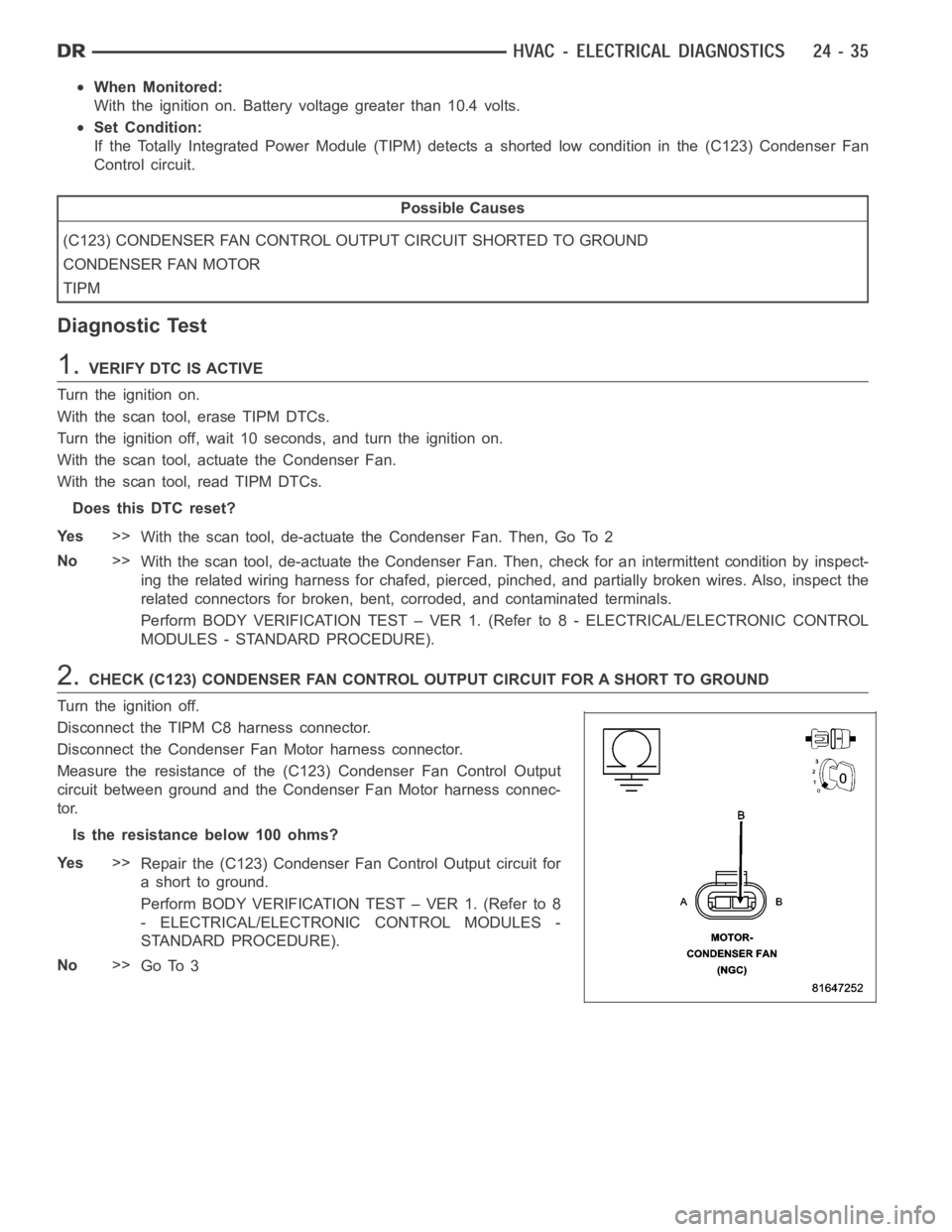
Measure the resistance of the (C123) Condenser Fan Control Output
circuit between ground and the Condenser Fan Motor harness connec-
tor.
Istheresistancebelow100ohms?
Ye s>>
Repair the (C123) Condenser Fan Control Output circuit for
a short to ground.
Perform BODY VERIFICATION TEST – VER 1. (Refer to 8
- ELECTRICAL/ELECTRONIC CONTROL MODULES -
STANDARD PROCEDURE).
No>>
Go To 3
Page 4879 of 5267
When Monitored:
With the ignition on. Battery voltage greater than 10.4 volts.
Set Condition:
If the Totally Integrated Power Module (TIPM) detects a shorted high condition in the (C123) Condenser Fan
Control circuit.
Possible Causes
(C123) CONDENSER FAN CONTROL OUTPUT CIRCUIT SHORTED TO BATTERY VOLTAGE
EXCESSIVE RESISTANCE IN THE (Z823) GROUND CIRCUIT
CONDENSER FAN MOTOR
TIPM
Diagnostic Test
1.VERIFY DTC IS ACTIVE
Turn the ignition on.
With the scan tool, erase TIPM DTCs.
Turn the ignition off, wait 10 seconds, and turn the ignition on.
With the scan tool, actuate the Condenser Fan.
With the scan tool, read TIPM DTCs.
Does this DTC reset?
Ye s>>
With the scan tool, de-actuate the Condenser Fan. Then, Go To 2
No>>
With the scan tool, de-actuate the Condenser Fan. Then, check for an intermittent condition by inspect-
ing the related wiring harness for chafed, pierced, pinched, and partially broken wires. Also, inspect the
related connectors for broken, bent, corroded, and contaminated terminals.
Perform BODY VERIFICATION TEST – VER 1. (Refer to 8 - ELECTRICAL/ELECTRONIC CONTROL
MODULES - STANDARD PROCEDURE).
2.CHECK (C123) CONDENSER FAN CONTROL OUTPUT CIRCUIT FOR A SHORT TO BATTERY VOLTA G E
Turn the ignition off
Disconnect the TIPM C8 harness connector.
Disconnect the Condenser Fan Motor harness connector.
Ignition on, engine not running.
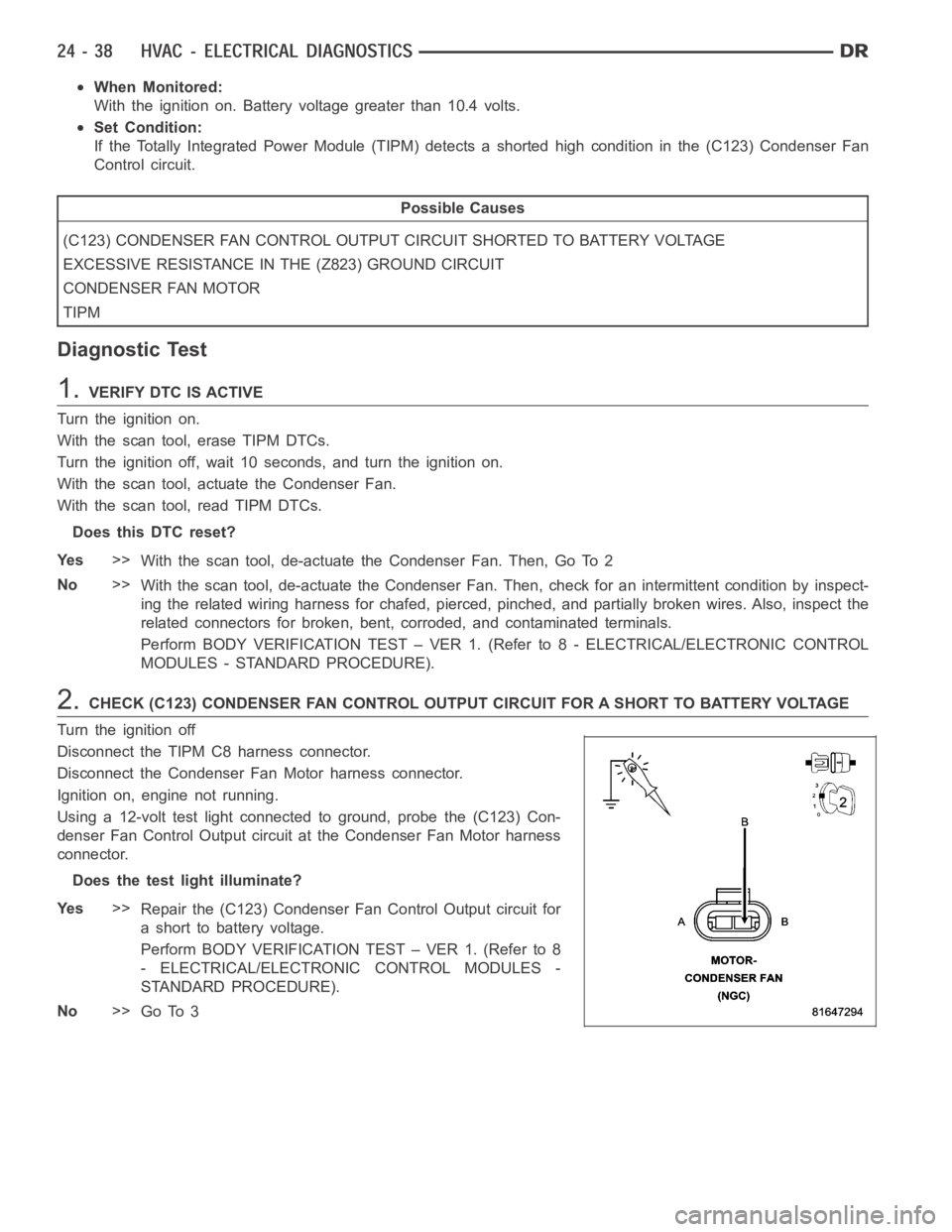
Using a 12-volt test light connected to ground, probe the (C123) Con-
denser Fan Control Output circuit at the Condenser Fan Motor harness
connector.
Does the test light illuminate?
Ye s>>
Repair the (C123) Condenser Fan Control Output circuit for
a short to battery voltage.
Perform BODY VERIFICATION TEST – VER 1. (Refer to 8
- ELECTRICAL/ELECTRONIC CONTROL MODULES -
STANDARD PROCEDURE).
No>>
Go To 3
Page 4884 of 5267
When Monitored:
With the ignition on. Battery voltage greater than 10.4 volts. TIPM requesting Condenser Fan operation.
Set Condition:
If the Totally Integrated Power Module (TIPM) detects an open condition inthe (C123) Condenser Fan Control
circuit.
Possible Causes
(C123) CONDENSER FAN CONTROL OUTPUT CIRCUIT OPEN
CONDENSER FAN MOTOR
TIPM
Diagnostic Test
1.VERIFY DTC IS ACTIVE
Turn the ignition on.
With the scan tool, erase TIPM DTCs.
Turn the ignition off, wait 10 seconds, and turn the ignition on.
With the scan tool, actuate the Condenser Fan.
With the scan tool, read TIPM DTCs.
Does this DTC reset?
Ye s>>
With the scan tool, de-actuate the Condenser Fan. Then, Go To 2
No>>
With the scan tool, de-actuate the Condenser Fan. Then, check for an intermittent condition by inspect-
ing the related wiring harness for chafed, pierced, pinched, and partially broken wires. Also, inspect the
related connectors for broken, bent, corroded, and contaminated terminals.
Perform BODY VERIFICATION TEST – VER 1. (Refer to 8 - ELECTRICAL/ELECTRONIC CONTROL
MODULES - STANDARD PROCEDURE).
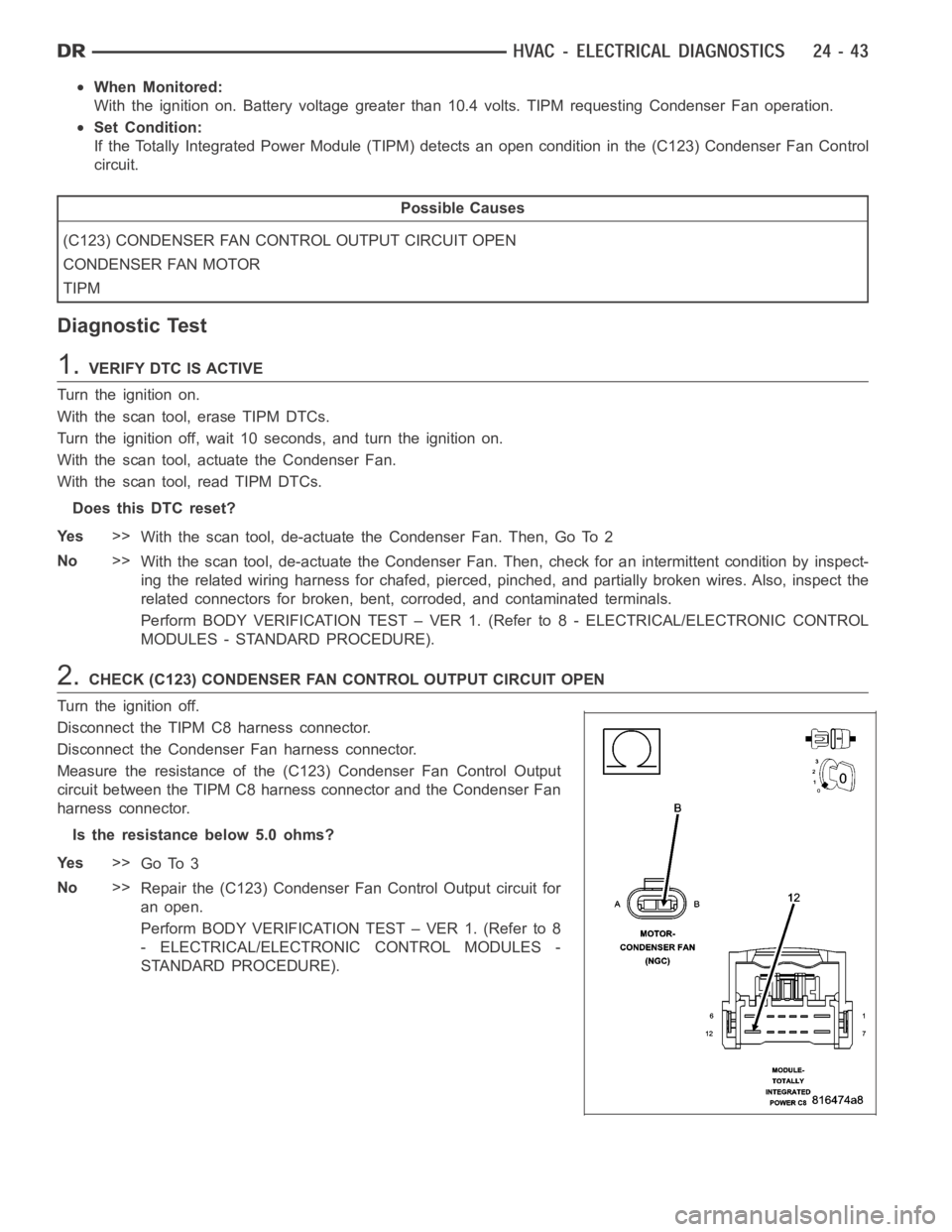
2.CHECK (C123) CONDENSER FAN CONTROL OUTPUT CIRCUIT OPEN
Turn the ignition off.
Disconnect the TIPM C8 harness connector.
Disconnect the Condenser Fan harness connector.
Measure the resistance of the (C123) Condenser Fan Control Output
circuit between the TIPM C8 harness connector and the Condenser Fan
harness connector.
Is the resistance below 5.0 ohms?
Ye s>>
Go To 3
No>>
Repair the (C123) Condenser Fan Control Output circuit for
an open.
Perform BODY VERIFICATION TEST – VER 1. (Refer to 8
- ELECTRICAL/ELECTRONIC CONTROL MODULES -
STANDARD PROCEDURE).
Page 4892 of 5267
When Monitored:
With the ignition on. Battery voltage greater than 10.4 volts. PCM requesting Condenser Fan operation.
Set Condition:
If the Totally Integrated Power Module (TIPM) detects an overcurrent condition on the (C123) Condenser Fan
Control Output circuit.
Possible Causes
TERMINAL DAMAGE OR CORROSION
(Z823) GROUND CIRCUIT HIGH RESISTANCE
(C123) CONDENSER FAN CONTROL OUTPUT CIRCUIT HIGH RESISTANCE
CONDENSER FAN MOTOR
TIPM
Diagnostic Test
1.VERIFY DTC IS ACTIVE
Turn the ignition on.
With the scan tool, erase TIPM DTCs.
Turn the ignition off, wait 10 seconds, and turn the ignition on.
With the scan tool, actuate the Condenser Fan.
With the scan tool, read TIPM DTCs.
Does this DTC reset?
Ye s>>
With the scan tool, de-actuate the Condenser Fan. Then, Go To 2
No>>
With the scan tool, de-actuate the Condenser Fan. Then, check for an intermittent condition by inspect-
ing the related wiring harness for chafed, pierced, pinched, and partially broken wires. Also, inspect the
related connectors for broken, bent, corroded, and contaminated terminals.
Perform BODY VERIFICATION TEST – VER 1. (Refer to 8 - ELECTRICAL/ELECTRONIC CONTROL
MODULES - STANDARD PROCEDURE).
2.INSPECT RELATED WIRING HARNESS & CONNECTORS
Turn the ignition off.
Disconnect the TIPM C8 harness connector.
Disconnect the Condenser Fan Motor harness connector.
Inspect the terminal and connector condition. Check for signs of corrosion build up and damage that would com-
promise the terminal to controller pin connection.
NOTE: Make sure that all in-line connectors are inspected for corrosion and damage.
Visually inspect the wiring harness. Look for any chafed, pierced, pinched or partially broken wires hidden in the
wire insulation.
Were any of the above conditions found?
Ye s>>
Repair or replace as necessary.
Perform BODY VERIFICATION TEST – VER 1. (Refer to 8 - ELECTRICAL/ELECTRONIC CONTROL
MODULES - STANDARD PROCEDURE).
No>>
Go To 3
Page 4896 of 5267
When Monitored:
With the ignition on.
Set Condition:
If the Totally Integrated Power Module (TIPM) detects an excessive current draw on the (F942) Fused Ignition
Switch Output (Run-Start) circuit for 20 micro seconds when blower motor operation is requested.
Possible Causes
(F942) FUSED IGNITION SWITCH OUTPUT (RUN-START) CIRCUIT SHORTED TO GROUND
BLOWER MOTOR
TIPM
Diagnostic Test
1.VERIFY DTC IS ACTIVE
Turn the blower control switch to off.
Turn the ignition off, wait 10 seconds, and turn the ignition on.
With the scan tool, erase TIPM DTCs.
Turn the ignition off, wait 10 seconds, and turn the ignition on.
Turn the blower control switch to on.
With the scan tool, read TIPM DTCs.
Does this DTC reset?
Ye s>>
Go To 2
No>>
Check for an intermittent condition by inspecting the related wiring harness for chafed, pierced, pinched,
and partially broken wires. Also, inspect the related connectors for broken, bent, corroded, and contam-
inated terminals.
Perform BODY VERIFICATION TEST – VER 1. (Refer to 8 - ELECTRICAL/ELECTRONIC CONTROL
MODULES - STANDARD PROCEDURE).
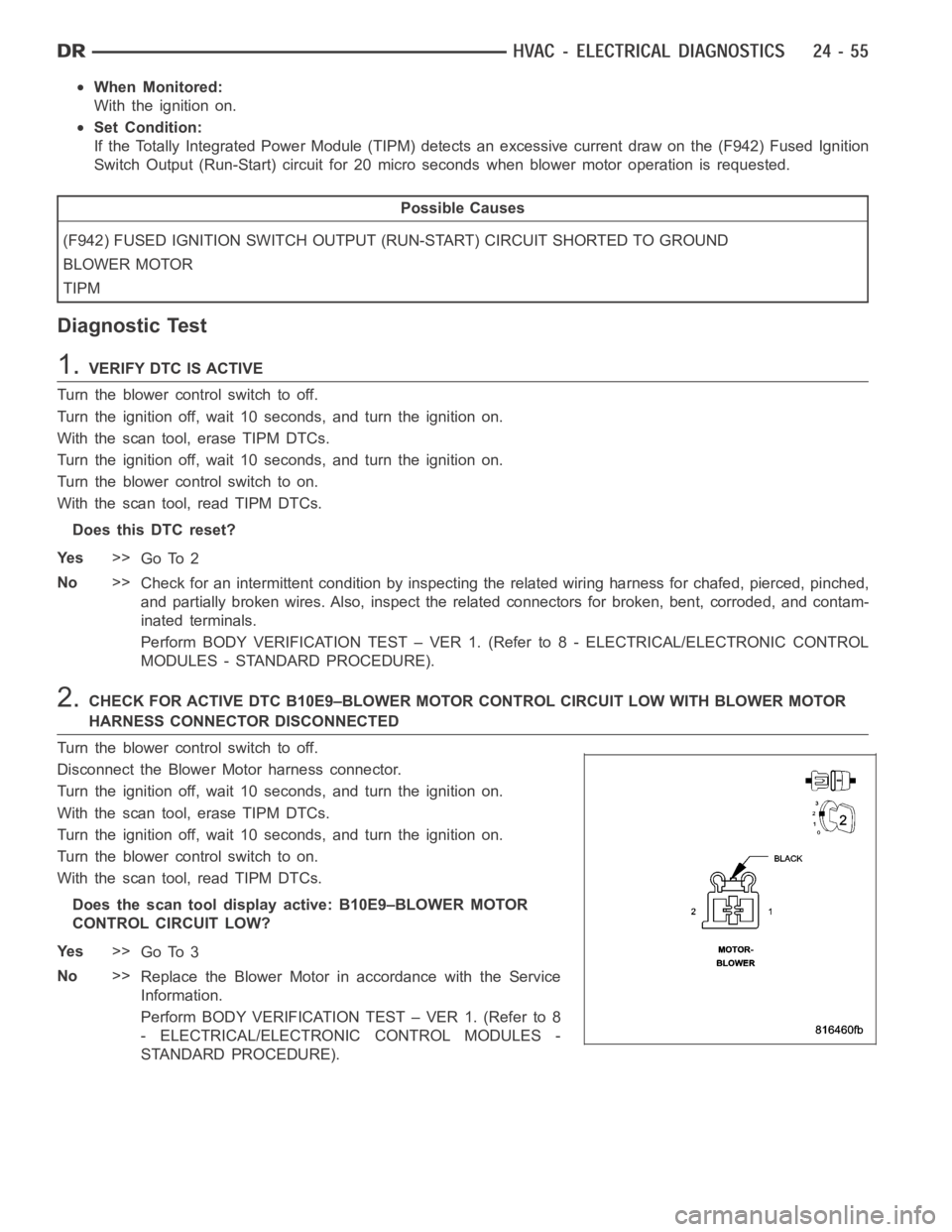
2.CHECK FOR ACTIVE DTC B10E9–BLOWER MOTOR CONTROL CIRCUIT LOW WITH BLOWER MOTOR
HARNESS CONNECTOR DISCONNECTED
Turn the blower control switch to off.
Disconnect the Blower Motor harness connector.
Turn the ignition off, wait 10 seconds, and turn the ignition on.
With the scan tool, erase TIPM DTCs.
Turn the ignition off, wait 10 seconds, and turn the ignition on.
Turn the blower control switch to on.
With the scan tool, read TIPM DTCs.
Does the scan tool display active: B10E9–BLOWER MOTOR
CONTROL CIRCUIT LOW?
Ye s>>
Go To 3
No>>
Replace the Blower Motor in accordance with the Service
Information.
Perform BODY VERIFICATION TEST – VER 1. (Refer to 8
- ELECTRICAL/ELECTRONIC CONTROL MODULES -
STANDARD PROCEDURE).