2005 NISSAN NAVARA lock
[x] Cancel search: lockPage 1463 of 3171
![NISSAN NAVARA 2005 Repair Workshop Manual PRIMARY TIMING CHAIN
EM-81
C
D
E
F
G
H
I
J
K
L
MA
EM
c. Using the pulley puller [SST], remove crankshaft pulley.
lUse two M6 bolts with approx. 60 mm (2.36 in) shank length
for securing crankshaft pul](/manual-img/5/57362/w960_57362-1462.png "NISSAN NAVARA 2005 Repair Workshop Manual PRIMARY TIMING CHAIN
EM-81
C
D
E
F
G
H
I
J
K
L
MA
EM
c. Using the pulley puller [SST], remove crankshaft pulley.
lUse two M6 bolts with approx. 60 mm (2.36 in) shank length
for securing crankshaft pul")
PRIMARY TIMING CHAIN
EM-81
C
D
E
F
G
H
I
J
K
L
MA
EM
c. Using the pulley puller [SST], remove crankshaft pulley.
lUse two M6 bolts with approx. 60 mm (2.36 in) shank length
for securing crankshaft pulley.
9. Remove oil pump housing.
lLoosen bolts in reverse order of that shown in the figure and
remove them.
lU s e t h e s e a l c u t t e r [ S S T: K V 1 0 1111 0 0 ] e t c . f o r r e m o v a l .
10. Remove crankshaft gear.
lRemove crankshaft gear (1) with the following procedure
(4WD models).
a. Make sure that No.1 piston is TDC on its compression stroke.
b. Turn the idler sub gear (3) counterclockwise with snap ring plier
(B) or suitable tool for aligning idler sub gear (3) and idler main
gear (2).
lIf idler gear rotates, hold the flat faces on balancer drive shaft
front end (4).
c. Install internal mechanism securing bolt and plate (Service part:
13012 EB30A and 13013 EB30A) (A) and tighten to the speci-
fied torque.
CAUTION:
lDo not loosen idler gear mounting bolt (5).
lOnly use the genuine internal mechanism securing bolt
and plate (A), or the idler gear (2) and (3) will be damaged.
lDo not remove internal mechanism securing bolt and
plate (A) from idler gear (2) and (3) until crankshaft gear
(1) and all of the parts in connection have been installed.
lIf internal mechanism securing bolt and plate (A) is not
installed, internal mechanism of idler gear (2) and (3) will
disengage after crankshaft gear (1) is removed. This will prohibit the balancer unit from being
reusable.
d. Apply mating marks (C) to crankshaft gear (1) and idler sub gear (3).
e. Remove crankshaft gear (1).
11. Remove front oil seal from oil pump housing.
lPunch out the seal off from the back surface of the oil pump housing using a flat-bladed screwdriver.
CAUTION:
Be careful not to damage oil pump housing.
JEM132G
PBIC3470E
: 4.0 N·m (0.41 kg-m, 35 in-lb)
PBIC3471E
Page 1468 of 3171
EM-86
PRIMARY TIMING CHAIN
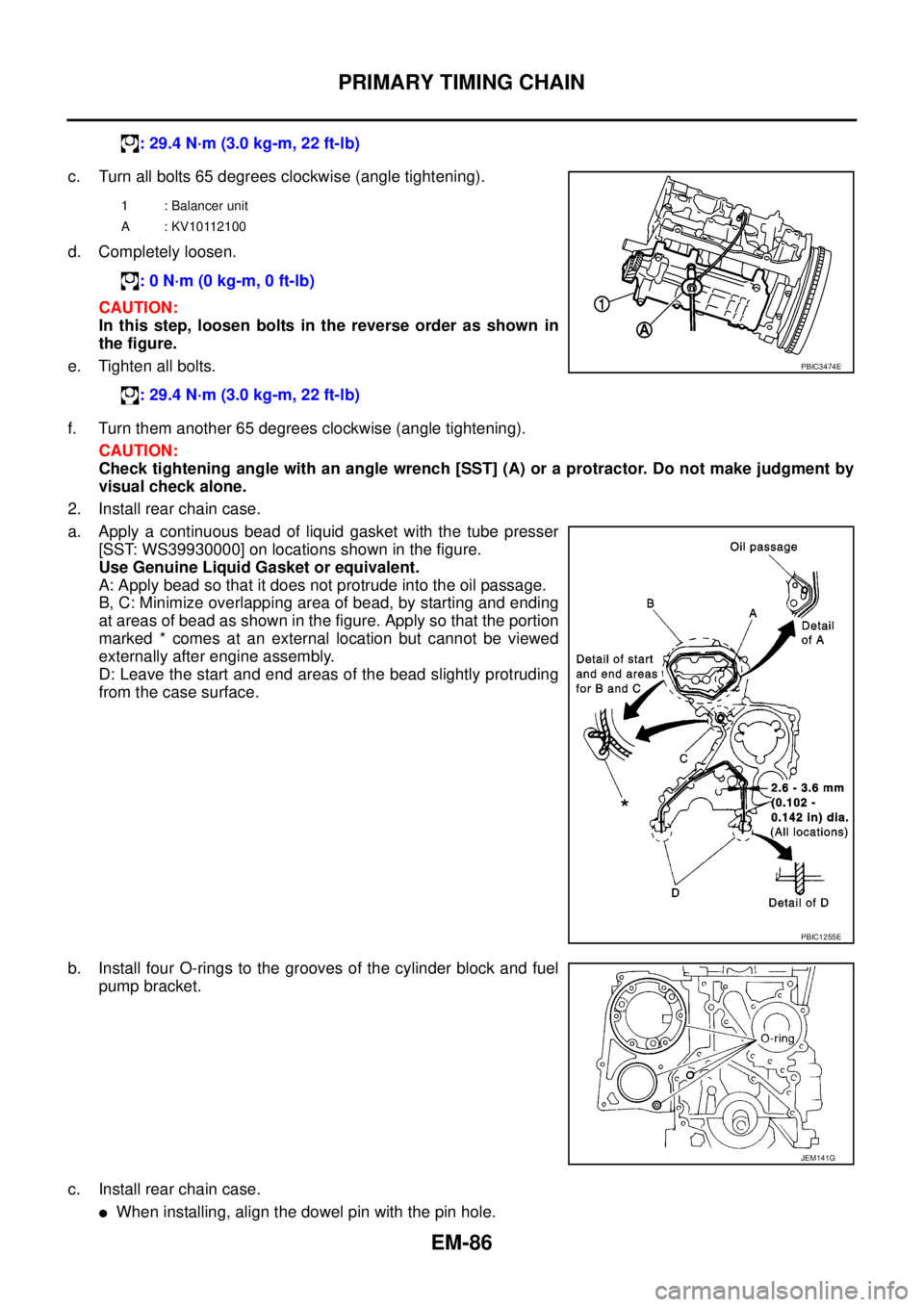
c. Turn all bolts 65 degrees clockwise (angle tightening).
d. Completely loosen.
CAUTION:
In this step, loosen bolts in the reverse order as shown in
the figure.
e. Tighten all bolts.
f. Turn them another 65 degrees clockwise (angle tightening).
CAUTION:
Check tightening angle with an angle wrench [SST] (A) or a protractor. Do not make judgment by
visual check alone.
2. Install rear chain case.
a. Apply a continuous bead of liquid gasket with the tube presser
[SST: WS39930000] on locations shown in the figure.
Use Genuine Liquid Gasket or equivalent.
A: Apply bead so that it does not protrude into the oil passage.
B, C: Minimize overlapping area of bead, by starting and ending
at areas of bead as shown in the figure. Apply so that the portion
marked * comes at an external location but cannot be viewed
externally after engine assembly.
D: Leave the start and end areas of the bead slightly protruding
from the case surface.
b. Install four O-rings to the grooves of the cylinder block and fuel
pump bracket.
c. Install rear chain case.
lWhen installing, align the dowel pin with the pin hole.: 29.4 N·m (3.0 kg-m, 22 ft-lb)
1 : Balancer unit
A : KV10112100
: 0 N·m (0 kg-m, 0 ft-lb)
: 29.4 N·m (3.0 kg-m, 22 ft-lb)
PBIC3474E
PBIC1255E
JEM141G
Page 1472 of 3171
EM-90
PRIMARY TIMING CHAIN
b. Install O-ring into the groove of rear chain case.
c. Install oil pump housing.
lWhen installing, align the inner rotor in the direction of the two facing flats of oil pump drive spacer.
lWhen installing, align the dowel pin with the pin hole.
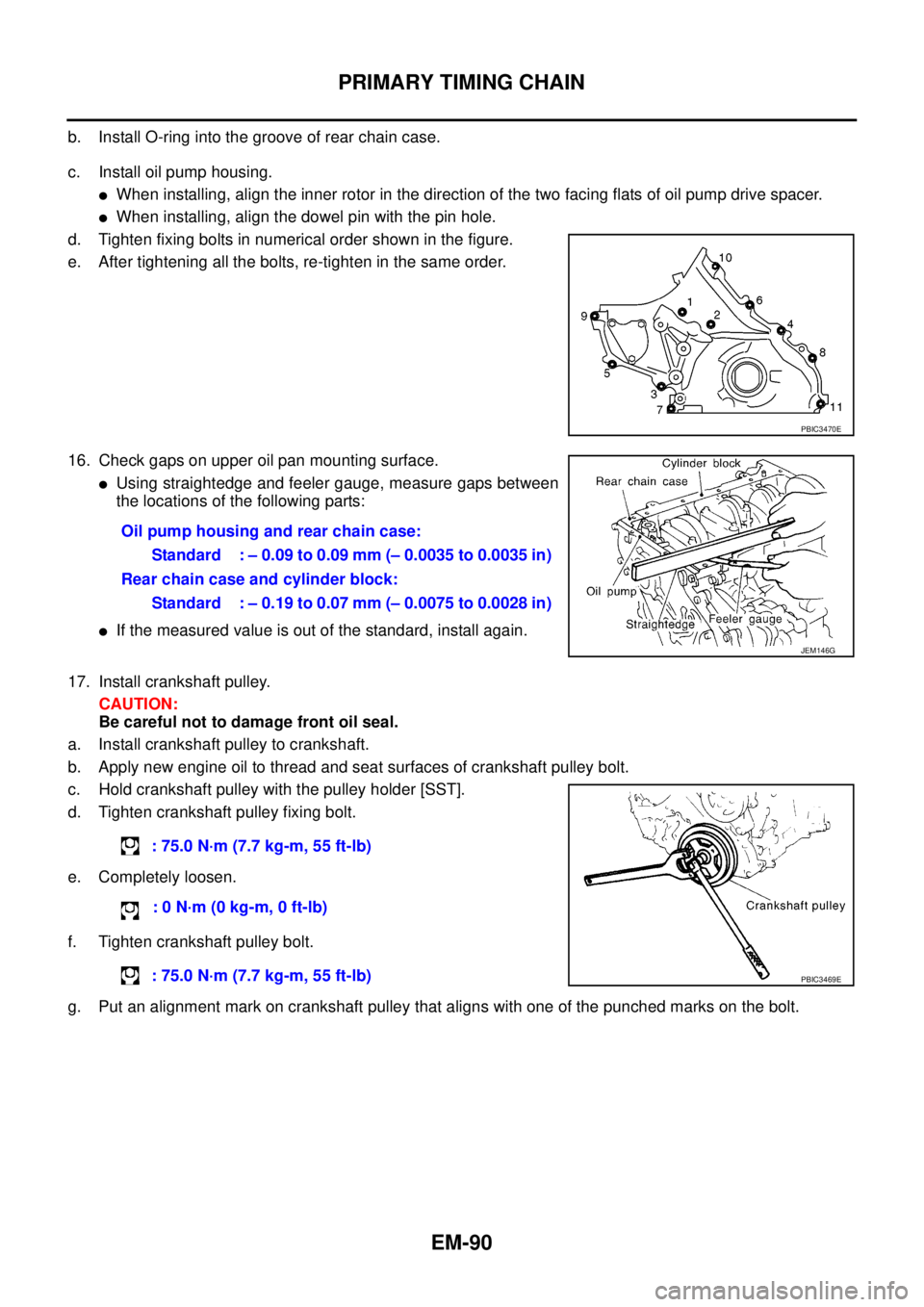
d. Tighten fixing bolts in numerical order shown in the figure.
e. After tightening all the bolts, re-tighten in the same order.
16. Check gaps on upper oil pan mounting surface.
lUsing straightedge and feeler gauge, measure gaps between
the locations of the following parts:
lIf the measured value is out of the standard, install again.
17. Install crankshaft pulley.
CAUTION:
Be careful not to damage front oil seal.
a. Install crankshaft pulley to crankshaft.
b. Apply new engine oil to thread and seat surfaces of crankshaft pulley bolt.
c. Hold crankshaft pulley with the pulley holder [SST].
d. Tighten crankshaft pulley fixing bolt.
e. Completely loosen.
f. Tighten crankshaft pulley bolt.
g. Put an alignment mark on crankshaft pulley that aligns with one of the punched marks on the bolt.
PBIC3470E
Oil pump housing and rear chain case:
Standard : – 0.09 to 0.09 mm (– 0.0035 to 0.0035 in)
Rear chain case and cylinder block:
Standard : – 0.19 to 0.07 mm (– 0.0075 to 0.0028 in)
JEM146G
: 75.0 N·m (7.7 kg-m, 55 ft-lb)
:0N·m(0kg-m,0ft-lb)
: 75.0 N·m (7.7 kg-m, 55 ft-lb)
PBIC3469E
Page 1475 of 3171
CYLINDER HEAD
EM-93
C
D
E
F
G
H
I
J
K
L
MA
EM
Compression pressure
Unit: kPa (bar, kg/cm2, psi)/rpm
lWhen engine rpm is out of the specified range, check the specific gravity of battery liquid. Measure
again under corrected conditions.
lIf engine rpm exceeds the limit, check valve clearance and combustion chamber components (valves,
valve seats, cylinder head gaskets, piston rings, pistons, cylinder bores, cylinder block upper and lower
surfaces) and measure again.
lIf compression pressure is low in some cylinders, apply engine oil from glow plug installation hole. Then
check pressure again.
–If compression pressure becomes normal after applying engine oil, piston ring may be worn or dam-
aged. Check piston ring for malfunction. If any, replace piston ring.
–If compression pressure is still low after applying engine oil, valve may be malfunctioning. Check valve
for malfunction. If contact malfunction is found, replace valve or valve seat.
lIf compression pressure in adjacent two cylinders is low after applying engine oil, pressure may be
leaking from gasket. In this case, replace cylinder head gasket.
9. Complete this operation as follows:
a. Turn the ignition switch to “OFF”.
b. Disconnect the battery cable from the negative terminal.
c. Install glow plug and install all the parts removed in step 4.
d. Install fuse [EGI (20A)].
e. Connect the battery cable to the negative terminal.
f. Using CONSULT-II make sure no DTC is indicated for items of self-diagnosis.
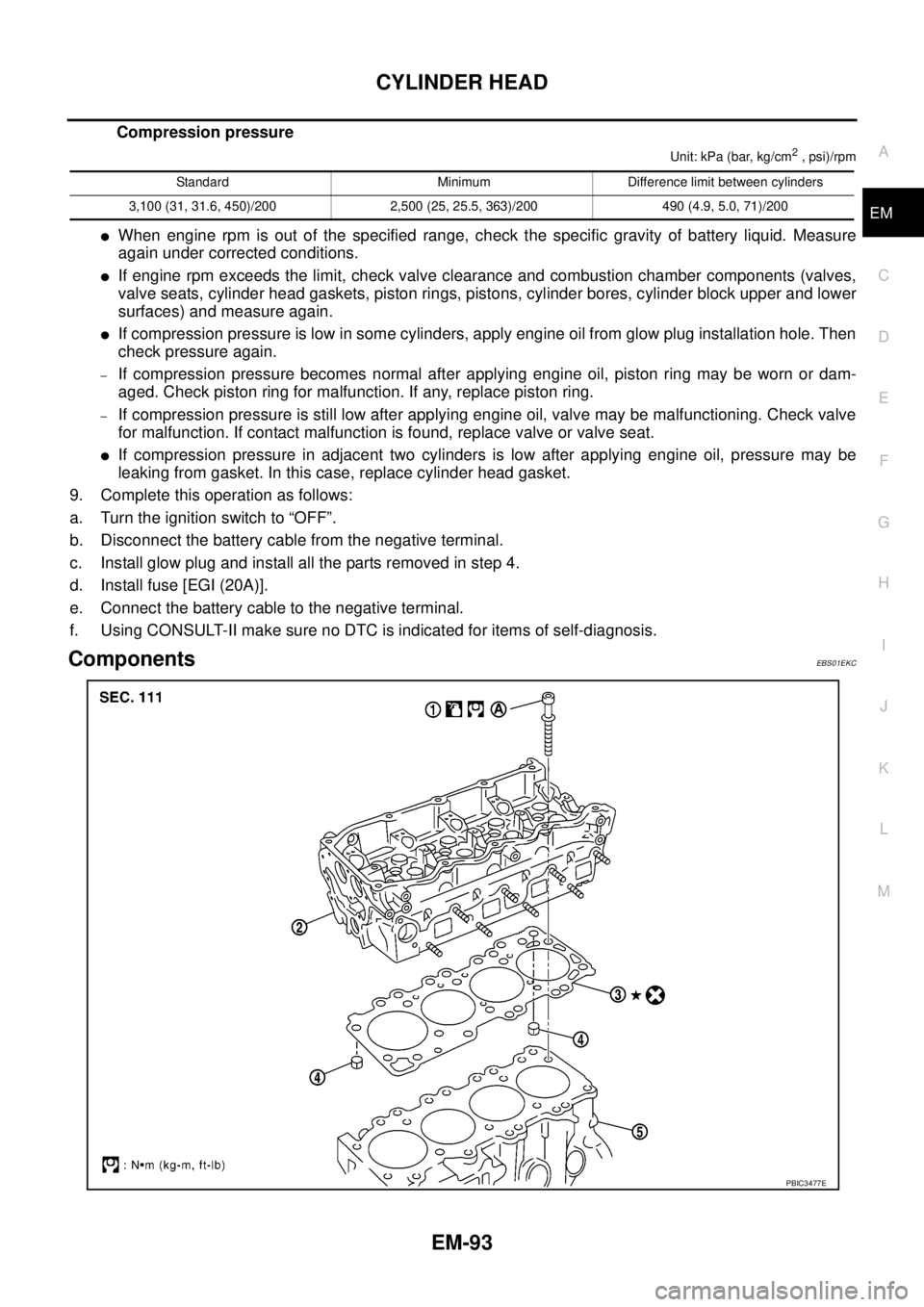
ComponentsEBS01EKC
Standard Minimum Difference limit between cylinders
3,100 (31, 31.6, 450)/200 2,500 (25, 25.5, 363)/200 490 (4.9, 5.0, 71)/200
PBIC3477E
Page 1476 of 3171
EM-94
CYLINDER HEAD
lRefer toGI-10, "Components"for symbol marks in the figure.
Removal and InstallationEBS01E6B
REMOVAL
1. Drain engine coolant. Refer toCO-7, "Changing Engine Coolant".
2. Remove the following:
lRocker cover (Refer toEM-56, "ROCKER COVER".)
lSpill tube and fuel injector (Refer toEM-44, "INJECTION TUBE AND FUEL INJECTOR".)
lIntake manifold (Refer toEM-20, "INTAKE MANIFOLD".)
lTurbocharger (Refer toEM-28, "TURBO CHARGER".)
lExhaust manifold (Refer toEM-34, "EXHAUST MANIFOLD".)
lSecondary timing chain (Refer toEM-73, "SECONDARY TIMING CHAIN".)
lCamshaft (Refer toEM-59, "CAMSHAFT".)
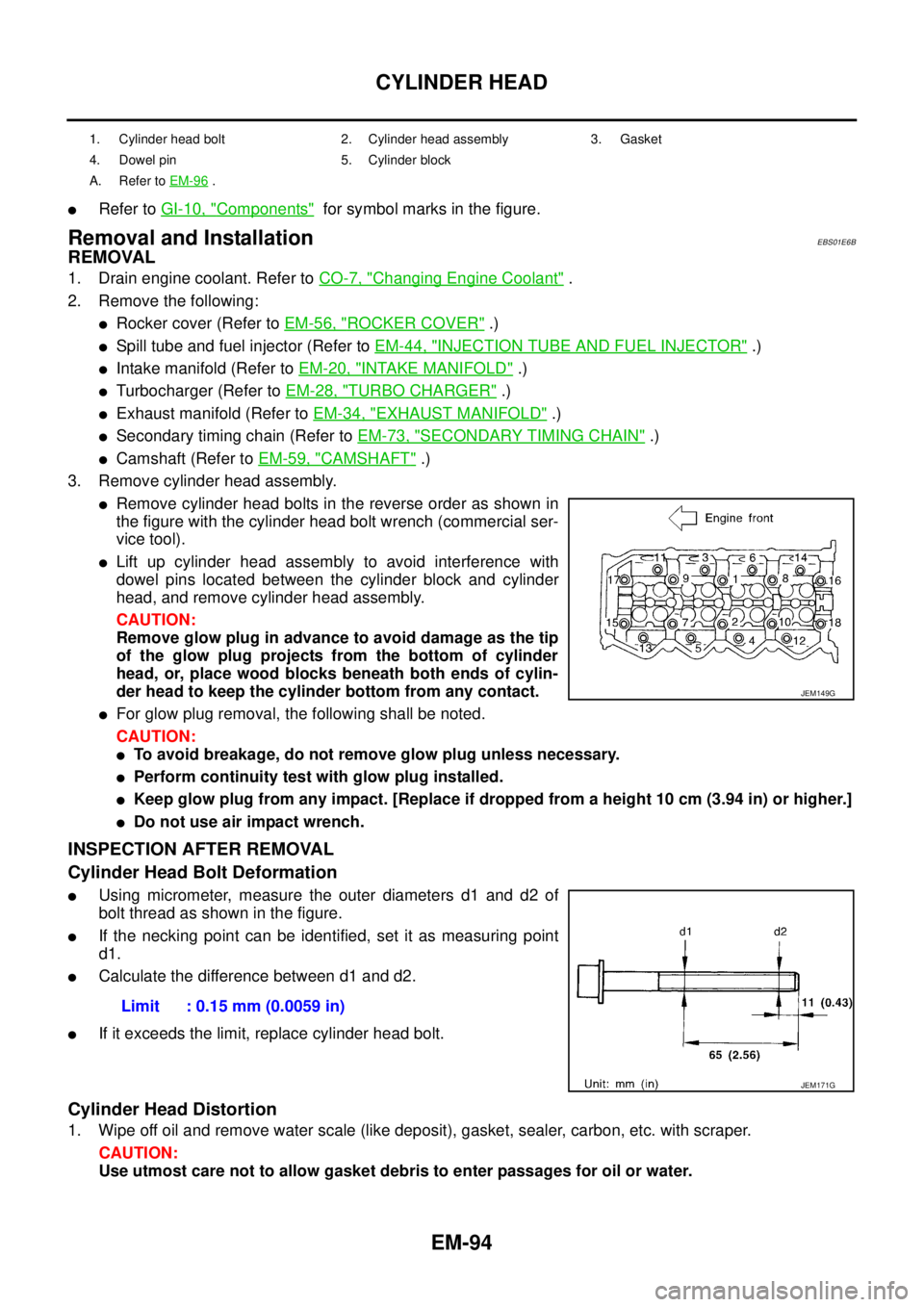
3. Remove cylinder head assembly.
lRemove cylinder head bolts in the reverse order as shown in
the figure with the cylinder head bolt wrench (commercial ser-
vice tool).
lLift up cylinder head assembly to avoid interference with
dowel pins located between the cylinder block and cylinder
head, and remove cylinder head assembly.
CAUTION:
Remove glow plug in advance to avoid damage as the tip
of the glow plug projects from the bottom of cylinder
head, or, place wood blocks beneath both ends of cylin-
der head to keep the cylinder bottom from any contact.
lFor glow plug removal, the following shall be noted.
CAUTION:
lTo avoid breakage, do not remove glow plug unless necessary.
lPerform continuity test with glow plug installed.
lKeep glow plug from any impact. [Replace if dropped from a height 10 cm (3.94 in) or higher.]
lDo not use air impact wrench.
INSPECTION AFTER REMOVAL
Cylinder Head Bolt Deformation
lUsing micrometer, measure the outer diameters d1 and d2 of
bolt thread as shown in the figure.
lIf the necking point can be identified, set it as measuring point
d1.
lCalculate the difference between d1 and d2.
lIf it exceeds the limit, replace cylinder head bolt.
Cylinder Head Distortion
1. Wipe off oil and remove water scale (like deposit), gasket, sealer, carbon, etc. with scraper.
CAUTION:
Use utmost care not to allow gasket debris to enter passages for oil or water.
1. Cylinder head bolt 2. Cylinder head assembly 3. Gasket
4. Dowel pin 5. Cylinder block
A. Refer toEM-96
.
JEM149G
Limit : 0.15 mm (0.0059 in)
JEM171G
Page 1478 of 3171
EM-96
CYLINDER HEAD
INSTALLATION
Before installation, remove old liquid gasket from mating surface of all liquid gasket applied parts.
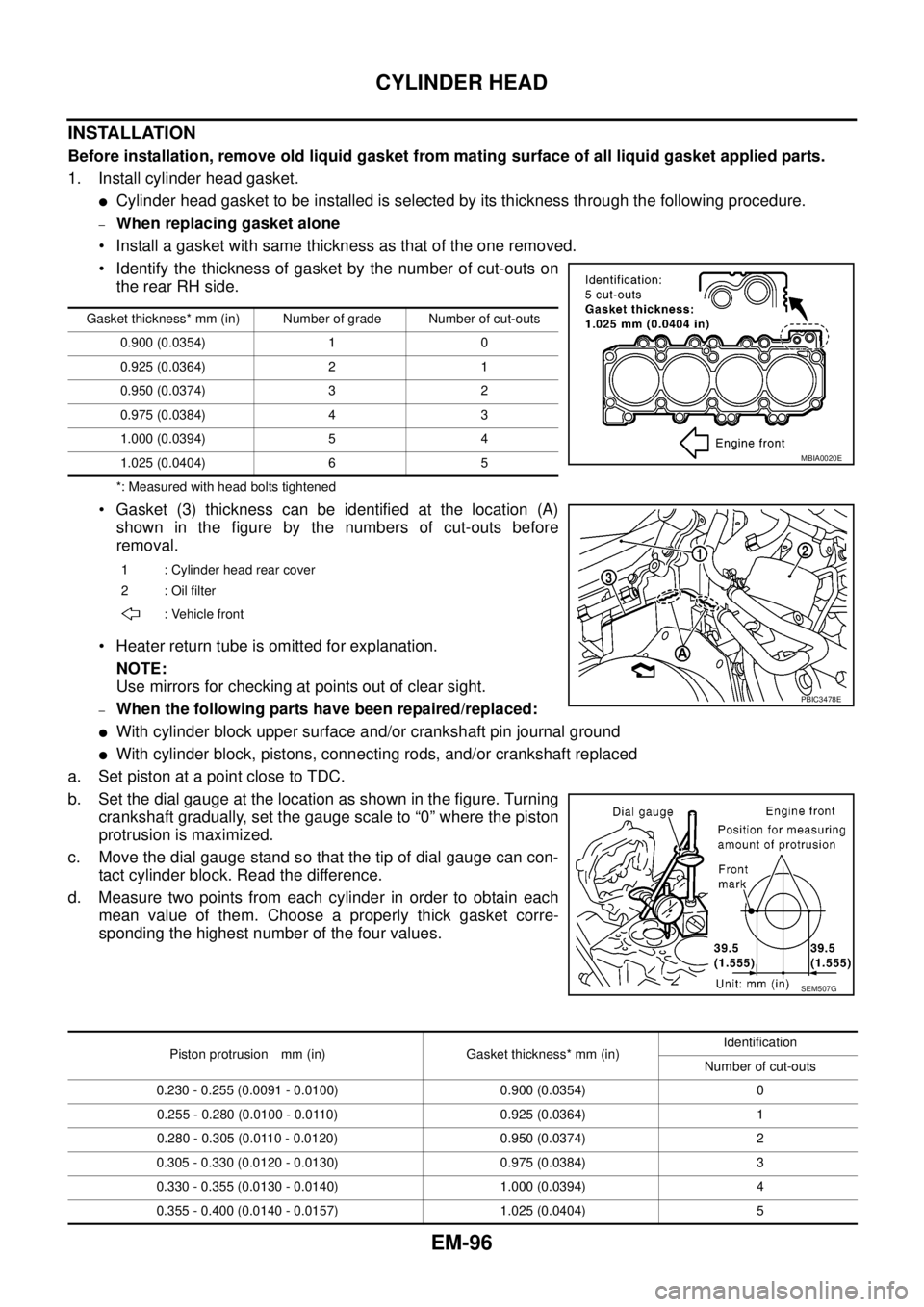
1. Install cylinder head gasket.
lCylinder head gasket to be installed is selected by its thickness through the following procedure.
–When replacing gasket alone
• Install a gasket with same thickness as that of the one removed.
• Identify the thickness of gasket by the number of cut-outs on
the rear RH side.
*: Measured with head bolts tightened
• Gasket (3) thickness can be identified at the location (A)
shown in the figure by the numbers of cut-outs before
removal.
• Heater return tube is omitted for explanation.
NOTE:
Use mirrors for checking at points out of clear sight.
–When the following parts have been repaired/replaced:
lWith cylinder block upper surface and/or crankshaft pin journal ground
lWith cylinder block, pistons, connecting rods, and/or crankshaft replaced
a. Set piston at a point close to TDC.
b. Set the dial gauge at the location as shown in the figure. Turning
crankshaft gradually, set the gauge scale to “0” where the piston
protrusion is maximized.
c. Movethedialgaugestandsothatthetipofdialgaugecancon-
tact cylinder block. Read the difference.
d. Measure two points from each cylinder in order to obtain each
mean value of them. Choose a properly thick gasket corre-
sponding the highest number of the four values.
Gasket thickness* mm (in) Number of grade Number of cut-outs
0.900 (0.0354) 1 0
0.925 (0.0364) 2 1
0.950 (0.0374) 3 2
0.975 (0.0384) 4 3
1.000 (0.0394) 5 4
1.025 (0.0404) 6 5
1 : Cylinder head rear cover
2:Oilfilter
: Vehicle front
MBIA0020E
PBIC3478E
SEM507G
Piston protrusion mm (in) Gasket thickness* mm (in)Identification
Number of cut-outs
0.230 - 0.255 (0.0091 - 0.0100) 0.900 (0.0354) 0
0.255 - 0.280 (0.0100 - 0.0110) 0.925 (0.0364) 1
0.280 - 0.305 (0.0110 - 0.0120) 0.950 (0.0374) 2
0.305 - 0.330 (0.0120 - 0.0130) 0.975 (0.0384) 3
0.330 - 0.355 (0.0130 - 0.0140) 1.000 (0.0394) 4
0.355 - 0.400 (0.0140 - 0.0157) 1.025 (0.0404) 5
Page 1479 of 3171
CYLINDER HEAD
EM-97
C
D
E
F
G
H
I
J
K
L
MA
EM
*: Measured with head bolts tightened
e. If out of above protrusion, check replaced parts.
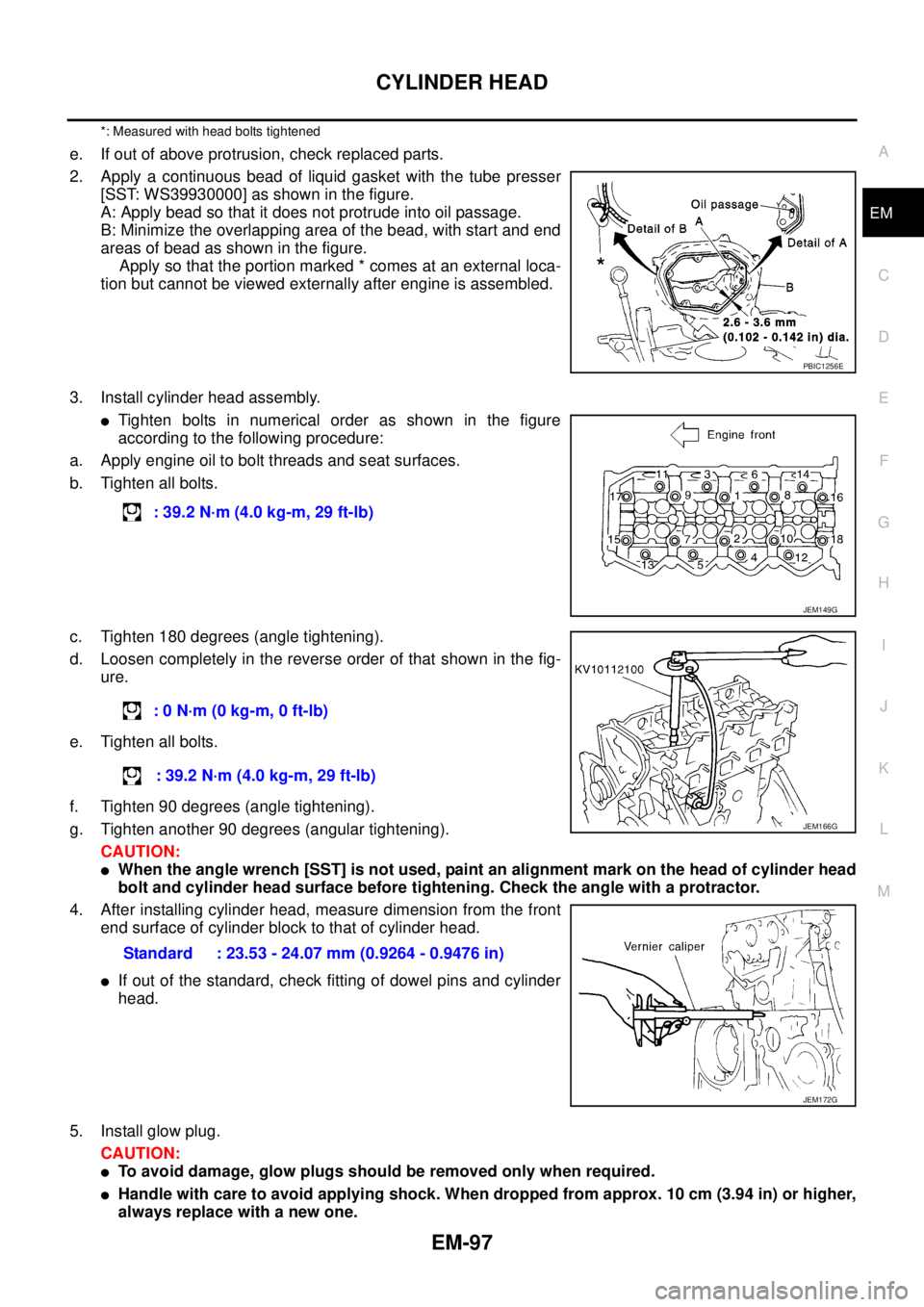
2. Apply a continuous bead of liquid gasket with the tube presser
[SST: WS39930000] as shown in the figure.
A: Apply bead so that it does not protrude into oil passage.
B: Minimize the overlapping area of the bead, with start and end
areas of bead as shown in the figure.
Apply so that the portion marked * comes at an external loca-
tion but cannot be viewed externally after engine is assembled.
3. Install cylinder head assembly.
lTighten bolts in numerical order as shown in the figure
according to the following procedure:
a. Apply engine oil to bolt threads and seat surfaces.
b. Tighten all bolts.
c. Tighten 180 degrees (angle tightening).
d. Loosen completely in the reverse order of that shown in the fig-
ure.
e. Tighten all bolts.
f. Tighten 90 degrees (angle tightening).
g. Tighten another 90 degrees (angular tightening).
CAUTION:
lWhen the angle wrench [SST] is not used, paint an alignment mark on the head of cylinder head
bolt and cylinder head surface before tightening. Check the angle with a protractor.
4. After installing cylinder head, measure dimension from the front
end surface of cylinder block to that of cylinder head.
lIf out of the standard, check fitting of dowel pins and cylinder
head.
5. Install glow plug.
CAUTION:
lTo avoid damage, glow plugs should be removed only when required.
lHandle with care to avoid applying shock. When dropped from approx. 10 cm (3.94 in) or higher,
always replace with a new one.
PBIC1256E
: 39.2 N·m (4.0 kg-m, 29 ft-lb)
JEM149G
:0N·m(0kg-m,0ft-lb)
: 39.2 N·m (4.0 kg-m, 29 ft-lb)
Standard : 23.53 - 24.07 mm (0.9264 - 0.9476 in)
JEM166G
JEM172G
Page 1492 of 3171
EM-110
CYLINDER BLOCK
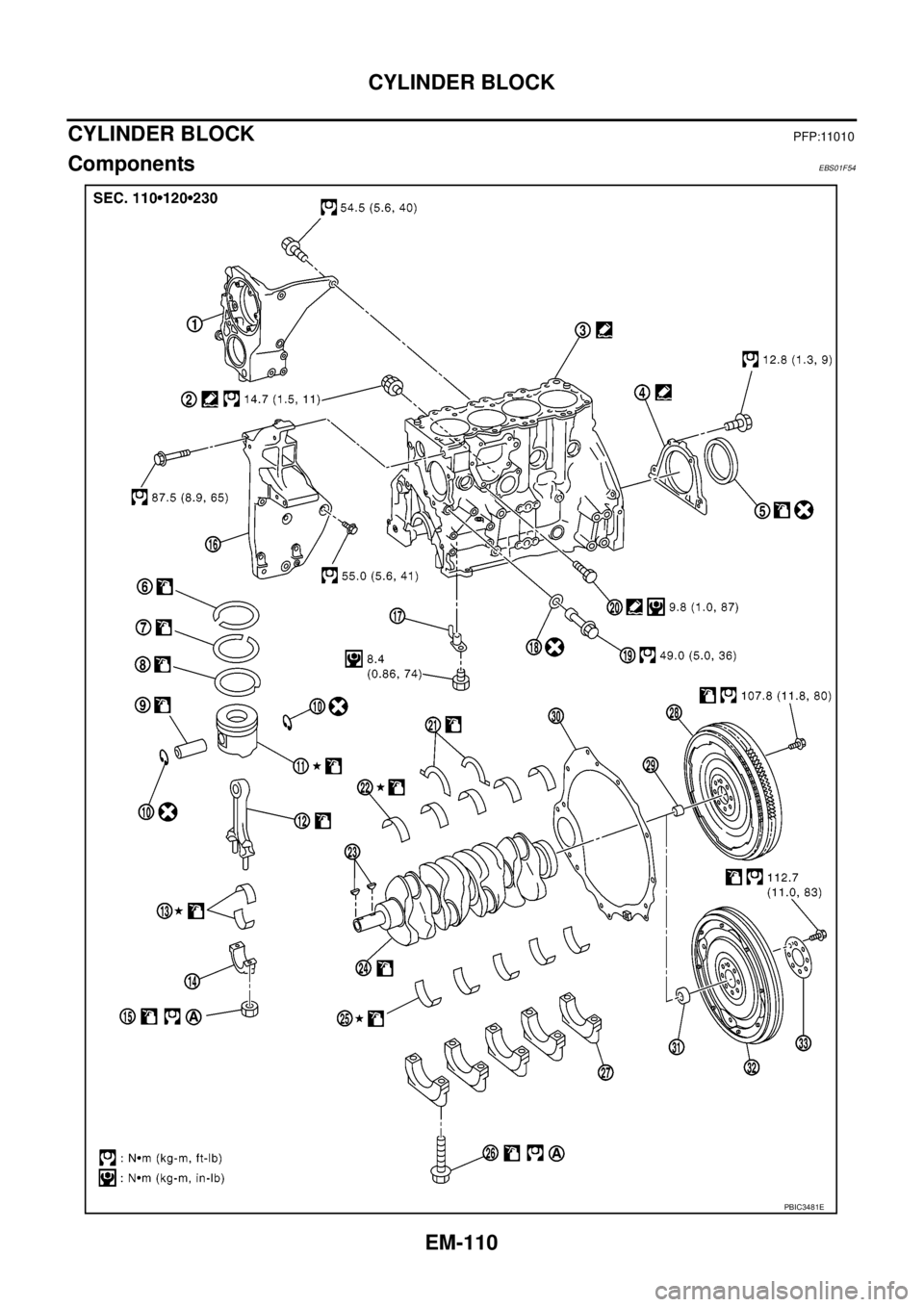
CYLINDER BLOCK
PFP:11010
ComponentsEBS01F54
PBIC3481E