Page 1414 of 3171
EM-32
TURBO CHARGER
Turbocharger Boost Control Actuator
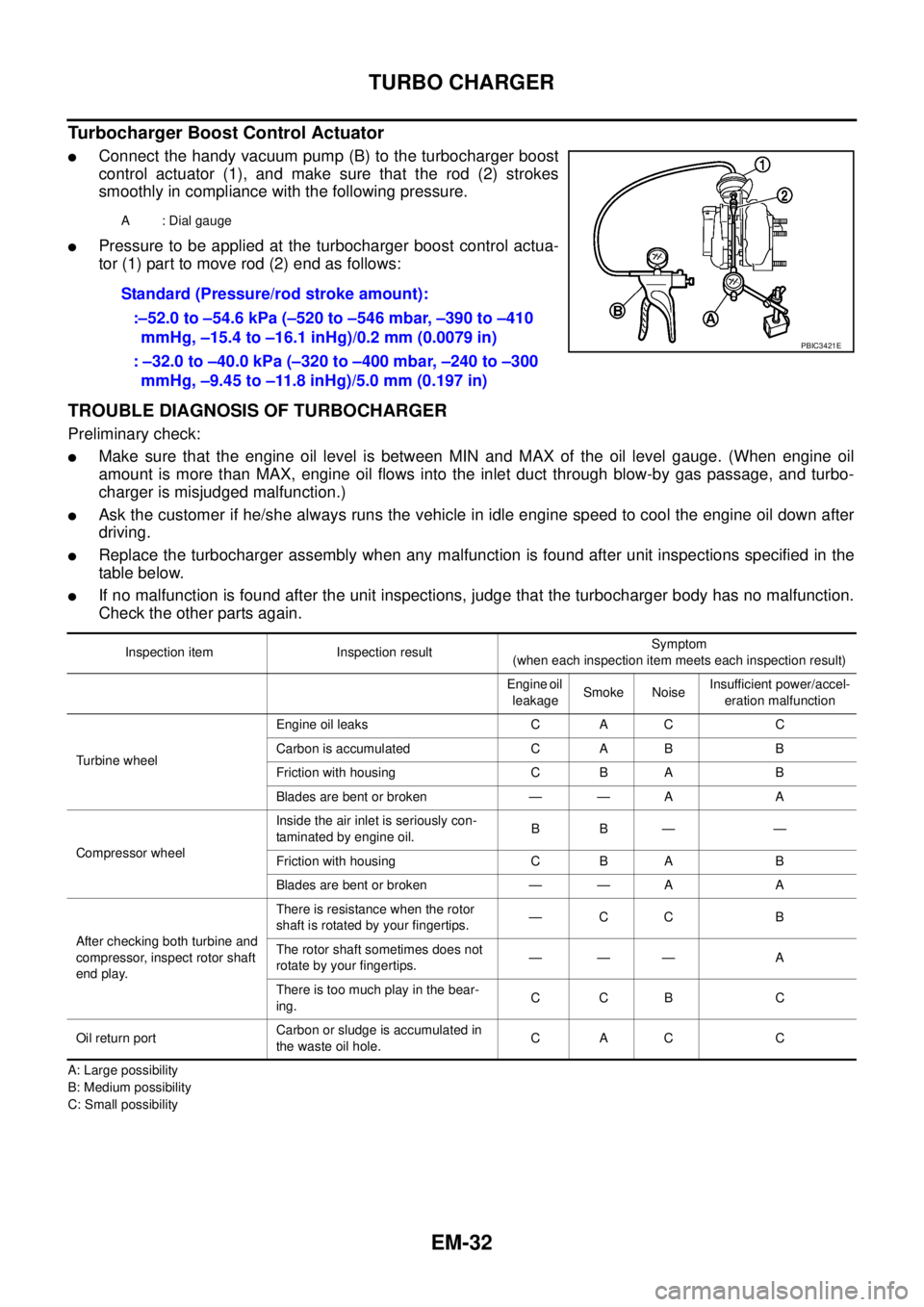
lConnect the handy vacuum pump (B) to the turbocharger boost
control actuator (1), and make sure that the rod (2) strokes
smoothly in compliance with the following pressure.
lPressure to be applied at the turbocharger boost control actua-
tor (1) part to move rod (2) end as follows:
TROUBLE DIAGNOSIS OF TURBOCHARGER
Preliminary check:
lMake sure that the engine oil level is between MIN and MAX of the oil level gauge. (When engine oil
amount is more than MAX, engine oil flows into the inlet duct through blow-by gas passage, and turbo-
charger is misjudged malfunction.)
lAsk the customer if he/she always runs the vehicle in idle engine speed to cool the engine oil down after
driving.
lReplace the turbocharger assembly when any malfunction is found after unit inspections specified in the
table below.
lIf no malfunction is found after the unit inspections, judge that the turbocharger body has no malfunction.
Check the other parts again.
A: Large possibility
B: Medium possibility
C: Small possibilityA : Dial gauge
Standard (Pressure/rod stroke amount):
:–52.0 to –54.6 kPa (–520 to –546 mbar, –390 to –410
mmHg, –15.4 to –16.1 inHg)/0.2 mm (0.0079 in)
: –32.0 to –40.0 kPa (–320 to –400 mbar, –240 to –300
mmHg, –9.45 to –11.8 inHg)/5.0 mm (0.197 in)
PBIC3421E
Inspection item Inspection resultSymptom
(when each inspection item meets each inspection result)
Engine oil
leakageSmoke NoiseInsufficient power/accel-
eration malfunction
Turbine wheelEngine oil leaks C A C C
Carbon is accumulated C A B B
Friction with housing C B A B
Blades are bent or broken — — A A
Compressor wheelInside the air inlet is seriously con-
taminated by engine oil.BB— —
Friction with housing C B A B
Blades are bent or broken — — A A
After checking both turbine and
compressor, inspect rotor shaft
end play.There is resistance when the rotor
shaft is rotated by your fingertips.—CC B
The rotor shaft sometimes does not
rotate by your fingertips.——— A
There is too much play in the bear-
ing.CCB C
Oil return portCarbon or sludge is accumulated in
the waste oil hole.CAC C
Page 1417 of 3171
EXHAUST MANIFOLD
EM-35
C
D
E
F
G
H
I
J
K
L
MA
EM
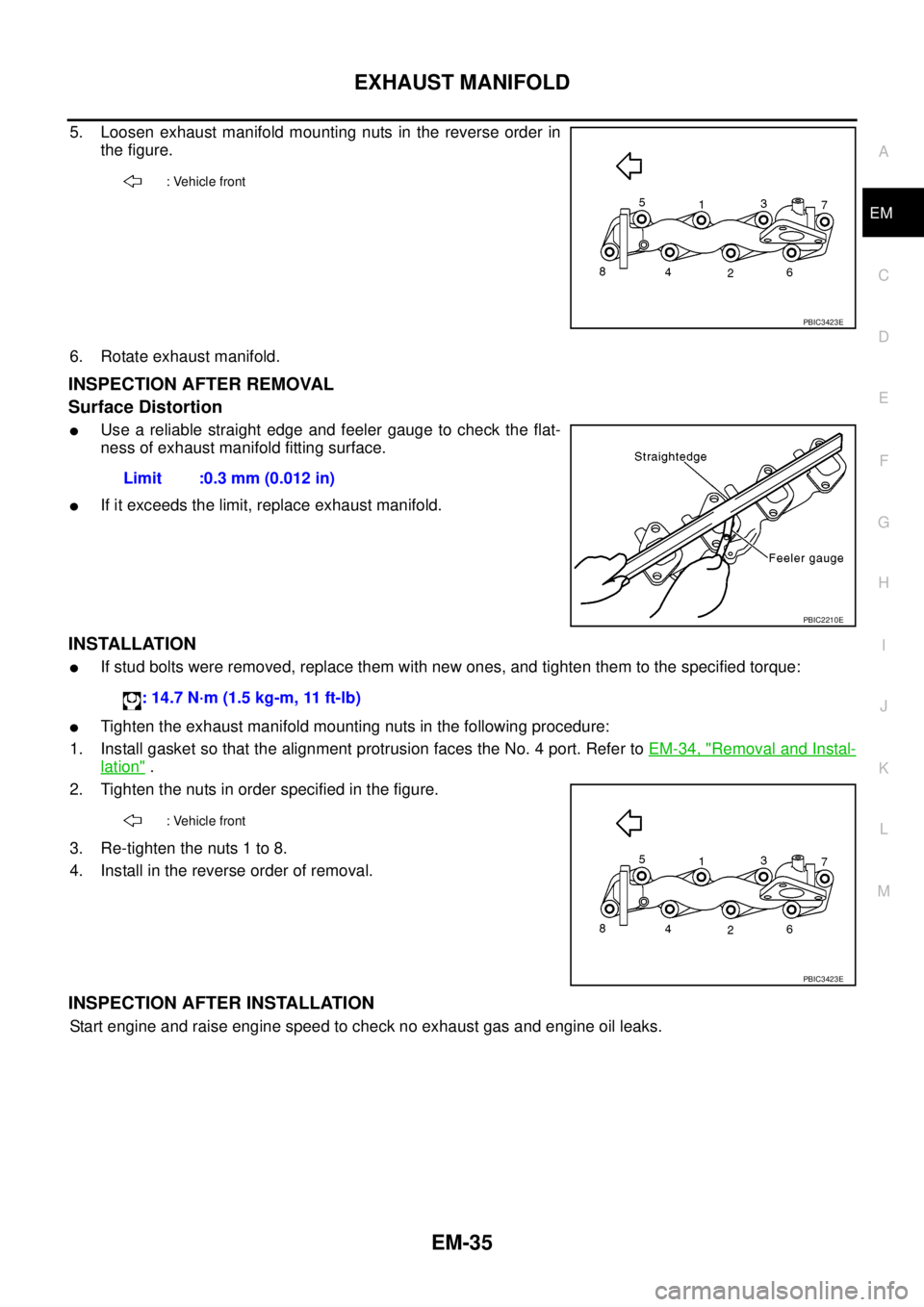
5. Loosen exhaust manifold mounting nuts in the reverse order in
the figure.
6. Rotate exhaust manifold.
INSPECTION AFTER REMOVAL
Surface Distortion
lUse a reliable straight edge and feeler gauge to check the flat-
ness of exhaust manifold fitting surface.
lIf it exceeds the limit, replace exhaust manifold.
INSTALLATION
lIf stud bolts were removed, replace them with new ones, and tighten them to the specified torque:
lTighten the exhaust manifold mounting nuts in the following procedure:
1. Install gasket so that the alignment protrusion faces the No. 4 port. Refer toEM-34, "
Removal and Instal-
lation".
2. Tighten the nuts in order specified in the figure.
3. Re-tighten the nuts 1 to 8.
4. Install in the reverse order of removal.
INSPECTION AFTER INSTALLATION
Start engine and raise engine speed to check no exhaust gas and engine oil leaks.
: Vehicle front
PBIC3423E
Limit :0.3 mm (0.012 in)
PBIC2210E
: 14.7 N·m (1.5 kg-m, 11 ft-lb)
: Vehicle front
PBIC3423E
Page 1422 of 3171
EM-40
OIL PAN AND OIL STRAINER
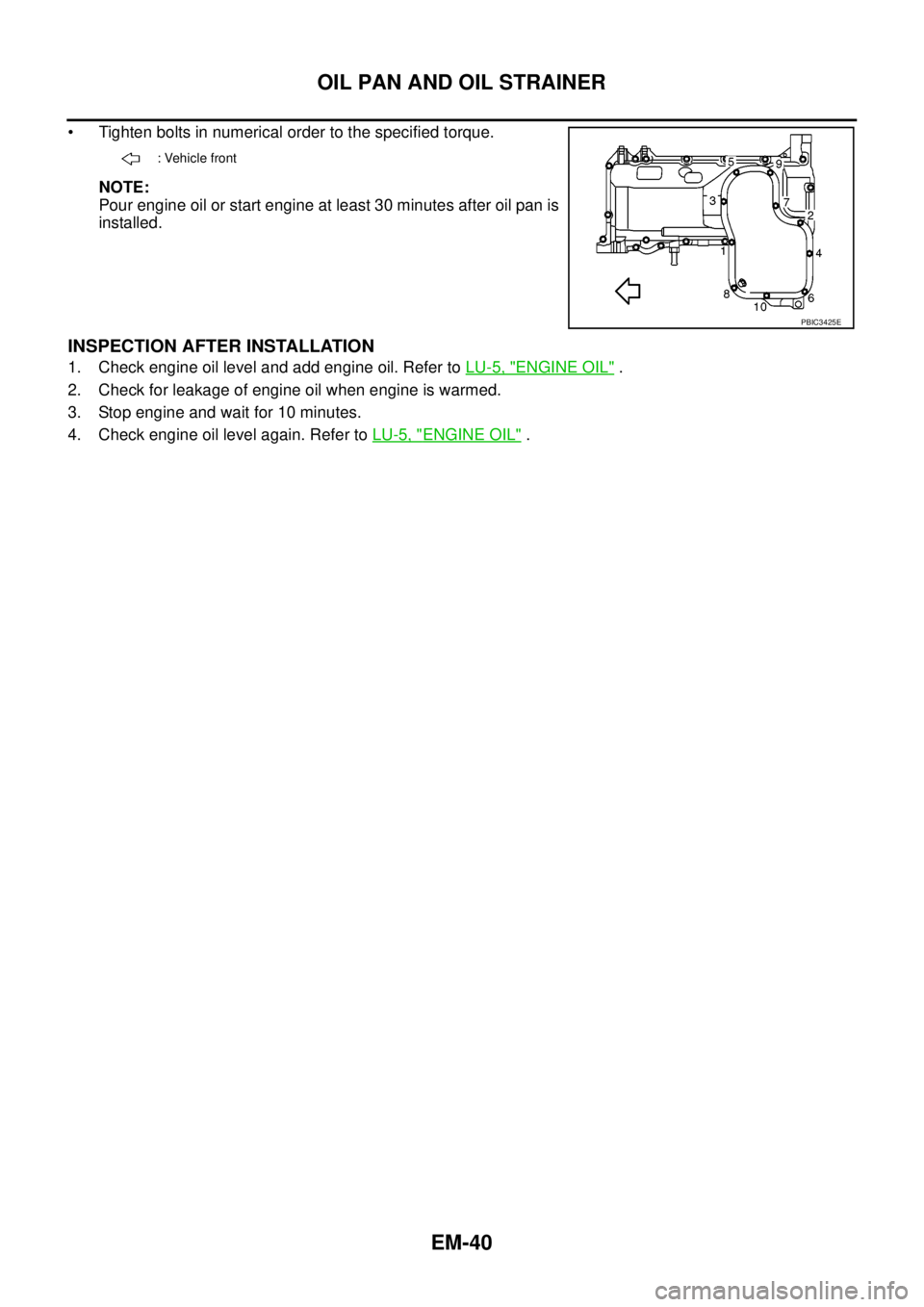
• Tighten bolts in numerical order to the specified torque.
NOTE:
Pour engine oil or start engine at least 30 minutes after oil pan is
installed.
INSPECTION AFTER INSTALLATION
1. Check engine oil level and add engine oil. Refer toLU-5, "ENGINE OIL".
2. Check for leakage of engine oil when engine is warmed.
3. Stop engine and wait for 10 minutes.
4. Check engine oil level again. Refer toLU-5, "
ENGINE OIL".
: Vehicle front
PBIC3425E
Page 1424 of 3171
EM-42
VACUUM PUMP
VACUUM PUMP
PFP:41920
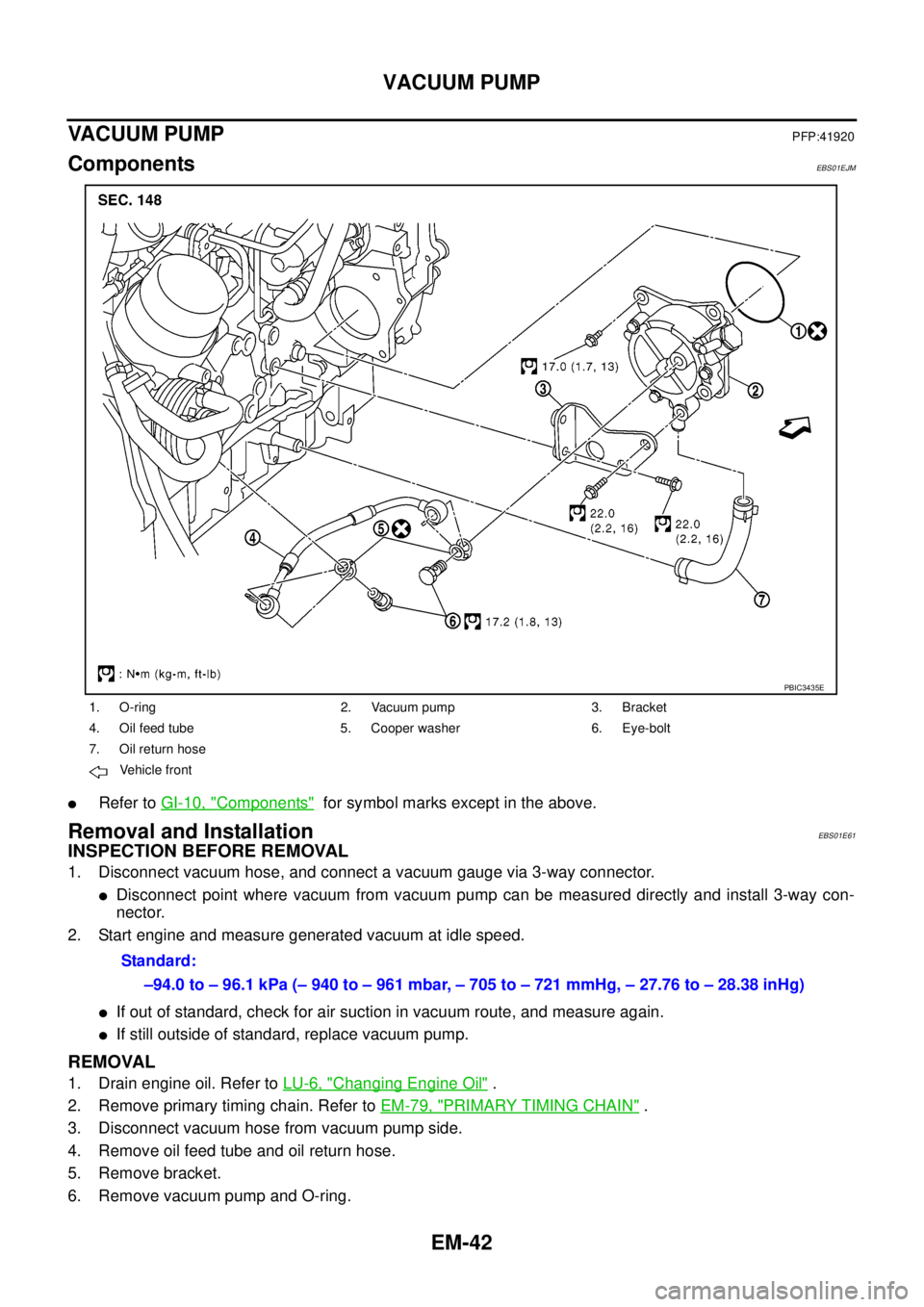
ComponentsEBS01EJM
lRefer toGI-10, "Components"for symbol marks except in the above.
Removal and InstallationEBS01E61
INSPECTION BEFORE REMOVAL
1. Disconnect vacuum hose, and connect a vacuum gauge via 3-way connector.
lDisconnect point where vacuum from vacuum pump can be measured directly and install 3-way con-
nector.
2. Start engine and measure generated vacuum at idle speed.
lIf out of standard, check for air suction in vacuum route, and measure again.
lIf still outside of standard, replace vacuum pump.
REMOVAL
1. Drain engine oil. Refer toLU-6, "Changing Engine Oil".
2. Remove primary timing chain. Refer toEM-79, "
PRIMARY TIMING CHAIN".
3. Disconnect vacuum hose from vacuum pump side.
4. Remove oil feed tube and oil return hose.
5. Remove bracket.
6. Remove vacuum pump and O-ring.
1. O-ring 2. Vacuum pump 3. Bracket
4. Oil feed tube 5. Cooper washer 6. Eye-bolt
7. Oil return hose
Vehicle front
PBIC3435E
Standard:
–94.0 to – 96.1 kPa (– 940 to – 961 mbar, – 705 to – 721 mmHg, – 27.76 to – 28.38 inHg)
Page 1430 of 3171
EM-48
INJECTION TUBE AND FUEL INJECTOR
NOTE:
Intake manifold and other related parts are omitted for explanation.
9. Install remaining parts in the reverse order of removal.
INSPECTION AFTER INSTALLATION
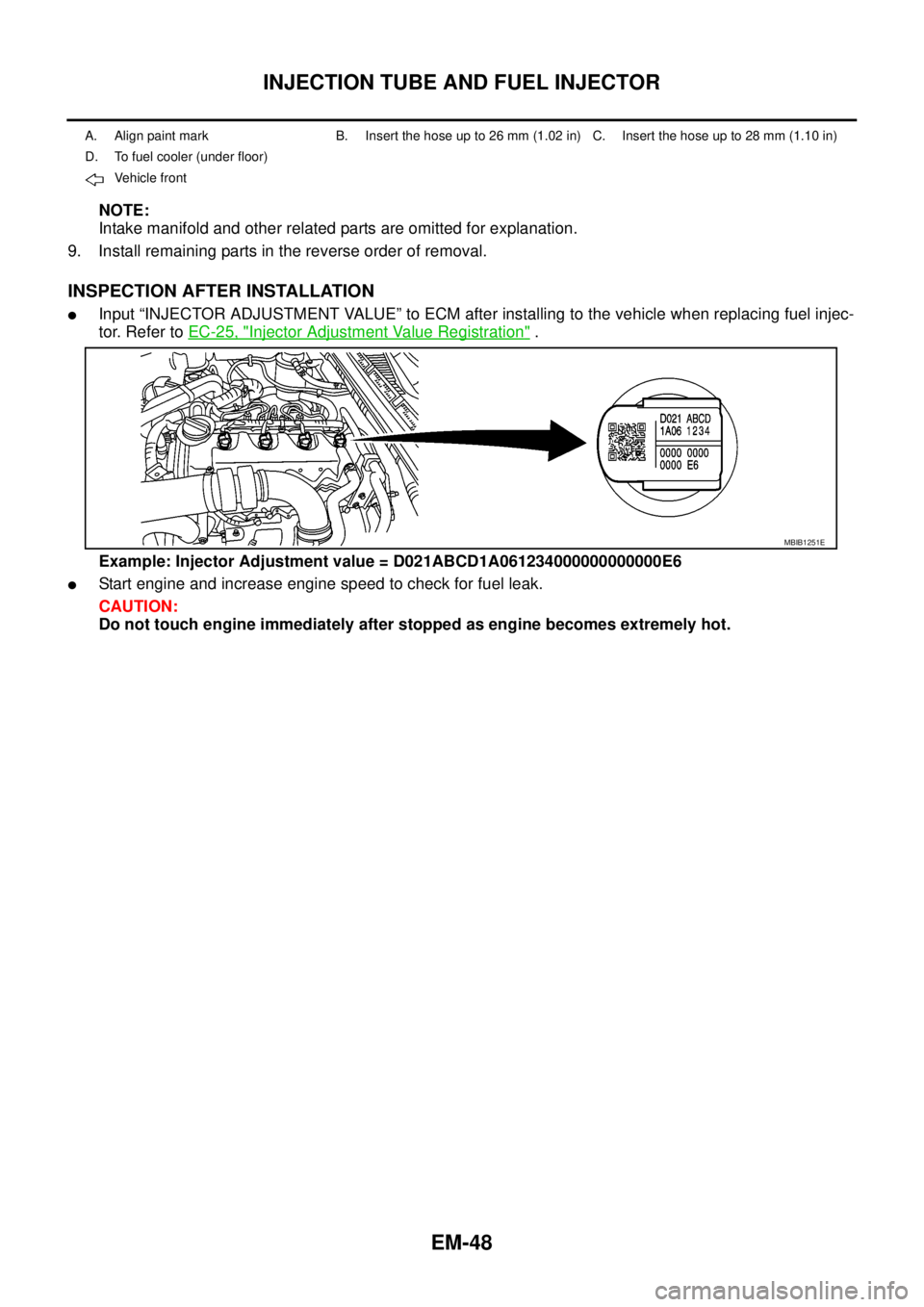
lInput “INJECTOR ADJUSTMENT VALUE” to ECM after installing to the vehicle when replacing fuel injec-
tor. Refer toEC-25, "
Injector Adjustment Value Registration".
Example: Injector Adjustment value = D021ABCD1A061234000000000000E6
lStart engine and increase engine speed to check for fuel leak.
CAUTION:
Do not touch engine immediately after stopped as engine becomes extremely hot.
A. Align paint mark B. Insert the hose up to 26 mm (1.02 in) C. Insert the hose up to 28 mm (1.10 in)
D. To fuel cooler (under floor)
Ve h ic le f ro n t
MBIB1251E
Page 1440 of 3171
EM-58
ROCKER COVER
INSPECTION AFTER INSTALLATION
Start engine and increase engine speed to check for fuel leak and engine oil leak.
CAUTION:
Do not touch the engine immediately after stopped as engine becomes extremely hot.
Page 1442 of 3171
EM-60
CAMSHAFT
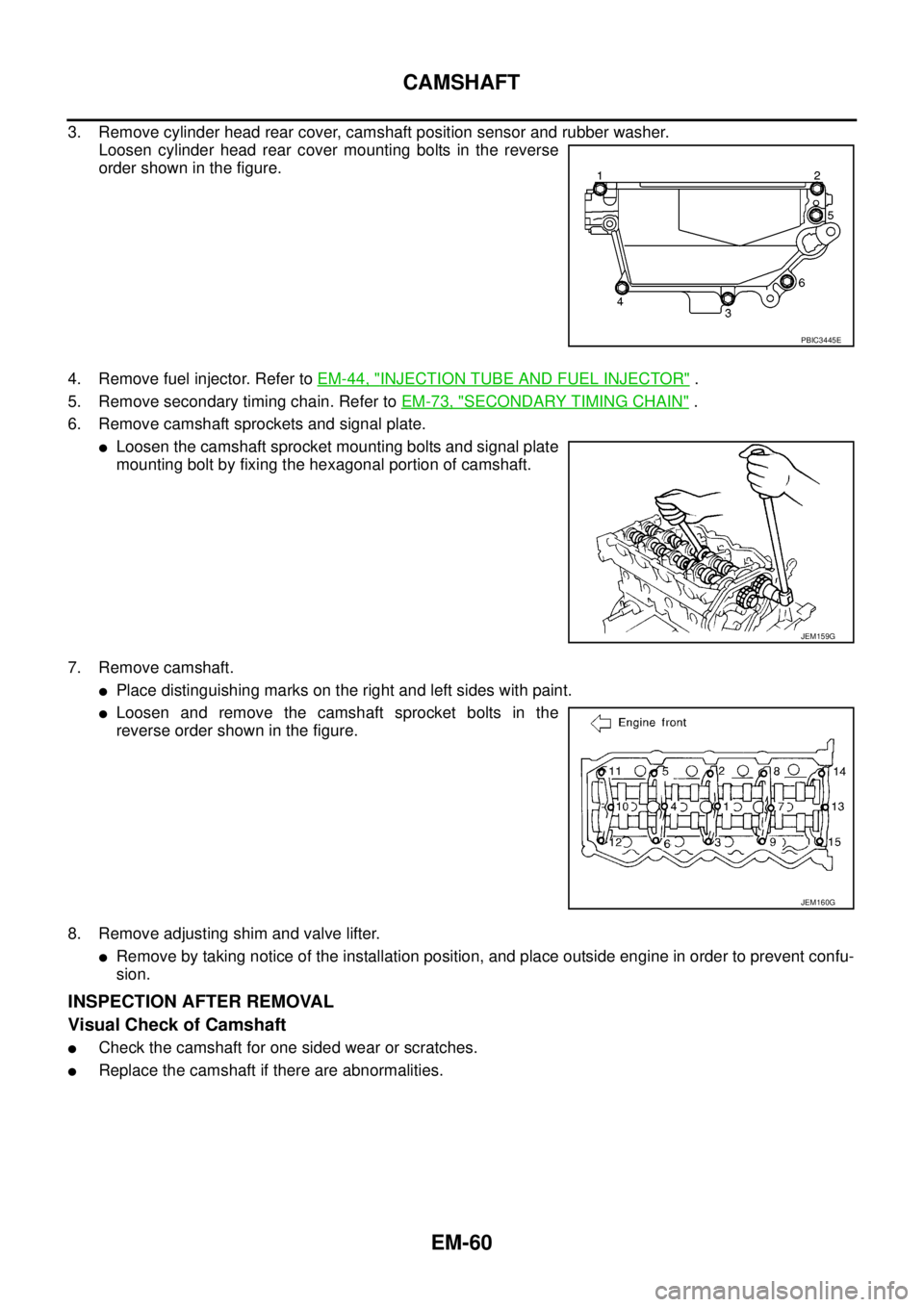
3. Remove cylinder head rear cover, camshaft position sensor and rubber washer.
Loosen cylinder head rear cover mounting bolts in the reverse
order shown in the figure.
4. Remove fuel injector. Refer toEM-44, "
INJECTION TUBE AND FUEL INJECTOR".
5. Remove secondary timing chain. Refer toEM-73, "
SECONDARY TIMING CHAIN".
6. Remove camshaft sprockets and signal plate.
lLoosen the camshaft sprocket mounting bolts and signal plate
mounting bolt by fixing the hexagonal portion of camshaft.
7. Remove camshaft.
lPlace distinguishing marks on the right and left sides with paint.
lLoosen and remove the camshaft sprocket bolts in the
reverse order shown in the figure.
8. Remove adjusting shim and valve lifter.
lRemove by taking notice of the installation position, and place outside engine in order to prevent confu-
sion.
INSPECTION AFTER REMOVAL
Visual Check of Camshaft
lCheck the camshaft for one sided wear or scratches.
lReplace the camshaft if there are abnormalities.
PBIC3445E
JEM159G
JEM160G
Page 1447 of 3171
CAMSHAFT
EM-65
C
D
E
F
G
H
I
J
K
L
MA
EM
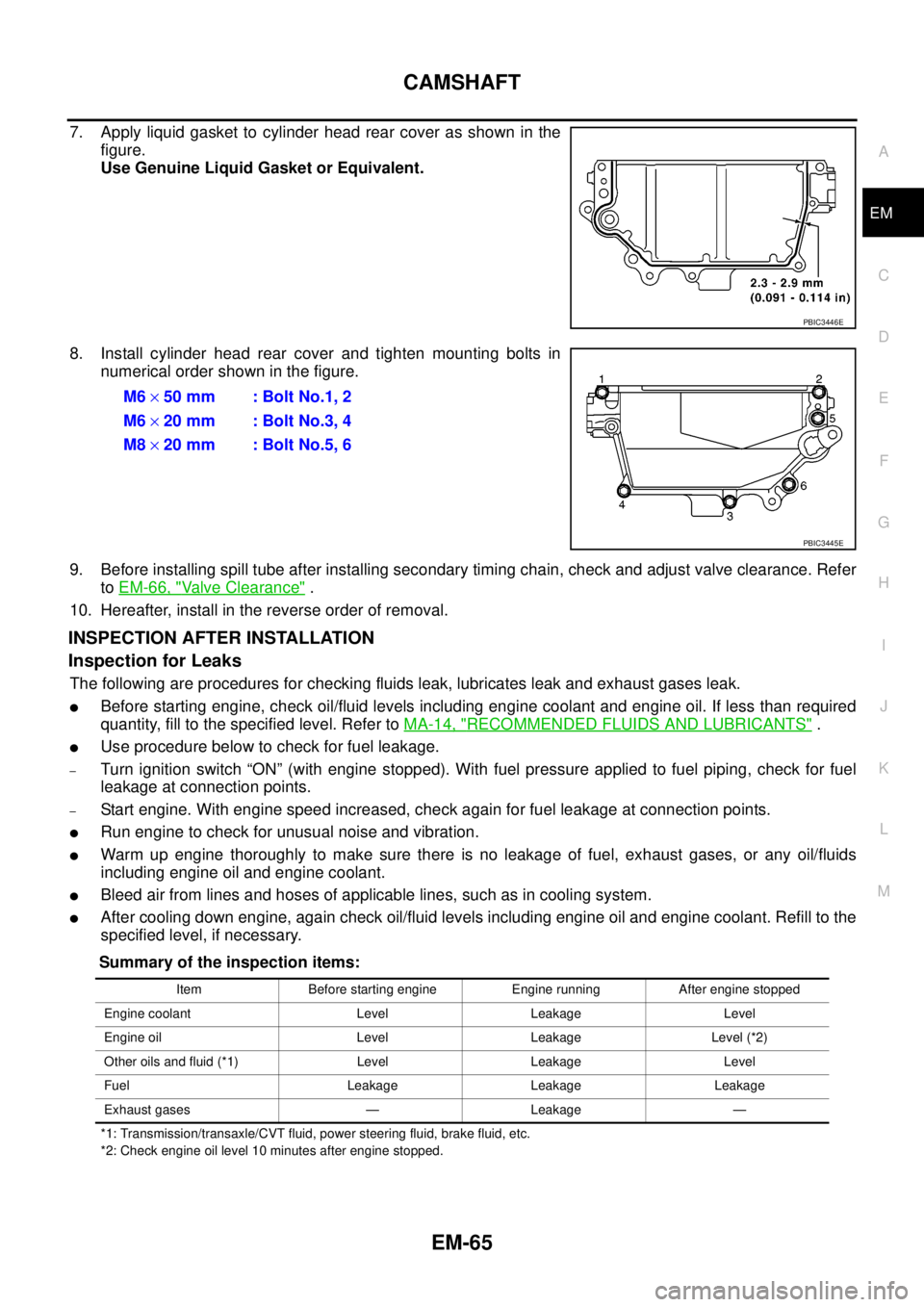
7. Apply liquid gasket to cylinder head rear cover as shown in the
figure.
Use Genuine Liquid Gasket or Equivalent.
8. Install cylinder head rear cover and tighten mounting bolts in
numerical order shown in the figure.
9. Before installing spill tube after installing secondary timing chain, check and adjust valve clearance. Refer
toEM-66, "
Valve Clearance".
10. Hereafter, install in the reverse order of removal.
INSPECTION AFTER INSTALLATION
Inspection for Leaks
The following are procedures for checking fluids leak, lubricates leak and exhaust gases leak.
lBefore starting engine, check oil/fluid levels including engine coolant and engine oil. If less than required
quantity, fill to the specified level. Refer toMA-14, "
RECOMMENDED FLUIDS AND LUBRICANTS".
lUse procedure below to check for fuel leakage.
–Turn ignition switch “ON” (with engine stopped). With fuel pressure applied to fuel piping, check for fuel
leakage at connection points.
–Start engine. With engine speed increased, check again for fuel leakage at connection points.
lRun engine to check for unusual noise and vibration.
lWarm up engine thoroughly to make sure there is no leakage of fuel, exhaust gases, or any oil/fluids
including engine oil and engine coolant.
lBleed air from lines and hoses of applicable lines, such as in cooling system.
lAfter cooling down engine, again check oil/fluid levels including engine oil and engine coolant. Refill to the
specified level, if necessary.
Summary of the inspection items:
*1: Transmission/transaxle/CVT fluid, power steering fluid, brake fluid, etc.
*2: Check engine oil level 10 minutes after engine stopped.
PBIC3446E
M6´50 mm : Bolt No.1, 2
M6´20 mm : Bolt No.3, 4
M8´20 mm : Bolt No.5, 6
PBIC3445E
Item Before starting engine Engine running After engine stopped
Engine coolant Level Leakage Level
Engine oil Level Leakage Level (*2)
Other oils and fluid (*1) Level Leakage Level
Fuel Leakage Leakage Leakage
Exhaust gases — Leakage —