Page 499 of 2870
EI-23
EXTERIOR/INTERIOR TRIM
Front Bumper
5. Front Bumper
A: REMOVAL
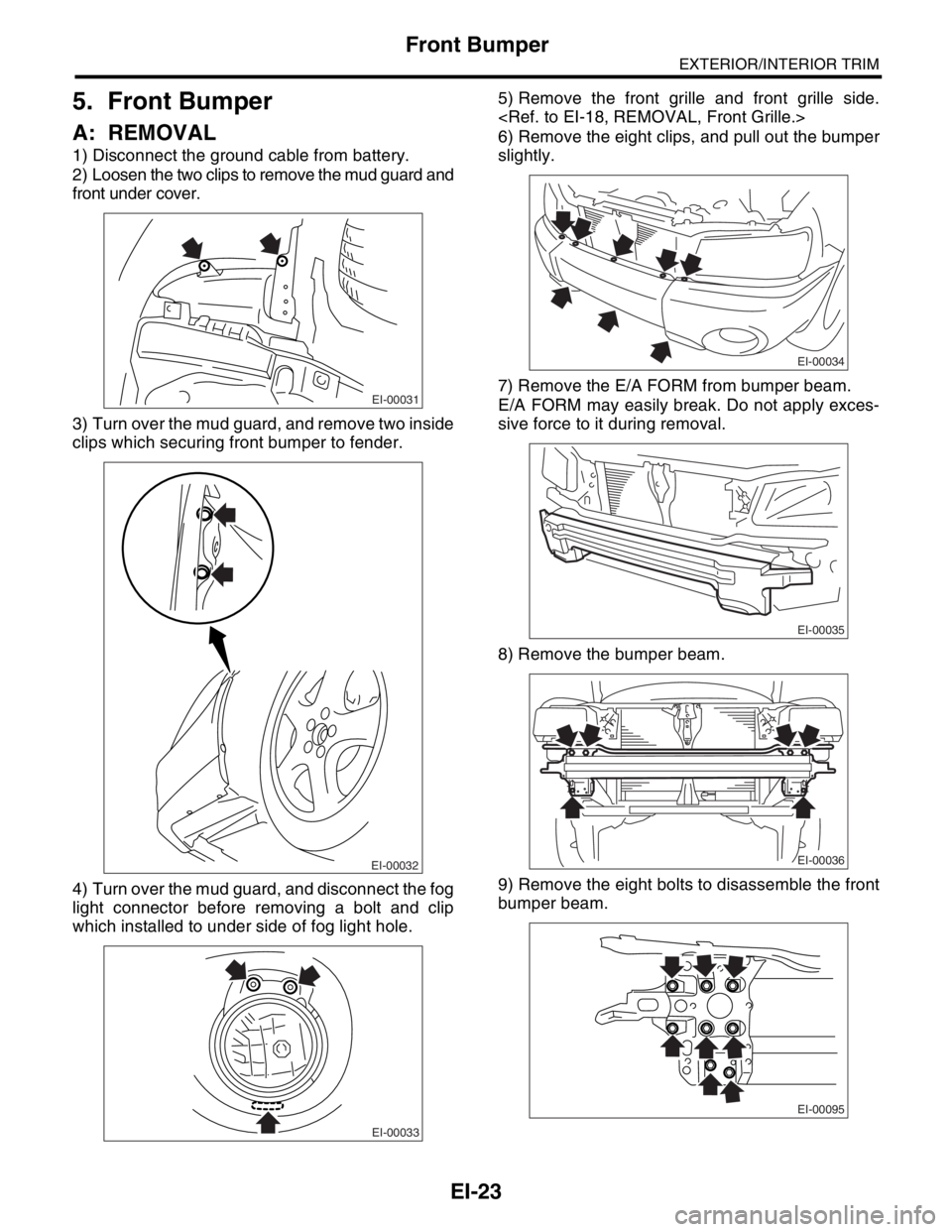
1) Disconnect the ground cable from battery.
2) Loosen the two clips to remove the mud guard and
front under cover.
3) Turn over the mud guard, and remove two inside
clips which securing front bumper to fender.
4) Turn over the mud guard, and disconnect the fog
light connector before removing a bolt and clip
which installed to under side of fog light hole.5) Remove the front grille and front grille side.
6) Remove the eight clips, and pull out the bumper
slightly.
7) Remove the E/A FORM from bumper beam.
E/A FORM may easily break. Do not apply exces-
sive force to it during removal.
8) Remove the bumper beam.
9) Remove the eight bolts to disassemble the front
bumper beam.
EI-00031
EI-00032
EI-00033
EI-00034
EI-00035
EI-00036
EI-00095
Page 503 of 2870
EI-27
EXTERIOR/INTERIOR TRIM
Front Bumper
3) Deep damage such as a break or hole that requires filling
Much of the peripheral grained surface must be sacrificed for repair, and the degree of restoration is not really
worth the expense. (The surface, however, will become almost flush with adjacent areas.)
Recommended repair kit: PP Part Repair Kit (NRM)
Pro-
cess
No.Process name Job contents
1 Bumper removal Remove the bumper as required.
2 Part removal Remove the parts built into bumper as required.
3 Bumper placementPlace the bumper on a paint worktable as
required.
It is recommended that contour of worktable
accommodate internal shape of bumper.
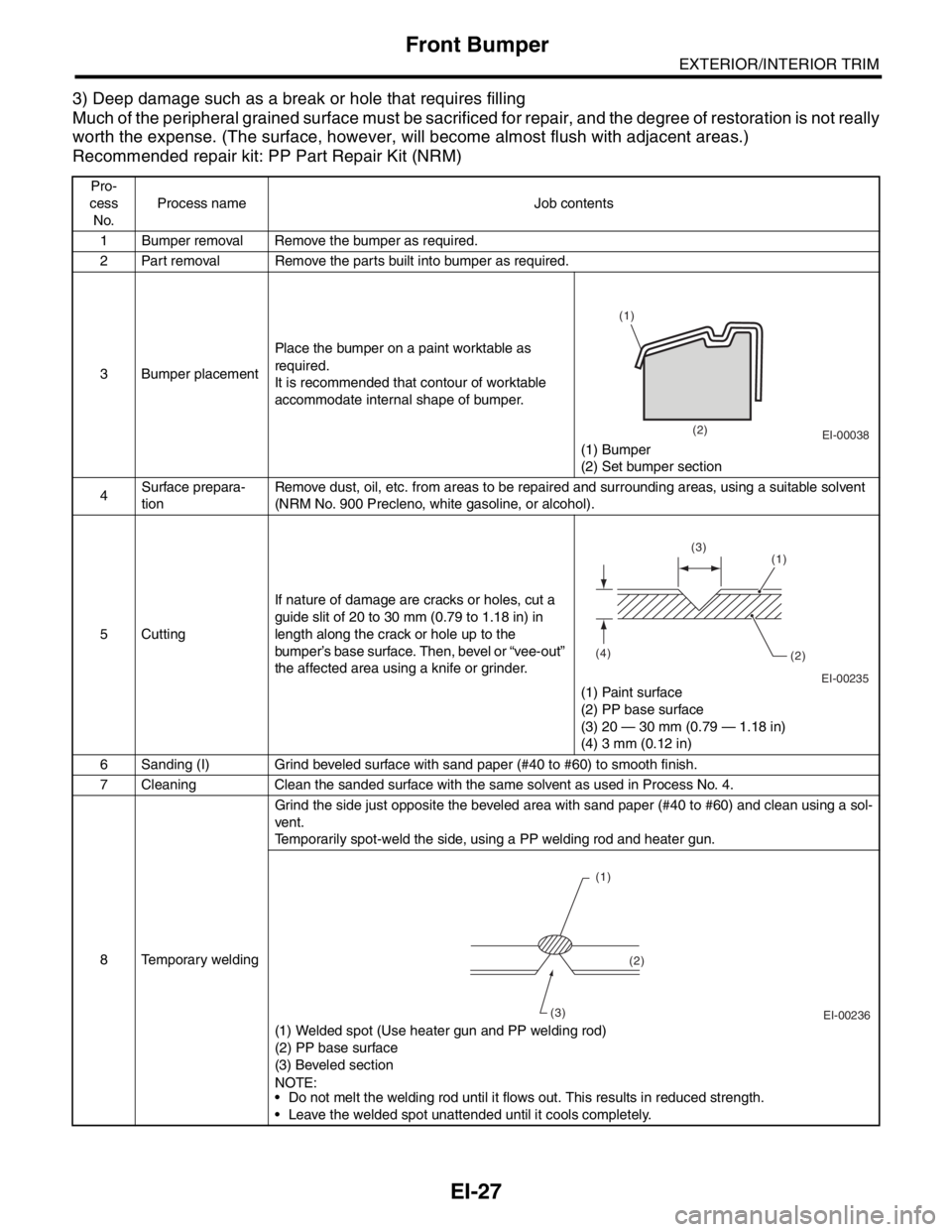
(1) Bumper
(2) Set bumper section
4Surface prepara-
tionRemove dust, oil, etc. from areas to be repaired and surrounding areas, using a suitable solvent
(NRM No. 900 Precleno, white gasoline, or alcohol).
5 CuttingIf nature of damage are cracks or holes, cut a
guide slit of 20 to 30 mm (0.79 to 1.18 in) in
length along the crack or hole up to the
bumper’s base surface. Then, bevel or “vee-out”
the affected area using a knife or grinder.
(1) Paint surface
(2) PP base surface
(3) 20 — 30 mm (0.79 — 1.18 in)
(4) 3 mm (0.12 in)
6 Sanding (I) Grind beveled surface with sand paper (#40 to #60) to smooth finish.
7 Cleaning Clean the sanded surface with the same solvent as used in Process No. 4.
8 Temporary weldingGrind the side just opposite the beveled area with sand paper (#40 to #60) and clean using a sol-
vent.
Temporarily spot-weld the side, using a PP welding rod and heater gun.
(1) Welded spot (Use heater gun and PP welding rod)
(2) PP base surface
(3) Beveled section
N
OTE:
Do not melt the welding rod until it flows out. This results in reduced strength.
Leave the welded spot unattended until it cools completely.
EI-00038
(1)
(2)
EI-00235 (4)
(2) (1) (3)
EI-00236 (1)
(2)
(3)
Page 543 of 2870
EB-13
EXTERIOR BODY PANEL
Front Sealing Cover
5. Front Sealing Cover
A: REMOVAL
1) Disconnect the ground cable from battery.
2) Remove the front door trim.
REMOVAL, Front Door Trim.>
3) Remove the front speaker.
MOVAL, Front Speaker.>
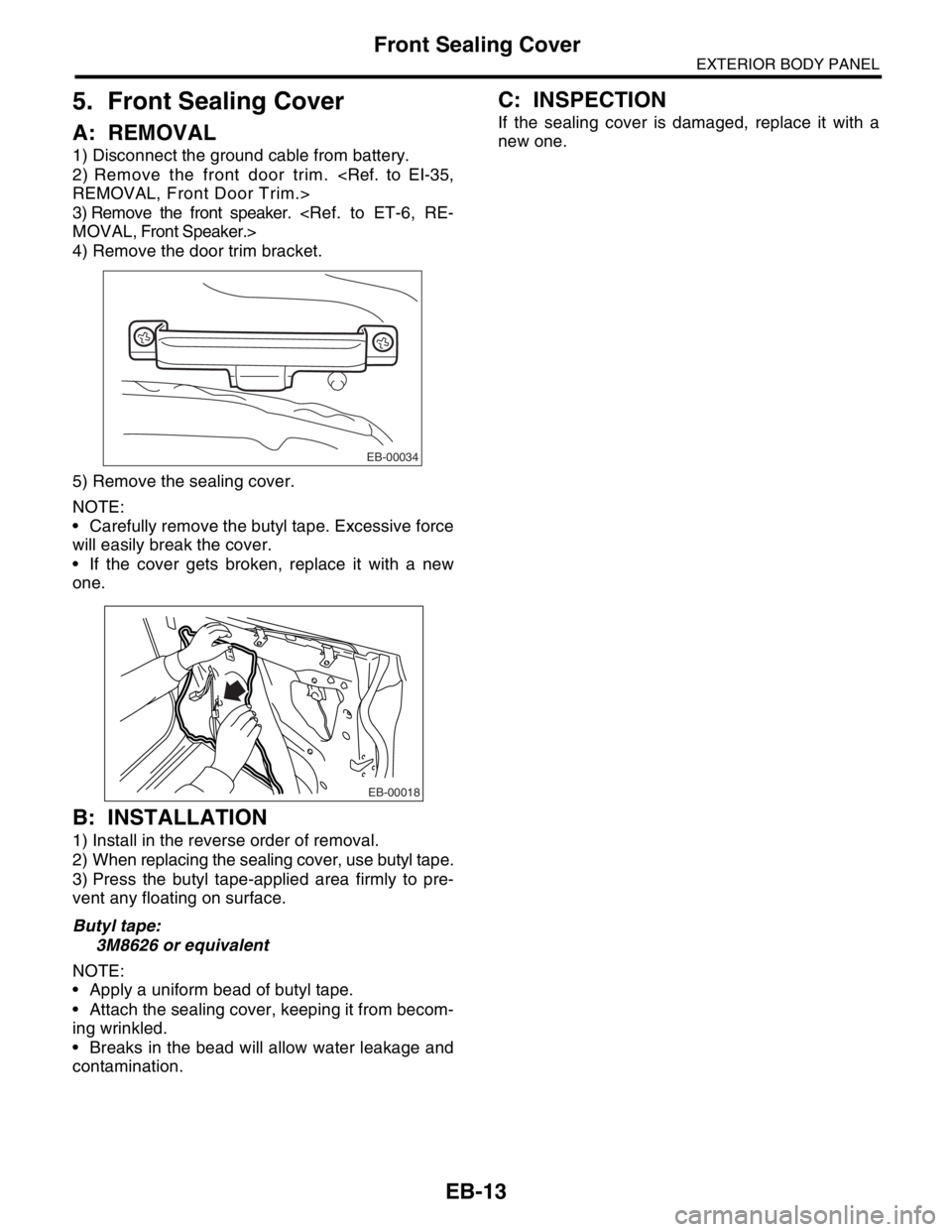
4) Remove the door trim bracket.
5) Remove the sealing cover.
NOTE:
Carefully remove the butyl tape. Excessive force
will easily break the cover.
If the cover gets broken, replace it with a new
one.
B: INSTALLATION
1) Install in the reverse order of removal.
2) When replacing the sealing cover, use butyl tape.
3) Press the butyl tape-applied area firmly to pre-
vent any floating on surface.
Butyl tape:
3M8626 or equivalent
NOTE:
Apply a uniform bead of butyl tape.
Attach the sealing cover, keeping it from becom-
ing wrinkled.
Breaks in the bead will allow water leakage and
contamination.
C: INSPECTION
If the sealing cover is damaged, replace it with a
new one.
EB-00034
EB-00018
Page 546 of 2870
EB-16
EXTERIOR BODY PANEL
Rear Sealing Cover
7. Rear Sealing Cover
A: REMOVAL
1) Disconnect the ground cable from battery.
2) Remove the rear door trim.
MOVAL, Rear Door Trim.>
3) Remove the door trim bracket.
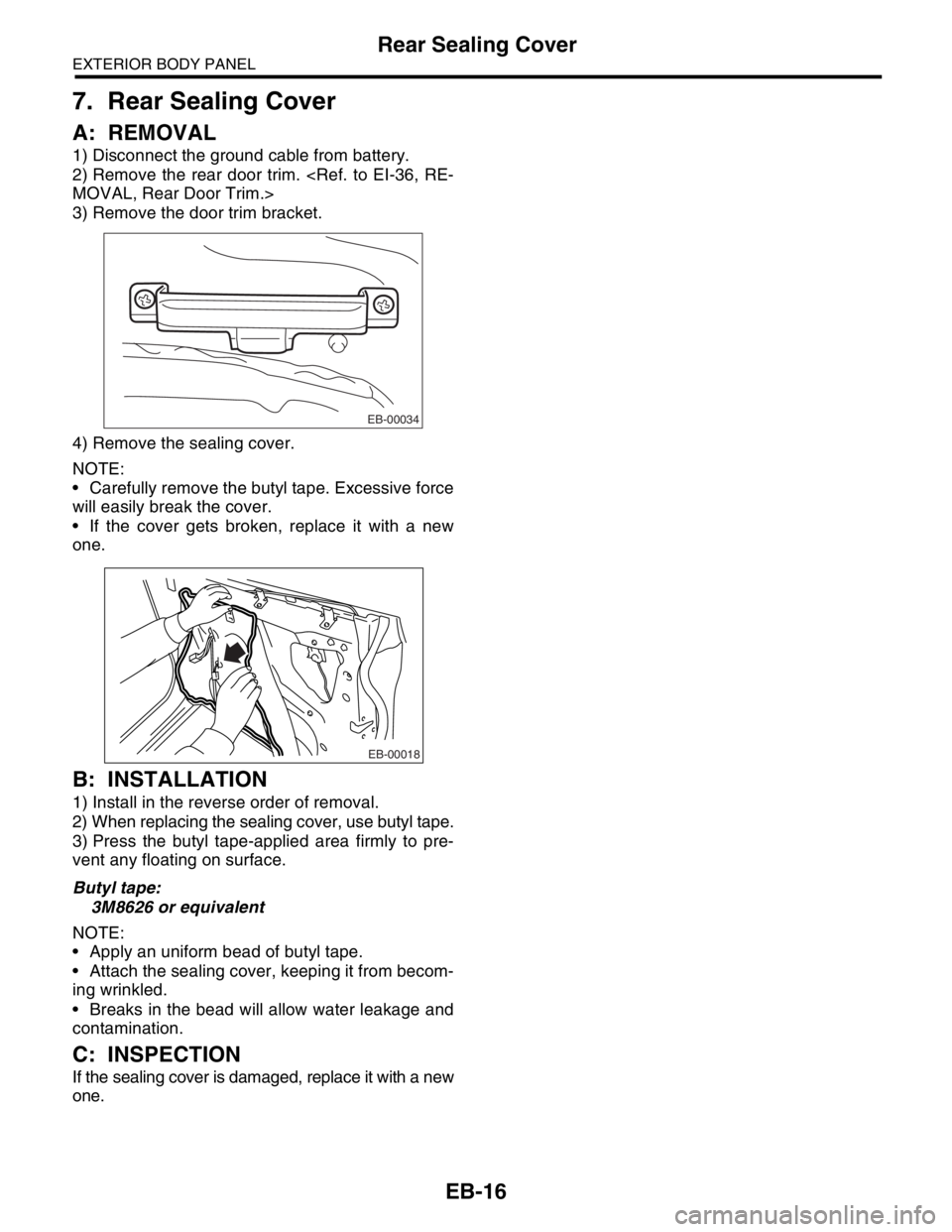
4) Remove the sealing cover.
NOTE:
Carefully remove the butyl tape. Excessive force
will easily break the cover.
If the cover gets broken, replace it with a new
one.
B: INSTALLATION
1) Install in the reverse order of removal.
2) When replacing the sealing cover, use butyl tape.
3) Press the butyl tape-applied area firmly to pre-
vent any floating on surface.
Butyl tape:
3M8626 or equivalent
NOTE:
Apply an uniform bead of butyl tape.
Attach the sealing cover, keeping it from becom-
ing wrinkled.
Breaks in the bead will allow water leakage and
contamination.
C: INSPECTION
If the sealing cover is damaged, replace it with a new
one.
EB-00034
EB-00018
Page 557 of 2870
CC-5
CRUISE CONTROL SYSTEM
Actuator
2. Actuator
A: REMOVAL
CAUTION:
Be careful not to apply excessive load to the
wire cable when adjusting and/or installing; oth-
erwise, the actuator may be deformed or dam-
aged.
Do not bend the cable sharply with a radius
less than 100 mm (3.94 in); otherwise, cable
may bend permanently, resulting in poor per-
formance.
When installing the cable, be careful not to
sharply bend or pinch the inner cable; other-
wise, the cable may break.
1) Disconnect the ground cable from battery.
2) Remove the clip bands from cruise control cable.
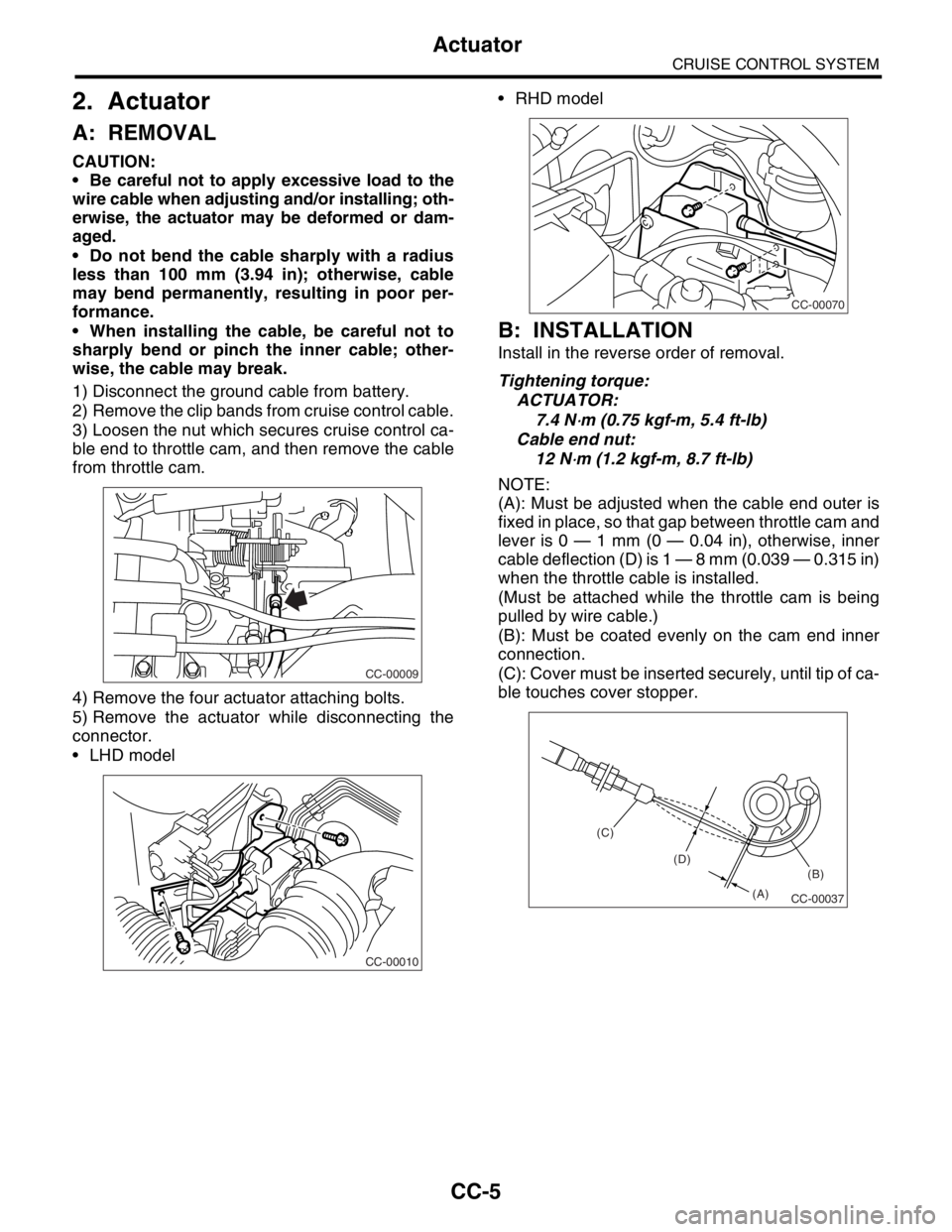
3) Loosen the nut which secures cruise control ca-
ble end to throttle cam, and then remove the cable
from throttle cam.
4) Remove the four actuator attaching bolts.
5) Remove the actuator while disconnecting the
connector.
LHD model RHD model
B: INSTALLATION
Install in the reverse order of removal.
Tightening torque:
ACTUATOR:
7.4 N
⋅m (0.75 kgf-m, 5.4 ft-lb)
Cable end nut:
12 N
⋅m (1.2 kgf-m, 8.7 ft-lb)
NOTE:
(A): Must be adjusted when the cable end outer is
fixed in place, so that gap between throttle cam and
lever is 0 — 1 mm (0 — 0.04 in), otherwise, inner
cable deflection (D) is 1 — 8 mm (0.039 — 0.315 in)
when the throttle cable is installed.
(Must be attached while the throttle cam is being
pulled by wire cable.)
(B): Must be coated evenly on the cam end inner
connection.
(C): Cover must be inserted securely, until tip of ca-
ble touches cover stopper.
CC-00009
CC-00010
CC-00070
CC-00037
(B)
(A) (D) (C)
Page 2856 of 2870
CL-30
CLUTCH SYSTEM
Clutch Pipe and Hose
B: INSTALLATION
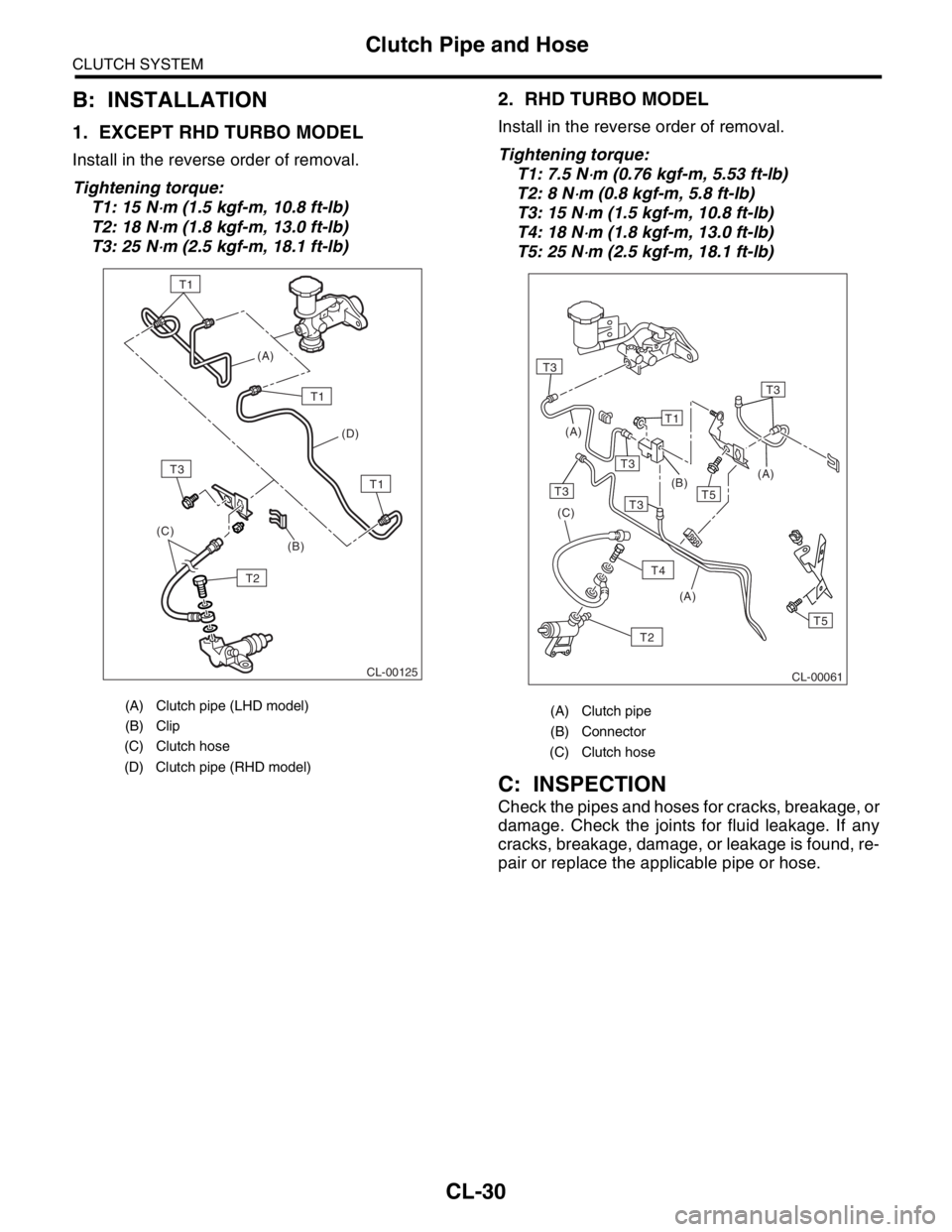
1. EXCEPT RHD TURBO MODEL
Install in the reverse order of removal.
Tightening torque:
T1: 15 N
⋅m (1.5 kgf-m, 10.8 ft-lb)
T2: 18 N
⋅m (1.8 kgf-m, 13.0 ft-lb)
T3: 25 N
⋅m (2.5 kgf-m, 18.1 ft-lb)
2. RHD TURBO MODEL
Install in the reverse order of removal.
Tightening torque:
T1: 7.5 N
⋅m (0.76 kgf-m, 5.53 ft-lb)
T2: 8 N
⋅m (0.8 kgf-m, 5.8 ft-lb)
T3: 15 N
⋅m (1.5 kgf-m, 10.8 ft-lb)
T4: 18 N
⋅m (1.8 kgf-m, 13.0 ft-lb)
T5: 25 N
⋅m (2.5 kgf-m, 18.1 ft-lb)
C: INSPECTION
Check the pipes and hoses for cracks, breakage, or
damage. Check the joints for fluid leakage. If any
cracks, breakage, damage, or leakage is found, re-
pair or replace the applicable pipe or hose.
(A) Clutch pipe (LHD model)
(B) Clip
(C) Clutch hose
(D) Clutch pipe (RHD model)
(D)
(B) (C)(A)
T1
T1
T2
T1
T3
CL-00125
(A) Clutch pipe
(B) Connector
(C) Clutch hose
(A)
(A) (A)
T3
T3T3
T3
T1
T3
T5
T5
(C)
T2
T4
(B)
CL-00061