2004 SUBARU FORESTER meter
[x] Cancel search: meterPage 2270 of 2870

EN(H4DOTC 2.5)-246
ENGINE (DIAGNOSTIC)
Diagnostic Procedure with Diagnostic Trouble Code (DTC)
Step Check Yes No
1 CHECK ACCELERATOR PEDAL POSITION
SENSOR OUTPUT.
1) Turn the ignition switch to ON.
2) Read the data of sub accelerator pedal
position sensor signal using Subaru Select
Monitor.
3) Check the voltage change by shaking the
harness and connector of ECM, engine har-
ness connector and accelerator pedal position
sensor connector harness.Is the voltage less than 4.8 V? Go to step 2.Go to step 3.
2 CHECK POOR CONTACT.
Check poor contact in connector between
ECM and accelerator pedal position sensor.Is there poor contact? Repair the poor
contact.Temporary poor
contact occurred,
but it is normal at
present.
3 CHECK HARNESS BETWEEN ECM AND AC-
CELERATOR PEDAL POSITION SENSOR.
1) Turn the ignition switch to OFF.
2) Disconnect the connector from ECM.
3) Disconnect the connector from the acceler-
ator pedal position sensor.
4) Measure the resistance between ECM con-
nector and accelerator pedal position sensor con-
nector.
Connector & terminal
(B136) No. 35 — (B315) No. 6:Is the resistance less than 1
Ω?Go to step 4.Repair the open
circuit of harness
connector.
4 CHECK HARNESS BETWEEN ECM AND AC-
CELERATOR PEDAL POSITION SENSOR.
1) Connect the ECM connector.
2) Measure the resistance between accelerator
pedal position sensor connector and engine
ground.
Connector & terminal
(B315) No. 6 — Engine ground:Is the resistance less than 5
Ω?Go to step 5.Repair the poor
contact in ECM
connector.
Replace the ECM
if defective.
5 CHECK HARNESS BETWEEN ECM AND AC-
CELERATOR PEDAL POSITION SENSOR.
1) Connect the ECM connector.
2) Turn the ignition switch to ON.
3) Measure the voltage between accelerator
pedal position sensor connector and engine
ground.
Connector & terminal
(B315) No. 1 (+) — Engine ground (
−):
4) Check the voltage is above the specified value
when shaking the harness and connector of ECM
while monitoring the value with voltage meter.Is the voltage less than 6 V? Go to step 6.Repair battery short
circuit in harness
between ECM con-
nector and acceler-
ator pedal position
sensor connector.
6 CHECK POWER SUPPLY OF ACCELERA-
TOR PEDAL POSITION SENSOR.
1) Measure the voltage between accelerator
pedal position sensor connector and engine
ground.
Connector & terminal
(B315) No. 2 (+) — Engine ground (
−):
2) Check the voltage change by shaking the
harness and connector of ECM while monitor-
ing the value with voltage meter.Is the voltage less than 4.8 V? Go to step 7.Repair short circuit
in harness between
ECM connector and
accelerator pedal
position sensor con-
nector.
Page 2274 of 2870

EN(H4DOTC 2.5)-250
ENGINE (DIAGNOSTIC)
Diagnostic Procedure with Diagnostic Trouble Code (DTC)
Step Check Yes No
1 CHECK SENSOR OUTPUT.
1) Turn the ignition switch to ON.
2) Measure the voltage between ECM con-
nector terminals.
Connector & terminal
(B136) No. 18 (+) — (B136) No. 35 (
−):
3) Check the voltage change by shaking the har-
ness and connector of ECM, engine harness con-
nector and electronic throttle control connector.Is the voltage more than 0.4 V? Go to step 2.Go to step 4.
2 CHECK SENSOR OUTPUT.
1) Measure the voltage between ECM con-
nector terminals.
Connector & terminal
(B136) No. 29 (+) — (B136) No. 35 (
−):
2) Check the voltage change by shaking the har-
ness and connector of ECM, engine harness con-
nector and electronic throttle control connector.Is the voltage more than 0.8 V? Go to step 3.Go to step 4.
3 CHECK POOR CONTACT.
Check the poor contact in connector between
ECM and electronic throttle control.Is there poor contact? Repair the poor
contact.Go to step 14.
4 CHECK HARNESS BETWEEN ECM AND
ELECTRONIC THROTTLE CONTROL.
1) Turn the ignition switch to OFF.
2) Disconnect the connector from ECM.
3) Disconnect the connectors from the elec-
tronic throttle control.
4) Measure the resistance between ECM con-
nector and electronic throttle control connector.
Connector & terminal
(B136) No. 16 — (E57) No. 5:Is the resistance less than 1
Ω?Go to step 5.Repair the open
circuit of harness
connector.
5 CHECK HARNESS BETWEEN ECM AND
ELECTRONIC THROTTLE CONTROL.
Measure the resistance between ECM connec-
tor and chassis ground.
Connector & terminal
(B136) No. 16 — Chassis ground:
(B136) No. 18 — Chassis ground:
(B136) No. 29 — Chassis ground:Is the resistance more than 1
MΩ?Go to step 6.Repair the ground
short circuit of har-
ness.
6 CHECK SENSOR POWER SUPPLY.
1) Connect the ECM connector.
2) Turn the ignition switch to ON.
3) Measure the voltage between electronic
throttle control connector and engine ground.
Connector & terminal
(E57) No. 5 (+) — Engine ground (
−):
4) Check the voltage change by shaking the
harness and connector of ECM and engine
harness connector while monitoring the value
with voltage meter.Is the voltage 4.5 — 5.5 V? Go to step 7.Repair the poor
contact in ECM
connector.
Replace the ECM
if defective.
7 CHECK SHORT CIRCUIT IN ECM.
1) Turn the ignition switch to OFF.
2) Measure the resistance between electronic
throttle control connector and engine ground.
Connector & terminal
(E57) No. 4 — Engine ground:
(E57) No. 6 — Engine ground:Is the resistance more than 10
Ω?Go to step 8.Repair the poor
contact in ECM
connector.
Replace the ECM
if defective.
Page 2275 of 2870

EN(H4DOTC 2.5)-251
ENGINE (DIAGNOSTIC)
Diagnostic Procedure with Diagnostic Trouble Code (DTC)
8 CHECK SENSOR OUTPUT.
1) Connect all the connectors.
2) Turn the ignition switch to ON.
3) Read the data of main throttle sensor signal
using Subaru Select Monitor.
4) Check the voltage change by shaking the har-
ness and connector of ECM, engine harness con-
nector and electronic throttle control connector.Is the voltage less than 4.63
V?Go to step 9.Go to step 11.
9 CHECK SENSOR OUTPUT.
1) Read the data of sub throttle sensor signal
using Subaru Select Monitor.
2) Check the voltage change by shaking the har-
ness and connector of ECM, engine harness con-
nector and electronic throttle control connector.Is the voltage less than 4.73
V?Go to step 10.Go to step 11.
10 CHECK POOR CONTACT.
Check the poor contact in connector between
ECM and electronic throttle control.Is there poor contact? Repair the poor
contact.Temporary poor
contact occurred,
but it is normal at
present.
11 CHECK HARNESS BETWEEN ECM AND
ELECTRONIC THROTTLE CONTROL.
1) Turn the ignition switch to OFF.
2) Disconnect the connector from ECM.
3) Disconnect the connectors from the elec-
tronic throttle control.
4) Measure the resistance between ECM con-
nector and electronic throttle control connector.
Connector & terminal
(B136) No. 18 — (E57) No. 6:
(B136) No. 29 — (E57) No. 4:
(B136) No. 35 — (E57) No. 3:Is the resistance less than 1
Ω?Go to step 12.Repair the open
circuit of harness
connector.
12 CHECK HARNESS BETWEEN ECM AND
ELECTRONIC THROTTLE CONTROL.
1) Connect the ECM connector.
2) Measure the resistance between electronic
throttle control connector and engine ground.
Connector & terminal
(E57) No. 3 — Engine ground:Is the resistance less than 5
Ω?Go to step 13.Repair the poor
contact in ECM con-
nector. Replace the
ECM if defective.
13 CHECK HARNESS BETWEEN ECM AND
ELECTRONIC THROTTLE CONTROL.
1) Connect the ECM connector.
2) Turn the ignition switch to ON.
3) Measure the voltage between electronic
throttle control connector and engine ground.
Connector & terminal
(E57) No. 5 (+) — Engine ground (
−):
4) Check the voltage change by shaking the
harness and connector of ECM and engine
harness connector while monitoring the value
with voltage meter.Is the voltage more than 10 V? Go to step 14.Repair battery short
circuit in harness
between ECM con-
nector and elec-
tronic throttle control
connector. Step Check Yes No
Page 2276 of 2870

EN(H4DOTC 2.5)-252
ENGINE (DIAGNOSTIC)
Diagnostic Procedure with Diagnostic Trouble Code (DTC)
14 CHECK HARNESS BETWEEN ECM AND
ELECTRONIC THROTTLE CONTROL.
1) Measure the voltage between electronic
throttle control connector and engine ground.
Connector & terminal
(E57) No. 4 (+) — Engine ground (
−):
(E57) No. 6 (+) — Engine ground (
−):
2) Check the voltage change by shaking the
harness and connector of ECM and engine
harness connector while monitoring the value
with voltage meter.Is the voltage less than 10 V? Go to step 15.Repair short circuit
in harness between
ECM connector and
electronic throttle
control connector.
15 CHECK HARNESS BETWEEN ECM AND
ELECTRONIC THROTTLE CONTROL.
1) Turn the ignition switch to OFF.
2) Disconnect the ECM connector.
3) Measure the resistance between ECM con-
nectors.
Connector & terminal
(B136) No. 18 — (B136) No. 35:
(B136) No. 29 — (B136) No. 35:Is the resistance more than 1
MΩ?Go to step 16.Repair short circuit
to sensor power
supply.
16 CHECK ELECTRONIC THROTTLE CON-
TROL HARNESS.
1) Disconnect the connector from ECM.
2) Disconnect the connectors from the elec-
tronic throttle control.
3) Measure the resistance between electronic
throttle control connector terminals.
Connector & terminal
(E57) No. 6 — (E57) No. 4:Is the resistance more than 1
MΩ?Repair the poor
contact in ECM con-
nector. Replace the
ECM if defective.Repair the short
circuit of harness. Step Check Yes No
Page 2278 of 2870

EN(H4DOTC 2.5)-254
ENGINE (DIAGNOSTIC)
Diagnostic Procedure with Diagnostic Trouble Code (DTC)
Step Check Yes No
1 CHECK ACCELERATOR PEDAL POSITION
SENSOR OUTPUT.
1) Turn the ignition switch to ON.
2) Measure the voltage between ECM con-
nector and terminal.
Connector & terminal
(B136) No. 17 (+) — (B136) No. 34 (
−):
(B136) No. 28 (+) — (B136) No. 35 (
−):
3) Check the voltage change by shaking the
harness and connector of ECM and accelera-
tor pedal position sensor connector and har-
ness.Is the voltage more than 0.4 V? Go to step 2.Go to step 3.
2 CHECK POOR CONTACT.
Check poor contact in connector between
ECM and accelerator pedal position sensor.Is there poor contact? Repair the poor
contact.Go to step 12.
3 CHECK HARNESS BETWEEN ECM AND AC-
CELERATOR PEDAL POSITION SENSOR.
1) Turn the ignition switch to OFF.
2) Disconnect the connector from ECM.
3) Disconnect the connector from the acceler-
ator pedal position sensor.
4) Measure the resistance between ECM con-
nector and accelerator pedal position sensor con-
nector.
Connector & terminal
(B136) No. 15 — (B315) No. 3:
(B136) No. 16 — (B315) No. 1:
(B136) No. 17 — (B315) No. 5:
(B136) No. 28 — (B315) No. 2:Is the resistance less than 1
Ω?Go to step 4.Repair the open
circuit of harness
connector.
4 CHECK HARNESS BETWEEN ECM AND AC-
CELERATOR PEDAL POSITION SENSOR.
Measure the resistance between ECM connec-
tor and chassis ground.
Connector & terminal
(B136) No. 15 — Chassis ground:
(B136) No. 16 — Chassis ground:
(B136) No. 17 — Chassis ground:
(B136) No. 28 — Chassis ground:Is the resistance more than 1
MΩ?Go to step 5.Repair the ground
short circuit of har-
ness.
5 CHECK POWER SUPPLY OF ACCELERA-
TOR PEDAL POSITION SENSOR.
1) Connect the ECM connector.
2) Turn the ignition switch to ON.
3) Measure the voltage between accelerator
pedal position sensor connector and engine
ground.
Connector & terminal
(B315) No. 3 (+) — Engine ground (
−):
(B315) No. 1 (+) — Engine ground (
−):
4) Check the voltage change by shaking the
harness and connector of ECM while monitor-
ing the value with voltage meter.Is the voltage 4.5 — 5.5 V? Go to step 6.Repair the poor
contact in ECM con-
nector. Replace the
ECM if defective.
6 CHECK ACCELERATOR PEDAL POSITION
SENSOR.
Measure the resistance of accelerator pedal
position sensor.
Te r m i n a l s
No. 3 — No. 4:Is the resistance 1.2 — 4.8
kΩ?Go to step 7.Replace the accel-
erator pedal posi-
tion sensor.
Page 2280 of 2870

EN(H4DOTC 2.5)-256
ENGINE (DIAGNOSTIC)
Diagnostic Procedure with Diagnostic Trouble Code (DTC)
14 CHECK HARNESS BETWEEN ECM AND AC-
CELERATOR PEDAL POSITION SENSOR.
1) Turn the ignition switch to OFF.
2) Disconnect the connector from ECM.
3) Disconnect the connector from the acceler-
ator pedal position sensor.
4) Measure the resistance between ECM con-
nector and accelerator pedal position sensor con-
nector.
Connector & terminal
(B136) No. 34 — (B315) No. 4:
(B136) No. 35 — (B315) No. 6:Is the resistance less than 1
Ω?Go to step 15.Repair the open
circuit of harness
connector.
15 CHECK HARNESS BETWEEN ECM AND AC-
CELERATOR PEDAL POSITION SENSOR.
1) Connect the ECM connector.
2) Measure the resistance between accelera-
tor pedal position sensor connector and engine
ground.
Connector & terminal
(B315) No. 4 — Engine ground:
(B315) No. 6 — Engine ground:Is the resistance less than 5
Ω?Go to step 16.Repair the poor
contact in ECM con-
nector. Replace the
ECM if defective.
16 CHECK HARNESS BETWEEN ECM AND AC-
CELERATOR PEDAL POSITION SENSOR.
1) Connect the ECM connector.
2) Turn the ignition switch to ON.
3) Measure the voltage between accelerator
pedal position sensor connector and engine
ground.
Connector & terminal
(B315) No. 1 (+) — Engine ground (
−):
(B315) No. 3 (+) — Engine ground (
−):
4) Check the voltage change by shaking the
harness and connector of ECM while monitor-
ing the value with voltage meter.Is the voltage less than 6 V? Go to step 17.Repair battery short
circuit in harness
between ECM con-
nector and acceler-
ator pedal position
sensor connector.
17 CHECK POWER SUPPLY OF ACCELERA-
TOR PEDAL POSITION SENSOR.
1) Measure the voltage between accelerator
pedal position sensor connector and engine
ground.
Connector & terminal
(B315) No. 2 (+) — Engine ground (
−):
(B315) No. 5 (+) — Engine ground (
−):
2) Check the voltage change by shaking the
harness and connector of ECM while monitor-
ing the value with voltage meter.Is the voltage less than 4.8 V? Go to step 18.Repair short circuit
in harness between
ECM connector and
accelerator pedal
position sensor con-
nector.
18 CHECK HARNESS BETWEEN ECM AND AC-
CELERATOR PEDAL POSITION SENSOR.
1) Turn the ignition switch to OFF.
2) Connect the accelerator pedal position sen-
sor connector.
3) Turn the ignition switch to ON.
4) Measure the voltage between ECM connector
and chassis ground.
Connector & terminal
(B136) No. 17 (+) — Chassis ground (
−):
(B136) No. 28 (+) — Chassis ground (
−):Is the voltage less than 4.8 V? Go to step 19.Repair poor contact
in accelerator pedal
position sensor con-
nector. Replace the
accelerator pedal
position sensor if
defective. Step Check Yes No
Page 2314 of 2870

4AT-2
AUTOMATIC TRANSMISSION
General Description
1. General Description
A: SPECIFICATION
1. TORQUE CONVERTER CLUTCH
2. OIL PUMP
3. TRANSMISSION CONTROL ELEMENT
4. TRANSMISSION GEAR RATIO5. PLANETARY GEAR AND PLATE
Model2.0 L
Non-
turbo2.5 L
Non-
turbo2.0 L
Tu r b o2.5 L
Tu r b o
Ty p eSymmetric, 3 element, single stage, 2 phase
torque converter
Stall torque
ratio2.0 —
2.21.9 —
2.11.85 —
2.152.05 —
2.35
Nominal
diameter246 mm (9.69 in)
Stall speed
(at sea level)2,000 —
2,500
rpm2,100 —
2,600
rpm2,600 —
3,300
rpm2,700 —
3,200
rpm
One-way
clutchSprague type one-way clutch
Type Pracoid constant-displacement pump
Driving method Driven by engine
Number of teethInner rotor 9
Outer rotor 10
Ty p e4-forward, 1-reverse, double-row plan-
etary gears
Multi-plate clutch 3 sets
Multi-plate brake 2 sets
One-way clutch
(sprague type)1 sets
Gear ratio
1st 2.785
2nd 1.545
3rd 1.000
4th 0.694
Rev 2.272
Model2.0 L Non-
turbo2.5 L Non-
turboTu r b o
Tooth num-
ber of front
sun gear33
Front pinion
number of
teeth21
Front inter-
nal gear
number of
teeth75
Tooth num-
ber of rear
sun gear42
Rear pinion
number of
teeth17
Tooth num-
ber of rear
internal gear75
Drive &
driven plate
number of
high clutch45
Drive &
driven plate
number of
low clutch467
Drive &
driven plate
number of
reverse
clutch2
Drive &
driven plate
number of 2-
4 brake34
Drive &
driven plate
number of
low &
reverse
brake467
Page 2341 of 2870
4AT-29
AUTOMATIC TRANSMISSION
General Description
2. GENERAL TOOL
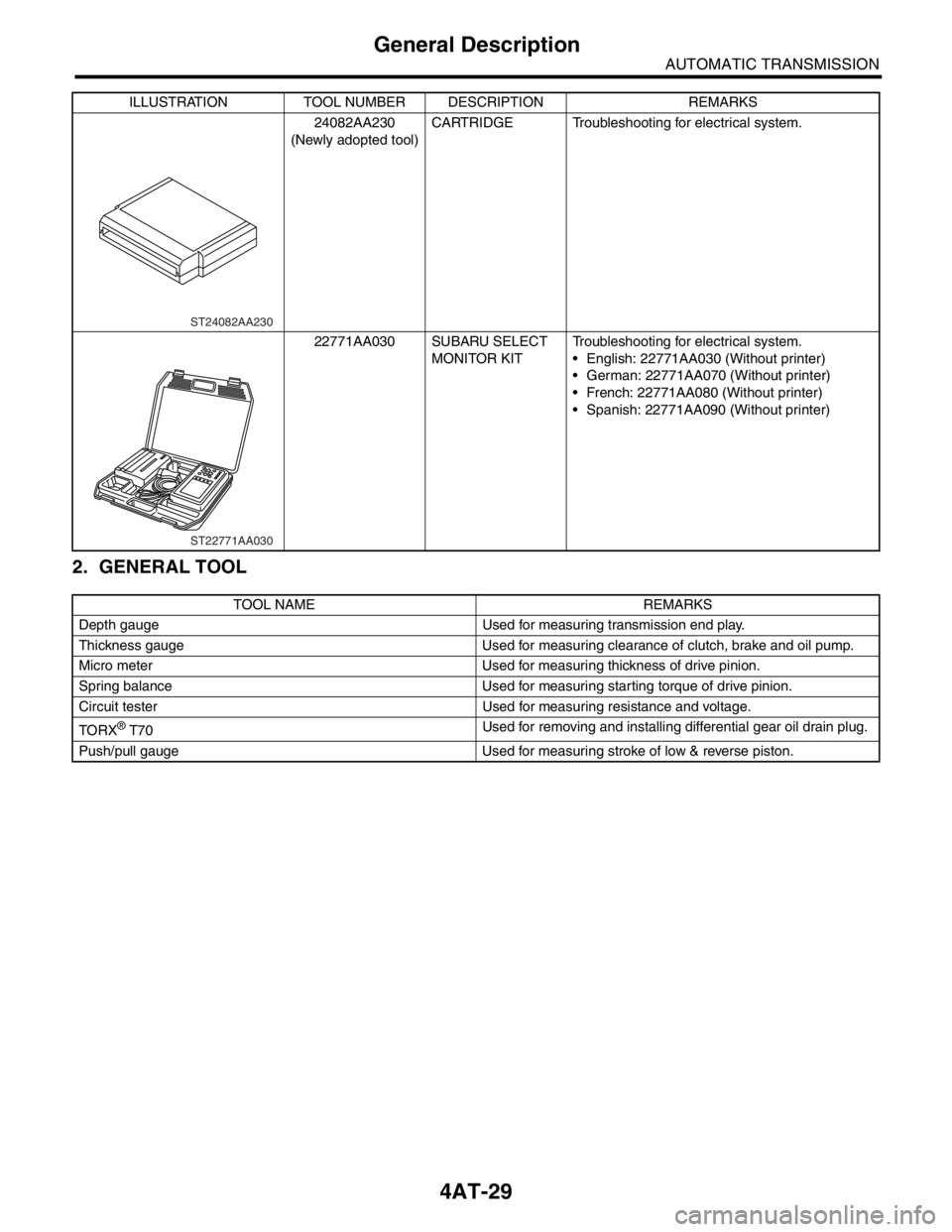
24082AA230
(Newly adopted tool)CARTRIDGE Troubleshooting for electrical system.
22771AA030 SUBARU SELECT
MONITOR KITTroubleshooting for electrical system.
English: 22771AA030 (Without printer)
German: 22771AA070 (Without printer)
French: 22771AA080 (Without printer)
Spanish: 22771AA090 (Without printer)
TOOL NAME REMARKS
Depth gauge Used for measuring transmission end play.
Thickness gauge Used for measuring clearance of clutch, brake and oil pump.
Micro meter Used for measuring thickness of drive pinion.
Spring balance Used for measuring starting torque of drive pinion.
Circuit tester Used for measuring resistance and voltage.
TO RX
® T70Used for removing and installing differential gear oil drain plug.
Push/pull gauge Used for measuring stroke of low & reverse piston.ILLUSTRATION TOOL NUMBER DESCRIPTION REMARKS
ST24082AA230
ST22771AA030