Page 550 of 1833
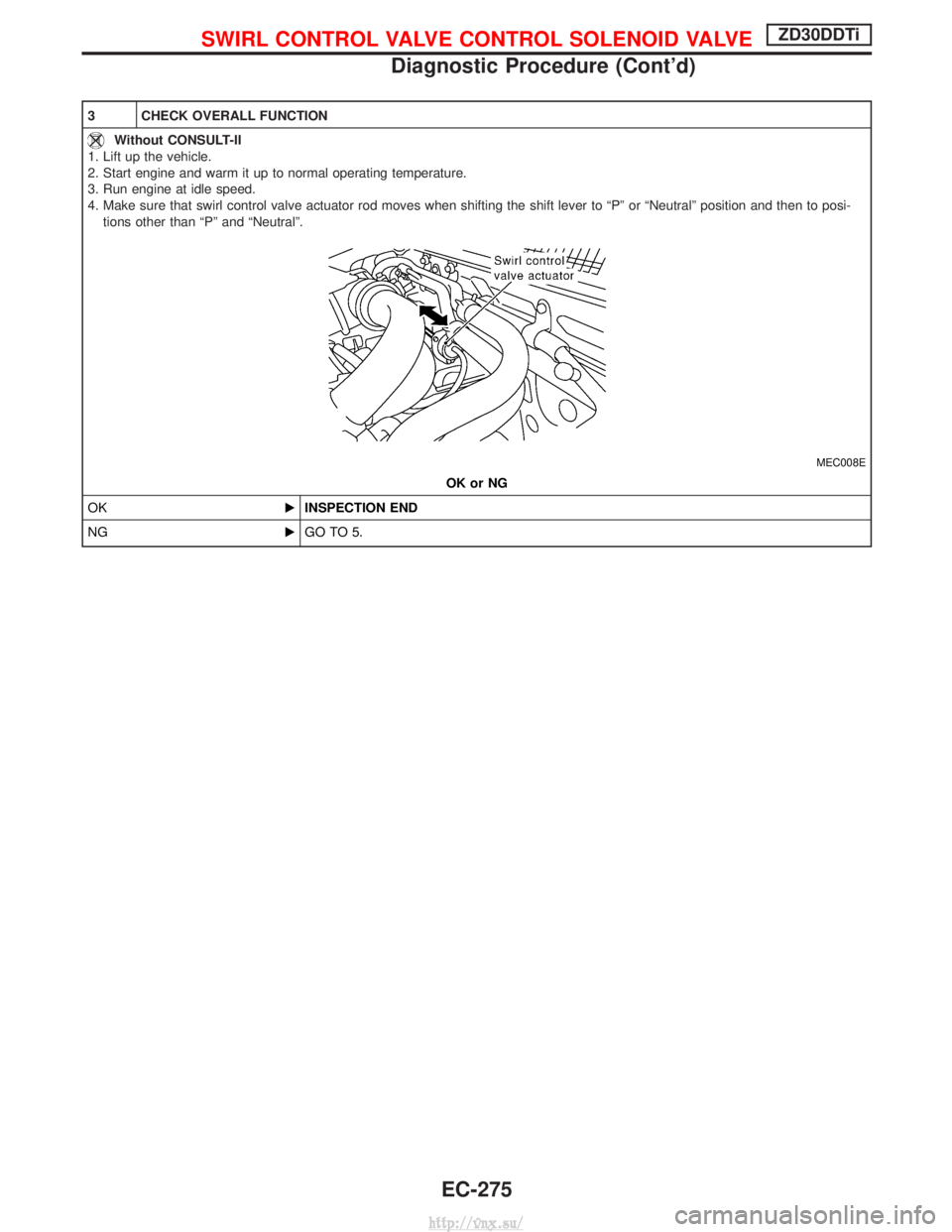
3 CHECK OVERALL FUNCTION
Without CONSULT-II
1. Lift up the vehicle.
2. Start engine and warm it up to normal operating temperature.
3. Run engine at idle speed.
4. Make sure that swirl control valve actuator rod moves when shifting the shift lever to ªPº or ªNeutralº position and then to posi- tions other than ªPº and ªNeutralº.
MEC008E
OK or NG
OK EINSPECTION END
NG EGO TO 5.
SWIRL CONTROL VALVE CONTROL SOLENOID VALVEZD30DDTi
Diagnostic Procedure (Cont'd)
EC-275
http://vnx.su/
Page 551 of 1833
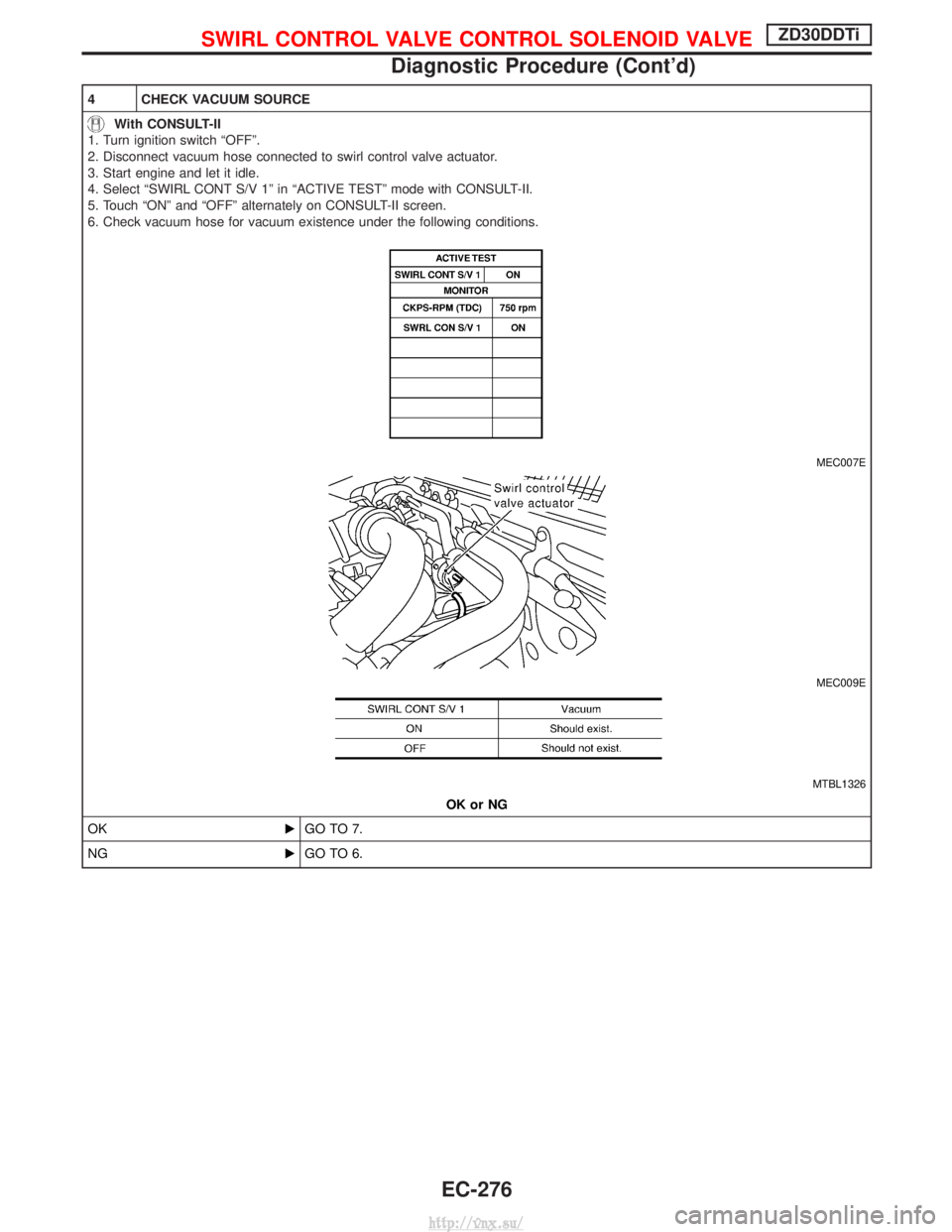
4 CHECK VACUUM SOURCE
With CONSULT-II
1. Turn ignition switch ªOFFº.
2. Disconnect vacuum hose connected to swirl control valve actuator.
3. Start engine and let it idle.
4. Select ªSWIRL CONT S/V 1º in ªACTIVE TESTº mode with CONSULT-II.
5. Touch ªONº and ªOFFº alternately on CONSULT-II screen.
6. Check vacuum hose for vacuum existence under the following conditions.
MEC007E
MEC009E
MTBL1326
OK or NG
OK EGO TO 7.
NG EGO TO 6.
SWIRL CONTROL VALVE CONTROL SOLENOID VALVEZD30DDTi
Diagnostic Procedure (Cont'd)
EC-276
http://vnx.su/
Page 552 of 1833
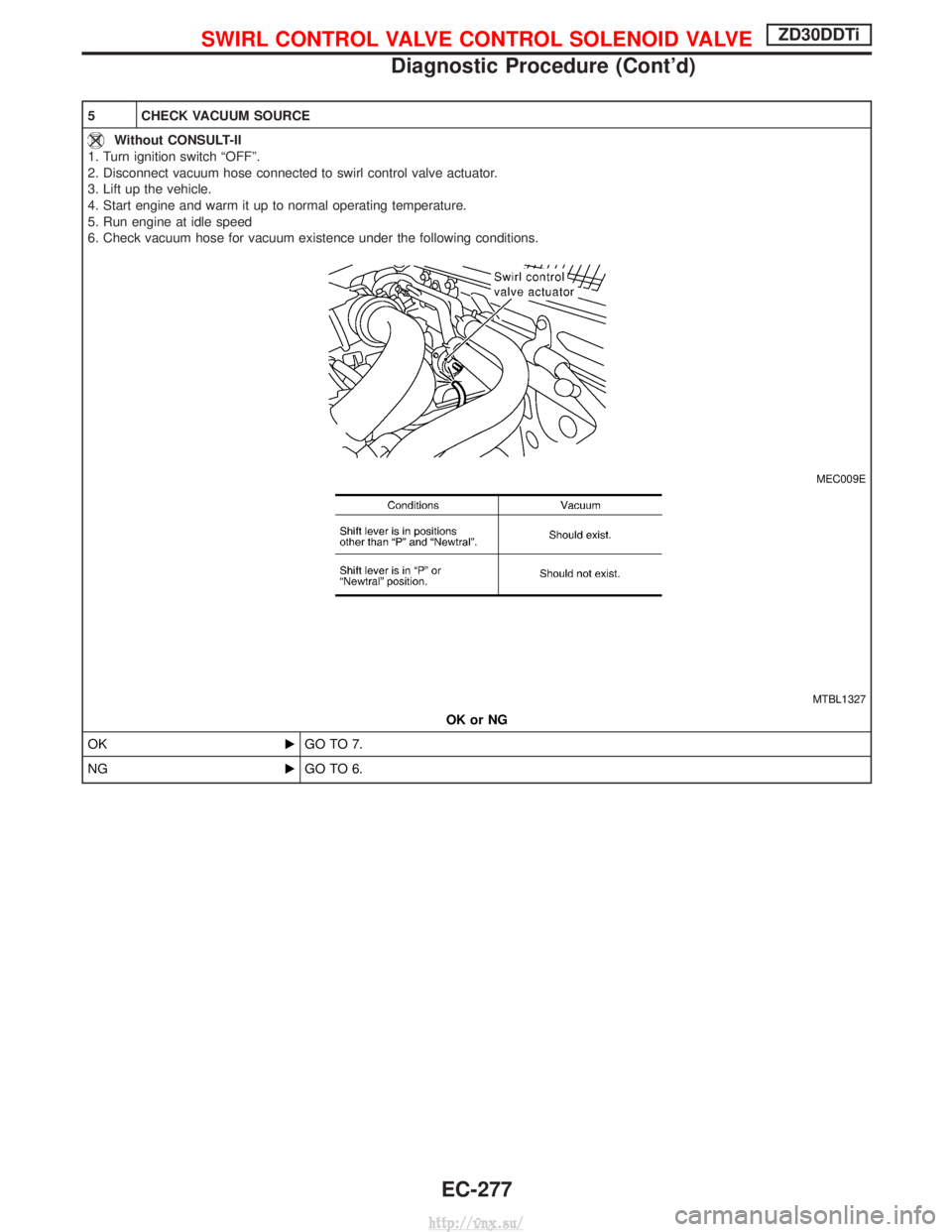
5 CHECK VACUUM SOURCE
Without CONSULT-II
1. Turn ignition switch ªOFFº.
2. Disconnect vacuum hose connected to swirl control valve actuator.
3. Lift up the vehicle.
4. Start engine and warm it up to normal operating temperature.
5. Run engine at idle speed
6. Check vacuum hose for vacuum existence under the following conditions.
MEC009E
MTBL1327
OK or NG
OK EGO TO 7.
NG EGO TO 6.
SWIRL CONTROL VALVE CONTROL SOLENOID VALVEZD30DDTi
Diagnostic Procedure (Cont'd)
EC-277
http://vnx.su/
Page 556 of 1833
Description
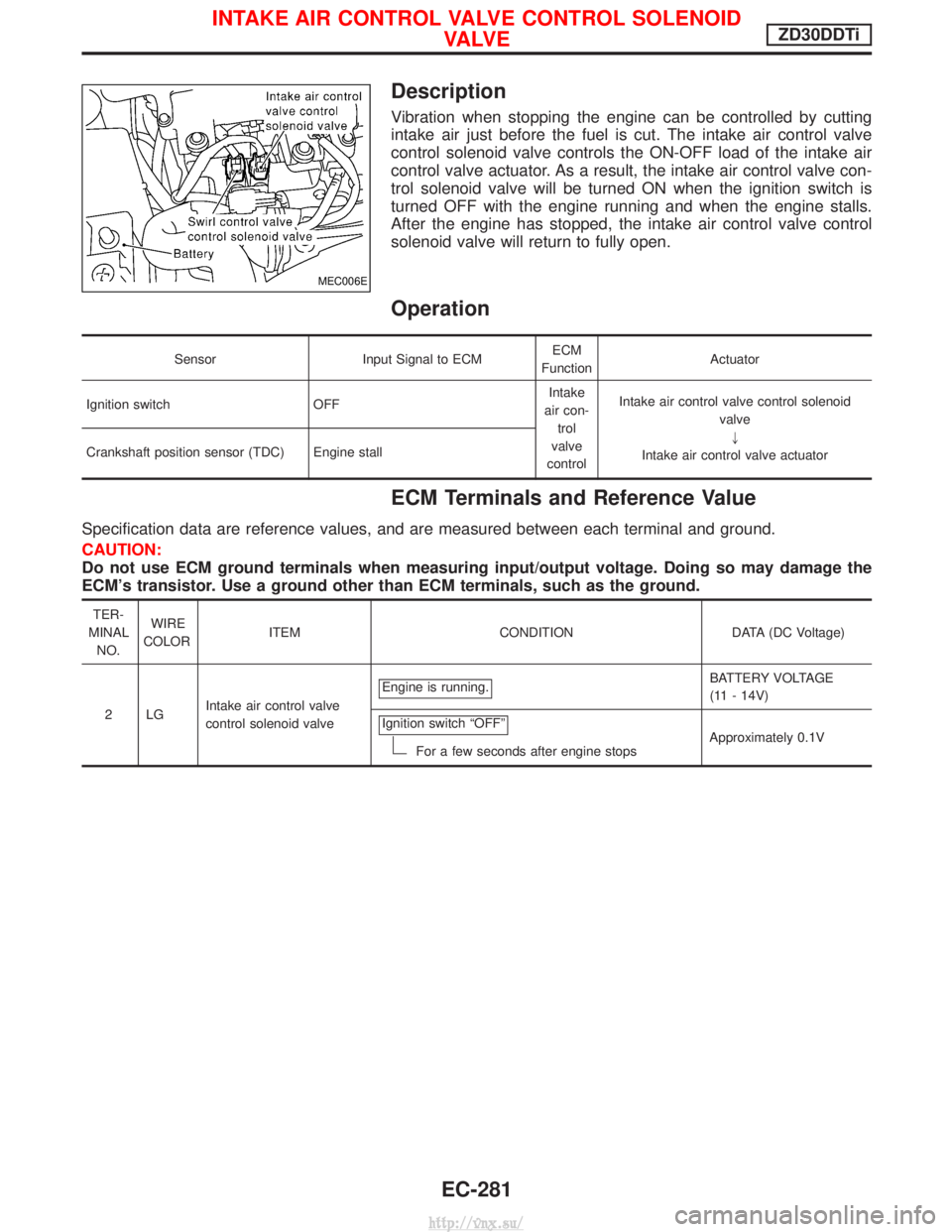
Vibration when stopping the engine can be controlled by cutting
intake air just before the fuel is cut. The intake air control valve
control solenoid valve controls the ON-OFF load of the intake air
control valve actuator. As a result, the intake air control valve con-
trol solenoid valve will be turned ON when the ignition switch is
turned OFF with the engine running and when the engine stalls.
After the engine has stopped, the intake air control valve control
solenoid valve will return to fully open.
Operation
SensorInput Signal to ECM ECM
Function Actuator
Ignition switch OFF Intake
air con- trol
valve
control Intake air control valve control solenoid
valve"
Intake air control valve actuator
Crankshaft position sensor (TDC) Engine stall
ECM Terminals and Reference Value
Specification data are reference values, and are measured between each terminal and ground.
CAUTION:
Do not use ECM ground terminals when measuring input/output voltage. Doing so may damage the
ECM's transistor. Use a ground other than ECM terminals, such as the ground.
TER-
MINAL NO. WIRE
COLOR ITEM CONDITION DATA (DC Voltage)
2LG Intake air control valve
control solenoid valve Engine is running.
BATTERY VOLTAGE
(11 - 14V)
Ignition switch ªOFFº
For a few seconds after engine stops Approximately 0.1V
MEC006E
INTAKE AIR CONTROL VALVE CONTROL SOLENOID
VA LV EZD30DDTi
EC-281
http://vnx.su/
Page 558 of 1833
Diagnostic Procedure
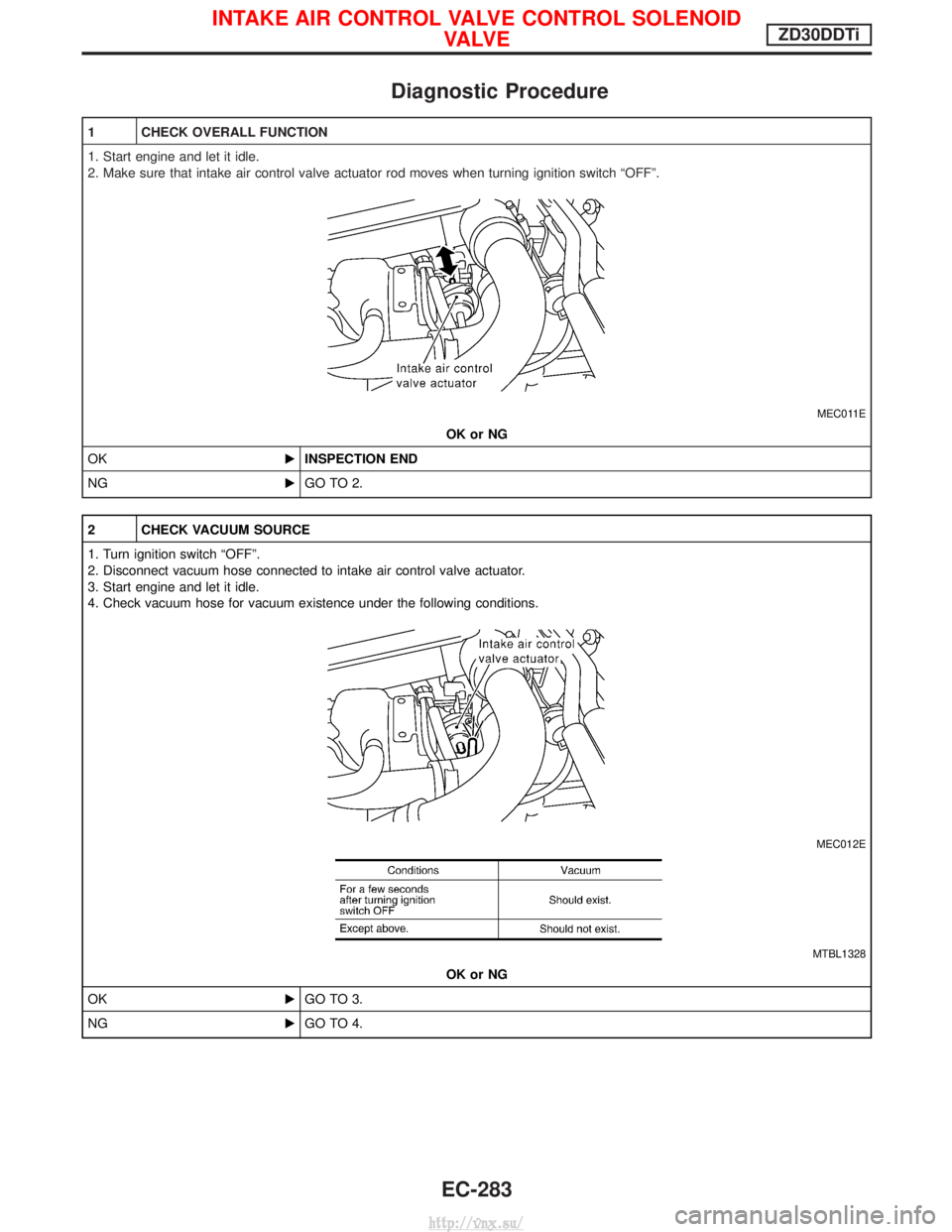
1 CHECK OVERALL FUNCTION
1. Start engine and let it idle.
2. Make sure that intake air control valve actuator rod moves when turning ignition switch ªOFFº.
MEC011E
OK or NG
OK EINSPECTION END
NG EGO TO 2.
2 CHECK VACUUM SOURCE
1. Turn ignition switch ªOFFº.
2. Disconnect vacuum hose connected to intake air control valve actuator.
3. Start engine and let it idle.
4. Check vacuum hose for vacuum existence under the following conditions.
MEC012E
MTBL1328
OK or NG
OK EGO TO 3.
NG EGO TO 4.
INTAKE AIR CONTROL VALVE CONTROL SOLENOID
VA LV EZD30DDTi
EC-283
http://vnx.su/
Page 564 of 1833
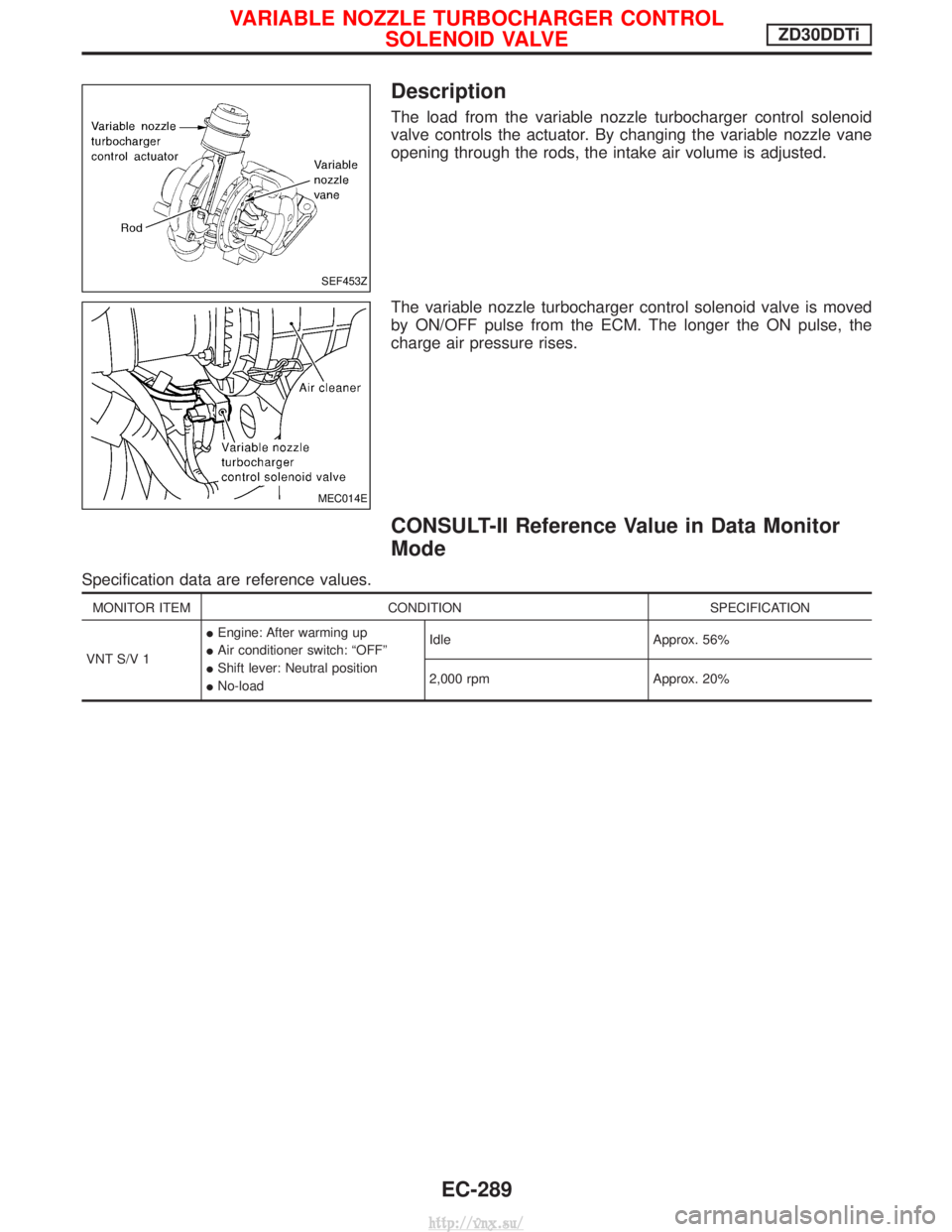
Description
The load from the variable nozzle turbocharger control solenoid
valve controls the actuator. By changing the variable nozzle vane
opening through the rods, the intake air volume is adjusted.
The variable nozzle turbocharger control solenoid valve is moved
by ON/OFF pulse from the ECM. The longer the ON pulse, the
charge air pressure rises.
CONSULT-II Reference Value in Data Monitor
Mode
Specification data are reference values.
MONITOR ITEMCONDITION SPECIFICATION
VNT S/V 1 I
Engine: After warming up
I Air conditioner switch: ªOFFº
I Shift lever: Neutral position
I No-load Idle Approx. 56%
2,000 rpm
Approx. 20%
SEF453Z
MEC014E
VARIABLE NOZZLE TURBOCHARGER CONTROL
SOLENOID VALVEZD30DDTi
EC-289
http://vnx.su/
Page 565 of 1833
ECM Terminals and Reference Value
Specification data are reference values, and are measured between each terminal and ground.
CAUTION:
Do not use ECM ground terminals when measuring input/output voltage. Doing so may damage the
ECM's transistor. Use a ground other than ECM terminals, such as the ground.
TER-
MINAL NO. WIRE
COLOR ITEM CONDITION DATA (DC Voltage)
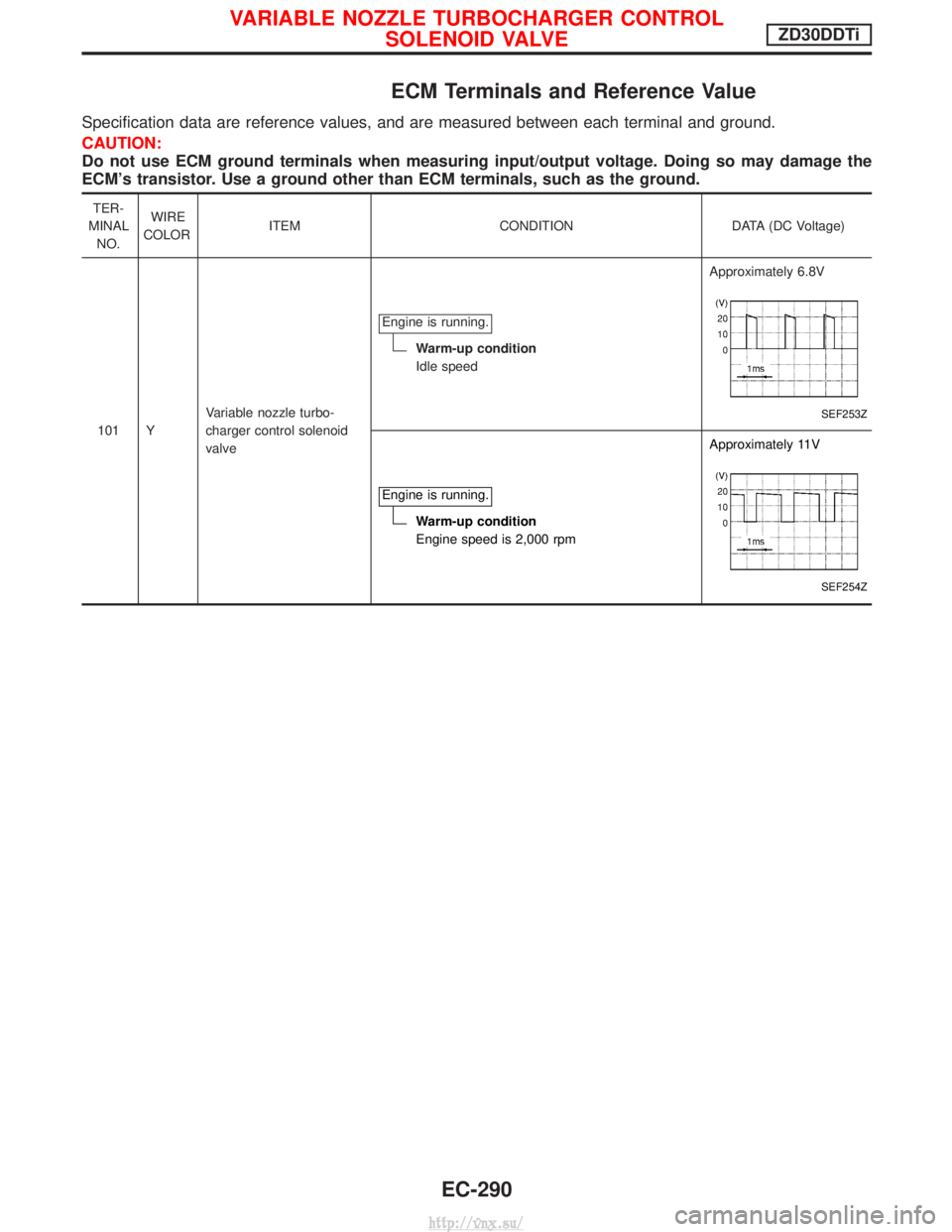
101 Y Variable nozzle turbo-
charger control solenoid
valve Engine is running.
Warm-up condition
Idle speed
Approximately 6.8V
SEF253Z
Engine is running.
Warm-up condition
Engine speed is 2,000 rpmApproximately 11V
SEF254Z
VARIABLE NOZZLE TURBOCHARGER CONTROL
SOLENOID VALVEZD30DDTi
EC-290
http://vnx.su/
Page 567 of 1833
Diagnostic Procedure
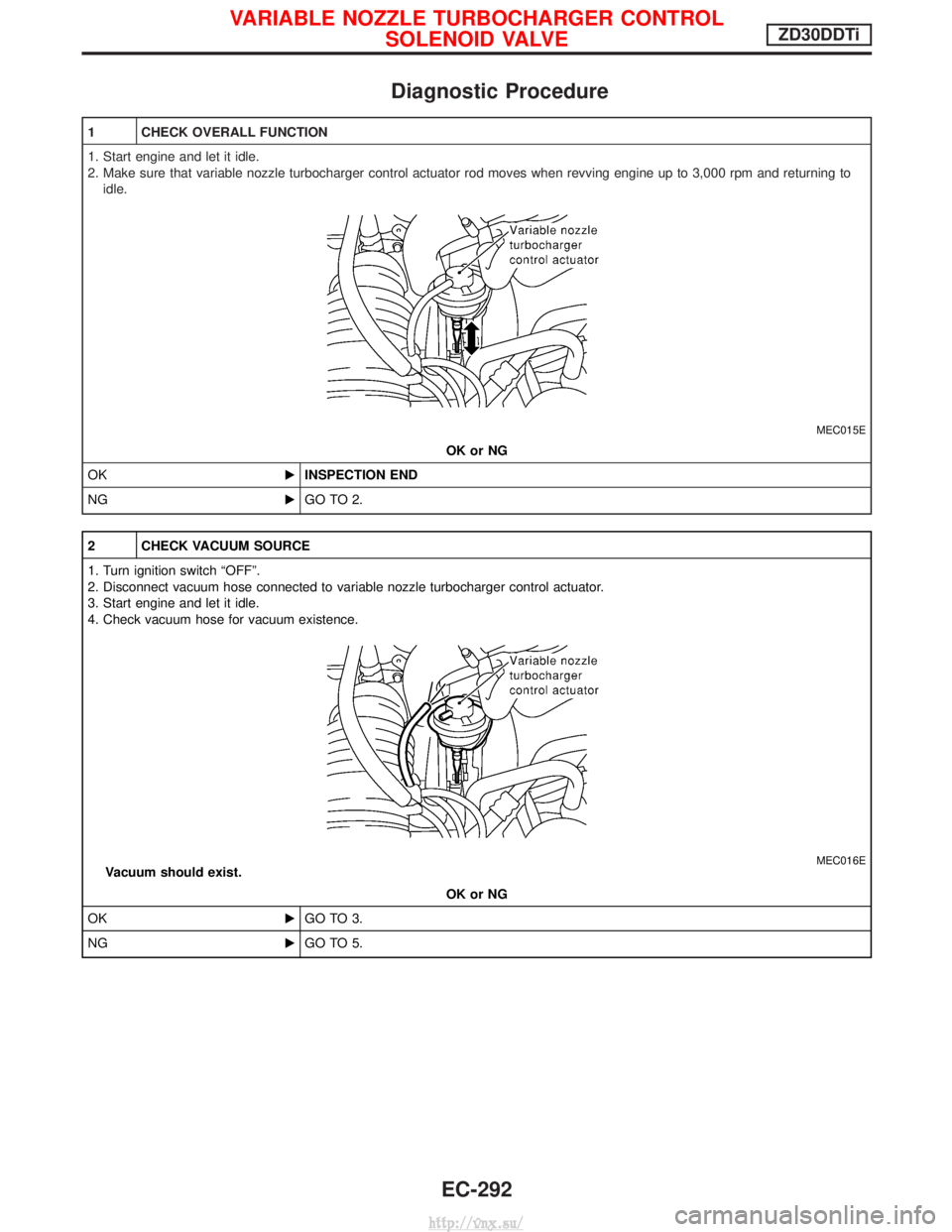
1 CHECK OVERALL FUNCTION
1. Start engine and let it idle.
2. Make sure that variable nozzle turbocharger control actuator rod moves when revving engine up to 3,000 rpm and returning toidle.
MEC015E
OK or NG
OK EINSPECTION END
NG EGO TO 2.
2 CHECK VACUUM SOURCE
1. Turn ignition switch ªOFFº.
2. Disconnect vacuum hose connected to variable nozzle turbocharger control actuator.
3. Start engine and let it idle.
4. Check vacuum hose for vacuum existence.
MEC016EVacuum should exist.
OK or NG
OK EGO TO 3.
NG EGO TO 5.
VARIABLE NOZZLE TURBOCHARGER CONTROL
SOLENOID VALVEZD30DDTi
EC-292
http://vnx.su/