Page 279 of 3870
length. Strip insulation from ends of wires. Connect wires at one end of harness
to clockspring connector stripped wires and cover connections with insulating
tape. Temporarily wrap other end of harness wires together to prevent
unexpected air bag deployment.
7. Stretch deployment harness as far away from vehicle as possible. Roll up
vehicle windows to lessen deployment noise and cover vehicle with car cover,
in case glass should shatter during deployment. Ensure area is clear of people.
Untwist deployment harness wire ends. Touch wire ends to 12 volt battery
terminals to deploy driver-side air bag module.
8. Repeat procedure for remaining air bag modules and seat belt pretensioners.
Use SRS Air Bag Adapter Harness (MB686560) for passenger-side and side
impact air bag modules. Use SRS Adapter Harness (MR991885) for seat belt
pretensioners. If any component fails to deploy, stay away from vehicle and
contact manufacturer for further instructions. Allow 30 minutes for air bag
modules to cool.
Off-vehicle Deployment 1. Before proceeding, see
AIR BAG SAFETY PRECAUTIONS
. Turn ignition
switch to LOCK position. Disconnect negative battery cable. Shield cable end.
Wait at least 60 seconds before continuing. Disconnect positive battery cable.
Remove battery from vehicle.
2. Fabricate a deployment harness using two wires at least 20 feet (6.1 m) in
length. Strip insulation from ends of wires. Twist together one end of wires
temporarily. Remove driver-side air bag module. See
DRIVER
-SIDE AIR
BAG MODULE & CLOCKSPRING
under REMOVAL &
INSTALLATION. Place driver-side air bag module on surface face up. Touch
vehicle body with bare hands to discharge static electricity from body. Cut
driver-side air bag module connector from pigtail leads. Strip insulation from
ends of
pigtail wires. Attach remainin
g ends of de
ployment harness to
pigtail NOTE: Driver-side and passenger-side air bag modules will be
either single-stage or dual-stage. Consult wiring
diagrams to ensure correct wires are cut and spliced
prior to deployment. See WIRING DIAGRAMS
.
2004 Mitsubishi Endeavor Limited
2004 ACCESSORIES/SAFETY EQUIPMENT Mitsubishi - Air Bag Restraint Systems
Page 280 of 3870
leads. Wrap connections with electrical tape.
3. Secure driver-side air bag module to an old tire and wheel. Run harness wires
through hole at rear of air bag module, through hole in wheel and out beneath
tire. Stack 3 more tires on top of first tire. Tie tires together with rope in four
locations. Untwist ends of deployment harness. Connect ends of deployment
harness to terminals of a 12-volt battery to deploy air bag module. If air bag
module fails to deploy, go to step 7 . If air bag module deploys, wait at least 30
minutes for air bag module to cool before touching. Go to next step.
4. Remove remaining components. See
REMOVAL & INSTALLATION
. For
passenger-side air bag modules and seat belt pretensioners, place component
on ground at least 20 feet (6.1 m) away from people or objects. Ensure trim
cover of passenger-side air bag module is facing up. For side impact air bag
modules, position seat back so rear of seat back is in contact with ground
surface, at least 20 feet (6.1 m) away from people or objects.
5. Make a deployment harness using two wires at least 20 feet (6.1 m) in length.
Temporarily twist wires on one end of harness together to prevent unexpected
deployment. Connect wires at other end of harness to stripped wires of SRS
Air Bag Adapter Harness "B" (MB686560) for passenger-side or side impact
air bag modules or SRS Air Bag Adapter Harness (MR991885) for seat belt
pretensioners.
6. Wrap connections with insulating tape. Connect appropriate adapter harness to
component connector. If deploying passenger-side air bag module or seat belt
pretensioner, secure component to a scrap tire and wheel. Run harness wires
through air bag module mounting hole, through hole in wheel and out beneath
tire. Stack 3 more tires on top of first tire. Tie tires together with rope in four
locations.
7. To deploy appropriate component, connect ends of deployment harness to
terminals of a 12-volt battery. If any component fails to deploy, stay away from
component. Contact manufacturer for further instructions. After deployment,
allow at least 30 minutes for component to cool before touching. Tightly seal
deployed component in a strong plastic bag and dispose of it as you would any
other part.
POST
-COLLISION INSPECTION
2004 Mitsubishi Endeavor Limited
2004 ACCESSORIES/SAFETY EQUIPMENT Mitsubishi - Air Bag Restraint Systems
Page 564 of 3870
Fig. 109: Installing Underdrive Clutch
Courtesy of MITSUBISHI MOTOR SALES OF AMERICA.
59. Place two beads of solder [each 10 mm (0.39 inch) in length, 3.5 mm (0.14
inch) in diameter] on the underdrive clutch retainer as shown in the illustration.
2004 Mitsubishi Endeavor XLS
2004 TRANSMISSION Automatic Transaxle Overhaul - Endeavor
Page 575 of 3870
Fig. 120: Installing Differential
Courtesy of MITSUBISHI MOTOR SALES OF AMERICA.
75. Place two beads of solder [each 10 mm (0.39 inch) in length, 3 mm (0.12 inch)
in diameter] on the tor
que converter housin
g as shown in the illustration
2004 Mitsubishi Endeavor XLS
2004 TRANSMISSION Automatic Transaxle Overhaul - Endeavor
Page 673 of 3870
2004 DRIVELINE/AXLES
Front Axle - Endeavor
GENERAL DESCRIPTION The front axle consists of front hubs, knuckles, wheel bearings and drive shafts, and
has the following features:
The wheel bearing incorporates a unit ball bearing (double-row angular contact
ball bearing) for reduced friction. The front wheel hub assembly combines the hub, wheel bearing, housing, and
oil seal in a single unit for fewer parts, better durability, improved assembly
precision, and better structural organization. The driveshaft incorporates BJ-PTJ type constant velocity joints< FWD>, BJ-
DOJ < AWD-LH>and BJ-TJ< AWD-RH> with high transmission efficiency
for low vibration and noise. Due to the use of the inner shaft and bracket assembly, the right and left drive
shafts are approximately the same in length. This reduces noise, vibration and
torque steer.< FWD> ABS rotor for detecting the wheel speeds is press-fitted to the rear hub in
vehicles with ABS.
CONSTRUCTION DIAGRAM NOTE:
PTJ: Pillow Tripod Joint BJ: Birfield Joint DOJ: Double Offset Joint TJ: Tripod Joint
2004 Mitsubishi Endeavor LS
2004 DRIVELINE/AXLES Front Axle - Endeavor
2004 Mitsubishi Endeavor LS
2004 DRIVELINE/AXLES Front Axle - Endeavor
Page 770 of 3870
Fig. 48: Using Vacuum Pump To Measuring Dimension "A"
Courtesy of MITSUBISHI MOTOR SALES OF AMERICA.
2. If the protrusion amount is not within the standard value range, adjust the push
rod length by turning the push rod. Use special tool MB991568 to turn the push
rod while holdin
g the rod s
pline with an
gle-nose
pliers.
2004 Mitsubishi Endeavor LS
2004 BRAKES Basic Brake System - Endeavor
Page 1092 of 3870
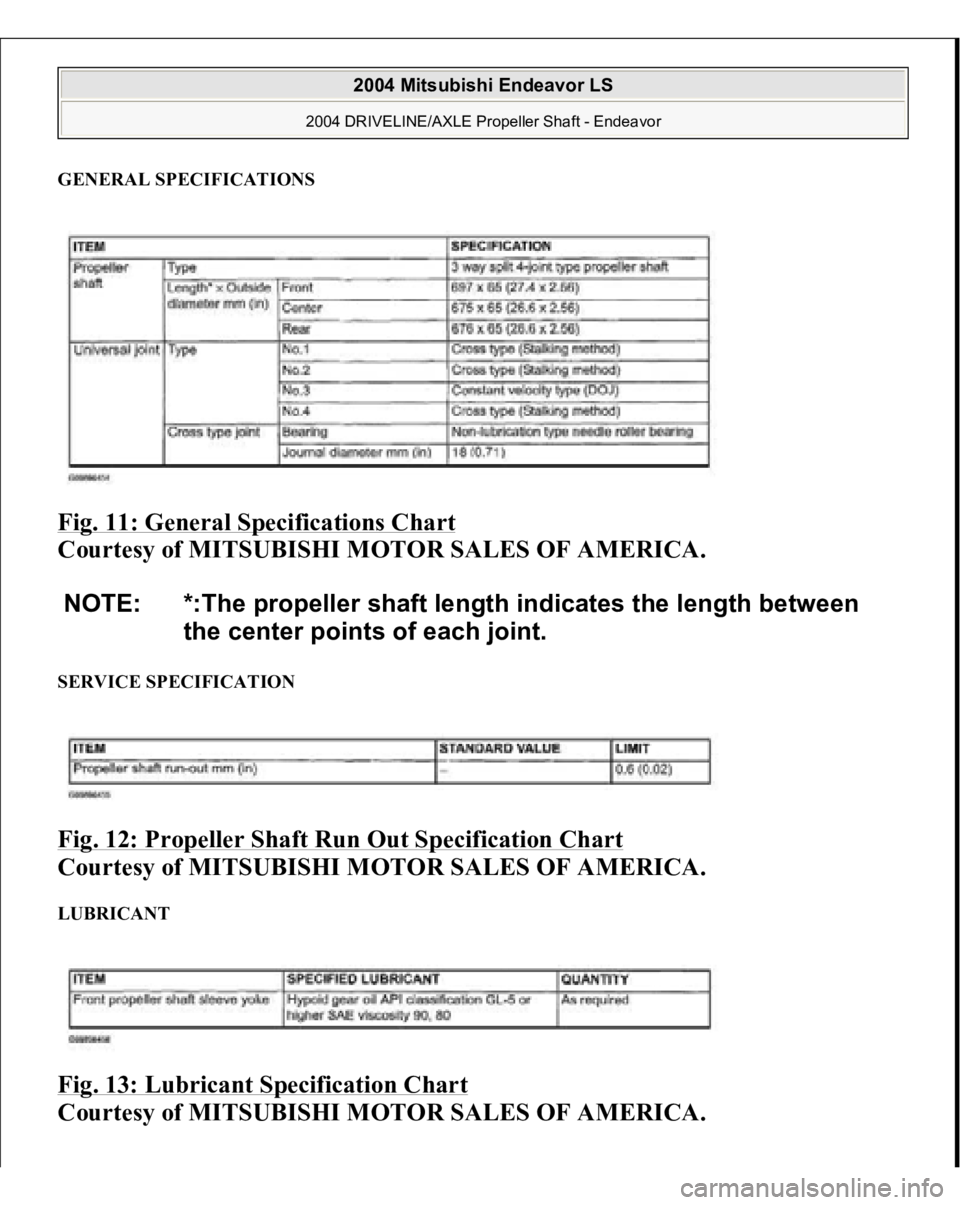
GENERAL SPECIFICATIONS Fig. 11: General Specifications Chart
Courtesy of MITSUBISHI MOTOR SALES OF AMERICA.
SERVICE SPECIFICATION Fig. 12: Propeller Shaft Run Out Specification Chart
Courtesy of MITSUBISHI MOTOR SALES OF AMERICA.
LUBRICANT Fig. 13: Lubricant Specification Chart
Courtesy of MITSUBISHI MOTOR SALES OF AMERICA.
NOTE: *:The propeller shaft length indicates the length between
the center points of each joint.
2004 Mitsubishi Endeavor LS
2004 DRIVELINE/AXLE Propeller Shaft - Endeavor
Page 1284 of 3870
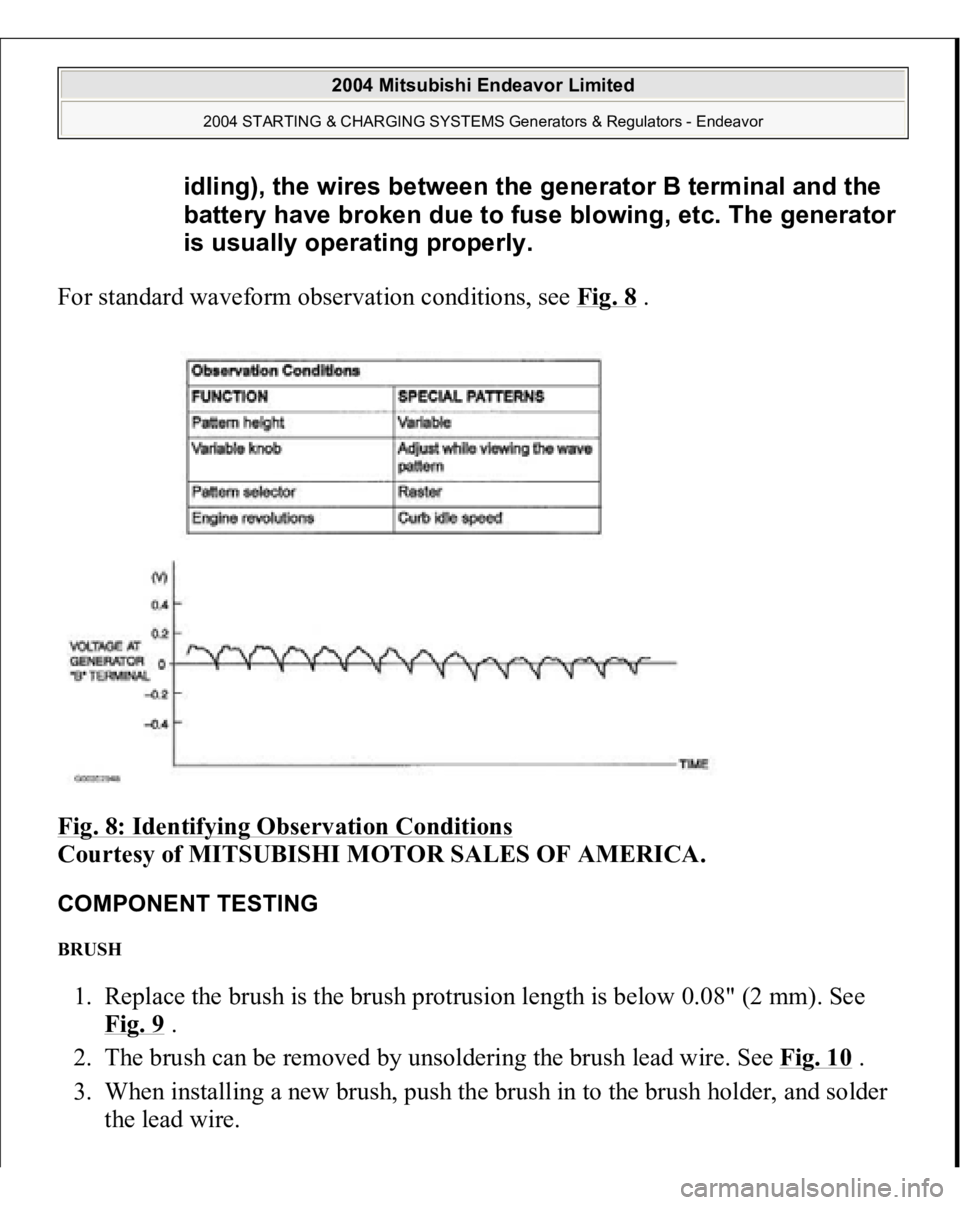
For standard waveform observation conditions, see Fig. 8
.
Fig. 8: Identifying Observation Conditions
Courtesy of MITSUBISHI MOTOR SALES OF AMERICA.
COMPONENT TESTING BRUSH 1. Replace the brush is the brush protrusion length is below 0.08" (2 mm). See
Fig. 9
.
2. The brush can be removed by unsoldering the brush lead wire. See Fig. 10
.
3. When installing a new brush, push the brush in to the brush holder, and solder
the lead wire.
idling), the wires between the generator B terminal and the
battery have broken due to fuse blowing, etc. The generator
is usually operating properly.
2004 Mitsubishi Endeavor Limited
2004 STARTING & CHARGING SYSTEMS Generators & Regulators - Endeavor
![MITSUBISHI ENDEAVOR 2004 Service Repair Manual Fig. 109: Installing Underdrive Clutch
Courtesy of MITSUBISHI MOTOR SALES OF AMERICA.
59. Place two beads of solder [each 10 mm (0.39 inch) in length, 3.5 mm (0.14
inch) in diameter] on the underd](/manual-img/19/57105/w960_57105-563.png "MITSUBISHI ENDEAVOR 2004 Service Repair Manual Fig. 109: Installing Underdrive Clutch
Courtesy of MITSUBISHI MOTOR SALES OF AMERICA.
59. Place two beads of solder [each 10 mm (0.39 inch) in length, 3.5 mm (0.14
inch) in diameter] on the underd")
![MITSUBISHI ENDEAVOR 2004 Service Repair Manual Fig. 120: Installing Differential
Courtesy of MITSUBISHI MOTOR SALES OF AMERICA.
75. Place two beads of solder [each 10 mm (0.39 inch) in length, 3 mm (0.12 inch)
in diameter] on the tor
que conve](/manual-img/19/57105/w960_57105-574.png "MITSUBISHI ENDEAVOR 2004 Service Repair Manual Fig. 120: Installing Differential
Courtesy of MITSUBISHI MOTOR SALES OF AMERICA.
75. Place two beads of solder [each 10 mm (0.39 inch) in length, 3 mm (0.12 inch)
in diameter] on the tor
que conve")