Page 240 of 4264
4C1-20 FRONT WHEEL DRIVE
6. Using snap ring pliers, remove the snap ring (1) fastening
the ball retainer to the center shaft.
7. Remove ball retainer, ball guide and bellows.
8. Use a hammer and chisel to remove the 3 pawls (above
the large and small boot bands on the UJ side).
CAUTION :
Take care not to damage the bellows during band removal.
9. Remove band (1).
10. Remove bellows.
11. Remove dust seal from UJ.
12. Remove UJ shaft assembly.
13. Remove the mounting bracket fixing bolts, and then
remove DOJ case assembly from the axle case.
14. Remove snap ring and bearing.
15. Remove snap ring and oil seal.
16. Remove bracket.
Inspection And Repair
Make necessary correction or parts replacement if wear,
damage, corrosion or any other abnormal condition are found
through inspection.
Check the following parts.
1. Drive shaft joint assembly
2. DOJ case, ball, ball guide, ball retainer
3. Bellows
4. Bearing
5. Dust seal, oil seal
Page 242 of 4264
4C1-22 FRONT WHEEL DRIVE
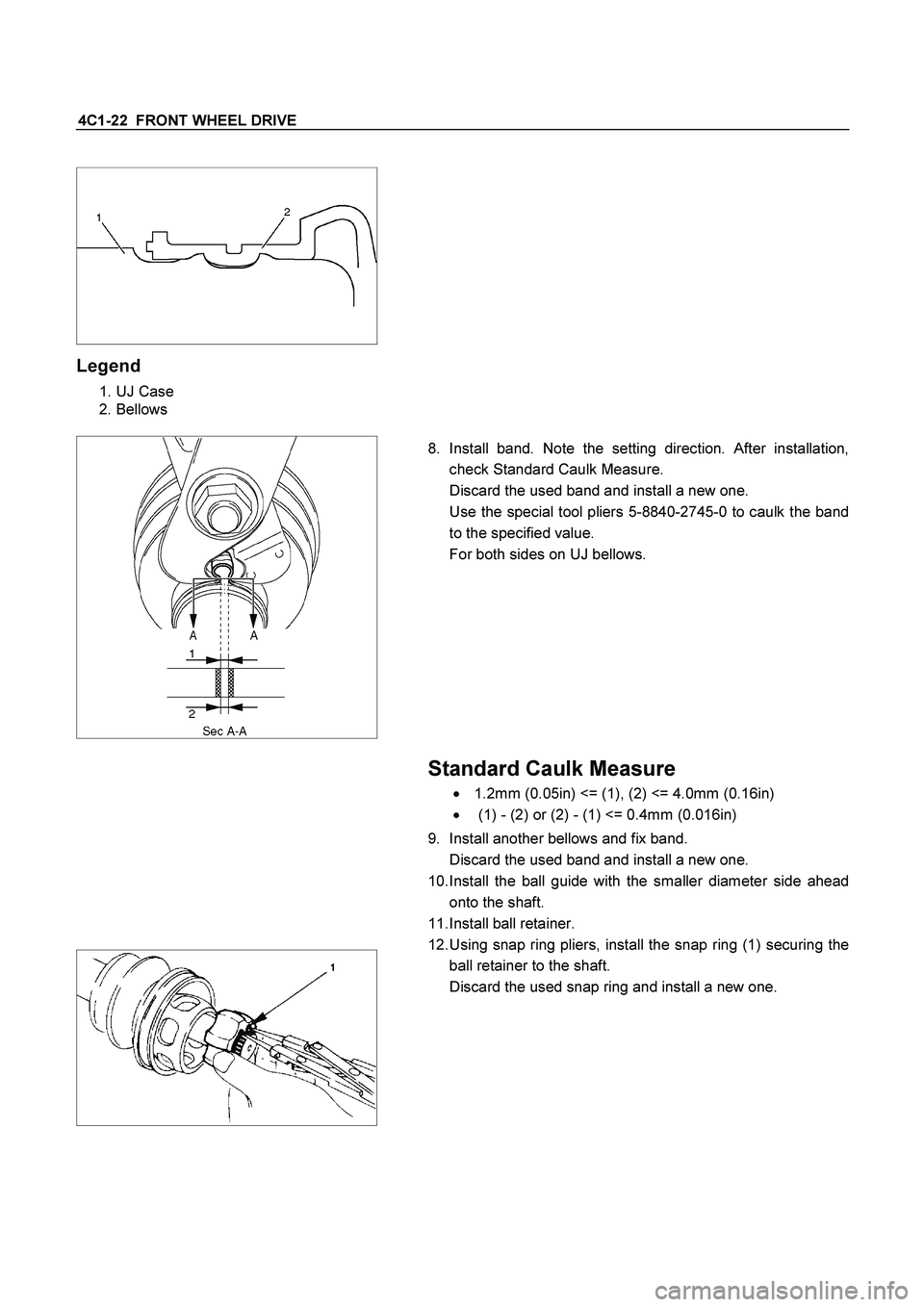
Legend
1. UJ Case
2. Bellows
8. Install band. Note the setting direction. After installation,
check Standard Caulk Measure.
Discard the used band and install a new one.
Use the special tool pliers 5-8840-2745-0 to caulk the band
to the specified value.
For both sides on UJ bellows.
Standard Caulk Measure
�
1.2mm (0.05in) <= (1), (2) <= 4.0mm (0.16in)
�
(1) - (2) or (2) - (1) <= 0.4mm (0.016in)
9. Install another bellows and fix band.
Discard the used band and install a new one.
10. Install the ball guide with the smaller diameter side ahead
onto the shaft.
11. Install ball retainer.
12. Using snap ring pliers, install the snap ring (1) securing the
ball retainer to the shaft.
Discard the used snap ring and install a new one.
Page 243 of 4264
FRONT WHEEL DRIVE 4C1-23
13. Align the track on the ball (1) retainer with the window in
the cage, and install the six balls into position.
14. Pack 150g of the specified grease in DOJ case, then install
drive shaft joint assembly. After reassembly, move the DOJ
longitudinally several times to get to fit.
15. Install the circlip (1) so that open ends are positioned away
from the ball groove.
Discard the used circlip and install a new one.
Legend
1. Outer Case
2. Circlip
3. Open Ends
16. Install band. After installation, check that the bellows is free
from distortion.
Discard the used band and install a new one.
Use the special tool pliers 5-8840-2745-0 to caulk the band
to the specified valve.
For both sides on UJ bellows.
Page 289 of 4264
FRONT WHEEL DRIVE 4C1-69
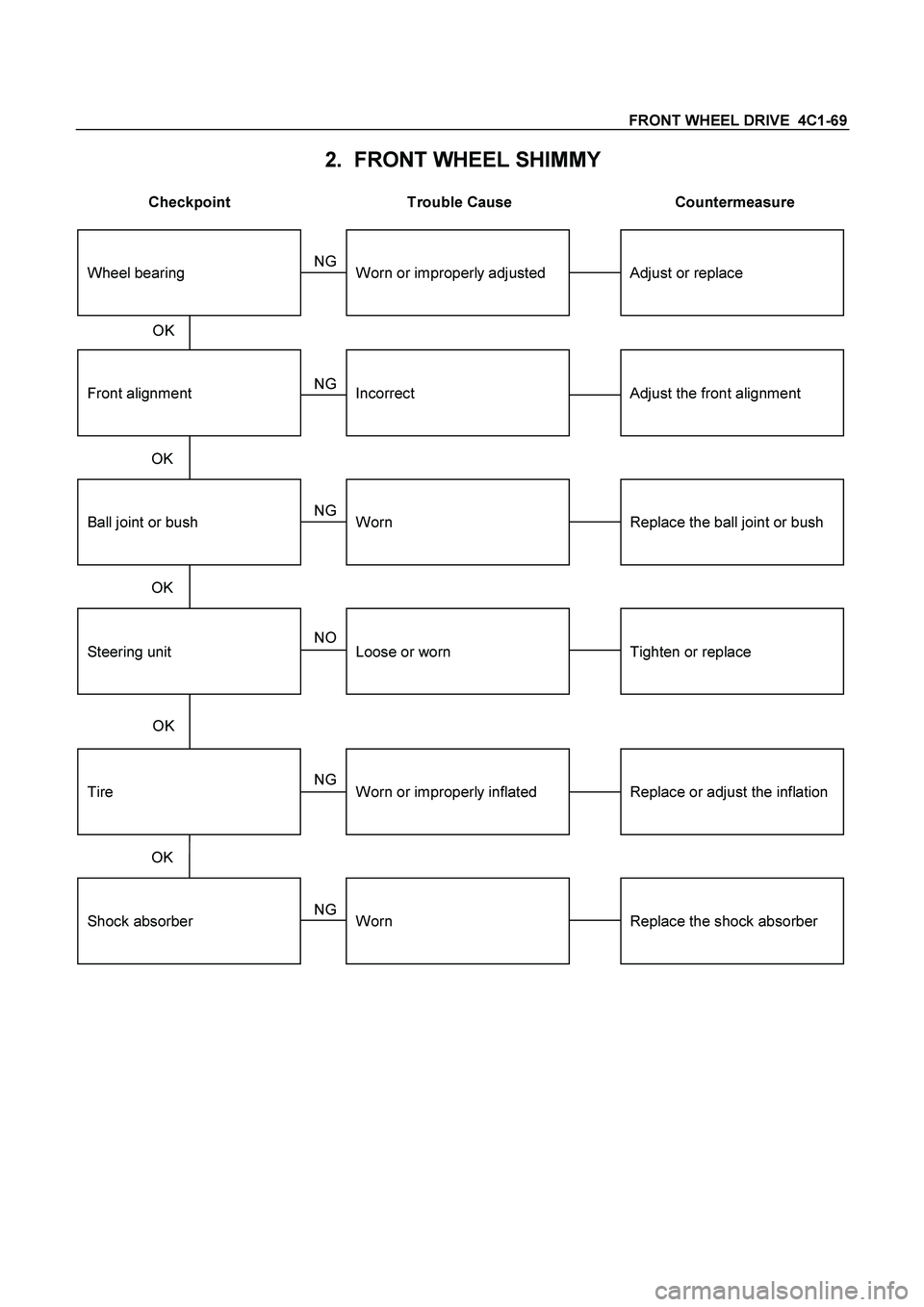
2. FRONT WHEEL SHIMMY
Checkpoint Trouble Cause Countermeasure
Ball joint or bush
Replace the ball joint or bush
Worn
Front alignment
Adjust the front alignment
Adjust or replace
Incorrect
Worn or improperly adjusted
OK
OK NG NG NG
OK
Wheel bearing
Tighten or replace
Loose or worn
NO
Shock absorber
Replace the shock absorber
Worn
Tire
Replace or adjust the inflation
Worn or improperly inflated
OK
NG NG OK
Steering unit
Page 293 of 4264
FRONT WHEEL DRIVE 4C1-73
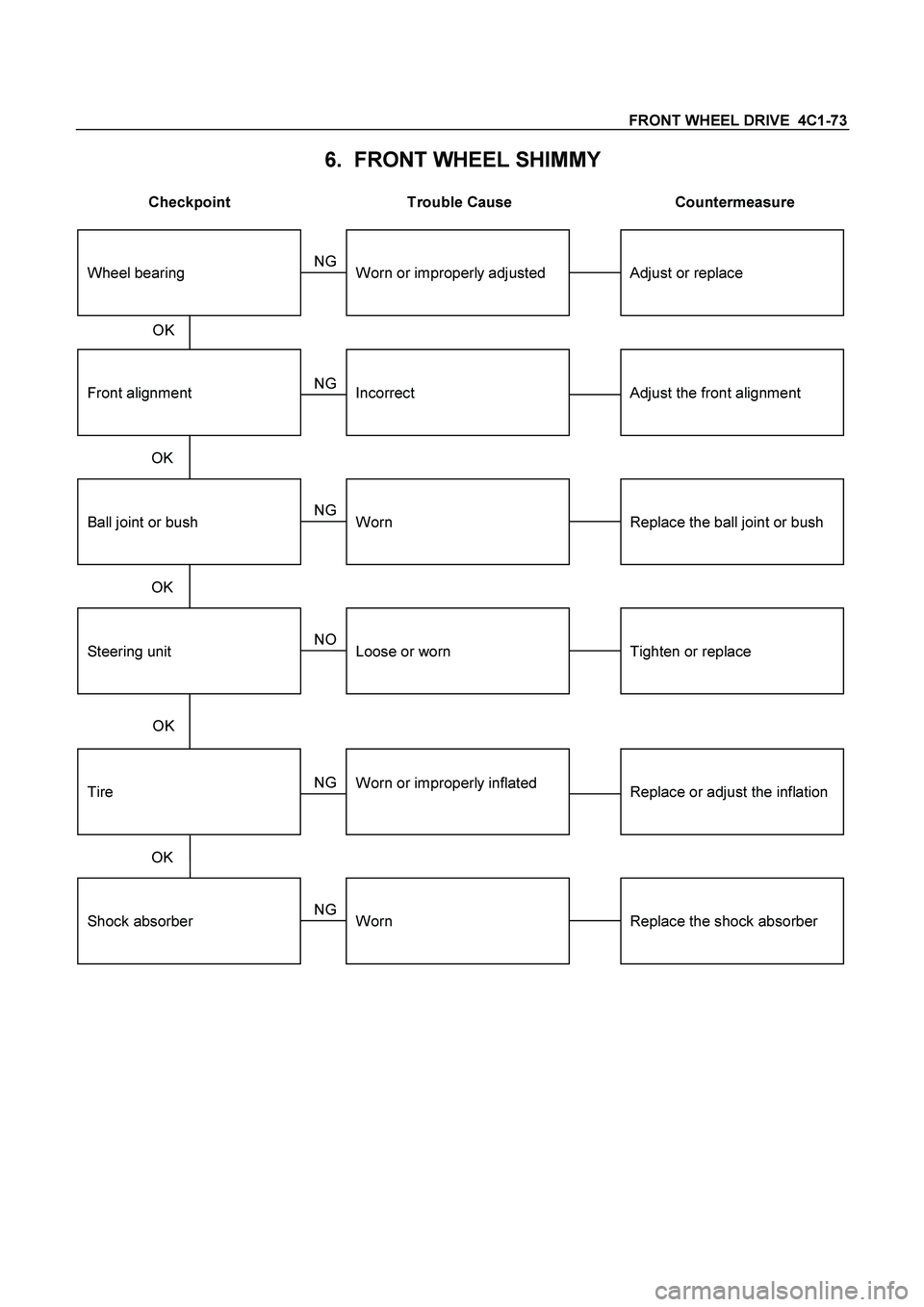
6. FRONT WHEEL SHIMMY
Checkpoint Trouble Cause Countermeasure
Ball joint or bush
Replace the ball joint or bush
Worn
Front alignment
Adjust the front alignment
Adjust or replace
Incorrect
Worn or improperly adjusted
OK
OK NG NG NG
OK
Wheel bearing
Tighten or replace
Loose or worn
NO
Shock absorber
Replace the shock absorber
Worn
Tire
Replace or adjust the inflation
Worn or improperly inflated
OK
NG NG OK
Steering unit
Page 2415 of 4264
ENGINE DIAGNOSIS (C24SE) 6-9
Abnormal Noise Due to Hydraulic Lash Adjuster
Should abnormal noise due to the hydraulic lash
adjuster trouble be heard immediately after the engine
is started, inspect as follows:
Condition Possible cause Correction
Abnormal noise is heard Air contaminated Bleed
HLA is spongy Check ball valve broken Repair
Safety valve in cylinder head
broken Replace
Valve clearance is not zero HLA inside stick Replace HLA assembly
Troubleshooting Procedure
Short out each spark plug in sequence using insulated
spark plug wire removers. Locate cylinder with
defective bearing by listening for abnormal noise that
stops when spark plug is shorted out.
Condition Possible cause Correction
Noise from connecting rods or
from connecting rod bearings
(Faulty connecting rods or
connecting rod bearings usually
make an abnormal noise slightly
higher than the crank bearing
noise, which becomes more
evident when engine is
accelerated) Bearing or crankshaft pin worn Replace connecting rod bearings
and crankshaft or regrind
crankshaft and install the under
size bearing
Crankpin out of round Replace connecting rod bearings
and crankshaft or regrind
crankshaft and install the under
size bearing
Connecting rod bent Correct or replace
Connecting rod bearing seized Replace connecting rod bearings
and crankshaft or regrind
crankshaft and install the under
size bearing
Troubleshooting Procedure
Abnormal noise stops when the spark plug on the
cylinder with defective parts is shorted out.
Condition Possible cause Correction
Piston and cylinder
(Faulty piston or cylinder usually
makes a combined mechanical
thumping noise which increases
when engine is suddenly
accelerated but diminishes
gradually as the engine warms up) Piston clearance increased due to
cylinder wear Replace piston and cylinder body
Piston seized Replace piston and cylinder body
Piston ring broken Replace piston and cylinder body
Piston defective Replace pistons and others
Page 2453 of 4264
ENGINE MECHANICAL (C24SE) 6A-33
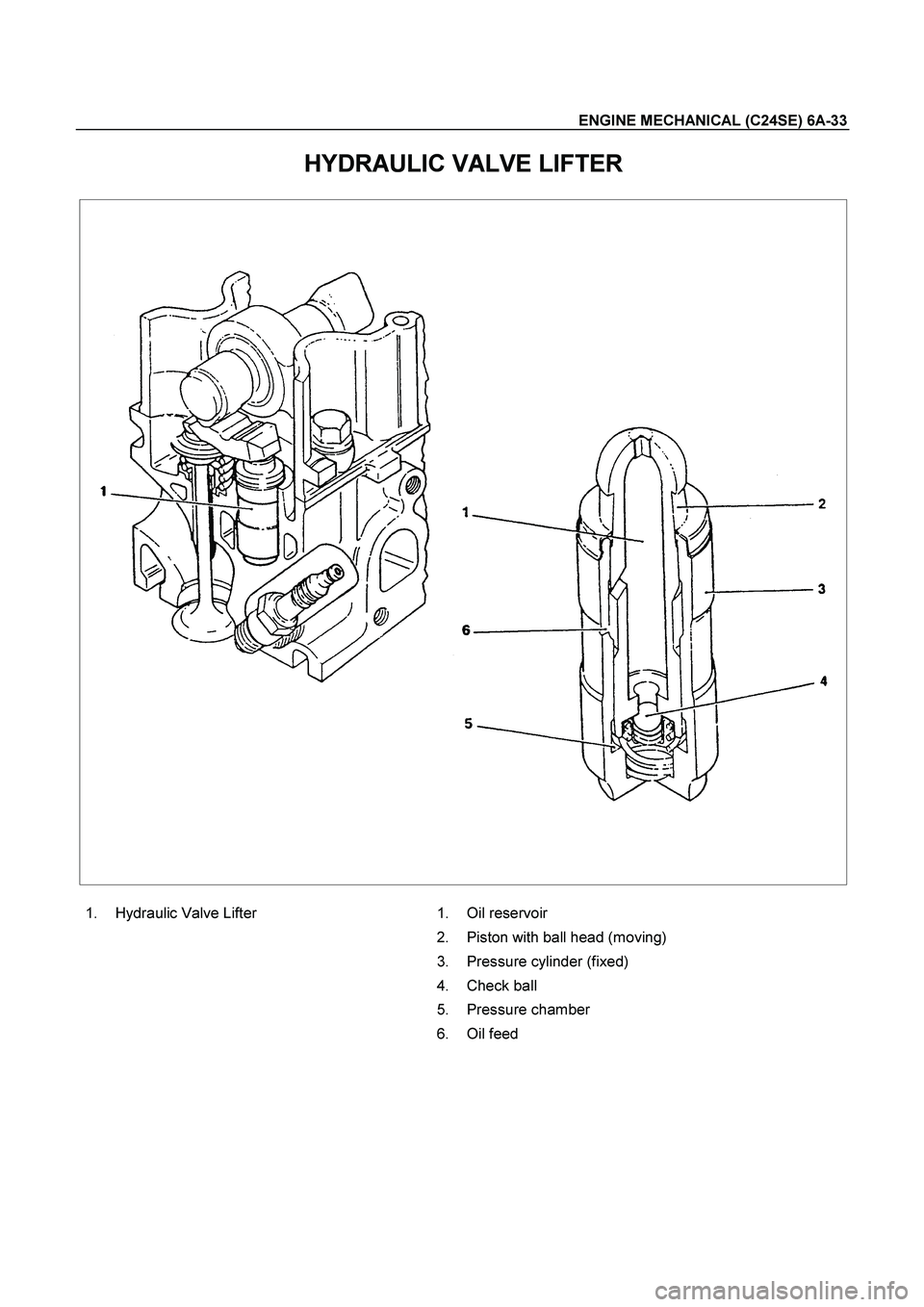
HYDRAULIC VALVE LIFTER
1. Hydraulic Valve Lifter
1. Oil reservoir
2. Piston with ball head (moving)
3. Pressure cylinder (fixed)
4. Check ball
5. Pressure chamber
6. Oil feed
Page 2571 of 4264
STARTING AND CHARGING SYSTEM 6D3-17
fan.
4. Replacing the brushes (inbuilt regulator)
Check the brushes for length, this is measured from the brush
holder to the end of the brush along it's centre line. Also
inspect for any sideways wear. If worn replace both brushes.
The minimum length is 3.8mm. Inspect the brush springs for
signs of corrosion or loss of tension or uneven tension.
Replacing the brushes, using a soldering iron apply heat to the
soldered joints on the rear of the brush holder of the regulator,
using a small lever prise up the retaining tabs to release the
brush lead and spring. Thread the new brush lead up the
brush holder along with the spring, pull the lead through the
tabs until the brush is protruding 12mm from the holder.
Bend down the tabs and solder the brush lead taking care not
to allow the solder to run up the lead which will reduce
flexibility. Use 60/40 resin cored solder.
5. Ball bearing
Please note the bearings used in this KCA generator are a
high
tolerance type, only fully sealed bearings of the same
specification are to be used as replacements. It is
recommended that the bearings be replaced during the
reconditioning process to restore the unit to original
specification.
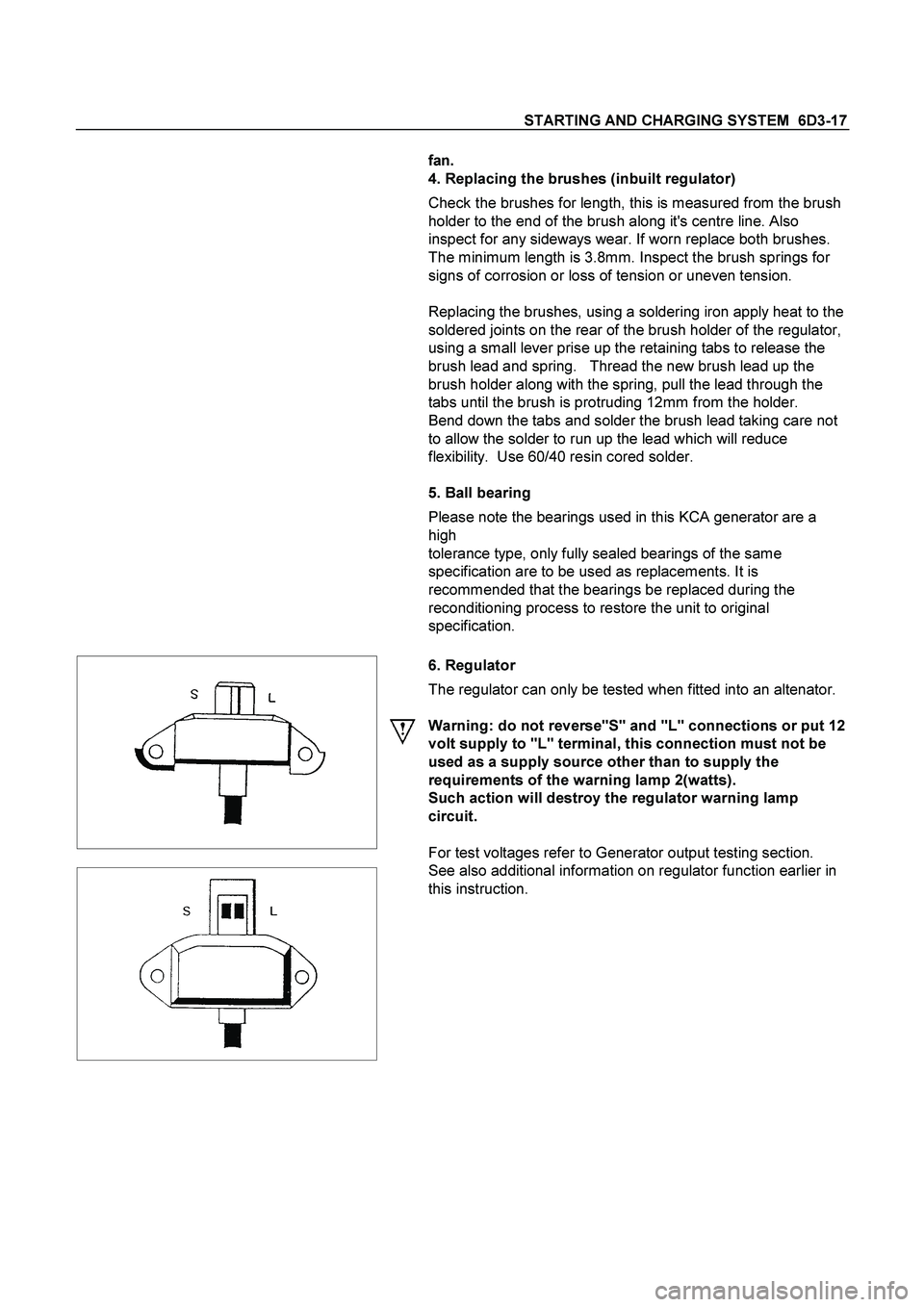
6. Regulator
The regulator can only be tested when fitted into an altenator.
Warning: do not reverse"S" and "L" connections or put 12
volt supply to "L" terminal, this connection must not be
used as a supply source other than to supply the
requirements of the warning lamp 2(watts).
Such action will destroy the regulator warning lamp
circuit.
For test voltages refer to Generator output testing section.
See also additional information on regulator function earlier in
this instruction.