Page 3918 of 4264
7A4–110 UNIT REPAIR (AW30–40LE)
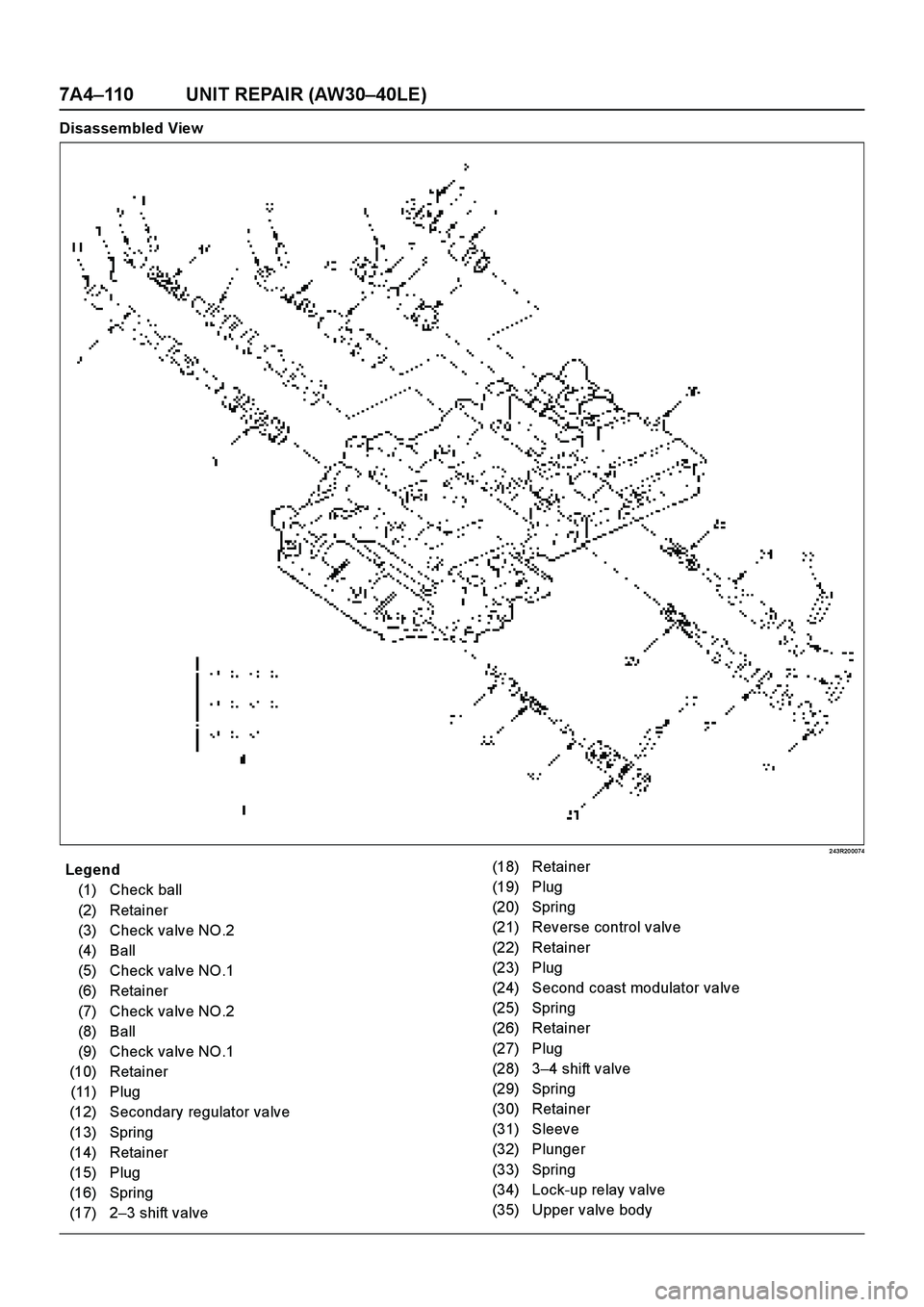
Disassembled View
2 43R20 0074
E nd O FCallo ut
Legend
(1) Check ball
(2) Retainer
(3) Check valve NO.2
(4) Ball
(5) Check valve NO.1
(6) Retainer
(7) Check valve NO.2
(8) Ball
(9) Check valve NO.1
(10) Retainer
(11) Plug
(12) Secondary regulator valve
(13) Spring
(14) Retainer
(15) Plug
(16) Spring
(17) 2–3 shift valve(18) Retainer
(19) Plug
(20) Spring
(21) Reverse control valve
(22) Retainer
(23) Plug
(24) Second coast modulator valve
(25) Spring
(26) Retainer
(27) Plug
(28) 3–4 shift valve
(29) Spring
(30) Retainer
(31) Sleeve
(32) Plunger
(33) Spring
(34) Lock-up relay valve
(35) Upper valve body
Page 3919 of 4264
UNIT REPAIR (AW30–40LE) 7A4–111
Disassembly
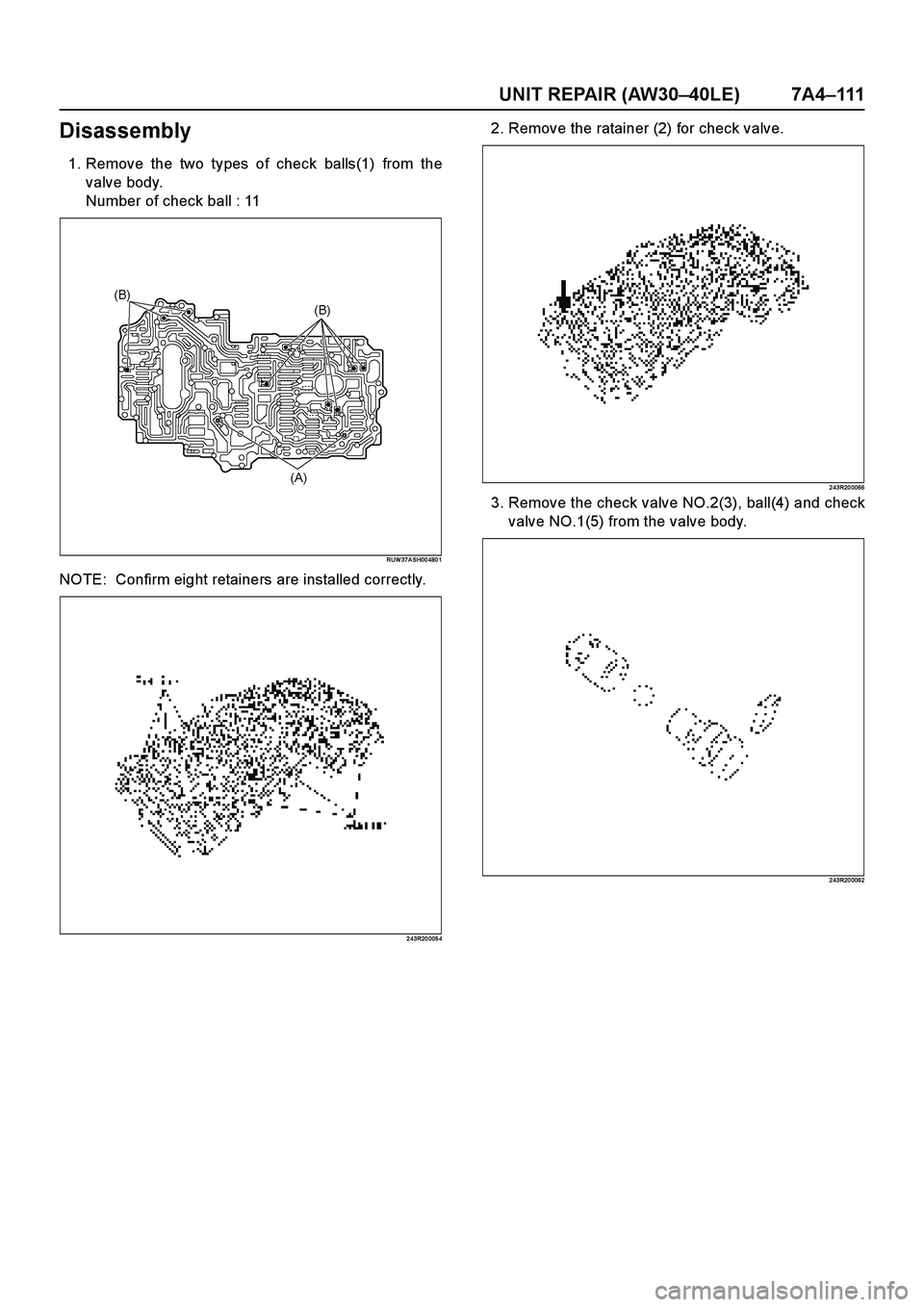
1. Remove the two types of check balls(1) from the
valve body.
Number of check ball : 11
RUW 37A SH00 480 1
NOTE: Confirm eight retainers are installed correctly.
2 43R20 005 4
2. Remove the ratainer (2) for check valve.
2 43R20 0066
3. Remove the check valve NO.2(3), ball(4) and check
valve NO.1(5) from the valve body.
2 43R20 0062
Page 3920 of 4264
7A4–112 UNIT REPAIR (AW30–40LE)
4. Remove the retainer (6) for check valve.
2 43R20 006 7
5. Remove the check valve NO.2(7), ball(8) and check
valve NO.1(9) from the valve body.
2 43R20 006 2
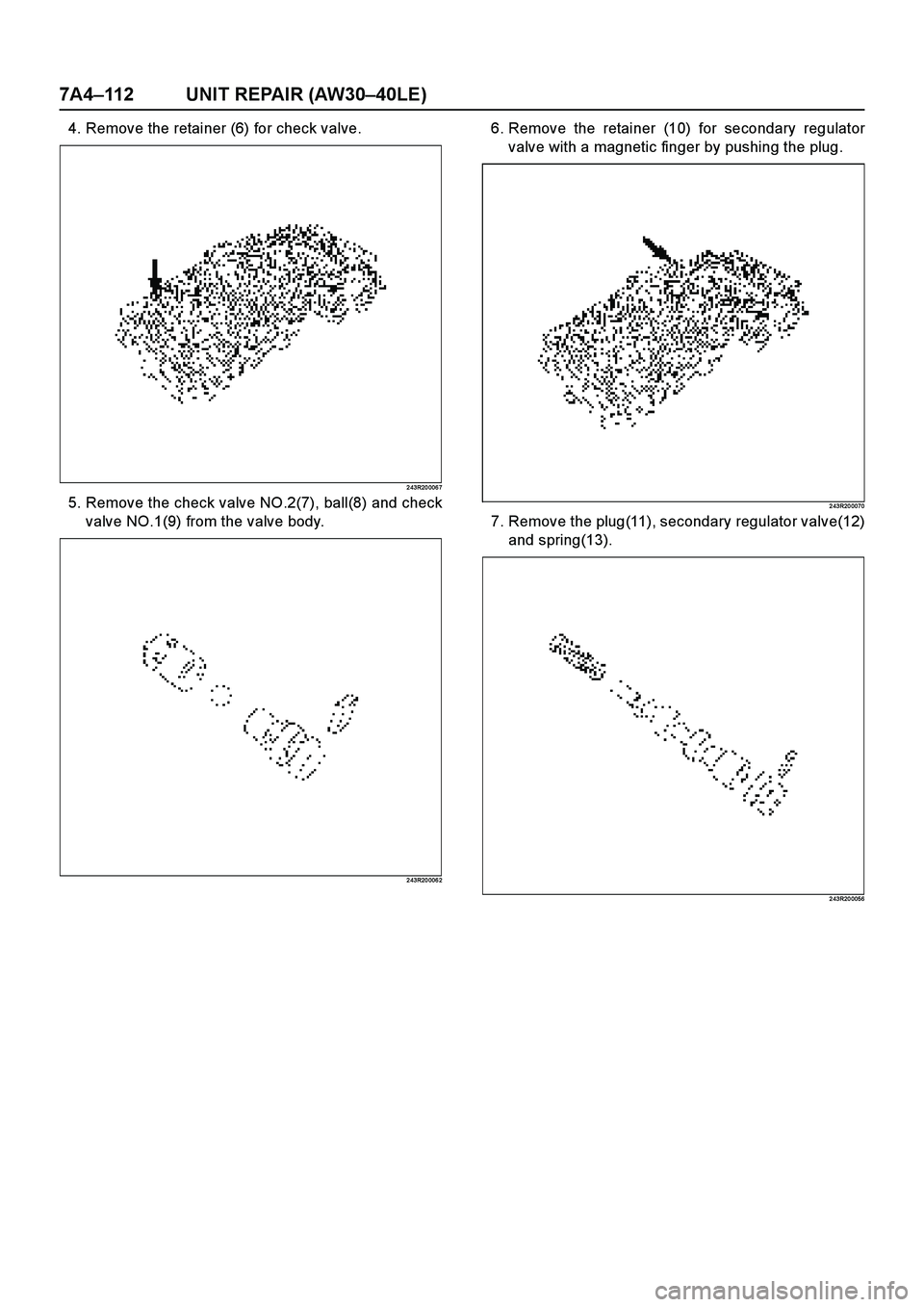
6. Remove the retainer (10) for secondary regulator
valve with a magnetic finger by pushing the plug.
2 43R20 0070
7. Remove the plug(11), secondary regulator valve(12)
and spring(13).
2 43R20 0056
Page 3927 of 4264
UNIT REPAIR (AW30–40LE) 7A4–11 9
13. Install the check valve NO.1(9), ball(8) and check
valve NO.2(7) to valve body.
2 43R20 006 2
14. Install the retainer(6).
2 43R20 006 7
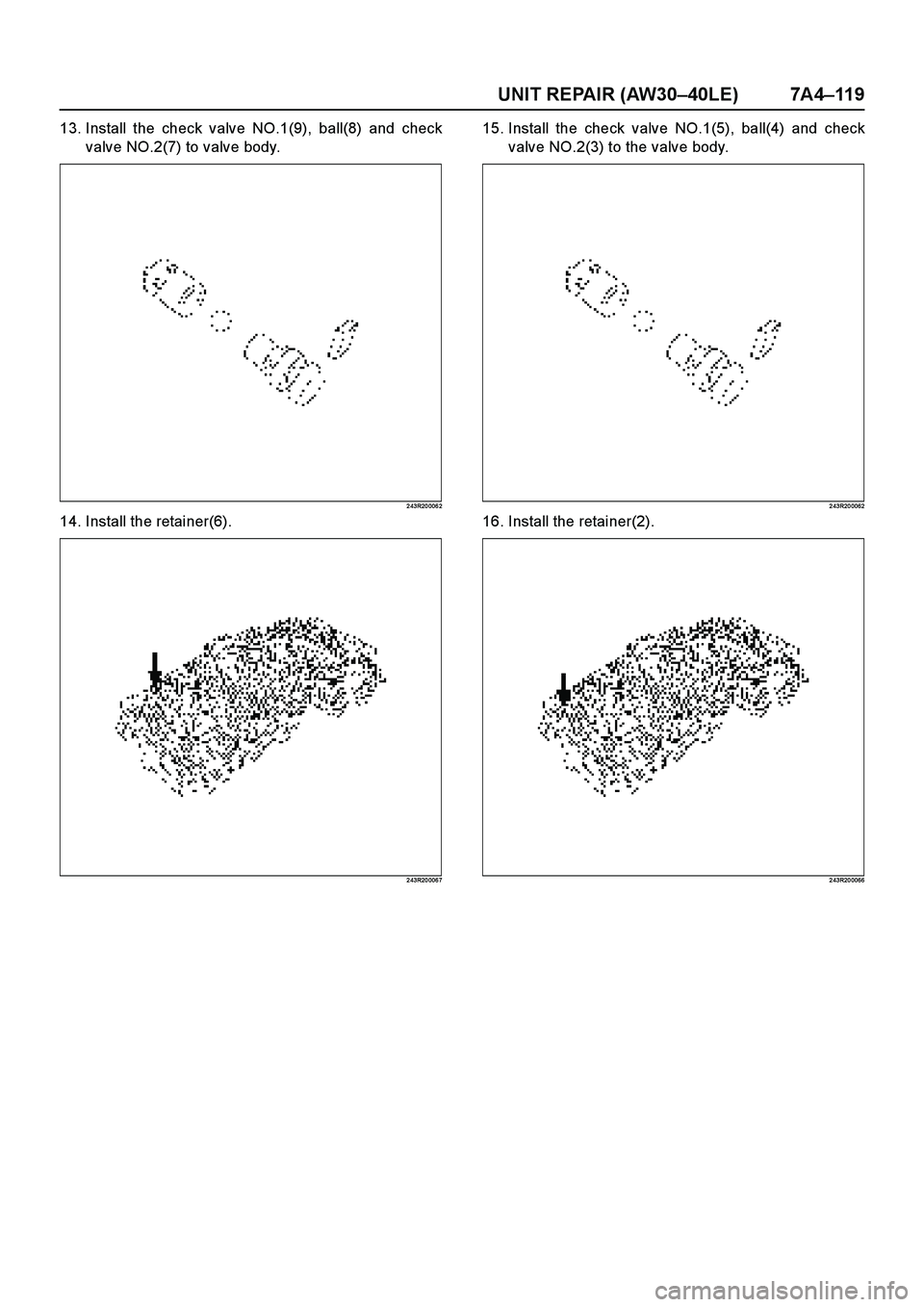
15. Install the check valve NO.1(5), ball(4) and check
valve NO.2(3) to the valve body.
2 43R20 0062
16. Install the retainer(2).
2 43R20 0066
Page 3928 of 4264
7A4–120 UNIT REPAIR (AW30–40LE)
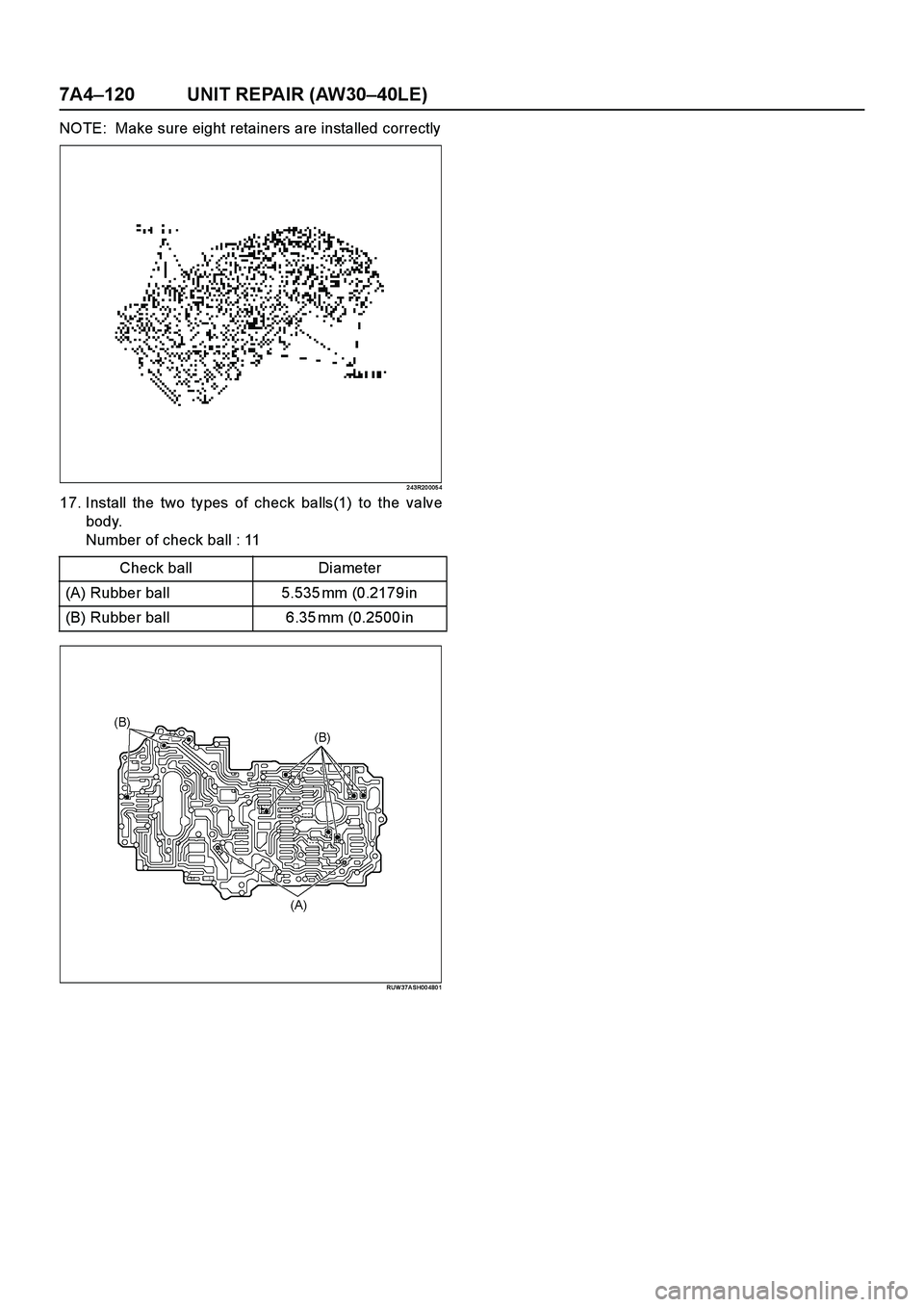
NOTE: Make sure eight retainers are installed correctly
2 43R20 005 4
17. Install the two types of check balls(1) to the valve
body.
Number of check ball : 11
RUW 37A SH00 480 1
Check ball Diameter
(A) Rubber ball 5.535 mm (0.2179 in
(B) Rubber ball 6.35 mm (0.2500 in
Page 3957 of 4264
CONSTRUCTION AND FUNCTION 7A1-11
� The JR405E consists of two sets of planetary gears, which are called front planetary gear and rear
planetary gear.
� The sun gear of front planetary gear is fixed to the drive plates of 2-4 brake and reverse clutch.
� The planetary carrier of front planetary gear is fixed to the drum of low clutch, the drive plates of low &
reverse brake and the hub of high clutch.
� The internal gear of front planetary gear and the planetary carrier of rear planetary gear are connected as
one, and they are fixed to output shaft.
� The sun gear of rear planetary gear is fixed to input shaft.
� The internal gear of rear planetary gear is fixed to the hub of low clutch.
Clutch and Brake
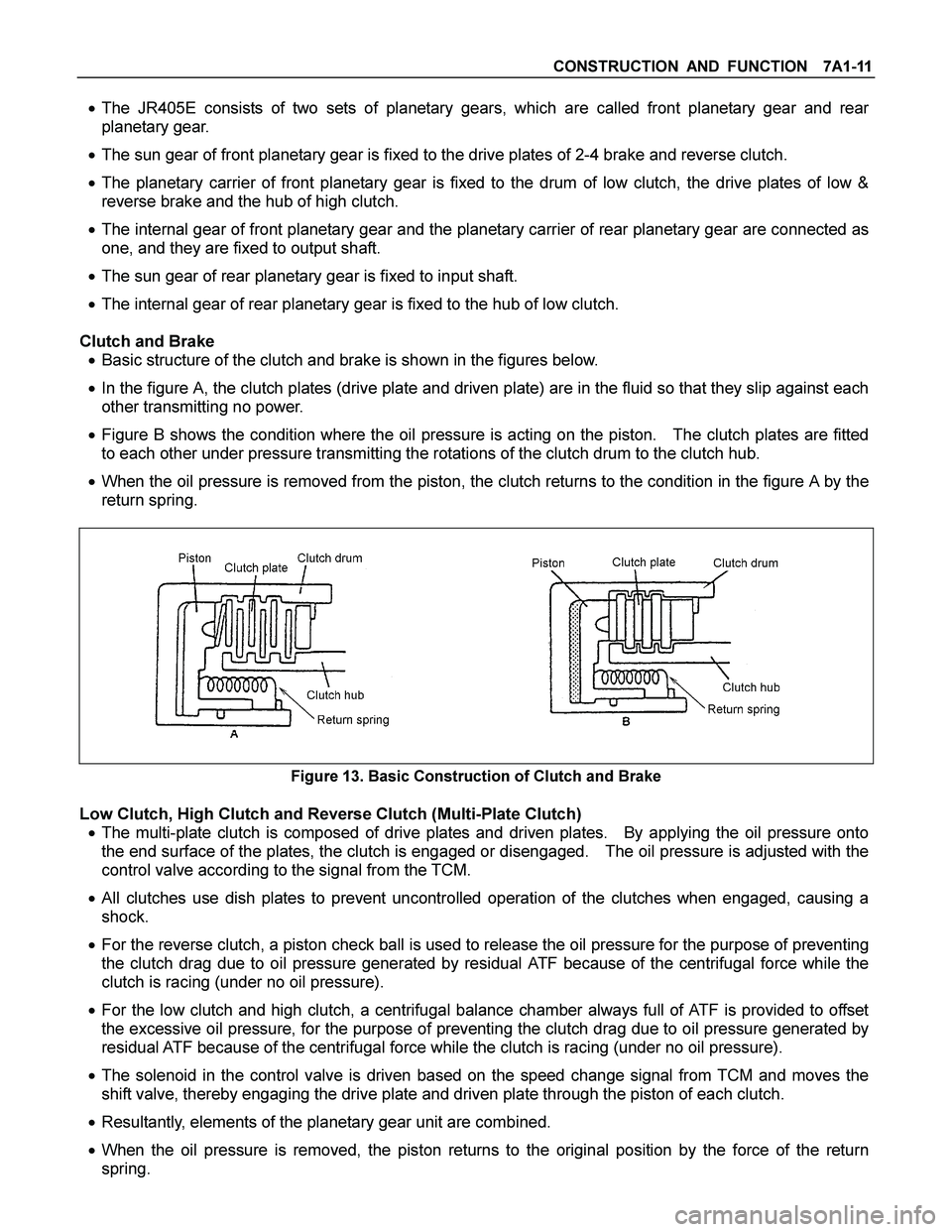
� Basic structure of the clutch and brake is shown in the figures below.
� In the figure A, the clutch plates (drive plate and driven plate) are in the fluid so that they slip against each
other transmitting no power.
� Figure B shows the condition where the oil pressure is acting on the piston. The clutch plates are fitted
to each other under pressure transmitting the rotations of the clutch drum to the clutch hub.
� When the oil pressure is removed from the piston, the clutch returns to the condition in the figure A by the
return spring.
Figure 13. Basic Construction of Clutch and Brake
Low Clutch, High Clutch and Reverse Clutch (Multi-Plate Clutch)
� The multi-plate clutch is composed of drive plates and driven plates. By applying the oil pressure onto
the end surface of the plates, the clutch is engaged or disengaged. The oil pressure is adjusted with the
control valve according to the signal from the TCM.
� All clutches use dish plates to prevent uncontrolled operation of the clutches when engaged, causing a
shock.
� For the reverse clutch, a piston check ball is used to release the oil pressure for the purpose of preventing
the clutch drag due to oil pressure generated by residual ATF because of the centrifugal force while the
clutch is racing (under no oil pressure).
� For the low clutch and high clutch, a centrifugal balance chamber always full of ATF is provided to offset
the excessive oil pressure, for the purpose of preventing the clutch drag due to oil pressure generated by
residual ATF because of the centrifugal force while the clutch is racing (under no oil pressure).
� The solenoid in the control valve is driven based on the speed change signal from TCM and moves the
shift valve, thereby engaging the drive plate and driven plate through the piston of each clutch.
� Resultantly, elements of the planetary gear unit are combined.
� When the oil pressure is removed, the piston returns to the original position by the force of the return
spring.