Page 103 of 256

Turn this dial clockwise to increase
fan speed and increase the airflow.
Turning this dial clockwise increases
the temperature of the airflow.
This button turns the air
conditioning on and of f . The light in
thebuttonisonwhentheA/Cison.
When the light in the button is on,
air f rom the vehicle’s interior is sent
throughout the system again. When
the light is of f , air is brought in f rom
the outside of the vehicle (Fresh Air
mode).The outside air intakes f or the
heating and cooling system are at
the base of the windshield. Keep this
area clear of leaves and other debris.
ThesystemshouldbeleftinFresh
Air mode under almost all conditions.
Keeping the system in Recirculation
mode, particularly with the A/C of f ,
can cause the windows to fog up.
Switch to Recirculation mode when
driving through dusty or smoky
conditions, then return to Fresh Air
mode.
This button turns the rear window
def ogger of f and on (see page ).
The system automatically
turns on the A/C and switches to
Recirculation mode. Air f lows f rom
the center and side vents in the
dashboard.
Air flows from the center
and corner vents in the dashboard.
Air f lows f rom the f loor
vents. When you select , the
system automatically switches to
Fresh Air mode.
Air f low is divided between
the f loor vents and the def roster
vents at the base of the windshield. Air f low is divided between
the vents in the dashboard and the
f loor vents.
Use the mode control dial to select
the vents the air flows from. Some
air will f low f rom the dashboard
vents in all modes. 66
Fan Control Dial
T emperature Control Dial
Air Conditioning (A/C) Button
Recirculation Button
Rear Window Def ogger Button
Mode Control Dial
Comf ort and Convenience Feat ures
Air Flow Buttons
99
Page 122 of 256
If your vehicle’s battery is
disconnected or goes dead, you will
need to set the clock.
Press the CLOCK button until you
hear a beep. The displayed time
begins to blink. Change the hours by
pressing the H button until the
numbers advance to the desired time.
Change the minutes by press the M
button until the numbers advance to
the desired time.
When you are f inished, press the
CLOCK button again.
You can quickly set the time to the
nearest hour. If the displayed time
is bef ore the half hour, press the
CLOCK button until you hear a
beep, then press the R (RESET)
button to set the clock back to the
previous hour. If the displayed
time is af ter the half hour, the
clock sets f orward to the
beginning of the next hour.For example:
1:06 will reset to 1:00
1:53 will reset to 2:00
Setting the Clock
Comf ort and Convenience Feat ures118
LX Model
RESET BUTTON
CLOCK BUTTON H BUTTON
H BUTTON CLOCK BUTTON
M BUTTON M BUTTON
RESET BUTTON
U.S.: EX Model
Canada: EX and EX-L Models
Page 134 of 256

Modif ying your vehicle, or installing
some non-Honda accessories, can
make your vehicle unsaf e. Bef ore
you make any modif ications or add
anyaccessories,besuretoreadthe
f ollowing inf ormation.When properly installed, cellular
phones, alarms, two-way radios, and
low-powered audio systems should
not interf ere with your vehicle’s
computer controlled systems, such
as the SRS and anti-lock brake
system.However, if electronic accessories
are improperly installed, or exceed
your vehicle’s electrical system
capacity, they can interf ere with the
operation of your vehicle, or even
cause the airbags to deploy.
Bef ore installing any accessory:
Be sure electronic accessories do
not overload electrical circuits
(see page ) or interf ere with
proper operation.
Have the installer contact your
Honda dealer f or assistance bef ore
installing any electronic accessory. Make sure the accessory does not
obscure any lights, or interf ere
with proper vehicle operation or
perf ormance.
Your dealer has Honda accessories
that allow you to personalize your
vehicle. These accessories have
been designed and approved f or your
vehicle, and are covered by warranty.
Although aftermarket accessories
may f it on your vehicle, they may not
meet f actory specif ications, and
could adversely af f ect your vehicle’s
handling and stability (see
‘‘Modif ications’’ on page f or
additional information).
218
131
Bef ore Driving
A ccessories and Modif ications
130
Improper accessories or
modifications can affect your
vehicle’s handling, stability, and
performance, and cause a
crash in which you can be hurt
or killed.
Follow all instructions in this
owner’s manual regarding
accessories and modifications.
Page 135 of 256

Larger or smaller wheels and tires
can interf ere with the operation of
your vehicle’s anti-lock brakes and
other systems.
Do not modif y your steering wheel
or any other part of your
Supplemental Restraint System.
Modif ications could make the
system inef f ective. See the saf ety
precautions on page .
If you plan to modif y your vehicle,
consult with your Honda dealer.
Removing parts f rom your vehicle,
or replacing components with non-
Honda (af termarket) components
could seriously af f ect your vehicle’s
handling, stability, and reliability.
Some examples are:
Lowering your vehicle with an
aftermarket suspension kit that
signif icantly reduces ground
clearance can allow the
undercarriage to hit speed bumps
or other raised objects, which
could cause the airbags to deploy.
Raising your vehicle with an
af termarket suspension kit can
af f ect the handling and stability.
Af termarket wheels, because they
are a universal design, can cause
excessive stress on suspension
components. Improperly
replacing or covering f ront seat-
back covers can prevent your side
airbags f rom inf lating during a
collision. 29
Bef ore Driving
A ccessories and Modif ications
Additional Saf ety Precaution
Do not cover or replace f ront seat -
back covers wit hout consult ing aHonda dealer.
131
Page 139 of 256

This section gives you tips on
starting the engine under various
conditions, and how to operate the
5-speed manual and automatic
transmissions. It also includes
important inf ormation on parking
your vehicle, the braking system,
and f acts you need if you are plan-
ning to tow a trailer or drive off-
highway.........................
Driving Guidelines .136
........................
Preparing to Drive .137
.......................
Starting the Engine .138
....
5-speed Manual Transmission . 139
..............
Automatic Transmission . 141
..................................
Parking Tips .146
.............................
Braking System .147
...............
Anti-lock Brakes (ABS) . 148
.................
Towing Weight Limits . 150
...........................
Towing a Trailer .152
......................
Trailer Driving Tips .155
Towing Your Vehicle Behind a ................................
Motorhome .157
Of f -Highway Driving ..................................
Guidelines .159
Driving
Driving135
Page 141 of 256
Check that any items you may be
carrying with you inside are stored
properly or f astened down
securely. Visually check the tires. If a tire
looks low, use a gauge to check its
pressure. Check that the hood, tailgate and
hatch glass are f ully closed. Make sure all windows, mirrors,
and outside lights are clean and
unobstructed. Remove f rost, snow,
or ice.
Youshoulddothefollowingchecks
and adjustments bef ore you drive
your vehicle.
Check the seat adjustment (see
page ).
Check the adjustment of the
inside and outside mirrors (see
page ).
Check the steering wheel
adjustment (see page ).Make sure the doors and tailgate
are securely closed and locked.
Fasten your seat belt. Check that
your passengers have f astened
their seat belts (see page ).
When you start the engine, check
the gauges and indicator lights in
the instrument panel (see page
).
1.
2.
3.
4. 5.
6.
7.
8.
9.
10.
77
89 68 15
55
Driving Guidelines
Driving
Preparing to Drive
137
Page 143 of 256
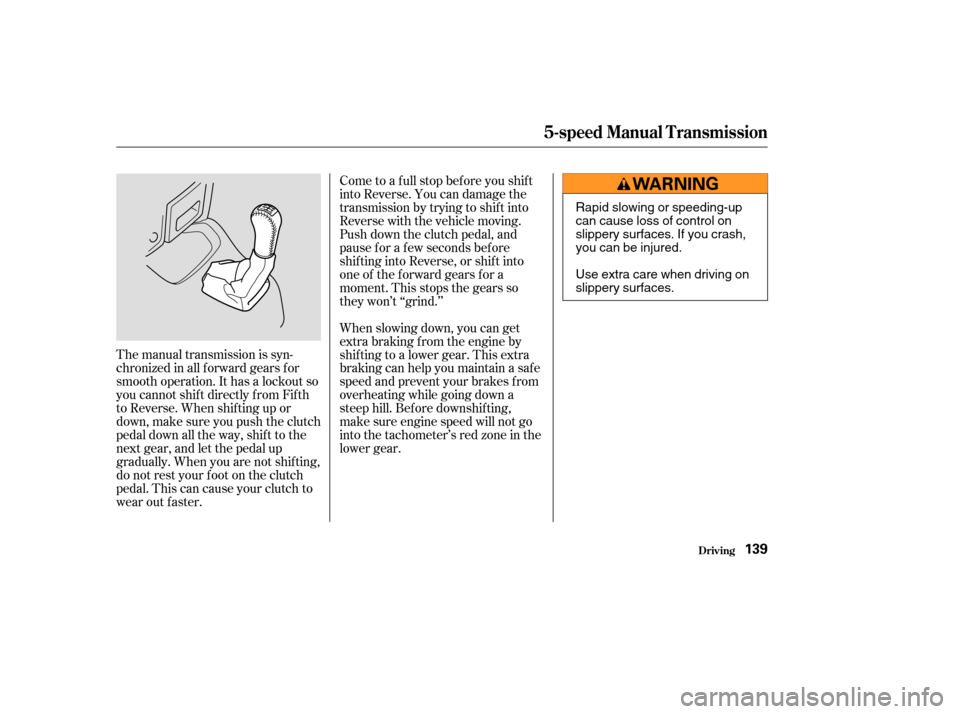
The manual transmission is syn-
chronizedinallforwardgearsfor
smooth operation. It has a lockout so
you cannot shift directly from Fifth
to Reverse. When shif ting up or
down,makesureyoupushtheclutch
pedal down all the way, shift to the
next gear, and let the pedal up
gradually. When you are not shif ting,
do not rest your f oot on the clutch
pedal. This can cause your clutch to
wear out faster.Come to a full stop before you shift
into Reverse. You can damage the
transmission by trying to shif t into
Reverse with the vehicle moving.
Push down the clutch pedal, and
pause f or a f ew seconds bef ore
shif ting into Reverse, or shif t into
one of the f orward gears f or a
moment. This stops the gears so
they won’t ‘‘grind.’’
When slowing down, you can get
extra braking f rom the engine by
shifting to a lower gear. This extra
braking can help you maintain a safe
speed and prevent your brakes f rom
overheating while going down a
steep hill. Bef ore downshif ting,
make sure engine speed will not go
into the tachometer’s red zone in the
lower gear.
5-speed Manual T ransmission
Driving139
Rapid slowing or speeding-up
can cause loss of control on
slippery surfaces. If you crash,
you can be injured.
Use extra care when driving on
slippery surfaces.
Page 145 of 256
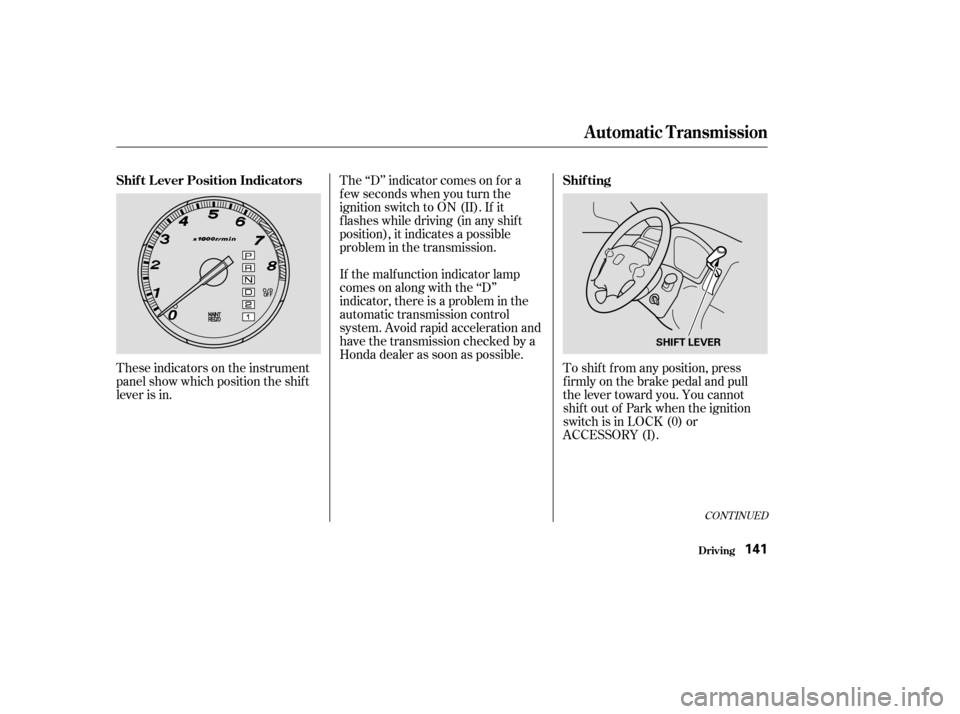
These indicators on the instrument
panel show which position the shif t
lever is in.The ‘‘D’’ indicator comes on f or a
f ew seconds when you turn the
ignition switch to ON (II). If it
f lashes while driving (in any shif t
position), it indicates a possible
problem in the transmission.
If the malf unction indicator lamp
comes on along with the ‘‘D’’
indicator, there is a problem in the
automatic transmission control
system. Avoid rapid acceleration and
havethetransmissioncheckedbya
Honda dealer as soon as possible.
To shif t f rom any position, press
f irmly on the brake pedal and pull
the lever toward you. You cannot
shif t out of Park when the ignition
switch is in LOCK (0) or
ACCESSORY (I).
CONT INUED
Shif t L ever Position Indicators Shif ting
Automatic Transmission
Driving141
SHIFT LEVER