Page 6 of 256
Your Vehicle at a Glance
2
POWER DOOR
LOCK SWITCHMIRROR CONTROLS
GAUGES
PARKING BRAKE
HEATING/COOLING
CONTROLS
HOOD RELEASE HANDLE
FUEL FILL DOOR RELEASE HANDLE
A/T model is shown. HATCH GLASS RELEASE
BUTTON
POWER WINDOW
SWITCHES
(P.72)
(P.86) (P.73) (P.125) (P.126)(P.98)(P.
67)
(P.61)
(P.89) INSTRUMENT PANEL (P.55)
Page 54 of 256

Your vehicle’s exhaust contains
carbon monoxide gas. You should
have no problem with carbon
monoxide entering the vehicle in
normal driving if you maintain your
vehicle properly.
Have the exhaust system inspected
f or leaks whenever:The vehicle is raised f or an oil
change.
You notice a change in the sound
of the exhaust.
The vehicle was in an accident
that may have damaged the under-
side. High levels of carbon monoxide can
collect rapidly in enclosed areas,
such as a garage. Do not run the
engine with the garage door closed.
Even with the door open, run the
engine only long enough to move the
vehicle out of the garage. With the tailgate/hatch glass open,
air flow can pull exhaust gas into
your vehicle’s interior and create a
hazardous condition. If you must
drive with the tailgate/hatch glass
open, open all the windows and set
the heating and cooling system as
shown below.
If you must sit in your parked vehicle,
even in an unconf ined area, with the
engine running, adjust the heating
and cooling system as f ollows:
Select the Fresh Air mode.
Select the mode.
Turn the f an on high speed.
Set the temperature control to a
comfortable setting.
1.
2.
3.
4.
Carbon Monoxide Hazard
Driver and Passenger Saf ety50
Carbon monoxide gas is toxic.
Breathing it can cause
unconsciousness and even kill
you.
Avoid any enclosed areas or
activities that expose you to
carbon monoxide.
Page 58 of 256
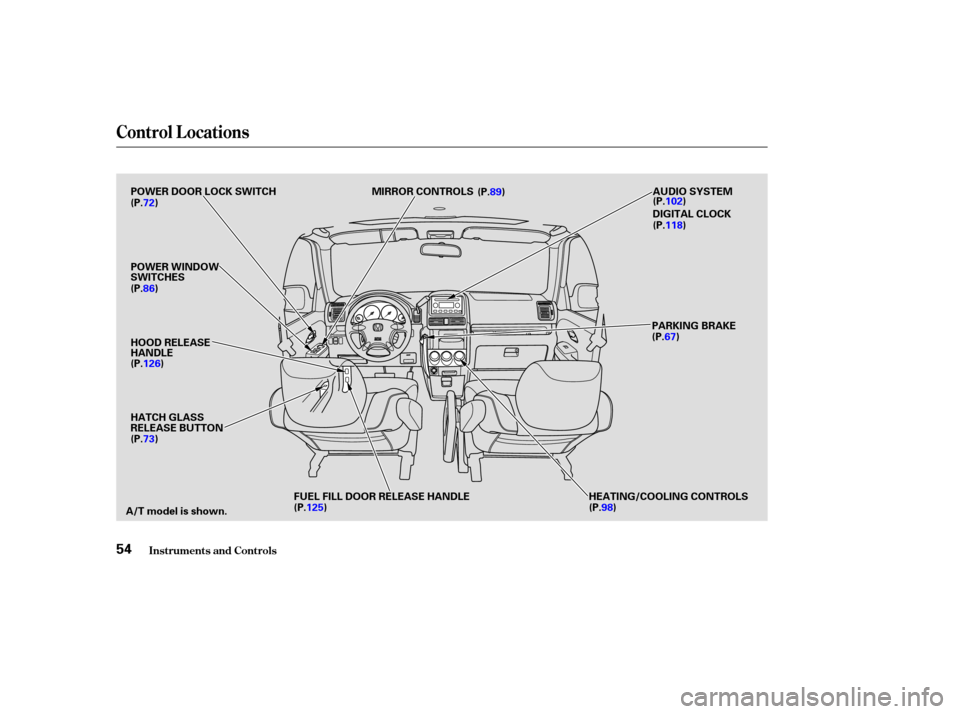
Control L ocations
Inst rument s and Cont rols54
POWER DOOR LOCK SWITCH
POWER WINDOW
SWITCHES
HOOD RELEASE
HANDLE
HATCH GLASS
RELEASE BUTTON
A/T model is shown. FUEL FILL DOOR RELEASE HANDLE
HEATING/COOLING CONTROLSPARKING BRAKE
DIGITAL CLOCK AUDIO SYSTEM
MIRROR CONTROLS
(P.72)
(P.86)
(P.126)
(P.73)
(P.125) (P.98)(P.67)
(P.118)
(P.89)
(P.102)
Page 66 of 256

�¶�µ�µ�µ�µ
�µ �µ�µ�µ
This shows the temperature of the
engine’s coolant. During normal
operation, the pointer should rise to
about the middle of the gauge. In
severe driving conditions, the pointer
may rise to the upper zone. If it
reaches the red (Hot) mark, pull
safely to the side of the road. Turn to
page f or instructions and
precautions on checking the engine’s
cooling system.
The temperature sensor is in the
f ront bumper. Theref ore, the
temperature reading can be af f ected
by heat ref lection f rom the road
surf ace, engine heat, and the
exhaust f rom surrounding traf f ic.
This can cause an incorrect
temperature reading when your
speed is under 30 km/h.If the outside temperature is
incorrectly displayed, you can adjust
it up to 3°C warmer or cooler.
NOTE: The temperature must be
stabilized bef ore doing this
procedure.
Select the outside temperature
display, then press the Select/Reset
knob f or ten seconds. The f ollowing
sequence will appear f or one second
each:0,1,2,3,4,5, 5, 4, 3, 2,
1, 0, 1 (0, 1, 2, 3, 3, 2, 1, 0, 1).
When it reaches the desired value,
release the Select/Reset knob. You
should see the new outside
temperature displayed.
In certain weather conditions,
temperature readings near f reezing 0
°Ccouldmeanthaticeisformingon
the road surface.
This light displays the outside
temperature Centigrade.
211
Canadian models only
Temperature Gauge
Outside Temperature Indicator
Gauges
Inst rument s and Cont rols62
OUTSIDE TEMPERATURE INDICATOR
Page 103 of 256

Turn this dial clockwise to increase
fan speed and increase the airflow.
Turning this dial clockwise increases
the temperature of the airflow.
This button turns the air
conditioning on and of f . The light in
thebuttonisonwhentheA/Cison.
When the light in the button is on,
air f rom the vehicle’s interior is sent
throughout the system again. When
the light is of f , air is brought in f rom
the outside of the vehicle (Fresh Air
mode).The outside air intakes f or the
heating and cooling system are at
the base of the windshield. Keep this
area clear of leaves and other debris.
ThesystemshouldbeleftinFresh
Air mode under almost all conditions.
Keeping the system in Recirculation
mode, particularly with the A/C of f ,
can cause the windows to fog up.
Switch to Recirculation mode when
driving through dusty or smoky
conditions, then return to Fresh Air
mode.
This button turns the rear window
def ogger of f and on (see page ).
The system automatically
turns on the A/C and switches to
Recirculation mode. Air f lows f rom
the center and side vents in the
dashboard.
Air flows from the center
and corner vents in the dashboard.
Air f lows f rom the f loor
vents. When you select , the
system automatically switches to
Fresh Air mode.
Air f low is divided between
the f loor vents and the def roster
vents at the base of the windshield. Air f low is divided between
the vents in the dashboard and the
f loor vents.
Use the mode control dial to select
the vents the air flows from. Some
air will f low f rom the dashboard
vents in all modes. 66
Fan Control Dial
T emperature Control Dial
Air Conditioning (A/C) Button
Recirculation Button
Rear Window Def ogger Button
Mode Control Dial
Comf ort and Convenience Feat ures
Air Flow Buttons
99
Page 158 of 256
When preparing to tow, and bef ore
driving away, be sure to check the
f ollowing:The vehicle has been properly
serviced, and the tires, brakes,
suspension, and cooling system
are in good operating condition.
If you tow f requently, f ollow the
Severe Conditions maintenance
schedule.
The trailer has been properly
serviced and is in good condition.
Thehitch,safetychains,andany
other attachments are secure.
Allitemsonandinthetrailerare
properly secured and cannot shif t
while you drive. The lights and brakes on your
vehicle and the trailer are working
properly.
Your vehicle tires and spare are
properly inf lated (see page ),
and the trailer tires and spare are
inflated as recommended by the
trailer maker.
All weights and loads are within
limits (see page ). 151 190
Towing a Trailer
Driving
Pre-T ow Checklist
154
Page 180 of 256
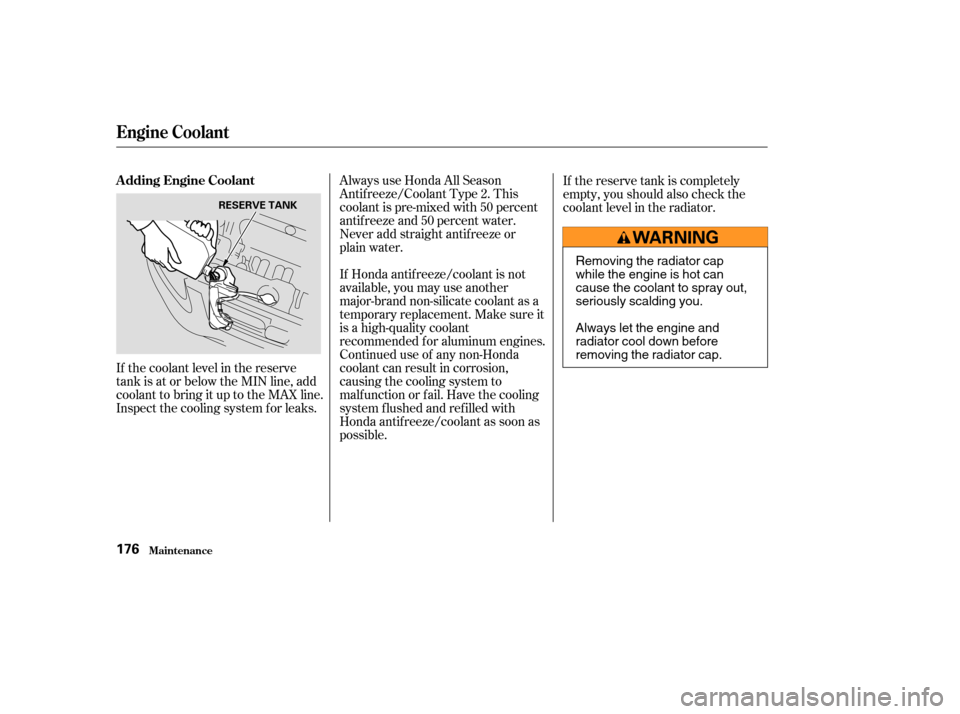
If the coolant level in the reserve
tank is at or below the MIN line, add
coolant to bring it up to the MAX line.
Inspect the cooling system f or leaks.Always use Honda All Season
Antif reeze/Coolant Type 2. This
coolant is pre-mixed with 50 percent
antif reeze and 50 percent water.
Never add straight antifreeze or
plain water.
If Honda antif reeze/coolant is not
available, you may use another
major-brand non-silicate coolant as a
temporaryreplacement.Makesureit
is a high-quality coolant
recommended f or aluminum engines.
Continued use of any non-Honda
coolant can result in corrosion,
causing the cooling system to
malf unction or f ail. Have the cooling
system f lushed and ref illed with
Honda antif reeze/coolant as soon as
possible.If the reserve tank is completely
empty, you should also check the
coolant level in the radiator.
Engine Coolant
Maint enance
A dding Engine Coolant
176
RESERVE TANK
Removing the radiator cap
while the engine is hot can
cause the coolant to spray out,
seriously scalding you.
Always let the engine and
radiator cool down before
removing the radiator cap.
Page 181 of 256
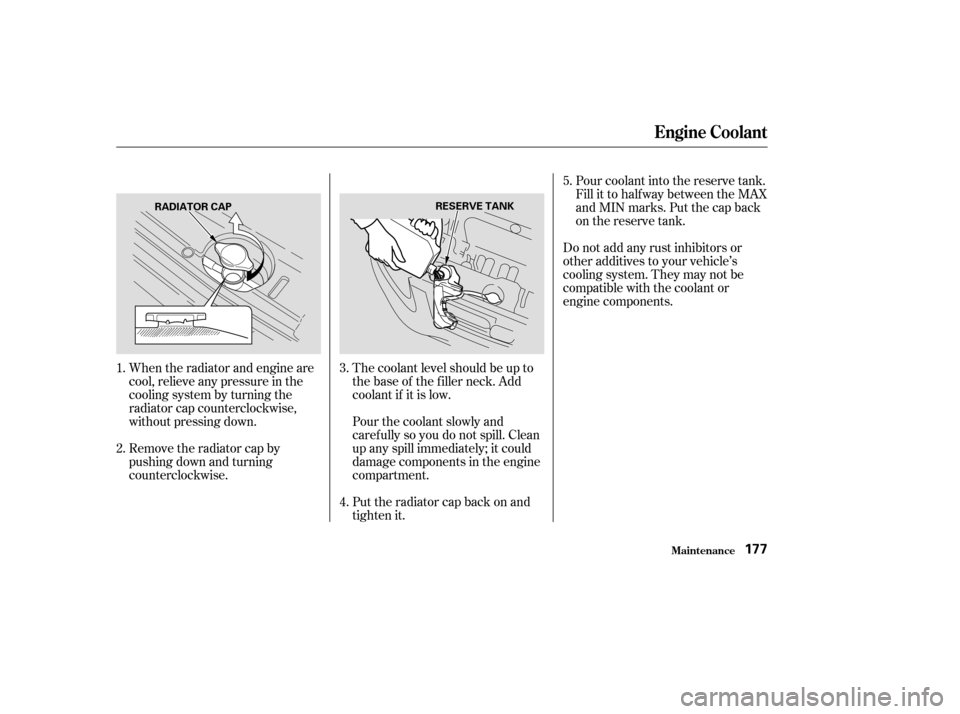
When the radiator and engine are
cool, relieve any pressure in the
cooling system by turning the
radiator cap counterclockwise,
without pressing down.
Remove the radiator cap by
pushing down and turning
counterclockwise.The coolant level should be up to
the base of the f iller neck. Add
coolant if it is low.
Pourthecoolantslowlyand
caref ully so you do not spill. Clean
up any spill immediately; it could
damage components in the engine
compartment.
Put the radiator cap back on and
tighten it.Pour coolant into the reserve tank.
Fill it to half way between the MAX
and MIN marks. Put the cap back
on the reserve tank.
Do not add any rust inhibitors or
other additives to your vehicle’s
cooling system. They may not be
compatible with the coolant or
engine components.
3.
4. 5.
2. 1.
Engine Coolant
Maint enance177
RADIATOR CAP RESERVE TANK