Page 173 of 256

�Î
�Î
�Ì �Î
�µ
�Ì�Ì�Î�Î
�Î
Follow the Severe Maintenance
Schedule if you drive your vehicle
MAINLY under one or more of the
f ollowing conditions: Extensive idling or long periods of
stop and go driving, such as a taxi or
a delivery vehicle. Driving less than 5 miles (8 km) per
trip or, in f reezing temperatures,
driving less than 10 miles (16 km)
per trip.
Driving in extremely hot [over 90°F
(32°C)] conditions.
Follow the
Maintenance Schedule f or Severe
Conditions. Driving on muddy, dusty, or de-iced
roads. T railer towing, driving with a roof
rack, or driving in mountainous
conditions.
commercial
Canadian Owners
Maint enance
169
miles x 1,000
km x 1,000
Every 3 years (independent of mileage)
( (O
O r
re
ev
ve
er
ry
y 3
3y
ye
ea
ar
rs
s, , w
w h
hi
ic
ch h e
ev
ve
er
r c
coo m
m e
es
s f
fi
ir
r s
st t)
)
(
(
O
O t
th
h e
er
rw
w i
is
se e a
ad
d j
ju
u s
stt o
o n
nl
ly
y i
if
f n
n o
oi
is
sy y )
)
(
(
O
O r
re
ev
ve
er
ry
y 2
2y
ye
ea
ar
rs
s, , w
w h
hi
ic
ch h e
ev
ve
er
r c
coo m
m e
es
s f
fi
ir
r s
st t)
)
10
16 50
8070
112
Check oil and coolant at each fuel stop 150
240
Service the items listed at the indicated distance (or time, if given).
Every 10,000 miles (16,000 km)
Check inflation and condition once a month
Every 5,000 miles (8,000 km) or every 6 months, whichever comes first
( (O
O r
re
ev
ve
er
ry
y 1
1y
ye
ea
ar
r,
, w
w h
hi
ic
ch h e
ev
ve
er
r c
coo m
m e
es
s f
fi
ir
r s
st t)
)
(
( O
O r
re
ev
ve
er
ry
y 1
1y
ye
ea
ar
r,
, w
w h
hi
ic
ch h e
ev
ve
er
r c
coo m
m e
es
s f
fi
ir
r s
st t)
)
40
64
20
32 60
9680
128
30
48
Every 160,000 miles (256,000 km)
At 120,000 miles (192,000 km) or 10 years, then every 60,000 miles (96,000 km) or 5 years
( (O
O r
re
ev
ve
er
ry
y 4
4y
ye
ea
ar
rs
s, , w
w h
hi
ic
ch h e
ev
ve
er
r c
coo m
m e
es
s f
fi
ir
r s
st t)
)
Replace at 60,000 miles (96,000 km) or 3
years, then every 30,000 miles (48,000
km) or 2 years.
90
144 100
160 140
224
130
208
120
192
110
176
See dust and pollen filter on page for
replacement information under special
driving conditions.
Check engine oil and coolant
Check tires
Replace engine oil
Rotate tires (follow pattern on page
193)
Replace engine oil filter
Check front and rear brakes
Lubricate all hinges, locks and latches
Inspect the following items: Tie rod ends, steering gear box, and boots
Suspension components, Driveshaft boots
Check parking brake adjustment
Inspect the following items: Brake hoses and lines (including ABS)
All fluid levels and condition of fluids
Exhaust system , Fuel lines and connections
Lights and controls/vehicle underbody
Inspect drive belts
Replace dust and pollen filter
Clean and replace air cleaner element
Replace spark plugs
Inspect valve clearance
Replace automatic transmission fluid
Replace manual transmission fluid
Replace rear differential fluid
Inspect idle speed
Replace engine coolant
Replace brake fluid Clean every 15,000 miles (24,000 km), and replace every 30,000
miles (48,000 km)
Use normal schedule except in dusty
condition.
See information on maintenance and
emission warranty on page .
1:
2:
: 188
3: 166
13
2
Maintenance Schedule for Severe Conditions
Page 181 of 256
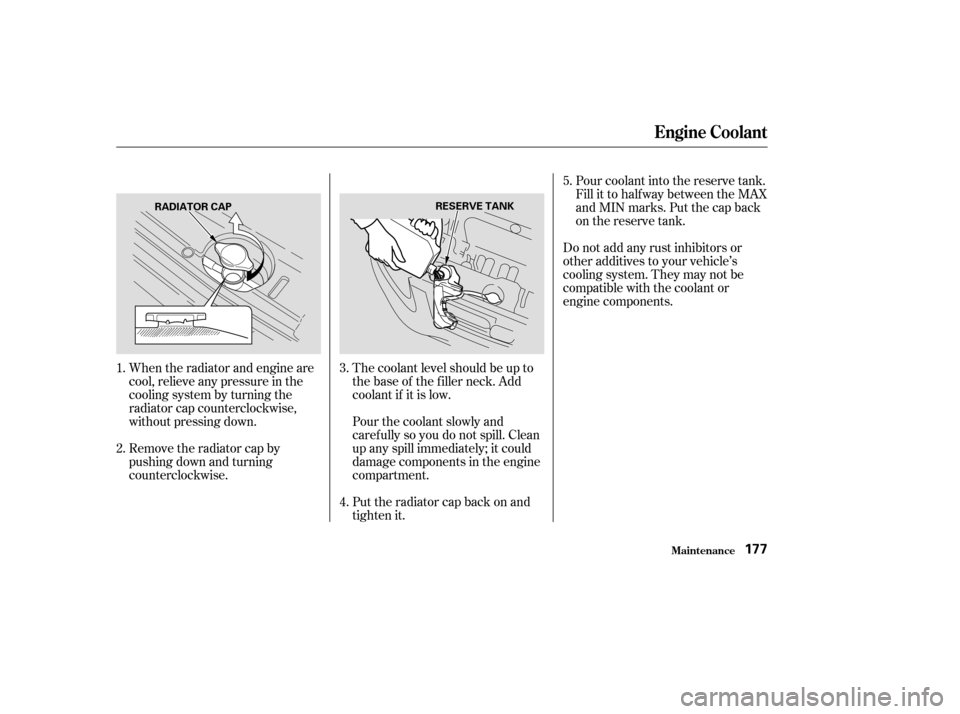
When the radiator and engine are
cool, relieve any pressure in the
cooling system by turning the
radiator cap counterclockwise,
without pressing down.
Remove the radiator cap by
pushing down and turning
counterclockwise.The coolant level should be up to
the base of the f iller neck. Add
coolant if it is low.
Pourthecoolantslowlyand
caref ully so you do not spill. Clean
up any spill immediately; it could
damage components in the engine
compartment.
Put the radiator cap back on and
tighten it.Pour coolant into the reserve tank.
Fill it to half way between the MAX
and MIN marks. Put the cap back
on the reserve tank.
Do not add any rust inhibitors or
other additives to your vehicle’s
cooling system. They may not be
compatible with the coolant or
engine components.
3.
4. 5.
2. 1.
Engine Coolant
Maint enance177
RADIATOR CAP RESERVE TANK
Page 186 of 256

Always use Honda Power Steering
Fluid. You may use another power
steering f luid as an emergency
replacement, but have the power
steering system f lushed and ref illed
with Honda PSF as soon as possible.
Check the level on the side of the
reservoir when the engine is cold.
The f luid should be between the
UPPER LEVEL and LOWER LEVEL.
If not, add power steering f luid to the
UPPER LEVEL. A low power steering f luid level can
indicate a leak in the system. Check
the f luid level f requently, and have
the system inspected as soon as
possible.
Clean the hood latch assembly with a
mild cleaner, then lubricate it with a
multipurpose grease. Lubricate all
the moving parts (as shown),
including the pivot. Follow the time
and distance recommendations in
the Maintenance Schedule. If you
are not sure how to clean and grease
the latch, contact your Honda dealer.
Power Steering Fluid
Hood L atch
Maint enance
Power Steering Fluid, Hood L atch
182
NOTICE:
UPPER LEVEL
LOWER LEVEL LATCH ASSEMBLY
T urning the steering wheel to
f ull lef t or right lock and holding it
there can damage the power steering
pump.
Page 188 of 256
Unclip the end of the hold-down
wire f rom its slot. Pivot it out of
the way and remove the bulb.
Insert the new bulb into the hole,
making sure the tabs are in their
slots. Pivot the hold-down wire
back in place, and clip the end into
the slot.
Reinstall the rubber seal. Make
sure it is right side up; it is marked
‘‘TOP.’’
Push the electrical connector onto
the new bulb.Pull the bulb straight out of its
socket.
Push the new bulb straight into
the socket until it bottoms.
Insert the socket back into the
headlight assembly. Turn it
clockwise to lock it in place.
Testthelightstomakesurethe
new bulb is working.
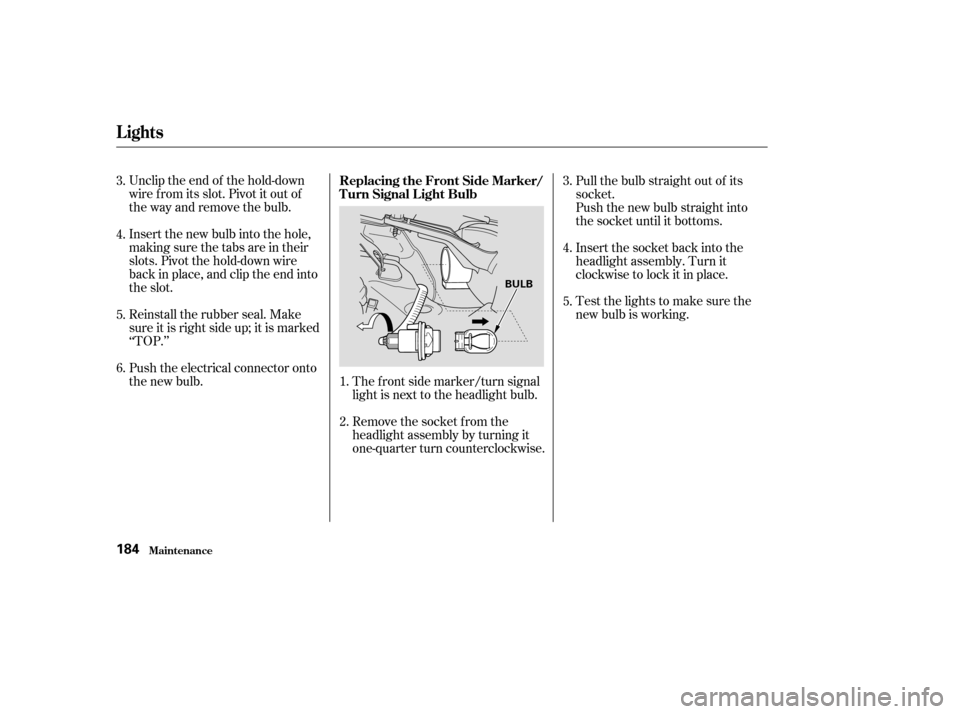
The f ront side marker/turn signal
light is next to the headlight bulb.
Remove the socket from the
headlight assembly by turning it
one-quarter turn counterclockwise.
4.
5.
6.
1.
2.3.
4.
5.
3.
Replacing the Front Side Marker/
Turn Signal Light Bulb
Lights
Maint enance184
BULB
Page 189 of 256
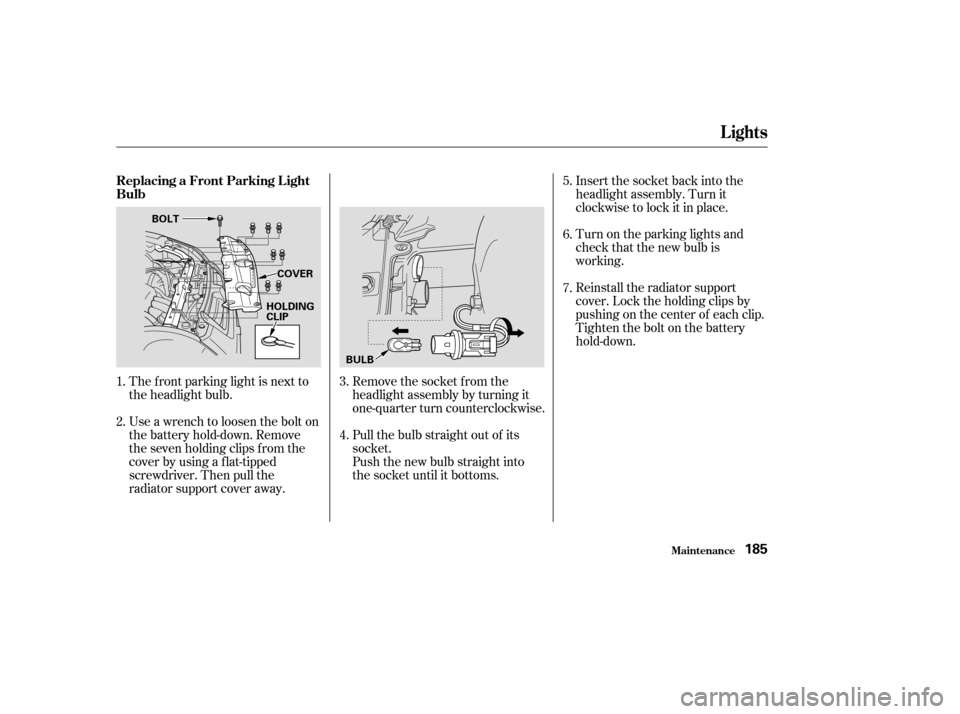
The f ront parking light is next to
the headlight bulb.Remove the socket from the
headlight assembly by turning it
one-quarter turn counterclockwise.
Pull the bulb straight out of its
socket.
Push the new bulb straight into
the socket until it bottoms.Insert the socket back into the
headlight assembly. Turn it
clockwise to lock it in place.
Turn on the parking lights and
check that the new bulb is
working.
Reinstall the radiator support
cover. Lock the holding clips by
pushing on the center of each clip.
Tighten the bolt on the battery
hold-down.
Use a wrench to loosen the bolt on
the battery hold-down. Remove
the seven holding clips f rom the
cover by using a flat-tipped
screwdriver. Then pull the
radiator support cover away.
1.
2.
3.
4.5.
6.
7.
Replacing a Front Parking L ight
Bulb
Lights
Maint enance185
BOLT
BULB
HOLDING
CLIP
COVER
Page 190 of 256
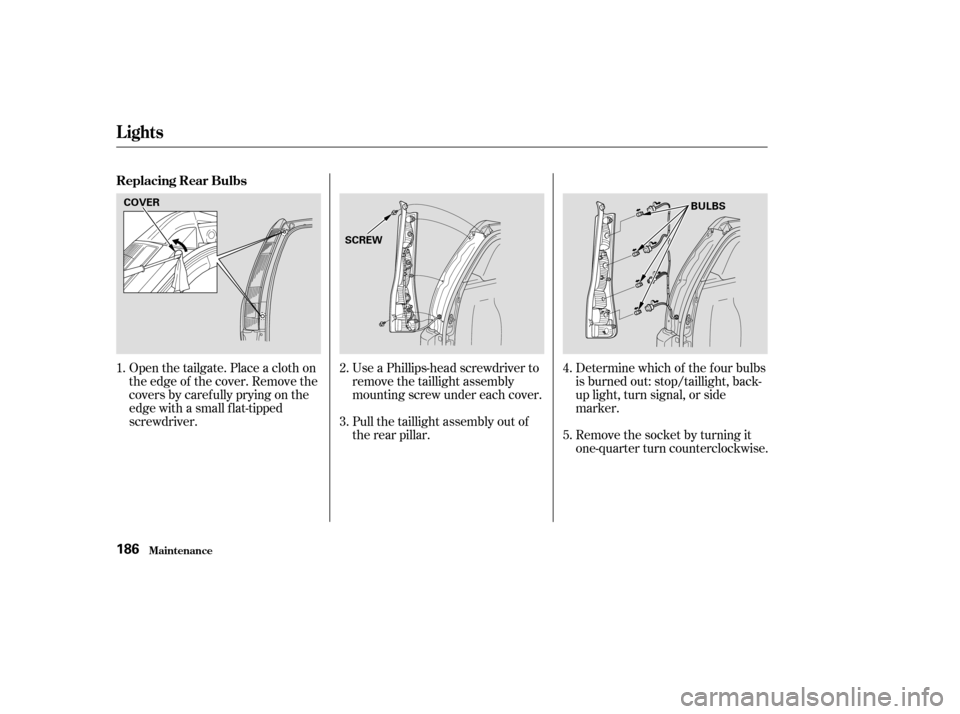
Open the tailgate. Place a cloth on
the edge of the cover. Remove the
covers by caref ully prying on the
edge with a small f lat-tipped
screwdriver.Use a Phillips-head screwdriver to
remove the taillight assembly
mounting screw under each cover.
Pull the taillight assembly out of
the rear pillar.Determine which of the f our bulbs
is burned out: stop/taillight, back-
up light, turn signal, or side
marker.
Remove the socket by turning it
one-quarter turn counterclockwise.
1.
2.
3.4.
5.
Replacing Rear Bulbs
Lights
Maint enance186
BULBS
SCREW
COVER
Page 191 of 256
Pull the bulb straight out of its
socket.
Push the new bulb straight into
the socket until it bottoms.
Reinstall the socket into the light
assembly by turning it clockwise
until it locks.
Testthelightstomakesurethe
new bulb is working.
Align the clips on the taillight
assembly with the holes in the
body, then push the taillight
assembly into place. Tighten the
two mounting screws securely and
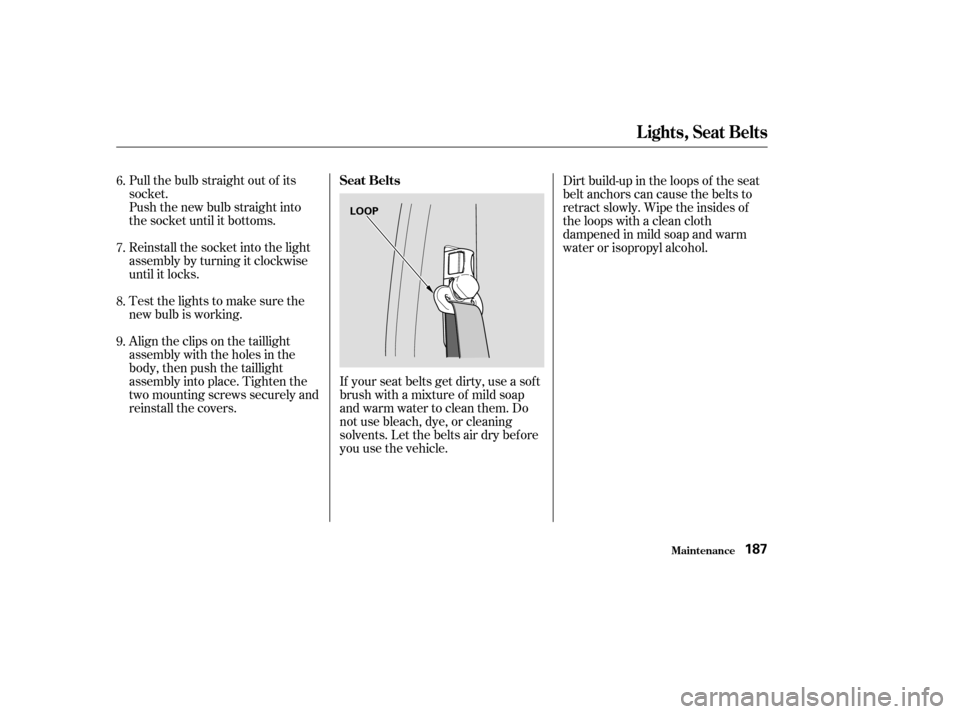
reinstall the covers.If your seat belts get dirty, use a sof t
brush with a mixture of mild soap
and warm water to clean them. Do
not use bleach, dye, or cleaning
solvents. Let the belts air dry bef ore
you use the vehicle. Dirt build-up in the loops of the seat
belt anchors can cause the belts to
retract slowly. Wipe the insides of
the loops with a clean cloth
dampened in mild soap and warm
water or isopropyl alcohol.
6.
7.
8.
9.
Maint enance
Seat Belts
L ights, Seat Belts
187
LOOP
Page 193 of 256
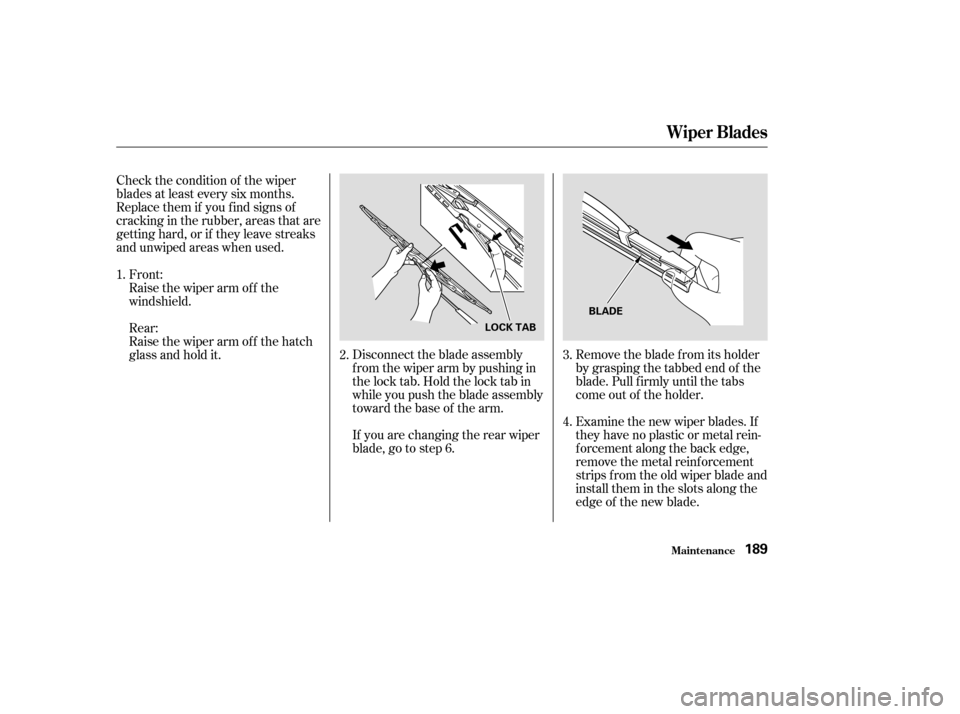
Check the condition of the wiper
blades at least every six months.
Replace them if you f ind signs of
cracking in the rubber, areas that are
getting hard, or if they leave streaks
and unwiped areas when used.Disconnect the blade assembly
fromthewiperarmbypushingin
the lock tab. Hold the lock tab in
while you push the blade assembly
toward the base of the arm.
If you are changing the rear wiper
blade, go to step 6.Remove the blade f rom its holder
by grasping the tabbed end of the
blade. Pull f irmly until the tabs
come out of the holder.
Examine the new wiper blades. If
they have no plastic or metal rein-
f orcement along the back edge,
remove the metal reinf orcement
strips f rom the old wiper blade and
install them in the slots along the
edge of the new blade.
Front:
Raise the wiper arm of f the
windshield.
Rear:
Raise the wiper arm of f the hatch
glass and hold it.
1.
3.
2.
4.
Maint enance
Wiper Blades
189
LOCK TABBLADE