2004 HONDA CR-V height
[x] Cancel search: heightPage 20 of 256
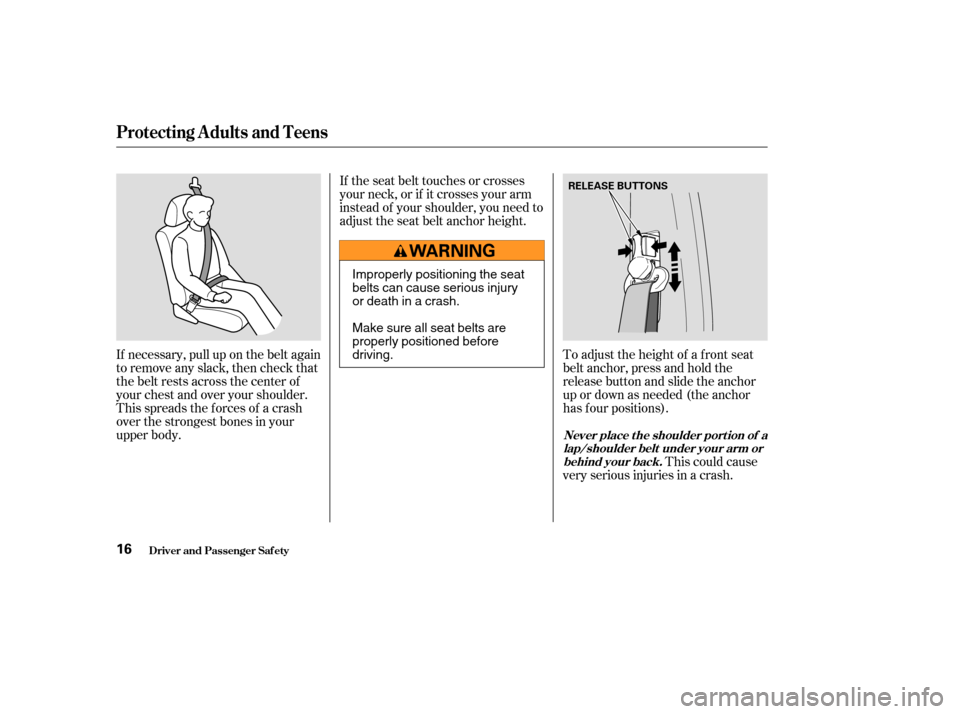
If necessary, pull up on the belt again
to remove any slack, then check that
the belt rests across the center of
your chest and over your shoulder.
This spreads the f orces of a crash
over the strongest bones in your
upper body.If the seat belt touches or crosses
your neck, or if it crosses your arm
instead of your shoulder, you need to
adjust the seat belt anchor height.
To adjust the height of a f ront seat
belt anchor, press and hold the
release button and slide the anchor
up or down as needed (the anchor
has f our positions).This could cause
very serious injuries in a crash.
Protecting A dults and Teens
Driver and Passenger Saf ety
Never place t he shoulder port ion of a
lap/shoulder belt under your arm orbehind your back.
16
RELEASE BUTTONS
Improperly positioning the seat
belts can cause serious injury
or death in a crash.
Make sure all seat belts are
properly positioned before
driving.
Page 40 of 256
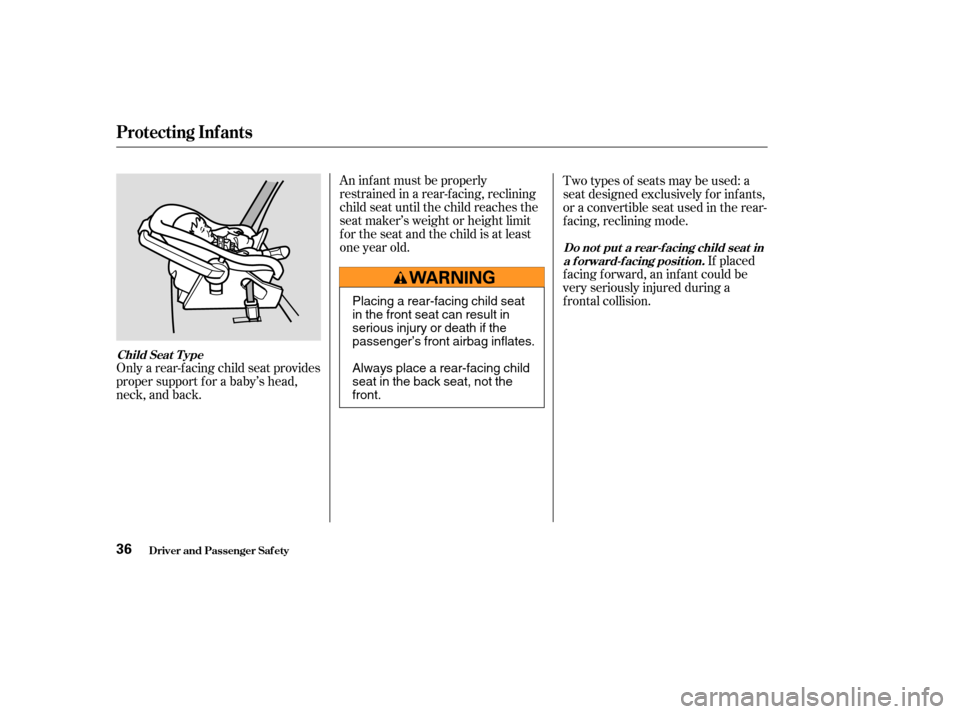
Only a rear-f acing child seat provides
proper support f or a baby’s head,
neck, and back.An inf ant must be properly
restrained in a rear-f acing, reclining
child seat until the child reaches the
seat maker’s weight or height limit
for the seat and the child is at least
one year old.
Two types of seats may be used: a
seat designed exclusively f or inf ants,
or a convertible seat used in the rear-
f acing, reclining mode.
If placed
f acing f orward, an inf ant could be
very seriously injured during a
f rontal collision.
Child Seat T ype Do not put a rear-f acing child seat in
a f orward-f acing position.
Protecting Inf ants
Driver and Passenger Saf ety36
Placing a rear-facing child seat
in the front seat can result in
serious injury or death if the
passenger’s front airbag inflates.
Always place a rear-facing child
seat in the back seat, not the
front.
Page 42 of 256
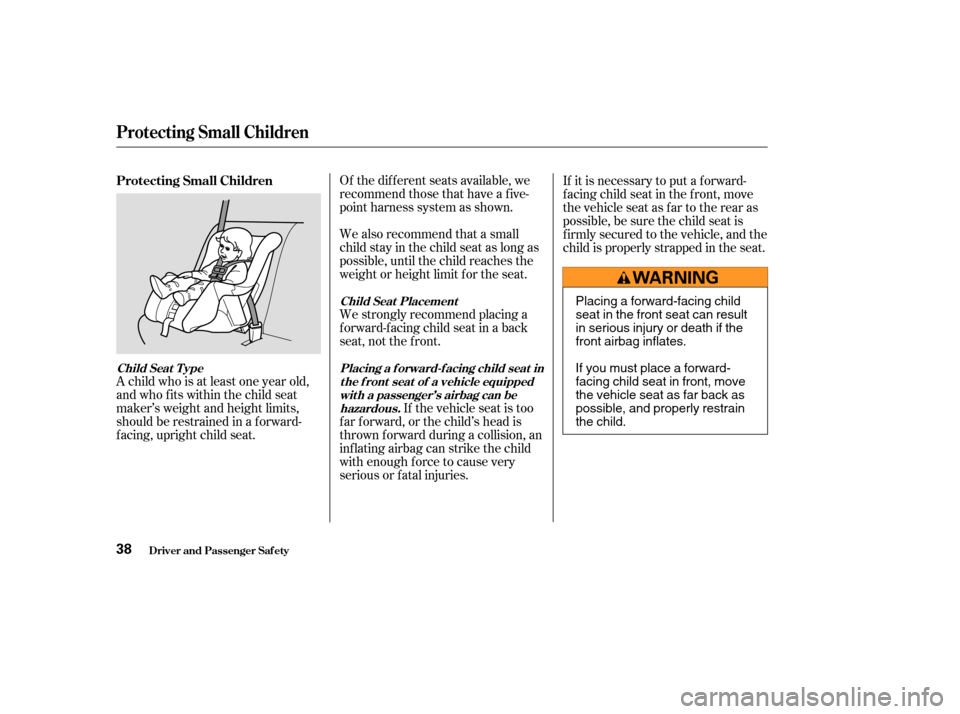
Of the different seats available, we
recommend those that have a f ive-
point harness system as shown.
A child who is at least one year old,
and who fits within the child seat
maker’s weight and height limits,
should be restrained in a f orward-
f acing, upright child seat. We also recommend that a small
child stay in the child seat as long as
possible, until the child reaches the
weight or height limit f or the seat.
If it is necessary to put a f orward-
f acing child seat in the f ront, move
the vehicle seat as far to the rear as
possible, be sure the child seat is
f irmly secured to the vehicle, and the
child is properly strapped in the seat.
We strongly recommend placing a
forward-facing child seat in a back
seat, not the f ront. If the vehicle seat is too
f ar f orward, or the child’s head is
thrown f orward during a collision, an
inf lating airbag can strike the child
with enough force to cause very
serious or f atal injuries.
Protecting Small Children
Child Seat T ype
Child Seat Placement
Placing a f orward-f acing child seat int he f ront seat of a vehicle equippedwith a passenger’s airbag can behazardous.
Protecting Small Children
Driver and Passenger Saf ety38
Placing a forward-facing child
seat in the front seat can result
in serious injury or death if the
front airbag inflates.
Ifyoumustplaceaforward-
facing child seat in front, move
the vehicle seat as far back as
possible, and properly restrain
the child.
Page 50 of 256
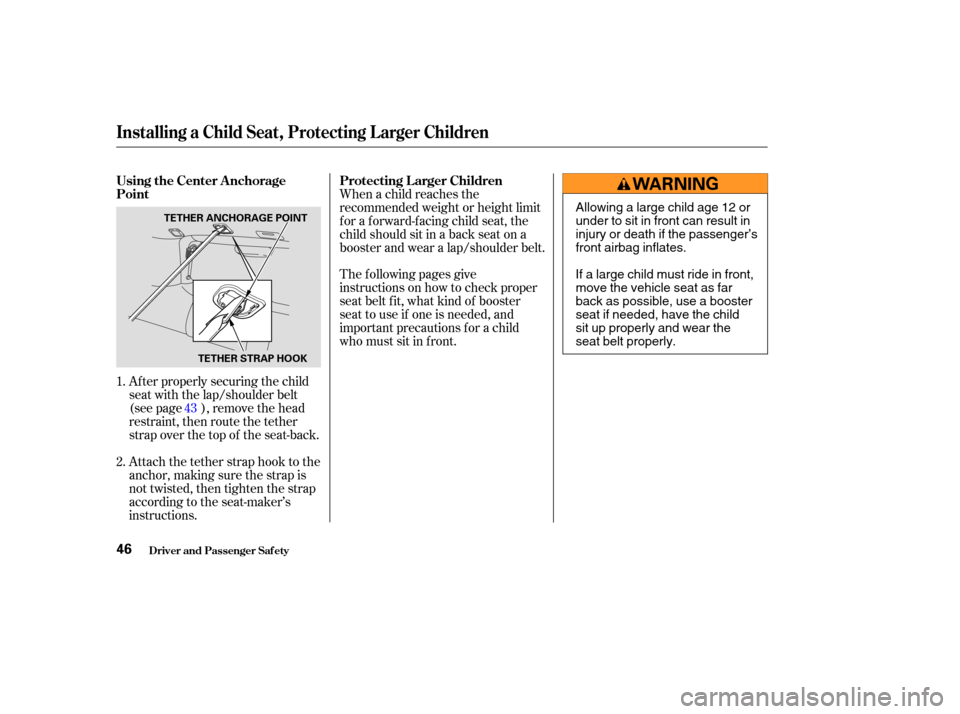
Af ter properly securing the child
seat with the lap/shoulder belt
(see page ), remove the head
restraint, then route the tether
strap over the top of the seat-back.
Attach the tether strap hook to the
anchor, making sure the strap is
not twisted, then tighten the strap
according to the seat-maker’s
instructions.When a child reaches the
recommended weight or height limit
for a forward-facing child seat, the
child should sit in a back seat on a
booster and wear a lap/shoulder belt.
The f ollowing pages give
instructions on how to check proper
seat belt f it, what kind of booster
seat to use if one is needed, and
important precautions f or a child
who must sit in f ront.
1.
2. 43
Using the Center A nchorage
Point
Protecting L arger Children
Installing a Child Seat, Protecting L arger Children
Driver and Passenger Saf ety46
TETHER ANCHORAGE POINT
TETHER STRAP HOOKAllowing a large child age 12 or
under to sit in front can result in
injury or death if the passenger’s
front airbag inflates.
If a large child must ride in front,
move the vehicle seat as far
back as possible, use a booster
seat if needed, have the child
sit up properly and wear the
seat belt properly.
Page 52 of 256

Some states also require children to
use a booster until they reach a
given age or weight (e.g., 6 years or
60lbs).Besuretocheckcurrent
laws in the state or states where you
intend to drive.The National Highway Traffic Safety
Administration and Transport
Canada recommend that all children
ages 12 and under be properly
restrained in the back seat.
If the passenger’s f ront airbag
inf lates in a moderate to severe
f rontal collision, the airbag can cause
serious injuries to a child who is
unrestrained, improperly restrained,
sitting too close to the airbag, or out
of position.
The side airbag also poses risks. If
any part of a larger child’s body is in
the path of a deploying side airbag,
the child could receive possibly
serious injuries.Of course, children vary widely. And
while age may be one indicator of
when a child can saf ely ride in the
f ront. There are other important
f actors you should consider.
To saf ely ride in f ront, a child must
be able to f ollow the rules, including
sitting properly, and wearing the seat
belt properly throughout a ride.
Booster seats can be high-back or
low-back. Whichever style you select,
make sure the booster meets f ederal
saf ety standards and that you f ollow
the booster seat maker’s instructions.
If a child who uses a booster must be
in front, move the passenger seat as
f ar back as possible and be sure the
child is wearing the seat belt
properly.
A child may continue using a booster
seat until the tops of their ears are
even with the top of the vehicle’s or
booster’s seat-back. A child of this
height should be tall enough to use
the lap/shoulder belt without a
booster. Physically, a child must be large
enough f or the lap/shoulder belt to
properly f it (see page ). If the seat
belt does not f it properly, with or
without the child sitting on a booster,
the child should not sit in the f ront.
47When Can a Larger Child Sit in Front
MaturityPhysical Size
Protecting L arger Children
Driver and Passenger Saf ety48
Page 57 of 256

This section gives inf ormation about
the controls and displays that
contribute to the daily operation of
your Honda. All the essential
controls are within easy reach............................
Control Locations .54
............................
Instrument Panel .55
.............................................
Gauges .61
...................................
Trip Meter .61
.....................................
Odometer .61
..................................
Fuel Gauge .61
...................
Temperature Gauge . 62
Outside Temperature ..................................
Indicator .62
Controls Near the Steering .......................................
Wheel .63
......................
Wipers and Washers .64
.........
Turn Signals and Headlights . 65
........
Instrument Panel Brightness . 66
.................
Hazard Warning Button . 66
.................
Rear Window Def ogger . 66
.................................
Parking Brake .67
..........
Steering Wheel Adjustment . 68
...............................
Keys and Locks .69
........................
Immobilizer System .70
................................
Ignition Switch .71
......................................
Door Locks .72
......................
Power Door Locks .72
..............
Childproof Door Locks . 72
...........
Tailgate and Hatch Glass . 73
.......................
Remote Transmitter .74 ....................................
Seat Heaters .76
.................................................
Seats .77
........................
Seat Adjustments .77
Driver’s Seat Height ..............................
Adjustment .78
......................................
Armrests .78
..........................
Head Restraints .79
..........
Reclining the Front Seats . 80
...
Folding the Rear Seats Down . 81
..........
Folding the Rear Seat Up . 82
.....................
Detachable Anchor .84
..............................
Power Windows .86
........................................
Grove Box .87
.........................................
Moonroof .88
.............................................
Mirrors .89
....
Adjusting the Power Mirrors . 89
................
Power Mirror Heaters . 90
...........
Interior Convenience Items . 91
.............................
Beverage Holder .92
...................................
Built-in Table .92
.....................................
Storage Box .94
..........................
Sunglasses Holder .94
....................................
Center Table .94
..............
Accessory Power Sockets . 95
Instruments and Controls
Inst rument s and Cont rols53
Page 82 of 256
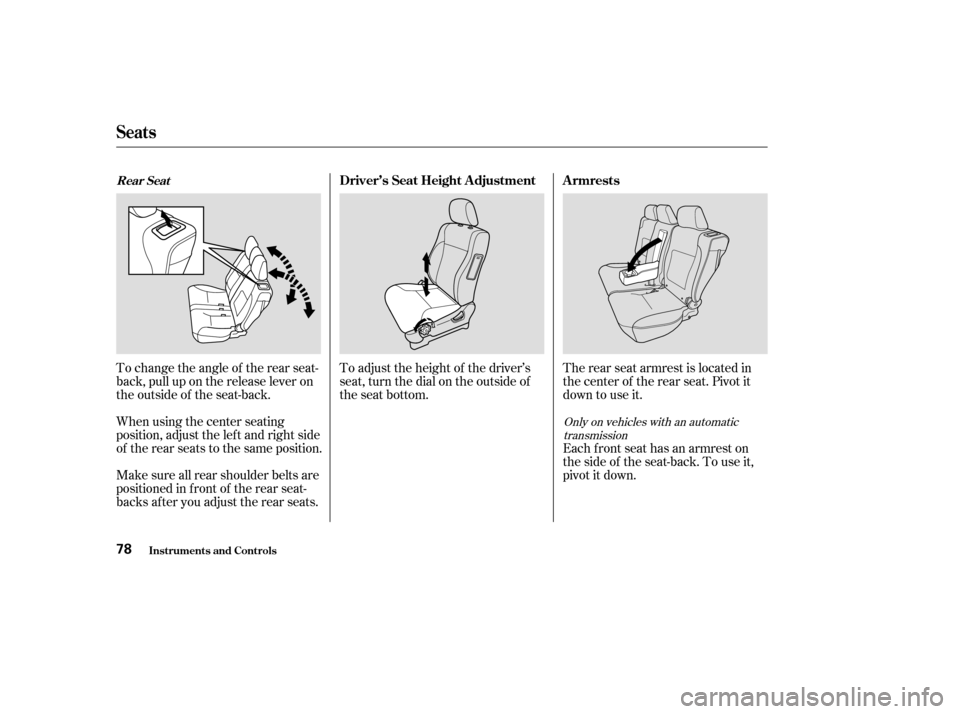
To adjust the height of the driver’s
seat, turn the dial on the outside of
the seat bottom.
To change the angle of the rear seat-
back, pull up on the release lever on
the outside of the seat-back. The rear seat armrest is located in
the center of the rear seat. Pivot it
down to use it.
Each front seat has an armrest on
thesideof theseat-back.Touseit,
pivotitdown.
When using the center seating
position, adjust the lef t and right side
of the rear seats to the same position.
Make sure all rear shoulder belts are
positioned in f ront of the rear seat-
backs af ter you adjust the rear seats.
Only on vehicles with an automatic
transmission
Seats
Inst rument s and Cont rols
Driver’s Seat Height A djustment A rmrestsRear Seat
78
Page 83 of 256
See page f or important saf etyinf ormation and a warning about how toproperly position the head restraints. 16
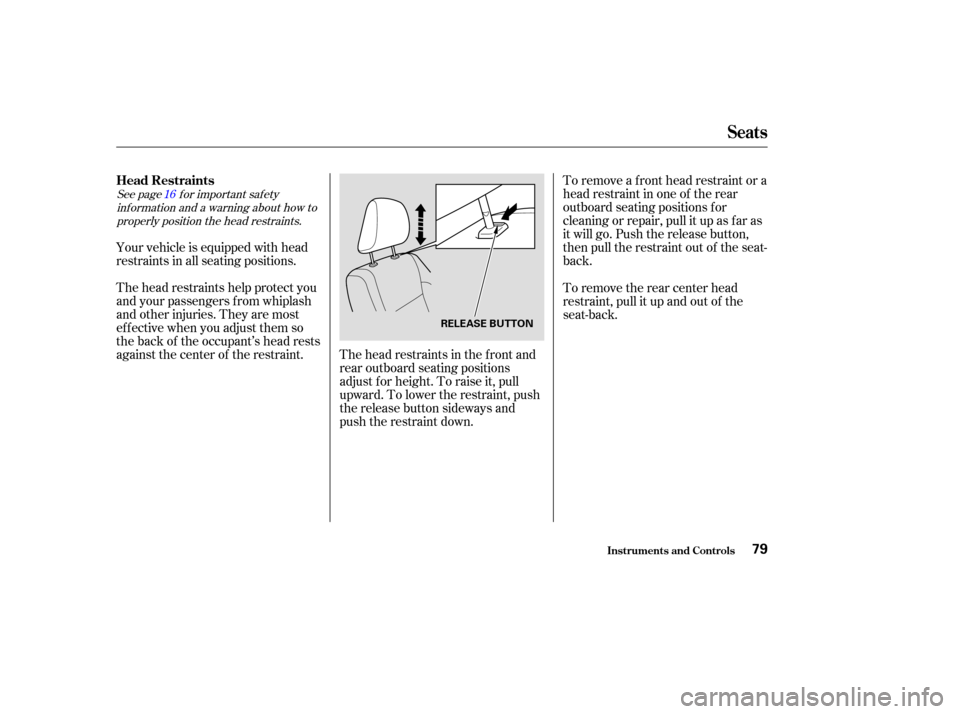
To remove a f ront head restraint or a
head restraint in one of the rear
outboard seating positions f or
cleaning or repair, pull it up as f ar as
it will go. Push the release button,
then pull the restraint out of the seat-
back.
Your vehicle is equipped with head
restraints in all seating positions.
The head restraints help protect you
and your passengers f rom whiplash
and other injuries. They are most
ef f ective when you adjust them so
the back of the occupant’s head rests
against the center of the restraint. The head restraints in the front and
rear outboard seating positions
adjust for height. To raise it, pull
upward. To lower the restraint, push
the release button sideways and
push the restraint down.To remove the rear center head
restraint, pull it up and out of the
seat-back.
Seats
Inst rument s and Cont rols
Head Restraints
79
RELEASE BUTTON