2004 DAEWOO LACETTI filter
[x] Cancel search: filterPage 831 of 2643

ENGINE CONTROLS 1F – 585
DAEWOO V–121 BL4
StepNo Yes Value(s) Action
71. Perform a cylinder compression test.
2. If the compression is low, repair the engine as
needed.
3. Inspect for proper valve timing, bent pushrods,
worn rocker arms, broken or weak valve
springs, and worn camshaft lobes.
4. Inspect the intake manifold and the exhaust
manifold passages for casting flash.
Is the problem found?–Go toStep 8Go toStep 9
8Repair or replace any components as needed.
Is the repair complete?–System OK–
91. Check the fuel system for a plugged in–line fuel
filter.
2. Check the fuel system for low fuel pressure. If
the fuel pressure is below the value specified,
service the fuel system as needed.
3. Inspect for contaminated fuel.
Is the problem found?41–47 psi
(284–325 kPa)Go toStep 10Go toStep 11
10Repair or replace any components as needed.
Is the repair complete?–System OK–
111. Disconnect all of the fuel injector harness con-
nectors at the fuel injectors.
2. Connect an injector test light to the harness
terminals of each fuel injector connector.
3. Note the test light while cranking the engine for
each fuel injector.
Does the test light blink for all of the fuel injectors?–Go toStep 13Go toStep 12
121. Repair or replace the faulty injector drive circuit
harness, the connector, or the connector termi-
nal.
2. If the harness, the connectors, and the termi-
nals are OK, replace the engine control module
(ECM).
Is the repair complete?–System OK–
13Measure the resistance of each fuel injector. The re-
sistance will increase slightly at higher tempera-
tures.
Is the injector resistance within the value specified?11.6–12.4 ΩGo toStep 15Go toStep 14
14Replace any fuel injectors with a resistance that is
out of specifications.
Is the repair complete?–System OK–
15Perform an injector balance test.
Is the problem found?–Go toStep 16Go toStep 17
16Replace any restricted or leaking fuel injectors.
Is the repair complete?–System OK–
Page 833 of 2643

ENGINE CONTROLS 1F – 587
DAEWOO V–121 BL4
POOR FUEL ECONOMY
Definition : Fuel economy, as measured by an actual road
test, is noticeably lower than expected. Also, fuel econo-
my is noticeably lower than it was on this vehicle at one
time, as previously shown by an actual road test.
Important : Driving habits affect fuel economy. Check the
owner’s driving habits by asking the following questions:1. Is the A/C system (i.e. defroster mode) turned on
all the time?
2. Are the tires at the correct air pressure?
3. Have excessively heavy loads been carried?
4. Does the driver accelerate too much and too often?
Suggest the driver read the section in the owner’s
manual about fuel economy.
Step
ActionValue(s)YesNo
1Were the Important Preliminary Checks performed?–Go toStep 2Go to
”Important Pre-
liminary
Checks”
21. Inspect the air filter for excessive contamina-
tion.
2. Inspect for fuel system leaks.
Are all needed checks complete?–Go toStep 3–
31. Inspect the spark plugs for excessive wear,
insulation cracks, improper gap, or heavy de-
posits.
2. Replace any faulty spark plugs.
3. Inspect the ignition wires for cracking, hard-
ness, and proper connections.
Are all needed checks and repairs complete?–Go toStep 4–
41. Inspect the engine coolant level.
2. Check the thermostat for being always open or
for an incorrect heat range.
3. Replace the thermostat as needed.
Are all needed checks and repairs complete?–Go toStep 5–
51. Check the transaxle shift pattern. Ensure all
transaxle gears are functioning.
2. Check the Torque Converter Clutch (TCC) op-
eration with a scan tool. The scan tool should
indicate rpm drop when the TCC is command-
ed on.
3. Check for proper calibration of the speedome-
ter.
4. Check the brakes for dragging.
5. Check the cylinder compression.
6. Repair, replace, or adjust any components as
needed.
Are all checks and needed repairs complete?–System OK–
Page 843 of 2643

ENGINE CONTROLS 1F – 597
DAEWOO V–121 BL4
8. Turn the lock ring counterclockwise to clear the
tank tabs.
9. Remove the fuel pump assembly from the tank.
Installation Procedure
1. Clean the gasket mating surface on the fuel tank.
2. Position the new gasket in place.
3. Install the fuel pump into the fuel tank in the same
location as removed for ease of line and connector
installation.
4. Position the lock ring in place and turn it clockwise
until it contacts the tank stop.
5. Connect the fuel pump assembly connector.
6. Install the fuel pump outlet line.
7. Install the fuel tank return line.
8. Install the fuel pump access cover.
9. Connect the negative battery cable.
10. Perform an operational check of the fuel pump.
11. Install the rear seat. Refer to Section 9H, Seats.
FUEL FILTER
Removal Procedure
CAUTION : The fuel system is under pressure. To
avoid fuel spillage and the risk of personal injury or
fire, it is necessary to relieve the fuel system pressure
before disconnecting the fuel lines.
1. Relieve the fuel system pressure. Refer to ” Fuel
System Pressure Relief ” in this section.
2. Disconnect the negative battery cable.
3. Remove the fuel filter mounting bracket assembly
bolt.
4. Remove the fuel filter cover.
5. Disconnect the inlet/outlet fuel lines by moving the
line connector lock forward and pulling the hose off
of the fuel filter tube.
Page 844 of 2643
1F – 598IENGINE CONTROLS
DAEWOO V–121 BL4
Installation Procedure
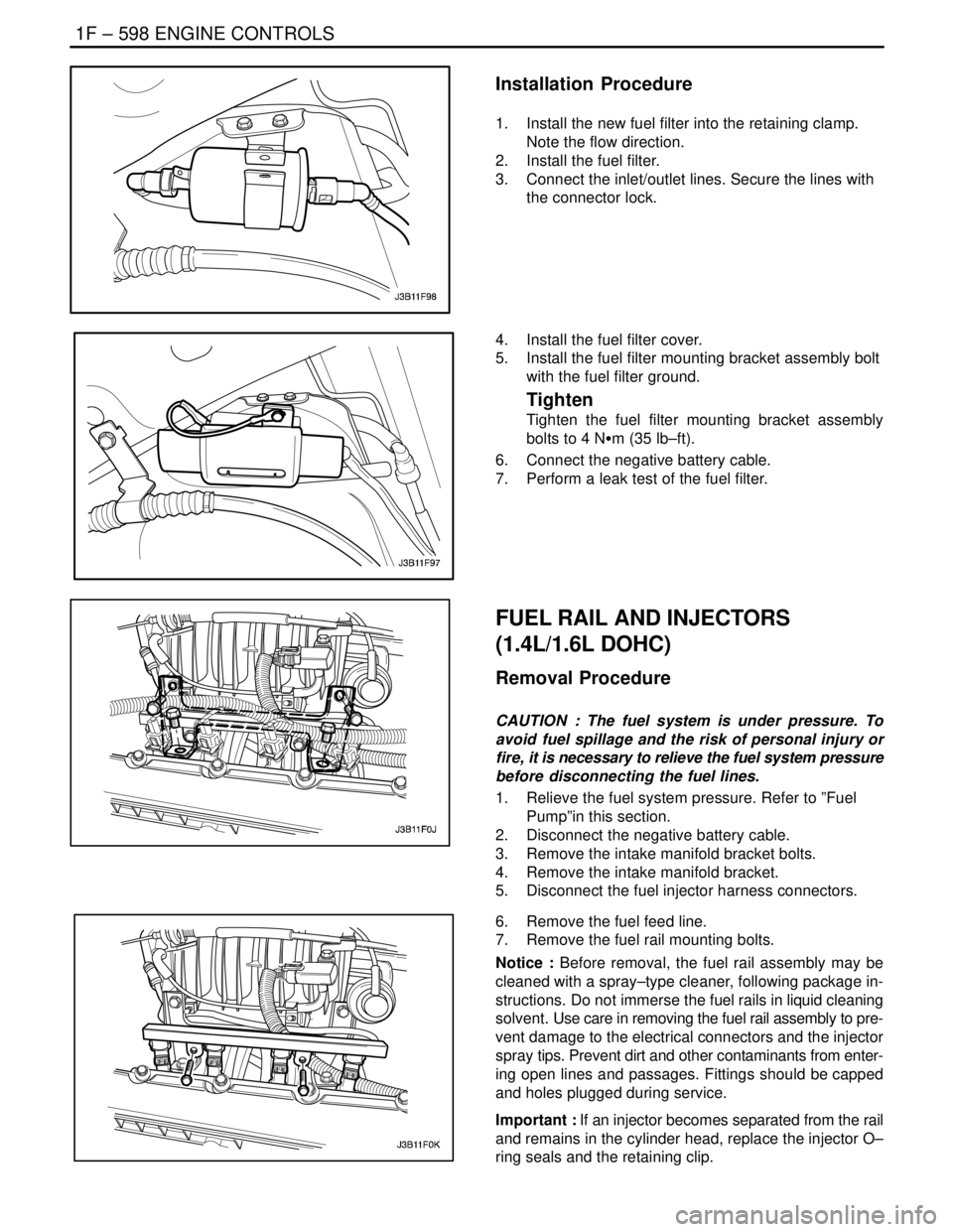
1. Install the new fuel filter into the retaining clamp.
Note the flow direction.
2. Install the fuel filter.
3. Connect the inlet/outlet lines. Secure the lines with
the connector lock.
4. Install the fuel filter cover.
5. Install the fuel filter mounting bracket assembly bolt
with the fuel filter ground.
Tighten
Tighten the fuel filter mounting bracket assembly
bolts to 4 NSm (35 lb–ft).
6. Connect the negative battery cable.
7. Perform a leak test of the fuel filter.
FUEL RAIL AND INJECTORS
(1.4L/1.6L DOHC)
Removal Procedure
CAUTION : The fuel system is under pressure. To
avoid fuel spillage and the risk of personal injury or
fire, it is necessary to relieve the fuel system pressure
before disconnecting the fuel lines.
1. Relieve the fuel system pressure. Refer to ”Fuel
Pump”in this section.
2. Disconnect the negative battery cable.
3. Remove the intake manifold bracket bolts.
4. Remove the intake manifold bracket.
5. Disconnect the fuel injector harness connectors.
6. Remove the fuel feed line.
7. Remove the fuel rail mounting bolts.
Notice : Before removal, the fuel rail assembly may be
cleaned with a spray–type cleaner, following package in-
structions. Do not immerse the fuel rails in liquid cleaning
solvent. Use care in removing the fuel rail assembly to pre-
vent damage to the electrical connectors and the injector
spray tips. Prevent dirt and other contaminants from enter-
ing open lines and passages. Fittings should be capped
and holes plugged during service.
Important : If an injector becomes separated from the rail
and remains in the cylinder head, replace the injector O–
ring seals and the retaining clip.
Page 865 of 2643

ENGINE CONTROLS 1F – 619
DAEWOO V–121 BL4
CAMSHAFT POSITION SENSOR
(1.8L DOHC)
Removal Procedure
1. Disconnect the negative battery cable.
2. Remove the engine cover.
3. Disconnect the sensor electrical connector.
4. Remove the timing belt front cover. Refer to Sec-
tion 1C, DOHC Engine Mechanical.
5. Remove the camshaft position sensor bolts.
6. Remove the camshaft position sensor from the top.
Installation Procedure
1. Install the camshaft position sensor and bolts.
Tighten
Tighten the camshaft position bolts to 8 NSm (71 lb–
in).
2. Install the timing belt front cover, the crankshaft
pulley, the accessory drive belt, and the air filter.
Refer to Section 1C, DOHC Engine Mechanical.
3. Connect the sensor electrical connector.
4. Install the engine cover.
5. Connect the negative battery cable.
Page 875 of 2643

ENGINE CONTROLS 1F – 629
DAEWOO V–121 BL4
tentially interfere with the operation of the Exhaust Gas
Recirculation (EGR) valve and thereby turn on the MIL.
Small leaks in the exhaust system near the post catalyst
oxygen sensor can also cause the MIL to turn on.
Aftermarket electronics, such as cellular phones, stereos,
and anti–theft devices, may radiate electromagnetic inter-
ference (EMI) into the control system if they are improperly
installed. This may cause a false sensor reading and turn
on the MIL.
Environment
Temporary environmental conditions, such as localized
flooding, will have an effect on the vehicle ignition system.
If the ignition system is rain–soaked, it can temporarily
cause engine misfire and turn on the MIL.
Refueling
A new EOBD diagnostic checks the integrity of the entire
Evaporative (EVAP) Emission system. If the vehicle is re-
started after refueling and the fuel cap is not secured cor-
rectly, the on–board diagnostic system will sense this as
a system fault, turn on the MIL, and set DTC P0440.
Vehicle Marshaling
The transportation of new vehicles from the assembly
plant to the dealership can involve as many as 60 key
cycles within 2 to 3 miles of driving. This type of operation
contributes to the fuel fouling of the spark plugs and will
turn on the MIL with a set DTC P0300.
Poor Vehicle Maintenance
The sensitivity of EOBD diagnostics will cause the MIL to
turn on if the vehicle is not maintained properly. Restricted
air filters, fuel filters, and crankcase deposits due to lack
of oil changes or improper oil viscosity can trigger actual
vehicle faults that were not previously monitored prior to
EOBD. Poor vehicle maintenance can not be classified as
a ”non–vehicle fault,” but with the sensitivity of EOBD
diagnostics, vehicle maintenance schedules must be
more closely followed.
Severe Vibration
The Misfire diagnostic measures small changes in the
rotational speed of the crankshaft. Severe driveline vibra-
tions in the vehicle, such as caused by an excessive
amount of mud on the wheels, can have the same effect
on crankshaft speed as misfire and, therefore, may set
DTC P0300.
Related System Faults
Many of the EOBD system diagnostics will not run if the
engine controlmodule (ECM) detects a fault on a related
system or component. One example would be that if the
ECM detected a Misfire fault, the diagnostics on the cata-
lytic converter would be suspended until the Misfire fault
was repaired. If the Misfire fault is severe enough, the cat-
alytic converter can be damaged due to overheating andwill never set a Catalyst DTC until the Misfire fault is re-
paired and the Catalyst diagnostic is allowed to run to
completion. If this happens, the customer may have to
make two trips to the dealership in order to repair the ve-
hicle.
SERIAL DATA COMMUNICATIONS
Class II Serial Data Communications
Government regulations require that all vehicle manufac-
turers establish a common communication system. This
vehicle utilizes the ”Class II” communication system. Each
bit of information can have one of two lengths: long or
short. This allows vehicle wiring to be reduced by transmit-
ting and receiving multiple signals over a single wire. The
messages carried on Class II data streams are also priori-
tized. If two messages attempt to establish communica-
tions on the data line at the same time, only the message
with higher priority will continue. The device with the lower
priority message must wait. Themost significant result of
this regulation is that it provides scan tool manufacturers
with the capability to access data from any make or model
vehicle that is sold.
The data displayed on the other scan tool will appear the
same, with some exceptions. Some scan tools will only be
able to display certain vehicle parameters as values that
are a coded representation of the true or actual value. On
this vehicle the scan tool displays the actual values for ve-
hicle parameters. It will not be necessary to perform any
conversions from coded values to actual values.
ON–BOARD DIAGNOSTIC (EOBD)
On–Board Diagnostic Tests
A diagnostic test is a series of steps, the result of which is
a pass or fail reported to the diagnostic executive. When
a diagnostic test reports a pass result, the diagnostic
executive records the following data:
S The diagnostic test has been completed since the
last ignition cycle.
S The diagnostic test has passed during the current
ignition cycle.
S The fault identified by the diagnostic test is not cur-
rently active.
When a diagnostic test reports a fail result, the diagnostic
executive records the following data:
S The diagnostic test has been completed since the
last ignition cycle.
S The fault identified by the diagnostic test is current-
ly active.
S The fault has been active during this ignition cycle.
S The operating conditions at the time of the failure.
Remember, a fuel trim Diagnostic Trouble Code (DTC)
may be triggered by a list of vehicle faults. Make use of all
information available (other DTCs stored, rich or lean con-
dition, etc.) when diagnosing a fuel trim fault.
Page 1354 of 2643

ZF 4 HP 16 AUTOMATIC TRANSAXLE 5A1 – 5
DAEWOO V–121 BL4
SPECIFICATIONS
GENERAL SPECIFICATIONS
Definition
Transaxle Type4–speed with four–wheel drive and transverse engine
Input Torque240 NSm (177 lb–ft)
Transaxle Weight76kg (168 lb)
Torque Converter Capacity9.72kg (21.4 lb)
Transaxle Fluid Type (manufacture company)ESSO LT 71141 or TOTAL ATF H50235
Transaxle Fluid Capacity7.3qt (6.9L)
TRANSAXLE GEAR RATIO
GearRatio
First2.719
Second1.487
Third1.000
Fourth0.717
Reverse 2.529
Final3.945:1
FLUID CAPACITY
LitresQuarts
Bottom Pan Removal44.2
Complete Overhaul6.97.3
Torque Converter Removal22.1
(Measurements are approximate)
FASTENER TIGHTENING SPECIFICATIONS
ApplicationNSmLb–FtLb–In
Bearing Plate Bolts23.517.5–
Slotted Nut220162–
Rear Cover Attachment Bolts23.517.5–
Baffle Plate Attachment Bolts10–89
Park/Neutral Position Switch10–89
Fluid Pump Connecting Bolts10–89
Fluid Filter Housing Cover Attachment Bolts10–89
Input Speed sensor Attachment Bolts8–71
Output Speed Sensor Attachment Bolts8–71
Valve Body Bolts8–71
Valve Body Upper & Lower Fixing Bolts6–53
Fluid Pan Connecting Bolts6–53
Fluid Pan Drain Plug4533–
Page 1383 of 2643
5A1 – 34IZF 4 HP 16 AUTOMATIC TRANSAXLE
DAEWOO V–121 BL4
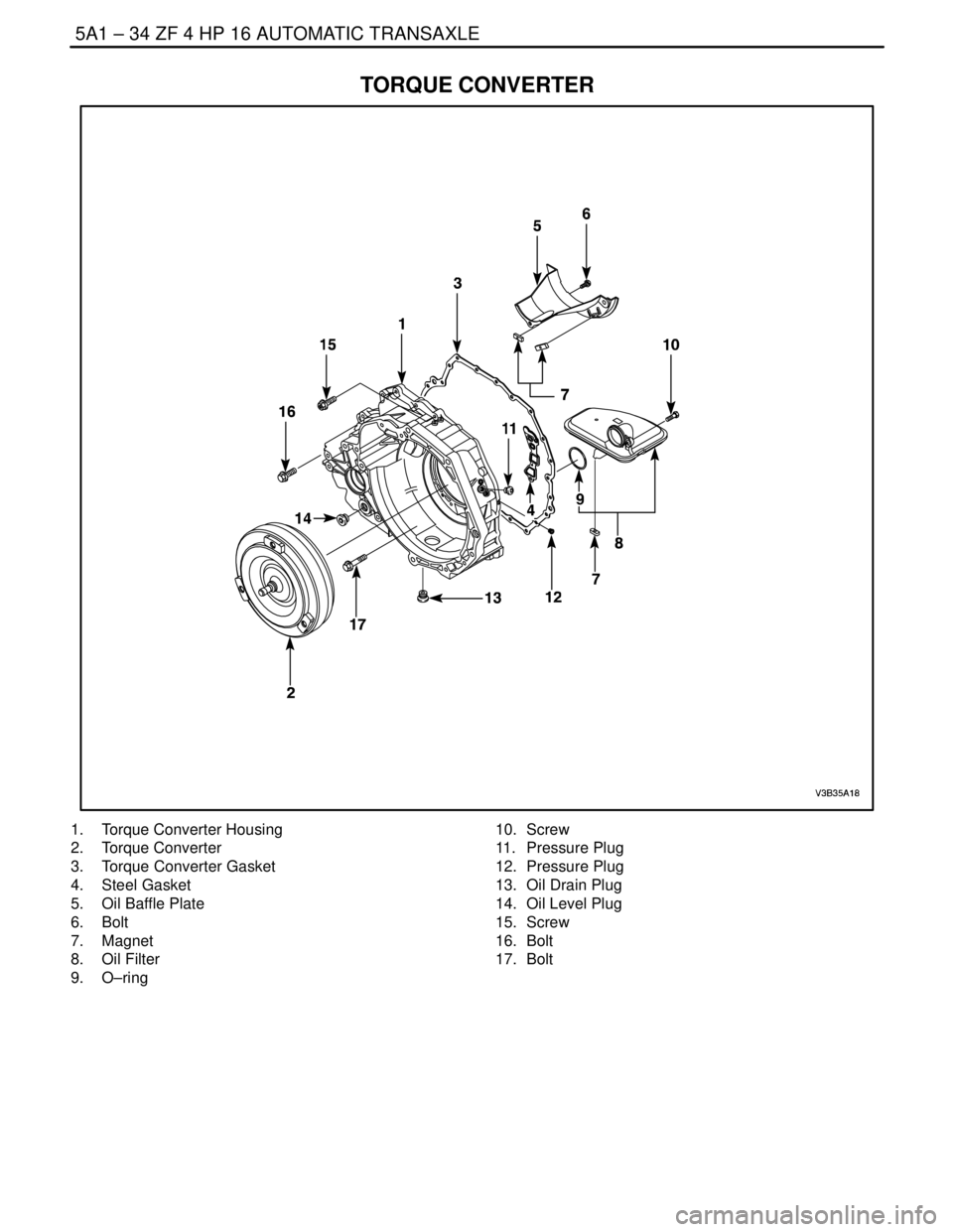
TORQUE CONVERTER
1. Torque Converter Housing
2. Torque Converter
3. Torque Converter Gasket
4. Steel Gasket
5. Oil Baffle Plate
6. Bolt
7. Magnet
8. Oil Filter
9. O–ring10. Screw
11. Pressure Plug
12. Pressure Plug
13. Oil Drain Plug
14. Oil Level Plug
15. Screw
16. Bolt
17. Bolt