2004 DAEWOO LACETTI filter
[x] Cancel search: filterPage 1982 of 2643

7A – 8IHEATING AND VENTILATION SYSTEM
DAEWOO V–121 BL4
StepNo Yes Value(s) Action
20Replace the thermostat. Refer to Section 2D, En-
gine Cooling.
Is the repair complete?–System OK–
21Reinstall the thermostat.
Is the repair complete?–System OK–
22Inspect the heater hoses for proper installation.
Are the heater hoses reversed?–Go to Step 23Go to Step 24
23Reinstall the heater hoses properly.
Is the repair complete?–System OK–
241. Back flush the heater core.
2. Drain the cooling system.
3. Replace the coolant.
4. Warm the engine to an average operating tem-
perature.
5. Feel the heater inlet hose and the heater outlet
hose.
Is the heater inlet hose hot and the heater outlet
hose warm?–System OKGo to Step 25
25Replace the heater core.
Is the repair complete?–System OK–
26Recheck the system using the ”Control Settings/
Correct Results” tests. Refer to ”Improper Air Deliv-
ery or No Mode Shift” in this section.
Is the repair complete?–System OKGo to Step 27
27Check for airflow from the defroster or the vent out-
lets.
Is there high airflow from the defroster or vent out-
lets?–Go to Step 28Go to Step 29
281. Check the heater door at the floor and the vent
door to get the proper airflow and to verify
proper operation.
2. Repair as required.
Is the repair complete?–System OK–
29Switch the mode knob to defrost.
Is the defroster airflow OK?–Go to Step 30Go to Step 31
301. Remove the heater outlet and check for ob-
structions.
2. Remove any obstructions in the heater outlet.
Is the repair complete?–System OK–
31Check for airflow change at various blower speeds.
Does the blower speed increase as the control is
turned from 1 to 4?–Go to Step 32Go to ”Blower
Electrical
(Manual and
Non–A/C)”
32Check for obstructions in the system at the blower
inlet and at the air filter, if the vehicle is equipped with
one.
Are there any obstructions?–Go to Step 33Go to Step 34
33Remove the obstructions in the system at the blower
inlet or replace a clogged filter.
Is the repair complete?–System OK–
Page 1987 of 2643

HEATING AND VENTILATION SYSTEM 7A – 13
DAEWOO V–121 BL4
StepNo Yes Value(s) Action
151. Check for obstructions in the system at the
blower inlet and check the air filter if the vehicle
is so equipped.
2. Remove any obstructions at the blower inlet
and replace the filter if it is clogged.
Is the repair complete?–System OKGo to Step 16
161. Set the blower on 4.
2. Rotate the temperature control from full hot to
full cold.
3. Listen for an airflow change.
Does the airflow change?–Go to Step 17Go to Step 18
171. Check the temperature door, the cable, the
linkage, and the control.
2. Adjust the temperature control to full hot.
Is the repair complete?–System OK–
181. Check the system for any obstruction between
the blower and the system outlets.
2. Remove any obstruction between the blower
and the system outlets.
Is the repair complete?–System OK–
TOO MUCH HEAT
StepActionValue(s)YesNo
1Verify the customer’s complaint.
Are the customer’s concerns verified?–Go to Step 2System OK
2Is there too much heat when the mode switch is in
the floor position?–Go to Step 3Go to Step 9
3Is there objectionable defroster bleed?–Go to Step 4Go to Step 5
41. Check the door travel, the cable, the vacuum
actuators, and the linkage for the heater and
the defroster.
2. Adjust or repair, as required.
Is the repair complete?–System OK–
51. In vehicles equipped with A/C, set the A/C
switch OFF.
2. In all vehicles, set the blower speed to maxi-
mum.
3. Set the temperature to full hot.
4. Turn the ignition switch ON.
5. Check for airflow from the floor outlets.
6. Check the floor outlet attachment.
Is the airflow high?–Go to Step 6Go to Step 8
6Check for a change in the airflow at different blower
speeds.
Does the airflow change as the setting for the blow-
er–speed switch is scanned?–Go to Step 7 Go to ”Blower
Electrical
(Manual and
Non–A/C)”
Page 2003 of 2643

SECTION : 7B
MANUAL CONTROL HEATING, VENTILATION
AND AIR CONDITIONING SYSTEM
CAUTION : Disconnect the negative battery cable before removing or installing any electrical unit or when a tool
or equipment could easily come in contact with exposed electrical terminals. Disconnecting this cable will help
prevent personal injury and damage to the vehicle. The ignition must also be in LOCK unless otherwise noted.
TABLE OF CONTENTS
SPECIFICATIONS7B–2 . . . . . . . . . . . . . . . . . . . . . . . . . .
General Specifications 7B–2. . . . . . . . . . . . . . . . . . . . .
Fastener Tightening Specifications 7B–2. . . . . . . . . . .
SPECIAL TOOLS7B–3 . . . . . . . . . . . . . . . . . . . . . . . . . . .
Special Tools Table 7B–3. . . . . . . . . . . . . . . . . . . . . . . .
SCHEMATIC AND ROUTING DIAGRAMS7B–6 . . . . .
A/C System – Typical 7B–6. . . . . . . . . . . . . . . . . . . . . .
Manual Control A/C Diagram 7B–7. . . . . . . . . . . . . . . .
DIAGNOSIS7B–8 . . . . . . . . . . . . . . . . . . . . . . . . . . . . . . . .
GENERAL DIAGNOSIS 7B–8. . . . . . . . . . . . . . . . . . . . . .
Testing the Refrigerant System 7B–8. . . . . . . . . . . . . .
Insufficient Cooling ”Quick Check” Procedure 7B–8. .
A/C Performance Test 7B–9. . . . . . . . . . . . . . . . . . . . . .
Pressure–Temperature Relationship of
R–134A 7B–10. . . . . . . . . . . . . . . . . . . . . . . . . . . . . . .
Leak Testing Refrigerant System 7B–11. . . . . . . . . . . .
V5 SYSTEM AIR CONDITIONING DIAGNOSIS 7B–12
Insufficient Cooling Diagnosis 7B–12. . . . . . . . . . . . . .
SYMPTOM DIAGNOSIS 7B–16. . . . . . . . . . . . . . . . . . . .
Pressure Test Chart (R–134A System) 7B–16. . . . . .
Low and High Side Pressure Relationship
Chart 7B–18. . . . . . . . . . . . . . . . . . . . . . . . . . . . . . . . . .
MAINTENANCE AND REPAIR7B–19 . . . . . . . . . . . . . .
ON–VEHICLE SERVICE 7B–19. . . . . . . . . . . . . . . . . . . .
GENERAL A/C SYSTEM SERVICE
PROCEDURES 7B–19. . . . . . . . . . . . . . . . . . . . . . . . . .
O–Ring Replacement 7B–19. . . . . . . . . . . . . . . . . . . . .
Handling Refrigerant 7B–19. . . . . . . . . . . . . . . . . . . . . .
Handling of Refrigerant Lines and Fittings 7B–19. . . .
Maintaining Chemical Stability in the Refrigeration
System 7B–20. . . . . . . . . . . . . . . . . . . . . . . . . . . . . . . .
Discharging, Adding Oil, Evacuating, and Charging
Procedures for A/C System 7B–20. . . . . . . . . . . . . .
SERVICEABLE COMPONENTS 7B–23. . . . . . . . . . . . . Components Used In Non–A/C Systems 7B–23. . . . .
A/C Pressure Transducer 7B–24. . . . . . . . . . . . . . . . . .
A/C Compressor Relay 7B–24. . . . . . . . . . . . . . . . . . . .
Air Filter 7B–25. . . . . . . . . . . . . . . . . . . . . . . . . . . . . . . . .
A/C Expansion Valve 7B–25. . . . . . . . . . . . . . . . . . . . . .
A/C High–Pressure Pipe Line 7B–26. . . . . . . . . . . . . . .
Evaporator Core 7B–29. . . . . . . . . . . . . . . . . . . . . . . . . .
A/C Suction Hose Assembly 7B–30. . . . . . . . . . . . . . .
A/C Discharge Hose Compressor to
Condenser 7B–31. . . . . . . . . . . . . . . . . . . . . . . . . . . . .
Receiver–Dryer 7B–32. . . . . . . . . . . . . . . . . . . . . . . . . . .
Compressor 7B–33. . . . . . . . . . . . . . . . . . . . . . . . . . . . . .
Condenser 7B–35. . . . . . . . . . . . . . . . . . . . . . . . . . . . . . .
UNIT REPAIR 7B–37. . . . . . . . . . . . . . . . . . . . . . . . . . . . .
COMPONENT LOCATOR 7B–37. . . . . . . . . . . . . . . . . . .
V5 Compressor 7B–37. . . . . . . . . . . . . . . . . . . . . . . . . . .
V5 AIR CONDITIONING COMPRESSOR
OVERHAUL 7B–38. . . . . . . . . . . . . . . . . . . . . . . . . . . . .
Clutch Plate and Hub Assembly 7B–38. . . . . . . . . . . .
Clutch Rotor and Bearing 7B–40. . . . . . . . . . . . . . . . . .
Clutch Coil 7B–42. . . . . . . . . . . . . . . . . . . . . . . . . . . . . . .
Shaft Seal Replacement 7B–44. . . . . . . . . . . . . . . . . . .
Control Valve Assembly 7B–46. . . . . . . . . . . . . . . . . . .
Rear Head, Gasket, Valve Plate, Reed Plate,
and O–ring 7B–47. . . . . . . . . . . . . . . . . . . . . . . . . . . . .
Cylinder to Front Head O–ring 7B–48. . . . . . . . . . . . . .
Leak Testing (External) 7B–50. . . . . . . . . . . . . . . . . . . .
GENERAL DESCRIPTION AND SYSTEM
OPERATION7B–51 . . . . . . . . . . . . . . . . . . . . . . . . . . . . .
GENERAL INFORMATION 7B–51. . . . . . . . . . . . . . . . . .
The V5 A/C System 7B–51. . . . . . . . . . . . . . . . . . . . . . .
System Components – Functional 7B–51. . . . . . . . . .
System Components – Control 7B–52. . . . . . . . . . . . .
V5 Compressor – General Description 7B–52. . . . . . .
V5 Compressor – Description of Operation 7B–52. . .
Page 2022 of 2643

7B – 20IMANUAL CONTROL HEATING, VENTILATION AND AIR CONDITIONING SYSTEM
DAEWOO V–121 BL4
S Dip new O–rings in clean polyalkaline glycol refrig-
erant oil before installation.
MAINTAINING CHEMICAL STABILITY
IN THE REFRIGERATION SYSTEM
The efficient operation and the life of the air conditioning
(A/C) system is dependent upon the chemical stability of
the refrigeration system. When foreign materials, such as
dirt, air, or moisture, contaminate the refrigeration system,
they will change the stability of the refrigerant and the poly-
alkaline glycol (PAG) compressor oil. They will also affect
the pressure–temperature relationship, reduce efficient
operation, and can possibly cause interior corrosion and
abnormal wear of moving parts.
Observe the following practices to ensure chemical stabil-
ity in the system:
S Wipe away dirt or oil at and near any connection
before opening that connection. This will reduce the
chance of dirt entering the system.
S Cap, plug, or tape both sides of a connection as
soon as possible after opening the connection. This
will prevent the entry of dirt, foreign material, and
moisture.
S Keep all tools clean and dry, including the manifold
gauge set and all replacement parts.
S Use a clean and dry transfer device and container
to add polyalkaline glycol refrigerant oil. This will
ensure that the oil remains as moisture–free as
possible. Refer to ”Discharging, Adding Oil, Eva-
cuating, and Charging Procedures for A/C System”
in this section.
S Have everything you need ready to allow you to
perform all operations quickly when opening an A/C
system. Do not leave the A/C system open any lon-
ger than necessary.
S Evacuate and recharge any A/C system that has
been opened. Refer to ”Discharging, Adding Oil,
Evacuating, and Charging Procedures for A/C Sys-
tem” in this section for the instructions to perform
this procedure properly.
All service parts are dehydrated and sealed before ship-
ping. They should remain sealed until just before making
connections. All the parts should be at room temperature
before uncapping. This prevents condensation of mois-
ture from the air from entering the system. Reseal all parts
as soon as possible.
DISCHARGING, ADDING OIL,
EVACUATING, AND CHARGING
PROCEDURES FOR A/C SYSTEM
CAUTION : Use only refillable refrigerant tanks that
are authorized for the charging station being used.
The use of other tanks may cause personal injury or
void the warranty. Refer to the manufacturer’s in-
structions for the charging station.CAUTION : To avoid personal injury, always wear
goggles and gloves when performing work that in-
volves opening the refrigeration system.
A charging station discharges, evacuates, and recharges
an air–conditioning (A/C) system with one hookup. Filter-
ing the refrigerant during the recovery cycle together with
filtering during the evacuation cycle ensures a supply of
clean, dry refrigerant for A/C system charging.
S Never use the R–134a charging station on a sys-
tem charged with R–12. The refrigerants and the
oils from each system are not compatible with
those from the other system and must never be
mixed, even in the smallest amount. Mixing refriger-
ant residue will damage the equipment.
S Never use adapters which convert from one size
fitting to another. Such use allows contamination,
which may cause system failure.
Charging Station Setup and Maintenance
There are many charging stations available. All perform
the various tasks required to discharge the system and re-
cover refrigerant, evacuate the system, add a measured
amount of oil, and recharge an A/C system with a mea-
sured amount of refrigerant. Refer to the manufacturer’s
instructions for all initial setup procedures and all mainte-
nance procedures.
Control Panel Functions
A charging station will have controls and indicators to allow
the operator to control and monitor the operation in prog-
ress. Refer to the manufacturer’s instructions for details.
These can be expected to include the following:
1. Main Power Switch
S Supplies electrical power to the control panel.
2. Display
S Shows the time programmed for vacuum.
S Shows the weight of the refrigerant programmed
for recharging.
S Refer to the manufacturer’s instructions for de-
tailed programming information.
3. Low–Side Manifold Gauge
S Shows the system’s low–side pressure.
4. High–Side Manifold Gauge
S Shows the system’s high–side pressure.
5. Controls Panel
S Controls the various operating functions.
6. Low–Side Valve
S Connects the low side of the A/C system to the
unit.
7. Moisture Indicator
S Shows whether the refrigerant is wet or dry.
8. High–Side Valve
S Connects the high side of the A/C system to the
unit.
Page 2027 of 2643
MANUAL CONTROL HEATING, VENTILATION AND AIR CONDITIONING SYSTEM 7B – 25
DAEWOO V–121 BL4
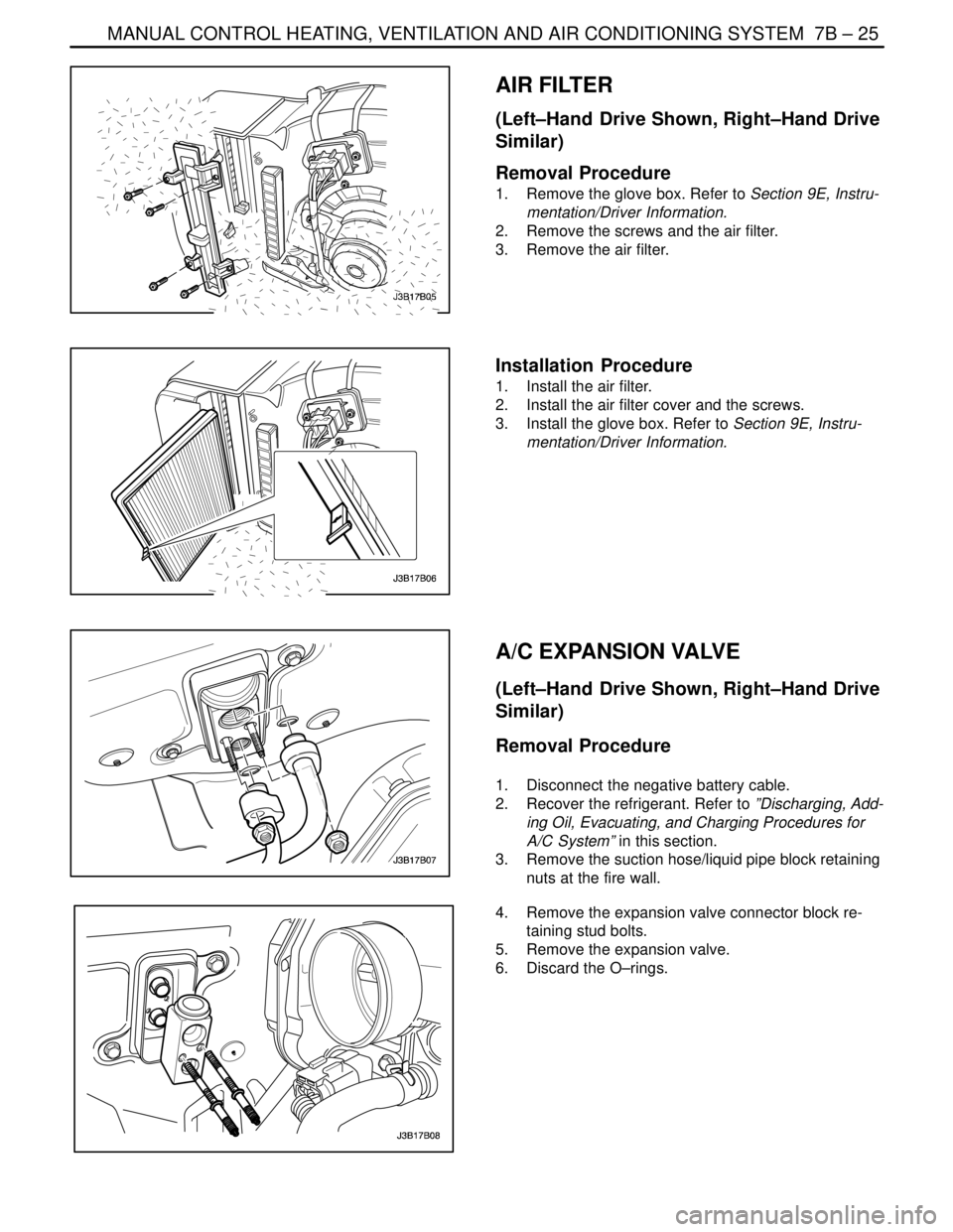
AIR FILTER
(Left–Hand Drive Shown, Right–Hand Drive
Similar)
Removal Procedure
1. Remove the glove box. Refer to Section 9E, Instru-
mentation/Driver Information.
2. Remove the screws and the air filter.
3. Remove the air filter.
Installation Procedure
1. Install the air filter.
2. Install the air filter cover and the screws.
3. Install the glove box. Refer to Section 9E, Instru-
mentation/Driver Information.
A/C EXPANSION VALVE
(Left–Hand Drive Shown, Right–Hand Drive
Similar)
Removal Procedure
1. Disconnect the negative battery cable.
2. Recover the refrigerant. Refer to ”Discharging, Add-
ing Oil, Evacuating, and Charging Procedures for
A/C System” in this section.
3. Remove the suction hose/liquid pipe block retaining
nuts at the fire wall.
4. Remove the expansion valve connector block re-
taining stud bolts.
5. Remove the expansion valve.
6. Discard the O–rings.
Page 2029 of 2643
MANUAL CONTROL HEATING, VENTILATION AND AIR CONDITIONING SYSTEM 7B – 27
DAEWOO V–121 BL4
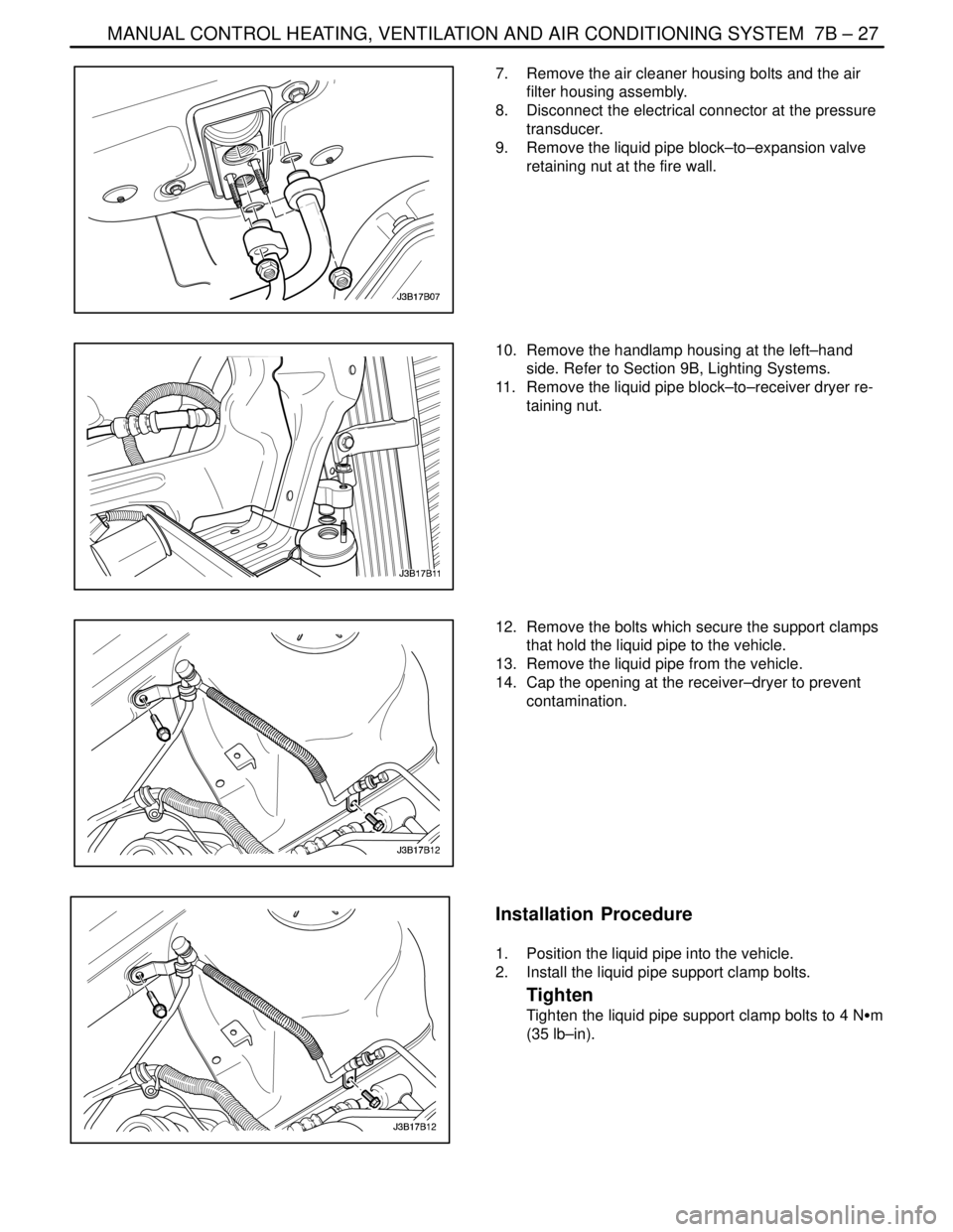
7. Remove the air cleaner housing bolts and the air
filter housing assembly.
8. Disconnect the electrical connector at the pressure
transducer.
9. Remove the liquid pipe block–to–expansion valve
retaining nut at the fire wall.
10. Remove the handlamp housing at the left–hand
side. Refer to Section 9B, Lighting Systems.
11. Remove the liquid pipe block–to–receiver dryer re-
taining nut.
12. Remove the bolts which secure the support clamps
that hold the liquid pipe to the vehicle.
13. Remove the liquid pipe from the vehicle.
14. Cap the opening at the receiver–dryer to prevent
contamination.
Installation Procedure
1. Position the liquid pipe into the vehicle.
2. Install the liquid pipe support clamp bolts.
Tighten
Tighten the liquid pipe support clamp bolts to 4 NSm
(35 lb–in).
Page 2030 of 2643
7B – 28IMANUAL CONTROL HEATING, VENTILATION AND AIR CONDITIONING SYSTEM
DAEWOO V–121 BL4
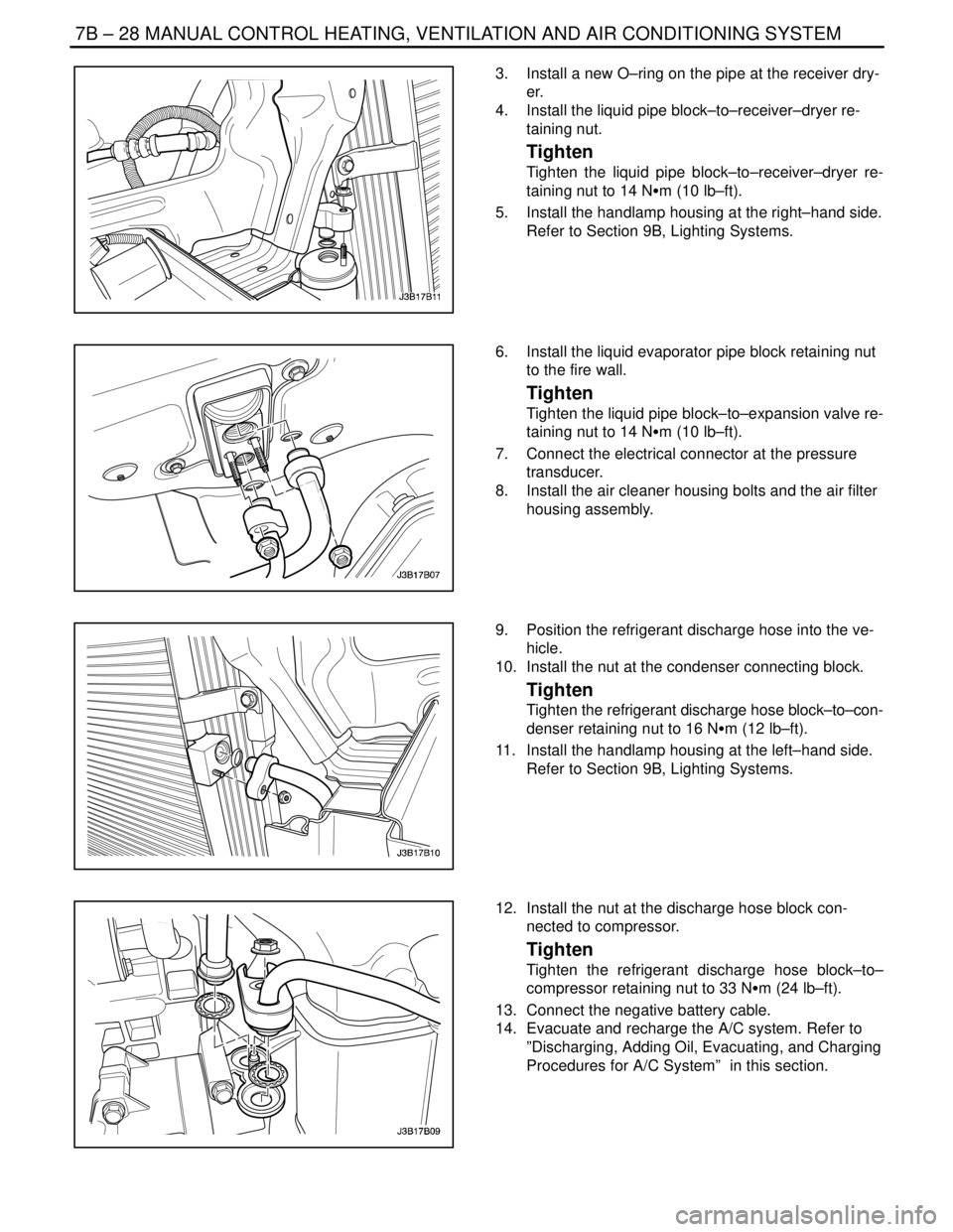
3. Install a new O–ring on the pipe at the receiver dry-
er.
4. Install the liquid pipe block–to–receiver–dryer re-
taining nut.
Tighten
Tighten the liquid pipe block–to–receiver–dryer re-
taining nut to 14 NSm (10 lb–ft).
5. Install the handlamp housing at the right–hand side.
Refer to Section 9B, Lighting Systems.
6. Install the liquid evaporator pipe block retaining nut
to the fire wall.
Tighten
Tighten the liquid pipe block–to–expansion valve re-
taining nut to 14 NSm (10 lb–ft).
7. Connect the electrical connector at the pressure
transducer.
8. Install the air cleaner housing bolts and the air filter
housing assembly.
9. Position the refrigerant discharge hose into the ve-
hicle.
10. Install the nut at the condenser connecting block.
Tighten
Tighten the refrigerant discharge hose block–to–con-
denser retaining nut to 16 NSm (12 lb–ft).
11. Install the handlamp housing at the left–hand side.
Refer to Section 9B, Lighting Systems.
12. Install the nut at the discharge hose block con-
nected to compressor.
Tighten
Tighten the refrigerant discharge hose block–to–
compressor retaining nut to 33 NSm (24 lb–ft).
13. Connect the negative battery cable.
14. Evacuate and recharge the A/C system. Refer to
”Discharging, Adding Oil, Evacuating, and Charging
Procedures for A/C System” in this section.
Page 2032 of 2643
7B – 30IMANUAL CONTROL HEATING, VENTILATION AND AIR CONDITIONING SYSTEM
DAEWOO V–121 BL4
3. Install the screws that connect the heater core
housing and the evaporator housing.
Tighten
Tighten the screws to 1.2 NSm (11 lb–in).
4. Connect the wiring harness and electrical connec-
tors to the heater/air distributor case assembly.
5. Install the heater/air distributor case assembly. Re-
fer to Section 7A, Heating and Ventilation System.
6. Evacuate and recharge the A/C system. Refer to
”Discharging, Adding Oil, Evacuating, and Charging
Procedures for A/C System” in this section.
7. Connect the negative battery cable.
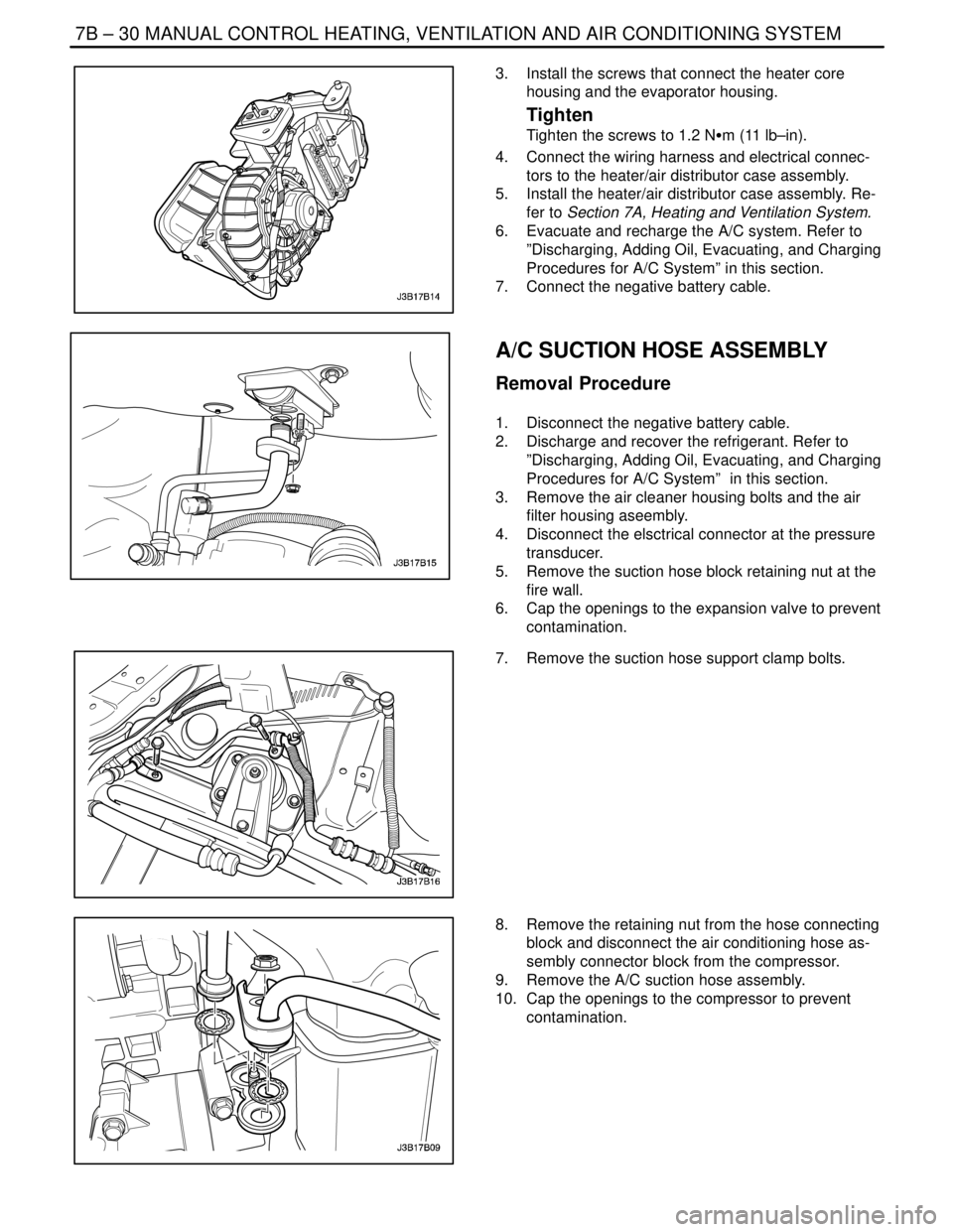
A/C SUCTION HOSE ASSEMBLY
Removal Procedure
1. Disconnect the negative battery cable.
2. Discharge and recover the refrigerant. Refer to
”Discharging, Adding Oil, Evacuating, and Charging
Procedures for A/C System” in this section.
3. Remove the air cleaner housing bolts and the air
filter housing aseembly.
4. Disconnect the elsctrical connector at the pressure
transducer.
5. Remove the suction hose block retaining nut at the
fire wall.
6. Cap the openings to the expansion valve to prevent
contamination.
7. Remove the suction hose support clamp bolts.
8. Remove the retaining nut from the hose connecting
block and disconnect the air conditioning hose as-
sembly connector block from the compressor.
9. Remove the A/C suction hose assembly.
10. Cap the openings to the compressor to prevent
contamination.