2004 DAEWOO LACETTI Rod
[x] Cancel search: RodPage 693 of 2643

ENGINE CONTROLS 1F – 447
DAEWOO V–121 BL4
DIAGNOSTIC TROUBLE CODE (DTC) P0325
KNOCK SENSOR INTERNAL MALFUNCTION
System Description
The Knock Sensor (KS) system is used to detect engine
detonation, allowing the Engine Control Module (ECM) to
retard the ignition control spark timing based on the KS
signal being received. The KS produces an AC signal so
that under a no–knock condition the signal on the KS cir-
cuit measures about 0.007 volts AC. The KS signal’s am-
plitude and frequency depend upon the amount of knock
being experienced. The ECM contains a nonreplaceable
knock filter module called a Digitally Controlled Signal–to–
Noise Enhancement Filter (DSNEF) module. This filter
module in the ECM determines whether or not knock is oc-
curring by comparing the signal level on the KS circuit with
the voltage level on the noise channel. The noise channel
allows the ECM to reject any false knock signal by knowing
the amount of normal engine mechanical noise present.
Normal engine noise varies depending on engine speed
and load. When the ECM determines that an abnormally
low noise channel voltage level is being experienced,
Diagnostic Trouble Code (DTC) P0325 will set.
Conditions for Setting the DTC
S DSNEF A/D reading is less than 1.0% or greater
than 80% any of the 4 cylinders.
S Vacuum is less than the predetermined value (10 to
50 kPa, based on rpm).
S The rpm is greater than 1600.
S DTC(s) P0106, P0107, P0108 are not set.
Action Taken When the DTC Sets
S The Malfunction Indicator Lamp (MIL) will not illumi-
nate.
S The ECM will record operating conditions at the
time the diagnostic fails. This information will be
stored in the Failure Records buffers.
S A history DTC is stored.
Conditions for Clearing the MIL/DTCS A history DTC will clear after 40 consecutive warm–
up cycles without a fault.
S DTC(s) can be cleared by using the scan tool.
S Disconnecting the ECM battery feed for more than
10 seconds.
Diagnostic Aids
Check and correct any abnormal engine noise before us-
ing the diagnostic table.
Any circuitry, that is suspected as causing the complaint,
should be thoroughly checked for the following conditions:
S Backed–out terminals
S Improper mating
S Broken locks
S Improperly formed
S Damaged terminals
S Poor terminal–to–wire connection
S Physical damage to the wiring harness
Test Description
Number(s) below refer to the step number(s) on the Diag-
nostic Table.
1. The On–Board Diagnostic (EOBD) System Check
prompts the technician to complete some basic
checks and store the freeze frame and failure re-
cords data on the scan tool if applicable. This
creates an electronic copy of the data taken when
the malfunction occurred. The information is then
stored on the scan tool for later reference.
2. If the conditions for the test as described above are
met, a DTC P0325 will set and MIL will illuminate.
4. If the engine has an internal knock or audible noise
that causes a knocking type noise on the engine
block, the knock sensor may be responding to the
noise.
6. The replacement ECM must be reprogrammed.
Refer to the latest Techline procedure for ECM re-
programming.
DTC P0325 – Knock Sensor Internal Malfunction
StepActionValue(s)YesNo
1Perform an On–Board Diagnostic (EOBD) System
Check.
Was the check performed?–Go to Step 2Go to
”On–Board
Diagnostic Sys-
tem Check”
21. Install a scan tool to the Data Link Connector
(DLC).
2. Clear the Diagnostic Trouble Codes (DTCs).
3. Start the engine.
4. Operate the vehicle within the Conditions for
Setting the DTC as noted.
Is the DTC set again.–Go to Step 3Go to Step 6
Page 695 of 2643

ENGINE CONTROLS 1F – 449
DAEWOO V–121 BL4
DIAGNOSTIC TROUBLE CODE (DTC) P0327
KNOCK SENSOR CIRCUIT FAULT
System Description
The Knock Sensor (KS) system is used to detect engine
detonation, allowing the Engine Control Module (ECM) to
retard the ignition control spark timing based on the KS
signal being received. The KS produces an AC signal so
that under a no–knock condition the signal on the KS cir-
cuit measures about 0.007 volts AC. The KS signal’s am-
plitude and frequency depend upon the amount of knock
being experienced. The ECM monitors the KS signal and
can diagnose the KS and circuitry.
Conditions for Setting the DTC
S Minimum difference between cylinders is greater
than 0.4%.
S Vacuum is less than the predetermined value (10 to
50 kPa, based on rpm).
S The rpm is greater than 1600.
S DTC(s) P0106, P0107, P0108 are not set.
Action Taken When the DTC Sets
S The Malfunction Indicator Lamp (MIL) will not illumi-
nate.
S The ECM will record operating conditions at the
time the diagnostic fails. This information will be
stored in the Failure Records buffers.
S A history DTC is stored.
Conditions for Clearing the MIL/DTC
S A history DTC will clear after 40 consecutive warm–
up cycles without a fault.
S DTC(s) can be cleared by using the scan tool.
S Disconnecting the ECM battery feed for more than
10 seconds.Diagnostic Aids
Check and correct any abnormal engine noise before us-
ing the diagnostic table.
Any circuitry, that is suspected as causing the complaint,
should be thoroughly checked for the following conditions:
S Backed–out terminals
S Improper mating
S Broken locks
S Improperly formed
S Damaged terminals
S Poor terminal–to–wire connection
S Physical damage to the wiring harness
Test Description
Number(s) below refer to the step number(s) on the Diag-
nostic Table.
1. The On–Board Diagnostic (EOBD) System Check
prompts the technician to complete some basic
checks and store the freeze frame and failure re-
cords data on the scan tool if applicable. This
creates an electronic copy of the data taken when
the malfunction occurred. The information is then
stored on the scan tool for later reference.
2. If the conditions for the test as described above are
met, a DTC P0327 will set and MIL will illuminate.
3. If the engine has an internal knock or audible noise
that causes a knocking type noise on the engine
block, the KS may be responding to the noise.
5. Checking the internal resistance of the KS or the
wiring to the KS is OK.
6. Any circuitry, that is suspected as causing the com-
plaint, should be thoroughly checked for backed–
out terminals, improper mating, broken locks, im-
Page 698 of 2643

1F – 452IENGINE CONTROLS
DAEWOO V–121 BL4
DIAGNOSTIC TROUBLE CODE (DTC) P0336
58X CRANK POSITION SENSOR EXTRA/MISSING
PULSES
Circuit Description
The 58X reference signal is produced by the Crankshaft
Position (CKP) sensor. During one crankshaft revolution,
58 crankshaft pulses will be produced. The Engine Control
Module (ECM) uses the 58X reference signal to calculate
engine rpm and CKP. The ECM constantly monitors the
number of pulses on the 58X reference circuit and
compares them to the number of Camshaft Position
(CMP) signal pulses being received. If the ECM receives
and incorrect number of pulses on the 58X reference cir-
cuit, Diagnostic Trouble Code (DTC) P0336 will set.
Conditions for Setting the DTC
S Engine is running.
S Extra or missing pulses detected between consecu-
tive 58X reference pulses.
S Number of extra or missing teeth is greater than or
equal to 2 per revolution.
S Above condition is detected in 10 of 100 crankshaft
rotations.
Action Taken When the DTC Sets
S The Malfunction Indicator Lamp (MIL) will illuminate
after three consecutive ignition cycle with a fail.
S The ECM will record operating conditions at the
time the diagnostic fails. This information will be
stored in the Freeze Frame and Failure Records
buffer.
S A history DTC is stored.
Conditions for Clearing the MIL/DTCS The MIL will turn OFF after four consecutive igni-
tion cycles in which the diagnostic runs without a
fault.
S A history DTC will clear after 40 consecutive warm–
up cycles have occurred without a fault.
S The DTC(s) can be cleared using the scan tool.
S Disconnecting the ECM battery feed for more than
10 seconds.
Diagnostic Aids
An intermittent may be caused by a poor connection,
rubbed–through wire insulation or a wire broken inside the
insulation. Check for:
S Poor connection – Inspect the ECM harness and
connectors for improper mating, broken locks, im-
properly formed or damaged terminals, and poor
terminal–towire connections.
S Damaged harness – Inspect the wiring harness for
damage. If the harness appears to be OK, discon-
nect the ECM, turn the ignition ON and observe a
voltmeter connected to the 58X reference circuit at
the ECM harness connector while moving the con-
nectors and the wiring harnesses related to the
ECM. A change in voltage will indicate the location
of the fault.
S Reviewing the Failure Records vehicle mileage
since the diagnostic test last failed may help deter-
mine how often the condition that caused the DTC
to be set occurs. This may assist in diagnosing the
condition.
Page 701 of 2643

ENGINE CONTROLS 1F – 455
DAEWOO V–121 BL4
DIAGNOSTIC TROUBLE CODE (DTC) P0337
58X CRANK POSITION SENSOR NO SIGNAL
Circuit Description
The 58X reference signal is produced by the Crankshaft
Position (CKP) sensor. During one crankshaft revolution,
58 crankshaft pulses will be produced. The Engine Control
Module (ECM) uses the 58X reference signal to calculate
engine rpm and CKP. The ECM constantly monitors the
number of pulses on the 58X reference circuit and
compares them to the number of Camshaft Position
(CMP) signal pulses being received. If the ECM does not
receive any 58X reference pulses on the 58X reference
circuit while cranking, Diagnostic Trouble Code (DTC)
P0337 will set.
Conditions for Setting the DTC
S 58X reference pulse not seen during cranking.
S DTCs P0341 and P0342 are not set.
S Change in voltage drop is greater than 0.5 volts and
change in Manifold Absolute Pressure (MAP) is
greater than 0.05kPa (0.07 psi).
S 58X reference pulse not seen for 0.078 seconds.
Action Taken When the DTC Sets
S The Malfunction Indicator Lamp (MIL) will illumi-
nate.
S The ECM will record operating conditions at the
time the diagnostic fails. This information will be
stored in the Freeze Frame and Failure Records
buffer.
S A history DTC is stored.
Conditions for Clearing the MIL/DTCS The MIL will turn OFF after four consecutive igni-
tion cycles in which the diagnostic runs without a
fault.
S A history DTC will clear after 40 consecutive warm–
up cycles have occurred without a fault.
S The DTC(s) can be cleared using the scan tool.
S Disconnecting the ECM battery feed for more than
10 seconds.
Diagnostic Aids
An intermittent may be caused by a poor connection,
rubbed–through wire insulation or a wire broken inside the
insulation. Check for:
S Poor connection – Inspect the ECM harness and
connectors for improper mating, broken locks, im-
properly formed or damaged terminals, and poor
terminal–towire connections.
S Damaged harness – Inspect the wiring harness for
damage. If the harness appears to be OK, discon-
nect the ECM, turn the ignition ON and observe a
voltmeter connected to the 58X reference circuit at
the ECM harness connector while moving the con-
nectors and the wiring harnesses related to the
ECM. A change in voltage will indicate the location
of the fault.
S Reviewing the Failure Records vehicle mileage
since the diagnostic test last failed may help deter-
mine how often the condition that caused the DTC
to be set occurs. This may assist in diagnosing the
condition.
Page 710 of 2643
1F – 464IENGINE CONTROLS
DAEWOO V–121 BL4
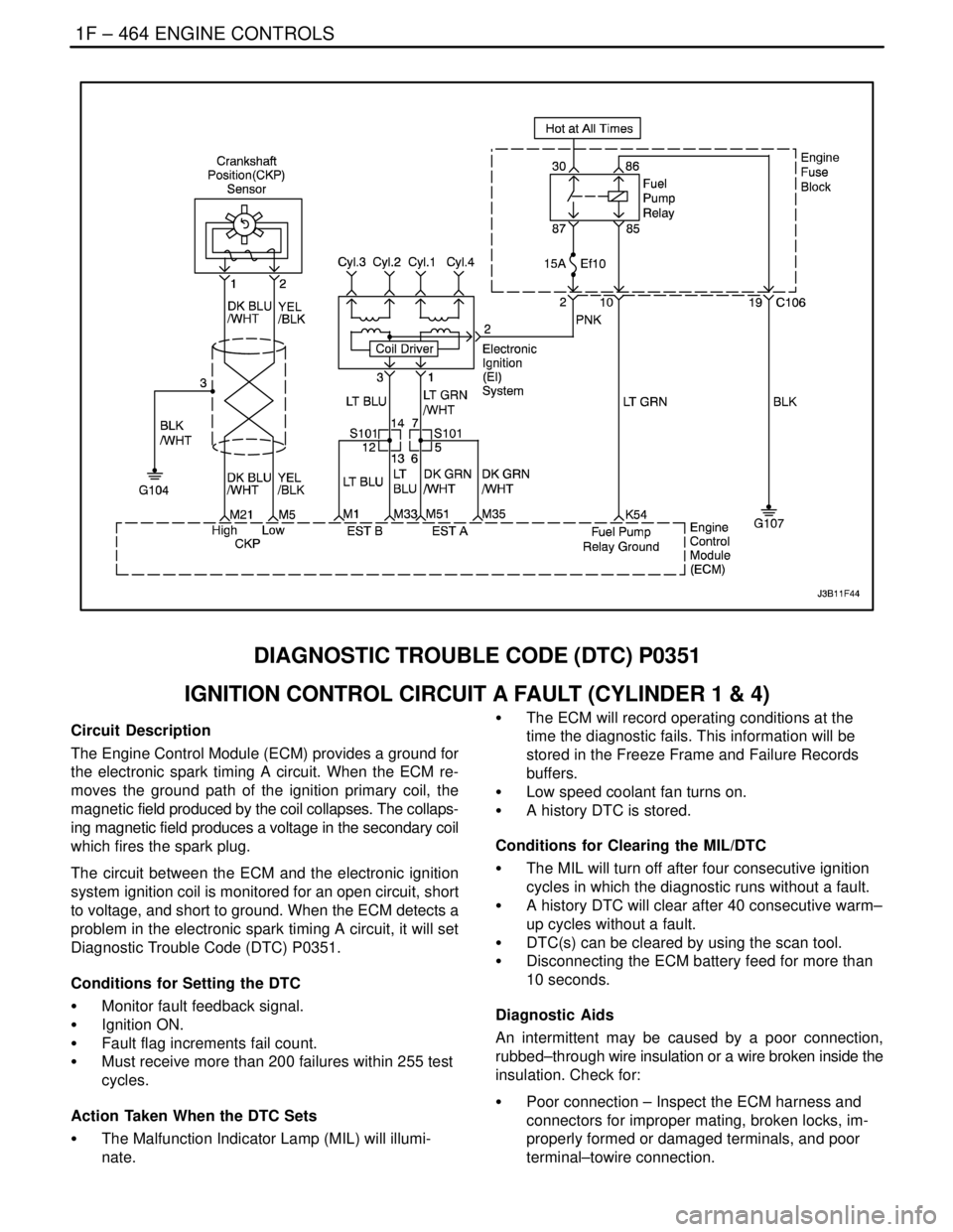
DIAGNOSTIC TROUBLE CODE (DTC) P0351
IGNITION CONTROL CIRCUIT A FAULT (CYLINDER 1 & 4)
Circuit Description
The Engine Control Module (ECM) provides a ground for
the electronic spark timing A circuit. When the ECM re-
moves the ground path of the ignition primary coil, the
magnetic field produced by the coil collapses. The collaps-
ing magnetic field produces a voltage in the secondary coil
which fires the spark plug.
The circuit between the ECM and the electronic ignition
system ignition coil is monitored for an open circuit, short
to voltage, and short to ground. When the ECM detects a
problem in the electronic spark timing A circuit, it will set
Diagnostic Trouble Code (DTC) P0351.
Conditions for Setting the DTC
S Monitor fault feedback signal.
S Ignition ON.
S Fault flag increments fail count.
S Must receive more than 200 failures within 255 test
cycles.
Action Taken When the DTC Sets
S The Malfunction Indicator Lamp (MIL) will illumi-
nate.S The ECM will record operating conditions at the
time the diagnostic fails. This information will be
stored in the Freeze Frame and Failure Records
buffers.
S Low speed coolant fan turns on.
S A history DTC is stored.
Conditions for Clearing the MIL/DTC
S The MIL will turn off after four consecutive ignition
cycles in which the diagnostic runs without a fault.
S A history DTC will clear after 40 consecutive warm–
up cycles without a fault.
S DTC(s) can be cleared by using the scan tool.
S Disconnecting the ECM battery feed for more than
10 seconds.
Diagnostic Aids
An intermittent may be caused by a poor connection,
rubbed–through wire insulation or a wire broken inside the
insulation. Check for:
S Poor connection – Inspect the ECM harness and
connectors for improper mating, broken locks, im-
properly formed or damaged terminals, and poor
terminal–towire connection.
Page 712 of 2643
1F – 466IENGINE CONTROLS
DAEWOO V–121 BL4
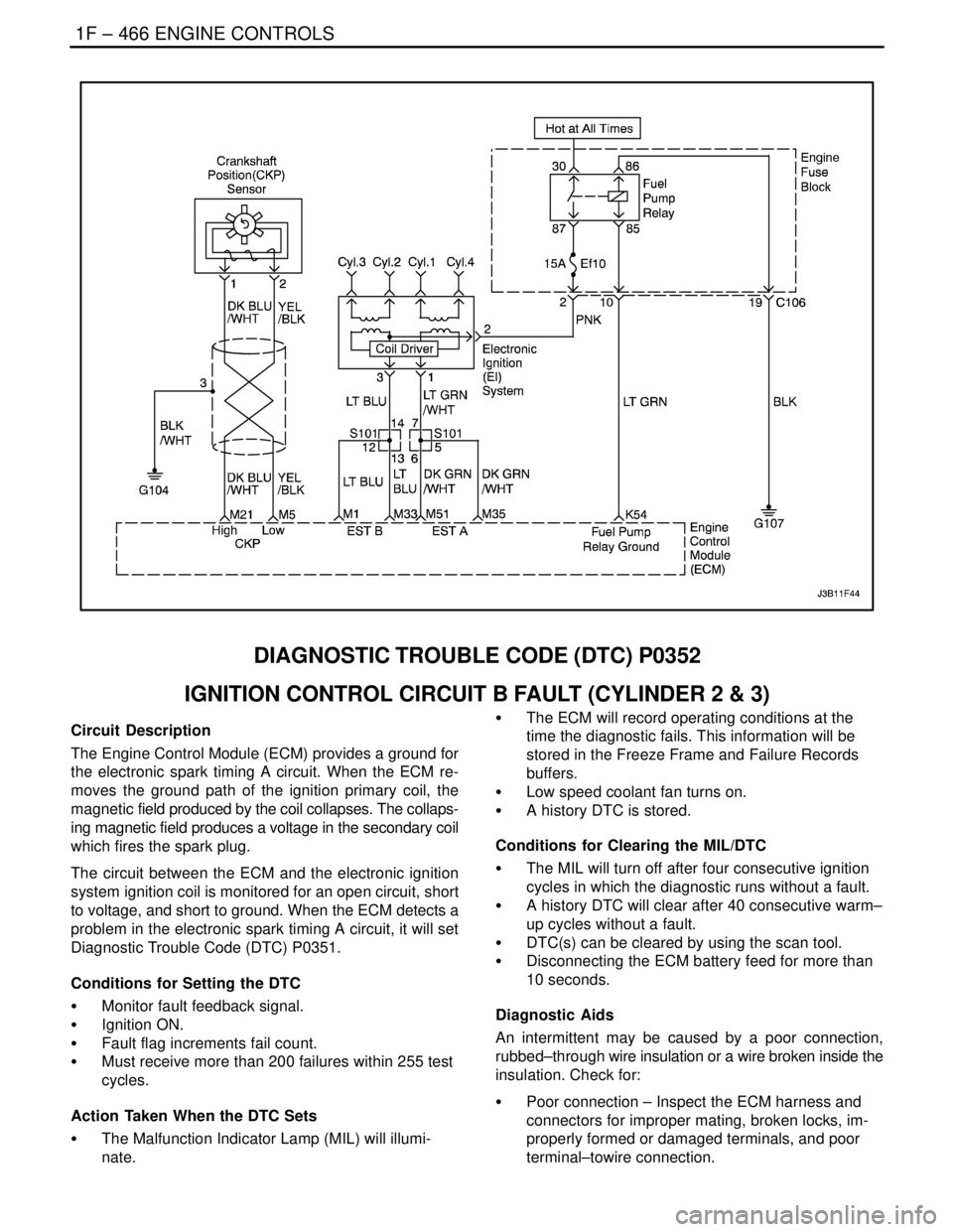
DIAGNOSTIC TROUBLE CODE (DTC) P0352
IGNITION CONTROL CIRCUIT B FAULT (CYLINDER 2 & 3)
Circuit Description
The Engine Control Module (ECM) provides a ground for
the electronic spark timing A circuit. When the ECM re-
moves the ground path of the ignition primary coil, the
magnetic field produced by the coil collapses. The collaps-
ing magnetic field produces a voltage in the secondary coil
which fires the spark plug.
The circuit between the ECM and the electronic ignition
system ignition coil is monitored for an open circuit, short
to voltage, and short to ground. When the ECM detects a
problem in the electronic spark timing A circuit, it will set
Diagnostic Trouble Code (DTC) P0351.
Conditions for Setting the DTC
S Monitor fault feedback signal.
S Ignition ON.
S Fault flag increments fail count.
S Must receive more than 200 failures within 255 test
cycles.
Action Taken When the DTC Sets
S The Malfunction Indicator Lamp (MIL) will illumi-
nate.S The ECM will record operating conditions at the
time the diagnostic fails. This information will be
stored in the Freeze Frame and Failure Records
buffers.
S Low speed coolant fan turns on.
S A history DTC is stored.
Conditions for Clearing the MIL/DTC
S The MIL will turn off after four consecutive ignition
cycles in which the diagnostic runs without a fault.
S A history DTC will clear after 40 consecutive warm–
up cycles without a fault.
S DTC(s) can be cleared by using the scan tool.
S Disconnecting the ECM battery feed for more than
10 seconds.
Diagnostic Aids
An intermittent may be caused by a poor connection,
rubbed–through wire insulation or a wire broken inside the
insulation. Check for:
S Poor connection – Inspect the ECM harness and
connectors for improper mating, broken locks, im-
properly formed or damaged terminals, and poor
terminal–towire connection.
Page 730 of 2643

1F – 484IENGINE CONTROLS
DAEWOO V–121 BL4
DIAGNOSTIC TROUBLE CODE (DTC) P0420
CATALYST OXYGEN SENSOR LOW EFFICIENCY
Circuit Description
In order to control exhaust emissions of Hydrocarbons
(HC), Carbon Monoxide (CO) and Nitrogen Oxide (NOx),
a Three–Way Catalytic Converter (TWC) is used. The cat-
alyst within the converter promotes a chemical reaction
which oxidizes the HC and CO present in the exhaust gas,
converting them into harmless water vapor and carbon
dioxide, it also reduces NOx, converting it into nitrogen.
The catalytic converter also has the ability to store oxygen.
The Engine Control Module (ECM) has the capability to
monitor this process using a Heated
Rear Heated Oxygen Sensor (HO2S2) located in the ex-
haust stream past the TWC. The HO2S2 produces an out-
put signal which indicates the oxygen storage capacity of
the catalyst; this in turn indicates the catalyst’s ability to
convert exhaust emissions effectively. The ECM monitors
the catalyst efficiency by first allowing the catalyst to heat
up, waiting for a stabilization period while the engine is id-
ling, and then adding and removing fuel while monitoring
the reaction of the HO2S2. When the catalyst is function-
ing properly, the HO2S2 response to the extra fuel is slow
compared to the Front Heated Oxygen Sensor (HO2S1).
When the HO2S2 response is close to that of the HO2S1,
the Oxygen storage capability or efficiency of the catalyst
is considered to be bad, and the Malfunction Indicator
Lamp (MIL) will illuminate.
Conditions for Setting the DTC
S Oxygen storage capacity index time is less than 0.3
seconds.
S Before idle test, the vehicle needs to be driven for
at least:
S 15 seconds at airflow is greater than 9.2 g/sec.
for manual transaxle.
S 11 seconds at airflow is greater than 12 g/sec
for automatic transaxle.
S Oxygen Sensor Capacity test condition:
S Closed loop stoichiometry.
S Purge concentration learned.
S Engine is running more than 330 seconds.
S Airflow is between 2.5 and 7.25 g/sec.
S Throttle Position (TP) sensor is less than 1.5%.
S Intake Air Temperature (IAT) is between –7°C
(19.4°F) and 105°C (221°F).
S Barometric pressure (BARO) is greater than 72 kPa
(10.4 psi).
S Catalyst temperature is between 500°C (932°F)
and 850°C (1562°F) for automatic transaxle.
S Catalyst temperature is between 450°C (842°F)
and 850°C (1562°F) for automatic transaxle.
S Closed Loop integrator change is less than 0.03.
S Idle time is less than 1 minute.
S Vehicle speed is less than 3 km/h (1.9 mph).S Block Learn Mode is learned.
S Above condition is stabilized for 5 seconds.
Note : Test is aborted for this idle if:
S Change in engine speed is greater than 80 rpm.
S A/C status changed.
S Cooling fan status changed.
S Insufficient air/fuel shift.
S DTC(s) P0106, P0107, P0108, P0117, P0118,
P0122, P0123, P0131, P0132, P0133, P1133,
P0134, P0135, P0137, P0138, P0140, P0141,
P1167, P1171, P0171, P0172, P0201, P0202,
P0203, P0204, P0300, P0336, P0337, P0341,
P0342, P0351, P0352, P0402, P0404, P1404,
P0405, P0406, P0443, P0502, P0506, P0507, and
P0562 are not set.
Action Taken When the DTC Sets
S The Malfunction Indicator Lamp (MIL) will illumi-
nate.
S The ECM will record operating conditions at the
time the diagnostic fails. This information will be
stored in the Freeze Frame and Failure Records
buffers.
S A history DTC is stored.
Conditions for Clearing the MIL/DTC
S The MIL will turn off after four consecutive ignition
cycles in which the diagnostic runs without a fault.
S A history DTC will clear after 40 consecutive warm–
up cycles without a fault.
S DTC(s) can be cleared by using the scan tool.
S Disconnecting the ECM battery feed for more than
10 seconds.
Diagnostic Aids
The catalyst test may abort due to a change in the engine
load. Do not change the engine load (i.e. A/C, coolant fan,
heater motor) while a catalyst test is in progress.
An intermittent problem may be caused by a poor connec-
tion, rubbed–through wire insulation, or a wire that is bro-
ken inside the insulation.
Any circuitry, that is suspected as causing the intermittent
complaint, should be thoroughly checked for the following
conditions:
S Backed–out terminals
S Improper mating
S Broken locks
S Improperly formed
S Damaged terminals
S Poor terminal–to–wire connection
Test Description
Number(s) below refer to the step number(s) on the Diag-
nostic Table.
Page 744 of 2643

1F – 498IENGINE CONTROLS
DAEWOO V–121 BL4
DIAGNOSTIC TROUBLE CODE (DTC) P0502
VEHICLE SPEED SENSOR NO SIGNAL (ENGINE SIDE)
Circuit Description
Vehicle speed information is provided to the Engine Con-
trol Module (ECM) by the Vehicle Speed Sensor (VSS).
The VSS is a permanent magnet generator that is
mounted in the transaxle and produces a pulsing voltage
whenever vehicle speed is over 3 mph (5 km/h). The Alter-
nating Current (AC) voltage level and the number of
pulses increases with vehicle speed. The ECM converts
the pulsing voltage into mph (km/h) and then supplies the
necessary signal to the instrument panel for speedometer/
odometer operation and to the cruise control module and
multi–function alarm module operation. This Diagnostic
Trouble Code (DTC) will detect if vehicle speed is reason-
able according to engine rpm and load.
Conditions for Setting the DTC
S Vehicle speed is less than 5 km/h (3.1 mph) for
Power and Decel test.
S Engine is running.
S Engine Coolant Temperature (ECT) is greater than
60 °C (140 °F).
S Ignition voltage is between 11–16 volts.
S Power Test
S The rpm is between 1200 and 4000.S Throttle Position (TP) sensor is between 25%
and 60%.
S MAP is greater than 60 kPa (8.7 psi).
S Deceleration Test
S Generator compensated Manifold Absolute
Pressure (MAP) is less than 30 kPa (4.4 psi)
S Change in rpm per cycle is less than 50 rpm/
cycle.
S Throttle Position (TP) sensor is less than 0.8%.
S The rpm is between 1800 and 6000.
S DTC(s) P0106, P0107, P0108, P0117, P0118,
P0122, P0123, P0201, P0202, P0203, P0204,
P0300, P0351, P0352, P0402, P0404, P1404,
P0405, and P0406 are not set.
Action Taken When the DTC Sets
S The Malfunction Indicator Lamp (MIL) will illuminate
after three consecutive trip with a fail.
S The ECM will record operating conditions at the
time the diagnostic fails. This information will be
stored in the Freeze Frame and Failure Records
buffers.
S A history DTC is stored.
Conditions for Clearing the MIL/DTC