2004 DAEWOO LACETTI Rod
[x] Cancel search: RodPage 872 of 2643

1F – 626IENGINE CONTROLS
DAEWOO V–121 BL4
EXHAUST GAS RECIRCULATION
VA LV E
The Exhaust Gas Recirculation (EGR) system is used on
engines equipped with an automatic transaxle to lower
NOx (oxides of nitrogen) emission levels caused by high
combustion temperature. The EGR valve is controlled by
the engine control module (ECM). The EGR valve feeds
small amounts of exhaust gas into the intake manifold to
decrease combustion temperature. The amount of ex-
haust gas recirculated is controlled by variations in vacu-
um and exhaust back pressure. If too much exhaust gas
enters, combustion will not take place. For this reason,
very little exhaust gas is allowed to pass through the valve,
especially at idle.
The EGR valve is usually open under the following condi-
tions:
S Warm engine operation.
S Above idle speed.
Results of Incorrect Operation
Too much EGR flow tends to weaken combustion, causing
the engine to run roughly or to stop. With too much EGR
flow at idle, cruise, or cold operation, any of the following
conditions may occur:
S The engine stops after a cold start.
S The engine stops at idle after deceleration.
S The vehicle surges during cruise.
S Rough idle.
If the EGR valve stays open all the time, the engine may
not idle. Too little or no EGR flow allows combustion tem-
peratures to get too high during acceleration and load con-
ditions. This could cause the following conditions:
S Spark knock (detonation)
S Engine overheating
S Emission test failure
INTAKE AIR TEMPERATURE
SENSOR
The Intake Air Temperature (IAT) sensor is a thermistor,
a resistor which changes value based on the temperature
of the air entering the engine. Low temperature produces
a high resistance (4,500 ohms at –40°F [–40°C]), while
high temperature causes a low resistance (70 ohms at
266°F [130°C]).
The engine control module (ECM) provides 5 volts to the
IAT sensor through a resistor in the ECM and measures
the change in voltage to determine the IAT. The voltage will
be high when the manifold air is cold and low when the air
is hot. The ECM knows the intake IAT by measuring the
voltage.
The IAT sensor is also used to control spark timing when
the manifold air is cold.
A failure in the IAT sensor circuit sets a diagnostic trouble
code P0112 or P0113.
IDLE AIR CONTROL VALVE
Notice : Do not attempt to remove the protective cap to
readjust the stop screw. Misadjustment may result in dam-
age to the Idle Air Control (IAC) valve or to the throttle
body.
The IAC valve is mounted on the throttle body where it
controls the engine idle speed under the command of the
engine control module (ECM). The ECM sends voltage
pulses to the IAC valve motor windings, causing the IAC
valve pintle to move in or out a given distance (a step or
count) for each pulse. The pintle movement controls the
airflow around the throttle valves which, in turn, control the
engine idle speed.
The desired idle speeds for all engine operating conditions
are programmed into the calibration of the ECM. These
programmed engine speeds are based on the coolant
temperature, the park/neutral position switch status, the
vehicle speed, the battery voltage, and the A/C system
pressure (if equipped).
The ECM ”learns” the proper IAC valve positions to
achieve warm, stabilized idle speeds (rpm) desired for the
various conditions (park/neutral or drive, A/C on or off, if
equipped). This information is stored in ECM ”keep alive”
memories. Information is retained after the ignition is
turned OFF. All other IAC valve positioning is calculated
based on these memory values. As a result, engine varia-
tions due to wear and variations in the minimum throttle
valve position (within limits) do not affect engine idle
speeds. This system provides correct idle control under all
conditions. This also means that disconnecting power to
the ECM can result in incorrect idle control or the necessity
to partially press the accelerator when starting until the
ECM relearns idle control.
Engine idle speed is a function of total airflow into the en-
gine based on the IAC valve pintle position, the throttle
valve opening, and the calibrated vacuum loss through ac-
cessories. The minimum throttle valve position is set at the
factory with a stop screw. This setting allows enough air-
flow by the throttle valve to cause the IAC valve pintle to
be positioned a calibrated number of steps (counts) from
the seat during ”controlled” idle operation. The minimum
throttle valve position setting on this engine should not be
considered the ”minimum idle speed,” as on other fuel in-
jected engines. The throttle stop screw is covered with a
plug at the factory following adjustment.
If the IAC valve is suspected as the cause of improper idle
speed, refer to ”Idle Air Control System Check” in this sec-
tion.
MANIFOLD ABSOLUTE PRESSURE
SENSOR
The Manifold Absolute Pressure (MAP) sensor measures
the changes in the intake manifold pressure which result
from engine load and speed changes. It converts these to
a voltage output.
Page 873 of 2643

ENGINE CONTROLS 1F – 627
DAEWOO V–121 BL4
A closed throttle on engine coast down produces a rela-
tively low MAP output. MAP is the opposite of vacuum.
When manifold pressure is high, vacuum is low. The MAP
sensor is also used to measure barometric pressure. This
is performed as part of MAP sensor calculations. With the
ignition ON and the engine not running, the engine control
module (ECM) will read the manifold pressure as baromet-
ric pressure and adjust the air/fuel ratio accordingly. This
compensation for altitude allows the system to maintaindriving performance while holding emissions low. The
barometric function will update periodically during steady
driving or under a wide open throttle condition. In the case
of a fault in the barometric portion of the MAP sensor, the
ECM will set to the default value.
A failure in the MAP sensor circuit sets a diagnostic trouble
code P0107 or P0108.
The following tables show the difference between absolute pressure and vacuum related to MAP sensor output, which
appears as the top row of both tables.
MAP
Volts4.94.43.83.32.72.21.71.10.60.30.3
kPa1009080706050403020100
in. Hg29.626.623.720.717.714.811.88.95.92.90
VACUUM
Volts4.94.43.83.32.72.21.71.10.60.30.3
kPa0102030405060708090100
in. Hg02.95.98.911.814.817..720.723.726.729.6
ENGINE CONTROL MODULE
The engine control module (ECM), located inside the pas-
senger kick–panel, is the control center of the fuel injection
system. It constantly looks at the information from various
sensors and controls the systems that affect the vehicle’s
performance. The ECM also performs the diagnostic func-
tions of the system. It can recognize operational problems,
alert the driver through the Malfunction Indicator Lamp
(MIL), and store diagnostic trouble code(s) which identify
problem areas to aid the technician in making repairs.
There are no serviceable parts in the ECM. The calibra-
tions are stored in the ECM in the Programmable Read–
Only Memory (PROM).
The ECM supplies either 5 or 12 volts to power the sensors
or switches. This is done through resistances in the ECM
which are so high in value that a test light will not come on
when connected to the circuit. In some cases, even an or-
dinary shop voltmeter will not give an accurate reading be-
cause its resistance is too low. You must use a digital volt-
meter with a 10 megohm input impedance to get accurate
voltage readings. The ECM controls output circuits such
as the fuel injectors, the idle air control valve, the A/C
clutch relay, etc., by controlling the ground circuit through
transistors or a device called a ”quad–driver.”
FUEL INJECTOR
The Multiport Fuel Injection (MFI) assembly is a solenoid–
operated device controlled by the engine control module
(ECM). It meters pressurized fuel to a single engine cylin-
der. The ECM energizes the fuel injector or the solenoid
to a normally closed ball or pintle valve. This allows fuel toflow into the top of the injector, past the ball or pintle valve,
and through a recessed flow director plate at the injector
outlet.
The director plate has six machined holes that control the
fuel flow, generating a conical spray pattern of finely atom-
ized fuel at the injector tip. Fuel from the tip is directed at
the intake valve, causing it to become further atomized
and vaporized before entering the combustion chamber.
A fuel injector which is stuck partially open will cause a loss
of fuel pressure after the engine is shut down. Also, an ex-
tended crank time will be noticed on some engines. Diesel-
ing can also occur because some fuel can be delivered to
the engine after the ignition is turned OFF.
KNOCK SENSOR
The knock sensor detects abnormal knocking in the en-
gine. The sensor is mounted in the engine block near the
cylinders. The sensor produces an AC output voltage
which increases with the severity of the knock. This signal
is sent to the engine control module (ECM). The ECM then
adjusts the ignition timing to reduce the spark knock.
ROUGH ROAD SENSOR
The engine control module (ECM) receives rough road in-
formation from the VR sensor. The ECM uses the rough
road information to enable or disable the misfire diagnos-
tic. The misfire diagnostic can be greatly affected by
crankshaft speed variations caused by driving on rough
road surfaces. The VR sensor generates rough road infor-
mation by producing a signal which is proportional to the
movement of a small metal bar inside the sensor.
If a fault occurs which causes the ECM to not receive
rough road information between 30 and 80 mph (50 and
132 km/h), DTC P1391 will set.
Page 874 of 2643

1F – 628IENGINE CONTROLS
DAEWOO V–121 BL4
STRATEGY – BASED DIAGNOSTICS
Strategy–Based Diagnostics
The strategy–based diagnostic is a uniform approach to
repair all Electrical/Electronic (E/E) systems. The diag-
nostic flow can always be used to resolve an E/E system
problem and is a starting point when repairs are neces-
sary. The following steps will instruct the technician on
how to proceed with a diagnosis:
S Verify the customer complaint. To verify the cus-
tomer complaint, the technician should know the
normal operation of the system.
S Perform preliminary checks as follows:
S Conduct a thorough visual inspection.
S Review the service history.
S Detect unusual sounds or odors.
S Gather Diagnostic Trouble Code (DTC) informa-
tion to achieve an effective repair.
S Check bulletins and other service information. This
includes videos, newsletters, etc.
S Refer to service information (manual) system
check(s).
S Refer to service diagnostics.
No Trouble Found
This condition exists when the vehicle is found to operate
normally. The condition described by the customer may be
normal. Verify the customer complaint against another ve-
hicle that is operating normally. The condition may be in-
termittent. Verify the complaint under the conditions de-
scribed by the customer before releasing the vehicle.
Re–examine the complaint.
When the complaint cannot be successfully found or iso-
lated, a re–evaluation is necessary. The complaint should
be re–verified and could be intermittent as defined in ”In-
termittents,” or could be normal.
After isolating the cause, the repairs should be made. Vali-
date for proper operation and verify that the symptom has
been corrected. This may involve road testing or other
methods to verify that the complaint has been resolved un-
der the following conditions:
S Conditions noted by the customer.
S If a DTC was diagnosed, verify a repair by duplicat-
ing conditions present when the DTC was set as
noted in the Failure Records or Freeze Frame data.
Verifying Vehicle Repair
Verification of the vehicle repair will be more comprehen-
sive for vehicles with On–Board Diagnostic (EOBD) sys-
tem diagnostics. Following a repair, the technician should
perform these steps:
Important : Follow the steps below when you verify re-
pairs on EOBD systems. Failure to follow these steps
could result in unnecessary repairs.S Review and record the Failure Records and the
Freeze Frame data for the DTC which has been
diagnosed (Freeze Fame data will only be stored
for an A or B type diagnostic and only if the MIL
has been requested).
S Clear the DTC(s).
S Operate the vehicle within conditions noted in the
Failure Records and Freeze Frame data.
S Monitor the DTC status information for the specific
DTC which has been diagnosed until the diagnostic
test associated with that DTC runs.
EOBD SERVICEABILITY ISSUES
Based on the knowledge gained from On–Board Diagnos-
tic (EOBD) experience in the 1994 and 1995 model years,
this list of non–vehicle faults that could affect the perfor-
mance of the EOBD system has been compiled. These
non–vehicle faults vary from environmental conditions to
the quality of fuel used. With the introduction of EOBD
diagnostics across the entire passenger car and light–duty
truck market in 1996, illumination of the MIL due to a non–
vehicle fault could lead to misdiagnosis of the vehicle, in-
creased warranty expense and customer dissatisfaction.
The following list of non–vehicle faults does not include ev-
ery possible fault and may not apply equally to all product
lines.
Fuel Quality
Fuel quality is not a new issue for the automotive industry,
but its potential for turning on the Malfunction Indicator
Lamp (MIL) with EOBD systems is new.
Fuel additives such as ”dry gas” and ”octane enhancers”
may affect the performance of the fuel. If this results in an
incomplete combustion or a partial burn, it will set DTC
P0300. The Reed Vapor Pressure of the fuel can also
create problems in the fuel system, especially during the
spring and fall months when severe ambient temperature
swings occur. A high Reed Vapor Pressure could show up
as a Fuel Trim DTC due to excessive canister loading.
High vapor pressures generated in the fuel tank can also
affect the Evaporative Emission diagnostic as well.
Using fuel with the wrong octane rating for your vehicle
may cause driveability problems. Many of the major fuel
companies advertise that using ”premium” gasoline will
improve the performance of your vehicle. Most premium
fuels use alcohol to increase the octane rating of the fuel.
Although alcohol–enhanced fuels may raise the octane
rating, the fuel’s ability to turn into vapor in cold tempera-
tures deteriorates. This may affect the starting ability and
cold driveability of the engine.
Low fuel levels can lead to fuel starvation, lean engine op-
eration, and eventually engine misfire.
Non–OEM Parts
All of the EOBD diagnostics have been calibrated to run
with Original Equipment Manufacturer (OEM) parts.
Something as simple as a high–performance exhaust sys-
tem that affects exhaust system back pressure could po-
Page 880 of 2643

1F – 634IENGINE CONTROLS
DAEWOO V–121 BL4
A rough road sensor, or G sensor, works together with the
misfire detection system. The G sensor produces a volt-
age that varies along with the intensity of road vibrations.
When the ECM detects a rough road, the misfire detection
system is temporarily disabled.
Misfire Counters
Whenever a cylinder misfires, the misfire diagnostic
counts the misfire and notes the crankshaft position at the
time the misfire occurred. These ”misfire counters” are ba-
sically a file on each engine cylinder. A current and a histo-
ry misfire counter are maintained for each cylinder. The
misfire current counters (Misfire Cur #1–4) indicate the
number of firing events out of the last 200 cylinder firing
events which were misfires. The misfire current counter
will display real time data without a misfire Diagnostic
Trouble Code (DTC) stored. The misfire history counters
(Misfire Hist #1–4) indicate the total number of cylinder fir-
ing events which were misfires. The misfire history count-
ers will display 0 until the misfire iagnostic has failed and
a DTC P0300 is set. Once the misfire DTC P0300 is set,
the misfire history counters will be updated every 200 cyl-
inder firing events. A misfire counter is maintained for each
cylinder.
If the misfire diagnostic reports a failure, the diagnostic
executive reviews all of the misfire counters before report-
ing a DTC. This way, the diagnostic executive reports the
most current information.
When crankshaft rotation is erratic, a misfire condition will
be detected. Because of this erratic condition, the data
that is collected by the diagnostic can sometimes incor-
rectly identify which cylinder is misfiring.
Use diagnostic equipment to monitor misfire counter data
on On–Board Diagnostic (EOBD) compliant vehicles.
Knowing which specific cylinder(s) misfired can lead to the
root cause, even when dealing with amultiple cylinder mis-
fire. Using the information in the misfire counters, identify
which cylinders are misfiring. If the counters indicate cylin-
ders numbers 1 and 4 misfired, look for a circuit or compo-
nent common to both cylinders number 1 and 4.
The misfire diagnostic may indicate a fault due to a tempo-
rary fault not necessarily caused by a vehicle emission
system malfunction. Examples include the following
items:
S Contaminated fuel.S Low fuel.
S Fuel–fouled spark plugs.
S Basic engine fault.
Fuel Trim System Monitor Diagnostic
Operation
This system monitors the averages of short–term and
long–term fuel trim values. If these fuel trim values stay at
their limits for a calibrated period of time, a malfunction is
indicated. The fuel trim diagnostic compares the averages
of short–term fuel trim values and long–term fuel trim val-
ues to rich and lean thresholds. If either value is within the
thresholds, a pass is recorded. If both values are outside
their thresholds, a rich or lean DTC will be recorded.
The fuel trim system diagnostic also conducts an intrusive
test. This test determines if a rich condition is being
caused by excessive fuel vapor from the Evaporative
(EVAP) Emission canister. In order to meet EOBD require-
ments, the control module uses weighted fuel trim cells to
determine the need to set a fuel trim DTC. A fuel trim DTC
can only be set if fuel trim counts in the weighted fuel trim
cells exceed specifications. This means that the vehicle
could have a fuel trim problem which is causing a problem
under certain conditions (i.e., engine idle high due to a
small vacuum leak or rough idle due to a large vacuum
leak) while it operates fine at other times. No fuel trim DTC
would set (although an engine idle speed DTC or HO2S2
DTC may set). Use a scan tool to observe fuel trim counts
while the problem is occurring.
A fuel trim DTC may be triggered by a number of vehicle
faults. Make use of all information available (other DTCs
stored, rich or lean condition, etc.) when diagnosing a fuel
trim fault.
Fuel Trim Cell Diagnostic Weights
No fuel trim DTC will set regardless of the fuel trim counts
in cell 0 unless the fuel trim counts in the weighted cells are
also outside specifications. This means that the vehicle
could have a fuel trim problem which is causing a problem
under certain conditions (i.e. engine idle high due to a
small vacuum leak or rough due to a large vacuum leak)
while it operates fine at other times. No fuel trim DTC
would set (although an engine idle speed DTC or HO2S2
DTC may set). Use a scan tool to observe fuel trim counts
while the problem is occurring.
Page 903 of 2643

2A – 2ISUSPENSION DIAGNOSIS
DAEWOO V–121 BL4
Abnormal or Excessive Tire Wear
ChecksAction
Check the front–wheel and the rear–wheel alignment.Align the front and the rear wheels.
Inspect for excessive toe on the front and the rear wheels.Adjust the toe on the front and the rear wheels.
Inspect for a broken or a sagging spring.Replace the spring.
Inspect for out–of–balance tires.Balance the tires.
Inspect for worn strut dampeners.Replace the strut dampeners.
Check for a failure to rotate tires.Rotate the tires. Replace the tires as needed.
Check for an overloaded vehicle.Maintain the proper load weight.
Inspect for low tire inflation.Inflate the tires to the proper pressure.
Scuffed Tires
ChecksAction
Inspect for incorrect toe on the front and the rear wheels.Adjust the toe on the front and the rear wheels.
Inspect for a twisted or a bent suspension arm.Replace the suspension arm.
Wheel Tramp
ChecksAction
Inspect for an out–of–balance tire or wheel.Balance the tire or the wheel.
Inspect for improper strut dampener action.Replace the strut dampeners.
Shimmy, Shake, or Vibration
ChecksAction
Inspect for an out–of–balance tire or wheel.Balance the tire or the wheel.
Inspect for excessive wheel hub runout.Measure the hub flange runout. Replace the hub as need-
ed.
Inspect for excessive brake drum or brake rotor imbal-
ance.Adjust the brakes. Replace the brake rotor or the brake
drum as needed.
Inspect for worn tie rod ends.Replace the outer tie rods.
Inspect for wheel trim imbalance.Balance the wheel.
Inspect for a worn lower ball joint.Replace the lower ball joint.
Inspect for excessive wheel runout.Measure the wheel runout. Replace the wheel as needed.
Inspect for excessive loaded radial runout on the tire and
wheel assembly.Match–mount the tire and wheel assembly.
Hard Steering
ChecksAction
Check the steering gear preload adjustment.Perform a rack bearing preload adjustment.
Check the hydraulic system. Test the power steering sys-
tem pressure with a gauge.Replace the seals and the hoses as needed.
Inspect for binding or catching in the steering gear.Lubricate the steering gear. Repair or replace the steering
gear as needed.
Inspect for a loose steering gear mounting.Tighten the steering gear mounting bracket nuts.
Page 904 of 2643

SUSPENSION DIAGNOSIS 2A – 3
DAEWOO V–121 BL4
Too Much Play in Steering
ChecksAction
Inspect for worn or loose wheel bearings.Tighten the drive axle nut. Replace the wheel bearings as
needed.
Inspect for a loose steering gear mounting.Tighten the steering gear mounting bracket nuts.
Inspect the joint from the column to the steering gear for
loose connections or wear.Tighten the intermediate shaft pinch bolts. Replace the in-
termediate shaft as needed.
Check the steering gear preload adjustment.Perform a rack bearing preload adjustment.
Poor Returnability
ChecksAction
Inspect for lack of lubrication of the ball joints and the tie
rod ends.Replace the ball joints and the outer tie rods.
Inspect for binding in the ball joints.Replace the ball joint.
Inspect for binding in the steering column.Lubricate the steering column. Replace the steering col-
umn as needed.
Check the front–wheel alignment.Align the front wheels.
Check the steering gear preload adjustment.Perform a rack bearing preload adjustment.
Inspect for a sticking valve.Lubricate the pinion valve assembly. Replace the pinion
valve assembly as needed.
Inspect for binding in the intermediate shaft on the steering
gear.Replace the intermediate shaft.
Abnormal Noise, Front Suspension
ChecksAction
Inspect for a lack of lubrication of the ball joints and the tie
rod ends.Replace the ball joints and the outer tie rods.
Inspect for damaged suspension components.Replace the damaged suspension components.
Inspect for worn control arm bushings or tie rod ends.Replace the control arm bushings or the tie rods.
Inspect for a loose stabilizer shaft link.Tighten the stabilizer shaft link.
Inspect for loose wheel bolts.Tighten the wheel bolts.
Inspect for loose suspension bolts or nuts.Tighten the suspension bolts or the nuts.
Inspect for worn strut dampeners or strut mountings.Replace the strut dampeners. Tighten the strut mounting
bolts.
Inspect for an improperly positioned strut spring.Adjust the strut spring to the proper position.
Wander or Poor Steering Ability
ChecksAction
Inspect for mismatched or uneven tires.Replace the tires.
Inspect for lack of lubrication of the ball joints and the tie
rod ends.Replace the ball joints and the outer tie rods.
Inspect for worn strut dampeners.Replace the strut dampeners.
Inspect for a loose stabilizer shaft link.Tighten the stabilizer shaft link.
Inspect for a broken or a sagging spring.Replace the spring.
Page 906 of 2643

SUSPENSION DIAGNOSIS 2A – 5
DAEWOO V–121 BL4
Steering Wheel Kickback
ChecksAction
Inspect for air in the power steering system.Purge the power steering system of air.
Inspect for a loose steering gear mounting.Tighten the steering gear mounting bracket nuts.
Inspect the joint from the column to the steering gear for
loose connections or wear.Tighten the intermediate shaft pinch bolts. Replace the in-
termediate shaft as needed.
Inspect for loose tie rod ends.Tighten the tie rod ends. Replace the outer tie rods as
needed.
Inspect for loose or worn wheel bearings.Tighten the drive axle nut. Replace the wheel bearings as
needed.
Steering Wheel Surges or Jerks
ChecksAction
Check the hydraulic system. Test the power steering sys-
tem pressure with a gauge.Replace the seals and the hoses as needed.
Inspect for a sluggish steering gear valve.Clean the pinion valve assembly. Replace the pinion valve
assembly as needed.
Inspect for a loose power steering pump serpentine belt.Adjust the power steering pump serpentine belt.
Cupped Tires
ChecksAction
Check the front–wheel and the rear–wheel alignment.Align the front and the rear wheels.
Inspect for worn strut dampeners.Replace the strut dampeners.
Inspect for worn or loose wheel bearings.Tighten the drive axle nut. Replace the wheel bearings as
needed.
Inspect for excessive tire or wheel runout.Match–mount the tires. Replace the tires as needed. Re-
place the wheels as needed.
Inspect for a worn ball joint.Replace the ball joint.
Check the steering gear preload adjustment.Perform a rack bearing preload adjustment.
TORQUE STEER
A degree of torque steer to the right may be experienced
during the use of heavy throttle on some front–wheel drive
cars with drive axles of unequal length. This torque steer
to the right results from the right drive axle being longer
than the left drive axle, which creates a difference in the
drive axle angle. Cars with intermediate shaft assemblies
have axles of almost equal length.
A difference in the drive axle lengths results in more torque
toe–in in the left front wheel. You will notice the torque toe–
in when the vehicle accelerates from a standing start or at
lower speeds.
Inspection Procedure
1. Place a small piece of tape at the top center of the
steering wheel.2. Note the inches of steering wheel deflection re-
quired to keep the vehicle straight during heavy ac-
celeration.
3. Compare this finding with similar cars.
Factors that may cause torque steer to be more apparent
on a particular vehicle include:
S Variations in the tire and wheel assemblies. This
has the most significant effect on torque steer. A
slightly smaller diameter on the right front tire will
increase a right torque lead.
S Large differences in the right and the left front tire
pressure.
S Looseness in the control arm bushings, the tie rod
assemblies, or the steering gear mounting. This
looseness permits a front wheel to pull forward and
toe–in under a torque greater than the wheel on the
opposite side. A loose suspension component may
result in an opposite lead upon deceleration.
Page 907 of 2643
2A – 6ISUSPENSION DIAGNOSIS
DAEWOO V–121 BL4
S A high front trim height. This height would increase
the drive axle angle and could cause wobble at
speeds between 24 to 48 km/h (15 to 30 mph).
S Binding or a tight drive axle joint. A tight drive axle
joint or a high front trim height may also cause a
wobble at speeds between 24 to 48 km/h (15 to 30
mph).
S Incorrect, worn, or loose engine mounts causing
adverse drive angles.
Refer to ”General Diagnosis” in this section for actions to
remedy these problems.
Conditions that may produce an effect similar to torque
steer include:
S Incorrect front or rear alignment.
S Frame misalignment or defect.
S Front suspension damage.
S Incorrectly mounted rear crossmember.
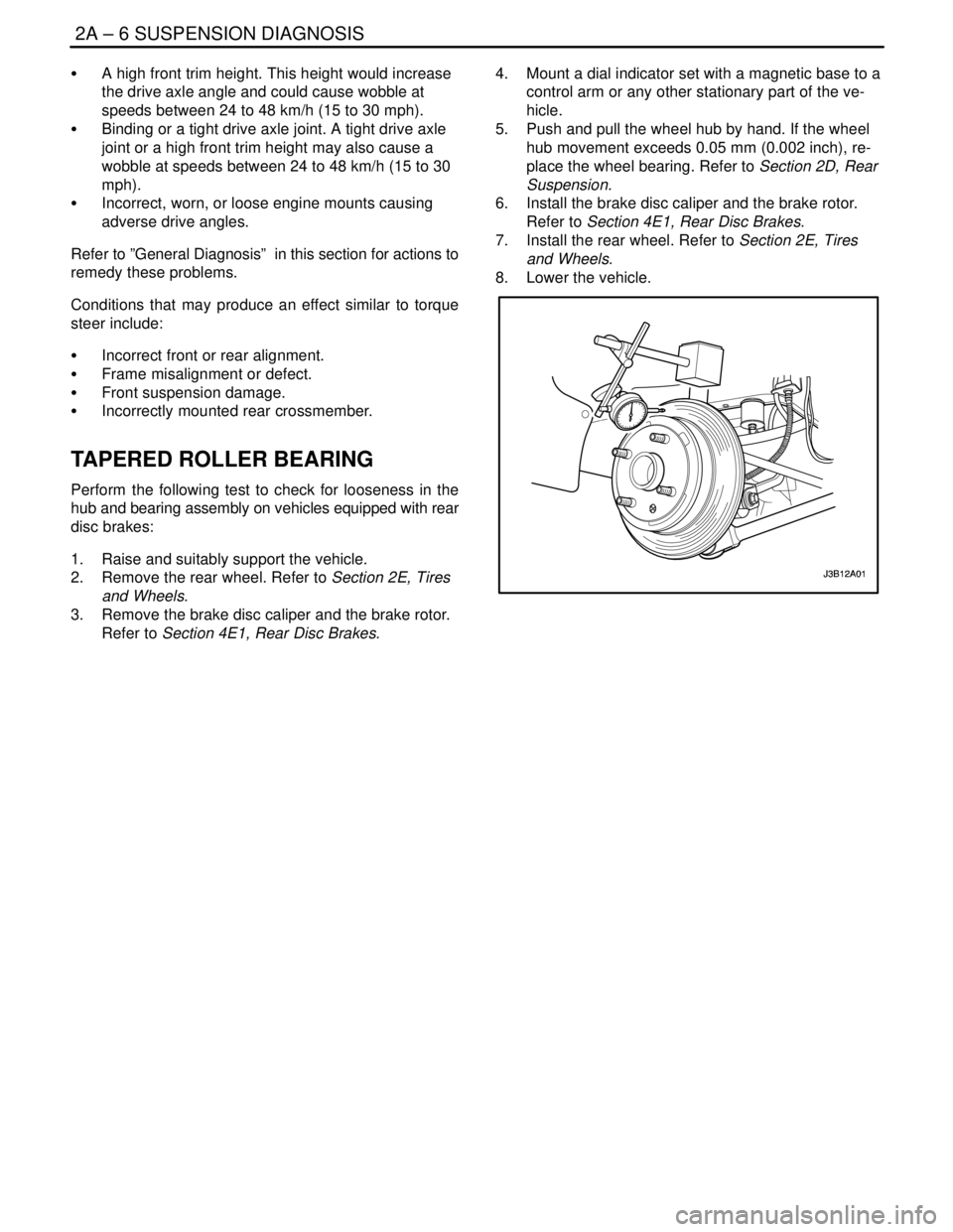
TAPERED ROLLER BEARING
Perform the following test to check for looseness in the
hub and bearing assembly on vehicles equipped with rear
disc brakes:
1. Raise and suitably support the vehicle.
2. Remove the rear wheel. Refer to Section 2E, Tires
and Wheels.
3. Remove the brake disc caliper and the brake rotor.
Refer to Section 4E1, Rear Disc Brakes.4. Mount a dial indicator set with a magnetic base to a
control arm or any other stationary part of the ve-
hicle.
5. Push and pull the wheel hub by hand. If the wheel
hub movement exceeds 0.05 mm (0.002 inch), re-
place the wheel bearing. Refer to Section 2D, Rear
Suspension.
6. Install the brake disc caliper and the brake rotor.
Refer to Section 4E1, Rear Disc Brakes.
7. Install the rear wheel. Refer to Section 2E, Tires
and Wheels.
8. Lower the vehicle.