Page 1006 of 3502
CO-54
[VQ]
SERVICE DATA AND SPECIFICATIONS (SDS)
SERVICE DATA AND SPECIFICATIONS (SDS)PFP:00100
Standard and LimitBBS004X9
ENGINE COOLANT CAPACITY (APPROXIMATE)
Unit: (Imp qt)
RADIATOR
Unit: kPa (bar, kg/cm2 , psi)
THERMOSTAT
Engine coolant capacity (With reservoir tank at “MAX” level)8.2 (7-1/4) [VQ23DE]
8.8 (7-3/4) [VQ35DE]
Reservoir tank engine coolant capacity (At “MAX” level) 0.8 (3/4)
Cap relief pressureStandard 78 - 98 (0.78 - 0.98, 0.8 - 1.0, 11 - 14)
Limit 59 (0.59, 0.6, 9)
Leakage test pressure 157 (1.57, 1.6, 23)
Valve opening temperature 80.5 - 83.5°C (177 - 182°F)
Maximum valve lift 8.6 mm / 95°C (0.339 in /203°F)
Valve closing temperature 77°C (171°F)
Page 1020 of 3502
CVT-14
CVT FLUID
9. Check CVT fluid condition.
�If CVT fluid is very dark or smells burned, check operation of
CVT. Flush cooling system after repair of CVT.
�If CVT fluid contains frictional material (clutches, bands, etc.),
replace radiator and flush cooler line using cleaning solvent
and compressed air after repair of CVT. Refer to CO-37,
"RADIATOR" .
Changing CVT FluidBCS001FY
1. Warm up CVT fluid by driving the vehicle for 10 minutes.
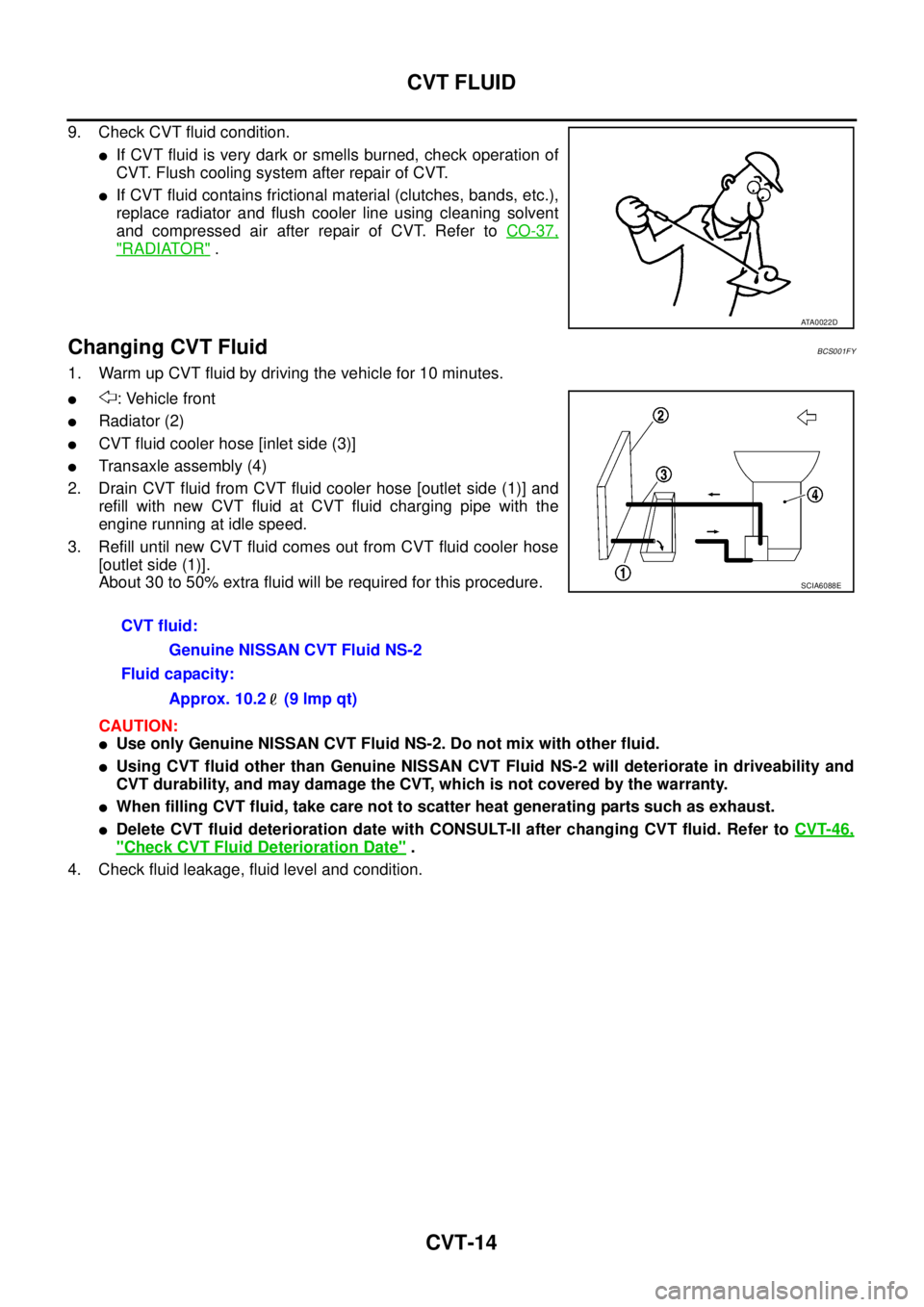
�: Vehicle front
�Radiator (2)
�CVT fluid cooler hose [inlet side (3)]
�Transaxle assembly (4)
2. Drain CVT fluid from CVT fluid cooler hose [outlet side (1)] and
refill with new CVT fluid at CVT fluid charging pipe with the
engine running at idle speed.
3. Refill until new CVT fluid comes out from CVT fluid cooler hose
[outlet side (1)].
About 30 to 50% extra fluid will be required for this procedure.
CAUTION:
�Use only Genuine NISSAN CVT Fluid NS-2. Do not mix with other fluid.
�Using CVT fluid other than Genuine NISSAN CVT Fluid NS-2 will deteriorate in driveability and
CVT durability, and may damage the CVT, which is not covered by the warranty.
�When filling CVT fluid, take care not to scatter heat generating parts such as exhaust.
�Delete CVT fluid deterioration date with CONSULT-II after changing CVT fluid. Refer to CVT-46,
"Check CVT Fluid Deterioration Date" .
4. Check fluid leakage, fluid level and condition.
ATA0022D
CVT fluid:
Genuine NISSAN CVT Fluid NS-2
Fluid capacity:
Approx. 10.2 (9 lmp qt)
SCIA6088E
Page 1196 of 3502
CVT-190
CVT FLUID COOLER SYSTEM
REMOVAL
WARNING:
Never remove the radiator cap when the engine is hot. Serious burns could occur from high pressure
engine coolant escaping from the radiator.
1. Remove engine undercover.
2. Drain engine coolant. Refer to CO-34, "
Changing Engine Coolant" .
CAUTION:
Perform when the engine is cold.
3. Remove air duct (inlet). Refer to EM-131, "
Removal and Installation" .
4. Remove battery. Refer to SC-13, "
Removal and Installation" .
5. Remove air cleaner case (upper and lower), resonator, mass air flow sensor and air duct assembly. Refer
to EM-131, "
Removal and Installation" .
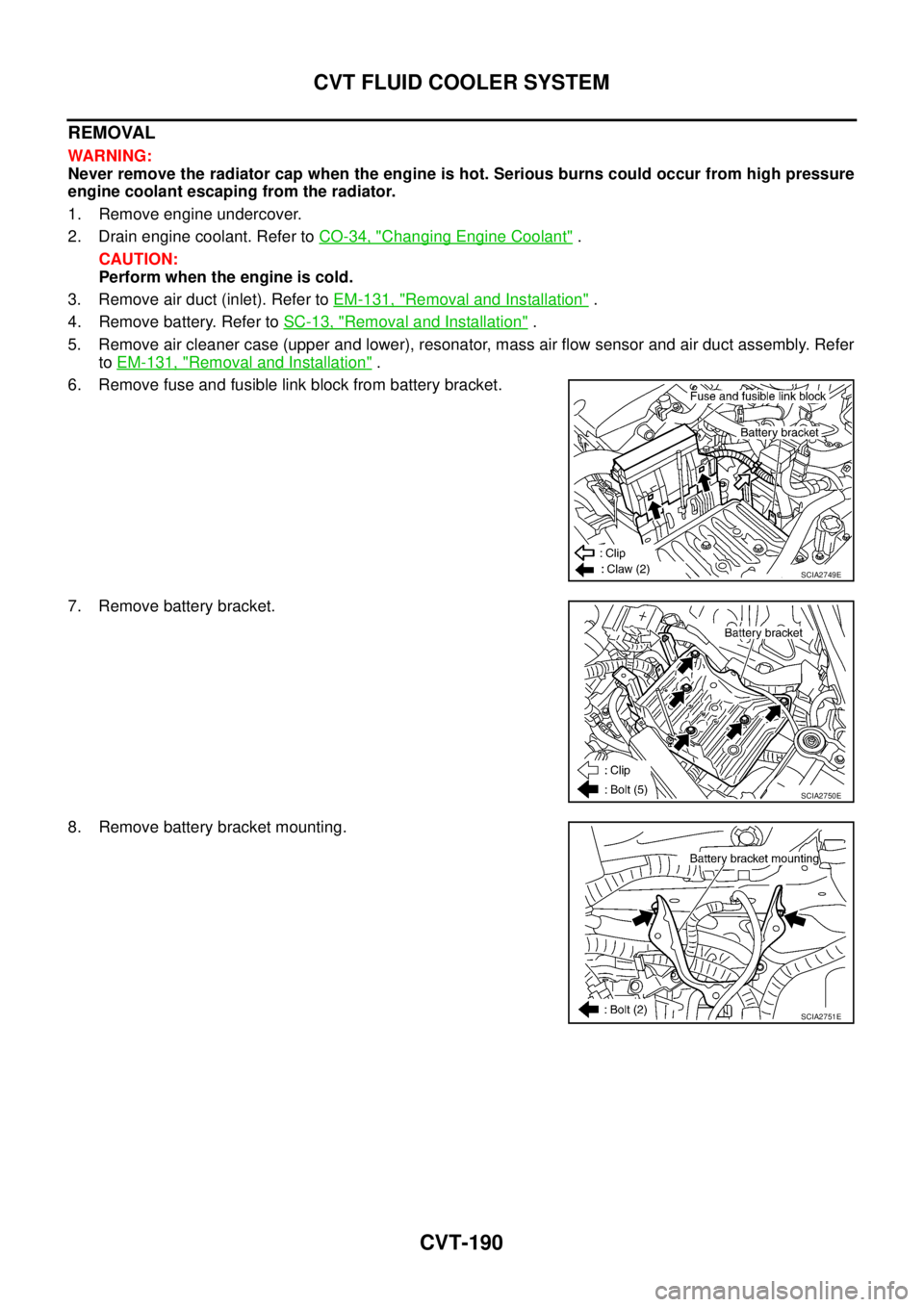
6. Remove fuse and fusible link block from battery bracket.
7. Remove battery bracket.
8. Remove battery bracket mounting.
SCIA2749E
SCIA2750E
SCIA2751E
Page 1199 of 3502
TRANSAXLE ASSEMBLY
CVT-193
D
E
F
G
H
I
J
K
L
MA
B
CVT
TRANSAXLE ASSEMBLYPFP:32020
Removal and InstallationBCS001N0
COMPONENTS
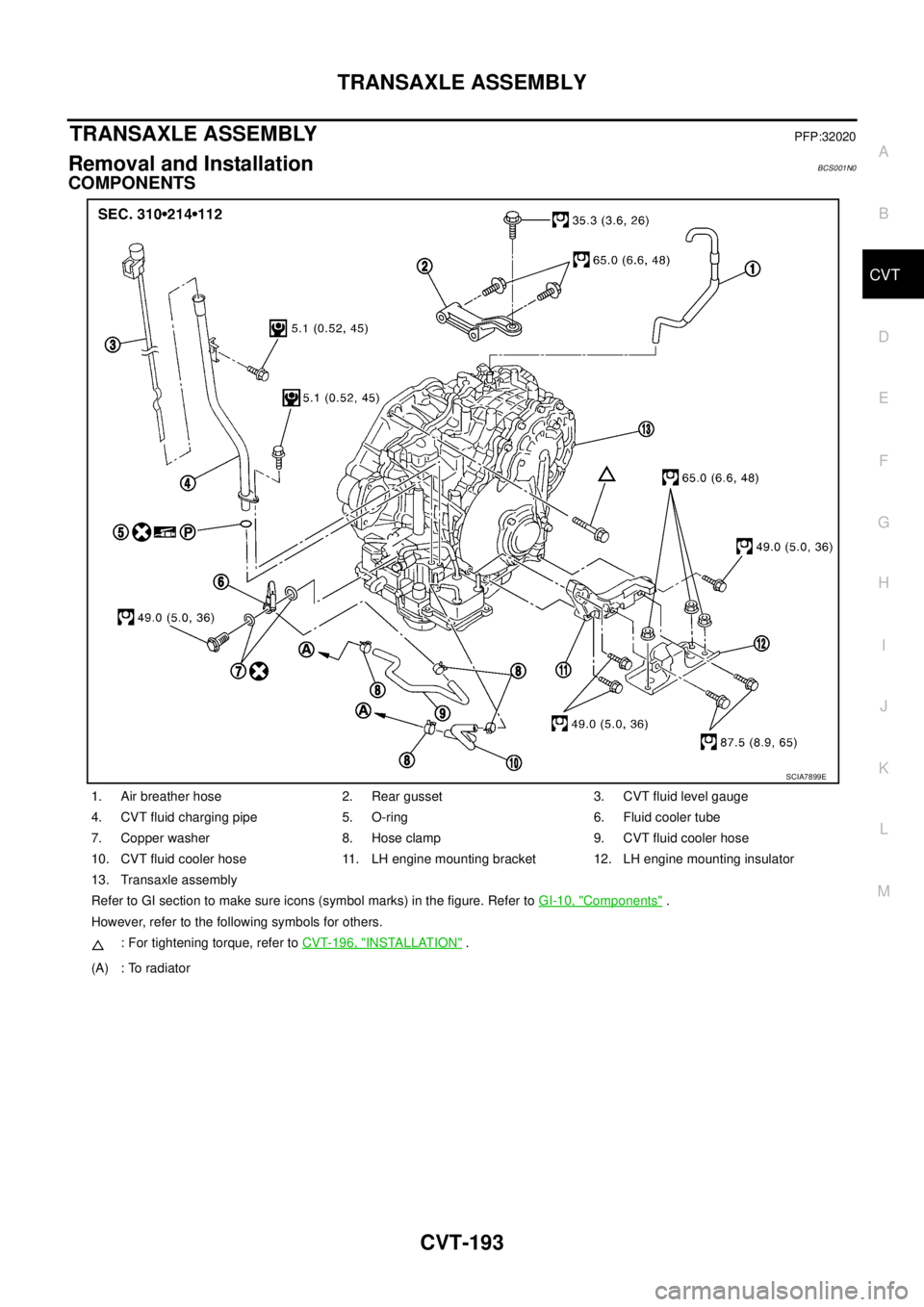
1. Air breather hose 2. Rear gusset 3. CVT fluid level gauge
4. CVT fluid charging pipe 5. O-ring 6. Fluid cooler tube
7. Copper washer 8. Hose clamp 9. CVT fluid cooler hose
10. CVT fluid cooler hose 11. LH engine mounting bracket 12. LH engine mounting insulator
13. Transaxle assembly
Refer to GI section to make sure icons (symbol marks) in the figure. Refer to GI-10, "
Components" .
However, refer to the following symbols for others.
: For tightening torque, refer to CVT-196, "
INSTALLATION" .
(A) : To radiator
SCIA7899E
Page 1300 of 3502
EC-18
[QR]
PREPARATION
PREPARATIONPFP:00002
Special Service ToolsBBS005BC
Tool number
Tool nameDescription
EG17650301
Radiator cap tester
adapterAdapting radiator cap tester to radiator cap and
radiator filler neck
a: 28 (1.10) dia.
b: 31.4 (1.236) dia.
c: 41.3 (1.626) dia.
Unit: mm (in)
KV10117100
Heated oxygen
sensor wrenchLoosening or tightening heated oxygen sensor
with 22 mm (0.87 in) hexagon nut
KV10114400
Heated oxygen
sensor wrenchLoosening or tightening heated oxygen sensor
a: 22 mm (0.87 in)
KV109E0010
Break-out boxMeasuring ECM signals with a circuit tester
KV109E0080
Y-cable adapterMeasuring ECM signals with a circuit tester
S-NT564
S-NT379
S-NT636
NT825
NT826
Page 1345 of 3502
TROUBLE DIAGNOSIS
EC-63
[QR]
C
D
E
F
G
H
I
J
K
L
MA
EC
1 - 6: The numbers refer to the order of inspection.Exhaust Exhaust manifold/Tube/Muffler/
Gasket
55555 55 5EM-23
, EX-
2Three way catalyst
Lubrica-
tionOil pan/Oil strainer/Oil pump/Oil
filter/Oil gallery
55555 55 52EM-26
, LU-
11 , LU-10 ,
LU-5
Oil level (Low)/Filthy oilLU-7
Cooling
Radiator/Hose/Radiator filler cap
55555 55 25CO-13,
CO-16
Thermostat 5CO-24
Water pumpCO-22
Water galleryCO-8
Cooling fan 5CO-20
Coolant level (low)/Contaminated
coolantCO-10
NATS (Nissan Anti-theft System) 1 1BL-139 or
EC-32
SYMPTOM
Reference
page
HARD/NO START/RESTART (EXCP. HA)
ENGINE STALL
HESITATION/SURGING/FLAT SPOT
SPARK KNOCK/DETONATION
LACK OF POWER/POOR ACCELERATION
HIGH IDLE/LOW IDLE
ROUGH IDLE/HUNTING
IDLING VIBRATION
SLOW/NO RETURN TO IDLE
OVERHEATS/WATER TEMPERATURE HIGH
EXCESSIVE FUEL CONSUMPTION
EXCESSIVE OIL CONSUMPTION
BATTERY DEAD (UNDER CHARGE)
Warranty symptom code AA AB AC AD AE AF AG AH AJ AK AL AM HA
Page 1502 of 3502
![NISSAN TEANA 2003 Service Manual EC-220
[QR]
DTC P1217 ENGINE OVER TEMPERATURE
CAUTION:
When a malfunction is indicated, be sure to replace the coolant. Refer to CO-10, "
Changing Engine
Coolant" . Also, replace the engine oil. Ref](/manual-img/5/57392/w960_57392-1501.png "NISSAN TEANA 2003 Service Manual EC-220
[QR]
DTC P1217 ENGINE OVER TEMPERATURE
CAUTION:
When a malfunction is indicated, be sure to replace the coolant. Refer to CO-10, \"
Changing Engine
Coolant\" . Also, replace the engine oil. Ref")
EC-220
[QR]
DTC P1217 ENGINE OVER TEMPERATURE
CAUTION:
When a malfunction is indicated, be sure to replace the coolant. Refer to CO-10, "
Changing Engine
Coolant" . Also, replace the engine oil. Refer to LU-9, "Changing Engine Oil" .
1. Fill radiator with coolant up to specified level with a filling speed of 2 liters per minute. Be sure to
use coolant with the proper mixture ratio. Refer to MA-15, "
Anti-Freeze Coolant Mixture Ratio" .
2. After refilling coolant, run engine to ensure that no water-flow noise is emitted.
Overall Function CheckBBS005GA
Use this procedure to check the overall function of the cooling fan. During this check, a DTC might not be con-
firmed.
WARNING:
Never remove the radiator cap when the engine is hot. Serious burns could be caused by high pres-
sure fluid escaping from the radiator.
Wrap a thick cloth around cap. Carefully remove the cap by turning it a quarter turn to allow built-up
pressure to escape. Then turn the cap all the way off.
WITH CONSULT-II
1. Check the coolant level in the reservoir tank and radiator.
Allow engine to cool before checking coolant level.
If the coolant level in the reservoir tank and/or radiator is below
the proper range, skip the following steps and go to EC-224,
"Diagnostic Procedure" .
2. Confirm whether customer filled the coolant or not. If customer
filled the coolant, skip the following steps and go to EC-224,
"Diagnostic Procedure" .
3. Turn ignition switch ON.
4. Perform “COOLING FAN” in “ACTIVE TEST” mode with CON-
SULT-II.
5. If the results are NG, go to EC-224, "
Diagnostic Procedure" .
DTC No. Trouble diagnosis name DTC detecting condition Possible cause
P1217
1217Engine over tempera-
ture (Overheat)
�Cooling fan does not operate properly (Over-
heat).
�Cooling fan system does not operate prop-
erly (Overheat).
�Engine coolant was not added to the system
using the proper filling method.
�Engine coolant is not within the specified
range.
�Harness or connectors
(The cooling fan circuit is open or
shorted.)
�IPDM E/R
�Cooling fan
�Radiator hose
�Radiator
�Radiator cap
�Water pump
�Thermostat
For more information, refer to EC-227,
"Main 12 Causes of Overheating" .
SEF621W
SEF646X
Page 1503 of 3502
DTC P1217 ENGINE OVER TEMPERATURE
EC-221
[QR]
C
D
E
F
G
H
I
J
K
L
MA
EC
WITHOUT CONSULT-II
1. Check the coolant level in the reservoir tank and radiator.
Allow engine to cool before checking coolant level.
If the coolant level in the reservoir tank and/or radiator is below
the proper range, skip the following steps and go to EC-224,
"Diagnostic Procedure" .
2. Confirm whether customer filled the coolant or not. If customer
filled the coolant, skip the following steps and go to EC-224,
"Diagnostic Procedure" .
3. Perform IPDM E/R auto active test and check cooling fan motors
operation, refer to PG-21, "
Auto Active Test" .
4. If NG, go to EC-224, "
Diagnostic Procedure" .SEF621W
![NISSAN TEANA 2003 Service Manual CO-54
[VQ]
SERVICE DATA AND SPECIFICATIONS (SDS)
SERVICE DATA AND SPECIFICATIONS (SDS)PFP:00100
Standard and LimitBBS004X9
ENGINE COOLANT CAPACITY (APPROXIMATE)
Unit: (Imp qt)
RADIATOR
Unit: kPa (](/manual-img/5/57392/w960_57392-1005.png "NISSAN TEANA 2003 Service Manual CO-54
[VQ]
SERVICE DATA AND SPECIFICATIONS (SDS)
SERVICE DATA AND SPECIFICATIONS (SDS)PFP:00100
Standard and LimitBBS004X9
ENGINE COOLANT CAPACITY (APPROXIMATE)
Unit: (Imp qt)
RADIATOR
Unit: kPa (")
![NISSAN TEANA 2003 Service Manual EC-18
[QR]
PREPARATION
PREPARATIONPFP:00002
Special Service ToolsBBS005BC
Tool number
Tool nameDescription
EG17650301
Radiator cap tester
adapterAdapting radiator cap tester to radiator cap and
ra](/manual-img/5/57392/w960_57392-1299.png "NISSAN TEANA 2003 Service Manual EC-18
[QR]
PREPARATION
PREPARATIONPFP:00002
Special Service ToolsBBS005BC
Tool number
Tool nameDescription
EG17650301
Radiator cap tester
adapterAdapting radiator cap tester to radiator cap and
ra")
![NISSAN TEANA 2003 Service Manual TROUBLE DIAGNOSIS
EC-63
[QR]
C
D
E
F
G
H
I
J
K
L
MA
EC
1 - 6: The numbers refer to the order of inspection.Exhaust Exhaust manifold/Tube/Muffler/
Gasket
55555 55 5EM-23
, EX-
2Three way catalyst
Lub](/manual-img/5/57392/w960_57392-1344.png "NISSAN TEANA 2003 Service Manual TROUBLE DIAGNOSIS
EC-63
[QR]
C
D
E
F
G
H
I
J
K
L
MA
EC
1 - 6: The numbers refer to the order of inspection.Exhaust Exhaust manifold/Tube/Muffler/
Gasket
55555 55 5EM-23
, EX-
2Three way catalyst
Lub")
![NISSAN TEANA 2003 Service Manual DTC P1217 ENGINE OVER TEMPERATURE
EC-221
[QR]
C
D
E
F
G
H
I
J
K
L
MA
EC
WITHOUT CONSULT-II
1. Check the coolant level in the reservoir tank and radiator.
Allow engine to cool before checking coolan](/manual-img/5/57392/w960_57392-1502.png "NISSAN TEANA 2003 Service Manual DTC P1217 ENGINE OVER TEMPERATURE
EC-221
[QR]
C
D
E
F
G
H
I
J
K
L
MA
EC
WITHOUT CONSULT-II
1. Check the coolant level in the reservoir tank and radiator.
Allow engine to cool before checking coolan")