2003 NISSAN 350Z run flat
[x] Cancel search: run flatPage 52 of 227
immediatelyand call a NISSAN dealer or other
authorized repair shop.
The engine oil pressure warning light is not
designed to indicate a low oil level. Use the
dipstick to check the oil level.See ªEngine
oilº in the ª8. Maintenance and do-it-yourselfº
section.
CAUTION
Running the engine with the engine oil
pressure warning light on could cause
serious damage to the engine almost
immediately. Turn off the engine as
soon as it is safe to do so.
Low tire pressure warning light
(if so equipped)
The light comes on for about 1 second when the
key switch is turned ON, and then it turns off.
If the vehicle is being driven with a flat tire or
extremely low tire pressure, the light will illumi-
nate. Also a chime will sound for about 10
seconds if a tire is flat.
For additional information, see ªLow tire pres-
sure warning systemº in the ª5. Starting and
drivingº section and ªFlat tireº in the ª6. In caseof emergencyº section. Also, you can check the
tire pressure of all 4 tires on the trip computer
display. See ªTrip computerº earlier in this sec-
tion.
WARNING
IIf the light does not come on with the
key switch turned ON, have the ve-
hicle checked by a NISSAN dealer as
soon as possible.
IIf the light comes on while driving,
avoid sudden steering maneuvers or
abrupt braking, reduce vehicle speed,
pull off the road to a safe location
and stop the vehicle as soon as pos-
sible. Serious vehicle damage could
occur and may lead to an accident
and could result in serious personal
injury. Check the pressure for all four
tires and adjust the pressure to the
COLD tire pressure shown on the tire
placard. If the light still comes on
while driving after adjusting the tire
pressure, a tire may be flat. If you
have a flat tire, replace it with a spare
tire as soon as possible.IWhen a spare tire is mounted or a
wheel is replaced, tire pressure will
not be indicated and the low tire
pressure warning system will not
function. Contact your NISSAN
dealer as soon as possible for tire
replacement and/or system reset-
ting.
CAUTION
IThe low tire pressure warning is not a
substitute for the regular tire pres-
sure check. Be sure to check the tire
pressure regularly.
IIf the vehicle is being driven at
speeds of less than 20 MPH (32
km/h), the low tire pressure warning
system may not operate correctly.
IBe sure to install the specified size
for the front and rear tires.
Low washer fluid warning light
This light comes on when the washer tank fluid is
Instruments and controls
2-13
Z
02.9.13/Z33-D/V5.0
X
Page 120 of 227
d. You have had an accident involv-
ing damage to the exhaust system,
underbody, or rear of the vehicle.
THREE WAY CATALYSTThe three way catalyst is an emission control
device installed in the exhaust system. Exhaust
gases in the converter are burned at high tem-
peratures to help reduce pollutants.
WARNING
IThe exhaust gas and the exhaust sys-
tem are very hot. Keep people, ani-
mals or flammable materials away
from the exhaust system compo-
nents.
IDo not stop or park the vehicle over
flammable materials such as dry
grass, waste paper or rags. They may
ignite and cause a fire.
CAUTION
IDo not use leaded gasoline. Deposits
from leaded gasoline seriously re-
duce the three way catalyst's ability
to help reduce exhaust pollutants.
IKeep your engine tuned up. Malfunc-
tions in the ignition, fuel injection, or
electrical systems can cause overrich
fuel flow into the three way catalyst,
causing it to overheat. Do not keep
driving if the engine misfires, or if
noticeable loss of performance or
other unusual operating conditions
are detected. Have the vehicle in-
spected promptly by a NISSAN
dealer.
IAvoid driving with an extremely low
fuel level. Running out of fuel could
cause the engine to misfire, damag-
ing the three way catalyst.
IDo not race the engine while warm-
ing it up.
IDo not push or tow your vehicle to
start the engine.
LOW TIRE PRESSURE WARNING
SYSTEM (if so equipped)The low tire pressure warning system displays
pressure of all tires (except the spare tire) on the
trip computer by sending a signal from a sensor
that is installed in each wheel.
The low tire pressure warning system will acti-
vate only when the vehicle is driven at speeds
above 20 MPH (32 km/h). Also, this system may
not detect a sudden drop in tire pressure (for
example, a flat tire by catching something while
driving).
Frequently check the tire pressure indicator on
the trip computer and adjust pressure of each
tire properly. See ªTrip computerº in the ª2.
Instruments and controlsº section for the tire
pressure indicator.Flat tire warningIf the vehicle is being driven with a flat tire or
extremely low tire pressure (lower than 28 psi),
the low tire pressure warning light comes on,
and the chime sounds for about 10 seconds. On
the trip computer, the PSI indicator starts flash-
ing and the current display switches to the tire
pressure indicator.
For additional information regarding the above
warning, see ªTrip computerº and
Starting and driving
5-3
Z
02.9.13/Z33-D/V5.0
X
Page 135 of 227
IFollow the recommended periodic mainte-
nance schedule.
IKeep the tires inflated at the correct pres-
sure. Low pressure will increase tire wear and
waste fuel.
IKeep the front wheels in correct alignment.
Improper alignment will cause not only tire
wear but also lower fuel economy.
IAir conditioner operation lowers fuel
economy. Use the air conditioner only when
necessary.
IWhen cruising at highway speeds, it is more
economical to use the air conditioner and
leave the windows closed to reduce drag.
WARNING
IDo not stop or park the vehicle over
flammable materials such as dry
grass, waste paper or rags. They may
ignite and cause a fire.
INever leave the engine running while
the vehicle is unattended.
INever leave children unattended in
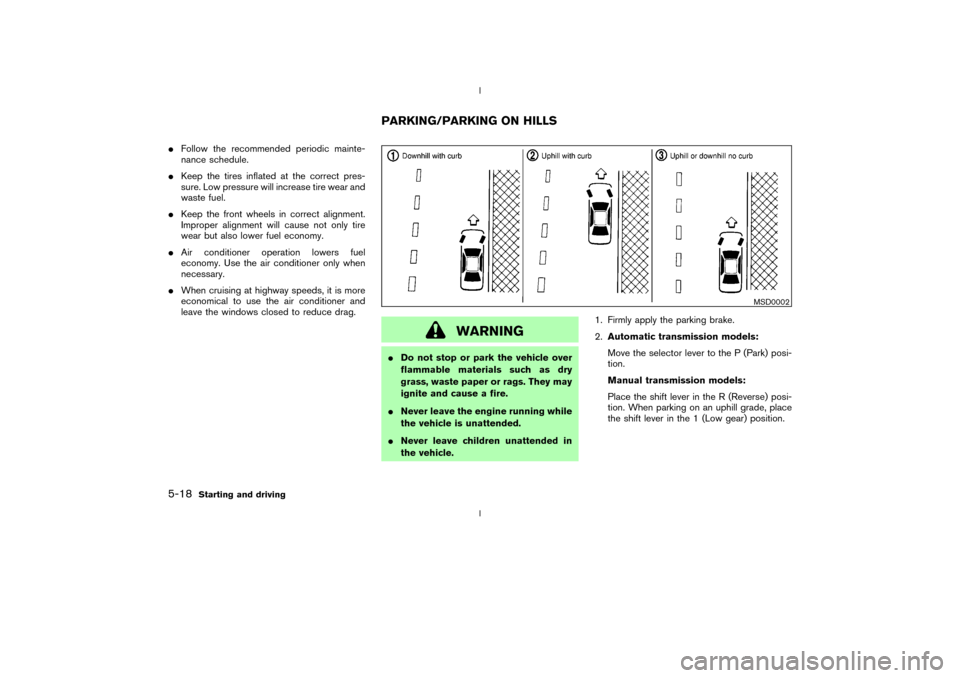
the vehicle.1. Firmly apply the parking brake.
2.Automatic transmission models:
Move the selector lever to the P (Park) posi-
tion.
Manual transmission models:
Place the shift lever in the R (Reverse) posi-
tion. When parking on an uphill grade, place
the shift lever in the 1 (Low gear) position.
MSD0002
PARKING/PARKING ON HILLS
5-18
Starting and driving
Z
02.9.13/Z33-D/V5.0
X
Page 221 of 227

Controls, Heater and air conditioner controls
(automatic) ..................................................................... 4-3
Coolant
Capacities and recommended fuel/
lubricants ................................................................. 9-2
Changing engine coolant .................................... 8-9
Checking engine coolant level........................... 8-8
Corrosion protection ................................................... 7-5
Cruise control............................................................. 5-15
Cup holders ................................................................ 2-30
Curtain side-impact air bag system (See
supplemental side air bag and curtain side-impact
air bag system) .......................................................... 1-13
D
Daytime running light system ................................. 2-23
Defroster switch, Rear window and outside mirror
defroster switch ......................................................... 2-21
Dimensions and weights ............................................ 9-9
Door open warning light .......................................... 2-12
Drive belts ................................................................... 8-17
Driving
Cold weather driving ......................................... 5-24
Driving with automatic transmission........ 5-5, 5-9
Driving with manual transmission .......... 5-6, 5-12
Precautions when starting and driving ............ 5-2
E
Economy, Fuel............................................................ 5-17
Emission control information label ........................ 9-11
Emission control system warranty......................... 9-20Engine
Before starting the engine .................................. 5-8
Capacities and recommended fuel/
lubricants ................................................................. 9-2
Changing engine coolant .................................... 8-9
Changing engine oil and filter ......................... 8-10
Checking engine coolant level........................... 8-8
Checking engine oil level ................................. 8-10
Coolant temperature gauge ............................... 2-5
Engine block heater ........................................... 5-25
Engine compartment check locations.............. 8-7
Engine cooling system ......................................... 8-8
Engine oil .............................................................. 8-10
Engine oil and oil filter recommendation......... 9-5
Engine oil viscosity ............................................... 9-5
Engine serial number ......................................... 9-11
Engine specifications ........................................... 9-8
If your vehicle overheats ...................................... 6-9
Starting the engine ............................................... 5-8
Exhaust gas (Carbon monoxide).............................. 5-2
F
F.M.V.S.S. certification label................................... 9-11
Filter, Air cleaner housing filter .............................. 8-18
Flashers (See hazard warning flasher switch) ... 2-24
Flat tire............................................................................ 6-2
Low tire pressure warning system .................... 5-3
Floor mat cleaning ....................................................... 7-4
Fluid
Automatic transmission fluid (ATF) ................ 8-12
Brake and clutch fluid ....................................... 8-13
Brake fluid............................................................. 8-13Capacities and recommended fuel/
lubricants ................................................................. 9-2
Engine coolant ....................................................... 8-8
Engine oil .............................................................. 8-10
Power steering fluid ........................................... 8-13
Window washer fluid ......................................... 8-14
FM-AM radio with cassette player and Compact
Disc (CD) changer.................................................... 4-13
Front air bag system (See supplemental restraint
system) ......................................................................... 1-11
Front manual seat adjustment .................................. 1-3
Front power seat adjustment .................................... 1-4
Fuel
Capacities and recommended fuel/
lubricants ................................................................. 9-2
filler cap................................................................. 3-10
filler lid ................................................................... 3-10
Fuel economy ...................................................... 5-17
Fuel octane rating ................................................. 9-3
Fuel recommendation ........................................... 9-3
Gauge ...................................................................... 2-6
Fuses ............................................................................ 8-22
Fusible links ................................................................ 8-23
G
Garage door opener, HomeLink
Universal
Transceiver .................................................................. 2-36
Gas cap ....................................................................... 3-10
Gauge ............................................................................. 2-3
Engine coolant temperature gauge .................. 2-5
Fuel gauge .............................................................. 2-6
Odometer ................................................................ 2-4
Speedometer .......................................................... 2-4
Z
02.9.13/Z33-D/V5.0
X
10-2