2003 NISSAN 350Z oil change
[x] Cancel search: oil changePage 43 of 227

Triple meter:
1. Trip computer
2. Engine oil pressure gauge
3. Volt meter
SPEEDOMETER AND ODOMETER
SpeedometerThe speedometer indicates vehicle speed.Odometer/Twin trip odometerThe odometer/twin trip odometer are displayed
when the ignition key is in the ON position.
The odometer records the total distance the
vehicle has been driven.
The twin trip odometer records the distance of
individual trips.Changing the display:
Pushing the reset knob changes the display as
follows:
TRIP A®TRIP B®TRIP A
Resetting the trip odometer:
Pushing the reset knob for more than 1 second
resets the trip odometer to zero.
SIC1948
SIC1949
2-4
Instruments and controls
Z
02.9.13/Z33-D/V5.0
X
Page 88 of 227

LOCK button again for 3 more seconds.Releasing the rear hatch1. Push the REAR HATCH button on the keyfob
for longer than 0.5 seconds with the key
removed from the ignition key cylinder.
2. The rear hatch opens.Using the panic alarmIf you are near your vehicle and feel threatened,
you may activate the alarm to call attention as
follows:
1. Push the PANIC button on the keyfob for
longer than 0.5 secondswith the key
removed from the ignition key cylinder.
2. The theft warning alarm and headlights will
stay on for 30 seconds.
3. The panic alarm stops when:
IIt has run for 30 seconds, or
IThe LOCK or the UNLOCK button is
pressed, or
IThe PANIC or the REAR HATCH button is
pushed on the keyfob for longer than 0.5
seconds.
BATTERY REPLACEMENTReplace the battery as follows:
1. Open the lid using a suitable tool.
2. Replace the battery with a new one.Recommended battery: CR2025 or equiva-
lent
Make sure that theÅside faces the
bottom case.
3. Close the lid securely.
4. Push the keyfob button two or three times to
check its operation.
See your NISSAN dealer if you need any assis-
tance for replacement.
If the battery is removed for any reason
other than replacement, perform step 4
above.
IBe careful not to touch the circuit board
and the battery terminal.
IAn improperly disposed battery can
harm the environment. Always confirm
local regulations for battery disposal.
IThe keyfob is water-resistant; however,
if it gets wet, immediately wipe it com-
pletely dry.
IWhen changing batteries, do not let
dust or oil get on the keyfob.
FCC Notice:
Changes or modifications not expressly
approved by the manufacturer compliance
SPA1374
Pre-driving checks and adjustments
3-7
Z
02.9.13/Z33-D/V5.0
X
Page 171 of 227
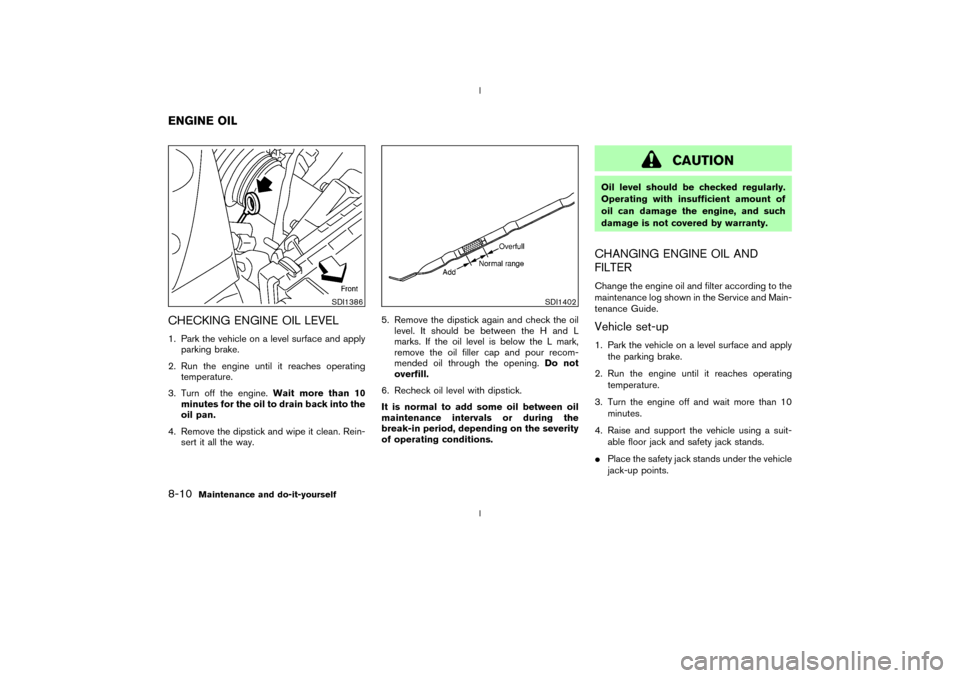
CHECKING ENGINE OIL LEVEL1. Park the vehicle on a level surface and apply
parking brake.
2. Run the engine until it reaches operating
temperature.
3. Turn off the engine.Wait more than 10
minutes for the oil to drain back into the
oil pan.
4. Remove the dipstick and wipe it clean. Rein-
sert it all the way.5. Remove the dipstick again and check the oil
level. It should be between the H and L
marks. If the oil level is below the L mark,
remove the oil filler cap and pour recom-
mended oil through the opening.Do not
overfill.
6. Recheck oil level with dipstick.
It is normal to add some oil between oil
maintenance intervals or during the
break-in period, depending on the severity
of operating conditions.
CAUTION
Oil level should be checked regularly.
Operating with insufficient amount of
oil can damage the engine, and such
damage is not covered by warranty.CHANGING ENGINE OIL AND
FILTERChange the engine oil and filter according to the
maintenance log shown in the Service and Main-
tenance Guide.Vehicle set-up1. Park the vehicle on a level surface and apply
the parking brake.
2. Run the engine until it reaches operating
temperature.
3. Turn the engine off and wait more than 10
minutes.
4. Raise and support the vehicle using a suit-
able floor jack and safety jack stands.
IPlace the safety jack stands under the vehicle
jack-up points.
SDI1386
SDI1402
ENGINE OIL8-10
Maintenance and do-it-yourself
Z
02.9.13/Z33-D/V5.0
X
Page 185 of 227

Replace the battery as follows:
1. Open the lid using a suitable tool.
2. Replace the battery with a new one.
Recommended battery: CR2025 or equiva-
lentMake sure that theÅside faces the
bottom case.
3. Close the lid securely.
4. Push the keyfob button two or three times to
check its operation.
See your NISSAN dealer if you need any assis-
tance for replacement.
If the battery is removed for any reason
other than replacement, perform step 4
above.
IBe careful not to touch the circuit board
and the battery terminal.
IAn improperly disposed battery can
harm the environment. Always confirm
local regulations for battery disposal.
IThe keyfob is water-resistant; however,
if it gets wet, immediately wipe it com-
pletely dry.
IWhen changing batteries, do not let
dust or oil get on the keyfob.
FCC Notice:
Changes or modifications not expressly
approved by the manufacturer compliance
could void the user's authority to operate
the equipment. This device complies with
Part 15 of the FCC Rules and RSS-210 ofIndustry Canada. Operation is subject to
the following two conditions: (1) This de-
vice may not cause harmful interference,
and (2) this device must accept any inter-
ference received, including interference
that may cause undesired operation of the
device.
SPA1374
KEYFOB BATTERY
REPLACEMENT8-24
Maintenance and do-it-yourself
Z
02.9.13/Z33-D/V5.0
X
Page 197 of 227

The following are approximate capacities. The actual refill capacities may be a little different. When refilling, follow the procedure
instructed in the ª8. Maintenance and do-it-yourselfº section to determine the proper refill capacity.
Capacity (Approximate)
Recommended
specifications US
measureImp
measureLiter
Fuel 20 gal 16-5/8 gal 76 Unleaded premium gasoline with an octane rating of at least 91 AKI (RON 96)*1
Engine oil (Drain and refill)*2
With oil filter change 5 qt 4-1/8 qt 4.7IAPI Certification Mark*3, *4
IAPI grade SG/SH, Energy ConservingI&IIorAPIgrade SJ or SL, Energy
Conserving*3, *4
IILSAC grade GF-I, GF-II & GF-III*2, *3 Without oil filter change 4-5/8 qt 3-7/8 qt 4.4
Cooling system
With reservoir 9-1/4 qt 7-5/8 qt 8.7
Genuine NISSAN anti-freeze coolant or equivalent
Reservoir 7/8 qt 3/5 qt 0.8
Automatic transmission fluid Ð Ð Ð Genuine Nissan ATF Matic Fluid J or exact equivalent*5
Manual transmission gear oil Ð Ð Ð API GL-4, Viscosity SAE 75W-85
Differential gear oil Ð Ð Ð API GL-5, Viscosity SAE 80W-90*6
Power steering fluid
Refill to the proper oil level according to the instructions in
the ª8. Maintenance and do-it-yourselfº section.Genuine Nissan PSF II or equivalent*7
Brake and clutch fluidGenuine Nissan Brake Fluid*8 or equivalent DOT 3 (U.S. FMVSS No. 116)
Multi-purpose grease Ð Ð Ð NLGI No. 2 (Lithium soap base)
Air conditioning system refrigerant Ð Ð Ð HFC-134a (R-134a)*9
Air conditioning system lubricants Ð Ð Ð Nissan A/C System Oil Type S or exact equivalent
*1: For additional information, see ªFuel recommendationº later in this chapter.
*2: For additional information, see ªEngine oilº in the ª8. Maintenance and do-it-yourselfº section for changing engine oil.
*3: For additional information, see ªEngine oil and oil filter recommendationº later in this chapter.
*4: For additional information, see ªRecommended SAE viscosity numberº later in this chapter.
*5: Using automatic transmission fluid other than Nissan Genuine ATF Matic Fluid J will cause deterioration in driveability and automatic transmission durability, and may
damage the automatic transmission, which is not covered by the NISSAN new vehicle limited warranty.
*6: For hot areas, viscosity SAE 90 is suitable for ambient temperatures above 32ÉF (0ÉC).
*7: Genuine Nissan PSF, Canada Nissan Automatic Transmission fluid, Dexron
TMIII/Mercon
TMor equivalent ATF may also be used.
*8: Available in mainland US through your NISSAN dealer.
*9: For additional information, see ªVehicle identificationº in this section for air conditioner specification label.
CAPACITIES AND
RECOMMENDED FUEL/
LUBRICANTS9-2
Technical and consumer information
Z
02.9.13/Z33-D/V5.0
X
Page 200 of 227

ENGINE OIL AND OIL FILTER
RECOMMENDATION
Selecting the correct oilIt is essential to choose the correct quality, and
viscosity oil to ensure satisfactory engine life and
performance. NISSAN recommends the use of a
low friction oil (energy conserving oil) in order to
improve fuel economy and conserve energy. Oils
which do not have the specified quality label
should not be used as they could cause engine
damage.
Only those engine oils with the American Petro-
leum Institute (API) certification mark on the frontof the container should be used. This type of oil
supersedes the existing API SG, SH, or SJ and
Energy ConservingI&IIcategories.
If you cannot find engine oil with the API certifi-
cation mark, use an API grade SG/SH, Energy
ConservingI&IIorAPIgrade SJ or SL, Energy
conserving oil. An oil with a single designation
SG or SH, or in combination with other catego-
ries (for example, SG/CC or SG/CD) may also
be used if one with the API certification mark
cannot be found. An ILSAC grade GF-I, GF-II &
GF-III oil can also be used.
NISSAN recommends mineral based oils. These
oils must however, meet the API quality and SAEviscosity ratings specified for your vehicle.
Oil additivesNISSAN does not recommend the use of oil
additives. The use of an oil additive is not
necessary when the proper oil type is used and
maintenance intervals are followed.
Oil which may contain foreign matter or has
been previously used should not be used.Oil viscosityThe engine oil viscosity or thickness changes
with temperature. Because of this, it is important
that the engine oil viscosity be selected based
on the temperatures at which the vehicle will be
operated before the next oil change. The ªRec-
ommended SAE viscosity numberº chart (on the
next page) shows the recommended oil viscosi-
ties for the expected ambient temperatures.
Choosing an oil viscosity other than that recom-
mended could cause serious engine damage.Selecting the correct oil filterYour new NISSAN vehicle is equipped with a
high-quality genuine NISSAN oil filter. When
replacing, use a genuine NISSAN oil filter or its
equivalent for the reason described in ªChange
intervalsº.
STI0293
Technical and consumer information
9-5
Z
02.9.13/Z33-D/V5.0
X
Page 201 of 227
Change intervalsThe oil and oil filter change intervals for your
engine are based on the use of the specified
quality oils and filters. Oil and filter other than the
specified quality, or oil and filter change intervals
longer than recommended could reduce engine
life. Damage to engines caused by improper
maintenance or use of incorrect oil and filter
quality and/or viscosity is not covered by the
new NISSAN vehicle warranties.
Your engine was filled with a high quality engine
oil when it was built. You do not have to change
the oil before the first recommended change
interval. Oil and filter change intervals depend
upon how you use your vehicle. Operation under
the following conditions may require more fre-
quent oil and filter changes.
Irepeated short distance driving at cold out-
side temperatures,
Idriving in dusty conditions,
Iextensive idling,
Itowing a trailer,
Istop and go ªrush hourº traffic.
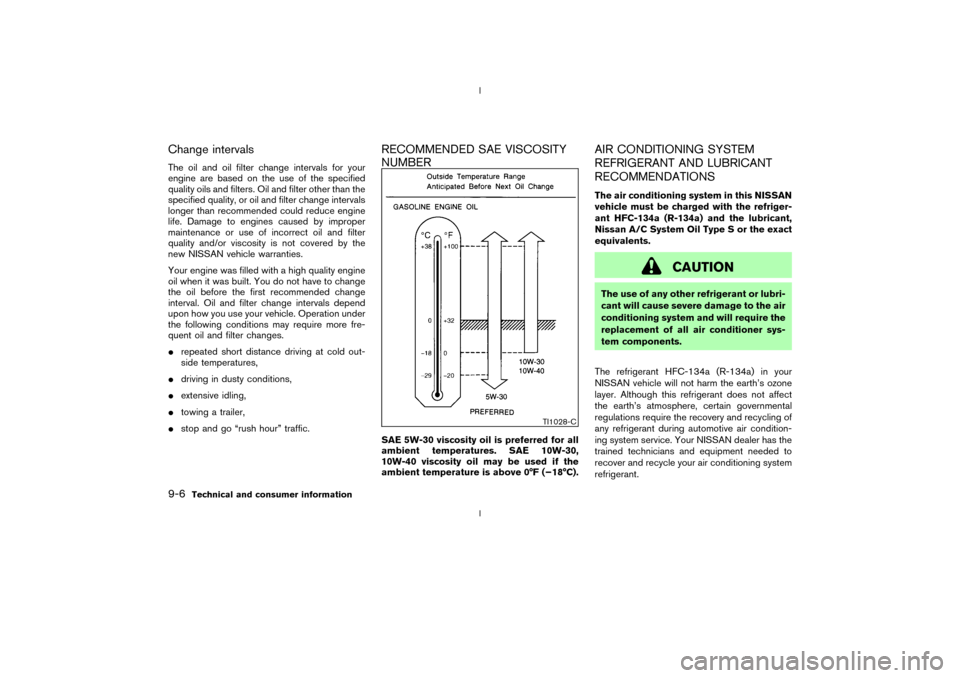
RECOMMENDED SAE VISCOSITY
NUMBERSAE 5W-30 viscosity oil is preferred for all
ambient temperatures. SAE 10W-30,
10W-40 viscosity oil may be used if the
ambient temperature is above 0ÉF (þ18ÉC).
AIR CONDITIONING SYSTEM
REFRIGERANT AND LUBRICANT
RECOMMENDATIONSThe air conditioning system in this NISSAN
vehicle must be charged with the refriger-
ant HFC-134a (R-134a) and the lubricant,
Nissan A/C System Oil Type S or the exact
equivalents.
CAUTION
The use of any other refrigerant or lubri-
cant will cause severe damage to the air
conditioning system and will require the
replacement of all air conditioner sys-
tem components.
The refrigerant HFC-134a (R-134a) in your
NISSAN vehicle will not harm the earth's ozone
layer. Although this refrigerant does not affect
the earth's atmosphere, certain governmental
regulations require the recovery and recycling of
any refrigerant during automotive air condition-
ing system service. Your NISSAN dealer has the
trained technicians and equipment needed to
recover and recycle your air conditioning system
refrigerant.
TI1028-C
9-6
Technical and consumer information
Z
02.9.13/Z33-D/V5.0
X
Page 221 of 227

Controls, Heater and air conditioner controls
(automatic) ..................................................................... 4-3
Coolant
Capacities and recommended fuel/
lubricants ................................................................. 9-2
Changing engine coolant .................................... 8-9
Checking engine coolant level........................... 8-8
Corrosion protection ................................................... 7-5
Cruise control............................................................. 5-15
Cup holders ................................................................ 2-30
Curtain side-impact air bag system (See
supplemental side air bag and curtain side-impact
air bag system) .......................................................... 1-13
D
Daytime running light system ................................. 2-23
Defroster switch, Rear window and outside mirror
defroster switch ......................................................... 2-21
Dimensions and weights ............................................ 9-9
Door open warning light .......................................... 2-12
Drive belts ................................................................... 8-17
Driving
Cold weather driving ......................................... 5-24
Driving with automatic transmission........ 5-5, 5-9
Driving with manual transmission .......... 5-6, 5-12
Precautions when starting and driving ............ 5-2
E
Economy, Fuel............................................................ 5-17
Emission control information label ........................ 9-11
Emission control system warranty......................... 9-20Engine
Before starting the engine .................................. 5-8
Capacities and recommended fuel/
lubricants ................................................................. 9-2
Changing engine coolant .................................... 8-9
Changing engine oil and filter ......................... 8-10
Checking engine coolant level........................... 8-8
Checking engine oil level ................................. 8-10
Coolant temperature gauge ............................... 2-5
Engine block heater ........................................... 5-25
Engine compartment check locations.............. 8-7
Engine cooling system ......................................... 8-8
Engine oil .............................................................. 8-10
Engine oil and oil filter recommendation......... 9-5
Engine oil viscosity ............................................... 9-5
Engine serial number ......................................... 9-11
Engine specifications ........................................... 9-8
If your vehicle overheats ...................................... 6-9
Starting the engine ............................................... 5-8
Exhaust gas (Carbon monoxide).............................. 5-2
F
F.M.V.S.S. certification label................................... 9-11
Filter, Air cleaner housing filter .............................. 8-18
Flashers (See hazard warning flasher switch) ... 2-24
Flat tire............................................................................ 6-2
Low tire pressure warning system .................... 5-3
Floor mat cleaning ....................................................... 7-4
Fluid
Automatic transmission fluid (ATF) ................ 8-12
Brake and clutch fluid ....................................... 8-13
Brake fluid............................................................. 8-13Capacities and recommended fuel/
lubricants ................................................................. 9-2
Engine coolant ....................................................... 8-8
Engine oil .............................................................. 8-10
Power steering fluid ........................................... 8-13
Window washer fluid ......................................... 8-14
FM-AM radio with cassette player and Compact
Disc (CD) changer.................................................... 4-13
Front air bag system (See supplemental restraint
system) ......................................................................... 1-11
Front manual seat adjustment .................................. 1-3
Front power seat adjustment .................................... 1-4
Fuel
Capacities and recommended fuel/
lubricants ................................................................. 9-2
filler cap................................................................. 3-10
filler lid ................................................................... 3-10
Fuel economy ...................................................... 5-17
Fuel octane rating ................................................. 9-3
Fuel recommendation ........................................... 9-3
Gauge ...................................................................... 2-6
Fuses ............................................................................ 8-22
Fusible links ................................................................ 8-23
G
Garage door opener, HomeLink
Universal
Transceiver .................................................................. 2-36
Gas cap ....................................................................... 3-10
Gauge ............................................................................. 2-3
Engine coolant temperature gauge .................. 2-5
Fuel gauge .............................................................. 2-6
Odometer ................................................................ 2-4
Speedometer .......................................................... 2-4
Z
02.9.13/Z33-D/V5.0
X
10-2