IUse the correct jack up points; never
use any other part of the vehicle for
jack support.
INever jack up the vehicle more than
necessary.
INever use blocks on or under the
jack.
IDo not start or run engine while ve-
hicle is on the jack, as it may cause
the vehicle to move. This is especially
true for vehicles with limited slip dif-
ferential carriers.
IDo not allow passengers to stay in
the vehicle while it is on the jack.
Installing the spare tire1. Clean any mud or dirt from the surface
between the wheel and hub.
2. Carefully put the wheel on and tighten the
wheel nuts finger tight. When replacing a
front tire, make sure the hole in the spare tire
wheel is aligned with the pin on the brake
rotor.
3. With the wheel nut wrench, tighten wheel
nuts alternately and evenly until they are tight.
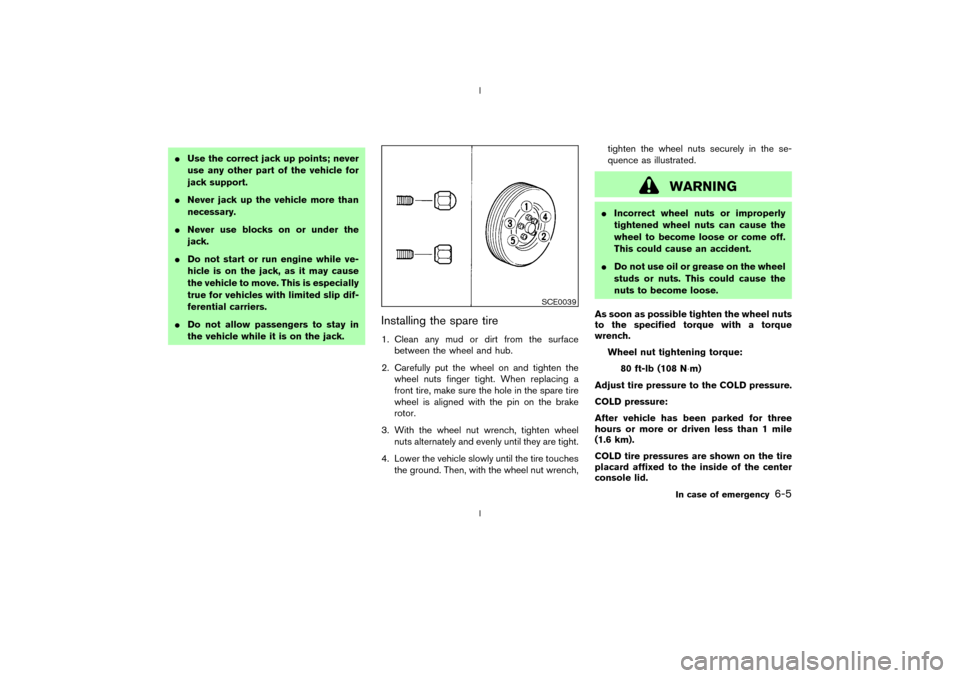
4. Lower the vehicle slowly until the tire touches
the ground. Then, with the wheel nut wrench,tighten the wheel nuts securely in the se-
quence as illustrated.
WARNING
IIncorrect wheel nuts or improperly
tightened wheel nuts can cause the
wheel to become loose or come off.
This could cause an accident.
IDo not use oil or grease on the wheel
studs or nuts. This could cause the
nuts to become loose.
As soon as possible tighten the wheel nuts
to the specified torque with a torque
wrench.
Wheel nut tightening torque:
80 ft-lb (108 N×m)
Adjust tire pressure to the COLD pressure.
COLD pressure:
After vehicle has been parked for three
hours or more or driven less than 1 mile
(1.6 km).
COLD tire pressures are shown on the tire
placard affixed to the inside of the center
console lid.
SCE0039
In case of emergency
6-5
Z
02.9.13/Z33-D/V5.0
X
All season tiresNISSAN specifies all season tires on some
models to provide good performance for use all
year around, including snowy and icy road con-
ditions. All season tires are identified by ALL
SEASON and/or M&S on the tire sidewall. Snow
tires have better snow traction than all season
tires and may be more appropriate in some
areas.Summer tiresNISSAN specifies summer tires on some models
to provide superior performance on dry roads.
Summer tire performance in snow and ice will be
substantially reduced. Summer tires do not have
the tire traction rating M&S on the tire sidewall.
If you operate your vehicle in snowy or icy
conditions, NISSAN recommends the use of
snow or all season tires on all four wheels.Snow tiresIf snow tires are needed, it is necessary to select
tires equivalent in size and load rating to the
original equipment tires. If you do not, it can
adversely affect the safety and handling of your
vehicle.
Generally, snow tires will have lower speed
ratings than factory equipped tires and may not
match the potential maximum vehicle speed.Never exceed the maximum speed rating of the
tire.
If you operate your vehicle in snowy or icy
conditions, NISSAN recommends the use of
snow or all season tires on all four wheels.
For additional traction on icy roads, studded tires
may be used. However, some provinces and
states prohibit their use. Check local, state and
provincial laws before installing studded tires.
Skid and traction capabilities of studded snow
tires, on wet or dry surfaces, may be poorer than
that of non-studded snow tires.
TIRE CHAINSUse of tire chains may be prohibited according
to location. Check the local laws before installing
tire chains. When installing tire chains, make
sure they are of proper size for the tires on your
vehicle and are installed according to the chain
manufacturer's suggestions.Use only SAE
class S chains.Class ªSº chains are used on
vehicles with restricted tire to vehicle clearance.
Vehicles that can use Class ªSº chains are
designed to meet the SAE standard minimum
clearances between the tire and the closest
vehicle suspension or body component required
to accommodate the use of a winter traction
device (tire chains or cables). The minimum
clearances are determined using the factory
equipped tire size. Other types may damageyour vehicle. Use chain tensioners when recom-
mended by the tire chain manufacturer to ensure
a tight fit. Loose end links of the tire chain must
be secured or removed to prevent the possibility
of whipping action damage to the fenders or
undercarriage. If possible, avoid fully loading
your vehicle when using tire chains. In addition,
drive at a reduced speed. Otherwise, your ve-
hicle may be damaged and/or vehicle handling
and performance may be adversely affected.
INever install tire chains on a T-type
spare tire.
IDo not use the chains on dry roads.
ITire chains must be installed only on the
rear wheels and not on the front wheels.
CHANGING WHEELS AND TIRES
Tire rotationTires cannot be rotated in this vehicle, as front
tires are different size from rear tires and the
direction of wheel rotation is fixed in each tire.
A pin is on the front brake rotor to prevent the
rear wheels from being installed in place of the
front wheels. The spare tire can be installed in
place of the front and rear wheels. When install-
ing the spare tire in the front wheel, the hole in
the spare tire wheel must be aligned with the pin
on the brake rotor.
Maintenance and do-it-yourself
8-31
Z
02.9.13/Z33-D/V5.0
X