Page 1381 of 1767
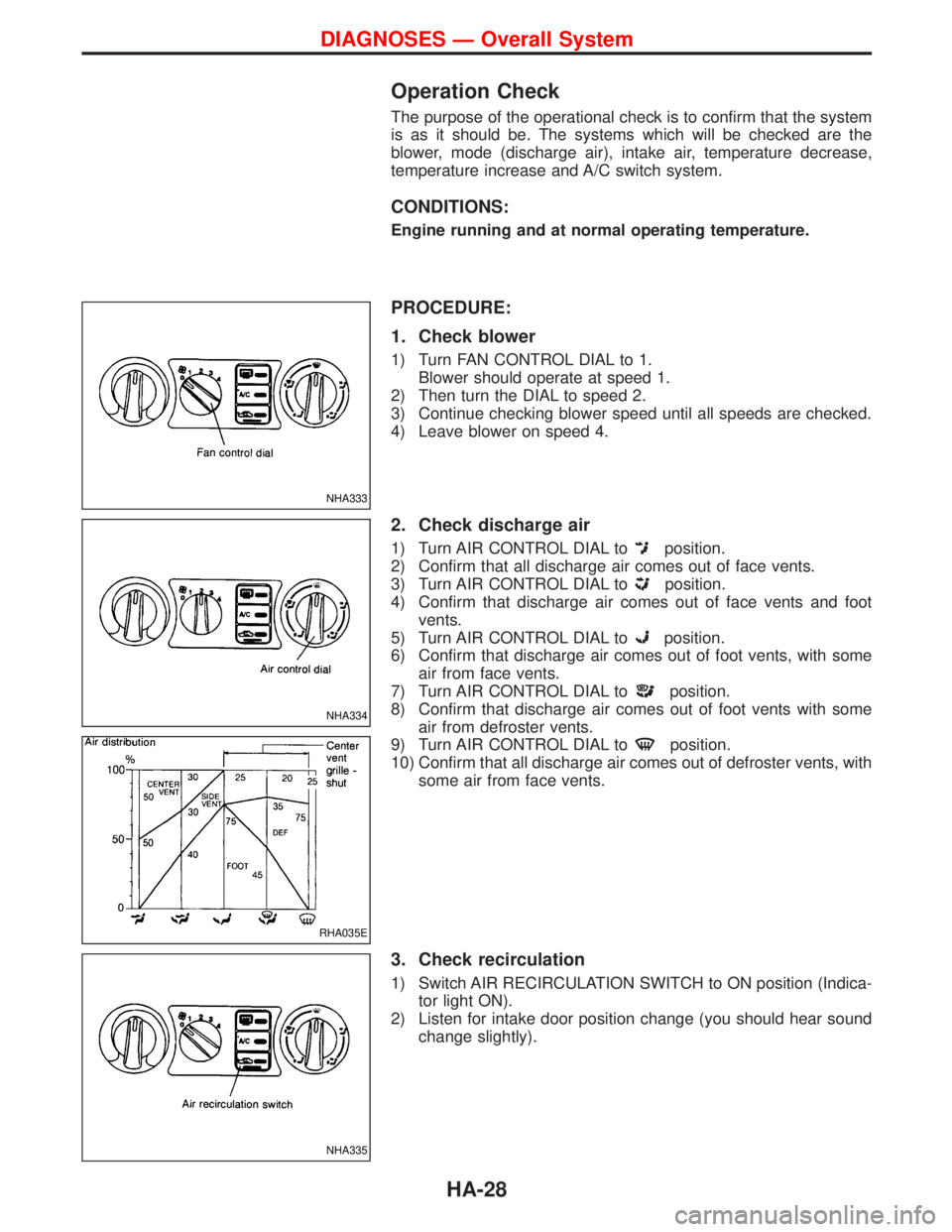
Operation Check
The purpose of the operational check is to confirm that the system
is as it should be. The systems which will be checked are the
blower, mode (discharge air), intake air, temperature decrease,
temperature increase and A/C switch system.
CONDITIONS:
Engine running and at normal operating temperature.
PROCEDURE:
1. Check blower
1) Turn FAN CONTROL DIAL to 1.
Blower should operate at speed 1.
2) Then turn the DIAL to speed 2.
3) Continue checking blower speed until all speeds are checked.
4) Leave blower on speed 4.
2. Check discharge air
1) Turn AIR CONTROL DIAL toposition.
2) Confirm that all discharge air comes out of face vents.
3) Turn AIR CONTROL DIAL to
position.
4) Confirm that discharge air comes out of face vents and foot
vents.
5) Turn AIR CONTROL DIAL to
position.
6) Confirm that discharge air comes out of foot vents, with some
air from face vents.
7) Turn AIR CONTROL DIAL to
position.
8) Confirm that discharge air comes out of foot vents with some
air from defroster vents.
9) Turn AIR CONTROL DIAL to
position.
10) Confirm that all discharge air comes out of defroster vents, with
some air from face vents.
3. Check recirculation
1) Switch AIR RECIRCULATION SWITCH to ON position (Indica-
tor light ON).
2) Listen for intake door position change (you should hear sound
change slightly).
NHA333
NHA334
RHA035E
NHA335
DIAGNOSES Ð Overall System
HA-28
Page 1385 of 1767
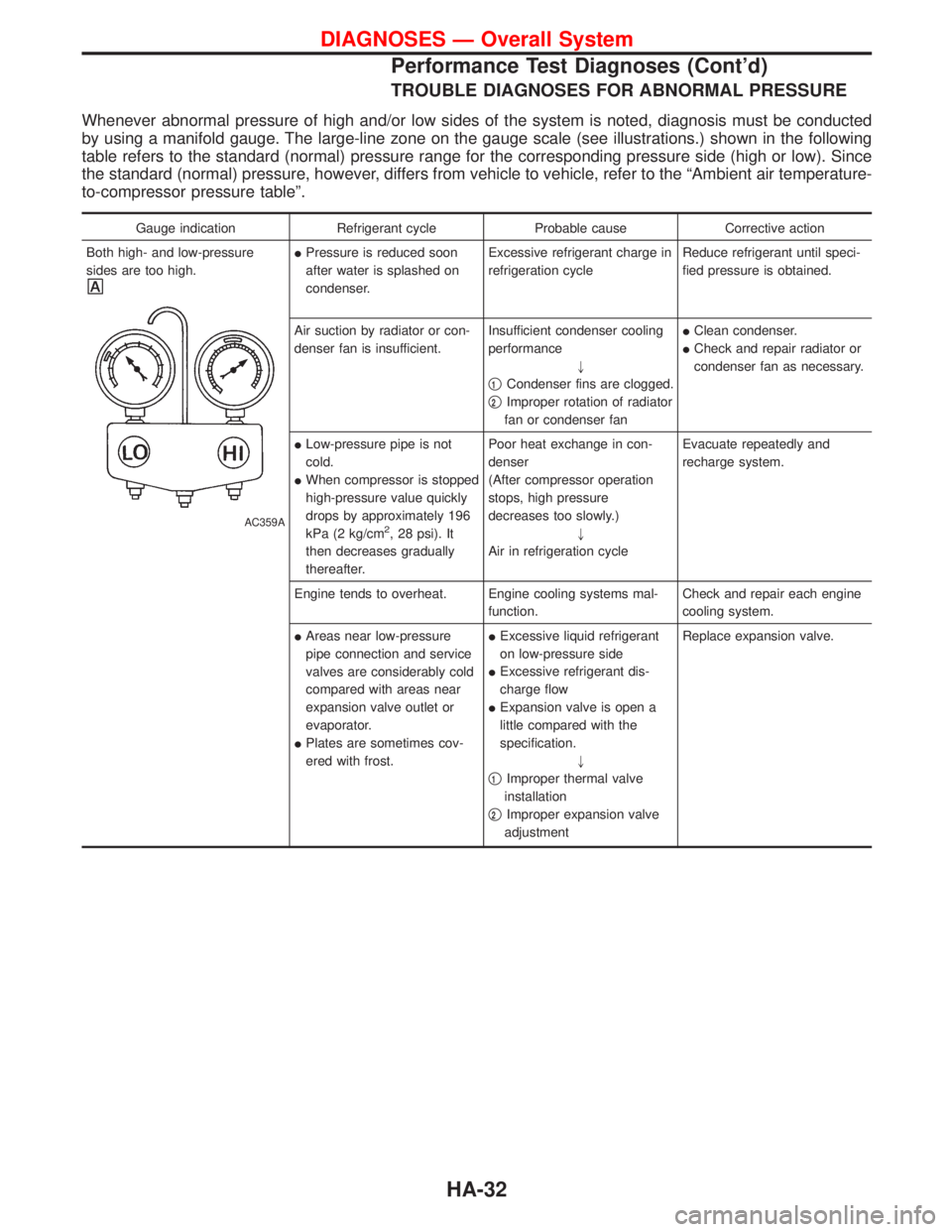
TROUBLE DIAGNOSES FOR ABNORMAL PRESSURE
Whenever abnormal pressure of high and/or low sides of the system is noted, diagnosis must be conducted
by using a manifold gauge. The large-line zone on the gauge scale (see illustrations.) shown in the following
table refers to the standard (normal) pressure range for the corresponding pressure side (high or low). Since
the standard (normal) pressure, however, differs from vehicle to vehicle, refer to the ªAmbient air temperature-
to-compressor pressure tableº.
Gauge indication Refrigerant cycle Probable cause Corrective action
Both high- and low-pressure
sides are too high.
AC359A
IPressure is reduced soon
after water is splashed on
condenser.Excessive refrigerant charge in
refrigeration cycleReduce refrigerant until speci-
fied pressure is obtained.
Air suction by radiator or con-
denser fan is insufficient.Insufficient condenser cooling
performance
"
q
1Condenser fins are clogged.
q
2Improper rotation of radiator
fan or condenser fanIClean condenser.
ICheck and repair radiator or
condenser fan as necessary.
ILow-pressure pipe is not
cold.
IWhen compressor is stopped
high-pressure value quickly
drops by approximately 196
kPa (2 kg/cm
2, 28 psi). It
then decreases gradually
thereafter.Poor heat exchange in con-
denser
(After compressor operation
stops, high pressure
decreases too slowly.)
"
Air in refrigeration cycleEvacuate repeatedly and
recharge system.
Engine tends to overheat. Engine cooling systems mal-
function.Check and repair each engine
cooling system.
IAreas near low-pressure
pipe connection and service
valves are considerably cold
compared with areas near
expansion valve outlet or
evaporator.
IPlates are sometimes cov-
ered with frost.IExcessive liquid refrigerant
on low-pressure side
IExcessive refrigerant dis-
charge flow
IExpansion valve is open a
little compared with the
specification.
"
q
1Improper thermal valve
installation
q
2Improper expansion valve
adjustmentReplace expansion valve.
DIAGNOSES Ð Overall System
Performance Test Diagnoses (Cont'd)
HA-32
Page 1391 of 1767
PRELIMINARY CHECK 2
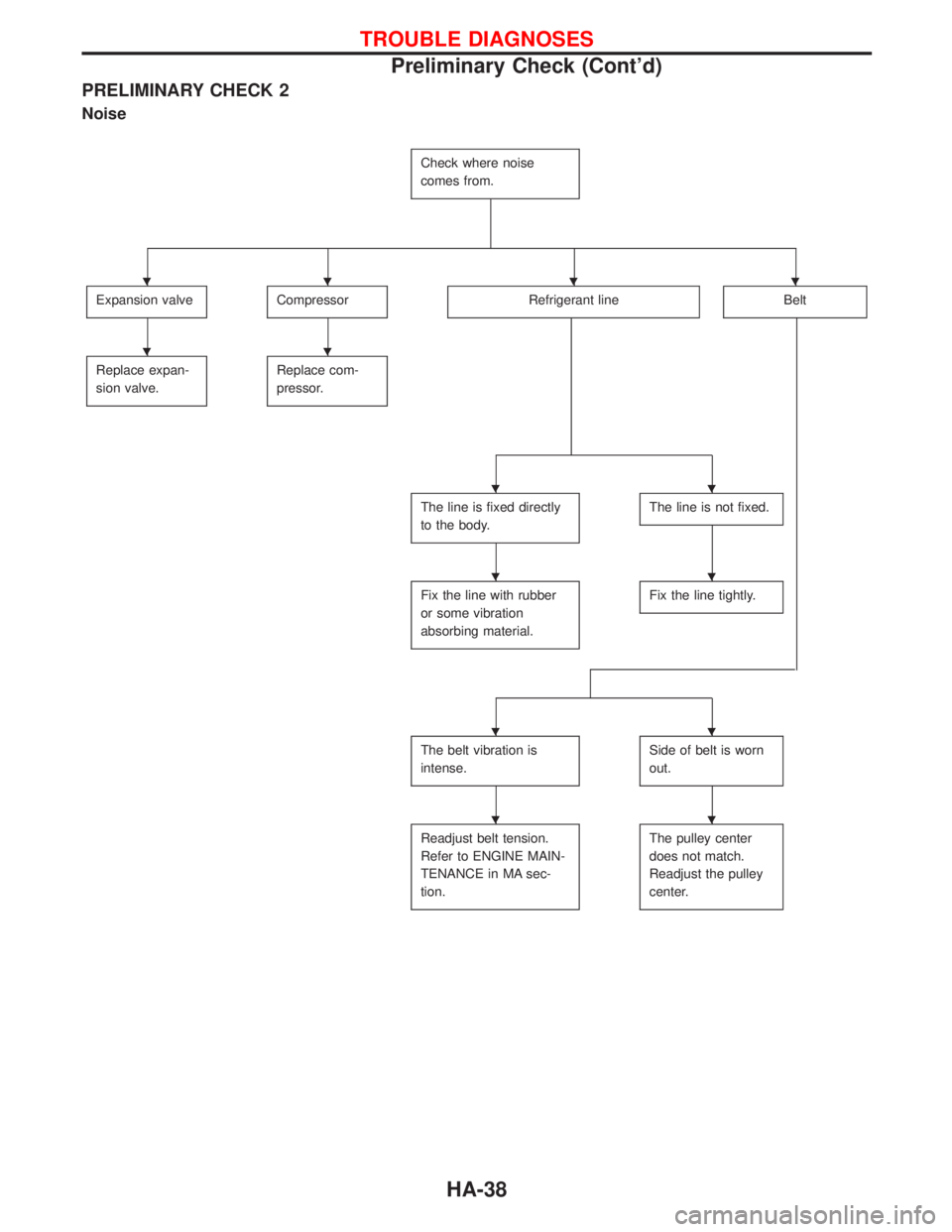
Noise
Check where noise
comes from.
Expansion valveCompressorRefrigerant lineBelt
Replace expan-
sion valve.Replace com-
pressor.
The line is fixed directly
to the body.The line is not fixed.
Fix the line with rubber
or some vibration
absorbing material.Fix the line tightly.
The belt vibration is
intense.Side of belt is worn
out.
Readjust belt tension.
Refer to ENGINE MAIN-
TENANCE in MA sec-
tion.The pulley center
does not match.
Readjust the pulley
center.
HHHH
HH
HH
HH
HH
HH
TROUBLE DIAGNOSES
Preliminary Check (Cont'd)
HA-38
Page 1417 of 1767
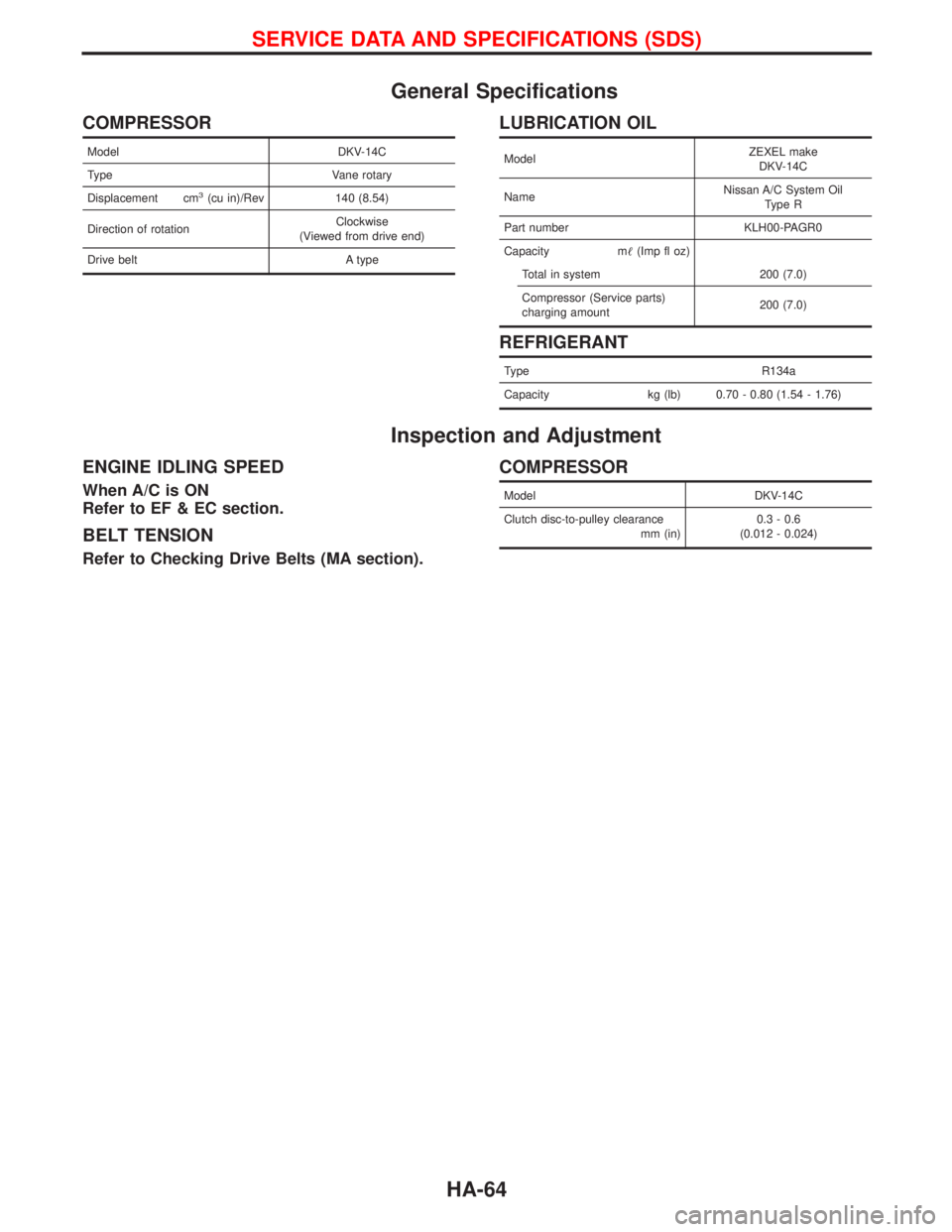
General Specifications
COMPRESSOR
Model DKV-14C
Type Vane rotary
Displacement cm
3(cu in)/Rev 140 (8.54)
Direction of rotationClockwise
(Viewed from drive end)
Drive belt A type
LUBRICATION OIL
ModelZEXEL make
DKV-14C
NameNissan A/C System Oil
Type R
Part number KLH00-PAGR0
Capacity m(Imp fl oz)
Total in system 200 (7.0)
Compressor (Service parts)
charging amount200 (7.0)
REFRIGERANT
Type R134a
Capacity kg (lb) 0.70 - 0.80 (1.54 - 1.76)
Inspection and Adjustment
ENGINE IDLING SPEED
When A/C is ON
Refer to EF & EC section.
BELT TENSION
Refer to Checking Drive Belts (MA section).
COMPRESSOR
Model DKV-14C
Clutch disc-to-pulley clearance
mm (in)0.3 - 0.6
(0.012 - 0.024)
SERVICE DATA AND SPECIFICATIONS (SDS)
HA-64
Page 1426 of 1767
ENGINE LUBRICATION &
COOLING SYSTEMS
SECTION
LC
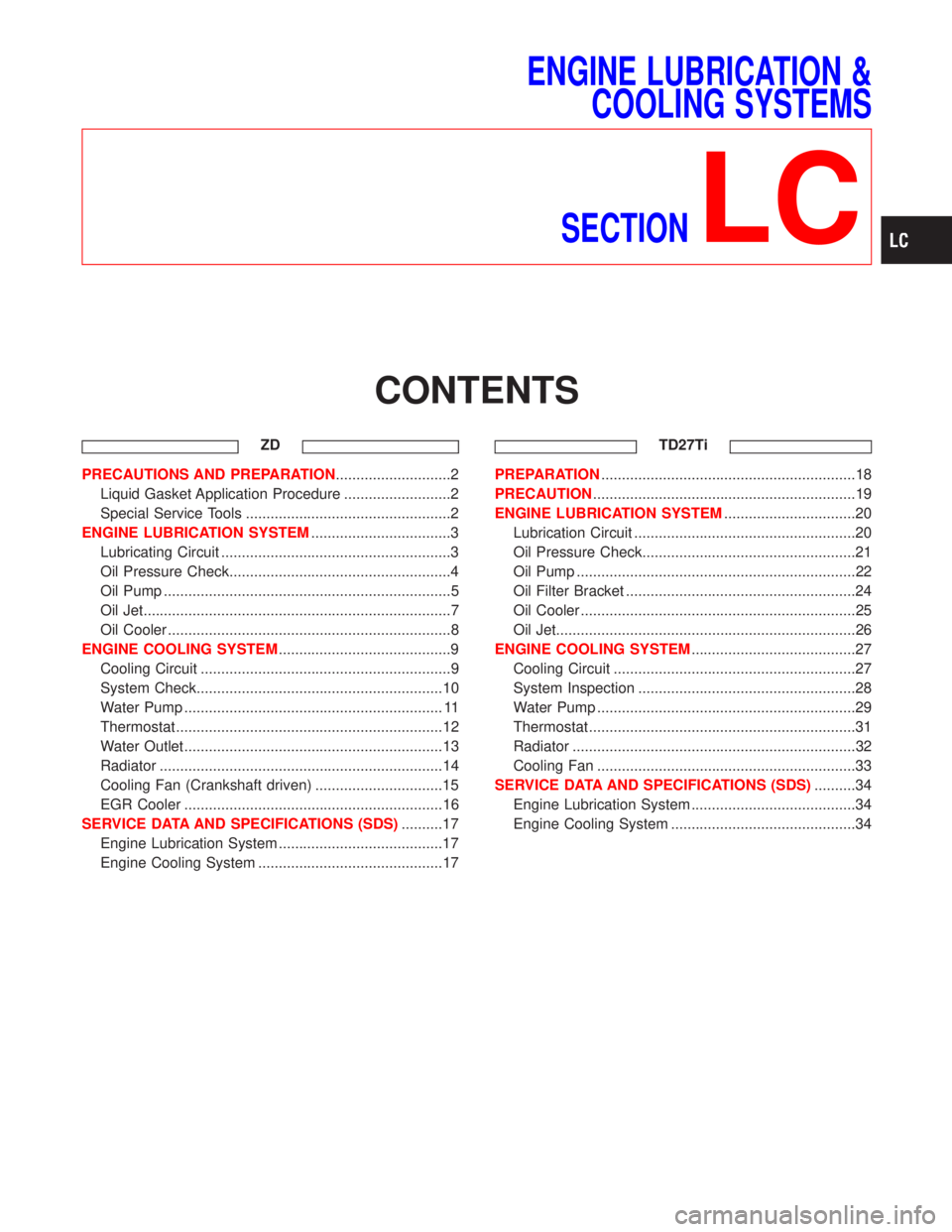
CONTENTS
ZD
PRECAUTIONS AND PREPARATION............................2
Liquid Gasket Application Procedure ..........................2
Special Service Tools ..................................................2
ENGINE LUBRICATION SYSTEM..................................3
Lubricating Circuit ........................................................3
Oil Pressure Check......................................................4
Oil Pump ......................................................................5
Oil Jet...........................................................................7
Oil Cooler .....................................................................8
ENGINE COOLING SYSTEM..........................................9
Cooling Circuit .............................................................9
System Check............................................................10
Water Pump ............................................................... 11
Thermostat .................................................................12
Water Outlet ...............................................................13
Radiator .....................................................................14
Cooling Fan (Crankshaft driven) ...............................15
EGR Cooler ...............................................................16
SERVICE DATA AND SPECIFICATIONS (SDS)..........17
Engine Lubrication System ........................................17
Engine Cooling System .............................................17TD27TiPREPARATION..............................................................18
PRECAUTION................................................................19
ENGINE LUBRICATION SYSTEM................................20
Lubrication Circuit ......................................................20
Oil Pressure Check....................................................21
Oil Pump ....................................................................22
Oil Filter Bracket ........................................................24
Oil Cooler ...................................................................25
Oil Jet.........................................................................26
ENGINE COOLING SYSTEM........................................27
Cooling Circuit ...........................................................27
System Inspection .....................................................28
Water Pump ...............................................................29
Thermostat .................................................................31
Radiator .....................................................................32
Cooling Fan ...............................................................33
SERVICE DATA AND SPECIFICATIONS (SDS)..........34
Engine Lubrication System ........................................34
Engine Cooling System .............................................34
Page 1429 of 1767
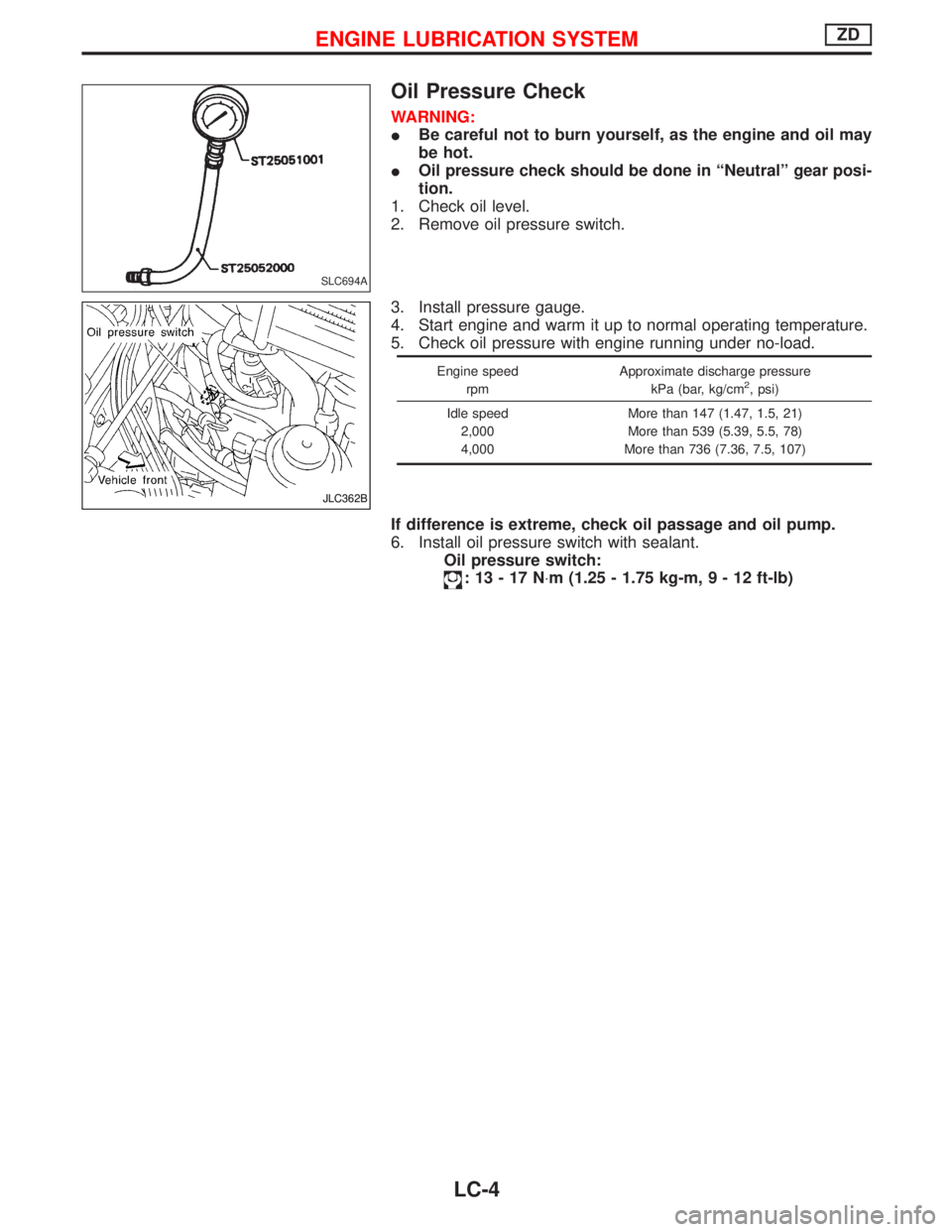
Oil Pressure Check
WARNING:
IBe careful not to burn yourself, as the engine and oil may
be hot.
IOil pressure check should be done in ªNeutralº gear posi-
tion.
1. Check oil level.
2. Remove oil pressure switch.
3. Install pressure gauge.
4. Start engine and warm it up to normal operating temperature.
5. Check oil pressure with engine running under no-load.
Engine speed
rpmApproximate discharge pressure
kPa (bar, kg/cm2, psi)
Idle speed
2,000
4,000More than 147 (1.47, 1.5, 21)
More than 539 (5.39, 5.5, 78)
More than 736 (7.36, 7.5, 107)
If difference is extreme, check oil passage and oil pump.
6. Install oil pressure switch with sealant.
Oil pressure switch:
:13-17N×m (1.25 - 1.75 kg-m,9-12ft-lb)
SLC694A
JLC362B
ENGINE LUBRICATION SYSTEMZD
LC-4
Page 1431 of 1767
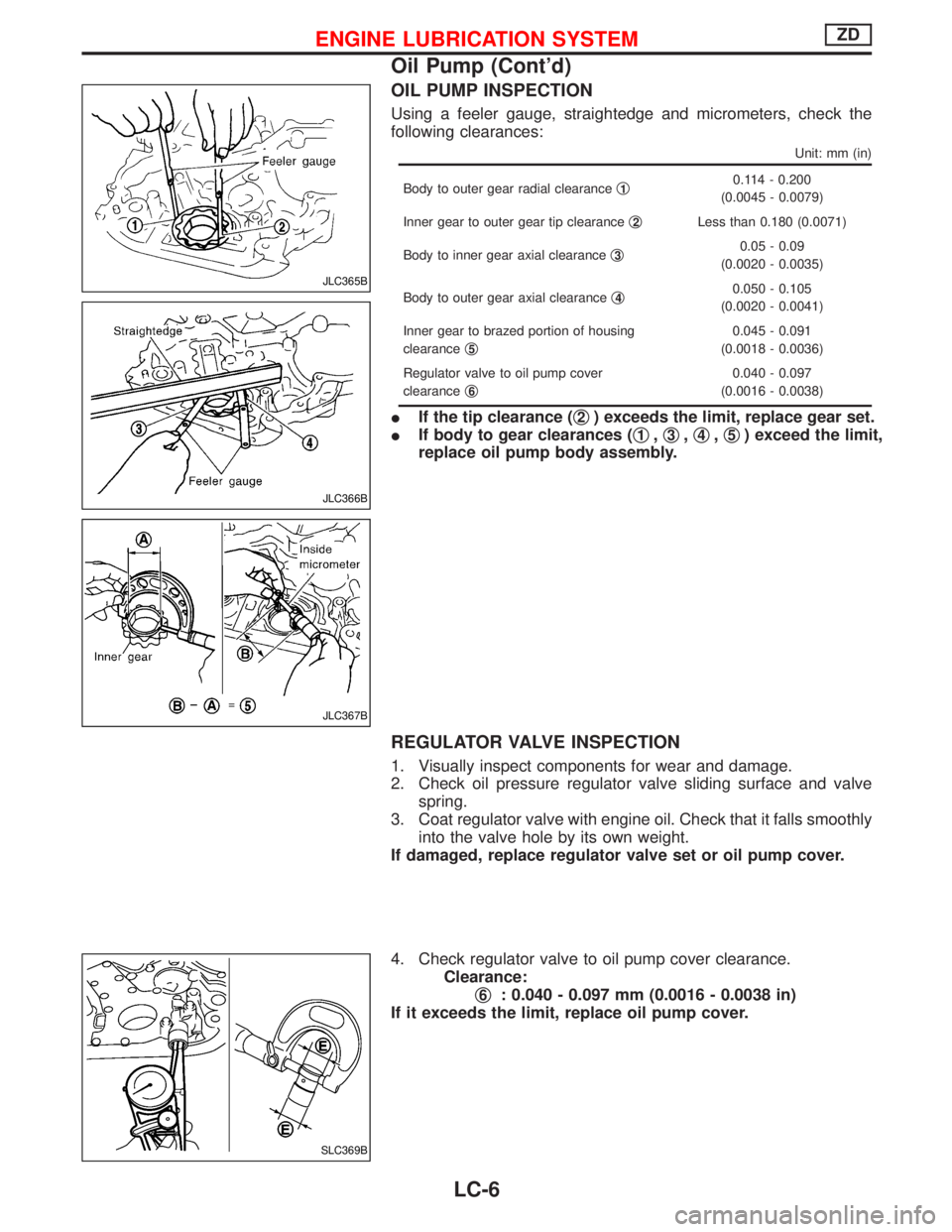
OIL PUMP INSPECTION
Using a feeler gauge, straightedge and micrometers, check the
following clearances:
Unit: mm (in)
Body to outer gear radial clearanceq10.114 - 0.200
(0.0045 - 0.0079)
Inner gear to outer gear tip clearanceq
2Less than 0.180 (0.0071)
Body to inner gear axial clearanceq
30.05 - 0.09
(0.0020 - 0.0035)
Body to outer gear axial clearanceq
40.050 - 0.105
(0.0020 - 0.0041)
Inner gear to brazed portion of housing
clearanceq
5
0.045 - 0.091
(0.0018 - 0.0036)
Regulator valve to oil pump cover
clearanceq
6
0.040 - 0.097
(0.0016 - 0.0038)
IIf the tip clearance (q2) exceeds the limit, replace gear set.
IIf body to gear clearances (q
1,q3,q4,q5) exceed the limit,
replace oil pump body assembly.
REGULATOR VALVE INSPECTION
1. Visually inspect components for wear and damage.
2. Check oil pressure regulator valve sliding surface and valve
spring.
3. Coat regulator valve with engine oil. Check that it falls smoothly
into the valve hole by its own weight.
If damaged, replace regulator valve set or oil pump cover.
4. Check regulator valve to oil pump cover clearance.
Clearance:
q
6: 0.040 - 0.097 mm (0.0016 - 0.0038 in)
If it exceeds the limit, replace oil pump cover.
JLC365B
JLC366B
JLC367B
SLC369B
ENGINE LUBRICATION SYSTEMZD
Oil Pump (Cont'd)
LC-6
Page 1432 of 1767
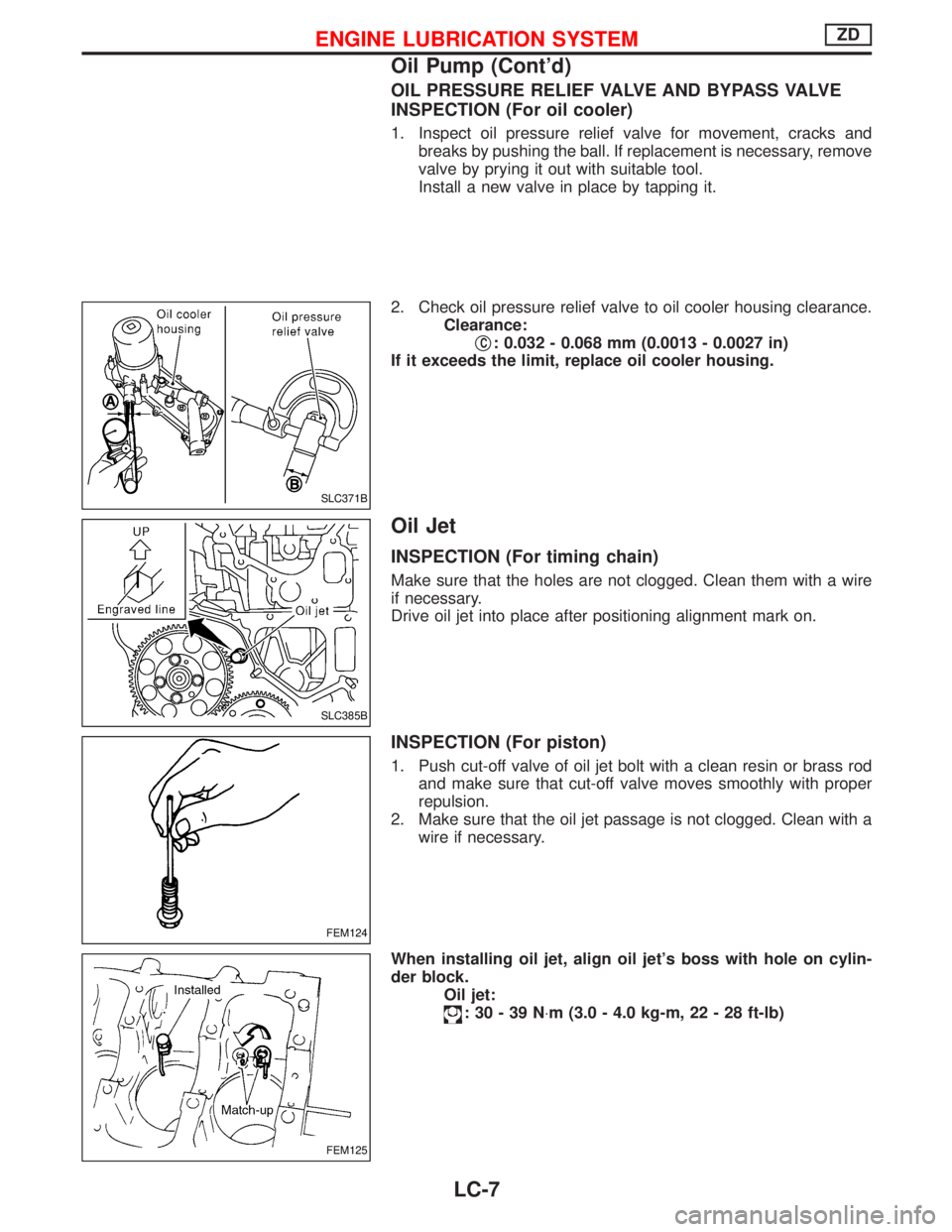
OIL PRESSURE RELIEF VALVE AND BYPASS VALVE
INSPECTION (For oil cooler)
1. Inspect oil pressure relief valve for movement, cracks and
breaks by pushing the ball. If replacement is necessary, remove
valve by prying it out with suitable tool.
Install a new valve in place by tapping it.
2. Check oil pressure relief valve to oil cooler housing clearance.
Clearance:
q
C: 0.032 - 0.068 mm (0.0013 - 0.0027 in)
If it exceeds the limit, replace oil cooler housing.
Oil Jet
INSPECTION (For timing chain)
Make sure that the holes are not clogged. Clean them with a wire
if necessary.
Drive oil jet into place after positioning alignment mark on.
INSPECTION (For piston)
1. Push cut-off valve of oil jet bolt with a clean resin or brass rod
and make sure that cut-off valve moves smoothly with proper
repulsion.
2. Make sure that the oil jet passage is not clogged. Clean with a
wire if necessary.
When installing oil jet, align oil jet's boss with hole on cylin-
der block.
Oil jet:
:30-39N×m (3.0 - 4.0 kg-m, 22 - 28 ft-lb)
SLC371B
SLC385B
FEM124
FEM125
ENGINE LUBRICATION SYSTEMZD
Oil Pump (Cont'd)
LC-7