Page 74 of 1767
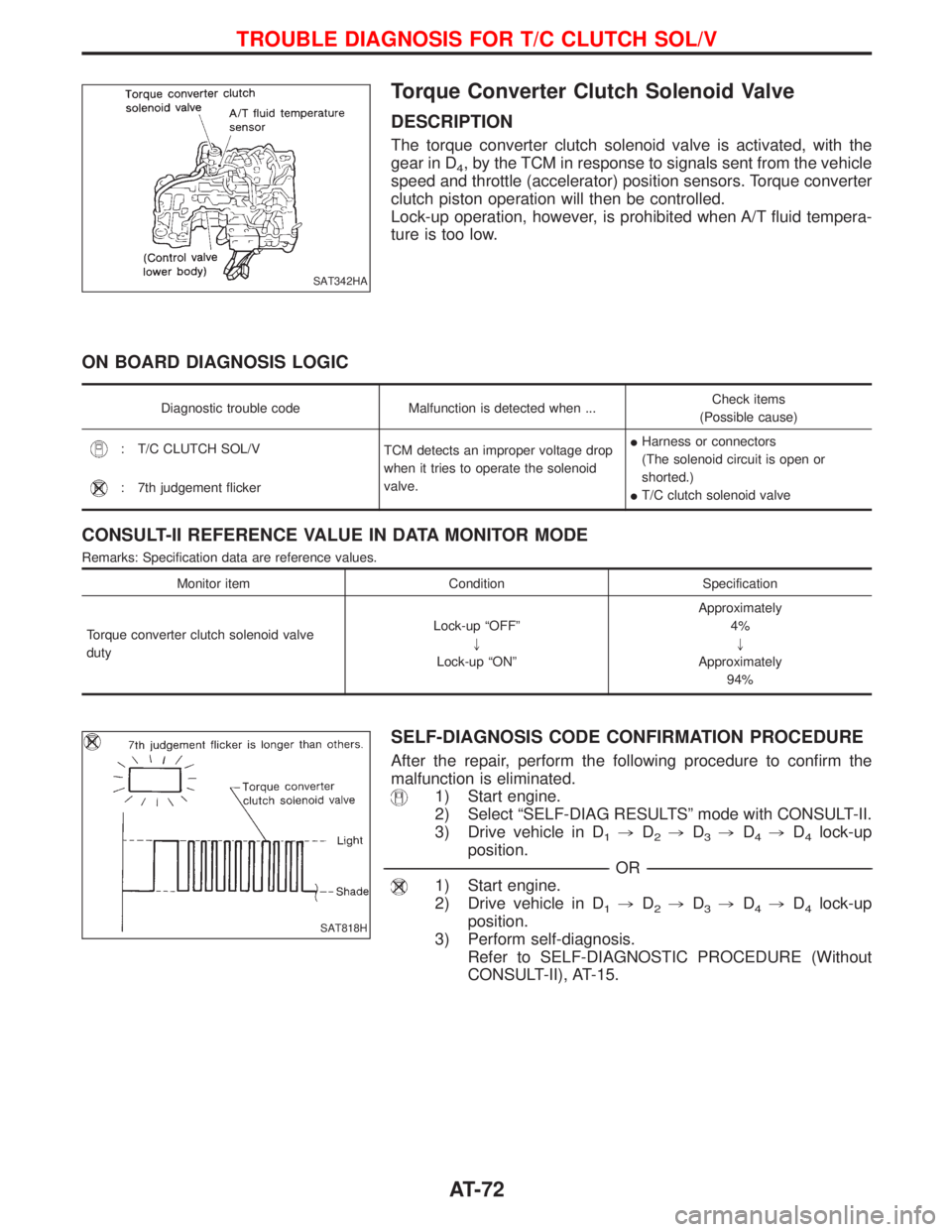
Torque Converter Clutch Solenoid Valve
DESCRIPTION
The torque converter clutch solenoid valve is activated, with the
gear in D
4, by the TCM in response to signals sent from the vehicle
speed and throttle (accelerator) position sensors. Torque converter
clutch piston operation will then be controlled.
Lock-up operation, however, is prohibited when A/T fluid tempera-
ture is too low.
ON BOARD DIAGNOSIS LOGIC
Diagnostic trouble code Malfunction is detected when ...Check items
(Possible cause)
: T/C CLUTCH SOL/V
TCM detects an improper voltage drop
when it tries to operate the solenoid
valve.IHarness or connectors
(The solenoid circuit is open or
shorted.)
IT/C clutch solenoid valve
: 7th judgement flicker
CONSULT-II REFERENCE VALUE IN DATA MONITOR MODE
Remarks: Specification data are reference values.
Monitor item Condition Specification
Torque converter clutch solenoid valve
dutyLock-up ªOFFº
"
Lock-up ªONºApproximately
4%
"
Approximately
94%
SELF-DIAGNOSIS CODE CONFIRMATION PROCEDURE
After the repair, perform the following procedure to confirm the
malfunction is eliminated.
1) Start engine.
2) Select ªSELF-DIAG RESULTSº mode with CONSULT-II.
3) Drive vehicle in D
1,D2,D3,D4,D4lock-up
position.
------------------------------------------------------------------------------------------------------------------------------------------------------------------------------------------------------------------------------------------------------------OR------------------------------------------------------------------------------------------------------------------------------------------------------------------------------------------------------------------------------------------------------------
1) Start engine.
2) Drive vehicle in D
1,D2,D3,D4,D4lock-up
position.
3) Perform self-diagnosis.
Refer to SELF-DIAGNOSTIC PROCEDURE (Without
CONSULT-II), AT-15.
SAT342HA
SAT818H
TROUBLE DIAGNOSIS FOR T/C CLUTCH SOL/V
AT-72
Page 108 of 1767
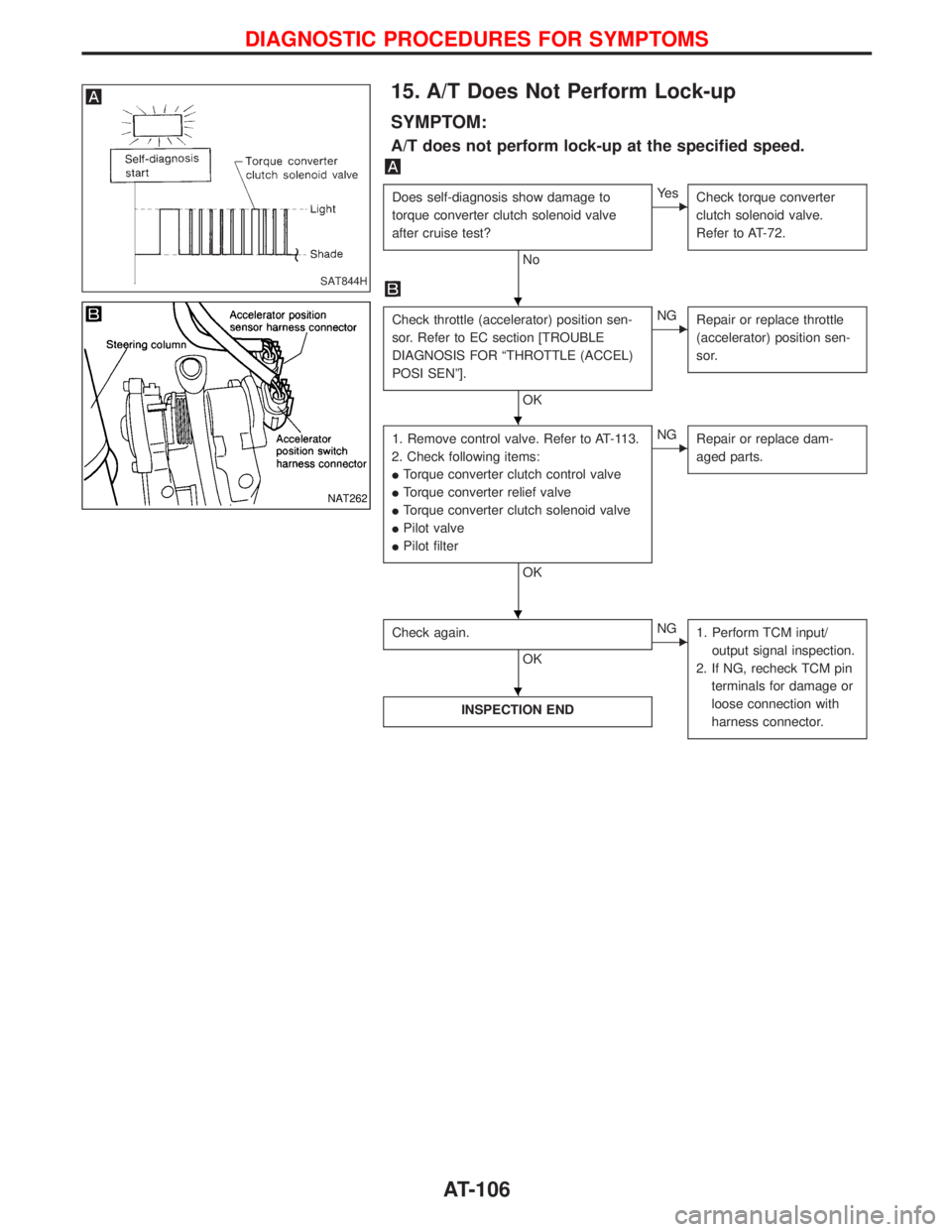
15. A/T Does Not Perform Lock-up
SYMPTOM:
A/T does not perform lock-up at the specified speed.
Does self-diagnosis show damage to
torque converter clutch solenoid valve
after cruise test?
No
EYe s
Check torque converter
clutch solenoid valve.
Refer to AT-72.
Check throttle (accelerator) position sen-
sor. Refer to EC section [TROUBLE
DIAGNOSIS FOR ªTHROTTLE (ACCEL)
POSI SENº].
OK
ENG
Repair or replace throttle
(accelerator) position sen-
sor.
1. Remove control valve. Refer to AT-113.
2. Check following items:
ITorque converter clutch control valve
ITorque converter relief valve
ITorque converter clutch solenoid valve
IPilot valve
IPilot filter
OK
ENG
Repair or replace dam-
aged parts.
Check again.
OK
ENG
1. Perform TCM input/
output signal inspection.
2. If NG, recheck TCM pin
terminals for damage or
loose connection with
harness connector.
INSPECTION END
SAT844H
NAT262
H
H
H H
H
DIAGNOSTIC PROCEDURES FOR SYMPTOMS
AT-106
Page 109 of 1767
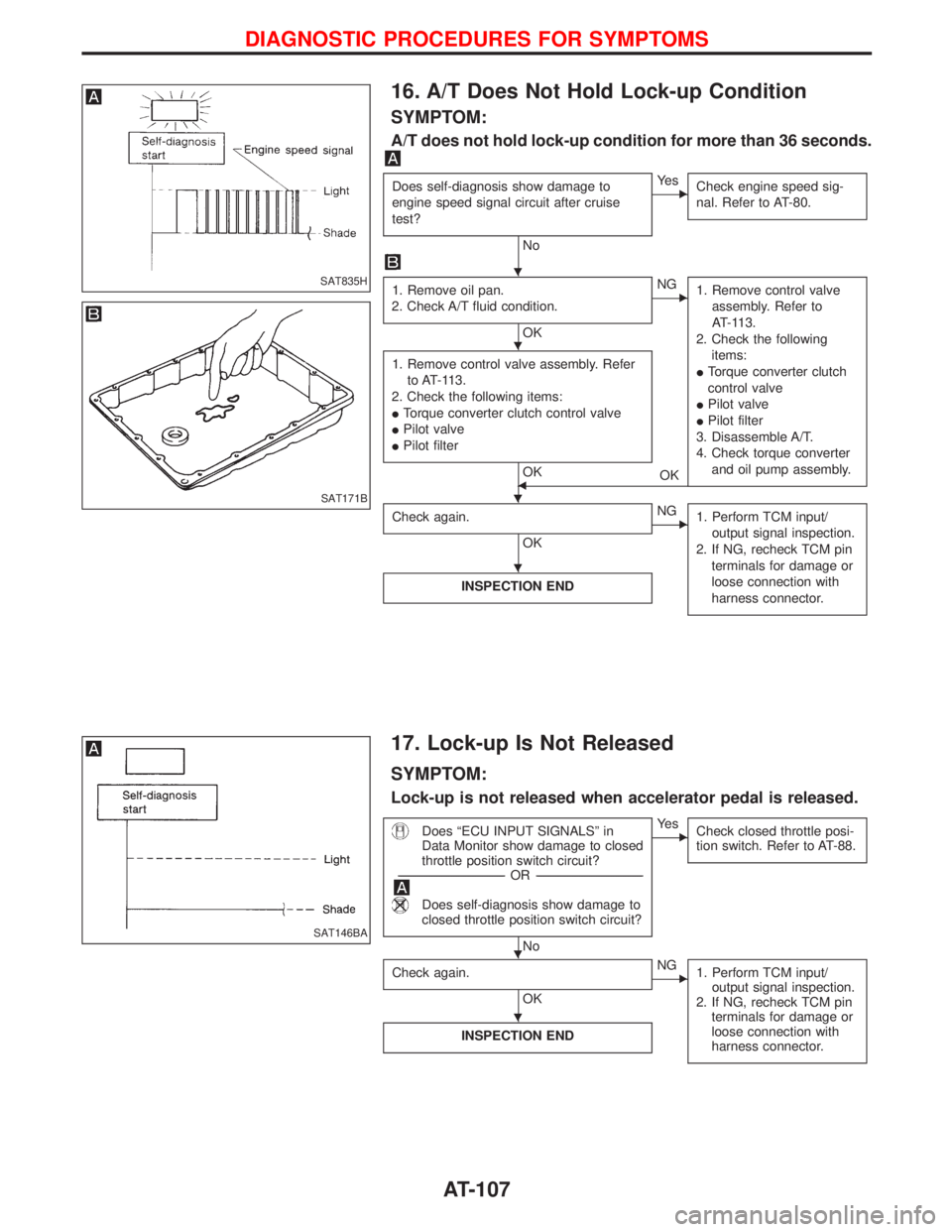
16. A/T Does Not Hold Lock-up Condition
SYMPTOM:
A/T does not hold lock-up condition for more than 36 seconds.
Does self-diagnosis show damage to
engine speed signal circuit after cruise
test?
No
EYe s
Check engine speed sig-
nal. Refer to AT-80.
1. Remove oil pan.
2. Check A/T fluid condition.
OK
ENG
1. Remove control valve
assembly. Refer to
AT-113.
2. Check the following
items:
ITorque converter clutch
control valve
IPilot valve
IPilot filter
3. Disassemble A/T.
4. Check torque converter
and oil pump assembly.
1. Remove control valve assembly. Refer
to AT-113.
2. Check the following items:
ITorque converter clutch control valve
IPilot valve
IPilot filter
OKFOK
Check again.
OK
ENG
1. Perform TCM input/
output signal inspection.
2. If NG, recheck TCM pin
terminals for damage or
loose connection with
harness connector.
INSPECTION END
17. Lock-up Is Not Released
SYMPTOM:
Lock-up is not released when accelerator pedal is released.
Does ªECU INPUT SIGNALSº in
Data Monitor show damage to closed
throttle position switch circuit?
-----------------------------------------------------------------------------------------------------------------------OR -----------------------------------------------------------------------------------------------------------------------
Does self-diagnosis show damage to
closed throttle position switch circuit?
No
EYe s
Check closed throttle posi-
tion switch. Refer to AT-88.
Check again.
OK
ENG
1. Perform TCM input/
output signal inspection.
2. If NG, recheck TCM pin
terminals for damage or
loose connection with
harness connector.
INSPECTION END
SAT835H
SAT171B
SAT146BA
H
H
H H
H
H
H
DIAGNOSTIC PROCEDURES FOR SYMPTOMS
AT-107
Page 117 of 1767
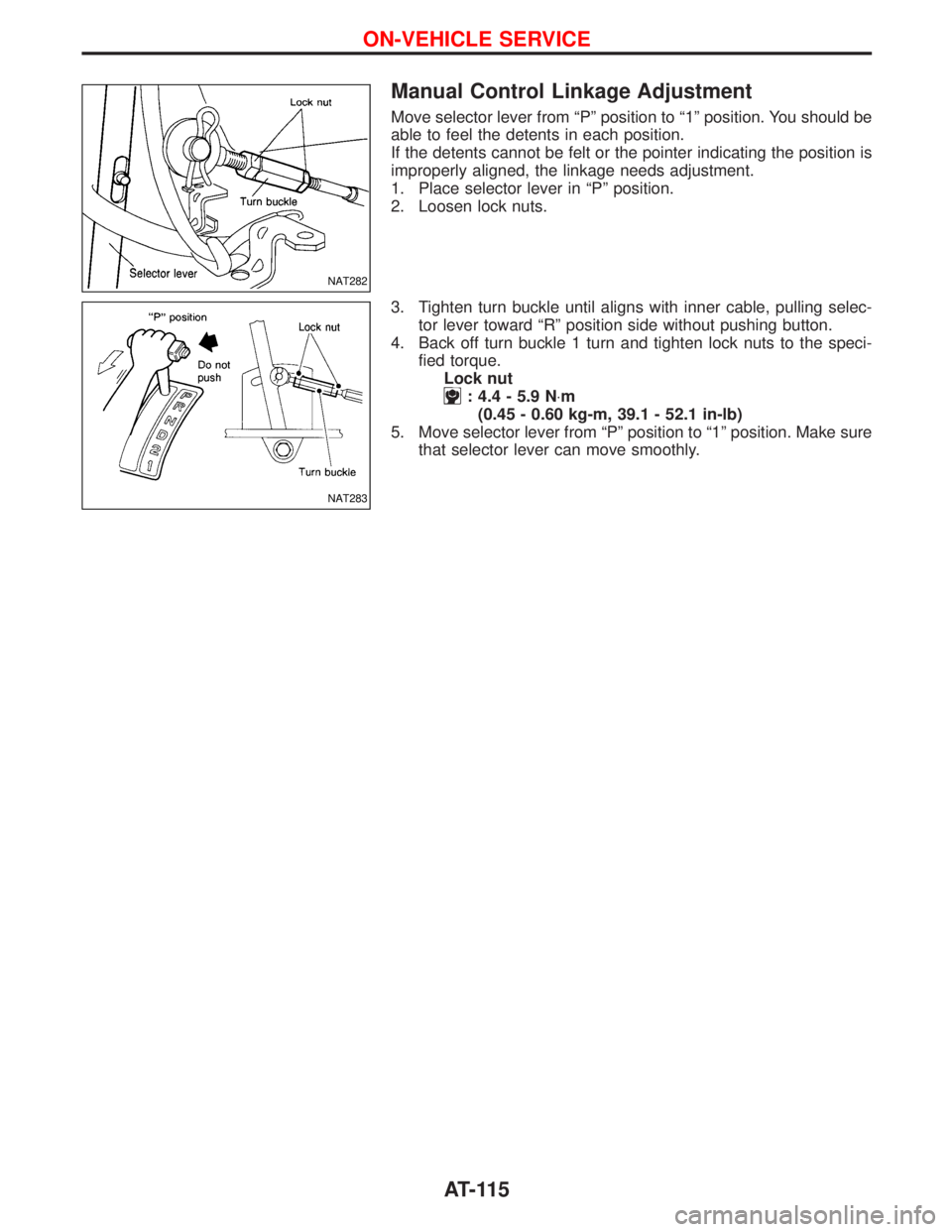
Manual Control Linkage Adjustment
Move selector lever from ªPº position to ª1º position. You should be
able to feel the detents in each position.
If the detents cannot be felt or the pointer indicating the position is
improperly aligned, the linkage needs adjustment.
1. Place selector lever in ªPº position.
2. Loosen lock nuts.
3. Tighten turn buckle until aligns with inner cable, pulling selec-
tor lever toward ªRº position side without pushing button.
4. Back off turn buckle 1 turn and tighten lock nuts to the speci-
fied torque.
Lock nut
: 4.4 - 5.9 N×m
(0.45 - 0.60 kg-m, 39.1 - 52.1 in-lb)
5. Move selector lever from ªPº position to ª1º position. Make sure
that selector lever can move smoothly.
NAT282
NAT283
ON-VEHICLE SERVICE
AT-115
Page 119 of 1767
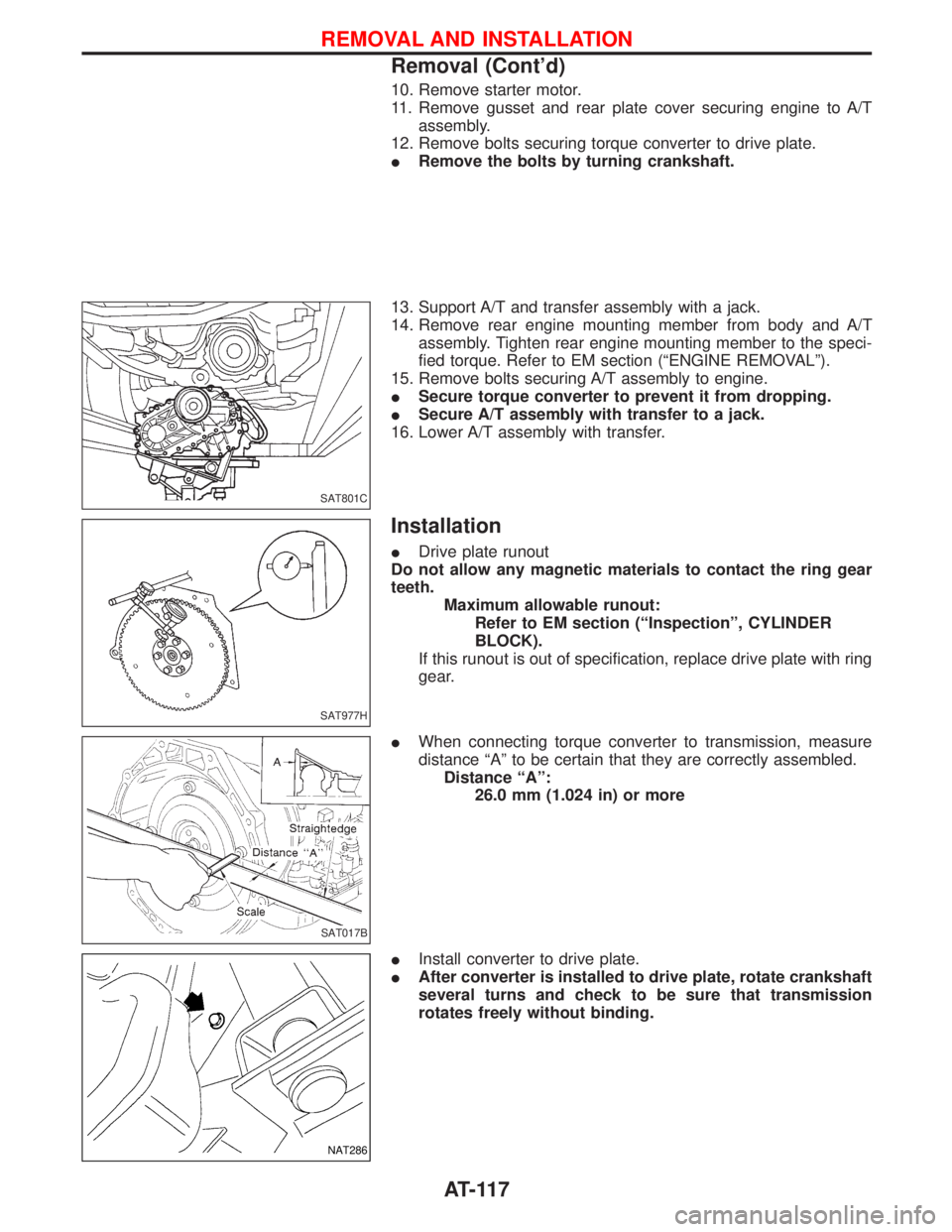
10. Remove starter motor.
11. Remove gusset and rear plate cover securing engine to A/T
assembly.
12. Remove bolts securing torque converter to drive plate.
IRemove the bolts by turning crankshaft.
13. Support A/T and transfer assembly with a jack.
14. Remove rear engine mounting member from body and A/T
assembly. Tighten rear engine mounting member to the speci-
fied torque. Refer to EM section (ªENGINE REMOVALº).
15. Remove bolts securing A/T assembly to engine.
ISecure torque converter to prevent it from dropping.
ISecure A/T assembly with transfer to a jack.
16. Lower A/T assembly with transfer.
Installation
IDrive plate runout
Do not allow any magnetic materials to contact the ring gear
teeth.
Maximum allowable runout:
Refer to EM section (ªInspectionº, CYLINDER
BLOCK).
If this runout is out of specification, replace drive plate with ring
gear.
IWhen connecting torque converter to transmission, measure
distance ªAº to be certain that they are correctly assembled.
Distance ªAº:
26.0 mm (1.024 in) or more
IInstall converter to drive plate.
IAfter converter is installed to drive plate, rotate crankshaft
several turns and check to be sure that transmission
rotates freely without binding.
SAT801C
SAT977H
SAT017B
NAT286
REMOVAL AND INSTALLATION
Removal (Cont'd)
AT-117
Page 125 of 1767
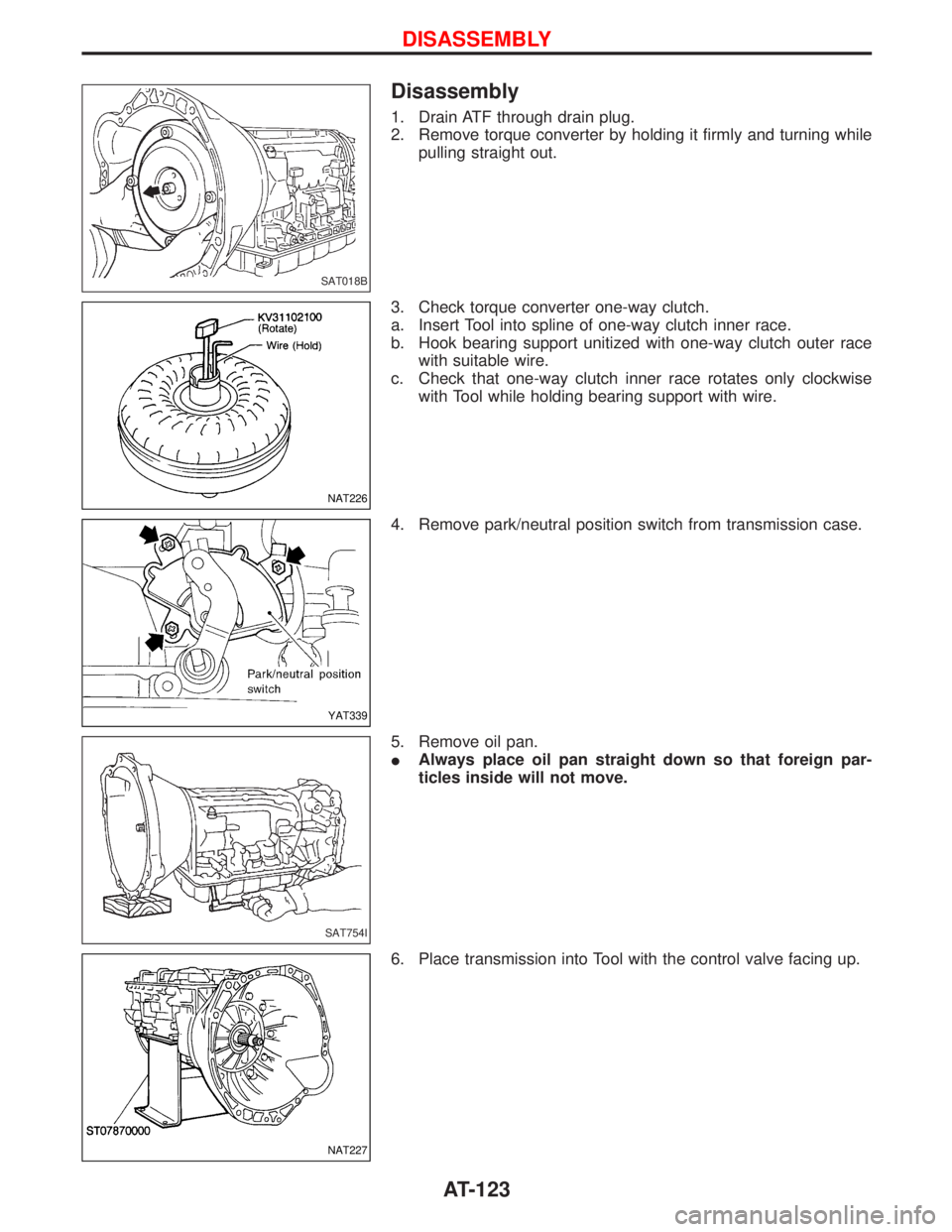
Disassembly
1. Drain ATF through drain plug.
2. Remove torque converter by holding it firmly and turning while
pulling straight out.
3. Check torque converter one-way clutch.
a. Insert Tool into spline of one-way clutch inner race.
b. Hook bearing support unitized with one-way clutch outer race
with suitable wire.
c. Check that one-way clutch inner race rotates only clockwise
with Tool while holding bearing support with wire.
4. Remove park/neutral position switch from transmission case.
5. Remove oil pan.
IAlways place oil pan straight down so that foreign par-
ticles inside will not move.
6. Place transmission into Tool with the control valve facing up.
SAT018B
NAT226
YAT339
SAT754I
NAT227
DISASSEMBLY
AT-123
Page 129 of 1767
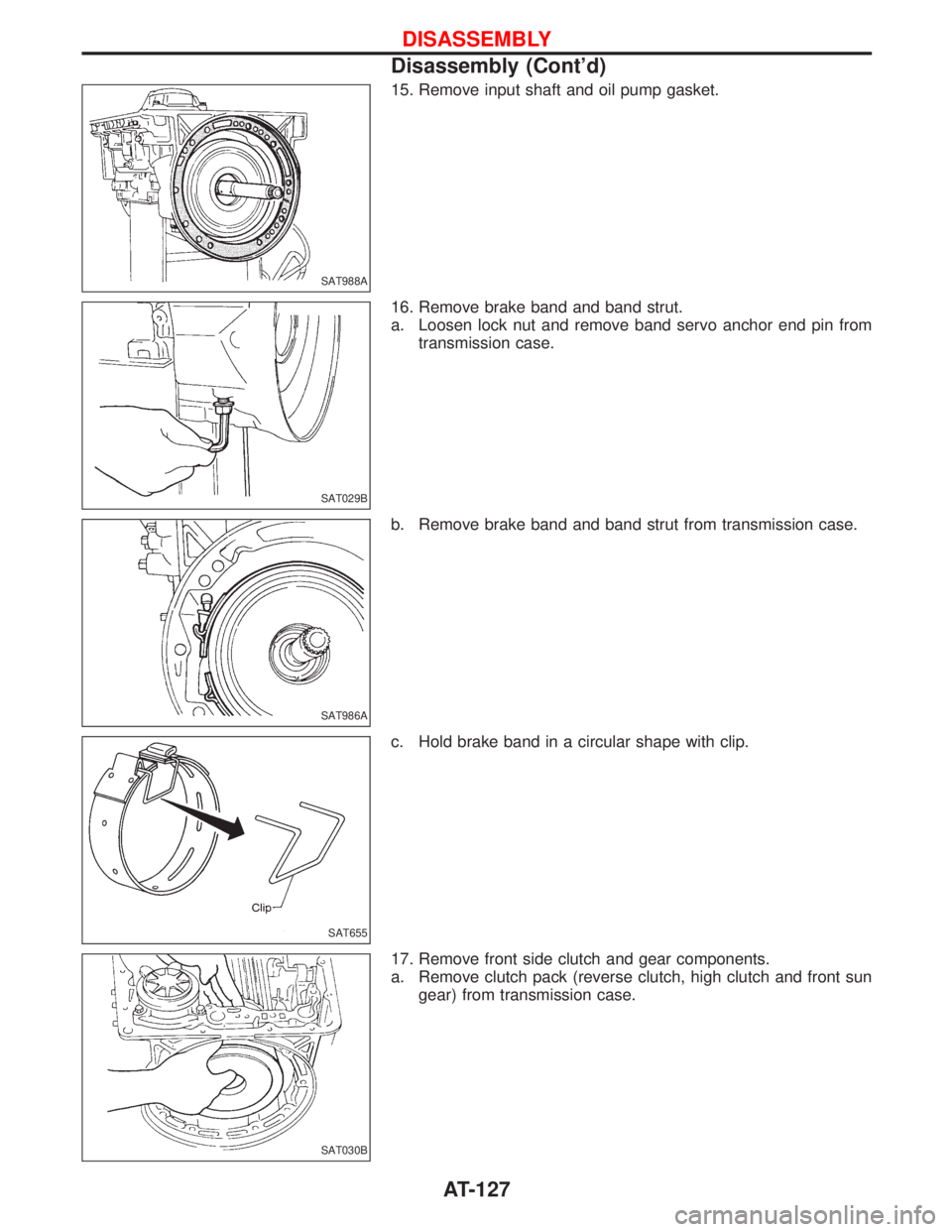
15. Remove input shaft and oil pump gasket.
16. Remove brake band and band strut.
a. Loosen lock nut and remove band servo anchor end pin from
transmission case.
b. Remove brake band and band strut from transmission case.
c. Hold brake band in a circular shape with clip.
17. Remove front side clutch and gear components.
a. Remove clutch pack (reverse clutch, high clutch and front sun
gear) from transmission case.
SAT988A
SAT029B
SAT986A
SAT655
SAT030B
DISASSEMBLY
Disassembly (Cont'd)
AT-127
Page 134 of 1767
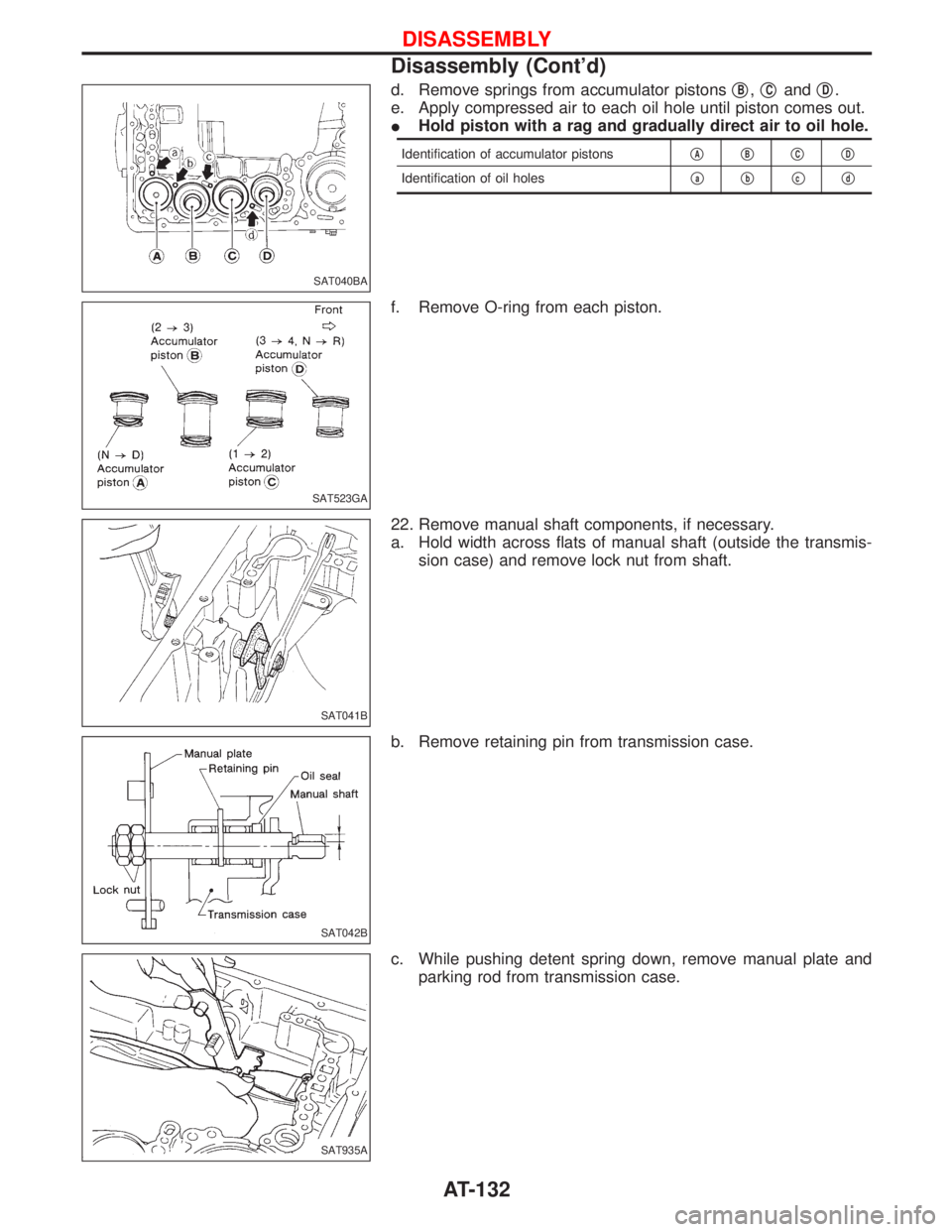
d. Remove springs from accumulator pistonsqB,qCandqD.
e. Apply compressed air to each oil hole until piston comes out.
IHold piston with a rag and gradually direct air to oil hole.
Identification of accumulator pistonsqAqBqCqD
Identification of oil holesqaqbqcqd
f. Remove O-ring from each piston.
22. Remove manual shaft components, if necessary.
a. Hold width across flats of manual shaft (outside the transmis-
sion case) and remove lock nut from shaft.
b. Remove retaining pin from transmission case.
c. While pushing detent spring down, remove manual plate and
parking rod from transmission case.
SAT040BA
SAT523GA
SAT041B
SAT042B
SAT935A
DISASSEMBLY
Disassembly (Cont'd)
AT-132