2002 LAND ROVER DISCOVERY oil
[x] Cancel search: oilPage 649 of 1672

MANIFOLDS AND EXHAUST SYSTEMS - V8
30-2-20 REPAIRS
20.Position container to collect spillage.
21.Release clips and disconnect 2 coolant hoses
from throttle housing.
22.Loosen outer cable locknuts and release
throttle and cruise control cables from
abutment.
23.Release throttle and cruise control cables from
clips and throttle cams and position aside.
24.Depress plastic collar and disconnect brake
servo hose from inlet manifold.
25.Release clip and disconnect breather hose
from manifold.
26.Disconnect vacuum hose from manifold.
27.Release engine harness from bulkhead clips
and position aside.
28.Release and remove bonnet seal from rear of
engine bay.
29.Remove 2 bolts securing air pipe and coil
bracket to manifold.
30.Loosen 2 lower bolts securing coil bracket
sufficiently to allow bracket to clear manifold.31.Release plug leads from upper manifold clips.
32.Loosen clip and disconnect air hose from air
valve.
33.Remove 2 nuts securing RH air manifold
support bracket to upper inlet manifold.
Page 650 of 1672

MANIFOLDS AND EXHAUST SYSTEMS - V8
REPAIRS 30-2-21
34.Release clip and disconnect IACV hose.
35.Remove 6 bolts securing upper manifold and
remove manifold.
36.Collect upper manifold gasket.
Refit
1.Clean upper and lower inlet manifold mating
faces, dowels and dowel holes.
2.Using a new gasket, position upper inlet
manifold. Fit bolts and, working in a diagonal
sequence, tighten to 22 Nm (16 lbf.ft).
3.Connect IACV hose and secure clip.
4.Connect hose to air valve and tighten clip.
5.Secure plug leads to clips.
6.Fit and tighten nuts securing RH air manifold
support bracket.
7.Align air pipe and coil bracket, fit bolts and
tighten to 8 Nm (6 lbf.ft).
8.Tighten 2 lower bolts securing coil bracket to 8
Nm (6 lbf.ft).
9.Fit bonnet seal.
10.Secure engine harness in bulkhead clips.11.Connect breather hose to manifold and secure
clip.
12.Connect vacuum hose to inlet manifold.
13.Connect brake servo hose to inlet manifold.
14.Connect throttle and cruise control cables.
15.Adjust throttle cable.
+ ENGINE MANAGEMENT SYSTEM -
V8, ADJUSTMENTS, Cable - throttle.
16.Adjust cruise control cable.
+ ENGINE MANAGEMENT SYSTEM -
V8, ADJUSTMENTS, Cable - cruise control.
17.Connect coolant hoses to throttle housing and
secure clips.
18.Connect multiplug to TP sensor.
19.Connect breather hose to throttle housing and
secure with clip.
20.Connect multiplug to IACV.
21.Secure purge valve and air control valve to clips
and bracket.
22.Connect purge hose to manifold.
23.Clean air manifold unions, position manifold
and start union nuts.
24.Fit and tighten nuts securing air manifold
support bracket.
25.Tighten air manifold union nuts to 25 Nm (18
lbf.ft)
26.Connect hose to air valve and tighten clip.
27.Connect vacuum hose to air valve.
28.Fit air intake hose.
29.Connect multiplug to MAF sensor.
30.Secure harness to clip.
31.Connect battery earth lead.
32.Fit battery cover and secure with fixings.
33.Top up cooling system.
+ MAINTENANCE, PROCEDURES,
Cooling system.
34.Fit bonnet.
+ EXTERIOR FITTINGS, REPAIRS,
Bonnet.
Page 657 of 1672

CLUTCH - TD5
33-1-6 DESCRIPTION AND OPERATION
Description
General
The clutch system is a diaphragm type clutch operated by a hydraulic cylinder. The drive plate is of the rigid centre
type with no integral damping springs. The flywheel is of the dual mass type with damping springs integral with the
flywheel. The clutch requires no adjustment to compensate for wear.
Hydraulic clutch
The hydraulic clutch comprises a master cylinder, slave cylinder and a hydraulic reservoir. The master and slave
cylinders are connected to each other hydraulically by plastic and metal pipes. The plastic section of the pipe allows
ease of pipe routing and also absorbs engine movements and vibrations.
The master cylinder comprises a body with a central bore. Two ports in the body connect the bore to the hydraulic
feed pipe to the slave cylinder and the fluid reservoir. The bore is also connected to a damper which prevents engine
pulses being transferred hydraulically to the clutch pedal. A piston is fitted in the bore and has an external rod which
is attached to the clutch pedal with a pin. Two coil springs on the clutch pedal reduce the effort required to depress
the pedal.
The master cylinder is mounted on the bulkhead and secured with two bolts. The cylinder is connected to the shared
brake/clutch reservoir on the brake servo by a braided connecting hose.
The slave cylinder is located on the left hand side of the gearbox housing and secured with two bolts. A heat shield
is fitted to protect the underside of the slave cylinder from heat generated from the exhaust system. The slave cylinder
comprises a cylinder with a piston and a rod. A port in the cylinder body provides the attachment for the hydraulic feed
pipe from the master cylinder. A second port is fitted witha bleed nipple used for removing air from the hydraulic
system after servicing. The piston rod locates on a clutch release lever located in the gearbox housing. The rod is
positively retained on the release lever with a clip.
Clutch mechanism
The clutch mechanism comprises a flywheel, drive plate, pressure plate, release lever and a release bearing. The
clutch mechanism is fully enclosed at the rear of the engine by the gearbox housing.
A clutch release bearing sleeve is attached in the gearbox housing with two bolts and located on two dowels. A spigot
with a ball end is formed on the release bearing sleeve and provides amounting and pivot point for the clutch release
lever. A dished pivot washer is located on the ball of the spigot. When the release lever is located on the ball, the pivot
washer seats against the rear face of the release lever. A spring clip is located on the lever and the pivot washer and
secures the lever on the spigot. A small bolt retains the spring clip in position.
The release lever is forked at its inner end and locates on the clutch release bearing carrier. The outer end of the
release lever has a nylon seat which locates the slave cylinder piston rod. A second nylon seat, positioned centrally
on the release lever, locates on the ball spigot of the release bearing sleeve and allows the release lever to pivot freely
around the ball.
The clutch release bearing locates on the clutch release lever and release bearing sleeve. The bearing is retained on
a carrier which has two flats to prevent the carrier rotating on the release lever. A clip retains the release lever on the
carrier. The bearing and carrier are not serviceable individually.
Page 659 of 1672
CLUTCH - TD5
33-1-8 DESCRIPTION AND OPERATION
The dual mass flywheel is used to insulate the gearbox from torsional and transient vibrations produced by the engine.
The flywheel comprises primary and secondary flywheels with the drive between the two transferred by a torsional
damper which comprises four coil springs. The springs are located in the inside diameter of the primary flywheel. Two
of the springs are of smaller diameter and fit inside the larger diameter springs.
The primary flywheel locates the ring gear and is attached to the crankshaft flange with eight bolts. The two pairs of
coil springs are located in a recess in the flywheel between two riveted retainers. A roller bearing is pressed onto the
central boss of the primary flywheel and retained with a riveted plate. The bearing provides the mounting for the
secondary flywheel.
The secondary flywheel comprises two parts; an outer flywheel which provides the friction surface for the clutch drive
plate and an inner drive plate which transfers the drive from the primary flywheel, via the coil springs, to the outer
flywheel. The two components of the secondary flywheel are secured to each other with rivets. The inner drive plate
is located between the two pairs of coil springs and can rotate on the ball bearing in either direction against the
combined compression force of the four coil springs. Under high torque loading conditions the secondary flywheel can
rotate in either direction up to 70
° in relation to the primary flywheel.
The operating face of the secondary flywheel is machined to provide a smooth surface for the drive plate to engage
on. Three dowels and six studs and nuts provide for the location and attachment of the pressure plate.
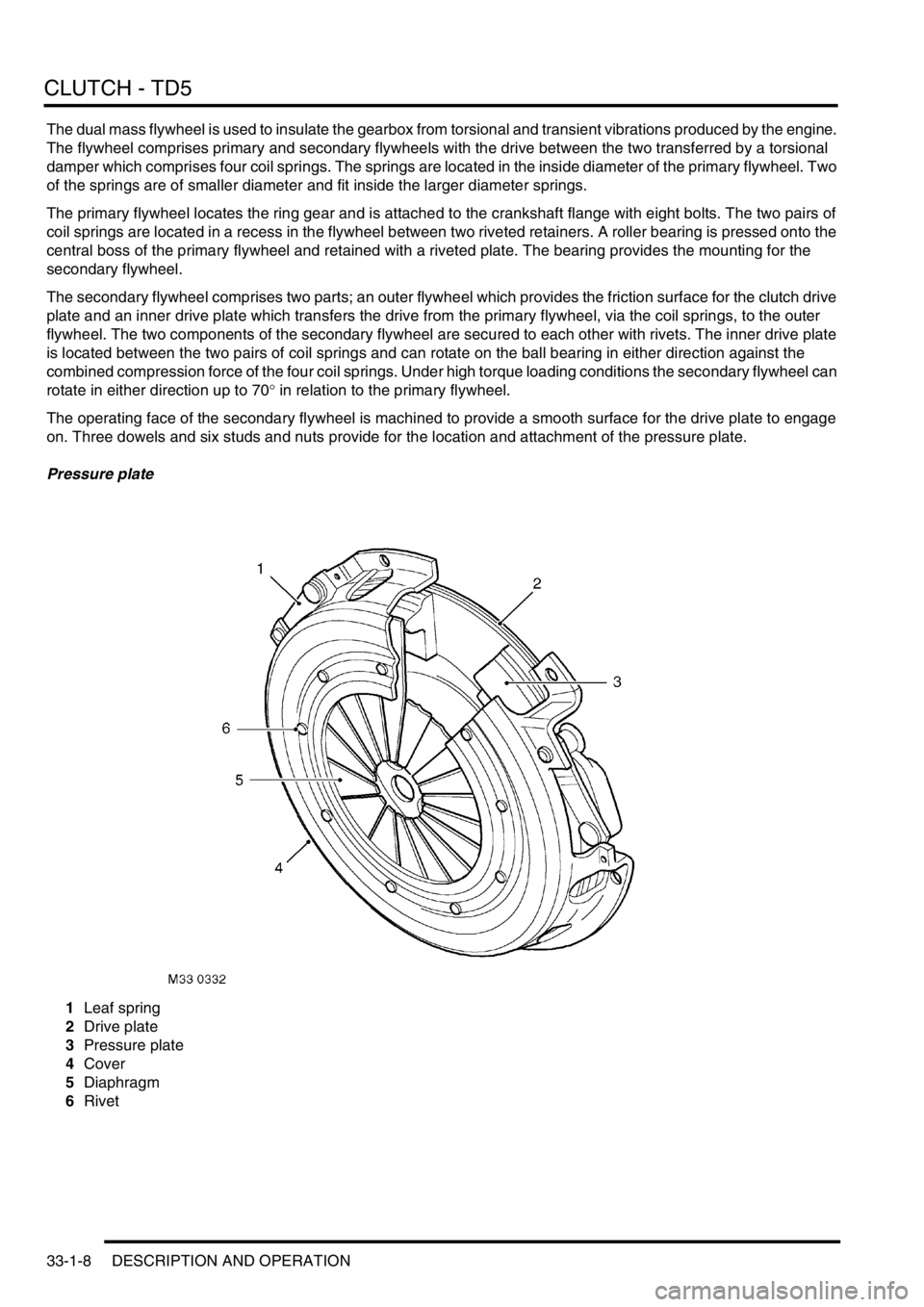
Pressure plate
1Leaf spring
2Drive plate
3Pressure plate
4Cover
5Diaphragm
6Rivet
Page 673 of 1672

CLUTCH - V8
33-2-6 DESCRIPTION AND OPERATION
Description
General
The clutch system is a conventional diaphragm type clutch operated by a hydraulic cylinder. The clutch requires no
adjustment to compensate for wear.
Hydraulic clutch
The hydraulic clutch comprises a master cylinder, slave cylinder and a hydraulic reservoir, which is also shared with
the braking system. The master and slave cylinders are connected to each other hydraulically by plastic and metal
pipes. The plastic section of the pipe allows ease of pipe routing and also absorbs engine movements and vibrations.
The master cylinder comprises a body with a central bore. Two ports in the body connect the bore to the hydraulic
feed pipe to the slave cylinder and the brake/clutch fluid reservoir. A piston is fitted in the bore and has an external
rod which is attached to the clutch pedal with a pin. Two coiled springs on the clutch pedal reduce the effort required
to depress the pedal.
The master cylinder is mounted on the bulkhead in the engine compartment and secured with two bolts. The cylinder
is connected to the shared brake/clutch reservoir on the brake servo by a braided connecting hose.
The slave cylinder is located on the left hand side of the gearbox housing and secured with two bolts. A heat shield
protects the underside of the cylinder from heat generated from the exhaust system. The slave cylinder comprises a
cylinder with a piston and a rod. A port in the cylinder body provides the attachment for the hydraulic feed pipe from
the master cylinder. A second port is fitted with a bleed nipple for removing air from the hydraulic system after
servicing. The piston rod locates on a clutch release lever located in the gearbox housing. The rod is positively
retained on the release lever with a clip.
Clutch mechanism
The clutch mechanism comprises a flywheel, drive plate, pressure plate, release lever and a release bearing. The
clutch mechanism is fully enclosed at the rear of the engine by the gearbox housing.
A clutch release bearing sleeve is attached in the gearbox housing with two bolts and located on two dowels. A spigot
with a ball end is formed on the release bearing sleeve and provides a mounting and pivot point for the clutch release
lever. A dished pivot washer is located on the ball of the spigot. When the release lever is located on the ball, the pivot
washer seats against the rear face of the release lever. A spring clip is located on the lever and the pivot washer and
secures the lever on the spigot. A small bolt retains the spring clip in position.
The release lever is forked at its inner end and locates on the clutch release bearing carrier. The outer end of the
release lever has a nylon seat which locates the slave cylinder piston rod. A second nylon seat, positioned centrally
on the release lever, locates on the ball spigot of the release bearing sleeve and allows the release lever to pivot freely
around the ball.
The clutch release bearing locates on the clutch release lever and the release bearing sleeve. The bearing is retained
on a carrier which has two flats to prevent the carrier rotating on the release lever. A clip retains the release lever on
the carrier. The bearing and carrier are not serviceable individually.
Page 685 of 1672

MANUAL GEARBOX - R380
37-2 DESCRIPTION AND OPERATION
Gearbox casings, gear change and oil
pump
Page 686 of 1672

MANUAL GEARBOX - R380
DESCRIPTION AND OPERATION 37-3
1Front cover
2Input shaft oil seal
3Oil filler/level plug
4Sealing washer
5Oil drain plug
6Gear case
7Interlock spool retainer, bolt and 'O' ring
8Centre plate
9Locating dowels
10Selector plug, detent balls and spring
11Splash shield and retaining bolt
12Extension housing
13Gate plate and retaining bolt
14Interlock spool retainer, retaining bolt and 'O'
ring – if fitted – extension housing
15Inhibitor cam spring
16Inhibitor cam
17Reverse inhibitor shaft
18Output shaft oil seal
19Oil seal collar
20Oil pump and retaining bolt
21'O' ring
22Reverse lamp switch23Oil by-pass block - UK and European models
24Bolt - oil by-pass block
25'O' ring - oil by-pass block
26Thermostat and housing - non UK and non
European models
27'O' ring - thermostat housing
28Bolt - thermostat housing
29Oil pick-up pipe
30Oil filter
31Oil pick-up ring
32Rubber gaiter
33Cable tie
34Upper gear lever
35Clamp bolt
36Bias springs
37Bolts and washers - bias adjusting plate and
housing
38Bias adjusting plate
39Lower gear lever and ball
40Railko bush
41Oil seal
42Gear change housing
Page 689 of 1672

MANUAL GEARBOX - R380
37-6 DESCRIPTION AND OPERATION
R380 gearbox cross section
1Input shaft
2Breather
3Input shaft 4th gear
4Selector shaft
53rd/4th selector fork
6Output shaft 3rd gear
7Output shaft 2nd gear
81st/2nd selector fork
9Output shaft 1st gear
10Selective shims - output shaft and layshaft end-
float
11Selective shim - reverse gear idler shaft end-
float
125th/reverse selector fork
13Selector yoke
14Gear change assembly15Railko bush
16Output shaft 5th gear
17Output shaft oil seal
18Output shaft
19Oil pump
205th/reverse gear synchromesh assembly
21Output shaft reverse gear
22Centre plate
23Oil filter
241st/2nd synchromesh assembly
25Layshaft
263rd/4th gear synchromesh assembly
27Input shaft oil seal