2002 LAND ROVER DISCOVERY oil
[x] Cancel search: oilPage 610 of 1672

COOLING SYSTEM - V8
DESCRIPTION AND OPERATION 26-2-9
Viscous fan
1Coolant pump pulley drive attachment
2Fan blades
3Bi-metallic coil
4Body
The viscous fan provides a means of controlling the speed of the fan relative to the operating temperature of the
engine. The fan rotation draws air through the radiator, reducing engine coolant temperatures when the vehicle is
stationary or moving slowly.
The viscous fan is attached to the coolant pump drive pulley and secured to the pulley by a nut. The nut is positively
attached to a spindle which is supported on bearings in the fan body. The viscous drive comprises a circular drive
plate attached to the spindle and driven from the coolant pump pulley and the coupling body. The drive plate and the
body have interlocking annular grooves with a small clearance which provides the drive when silicone fluid enters the
fluid chamber. A bi-metallic coil is fitted externally on the forward face of the body. The coil is connected to and
operates a valve in the body. The valve operates on a valve plate with ports that connect the reservoir to the fluid
chamber. The valve plate also has return ports which, when the valve is closed, scoop fluid from the fluid chamber
and push it into the reservoir under centrifugal force.
Silicone fluid is retained in a reservoir at the front of the body. When the engine is off and the fan is stationary, the
silicone fluid level stabilises between the reservoir and the fluid chamber. This will result in the fan operating when the
engine is started, but the drive will be removed quickly after the fan starts rotating and the fan will 'freewheel'.
At low radiator temperatures, the fan operation is not required and the bi-metallic coil keeps the valve closed,
separating the silicone fluid from the drive plate. This allows the fan to 'freewheel' reducing the load on the engine,
improving fuel consumption and reducing noise generated by the rotation of the fan.
When the radiator temperature increases, the bi-metallic coil reacts and moves the valve, allowing the silicone fluid
to flow into the fluid chamber. The resistance to shear of the silicone fluid creates drag on the drive plate and provides
drive to the body and the fan blades.
Page 612 of 1672

COOLING SYSTEM - V8
DESCRIPTION AND OPERATION 26-2-11
Viscous fan operation
A = Cold, B = Hot
1Drive plate
2Fan body
3Clearance
4Valve plate
5Valve
6Bi-metallic coil7Fluid seals
8Ball race
9Fluid chamber
10Reservoir
11Return port
When the engine is off and the fan is not rotating, the silicone fluid stabilises within the fluid chamber and the reservoir.
The fluid levels equalise due to the return port in the valve plate being open between the fluid chamber and the
reservoir. In this condition, when the engine is started, silicone fluid is present in the fluid chamber and causes drag
to occur between the drive plate and the body. This causes the fan to operate initially when the engine is started.
As the fan speed increases, centrifugal force and a scoop formed on the fluid chamber side of the valve plate, pushes
the silicone fluid through the return port in the valve plate into the reservoir. As the fluid chamber empties, the drag
between the drive plate and body is reduced, causing the drive plate to slip. This reduces the rotational speed of the
fan and allows it to 'freewheel'.
When the coolant temperature is low, the heat emitted from the radiator does not affect the bi-metallic coil. The valve
remains closed, preventing fluid escaping from the reservoir into the fluid chamber. In this condition the fan will
'freewheel' at a slow speed.
Page 613 of 1672

COOLING SYSTEM - V8
26-2-12 DESCRIPTION AND OPERATION
As the coolant temperature increases, the heat emitted from the radiator causes the bi-metallic coil to tighten. This
movement of the coil moves the valve to which it is attached. The rotation of the valve exposes ports in the valve plate
which allow silicone fluid to spill into the fluid chamber. As the fluid flows into the clearance between the annular
grooves in the drive plate and body, drag is created between the two components. The drag is due to the viscosity
and shear qualities of the silicone fluid and cause the drive plate to rotate the body and fan blades.
As the coolant temperature decreases, the bi-metallic coil expands, rotating the valve and closing off the ports in the
valve plate. When the valve is closed, centrifugal force pushes silicone fluid through the return port, emptying the fluid
chamber. As the fluid chamber empties, the drag between the drive plate and the body is reduced and the body slips
on the drive plate, slowing the rotational speed of the fan.
Page 617 of 1672

COOLING SYSTEM - V8
26-2-16 REPAIRS
8.Remove 6 scrivets and remove LH and RH air
deflectors from front panel. Disconnect
multiplug of gearbox oil temperature sensor
(arrowed).
9.Remove nut and move horn aside. 10.Remove 2 bolts securing radiator LH and RH
upper mounting brackets to body panel and
remove brackets.
11.Remove 4 screws securing air conditioning
condenser LH and RH upper mounting
brackets to condenser.
12.Remove brackets with rubber mounts from
radiator extension brackets.
13.Position absorbent cloth under each cooler
hose to collect oil spillage.
14.Push against coupling release rings and
disconnect hoses from gearbox oil cooler.
CAUTION: Always fit plugs to open
connections to prevent contamination.
15. If fitted: Push against coupling release rings
and disconnect hoses from engine oil cooler.
Page 618 of 1672
COOLING SYSTEM - V8
REPAIRS 26-2-17
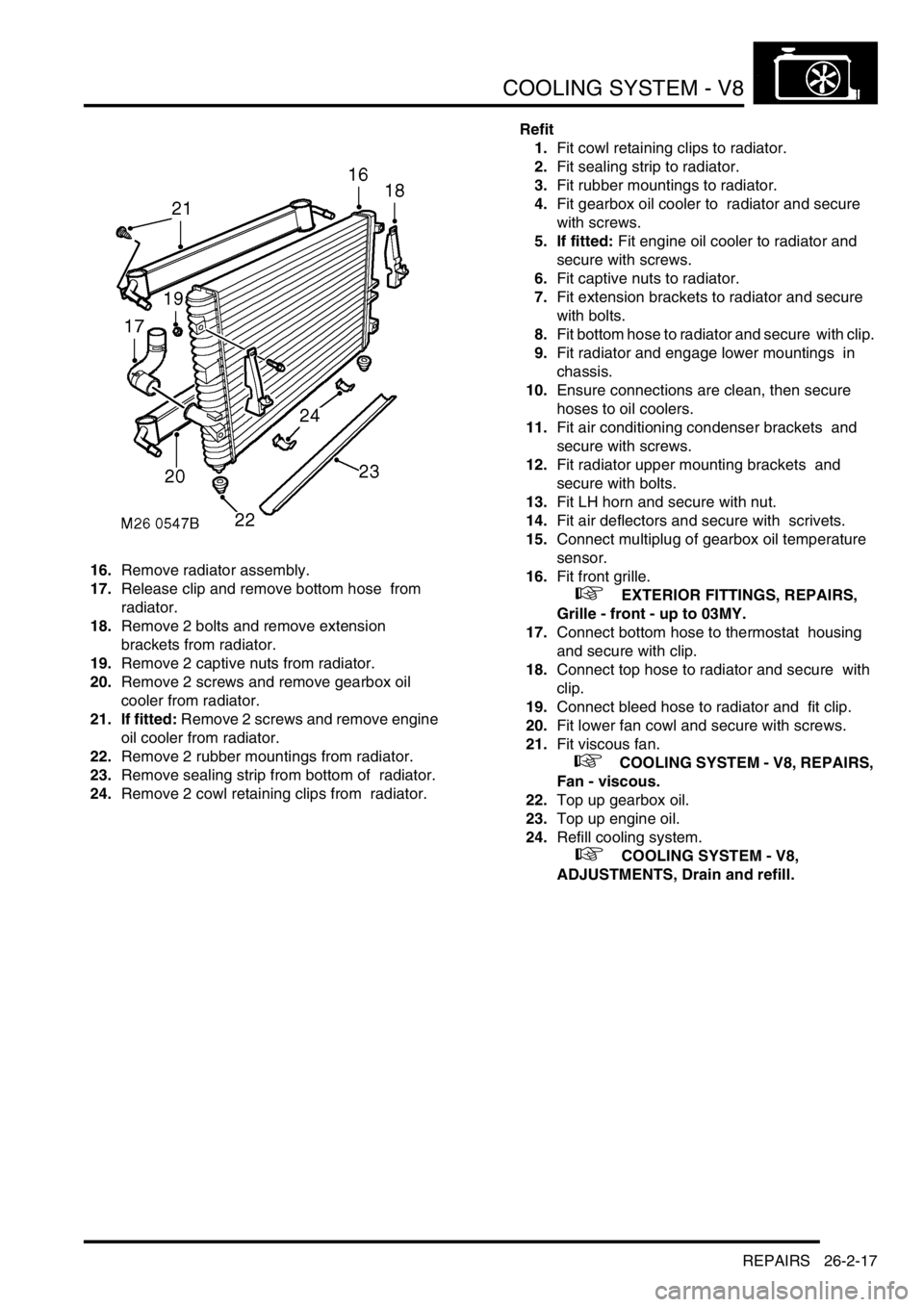
16.Remove radiator assembly.
17.Release clip and remove bottom hose from
radiator.
18.Remove 2 bolts and remove extension
brackets from radiator.
19.Remove 2 captive nuts from radiator.
20.Remove 2 screws and remove gearbox oil
cooler from radiator.
21. If fitted: Remove 2 screws and remove engine
oil cooler from radiator.
22.Remove 2 rubber mountings from radiator.
23.Remove sealing strip from bottom of radiator.
24.Remove 2 cowl retaining clips from radiator. Refit
1.Fit cowl retaining clips to radiator.
2.Fit sealing strip to radiator.
3.Fit rubber mountings to radiator.
4.Fit gearbox oil cooler to radiator and secure
with screws.
5. If fitted: Fit engine oil cooler to radiator and
secure with screws.
6.Fit captive nuts to radiator.
7.Fit extension brackets to radiator and secure
with bolts.
8.Fit bottom hose to radiator and secure with clip.
9.Fit radiator and engage lower mountings in
chassis.
10.Ensure connections are clean, then secure
hoses to oil coolers.
11.Fit air conditioning condenser brackets and
secure with screws.
12.Fit radiator upper mounting brackets and
secure with bolts.
13.Fit LH horn and secure with nut.
14.Fit air deflectors and secure with scrivets.
15.Connect multiplug of gearbox oil temperature
sensor.
16.Fit front grille.
+ EXTERIOR FITTINGS, REPAIRS,
Grille - front - up to 03MY.
17.Connect bottom hose to thermostat housing
and secure with clip.
18.Connect top hose to radiator and secure with
clip.
19.Connect bleed hose to radiator and fit clip.
20.Fit lower fan cowl and secure with screws.
21.Fit viscous fan.
+ COOLING SYSTEM - V8, REPAIRS,
Fan - viscous.
22.Top up gearbox oil.
23.Top up engine oil.
24.Refill cooling system.
+ COOLING SYSTEM - V8,
ADJUSTMENTS, Drain and refill.
Page 642 of 1672

MANIFOLDS AND EXHAUST SYSTEMS - V8
REPAIRS 30-2-13
5.Remove 3 bolts securing ACE pump, release
pump and position aside.
6.Remove 2 bolts securing alternator and
remove alternator. 7.Remove 3 bolts securing PAS pump pulley and
remove pulley.
8.Remove jockey pulley.
9.Position tray to catch spillage, release PAS
pump high pressure pipe.
CAUTION: Always fit plugs to open
connections to prevent contamination.
10.Remove bolt securing oil cooling pipe and
release bracket from auxiliary housing.
11.Remove two bolts securing PAS pump.
12.Remove 5 bolts and one nut securing auxiliary
housing. Pull housing forward, release PAS
pump and remove housing.
Page 644 of 1672

MANIFOLDS AND EXHAUST SYSTEMS - V8
REPAIRS 30-2-15
Refit
1.Clean old RTV sealant from cylinder head and
cylinder block notches.
2.Clean mating faces of cylinder block, cylinder
head and inlet manifold.
3.Apply RTV sealant to cylinder head and
cylinder block notches.
4.Fit new gasket seals, ensuring ends engage
correctly in notches.
5.Fit new inlet manifold gasket.
6.Position gasket clamps and fit bolts, but do not
tighten at this stage.
7.Position inlet manifold to engine. Fit manifold
bolts and, working in the sequence shown,
tighten bolts initially to 10 Nm (7 lbf.ft) then to
51 Nm (38 lbf.ft).
8.Tighten gasket clamp bolts to 18 Nm (13 lbf.ft).
9.Connect fuel pipe.
10.Clean top hose outlet pipe mating faces.
11.Fit new 'O' ring to outlet pipe.
12.Position outlet pipe, fit bolts and tighten to 22
Nm (16 lbf.ft).
13.Position alternator, fit bolts and tighten to 45
Nm (33 lbf.ft).
14.Position PAS pump to auxiliary housing and
locate housing on engine. Fit bolts and tighten
to 40 Nm (30 lbf.ft).
15.Fit and tighten auxiliary housing nut to 10 Nm (7
lbf.ft).
16.Fit bolts securing PAS pump and tighten to 22
Nm (16 lbf.ft). 17.Position oil cooling pipe bracket fit bolt and
tighten to 22 Nm (16 lbf.ft).
18.Fit and tighten PAS pump high pressure pipe.
19.Position jockey pulley and tighten bolt to 50 Nm
(37 lbf.ft).
20.Clean PAS pump pulley mating faces.
21.Position PAS pump pulley, fit bolts and tighten
to 22 Nm (16 lbf.ft).
22.Clean ACE pump dowels and dowel holes.
23.Position ACE pump, fit bolts and tighten to 22
Nm (16 lbf.ft).
24.Fit auxiliary drive belt.
+ CHARGING AND STARTING,
REPAIRS, Belt - auxiliary drive.
25.Secure injector harness and connect injector
multiplugs.
26.Position top hose and secure clips.
27.Fit rocker covers.
l
+ ENGINE - V8, REPAIRS, Gasket
- rocker cover - LH.
l
+ ENGINE - V8, REPAIRS, Gasket
- rocker cover - RH.
28.Check and top up PAS fluid
Page 647 of 1672

MANIFOLDS AND EXHAUST SYSTEMS - V8
30-2-18 REPAIRS
13.Disconnect breather hose from inlet plenum.
14.Remove bolt securing coolant rails.
15.Release engine harness from bulkhead clips
and position aside.
16.Remove 4 bolts securing ignition coils and
position ignition coils aside.
17.Release plug leads from upper manifold clips.
18.Disconnect multiplug from IACV.
19.Release and disconnect IACV hose.
20.Remove 6 bolts securing upper inlet manifold
and remove upper inlet manifold. 21.Collect upper inlet manifold gasket.
Refit
1.Clean upper and lower inlet manifold mating
faces, dowels and dowel holes.
2.Using a new gasket, position upper inlet
manifold. Fit bolts and, working in a diagonal
sequence, tighten to 22 Nm (16 lbf.ft).
3.Connect hose and multiplug to TP sensor.
4.Connect hose and multiplug to IACV. Secure
hose with clip.
5.Secure ht leads to upper inlet manifold.
6.Position ignition coils, fit bolts and tighten to 8
Nm (6 lbf.ft).
7.Ensure clip under ignition coils is located on
fuel pipe.
8.Secure engine harness in bulkhead clips.
9.Fit coolant rail bolt and tighten to 22 Nm (16
lbf.ft).
10.Connect breather hose to inlet plenum.
11.Connect brake servo vacuum pipe to inlet
plenum.
12.Connect EVAP pipe to inlet plenum.
13.Position coolant hoses to throttle body and
secure hose clips.
14.Fit breather hose to throttle body and secure
clip.
15.Connect multiplug to throttle body.
16.Connect throttle and cruise control cables and
secure in throttle body cams.
17.Adjust throttle and cruise control cables.
l
+ ENGINE MANAGEMENT SYSTEM
- V8, ADJUSTMENTS, Cable - cruise
control.
l
+ ENGINE MANAGEMENT SYSTEM
- V8, ADJUSTMENTS, Cable - throttle.
18.Connect air intake hose and tighten clips.
Secure harness to air intake hose.
19.Top-up cooling system
+ MAINTENANCE, PROCEDURES,
Cooling system..
20.Fit bonnet.
+ EXTERIOR FITTINGS, REPAIRS,
Bonnet.
21.Connect battery earth lead.
22.Fit battery cover and secure with fixings.