2002 LAND ROVER DISCOVERY air condition
[x] Cancel search: air conditionPage 607 of 1672

COOLING SYSTEM - V8
26-2-6 DESCRIPTION AND OPERATION
Description
General
The cooling system used on the V8 engine is a pressure relief by-pass type system which allows coolant to circulate
around the cylinder block and the heater circuit when the thermostat is closed. With coolant not passing through the
radiator, this promotes faster heater warm-up which in turn improves passenger comfort.
A coolant pump is located in a housing at the front of the engine and is driven by a drive belt. The pump is connected
into the coolant passages cast in the cylinder block and pumps coolant from the radiator through the cylinder block.
A viscous fan is attached by means of a nut to the coolant pump pulley drive spindle. The fan draws air through the
radiator to assist in cooling when the vehicle is stationary. The fan rotational speed is controlled relative to the running
temperature of the engine by a thermostatic valve regulated by a bi-metallic coil.
The cooling system uses a 50/50 mix of anti-freeze and water.
Thermostat housing
A plastic thermostat housing is located behind the radiator. The housing has three connections which locate the
radiator bottom hose, top hose and coolant pump feed hose. The housing contains a wax element and a spring loaded
by-pass flow valve.
Thermostat - Main valve
The thermostat is used to maintain the coolant at the optimum temperature for efficient combustion and to aid engine
warm-up. The thermostat is closed at temperatures below approximately 82
°C (179°F). When the coolant
temperature reaches approximately 82
°C the thermostat starts to open and is fully open at approximately 96°C
(204
°F). In this condition the full flow of coolant is directed through the radiator.
The thermostat is exposed to 90% hot coolant from the engine on one side and 10% cold coolant returning from the
radiator bottom hose on the other side.
Hot coolant from the engine passes from the by-pass pipe through four sensing holes in the flow valve into a tube
surrounding 90% of the thermostat sensitive area. Cold coolant returning from the engine, cooled by the radiator,
conducts through 10% of the sensitive area.
In cold ambient temperatures, the engine temperature is raised by approximately 10
°C (50°F) to compensate for the
heat loss of 10% exposure to the cold coolant returning from the bottom hose.
By-pass flow valve
The by-pass flow valve is held closed by a light spring. It operates to further aid heater warm-up. When the main valve
is closed and the engine speed is at idle, the coolant pump does not produce sufficient flow and pressure to open the
valve. In this condition the valve prevents coolant circulating through the by-pass circuit and forces the coolant through
the heater matrix only. This provides a higher flow of coolant through the heater matrix to improve passenger comfort
in cold conditions.
When the engine speed increases above idle the coolant pump produces a greater flow and pressure than the heater
circuit can take. The pressure acts on the flow valve and overcomes the valve spring pressure, opening the valve and
limiting the pressure in the heater circuit. The valve modulates to provide maximum coolant flow through the heater
matrix and yet allowing excess coolant to flow into the by-pass circuit to provide the engine's cooling needs at higher
engine rev/min.
Page 611 of 1672

COOLING SYSTEM - V8
26-2-10 DESCRIPTION AND OPERATION
Operation
Coolant flow - Engine warm up
Refer to illustration.
+ COOLING SYSTEM - V8, DESCRIPTION AND OPERATION, Cooling system coolant flow.
During warm-up the coolant pump moves fluid through the cylinder block and it emerges from the inlet manifold outlet
pipe. From the outlet pipe, the warm coolant flow is prevented from flowing through the radiator because the
thermostat is closed. The coolant is directed into the heater circuit.
Some coolant from the by-pass pipe can pass through small sensing holes in the flow valve. The warm coolant enters
a tube in the thermostat housing and surrounds 90% of the thermostat sensitive area. Cold coolant returning from the
radiator bottom hose conducts through 10% of the thermostat sensitive area. In cold ambient temperatures the engine
temperature can be raised by up to 10
°C (50°F) to compensate for the heat loss of the 10% exposure to the cold
coolant returning from the radiator bottom hose.
At engine idle speed, the by-pass valve is closed only allowing the small flow through the sensing holes. As the engine
speed increases above idle, the greater flow and pressure from the pump overcomes the light spring and opens the
by-pass flow valve. The flow valve opens to meet the engines cooling needs at higher engine speeds and prevents
excess pressure in the system. With the thermostat closed, maximum flow is directed through the heater circuit.
The heater matrix acts as a heat exchanger reducing coolant temperature as it passes through the matrix. Coolant
emerges from the matrix and flows into the coolant pump feed pipe and recirculated around the heater circuit. In this
condition the cooling system is operating at maximum heater performance.
Coolant flow - Engine hot
As the coolant temperature increases the thermostat opens. This allows some coolant from the outlet housing to flow
through the top hose and into the radiator to be cooled. The hot coolant flows from the left tank in the radiator, along
the tubes to the right tank. The air flowing through the fins between the tubes cools the coolant as it passes through
the radiator.
A controlled flow of the lower temperature coolant is drawn by the pump and blended with hot coolant from the by-
pass and the heater return pipes in the pump feed pipe. The pump then passes this coolant into the cylinder block to
cool the cylinders.
Page 617 of 1672

COOLING SYSTEM - V8
26-2-16 REPAIRS
8.Remove 6 scrivets and remove LH and RH air
deflectors from front panel. Disconnect
multiplug of gearbox oil temperature sensor
(arrowed).
9.Remove nut and move horn aside. 10.Remove 2 bolts securing radiator LH and RH
upper mounting brackets to body panel and
remove brackets.
11.Remove 4 screws securing air conditioning
condenser LH and RH upper mounting
brackets to condenser.
12.Remove brackets with rubber mounts from
radiator extension brackets.
13.Position absorbent cloth under each cooler
hose to collect oil spillage.
14.Push against coupling release rings and
disconnect hoses from gearbox oil cooler.
CAUTION: Always fit plugs to open
connections to prevent contamination.
15. If fitted: Push against coupling release rings
and disconnect hoses from engine oil cooler.
Page 618 of 1672
COOLING SYSTEM - V8
REPAIRS 26-2-17
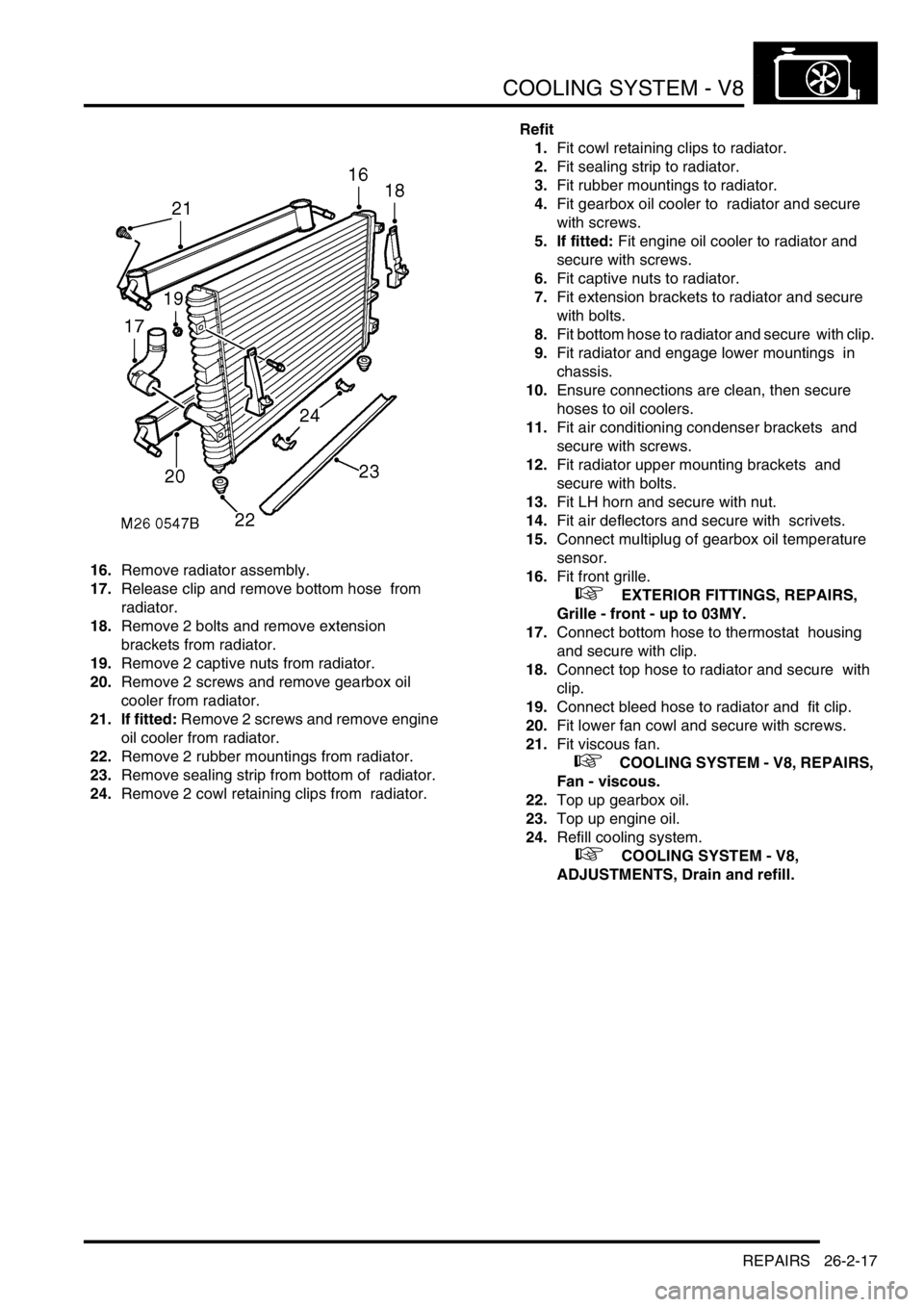
16.Remove radiator assembly.
17.Release clip and remove bottom hose from
radiator.
18.Remove 2 bolts and remove extension
brackets from radiator.
19.Remove 2 captive nuts from radiator.
20.Remove 2 screws and remove gearbox oil
cooler from radiator.
21. If fitted: Remove 2 screws and remove engine
oil cooler from radiator.
22.Remove 2 rubber mountings from radiator.
23.Remove sealing strip from bottom of radiator.
24.Remove 2 cowl retaining clips from radiator. Refit
1.Fit cowl retaining clips to radiator.
2.Fit sealing strip to radiator.
3.Fit rubber mountings to radiator.
4.Fit gearbox oil cooler to radiator and secure
with screws.
5. If fitted: Fit engine oil cooler to radiator and
secure with screws.
6.Fit captive nuts to radiator.
7.Fit extension brackets to radiator and secure
with bolts.
8.Fit bottom hose to radiator and secure with clip.
9.Fit radiator and engage lower mountings in
chassis.
10.Ensure connections are clean, then secure
hoses to oil coolers.
11.Fit air conditioning condenser brackets and
secure with screws.
12.Fit radiator upper mounting brackets and
secure with bolts.
13.Fit LH horn and secure with nut.
14.Fit air deflectors and secure with scrivets.
15.Connect multiplug of gearbox oil temperature
sensor.
16.Fit front grille.
+ EXTERIOR FITTINGS, REPAIRS,
Grille - front - up to 03MY.
17.Connect bottom hose to thermostat housing
and secure with clip.
18.Connect top hose to radiator and secure with
clip.
19.Connect bleed hose to radiator and fit clip.
20.Fit lower fan cowl and secure with screws.
21.Fit viscous fan.
+ COOLING SYSTEM - V8, REPAIRS,
Fan - viscous.
22.Top up gearbox oil.
23.Top up engine oil.
24.Refill cooling system.
+ COOLING SYSTEM - V8,
ADJUSTMENTS, Drain and refill.
Page 629 of 1672

MANIFOLDS AND EXHAUST SYSTEMS - TD5
30-1-8 REPAIRS
Gasket - exhaust manifold
$% 30.15.12
Remove
Note: The following procedure covers engines
fitted with or without an EGR cooler. The EGR
cooler is bolted to the front of the cylinder head.
1.Remove turbocharger.
+ ENGINE MANAGEMENT SYSTEM -
Td5, REPAIRS, Turbocharger.
2. Models with air conditioning: Remove
auxiliary drive belt.
+ CHARGING AND STARTING,
REPAIRS, Belt - auxiliary drive.
3. Models with air conditioning: Remove 4 bolts
securing compressor and move to one side.
4.Remove and discard 2 Allen screws securing
EGR pipe to exhaust manifold.
Note: Engine with EGR cooler illustrated.5.Remove 10 nuts securing exhaust manifold to
cylinder head.
6.Remove exhaust manifold and gasket.
Refit
1.Clean exhaust manifold and mating faces.
2.Fit new gasket.Fit exhaust manifold and,
working from the centre outwards, tighten nuts
to 25 Nm (18 lbf.ft) .
3. Models with air conditioning:
Positioncompressor and tighten bolts to 25 Nm
(18 lbf.ft).
4.Position EGR valve pipe, fit new Allen screws
and tighten to 9 Nm (7 lbf.ft).
5.Fit turbocharger.
+ ENGINE MANAGEMENT SYSTEM -
Td5, REPAIRS, Turbocharger.
6. Models with air conditioning: Fit auxiliary
drive belt.
+ CHARGING AND STARTING,
REPAIRS, Belt - auxiliary drive.
Page 659 of 1672
CLUTCH - TD5
33-1-8 DESCRIPTION AND OPERATION
The dual mass flywheel is used to insulate the gearbox from torsional and transient vibrations produced by the engine.
The flywheel comprises primary and secondary flywheels with the drive between the two transferred by a torsional
damper which comprises four coil springs. The springs are located in the inside diameter of the primary flywheel. Two
of the springs are of smaller diameter and fit inside the larger diameter springs.
The primary flywheel locates the ring gear and is attached to the crankshaft flange with eight bolts. The two pairs of
coil springs are located in a recess in the flywheel between two riveted retainers. A roller bearing is pressed onto the
central boss of the primary flywheel and retained with a riveted plate. The bearing provides the mounting for the
secondary flywheel.
The secondary flywheel comprises two parts; an outer flywheel which provides the friction surface for the clutch drive
plate and an inner drive plate which transfers the drive from the primary flywheel, via the coil springs, to the outer
flywheel. The two components of the secondary flywheel are secured to each other with rivets. The inner drive plate
is located between the two pairs of coil springs and can rotate on the ball bearing in either direction against the
combined compression force of the four coil springs. Under high torque loading conditions the secondary flywheel can
rotate in either direction up to 70
° in relation to the primary flywheel.
The operating face of the secondary flywheel is machined to provide a smooth surface for the drive plate to engage
on. Three dowels and six studs and nuts provide for the location and attachment of the pressure plate.
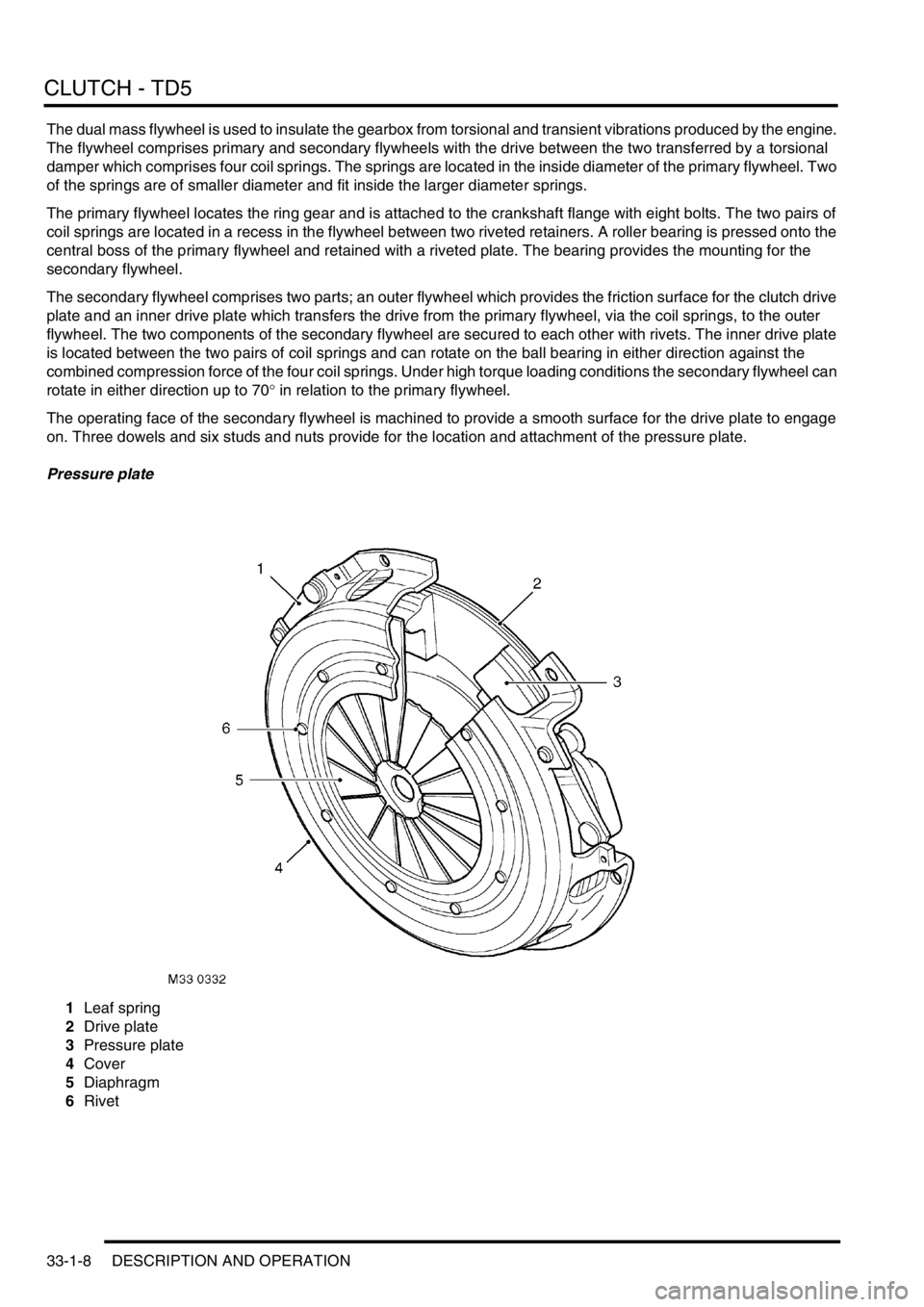
Pressure plate
1Leaf spring
2Drive plate
3Pressure plate
4Cover
5Diaphragm
6Rivet
Page 952 of 1672

FRONT SUSPENSION
DESCRIPTION AND OPERATION 60-13
Lateral acceleration of the body is sensed by two accelerometers and signals are transmitted to the ECU. The engine
driven hydraulic pump supplies a constant hydraulic flow to the valve block. Two directional control valves are
solenoid operated by the ECU and these supply fluid to the applicable side of each actuator to apply an equal and
opposite force to the torsion bar. In operation the ACE system maintains the attitude of the vehicle body when
cornering.
The ACE system uses a semi-synthetic hydraulic fluid which is the same as the fluid used for the PAS system. The
total capacity of the ACE system is 1.62 litres (0.42 US Gallons).
CAUTION: The ACE hydraulic system is extremely sensitive to the ingress of dirt or debris. The smallest
amount could render the system unserviceable. It is imperative that the following precautions are taken.
lACE components are thoroughly cleaned externally before work commences;
lall opened pipe and module ports are capped immediately;
lall fluid is stored in and administered through clean containers.
In the event of an ECU or hydraulic failure the system will fail safe to a 'locked bars' condition. The 'locked bars'
condition will allow the torsion bars to operate in a similar manner as conventional 'passive' anti-roll bars. Prolonged
cornering forces will allow a progressive increase in roll angle due to hydraulic leakage through the actuators and
valve block. Failures will be relayed to the driver by the illumination of the ACE warning lamp in the instrument pack.
Faults are recorded by the ECU and can be retrieved using TestBook.
When the ignition switch is moved to position II, the warning lamp will illuminate for two seconds to check functionality.
The warning lamp functionality can also be checked using TestBook.
TestBook must also be used to perform a bleeding procedure after maintenance operations have been performed to
ensure that complete system bleeding is performed. Trapped air in the system can seriously reduce the system
performance.
Fluid reservoir
The moulded plastic fluid reservoir is mounted on the left hand side of the engine compartment on a bracket which is
attached to the inner wing. The reservoir is dual purpose, being divided into two separate chambers; one for the ACE
system and one for the PAS system. Each chamber has its own filler neck and cap and is identified by moulded
lettering on the reservoir adjacent to each filler.
A non-serviceable filter assembly is fitted in the base of each chamber. The filter is made from fine stainless steel
mesh which is moulded into the body of the reservoir. The filter removes particulate matter from the fluid before it is
drawn into the hydraulic pump.
Upper and lower fluid level marks are moulded onto the reservoir body. The capacity of the ACE reservoir chamber
to the upper level mark is 0.5 litre (0.13 US Gallon).
Page 986 of 1672

FRONT SUSPENSION
REPAIRS 60-47
5.Remove 2 nuts securing rear pipe clamping
plate. Release clamping plate and pipes from
valve block.
CAUTION: Always fit plugs to open
connections to prevent contamination.
NOTE: Keep pipes assembled to clamping
plate to maintain correct pipe positions for
refitting.
6.Remove 2 nuts securing front pipe clamping
plate.7.Remove 3 bolts securing valve block to
chassis.
8.Release front pipes and clamping plate from
valve block and remove valve block.
CAUTION: Always fit plugs to open
connections to prevent contamination.
NOTE: Keep pipes assembled to clamping
plate to maintain correct pipe positions for
refitting.
9.Remove 6 bushes from valve block.
Refit
1.Fit 6 bushes to valve block.
2.Ensure valve block and pipe connections are
clean.
3.It is important that the pipe ends are in good
condition to achieve a seal.
4.Position valve block and connect front pipes
and clamping plate. To avoid damage to
seals, keep pipes square to valve block. Fit
and tighten bolts securing valve block to
chassis to 18 Nm (13 lbf.ft).
CAUTION: Ensure pipes are installed in
their correct ports or serious system
damage will occur.
5.Fit and tighten nuts securing front clamping
plate to valve block to 21 Nm (15 lbf.ft).