Page 362 of 432
6-36
Windshield Wiper
Blade Replacement
Windshield wiper blades should be inspected at least
twice a year for wear or cracking. See ªWiper Blade
Checkº in the Index for more information.
See ªNormal Maintenance Replacement Partsº in the
Index for the proper type of replacement blade.
NOTICE:
Use care when removing or installing a blade
assembly. Accidental bumping can cause the
arm to fall back and strike the windshield.
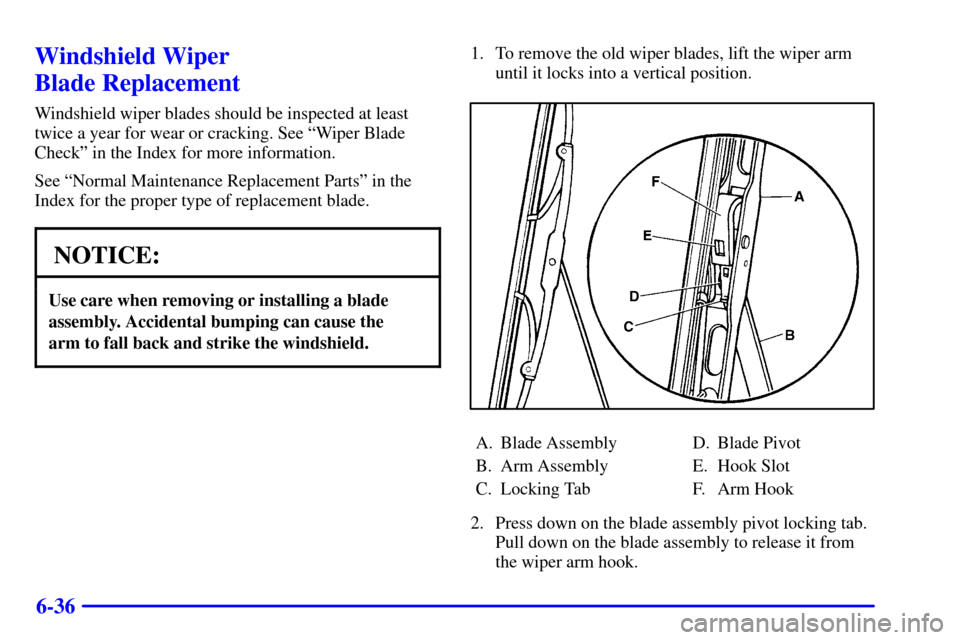
1. To remove the old wiper blades, lift the wiper arm
until it locks into a vertical position.
A. Blade Assembly
B. Arm Assembly
C. Locking TabD. Blade Pivot
E. Hook Slot
F. Arm Hook
2. Press down on the blade assembly pivot locking tab.
Pull down on the blade assembly to release it from
the wiper arm hook.
Page 363 of 432
6-37
3. Remove the insert from the blade assembly. The
insert has two notches at one end that are locked
by the bottom claws of the blade assembly. At the
notched end, pull the insert from the blade assembly.
4. To install the new wiper insert, slide the insert (D),
notched end last, into the end with two blade claws (A).
Slide the insert all the way through the blade claws at the
opposite end (B). The plastic caps (C) will be forced off
as the insert is fully inserted.
5. Be sure that the notches are locked by the bottom
claws. Make sure that all other claws are properly
locked on both sides of the insert slots.
A. Claw in Notch
B. Correct Installation
C. Incorrect Installation
6. Put the blade assembly pivot in the wiper arm
hook. Pull up until the pivot locking tab locks in
the hook slot.
7. Carefully lower the wiper arm and blade assembly
onto the windshield.
Page 364 of 432
6-38 Backglass Wiper Blade Replacement
See ªWindshield Wiper Blade Replacementº in this
section for instructions on how to change the backglass
wiper blade. The backglass wiper blade will not lock
in a vertical position like the windshield wiper blade,
so care should be used when pulling it away from
the vehicle.
Tires
Your new vehicle comes with high-quality tires made by
a leading tire manufacturer. If you ever have questions
about your tire warranty and where to obtain service,
see your Chevrolet Warranty booklet for details.
CAUTION:
Poorly maintained and improperly used tires
are dangerous.
�Overloading your tires can cause
overheating as a result of too much friction.
You could have an air
-out and a serious
accident. See ªLoading Your Vehicleº in
the Index.
�Underinflated tires pose the same danger
as overloaded tires. The resulting accident
could cause serious injury. Check all tires
frequently to maintain the recommended
pressure. Tire pressure should be checked
when your tires are cold.
�Overinflated tires are more likely to be
cut, punctured or broken by a sudden
impact
-- such as when you hit a pothole.
Keep tires at the recommended pressure.
�Worn, old tires can cause accidents. If your
tread is badly worn, or if your tires have
been damaged, replace them.
Page 383 of 432
6-57 Fuses and Circuit Breakers
The wiring circuits in your vehicle are protected from
short circuits by a combination of fuses and circuit
breakers. This greatly reduces the chance of fires
caused by electrical problems.
Look at the silver
-colored band inside the fuse. If the band
is broken or melted, replace the fuse. Be sure you replace
a bad fuse with a new one of the identical size and rating.
If you ever have a problem on the road and don't have
a spare fuse, you can borrow one that has the same
amperage. Just pick some feature of your vehicle that
you can get along without
-- like the radio or cigarette
lighter
-- and use its fuse, if it is the correct amperage.
Replace it as soon as you can.Engine Compartment Fuse Block
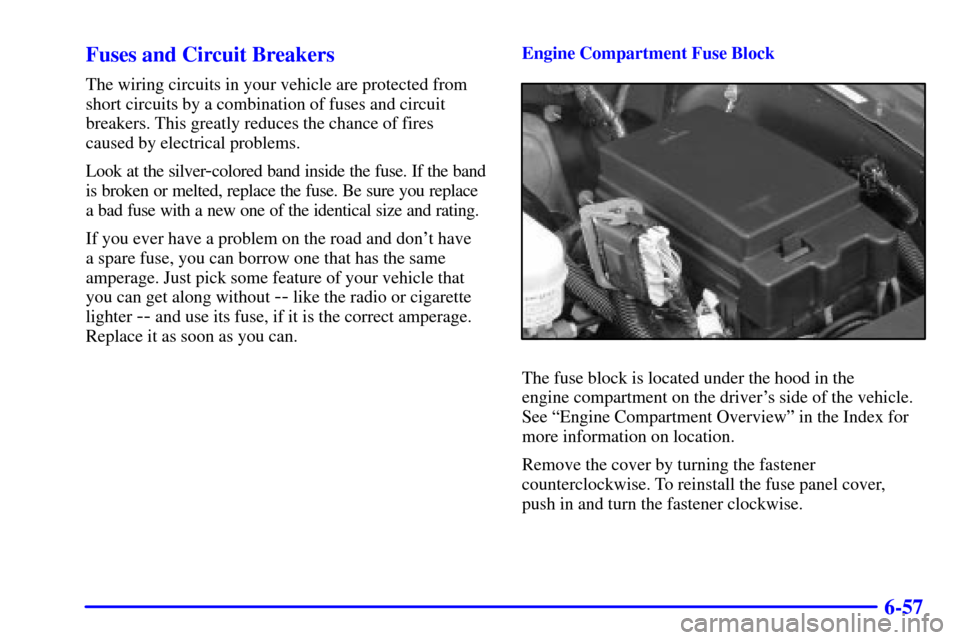
The fuse block is located under the hood in the
engine compartment on the driver's side of the vehicle.
See ªEngine Compartment Overviewº in the Index for
more information on location.
Remove the cover by turning the fastener
counterclockwise. To reinstall the fuse panel cover,
push in and turn the fastener clockwise.
Page 385 of 432
6-59
Mini Fuses Usage
1 ECAS
2 Passenger's Side
High
-Beam Headlamp
3 Passenger's Side
Low
-Beam Headlamp
4 Back
-Up Trailer Lamps
5 Driver's Side
High
-Beam Headlamp
6 Driver's Side
Low
-Beam Headlamp
7 WASH
8ATC
9 Windshield Wipers
10 Powertrain Control Module B
11 Fog Lamps
12 ST/LP
13 Cigarette Lighter
14 COILS
15 RIDE
16 TBD
-- Ignition 1Mini Fuses Usage
17 Crank
18 Air Bag
19 ELEK Brake
20 Cooling Fan
21 Horn
22 Ignition E
23 ETC
24 Instrument Panel Cluster, Driver
Information Center
25 Automatic Shift Lock
Control System
26 ENG 1
27 Back
-Up
28 Powertrain Control Module 1
29 Oxygen Sensor
30 Air Conditioning
31 TBC
50 Passenger's Side Trailer TRN
51 Driver's Side Trailer TRN
52 Hazard Flashers
Page 386 of 432
6-60
J-Case Fuses Usage
32 Trailer
33 Anti
-Lock Brakes (ABS)
34 Ignition A
35 Blower Motor
36 Ignition B
Micro Relays Usage
37 Blank
38 Rear Window Washer
39 Fog Lamps
40 Horn
41 Fuel Pump
42 Windshield Wipers/Washer
43 High
-Beam Headlamp
44 Air Conditioning
Solid
State RelaysUsage
45 Cooling Fan
46 HDMMini Relay Usage
47 Starter
Miscellaneous Usage
48 Instrument Panel Battery
49 Fuse Puller
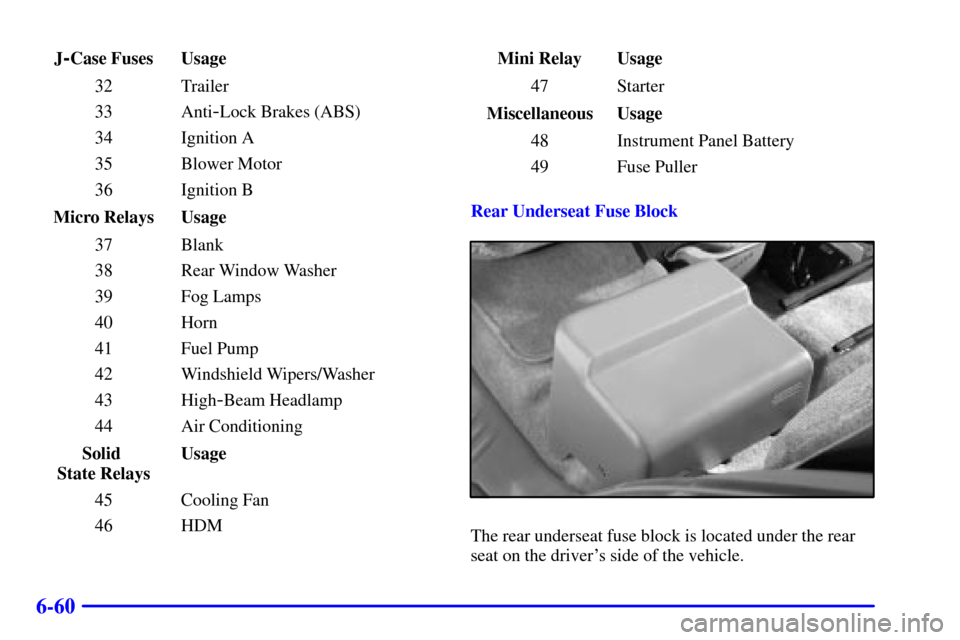
Rear Underseat Fuse Block
The rear underseat fuse block is located under the rear
seat on the driver's side of the vehicle.
Page 388 of 432
6-62
Fuse Usage
17 Right Rear Parking Lamps
18 LOCKS
19 Blank
20 Sunroof
21 LOCK
23 Blank
24 UNLOCK
25 Blank
26 Blank
27 OH Battery/OnStar
� System
29 Rainsense Wipers
30 Parking Lamps
31 TBC 4CC
32 TBC5
33 Front Wipers
34 VEH STOP
35 BlankFuse Usage
36 HVAC B
37 Front Parking Lamps
38 Left Turn Signal
39 HVAC 1
40 TBC 4
41 Radio
42 TR PARK
43 Right Turn Signal
44 HVAC
45 Rear Fog Lamps
46 Auxiliary Power 1
47 Ignition 0
48 Four
-Wheel Drive
49 Blank
50 TBC IG
51 Brakes
52 TBC RUN
Page 406 of 432

7-17
Weatherstrip Lubrication
Silicone grease on weatherstrips will make them last
longer, seal better, and not stick or squeak. Apply
silicone grease with a clean cloth. During very cold,
damp weather more frequent application may be
required. See ªRecommended Fluids and Lubricantsº in
the Index.
Automatic Transmission Check
Check the transmission fluid level; add if needed. See
ªAutomatic Transmission Fluidº in the Index. A fluid
loss may indicate a problem. Check the system and
repair if needed.At Least Once a Year
Key Lock Cylinders Service
Lubricate the key lock cylinders with the lubricant
specified in Part D.
Body Lubrication Service
Lubricate all hood latch assembly, secondary latch,
pivots, spring anchor, release pawl, rear compartment
hinges, outer liftgate handle pivot points, rear door
detent link, roller mechanism, liftgate handle pivot
points, latch bolt, fuel door hinge, cargo door hinge,
locks and folding seat hardware. Part D tells you what to
use. More frequent lubrication may be required when
exposed to a corrosive environment.