Page 4 of 432
Table of Contents
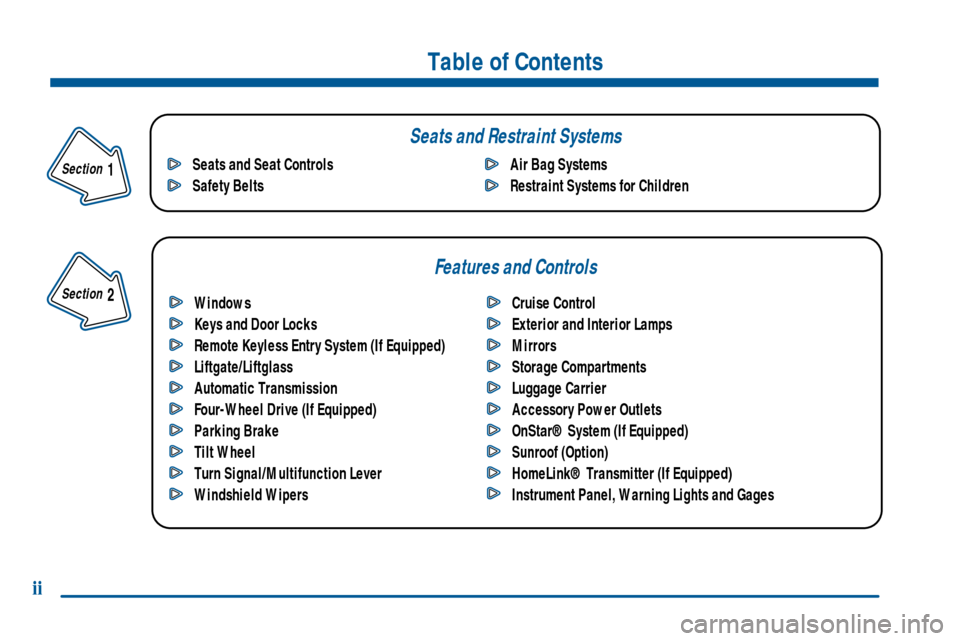
Windows
Keys and Door Locks
Remote Keyless Entry System (If Equipped)
Liftgate/Liftglass
Automatic Transmission
Four-Wheel Drive (If Equipped)
Parking Brake
Tilt Wheel
Turn Signal/Multifunction Lever
Windshield WipersCruise Control
Exterior and Interior Lamps
Mirrors
Storage Compartments
Luggage Carrier
Accessory Power Outlets
OnStar® System (If Equipped)
Sunroof (Option)
HomeLink® Transmitter (If Equipped)
Instrument Panel, Warning Lights and Gages Seats and Seat Controls
Safety BeltsAir Bag Systems
Restraint Systems for Children
Section
1
Section
2
Seats and Restraint Systems
Features and Controls
ii
Page 10 of 432
viii
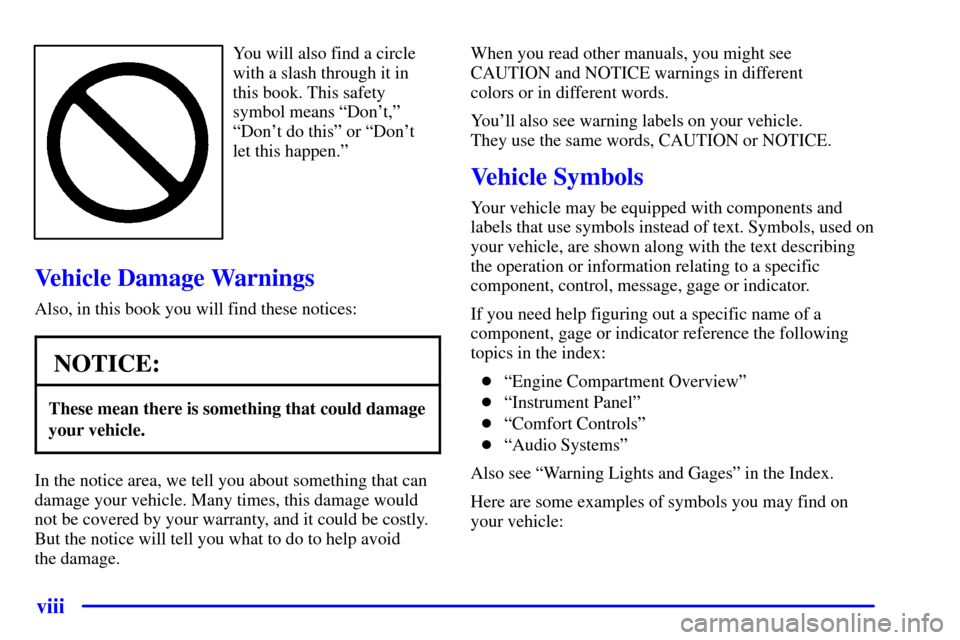
You will also find a circle
with a slash through it in
this book. This safety
symbol means ªDon't,º
ªDon't do thisº or ªDon't
let this happen.º
Vehicle Damage Warnings
Also, in this book you will find these notices:
NOTICE:
These mean there is something that could damage
your vehicle.
In the notice area, we tell you about something that can
damage your vehicle. Many times, this damage would
not be covered by your warranty, and it could be costly.
But the notice will tell you what to do to help avoid
the damage.When you read other manuals, you might see
CAUTION and NOTICE warnings in different
colors or in different words.
You'll also see warning labels on your vehicle.
They use the same words, CAUTION or NOTICE.
Vehicle Symbols
Your vehicle may be equipped with components and
labels that use symbols instead of text. Symbols, used on
your vehicle, are shown along with the text describing
the operation or information relating to a specific
component, control, message, gage or indicator.
If you need help figuring out a specific name of a
component, gage or indicator reference the following
topics in the index:
�ªEngine Compartment Overviewº
�ªInstrument Panelº
�ªComfort Controlsº
�ªAudio Systemsº
Also see ªWarning Lights and Gagesº in the Index.
Here are some examples of symbols you may find on
your vehicle:
Page 17 of 432
1-5
Two personalized exit positions can be set by first
recalling the driver's position (by pressing 1 or 2), then
positioning the seat in the desired exit position for that
driver. Then press and hold the button with the exit
symbol for three seconds. A chime will sound to let you
know that the position has been stored. With the vehicle
in PARK (P), the exit position for that driver can be
recalled by pressing the exit button. The mirrors,
power lumbar and recline positions will not be stored
or recalled for the exit positions.
Programming for automatic seat and mirror movement
can be done through the Driver Information Center
(DIC). You can choose to either select or not select
automatic seat and mirror movement by using the
remote keyless entry transmitter, by placing your
key in the ignition, or when exiting the vehicle. For
programming information, see ªVehicle Programming
and Personalization Featuresº in the Index.Heated Front Seats (Option)
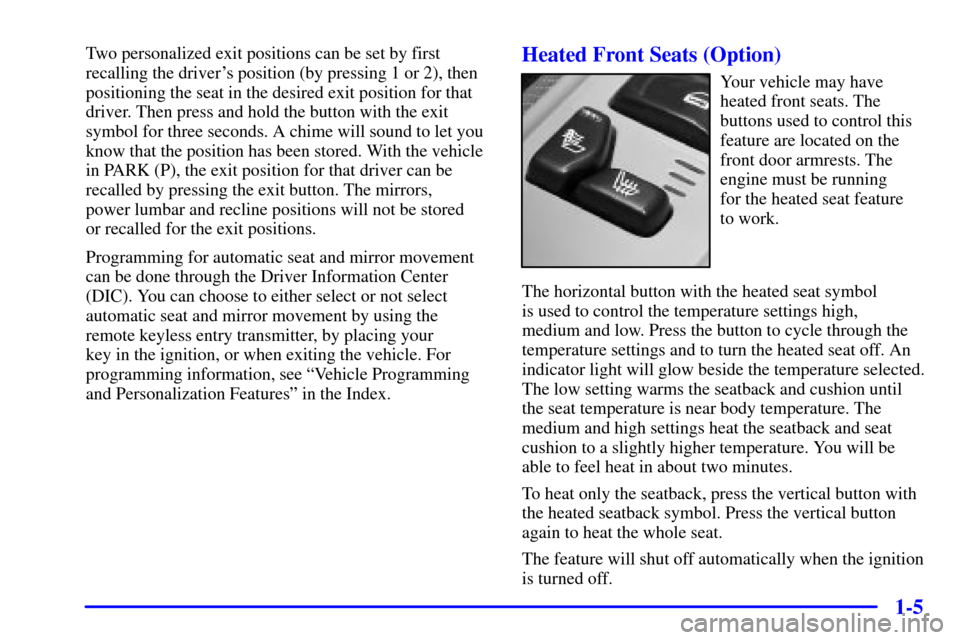
Your vehicle may have
heated front seats. The
buttons used to control this
feature are located on the
front door armrests. The
engine must be running
for the heated seat feature
to work.
The horizontal button with the heated seat symbol
is used to control the temperature settings high,
medium and low. Press the button to cycle through the
temperature settings and to turn the heated seat off. An
indicator light will glow beside the temperature selected.
The low setting warms the seatback and cushion until
the seat temperature is near body temperature. The
medium and high settings heat the seatback and seat
cushion to a slightly higher temperature. You will be
able to feel heat in about two minutes.
To heat only the seatback, press the vertical button with
the heated seatback symbol. Press the vertical button
again to heat the whole seat.
The feature will shut off automatically when the ignition
is turned off.
Page 22 of 432
1-10
CAUTION:
It is extremely dangerous to ride in a cargo area,
inside or outside of a vehicle. In a collision,
people riding in these areas are more likely to
be seriously injured or killed. Do not allow people
to ride in any area of your vehicle that is not
equipped with seats and safety belts. Be sure
everyone in your vehicle is in a seat and using
a safety belt properly.
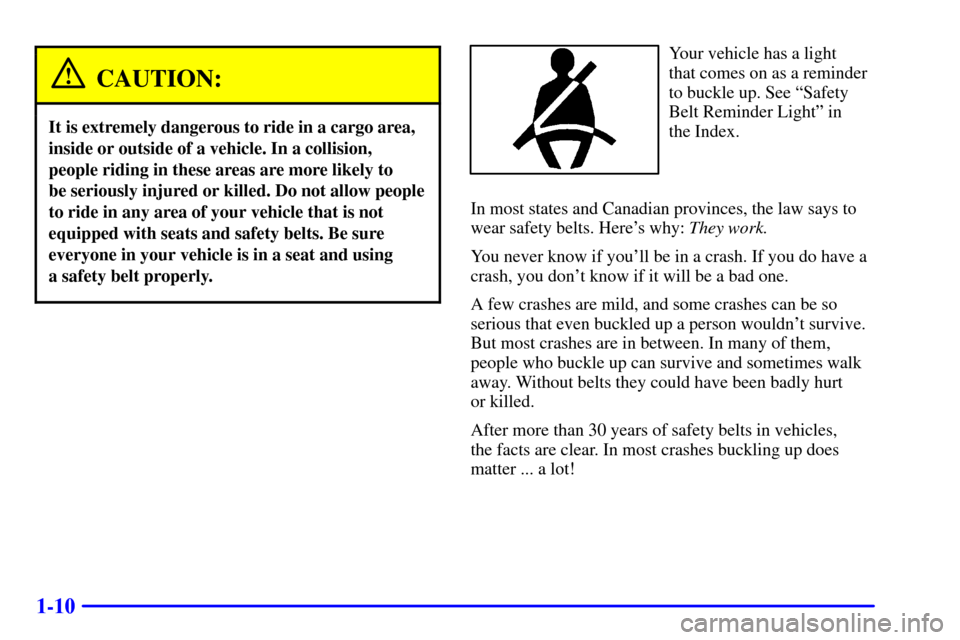
Your vehicle has a light
that comes on as a reminder
to buckle up. See ªSafety
Belt Reminder Lightº in
the Index.
In most states and Canadian provinces, the law says to
wear safety belts. Here's why: They work.
You never know if you'll be in a crash. If you do have a
crash, you don't know if it will be a bad one.
A few crashes are mild, and some crashes can be so
serious that even buckled up a person wouldn't survive.
But most crashes are in between. In many of them,
people who buckle up can survive and sometimes walk
away. Without belts they could have been badly hurt
or killed.
After more than 30 years of safety belts in vehicles,
the facts are clear. In most crashes buckling up does
matter ... a lot!
Page 36 of 432
1-24
CAUTION:
Anyone who is up against, or very close to, any
air bag when it inflates can be seriously injured
or killed. Air bags plus lap
-shoulder belts offer
the best protection for adults, but not for young
children and infants. Neither the vehicle's safety
belt system nor its air bag system is designed
for them. Young children and infants need the
protection that a child restraint system can
provide. Always secure children properly in
your vehicle. To read how, see the part of this
manual called ªChildren.º
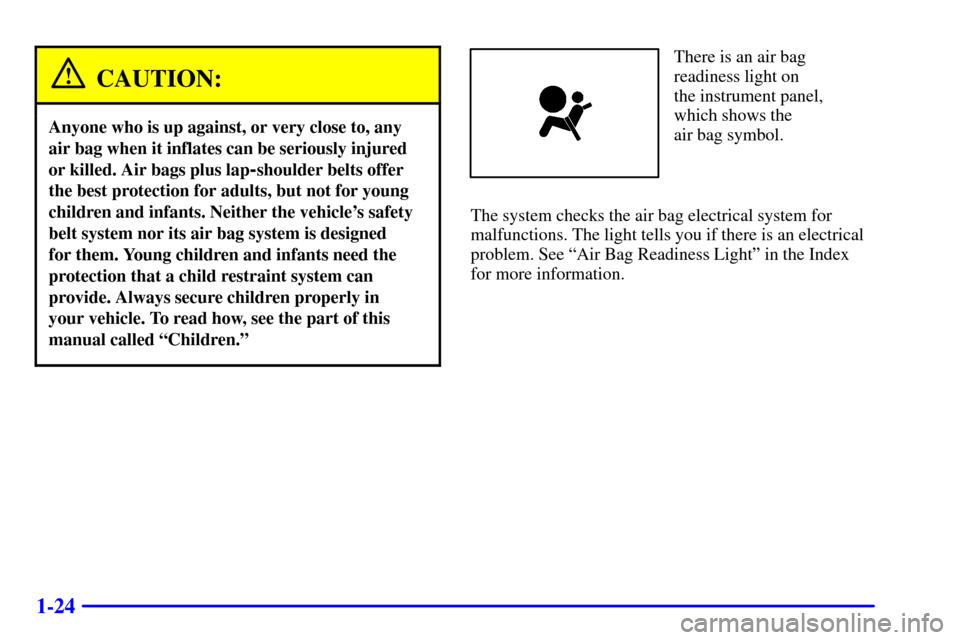
There is an air bag
readiness light on
the instrument panel,
which shows the
air bag symbol.
The system checks the air bag electrical system for
malfunctions. The light tells you if there is an electrical
problem. See ªAir Bag Readiness Lightº in the Index
for more information.
Page 69 of 432
1-57
Safety Belt Extender
If the vehicle's safety belt will fasten around you,
you should use it.
But if a safety belt isn't long enough to fasten, your
dealer will order you an extender. It's free. When you go
in to order it, take the heaviest coat you will wear, so the
extender will be long enough for you. The extender will
be just for you, and just for the seat in your vehicle that
you choose. Don't let someone else use it, and use it
only for the seat it is made to fit. To wear it, just attach
it to the regular safety belt.
Checking Your Restraint Systems
Now and then, make sure the safety belt reminder light
and all your belts, buckles, latch plates, retractors and
anchorages are working properly. Look for any other
loose or damaged safety belt system parts. If you see
anything that might keep a safety belt system from
doing its job, have it repaired.
Torn or frayed safety belts may not protect you in a
crash. They can rip apart under impact forces. If a belt
is torn or frayed, get a new one right away.
Also look for any opened or broken air bag covers, and
have them repaired or replaced. (The air bag system
does not need regular maintenance.)
Replacing Restraint System Parts
After a Crash
If you've had a crash, do you need new belts?
After a very minor collision, nothing may be necessary.
But if the belts were stretched, as they would be if worn
during a more severe crash, then you need new belts.
If belts are cut or damaged, replace them. Collision
damage also may mean you will need to have safety belt
or seat parts repaired or replaced. New parts and repairs
may be necessary even if the belt wasn't being used at
the time of the collision.
If an air bag inflates, you'll need to replace air bag
system parts. See the part on the air bag system
earlier in this section.
Page 70 of 432
2-
2-1
Section 2 Features and Controls
Here you can learn about the many standard and optional features on your vehicle, and information on starting,
shifting and braking. Also explained are the instrument panel and the warning systems that tell you if everything is
working properly
-- and what to do if you have a problem.
2
-2 Windows
2
-4 Keys
2
-6 Door Locks
2
-10 Remote Keyless Entry System (If Equipped)
2
-13 Liftgate/Liftglass
2
-14 Theft
2
-16 Content Theft-Deterrent (If Equipped)
2
-17 Passlock�
2-18 New Vehicle ªBreak-Inº
2
-19 Ignition Positions
2
-20 Starting Your Engine
2
-21 Engine Coolant Heater (If Equipped)
2
-22 Automatic Transmission Operation
2
-26 Four-Wheel Drive (If Equipped)
2
-30 Parking Brake
2
-31 Shifting Into PARK (P)
2
-33 Shifting Out of PARK (P)
2
-33 Parking Over Things That Burn
2
-34 Engine Exhaust2
-34 Running Your Engine While You're Parked
2
-35 Locking Rear Axle
2
-36 Tilt Wheel
2
-36 Turn Signal/Multifunction Lever
2
-44 Exterior Lamps
2
-47 Interior Lamps
2
-49 Mirrors
2
-56 Storage Compartments
2
-61 Ashtrays and Cigarette Lighter
2
-62 Accessory Power Outlets
2
-63 OnStar� System (If Equipped)
2
-66 Sunroof (Option)
2
-67 HomeLink� Transmitter (If Equipped)
2
-70 Instrument Panel -- Your Information System
2
-72 Instrument Panel Cluster
2
-74 Warning Lights, Gages and Indicators
2
-89 Driver Information Center (DIC)
(If Equipped)
Page 72 of 432
2-3
Power Windows
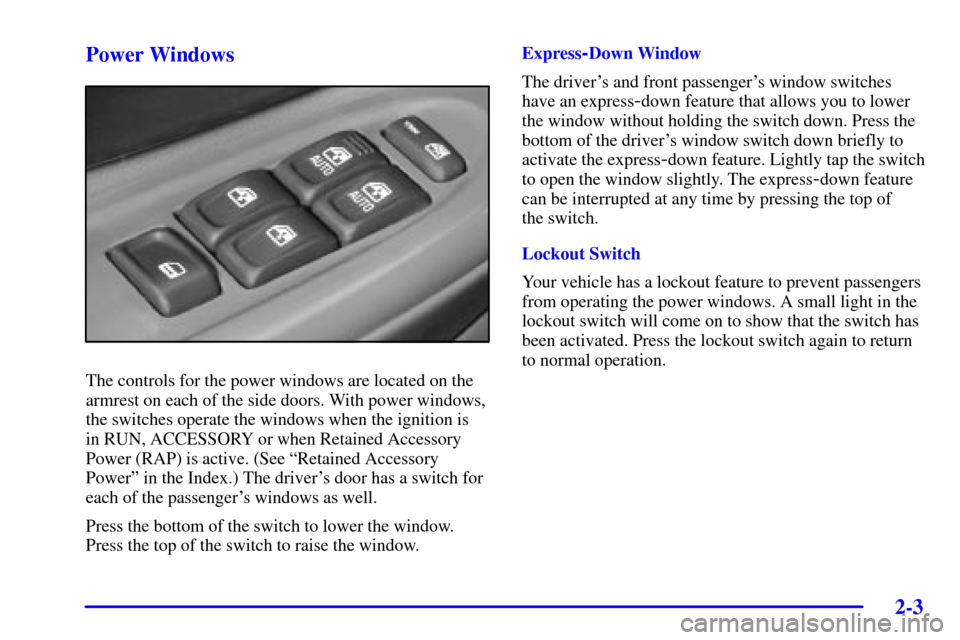
The controls for the power windows are located on the
armrest on each of the side doors. With power windows,
the switches operate the windows when the ignition is
in RUN, ACCESSORY or when Retained Accessory
Power (RAP) is active. (See ªRetained Accessory
Powerº in the Index.) The driver's door has a switch for
each of the passenger's windows as well.
Press the bottom of the switch to lower the window.
Press the top of the switch to raise the window.Express
-Down Window
The driver's and front passenger's window switches
have an express
-down feature that allows you to lower
the window without holding the switch down. Press the
bottom of the driver's window switch down briefly to
activate the express
-down feature. Lightly tap the switch
to open the window slightly. The express
-down feature
can be interrupted at any time by pressing the top of
the switch.
Lockout Switch
Your vehicle has a lockout feature to prevent passengers
from operating the power windows. A small light in the
lockout switch will come on to show that the switch has
been activated. Press the lockout switch again to return
to normal operation.