Page 216 of 432
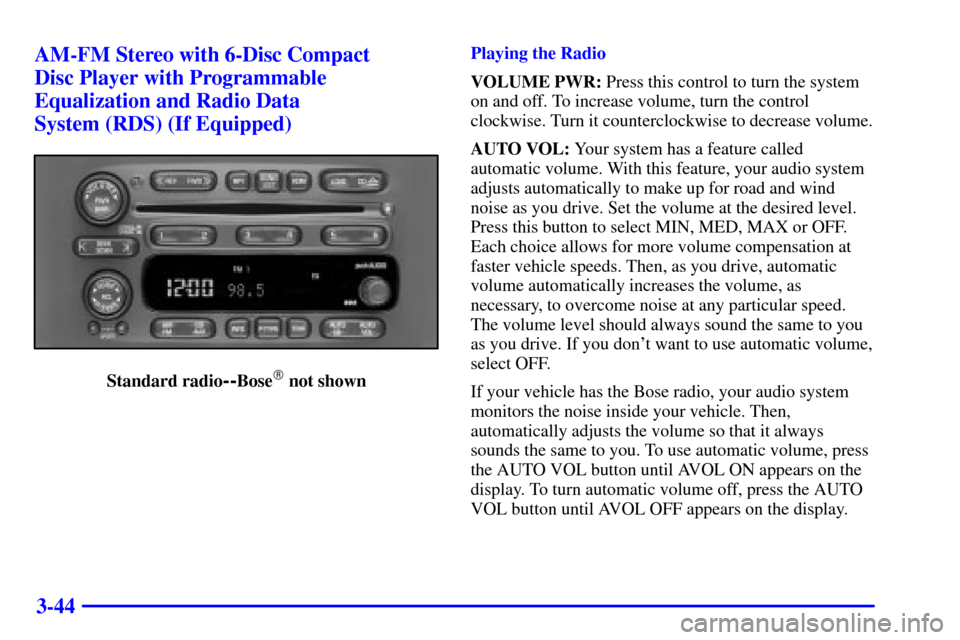
3-44 AM-FM Stereo with 6-Disc Compact
Disc Player with Programmable
Equalization and Radio Data
System (RDS) (If Equipped)
Standard radio--Bose� not shownPlaying the Radio
VOLUME PWR: Press this control to turn the system
on and off. To increase volume, turn the control
clockwise. Turn it counterclockwise to decrease volume.
AUTO VOL: Your system has a feature called
automatic volume. With this feature, your audio system
adjusts automatically to make up for road and wind
noise as you drive. Set the volume at the desired level.
Press this button to select MIN, MED, MAX or OFF.
Each choice allows for more volume compensation at
faster vehicle speeds. Then, as you drive, automatic
volume automatically increases the volume, as
necessary, to overcome noise at any particular speed.
The volume level should always sound the same to you
as you drive. If you don't want to use automatic volume,
select OFF.
If your vehicle has the Bose radio, your audio system
monitors the noise inside your vehicle. Then,
automatically adjusts the volume so that it always
sounds the same to you. To use automatic volume, press
the AUTO VOL button until AVOL ON appears on the
display. To turn automatic volume off, press the AUTO
VOL button until AVOL OFF appears on the display.
Page 227 of 432
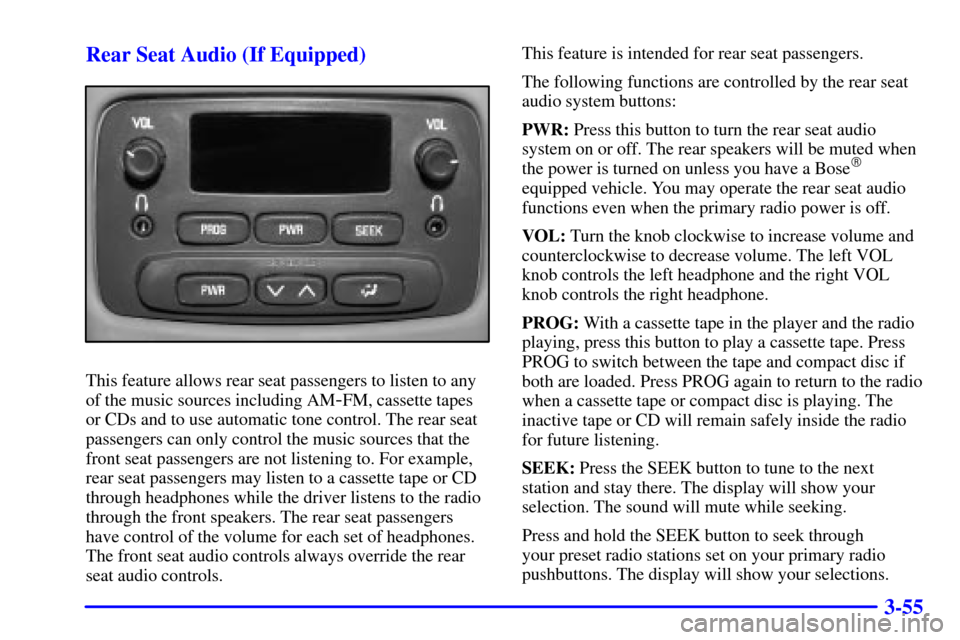
3-55 Rear Seat Audio (If Equipped)
This feature allows rear seat passengers to listen to any
of the music sources including AM
-FM, cassette tapes
or CDs and to use automatic tone control. The rear seat
passengers can only control the music sources that the
front seat passengers are not listening to. For example,
rear seat passengers may listen to a cassette tape or CD
through headphones while the driver listens to the radio
through the front speakers. The rear seat passengers
have control of the volume for each set of headphones.
The front seat audio controls always override the rear
seat audio controls.This feature is intended for rear seat passengers.
The following functions are controlled by the rear seat
audio system buttons:
PWR: Press this button to turn the rear seat audio
system on or off. The rear speakers will be muted when
the power is turned on unless you have a Bose
�
equipped vehicle. You may operate the rear seat audio
functions even when the primary radio power is off.
VOL: Turn the knob clockwise to increase volume and
counterclockwise to decrease volume. The left VOL
knob controls the left headphone and the right VOL
knob controls the right headphone.
PROG: With a cassette tape in the player and the radio
playing, press this button to play a cassette tape. Press
PROG to switch between the tape and compact disc if
both are loaded. Press PROG again to return to the radio
when a cassette tape or compact disc is playing. The
inactive tape or CD will remain safely inside the radio
for future listening.
SEEK: Press the SEEK button to tune to the next
station and stay there. The display will show your
selection. The sound will mute while seeking.
Press and hold the SEEK button to seek through
your preset radio stations set on your primary radio
pushbuttons. The display will show your selections.
Page 228 of 432
3-56
The SEEK button is inactive if the AM FM mode on
the front radio is in use.
While listening to a cassette tape, press the SEEK button
to hear the next selection on the tape. Press and hold the
SEEK button to go to the other side of the tape. The
SEEK button is inactive if the tape mode on the front
radio is in use.
While listening to a CD, press the SEEK button to
hear the next selection on the CD. The SEEK button
is inactive if the CD mode on the front radio or the
CD changer is in use.
Theft-Deterrent Feature RDS Radios
THEFTLOCK� is designed to discourage theft of your
radio. The feature works automatically by learning a
portion of the Vehicle Identification Number (VIN).
If the radio is moved to a different vehicle, it will not
operate and LOCKED will be displayed.
When the radio and vehicle are turned off, the blinking
red light indicates that THEFTLOCK is armed.
With THEFTLOCK activated, your radio will not
operate if stolen.
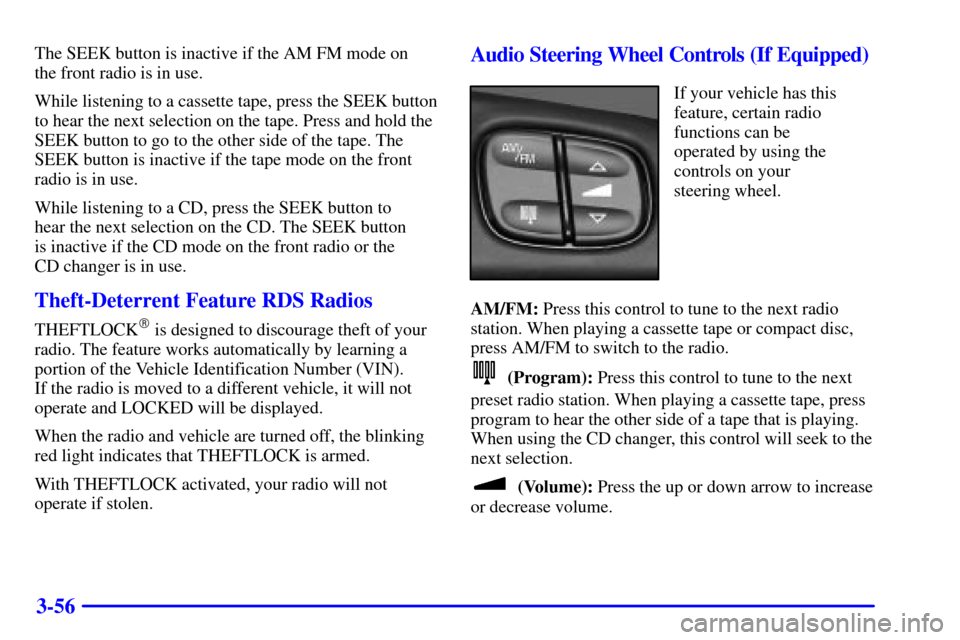
Audio Steering Wheel Controls (If Equipped)
If your vehicle has this
feature, certain radio
functions can be
operated by using the
controls on your
steering wheel.
AM/FM: Press this control to tune to the next radio
station. When playing a cassette tape or compact disc,
press AM/FM to switch to the radio.
(Program): Press this control to tune to the next
preset radio station. When playing a cassette tape, press
program to hear the other side of a tape that is playing.
When using the CD changer, this control will seek to the
next selection.
(Volume): Press the up or down arrow to increase
or decrease volume.
Page 239 of 432

4-7
Avoid needless heavy braking. Some people drive in
spurts
-- heavy acceleration followed by heavy
braking
-- rather than keeping pace with traffic.
This is a mistake. Your brakes may not have time to
cool between hard stops. Your brakes will wear out
much faster if you do a lot of heavy braking. If you
keep pace with the traffic and allow realistic following
distances, you will eliminate a lot of unnecessary
braking. That means better braking and longer
brake life.
If your engine ever stops while you're driving, brake
normally but don't pump your brakes. If you do, the
pedal may get harder to push down. If your engine
stops, you will still have some power brake assist.
But you will use it when you brake. Once the power
assist is used up, it may take longer to stop and the
brake pedal will be harder to push.
Anti-Lock Brake System (ABS)
Your vehicle has anti-lock brakes (ABS). ABS is
an advanced electronic braking system that will help
prevent a braking skid.
When you start your engine and begin to drive away,
your anti
-lock brake system will check itself. You may
hear a momentary motor or clicking noise while this test
is going on. This is normal.
If there's a problem with
the anti
-lock brake system,
this warning light will stay
on. See ªAnti
-Lock Brake
System Warning Lightº in
the Index.
Page 240 of 432
4-8
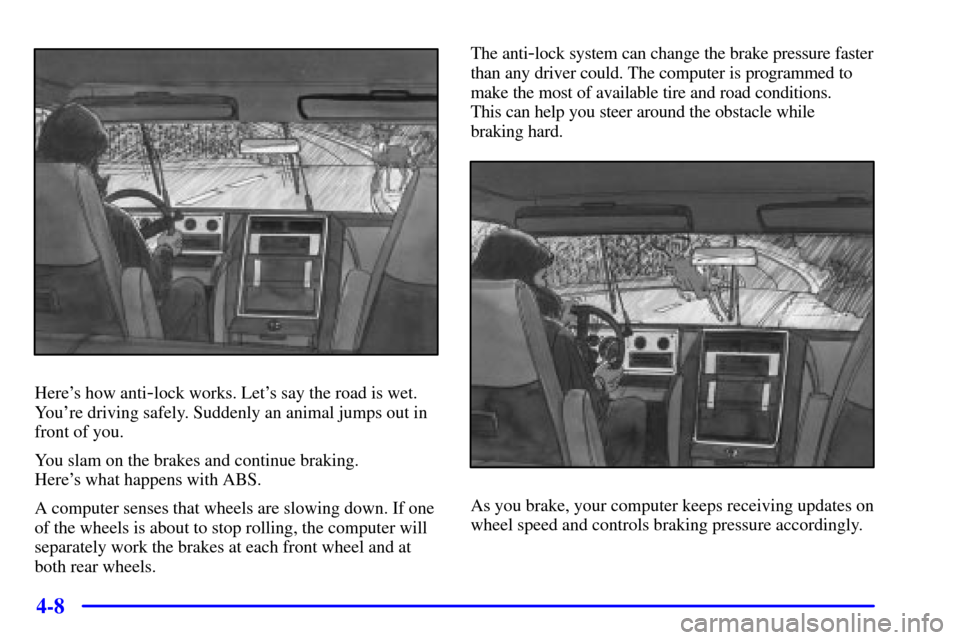
Here's how anti-lock works. Let's say the road is wet.
You're driving safely. Suddenly an animal jumps out in
front of you.
You slam on the brakes and continue braking.
Here's what happens with ABS.
A computer senses that wheels are slowing down. If one
of the wheels is about to stop rolling, the computer will
separately work the brakes at each front wheel and at
both rear wheels.The anti
-lock system can change the brake pressure faster
than any driver could. The computer is programmed to
make the most of available tire and road conditions.
This can help you steer around the obstacle while
braking hard.
As you brake, your computer keeps receiving updates on
wheel speed and controls braking pressure accordingly.
Page 241 of 432

4-9
Remember: Anti-lock doesn't change the time you need
to get your foot up to the brake pedal or always decrease
stopping distance. If you get too close to the vehicle in
front of you, you won't have time to apply your brakes
if that vehicle suddenly slows or stops. Always leave
enough room up ahead to stop, even though you
have anti
-lock brakes.
Using Anti
-Lock
Don't pump the brakes. Just hold the brake pedal down
firmly and let anti
-lock work for you. You may feel the
brakes vibrate, or you may notice some noise, but this
is normal.
Braking in Emergencies
With anti-lock, you can steer and brake at the same
time. In many emergencies, steering can help you
more than even the very best braking.
Traction Assist System (TAS)
(Two
-Wheel Drive Only)
Your vehicle has a Traction Assist System (TAS) that
limits wheel spin. This is especially useful in slippery
road conditions. The system operates only if it senses
that one or both of the rear wheels are spinning or
beginning to lose traction. When this happens, the
system reduces engine power to limit wheel spin.
The LOW TRAC light next to the button will come on
when the TAS is limiting wheel spin. You may feel or
hear the system working, but this is normal.
The Traction Assist System may operate on dry roads
under some conditions. When this happens, you may
notice a reduction in acceleration. This is normal and
doesn't mean there's a problem with your vehicle.
Examples of these conditions include a hard acceleration
in a turn, an abrupt upshift or downshift of the
transmission or driving on rough roads.
If your vehicle is in cruise control when the TAS begins
to limit wheel spin, the cruise control will automatically
disengage. When road conditions allow you to safely
use it again, you may re
-engage the cruise control. See
ªCruise Controlº in the Index. When the TRAC OFF
light on the button is on, the TAS is off and will not
limit wheel spin. Adjust your driving accordingly.
Page 242 of 432
4-10
The TRAC OFF light on the button will come on under
the following conditions:
�The Traction Assist System is turned off, either by
pressing the TAS on/off button or turning off the
automatic engagement feature of the TAS.
�The transmission is in FIRST (1); TAS will not
operate in this gear. This is normal.
�The vehicle is driven on an extremely rough road.
When the vehicle leaves the rough surface, slows
down or stops, the light will go off and TAS will
be on again. This is normal.
�A Traction Assist System, Anti
-Lock Brake System
or engine
-related problem has been detected and the
vehicle needs service.
The Traction Assist System, as delivered from the
factory, will automatically come on whenever you start
your vehicle. To limit wheel spin, especially in slippery
road conditions, you should always leave the system
on. But you can turn the TAS off if you ever need to.
You should turn the TAS off if your vehicle ever gets
stuck in sand, mud or snow and rocking the vehicle is
required. See ªRocking Your Vehicleº in the Index.
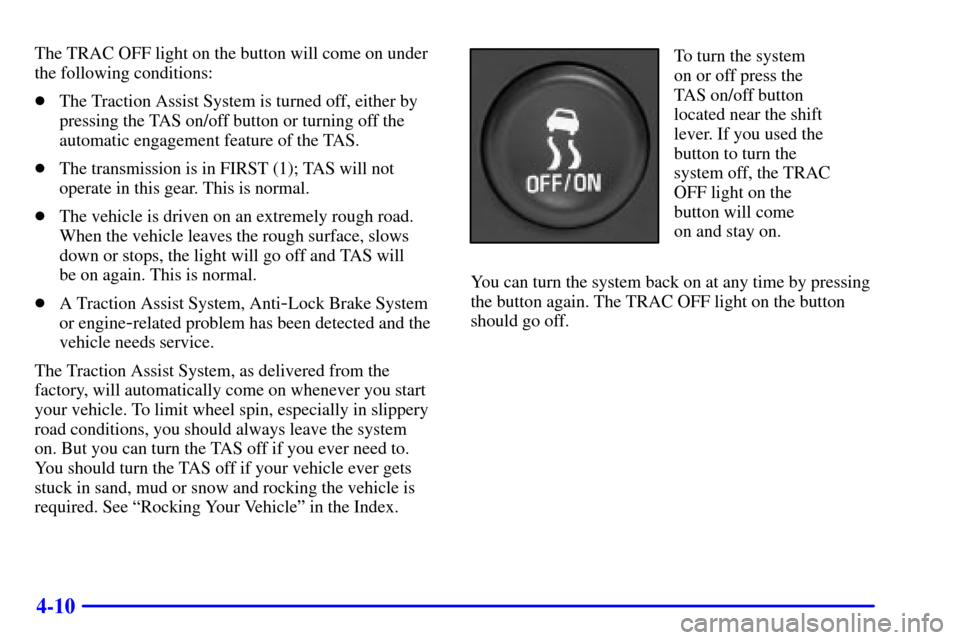
To turn the system
on or off press the
TAS on/off button
located near the shift
lever. If you used the
button to turn the
system off, the TRAC
OFF light on the
button will come
on and stay on.
You can turn the system back on at any time by pressing
the button again. The TRAC OFF light on the button
should go off.
Page 245 of 432

4-13
An emergency like this requires close attention and a
quick decision. If you are holding the steering wheel at
the recommended 9 and 3 o'clock positions, you can
turn it a full 180 degrees very quickly without removing
either hand. But you have to act fast, steer quickly, and
just as quickly straighten the wheel once you have
avoided the object.
The fact that such emergency situations are always
possible is a good reason to practice defensive driving
at all times and wear safety belts properly.
Off-Road Recovery
You may find that your right wheels have dropped off the
edge of a road onto the shoulder while you're driving.
If the level of the shoulder is only slightly below the
pavement, recovery should be fairly easy. Ease off the
accelerator and then, if there is nothing in the way,
steer so that your vehicle straddles the edge of the
pavement. You can turn the steering wheel up to
one
-quarter turn until the right front tire contacts the
pavement edge. Then turn your steering wheel to go
straight down the roadway.