Page 5 of 432
Comfort Controls and Audio Systems
Your Driving and the Road
Table of Contents (cont'd)
Defensive Driving
Drunken Driving
Control of a Vehicle
Braking
SteeringDriving Tips for Various Road Conditions
Off-Road Driving
Recreational Vehicle Towing
Loading Your Vehicle
Towing a Trailer Heating and Air Conditioning
Setting the Radio Clock
Radio/Cassette Player/CD PlayerRadio Theft-Deterrent Feature
Steering Wheel Controls (If Equipped)
Hazard Warning Flashers
Jump Starting
Towing Your VehicleEngine Overheating
Changing a Flat Tire
If You're Stuck
Problems on the Road
iii
Section
5
Section
4
Section
3
Page 20 of 432
1-8 Rear Seats
Your vehicle has a folding rear seat which lets you fold
the seatbacks down for more cargo space.
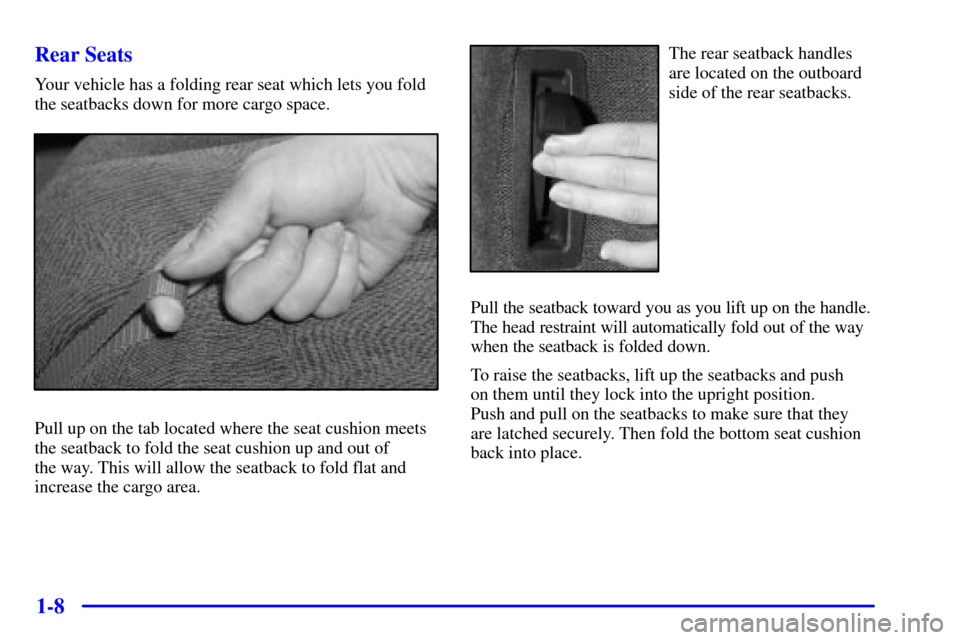
Pull up on the tab located where the seat cushion meets
the seatback to fold the seat cushion up and out of
the way. This will allow the seatback to fold flat and
increase the cargo area.
The rear seatback handles
are located on the outboard
side of the rear seatbacks.
Pull the seatback toward you as you lift up on the handle.
The head restraint will automatically fold out of the way
when the seatback is folded down.
To raise the seatbacks, lift up the seatbacks and push
on them until they lock into the upright position.
Push and pull on the seatbacks to make sure that they
are latched securely. Then fold the bottom seat cushion
back into place.
Page 40 of 432

1-28
In any particular crash, no one can say whether an air
bag should have inflated simply because of the damage
to a vehicle or because of what the repair costs were.
For frontal air bags, inflation is determined by the angle
of the impact and how quickly the vehicle slows down
in frontal and near
-frontal impacts. For side impact air
bags, inflation is determined by the location and severity
of the impact.
The air bag system is designed to work properly under
a wide range of conditions, including off
-road usage.
Observe safe driving speeds, especially on rough terrain.
As always, wear your safety belt. See ªOff
-Road
Drivingº in the Index for more tips on off
-road driving.
What makes an air bag inflate?
In an impact of sufficient severity, the air bag sensing
system detects that the vehicle is in a crash. For both
frontal and side impact air bags, the sensing system
triggers a release of gas from the inflator, which inflates
the air bag. The inflator, air bag and related hardware
are all part of the air bag modules inside the steering
wheel, instrument panel and the side of the front
seatbacks closest to the door.How does an air bag restrain?
In moderate to severe frontal or near frontal collisions,
even belted occupants can contact the steering wheel
or the instrument panel. In moderate to severe side
collisions, even belted occupants can contact the inside
of the vehicle. The air bag supplements the protection
provided by safety belts. Air bags distribute the force of
the impact more evenly over the occupant's upper body,
stopping the occupant more gradually. But the frontal
air bags would not help you in many types of collisions,
including rollovers, rear impacts, and side impacts,
primarily because an occupant's motion is not toward
the air bag. Side impact air bags would not help you
in many types of collisions, including frontal or near
frontal collisions, rollovers, and rear impacts, primarily
because an occupant's motion is not toward those air
bags. Air bags should never be regarded as anything
more than a supplement to safety belts, and then only
in moderate to severe frontal or near
-frontal collisions
for the driver's and right front passenger's frontal air
bags, and only in moderate to severe side collisions
for the driver's and right front passenger's side impact
air bags.
Page 52 of 432
1-40
Restraint Systems for Children
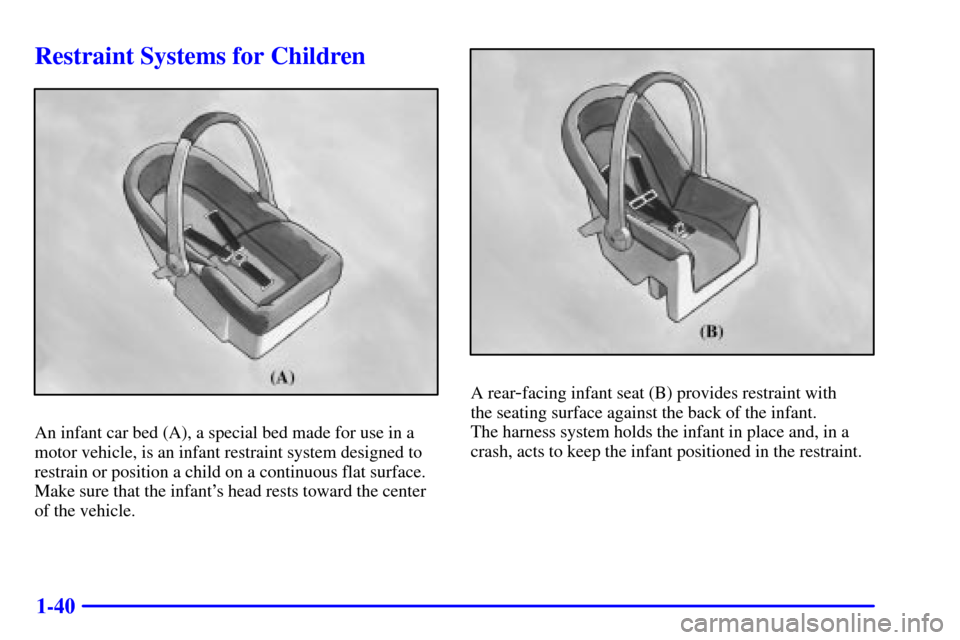
An infant car bed (A), a special bed made for use in a
motor vehicle, is an infant restraint system designed to
restrain or position a child on a continuous flat surface.
Make sure that the infant's head rests toward the center
of the vehicle.
A rear-facing infant seat (B) provides restraint with
the seating surface against the back of the infant.
The harness system holds the infant in place and, in a
crash, acts to keep the infant positioned in the restraint.
Page 67 of 432
1-55
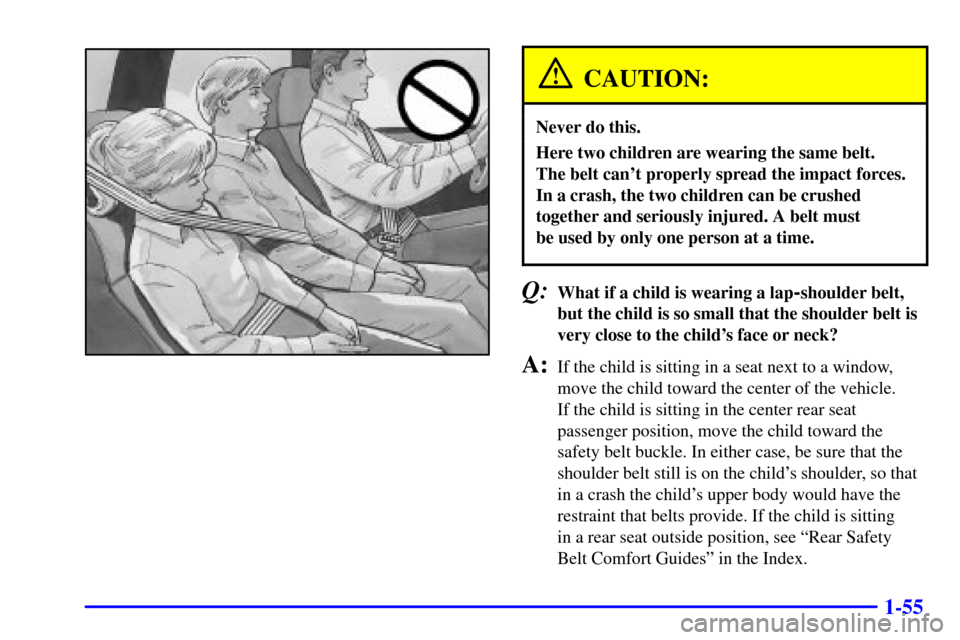
CAUTION:
Never do this.
Here two children are wearing the same belt.
The belt can't properly spread the impact forces.
In a crash, the two children can be crushed
together and seriously injured. A belt must
be used by only one person at a time.
Q:What if a child is wearing a lap-shoulder belt,
but the child is so small that the shoulder belt is
very close to the child's face or neck?
A:If the child is sitting in a seat next to a window,
move the child toward the center of the vehicle.
If the child is sitting in the center rear seat
passenger position, move the child toward the
safety belt buckle. In either case, be sure that the
shoulder belt still is on the child's shoulder, so that
in a crash the child's upper body would have the
restraint that belts provide. If the child is sitting
in a rear seat outside position, see ªRear Safety
Belt Comfort Guidesº in the Index.
Page 76 of 432
2-7
Power Door Locks
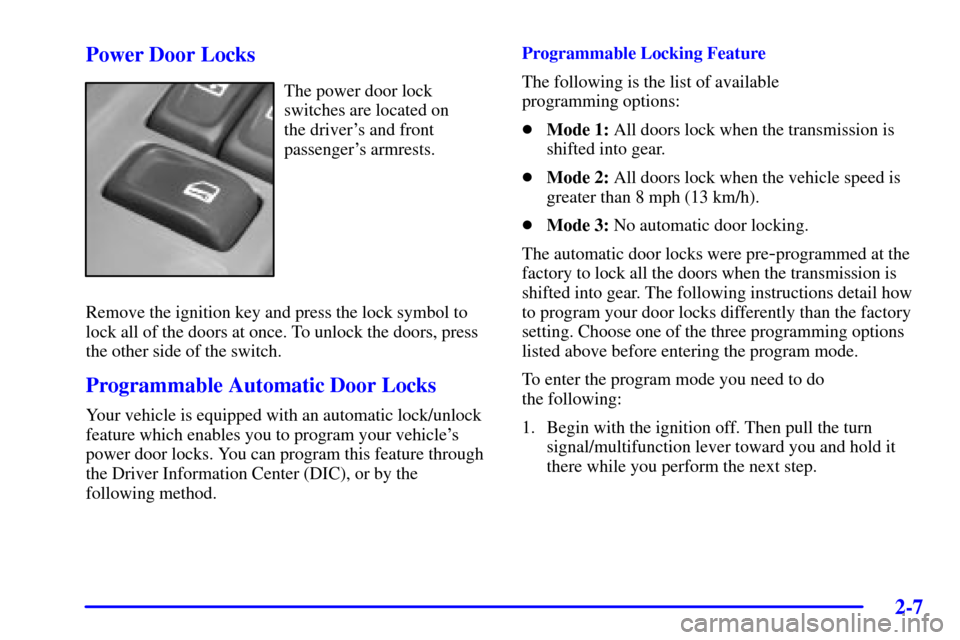
The power door lock
switches are located on
the driver's and front
passenger's armrests.
Remove the ignition key and press the lock symbol to
lock all of the doors at once. To unlock the doors, press
the other side of the switch.
Programmable Automatic Door Locks
Your vehicle is equipped with an automatic lock/unlock
feature which enables you to program your vehicle's
power door locks. You can program this feature through
the Driver Information Center (DIC), or by the
following method.Programmable Locking Feature
The following is the list of available
programming options:
�Mode 1: All doors lock when the transmission is
shifted into gear.
�Mode 2: All doors lock when the vehicle speed is
greater than 8 mph (13 km/h).
�Mode 3: No automatic door locking.
The automatic door locks were pre
-programmed at the
factory to lock all the doors when the transmission is
shifted into gear. The following instructions detail how
to program your door locks differently than the factory
setting. Choose one of the three programming options
listed above before entering the program mode.
To enter the program mode you need to do
the following:
1. Begin with the ignition off. Then pull the turn
signal/multifunction lever toward you and hold it
there while you perform the next step.
Page 78 of 432

2-9
To enter the program mode you need to do
the following:
1. Begin with the ignition off. Then pull the turn
signal/multifunction lever toward you and hold
it there while you perform the next step.
2. Turn the key to RUN and LOCK twice. Then,
with the key in LOCK, release the turn
signal/multifunction lever. Once you do this, you
will hear the lock switch lock and unlock, the horn
will chirp twice, and a 30 second program timer
will begin.
3. You are now ready to program the automatic door
locks. Select one of the four programming options
listed above, and press the unlock side of the power
door lock switch to cycle through the unlocking
options. You will have 30 seconds to begin
programming. If you exceed the 30 second limit,
the locks will automatically lock and unlock and the
horn will chirp twice to indicate that you have left
the program mode. If this occurs, repeat the
procedure beginning with Step 1 to re
-enter the
programming mode.You can exit the program mode any time by turning
the ignition to RUN (the locks will automatically lock
and unlock and the horn will chirp twice to indicate that
you are leaving the program mode). If the lock/unlock
switches are not pressed while in the programming
mode, the current auto lock/unlock setting will not
be modified.
See your dealer for more information.
Rear Door Security Locks
With this feature, you can lock the rear doors so they
can't be opened from the inside by passengers. To use
one of these locks do the following:
1. Open one of the rear doors.
Page 87 of 432
2-18
If the engine does not start after three tries, the vehicle
needs service.
If the engine is running and the SECURITY light comes
on, you will be able to restart the engine if you turn the
engine off. However, your Passlock system is not
working properly and must be serviced by your dealer.
Your vehicle is not protected by Passlock at this time.
You may also want to check the fuse (see ªFuses and
Circuit Breakersº in the Index). See your dealer
for service.
In an emergency, call the GM Roadside Assistance
Center. See ªRoadside Assistanceº in the Index.New Vehicle ªBreak-Inº
NOTICE:
Your vehicle doesn't need an elaborate
ªbreak
-in.º But it will perform better in the long
run if you follow these guidelines:
�Keep your speed at 55 mph (88 km/h) or
less for the first 500 miles (805 km).
�Don't drive at any one speed
-- fast or
slow
-- for the first 500 miles (805 km).
Don't make full
-throttle starts.
�Avoid making hard stops for the first
200 miles (322 km) or so. During this time
your new brake linings aren't yet broken
in. Hard stops with new linings can mean
premature wear and earlier replacement.
Follow this breaking
-in guideline every
time you get new brake linings.
�Don't tow a trailer during break
-in.
See ªTowing a Trailerº in the Index for
more information.