Page 27 of 132
INSTRUMENT AND CONTROL FUNCTIONS
3-12
3 2. Turn the key counterclockwise to
the original position, remove it,
and then close the lock cover.
NOTE:@ The fuel tank cap cannot be installed
unless the key is in the lock. In addition,
the key cannot be removed if the cap is
not properly installed and locked. @
EW000024
WARNING
@ Make sure that the fuel tank cap is
properly installed before riding. @
EAU03753
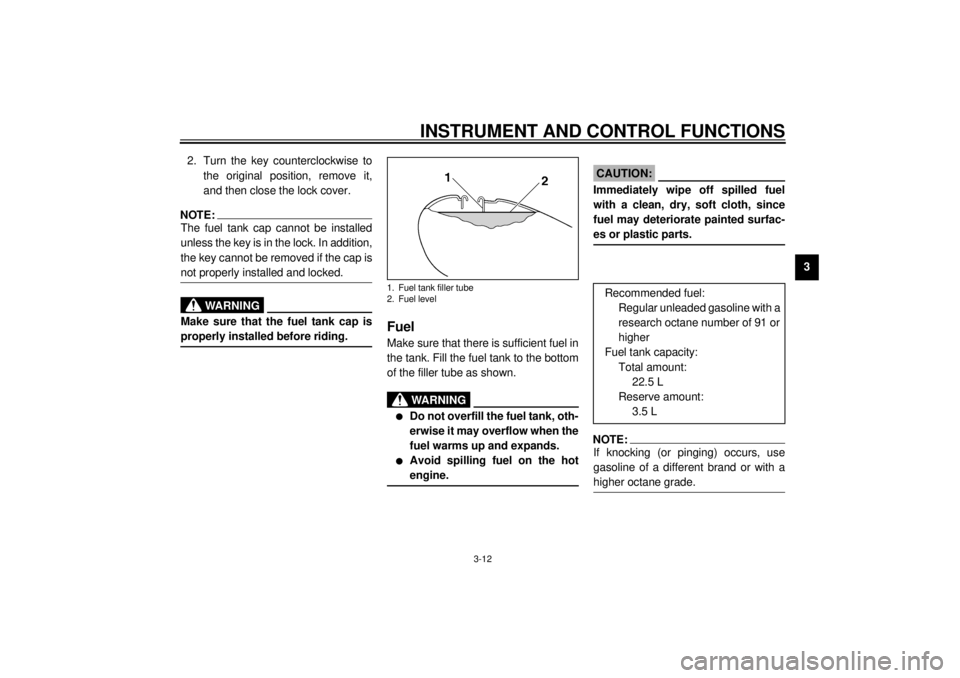
Fuel Make sure that there is sufficient fuel in
the tank. Fill the fuel tank to the bottom
of the filler tube as shown.
EW000130
WARNING
_ l
Do not overfill the fuel tank, oth-
erwise it may overflow when the
fuel warms up and expands.
l
Avoid spilling fuel on the hot
engine.
_
EAU00185
CAUTION:_ Immediately wipe off spilled fuel
with a clean, dry, soft cloth, since
fuel may deteriorate painted surfac-
es or plastic parts. _
EAU00191
NOTE:_ If knocking (or pinging) occurs, use
gasoline of a different brand or with a
higher octane grade. _
1. Fuel tank filler tube
2. Fuel level
Recommended fuel:
Regular unleaded gasoline with a
research octane number of 91 or
higher
Fuel tank capacity:
Total amount:
22.5 L
Reserve amount:
3.5 L
E_5jc.book Page 12 Monday, January 22, 2001 12:12 PM
Page 31 of 132
INSTRUMENT AND CONTROL FUNCTIONS
3-16
3
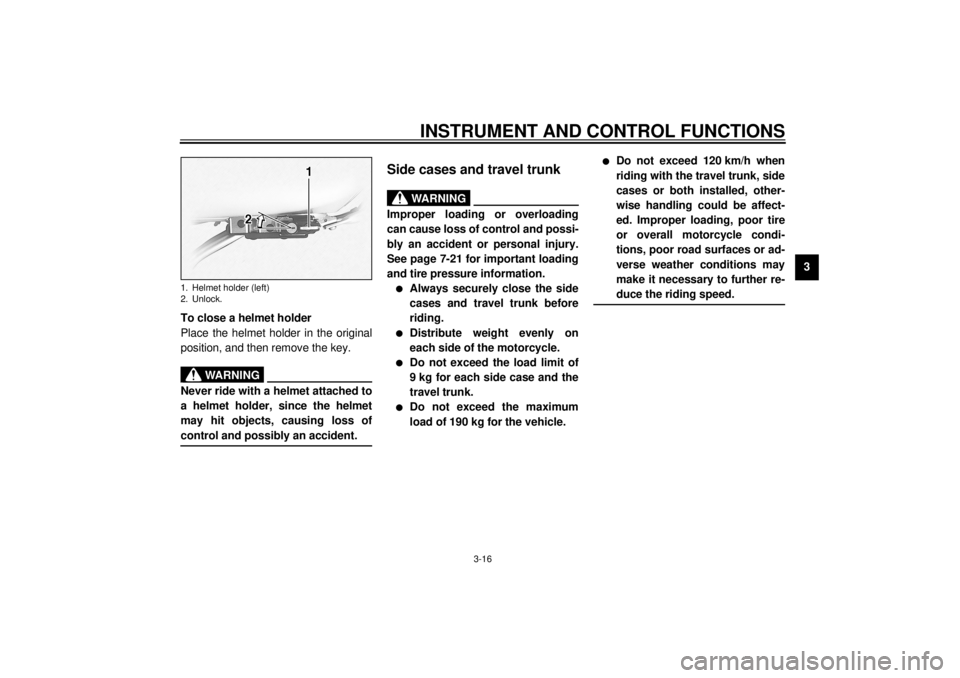
To close a helmet holder
Place the helmet holder in the original
position, and then remove the key.
EWA00015
WARNING
@ Never ride with a helmet attached to
a helmet holder, since the helmet
may hit objects, causing loss of
control and possibly an accident. @
EAU01866*
Side cases and travel trunk
EWA00021*
WARNING
@ Improper loading or overloading
can cause loss of control and possi-
bly an accident or personal injury.
See page 7-21 for important loading
and tire pressure information.l
Always securely close the side
cases and travel trunk before
riding.
l
Distribute weight evenly on
each side of the motorcycle.
l
Do not exceed the load limit of
9 kg for each side case and the
travel trunk.
l
Do not exceed the maximum
load of 190 kg for the vehicle.
l
Do not exceed 120 km/h when
riding with the travel trunk, side
cases or both installed, other-
wise handling could be affect-
ed. Improper loading, poor tire
or overall motorcycle condi-
tions, poor road surfaces or ad-
verse weather conditions may
make it necessary to further re-
duce the riding speed.
@
1. Helmet holder (left)
2. Unlock.
E_5jc.book Page 16 Monday, January 22, 2001 12:12 PM
Page 34 of 132

INSTRUMENT AND CONTROL FUNCTIONS
3-19
3
EAU03719
Adjusting the front fork This front fork is equipped with air
valves for adjusting the spring rate.
EW000035
WARNING
_ Always adjust both fork legs equal-
ly, otherwise poor handling and loss
of stability may result. _Adjust the spring rate as follows.
1. Place the motorcycle on the side-
stand.NOTE:_ When checking and adjusting the air
pressure, there should be no weight on
the motorcycle. _
2. Remove the air valve cap from
each fork leg.
3. Check the air pressure in each
fork leg with the air pressure
gauge included in the owner’s tool
kit.
4. To increase the spring rate and
thereby harden the suspension,
increase the air pressure with an
air pump. To decrease the spring
rate and thereby soften the sus-
pension, decrease the air pres-
sure by pushing each valve stem
down.
EC000012
CAUTION:_ Never exceed the maximum air pres-
sure, otherwise the front fork oil
seals may become damaged. _5. Securely install the air valve caps.
1. Front fork air valve cap
Spring rate:
Minimum (soft):
Air pressure =
0 kPa (0 kgf/cm
2, 0 bar)
Standard:
Air pressure =
0 kPa (0 kgf/cm2, 0 bar)
Maximum (hard):
Air pressure =
50 kPa (0.5 kgf/cm
2, 0.5 bar)
E_5jc.book Page 19 Monday, January 22, 2001 12:12 PM
Page 36 of 132

INSTRUMENT AND CONTROL FUNCTIONS
3-21
3
ECA00050
CAUTION:_ Never exceed the maximum air pres-
sure, otherwise the oil seal may be-
come damaged. _5. Securely install the air valve cap.
EAU00330
Sidestand The sidestand is located on the left side
of the frame. Raise the sidestand or
lower it with your foot while holding the
motorcycle upright.NOTE:@ The built-in sidestand switch is part of
the ignition circuit cut-off system, which
cuts the ignition in certain situations.
(See further down for an explanation of
the ignition circuit cut-off system.) @
EW000044
WARNING
@ The motorcycle must not be ridden
with the sidestand down, or if the
sidestand cannot be properly
moved up (or does not stay up), oth-
erwise the sidestand could contact
the ground and distract the opera-
tor, resulting in a possible loss of
control. Yamaha’s ignition circuit
cut-off system has been designed to
assist the operator in fulfilling the
responsibility of raising the side-
stand before starting off. Therefore,
check this system regularly as de-
scribed below and have a Yamaha
dealer repair it if it does not function
properly. @
E_5jc.book Page 21 Monday, January 22, 2001 12:12 PM
Page 37 of 132
INSTRUMENT AND CONTROL FUNCTIONS
3-22
3
EAU03720
Ignition circuit cut-off system The ignition circuit cut-off system (com-
prising the sidestand switch, clutch
switch and neutral switch) has the fol-
lowing functions.l
It prevents starting when the trans-
mission is in gear and the side-
stand is up, but the clutch lever is
not pulled.
l
It prevents starting when the trans-
mission is in gear and the clutch
lever is pulled, but the sidestand is
still down.
l
It cuts the running engine when
the transmission is in gear and the
sidestand is moved down.
Periodically check the operation of the
ignition circuit cut-off system according
to the following procedure.
EW000045
WARNING
_ If a malfunction is noted, have a
Yamaha dealer check the system
before riding. _
E_5jc.book Page 22 Monday, January 22, 2001 12:12 PM
Page 39 of 132
INSTRUMENT AND CONTROL FUNCTIONS
3-24
3
EAU01788
Auxiliary DC jack and
terminals 12-V accessories connected to the
auxiliary DC jack at the front and auxil-
iary DC terminals under the rider seat
can be used when the key is in the
“ACC” or “ON” position.
ECA00044
CAUTION:@ The accessories connected to the
auxiliary DC jack and terminals
should not be used with the engine
turned off, and their combined load
must never exceed 5 A or 60 W, oth-
erwise the battery may discharge. @
EWA00017
WARNING
@ To prevent electrical shock or short-
circuiting, make sure that the caps
are installed when the auxiliary DC
jack and terminals are not being
used. @
1. Auxiliary DC jack
1. Auxiliary DC terminal
E_5jc.book Page 24 Monday, January 22, 2001 12:12 PM
Page 43 of 132
AUDIO SYSTEM
4-2
4
WARNING
_ l
It is dangerous to operate the
audio system controls while
riding. Never take your hands
off the handlebars while riding.
l
Keep the volume at a low
enough level to be aware of traf-
fic conditions and ensure
safety.
_CAUTION:_ l
Do not use the audio system for
a long period of time when the
engine is not running as the bat-
tery may discharge.
l
The control unit, cassette deck
and speakers are water-resis-
tant; however, it is good prac-
tice to cover them with a plastic
bag when washing the motor-
cycle.
l
When cleaning the control unit
display, use a neutral detergent.
Never use strong abrasive
cleaning products, fuel (gaso-
line), thinner, etc.
_
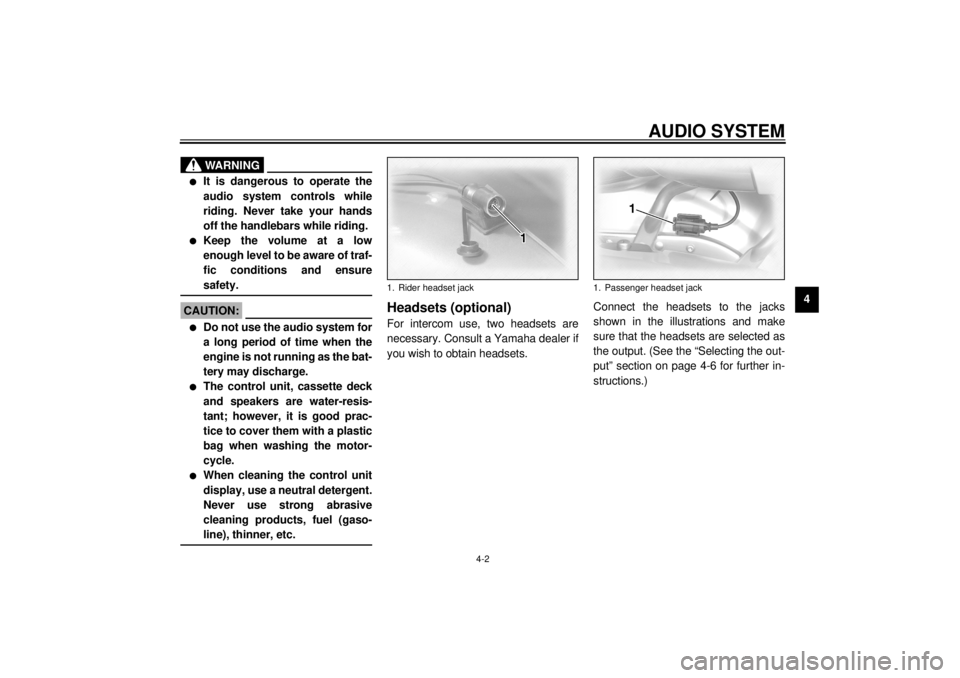
Headsets (optional) For intercom use, two headsets are
necessary. Consult a Yamaha dealer if
you wish to obtain headsets.Connect the headsets to the jacks
shown in the illustrations and make
sure that the headsets are selected as
the output. (See the “Selecting the out-
put” section on page 4-6 for further in-
structions.)1. Rider headset jack
1. Passenger headset jack
E_5jc.book Page 2 Monday, January 22, 2001 12:12 PM
Page 50 of 132
AUDIO SYSTEM
4-9
4
Cassette deck operation
WARNING
_ l
It is dangerous to operate the
cassette deck while riding. Nev-
er take your hands off the han-
dlebars while riding.
l
Keep the volume at a low
enough level to be aware of traf-
fic conditions and ensure
safety.
_
CAUTION:_ l
Keep the cassette deck lid
closed at all times, except when
inserting or removing a cas-
sette.
l
Do not leave cassette tapes in
direct sunlight for a long period
of time.
l
Do not allow the inside of the
cassette deck to get wet. If this
happens, keep the cassette
deck lid open and dry out the
deck in the shade.
l
To clean the tape head, use a
de-magnetizing cleaning cas-
sette, but be sure to turn the
volume all the way down to
avoid speaker damage.
_
1. Cassette deck compartment
2. Eject (“ ”) button
3. Cassette deck lidE_5jc.book Page 9 Monday, January 22, 2001 12:12 PM


