Page 335 of 1943
THS (TOYOTA HYBRID SYSTEM)
182TH34
Battery Pack Upper Case
Service Plug
SMR
(System Main Relay)Battery ECU
HV Battery Module37
HV BATTERY
�DESCRIPTION
The sealed nickel metal hydride (Ni-MH) battery technology has been further evolved in the newly devel-
oped HV battery that offers features such as high power density, lightweight, and longevity, that are specifi-
cally designed to match the characteristics of the THS. Because the THS effects charge / discharge control
to maintain a constant level of SOC (state of charge) while the vehicle is operating normally, it does not rely
on the use of external rechargers.
In the battery area, six 1.2-volt cells are connected in series to form one module. A total of 38 modules are
divided into two holders and connected in series. Thus, the HV battery containing a total of 228 cells has a
rated voltage of 273.6 V.
The electrode plates in the HV battery are made of materials such as porous nickel and metal hydride alloy.
Page 466 of 1943
B04748
B04749
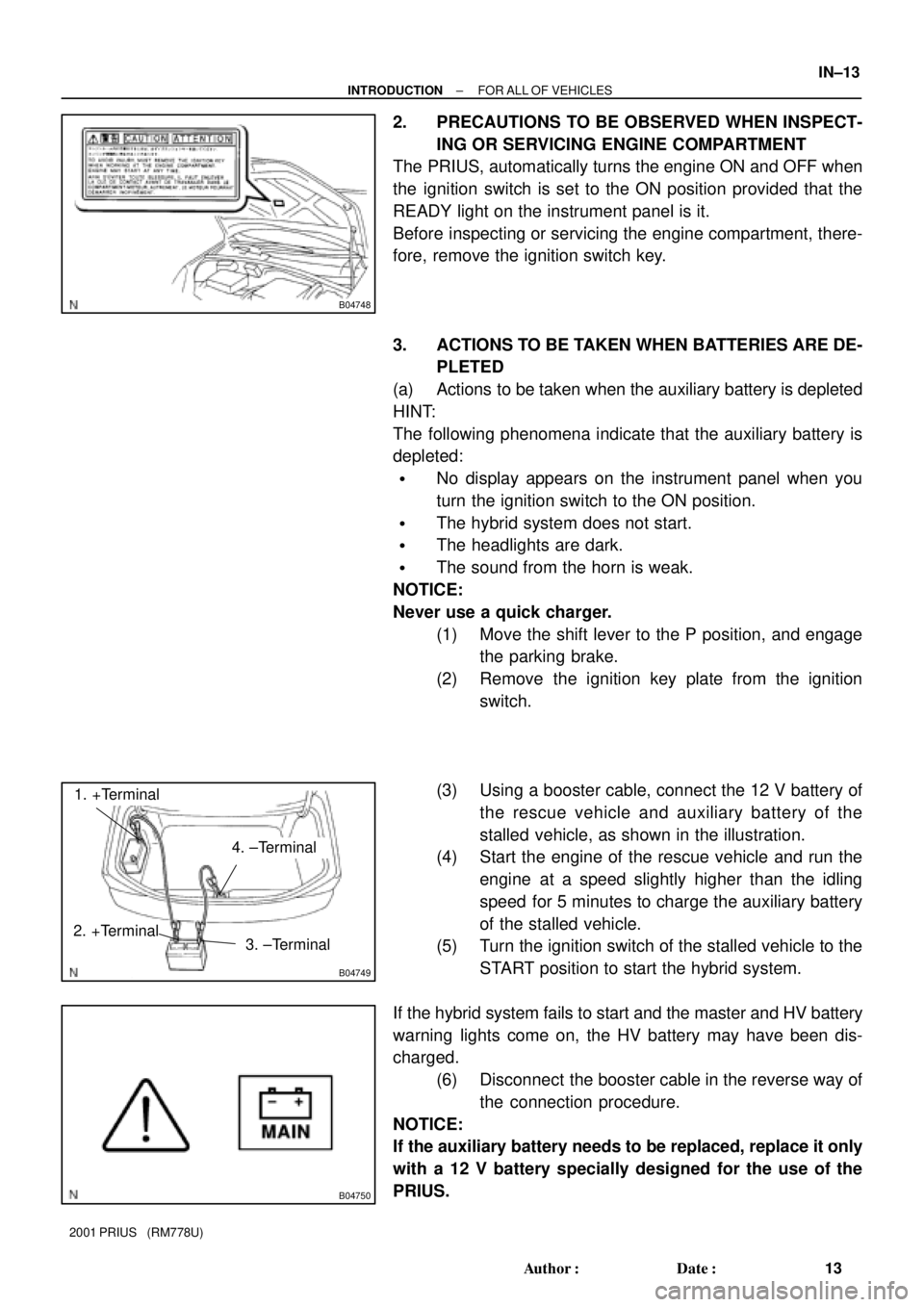
1. +Terminal
2. +Terminal3. ±Terminal
4. ±Terminal
B04750
± INTRODUCTIONFOR ALL OF VEHICLES
IN±13
13 Author�: Date�:
2001 PRIUS (RM778U)
2. PRECAUTIONS TO BE OBSERVED WHEN INSPECT-
ING OR SERVICING ENGINE COMPARTMENT
The PRIUS, automatically turns the engine ON and OFF when
the ignition switch is set to the ON position provided that the
READY light on the instrument panel is it.
Before inspecting or servicing the engine compartment, there-
fore, remove the ignition switch key.
3. ACTIONS TO BE TAKEN WHEN BATTERIES ARE DE-
PLETED
(a) Actions to be taken when the auxiliary battery is depleted
HINT:
The following phenomena indicate that the auxiliary battery is
depleted:
�No display appears on the instrument panel when you
turn the ignition switch to the ON position.
�The hybrid system does not start.
�The headlights are dark.
�The sound from the horn is weak.
NOTICE:
Never use a quick charger.
(1) Move the shift lever to the P position, and engage
the parking brake.
(2) Remove the ignition key plate from the ignition
switch.
(3) Using a booster cable, connect the 12 V battery of
the rescue vehicle and auxiliary battery of the
stalled vehicle, as shown in the illustration.
(4) Start the engine of the rescue vehicle and run the
engine at a speed slightly higher than the idling
speed for 5 minutes to charge the auxiliary battery
of the stalled vehicle.
(5) Turn the ignition switch of the stalled vehicle to the
START position to start the hybrid system.
If the hybrid system fails to start and the master and HV battery
warning lights come on, the HV battery may have been dis-
charged.
(6) Disconnect the booster cable in the reverse way of
the connection procedure.
NOTICE:
If the auxiliary battery needs to be replaced, replace it only
with a 12 V battery specially designed for the use of the
PRIUS.
Page 1597 of 1943
B11968
B11969
B11967
B11966
B12006
HV±10
± HYBRID VEHICLE CONTROLHV BATTERY
2001 PRIUS (RM778U) 4/6/01
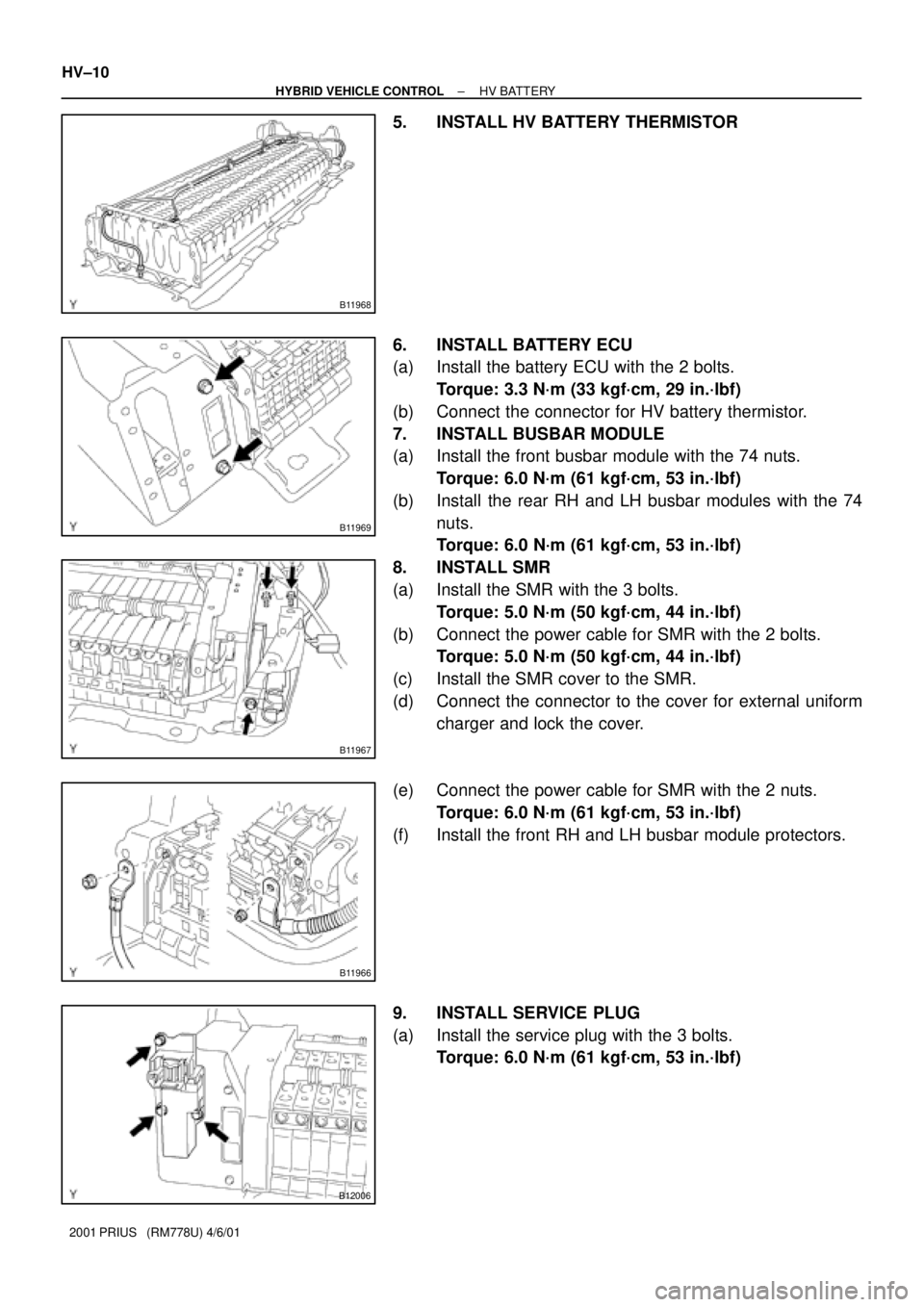
5. INSTALL HV BATTERY THERMISTOR
6. INSTALL BATTERY ECU
(a) Install the battery ECU with the 2 bolts.
Torque: 3.3 N´m (33 kgf´cm, 29 in.´lbf)
(b) Connect the connector for HV battery thermistor.
7. INSTALL BUSBAR MODULE
(a) Install the front busbar module with the 74 nuts.
Torque: 6.0 N´m (61 kgf´cm, 53 in.´lbf)
(b) Install the rear RH and LH busbar modules with the 74
nuts.
Torque: 6.0 N´m (61 kgf´cm, 53 in.´lbf)
8. INSTALL SMR
(a) Install the SMR with the 3 bolts.
Torque: 5.0 N´m (50 kgf´cm, 44 in.´lbf)
(b) Connect the power cable for SMR with the 2 bolts.
Torque: 5.0 N´m (50 kgf´cm, 44 in.´lbf)
(c) Install the SMR cover to the SMR.
(d) Connect the connector to the cover for external uniform
charger and lock the cover.
(e) Connect the power cable for SMR with the 2 nuts.
Torque: 6.0 N´m (61 kgf´cm, 53 in.´lbf)
(f) Install the front RH and LH busbar module protectors.
9. INSTALL SERVICE PLUG
(a) Install the service plug with the 3 bolts.
Torque: 6.0 N´m (61 kgf´cm, 53 in.´lbf)